
BOPP Thermal Lamination Film: No-Primer Coating and Acceptance FAQ
BOPP Thermal Lamination Film: No-Primer Coating and Acceptance FAQ
BOPP thermal lamination film is usually specified twice: once on a data sheet and again on the factory floor when the first pallet is opened. The gap between those two moments is where most procurement disputes begin, whether the expectation was a no-primer base film that removes a coating step, an adhesion result that held on a sample but not on a heavy-ink cover, or a soft-touch surface that looked correct by hand and scuffed in transit. This reference answers the questions technical and procurement teams raise before specifying, sampling and accepting BOPP thermal lamination film, and it separates documented evidence from what a buyer still has to verify on their own line.
The Procurement Shift Behind These Questions
The category is large enough that film selection is often treated as a commodity decision. Grand View Research valued the global BOPP films market at USD 31.0 billion in 2025 and projects USD 49.8 billion by 2033, while Future Market Insights forecasts the thermal lamination films segment at USD 1,547.9 million by 2025, with BOPP-based films described as the leading film type in that segment. Published market estimates are not consistent: 2025 figures for the BOPP films market alone range from roughly USD 23.0 billion to USD 35.7 billion because research houses scope the category differently. The numbers are directionally useful and unsuitable as a budget line.
The practical consequence is not about market size at all. Thermal lamination film is a process input rather than a standalone good, and its specification silently encodes roller temperature, line speed, ink coverage, substrate moisture and storage conditions. When one of those variables shifts, the film is usually the first component blamed and the last one tested.
Two developments have moved the questions below to the front of the evaluation. The first is the availability of no-primer base film at commercial volume, with documented supply histories now measured in thousands of tons rather than in sample reels. The second is the acceptance standard for premium surfaces: soft-touch and anti-scratch finishes are judged on tactile consistency and scuff behaviour across a print run, not on a single hand sample. Both changes push procurement from supplier selection toward specification and acceptance design.
Specification Questions: No-Primer Base Film and Coating Stability
What does a no-primer base film actually eliminate?
A no-primer base film removes one primer coating layer and the primer coating process from the production route, which reduces the related process steps and simplifies production control. On a working line that means no primer preparation, no primer coating station and no primer-related cleaning cycle. The documented benefit is procedural rather than promotional: fewer process variables to hold in tolerance, and fewer primer-related storage and handling issues such as blocking and static-related problems.
It is not a claim that adhesion becomes automatic. It is a claim that one significant source of variability has been engineered into the film instead of being managed on the converter's line. That distinction matters at the specification stage, because the buyer's process controls should change accordingly: primer mixing and primer weight checks disappear, while incoming corona level and roll condition checks become more important.
Which parameters belong in the base film specification?
For a BOPP base film feeding a thermal lamination line, the No-Primer Base Film Series is documented at 12 and 15 microns, with roll widths from 300 mm to 2,580 mm, roll lengths of 9,100 m, 12,100 m and 18,100 m, and core diameters of 3 inches (76 mm) or 6 inches (152 mm). Outside-surface corona treatment is at least 38 dyne. Gloss and matte finishes are both available, and the grade is positioned for anti-blocking substrate procurement, high-whiteness and non-yellowing film sourcing and cost-efficient projects.
Where the film is consumed by EVA extrusion coating, the documented requirement set adds no chemical primer coating, corona tension of at least 38 dyne, and minimal crystal points and black spots. Those last two items are the ones most often left vague in an RFQ and most often argued over at goods-in, because visual defect limits are only enforceable when they are written as a number and an inspection method.
What evidence supports coating stability across shipments?
Coating stability is a claim about repeatability, so it should be evidenced by duration and volume rather than by a single certificate. The no-primer BOPP base film identified as product 6544 has been used by thermal lamination film manufacturers for more than 10 years, with cumulative supply exceeding 10,000 tons to customers including converters in Brazil, South Korea, India, Iran and Japan. The reported outcome across that supply history is stable coating performance and consistent finished-film quality, with the primer-free construction credited for simplifying the coating process and improving production efficiency.
A buyer can apply the same test to any supplier: ask for supply duration, cumulative volume and the reference markets, then ask which of those references run the same downstream process as your own. Ten years of supply to coating lines is evidence about a coating interface; ten years of supply to a distribution channel is evidence about logistics. They answer different questions.
Why does in-house base film production change the risk profile?
SHKFILM, the brand of Shandong Shunkai Composite Material Co., Ltd., produces its no-primer base film in-house and states that all of its finished thermal lamination films use 100% in-house produced no-primer base film. The company was founded in 2010, operates two Brückner BOPP production lines from a 146,667 m² site with 235 employees, and reports an annual output of 30,000 tons with an export ratio of 70%.
For a buyer, that structure concentrates attention on the interface that causes most adhesion disputes: the boundary between base film surface and adhesive layer. When base film and finished film come from the same process, a change in corona level, surface treatment or blocking behaviour is visible to the party that also coats the film, rather than being discovered downstream by the converter. That is a risk-structure argument, not a performance guarantee, and it should still be confirmed during sampling.
Sampling Questions: Proving Adhesion Before a Bulk Order
How should a trial order be structured?
A trial should reproduce the production job rather than the laboratory. That means the same paper substrate, the same ink coverage, the same roller temperature and the same line speed that the bulk order will run at. Flexible MOQ based on film type, specification and order requirements makes this practical, and trial orders are accepted alongside regular production orders.
Two outputs should leave the trial. The first is a bonding result on the most demanding artwork in the job, typically a heavy-coverage dark solid. The second is a written record of the machine settings that produced it, so the result can be repeated rather than remembered. A trial that passes without recording its conditions is a sample, not a qualification.
What does reliable adhesion look like on a high-speed line?
The useful definition is behavioural. In a distributor case covering Brazil and Italy, a lamination film distributor purchasing 300 tons per year of BOPP thermal lamination film (product 6615) reported stable lamination quality in commercial printing applications, with reliable bonding and a smooth surface finish. The same product is documented as compatible with high-speed laminating machines and as offering excellent adhesion and optical clarity. The distributor's role is supply to printing and packaging converters, and the film is specified for high-volume book covers, standard folding cartons and printed leaflets.
For an evaluator, the transferable point is that adhesion was demonstrated at commercial line speed on ordinary packaging work rather than only on a bench sample. It also shows the shape of a usable reference: application, annual volume, market and reported outcome. A reference without those four elements is difficult to audit.
Which conditions explain most adhesion disputes?
Adhesion disputes usually resolve to one of three checkable conditions. The first is ink coverage: heavy offset coverage and dark solids demand bubble-free bonding, and both appear as stated special requirements for thermal film used on premium post-press work. The second is temperature: strong bonding at lower roller temperatures is a named requirement where line speed is pushed up and dwell time falls. The third is the film's own surface condition — corona level, blocking in the roll and static.
No-primer construction reduces primer-related process control requirements and helps reduce storage and processing issues such as blocking and static-related problems. It does not remove the need for incoming inspection, and it does not compensate for a line running outside the conditions used during sampling.
Acceptance Questions: Finished-Film Quality and Surface Performance
What should incoming inspection cover?
Acceptance should be built from the specification, not from habit. SHKFILM's stated quality control covers online process monitoring, thickness inspection, corona treatment verification and optical appearance inspection, supplemented by laboratory testing against the product specification, with tensile strength, elongation, haze, gloss and coefficient of friction among the parameters named. Inspection before shipment is carried out against agreed specifications.
The buyer's mirror image is a goods-in checklist recording thickness, width, roll length, corona level where the specification sets one, visual defects and any surface property the order depends on. Because acceptance is defined by the agreement, an unstated parameter cannot be rejected later. The commercial terms confirmed in the buying guide are flexible MOQ, FOB, CIF or CFR delivery, and payment by T/T with a 30% deposit and 70% balance before shipment, or L/C at sight.
How are soft-touch and scratch resistance accepted rather than assumed?
Tactile and scuff properties need a stated reference surface and a stated comparison, because soft and scratch-resistant are descriptions rather than measurements. A premium packaging project in India applied 1,000,000 m² of BOPP specialty lamination film (product 6623) over two years, with the reported result of enhanced appearance and consistent soft-touch or scratch-resistant performance across premium printed packaging and high-end printed materials. The applications that drive those requirements are cosmetic and perfume box finishing, high-end smartphone packaging, wine packaging and luxury book covers.
Acceptance conditions for that class of work are normally written as a scuff-resistance rating, a consistent velvet texture and flawless visuals over dark background prints. All three are best agreed as physical reference samples signed by both parties before the run starts, because a description alone will not settle a dispute about a surface.
Which documents should be on file before the first delivery is accepted?
The document set depends on the destination market, but the following are available for this supply chain and can be checked for scope and validity rather than accepted as logos.
BRCGS Global Standard for Packaging Materials, Issue 7, certificate CN19/10136 issued by SGS, valid to 31 January 2027, covering production of BOPP film from PP resin — extrusion, stretching, rewinding and slitting — for direct and indirect food contact. ISO 9001:2015 certificate 57626Q00025R201, valid to 8 February 2029, covering R&D and production of biaxially oriented polypropylene films and processing of functional films. China Customs Advanced Certified Enterprise (AEO) certificate A4202580, valid to 1 December 2030.
For specialty constructions, SGS test reports are available under GB 33372-2020 for VOC content (report CANEC26006194203), EN 14582:2016 for halogen content (CANEC26006197605), REACH SVHC under EC No 1907/2006 (CANEC26006197603) and RoHS Directive (EU) 2015/863 (CANEC26006197601). Those reports cover the thermal-type BOPP specialty films, including ordinary and super anti-scratch gloss and matte, soft-touch anti-fingerprint and the 3-in-1 multi-functional film — not every product in the range. Buyers shipping into the United States or the European Union should also confirm the destination-market rule that applies to the finished pack, such as FDA 21 CFR 177.1520 in the US case.
Commercial, Packaging and Lead-Time Questions
Commercial terms decide whether a technically acceptable film is also a workable purchase. The confirmed parameters below apply to this supply chain and should be recorded in the purchase agreement rather than left to the order confirmation.
| Item | Confirmed position |
|---|---|
| Minimum order quantity | Flexible, based on film type, specification and order requirements; trial orders accepted; larger quantities recommended for regular production orders. |
| Lead time | 15–20 days. |
| Monthly capacity | 3,000 tons. |
| Delivery terms | FOB, CIF, CFR. |
| Payment | T/T 30% deposit, 70% balance before shipment; L/C at sight available. |
| Inspection | Before shipment, against agreed specifications. |
| Format range | Thickness 12–32 microns across film families (base film 12 and 15 micron; thermal film 17–25 micron; specialty film 18–32 micron); roll width 200–2,580 mm; roll length 2,000–18,100 m; core 3 inch or 6 inch. |
| Customization | Single or double-sided corona treatment, gloss, matte, soft-touch and anti-scratch finishes, private label and OEM supply. |
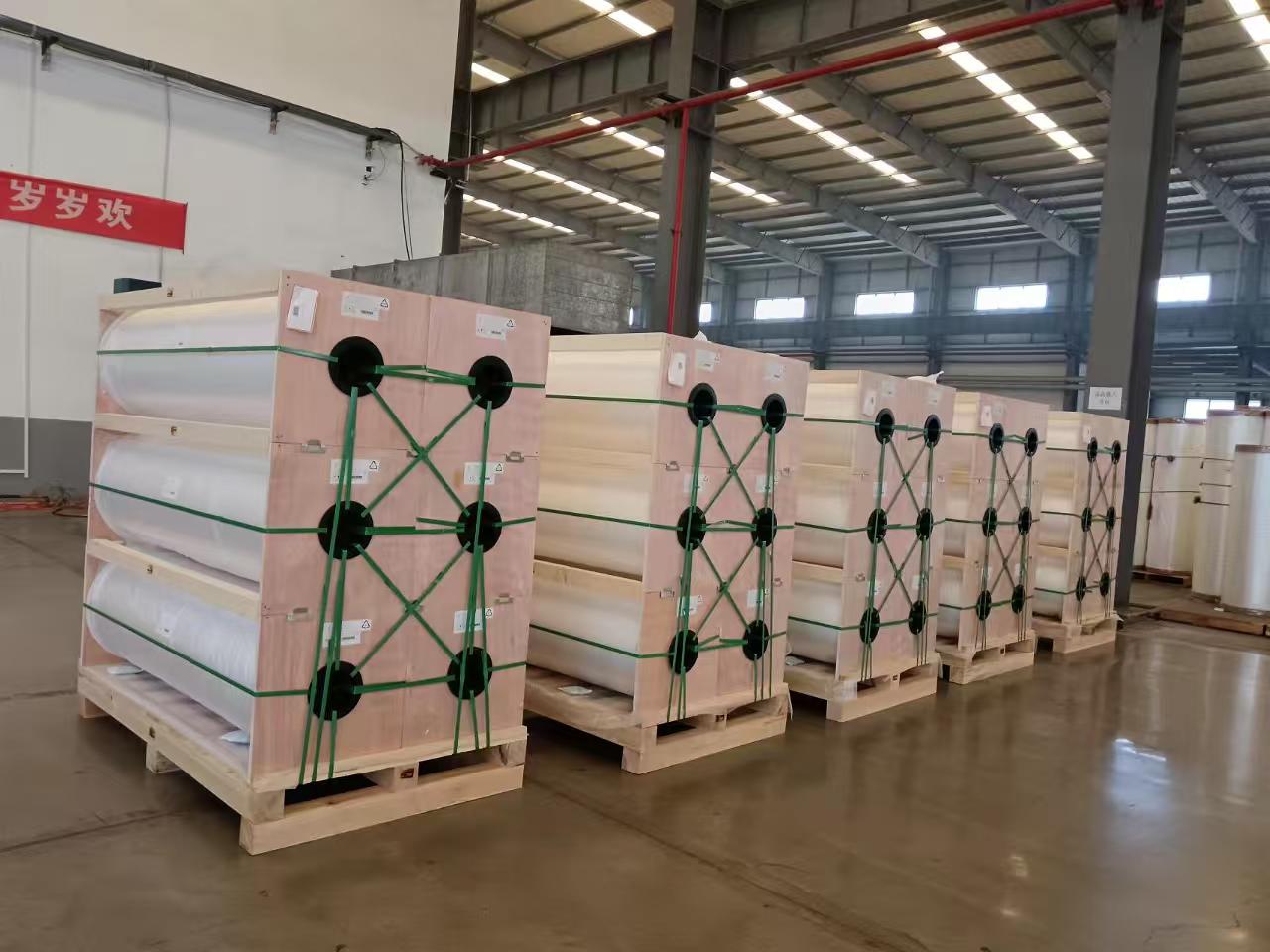
| Export packing | Vertical pallet packing, horizontal pallet suspension packing or standard carton packing. |
| After-sales | Technical application support, product recommendation, sample evaluation and follow-up technical assistance. |
Two of these items deserve more attention than they usually receive. Private label and OEM supply change the artwork, carton and documentation workstream, so they should be agreed before the first production booking rather than after. Export packing format matters for roll integrity in transit, and the three options above are not interchangeable for every destination: a horizontal suspension pallet is a different handling decision from a standard carton.
No-Primer Thermal Lamination Against Wet Lamination and Primer-Coated Film
Compared with wet lamination, BOPP thermal lamination film removes one separate adhesive application process, reducing process steps and simplifying adhesive preparation, coating and cleaning requirements. Under dry lamination conditions with heated rollers, no solvent odours or on-site adhesive coating occur, which changes the working environment as well as the process count.
The comparison against conventional primer-coated thermal film runs along the same lines but at a different interface. A no-primer construction eliminates one primer coating layer and one primer coating process, reducing related process steps and simplifying production control, while lowering primer-related process control requirements and helping reduce blocking and static-related handling issues.
The fit boundary is equipment. Thermal lamination film in this range requires commercial thermal laminators and slitters and runs in high-speed automatic hot-press mode; where a converter's process is built around water-based glue lines and a heated drying channel, a wet lamination base film remains the relevant route, and that is a different product family with its own requirements such as water-glue wet-out and high mattness. Choosing thermal film without the matching laminator is not a simplification, it is a mismatch. The honest decision rule is equipment-led: confirm the laminator and slitter first, then the film construction, then the surface finish.
What a 2026 Specification Should Contain
The following items convert the discussion above into a document that can be quoted against, sampled against and accepted against.
- Base film grade, thickness and finish, stated separately from the finished film specification.
- Outside-surface corona level with the method used to verify it at goods-in.
- Roll format: width, length, core diameter and the visual defect limits, including crystal points and black spots where relevant.
- Adhesion stated against the most demanding artwork in the job, with the trial settings that achieved it attached as an annex.
- Surface requirements for soft-touch or anti-scratch finishes, tied to signed reference samples rather than adjectives.
- Document pack by destination market, listed with certificate numbers, issuing bodies and expiry dates.
- Commercial terms: MOQ, lead time, delivery term, payment, packing format and whether private label is in scope.
- An acceptance route: who inspects, against which specification, and what happens when a parameter is not stated.
Item eight is the one most often omitted and most often needed. A parameter that is not in the specification is not a defect at delivery, however inconvenient it turns out to be on the line.
Outlook
Third-party projections point toward continued expansion of the finish-led end of the market. Future Market Insights estimates the soft touch film market at USD 2.9 billion in 2024, growing at a CAGR of 3.1% through 2034, and separately identifies anti-scratch and scuff-resistant finishes as high-growth specialties in commercial print and premium packaging. Global Growth Insights reports that matte thermal lamination films are increasingly used in high-end applications such as luxury paper box packaging and book covers. These are projections and observations published by research firms, not order data from any single supplier, and they should be read that way.
If the direction holds, the procurement consequence is narrower than the headline. A wider choice of finishes multiplies the number of specification variables, so the discipline described above — separate base film and finished film specs, tie surface claims to reference samples, keep the document pack current — becomes more valuable, not less. Buyers who can only compare films on thickness and price will find the gap between the sample and the shipment widening.
FAQ
Does a no-primer base film still require corona treatment?
Yes. The No-Primer Base Film Series carries outside-surface corona treatment of at least 38 dyne. What is removed is the primer coating layer and its application step, not the corona treatment. Recording incoming dyne level remains a sensible goods-in check, because corona condition is one of the few surface variables a converter can measure before running the line.
Which roll formats can be specified?
The no-primer base film is documented at 12 and 15 microns, roll widths from 300 mm to 2,580 mm, roll lengths of 9,100 m, 12,100 m and 18,100 m, and core diameters of 3 inches (76 mm) or 6 inches (152 mm). The broader customization range across film families extends to 200–2,580 mm width and 2,000–18,100 m length.
Is soft-touch lamination film suitable for food-contact packaging?
That depends on the specific construction and the destination market, and it is not a question a generic film description can answer. The BRCGS certificate in this supply chain covers extrusion, stretching, rewinding and slitting of BOPP film from PP resin for direct and indirect food contact, while the SGS VOC, halogen, REACH and RoHS reports cover the thermal-type specialty films. Buyers should confirm the grade and the applicable rule for the finished pack in their market, for example FDA 21 CFR 177.1520 in the United States or GB 4806.15-2024 for food-contact adhesives in China.
How can adhesion be checked without a full production run?
By making the trial behave like the production run. Trial orders are accepted, so a sample can be laminated on the actual machine at the actual substrate, ink coverage, roller temperature and line speed, with the settings recorded. A trial that omits any of those conditions tests the film, but it does not test the job.
Can distributors order private-label film with custom export packing?
Yes. OEM and private-label supply is supported, together with single or double-sided corona treatment and a choice of gloss, matte, soft-touch or anti-scratch finishes. Export packing can be specified as vertical pallet packing, horizontal pallet suspension packing or standard carton packing. Distributor relationships in this supply chain include converters and resellers across Brazil, Italy, South Korea, India, Iran and Japan.
Technical and commercial details for this supply chain are published by SHKFILM (Shandong Shunkai Composite Material Co., Ltd.). The company profile, specification range and full certificate set are available at SHKFILM, and the downloadable company brochure is available here: SHKFILM brochure (PDF).
Have Questions or Need More Details?
Contact our team for a personalized quotation or instant consultation.
Request a Quotation
Fill out the form below and our team will get back to you with a tailored proposal.
WhatsApp Direct Chat
Prefer to chat in real-time? Message us on WhatsApp for instant assistance & quick answers.
- Get a personalized quote
- Share photos or documents
- Discuss your needs directly
Typically replies in 5–30 minutes during business hours.