
BRC, Lab Tests, Samples and Transit Risk: What Each Proves
BRC, Lab Tests, Samples and Transit Risk: What Each Proves
Four documents usually arrive in the same supplier email: a BRC certificate, a laboratory report, a sample pouch, and a quotation that says where the seller's responsibility ends and the buyer's begins. They look like one assurance package. They are not. Each answers a different question, and each leaves a different risk open.
For buyers sourcing food packaging bags, printed laminated pouches, vacuum bags, stand-up and zipper pouches, aluminum foil bags or retort pouches, the short answer is that the four layers are complementary rather than interchangeable. A BRC certificate describes the manufacturing site. A laboratory report describes a tested specimen under a stated method and date. A sample shows what a design becomes in material and how it handles. Transit risk — the risk that a conforming bag arrives crushed, damp or misclassified — sits outside all three and is only partly a quality question at all.
Scale explains why this paperwork has become standard. Grand View Research estimates the global flexible packaging market at USD 307.2 billion in 2026, with pouches holding the largest product-segment share at 39.0% in 2025. Where formats are widely available, assurance documents become one of the few differentiators a buyer can actually read. The useful skill is not collecting more certificates; it is mapping each document to the failure it can prevent.
BRC tells you about the factory, not about your bag
BRCGS is a facility standard. It certifies manufacturing facilities — not individual bags — for hygiene and traceability, and it is a GFSI-benchmarked scheme used as a supplier-approval gate by many food manufacturers and exporters. Read in that light, a certificate is a third-party statement about the site's hygiene, documentation and traceability systems at a point in time.
What that supports is real: a site-level approval decision, confidence that production records and trace-back exist, and a shorter conversation with your own retail or brand customer when they ask whether your packaging supplier is certified. What it does not support is equally specific — a claim about the material structure of the bag you are buying, the seal strength at your filler's line speed, the retained-solvent level of the ink and adhesive combination used on your artwork, a food-contact declaration for your particular article, or the condition of the pallet when it reaches your dock.
Three questions keep the certificate honest. Which site does it cover? Which product categories and processes fall inside the audited scope? When does it expire, and is a surveillance audit scheduled before your production window? A certificate that is genuinely valid but scoped to a different plant, or to a narrower process list than your order requires, is a different fact from the one the buyer assumed.
Laboratory reports are the only layer that produces numbers
A test report is the only one of the four layers that measures the material itself. It is also the easiest to over-read, because a number without its structure, method and date cannot be compared with anything else.
A converter's published test menu can be long — adhesion strength, compression strength, friction measurement, gas chromatography, gas permeability, gauge (thickness) measurement, heat seal strength, hot tack force, impact strength, infrared spectroscopy, leak resistance, puncture resistance, seal strength, shear strength, shrinkage measurement, tear resistance, tensile strength and water vapor permeability. The list matters less than the match between a test and the failure you are trying to avoid.
| Failure you are trying to avoid | Test to request | Why it belongs in the decision |
|---|---|---|
| Weak, channeling or leaking seals on your filler | Heat seal strength, hot tack force, seal strength | Hot tack governs how quickly a pouch can be filled before the seal is cool enough to hold product weight. |
| Short shelf life, staleness or rancidity | OTR (oxygen transmission rate), WVTR (water vapor transmission rate) | Barrier numbers, not the pouch name, set the shelf-life model for a given structure and thickness. |
| Odour or taste complaints from consumers | Gas chromatography, total retained solvents | Printing and lamination residues are a common transfer source in printed laminated pouches. |
| Leaks or bursts after retort or boiling | Retort test, leak resistance, seal strength | A thermal process stresses both the seal and any aluminum foil layer; pinholes and flex cracking show up here. |
| Damage during stacking and handling | Compression strength, impact strength, puncture resistance, tear resistance | These describe the bag's resistance, not the pallet pattern or container loading that also drive damage. |
| Line stoppages, blocking or poor tracking | Coefficient of friction, gauge (thickness) measurement | Machine behaviour depends on surface slip and thickness consistency across the roll or stack. |
Table 1. Matching a flexible packaging test to the failure mode the buyer is actually trying to prevent.
Reports also come in two forms that buyers often confuse: qualification reports and routine production checks. The routine programme is usually the better indicator of consistency. At TENBOO Flexible Packaging — the export brand of Dalian Tianbao Color Printing Co., Ltd, a Dalian-based converter founded in 2000 — that programme starts with incoming raw-material inspection, continues with online quality patrols every two hours during production, and ends with sampling of finished goods after packaging, using routine items such as gauge, basis weight, yield, lamination bond strength, seal strength, total retained solvents, WVTR, OTR, coefficient of friction, tear strength and retort testing.
Three comparability conditions before you compare two reports
Check the structure (the film and foil combination plus thickness), the method and units, and the date. A seal-strength figure for a thin two-layer laminate cannot be used to judge an aluminum foil retort structure, and a report from three years ago is history rather than evidence about the run you are ordering.
Specification language matters here. A 2013 Flexible Packaging Association analysis noted that no official industry standard existed for converting length, width and gusseting pattern into effective volume — the current status in any given market should be checked separately, but the practical conclusion holds. Nominal pouch names such as stand-up pouch, zipper pouch or spice packaging do not normalize geometry or fill volume across suppliers, so the purchase specification should carry dimensions, fill volume, structure, seal requirement and test method, and the report should be requested against that document.
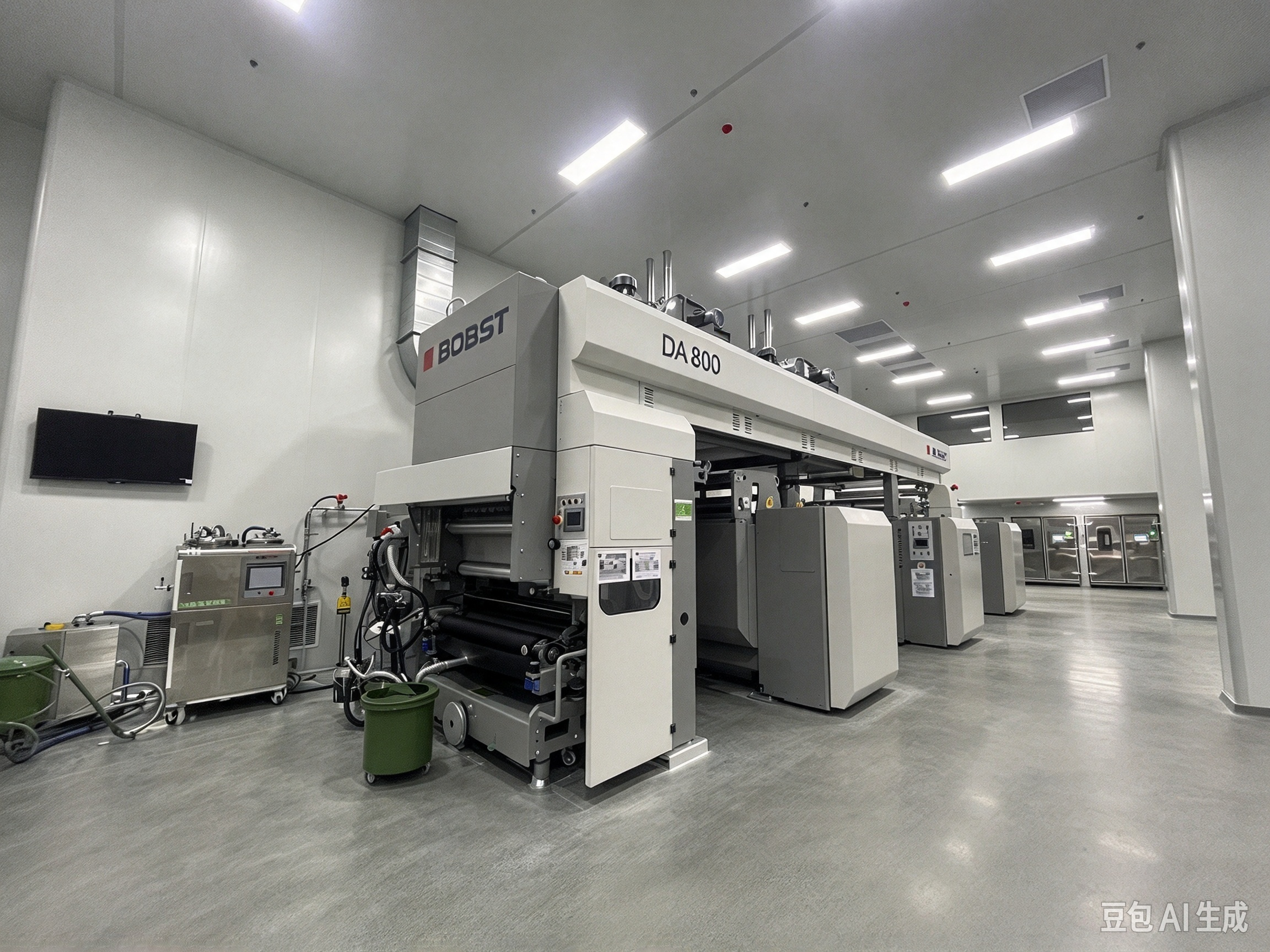
Laminating workshop: the adhesive and film combination chosen here is the structure that laboratory reports should describe.
Samples show what the artwork becomes, not how the run behaves
A sample answers appearance and handling questions that no certificate can: whether registration holds on small text, whether the colour matches the brand standard, whether the zipper, spout, one-way valve, easy-tear opening or eye mark functions, and whether the pouch physically fits your filling line and shelf. TENBOO's stated sample route is a test print of the buyer's design on the intended material, supplied as roll material of about one metre for a fee on request, with a 3D proof view in the customer profile offered as a preview before printing.
What a sample cannot do is stand in for production. One metre of roll or a handful of pouches cannot demonstrate run-to-run variance, the seal window at your line speed, retained solvents across a full print run, or behaviour inside a container. A sample approves intent; it becomes evidence only when it is tied to a written specification and to a first-production check confirming that the production run matches the approved sample.
Practical requests that raise a sample's value: the same structure and thickness you intend to buy, the same print process, the same accessories, a note of which tests were run on it, and a signed reference sample retained on both sides. Ask whether the sample came from a pilot run or from a production line — the two answer different questions.
Transit risk sits outside every quality document
Three risks travel with the bag after it leaves the dock, and none is closed by a quality certificate.
Physical risk. Compression in a stacked container, impact and puncture during handling, moisture and temperature swings, and flex cracking of foil layers are all transit phenomena. Compression, impact, puncture and leak tests predict part of this behaviour, but pallet pattern, container loading and route exposure sit outside the bag specification, so they belong in the purchase order as agreed requirements rather than assumptions.
Documentary risk. Customs classification follows polymer composition. HS 392321 covers sacks and bags of ethylene polymers used for conveying or packing goods, and HS 392329 covers plastic sacks and bags of other polymers; a multilayer structure containing aluminum foil requires code confirmation against the applicable tariff schedule with a customs broker, because a commercial name such as aluminum foil bag is not a classification.
Timing and commercial risk. TENBOO's stated lead times are 20–30 days for finished pouches once artwork is approved and 15–25 days for rollstock, shipping from Dalian Port, Liaoning, China. Those windows start the logistics clock rather than end it, which matters for launch dates and seasonal promotions. And where risk transfers is defined by the agreed trade term together with the freight and insurance arrangement: a supplier's quality system says nothing about who owns a crushed pallet at destination, so that question should be settled before the first order, not after the first claim.
| Assurance layer | Question it answers | What it does not cover | Document to request |
|---|---|---|---|
| BRC certificate | Does this site run audited hygiene and traceability systems? | Your structure, your seal, your artwork's residue profile | Certificate with site, scope and expiry |
| Laboratory report | How did this specimen perform under this method on this date? | Other structures, other run conditions, pallet behaviour | Test report matched to your specification |
| Sample | Does the design, material and accessory work in practice? | Run-to-run variance, line-speed seal window, transit survival | Approved sample plus signed specification |
| Routine QC records | Is consistency checked batch after batch? | Independent verification of the values reported | Written QC plan and patrol interval |
| Transit and trade terms | Who bears which risk, and from which point? | Product performance itself | Agreed trade term, freight and insurance terms |
Table 2. The four assurance layers, plus routine QC, mapped to the questions they can and cannot answer.
Certificate-only sourcing versus a layered verification path
The traditional approach is certificate-only sourcing: one BRC certificate, a unit price and a lead time. It is fast and administratively light, and it is defensible where the structure is unchanged from a previous validated order and the application carries low consequence. Its weakness is structural — it answers the site question and leaves the article, run and transit questions open, and those are the questions that typically surface at destination, where correcting them costs the most.
The layered path adds a structure-matched report, a specification-approved sample, a written QC plan and agreed transit terms. The trade-off is real: sample fees, testing lead time and more specification work before the order. The return is that a sealant or foil gauge problem is discovered at the quotation stage, where changing it is inexpensive, rather than after a container has been loaded.
The fit boundary runs both ways. Repeat orders on an unchanged, already-validated structure can reasonably be trimmed to periodic re-testing rather than full re-qualification. Small promotional runs with generous appearance tolerance and short shelf life may not justify a full test panel. Conversely, retort pouches, vacuum bags, frozen food bags and long-shelf-life formats put more weight on the laboratory layer, because the failure modes there are expensive and often invisible until the consumer opens the pack.
Where TENBOO Flexible Packaging fits the layered model
TENBOO Flexible Packaging is the export brand of Dalian Tianbao Color Printing Co., Ltd, a converter founded in 2000 in Jinpu New Area, Dalian, China, and focused on the flexible plastic packaging sector for 26 years. The company operates a 36,000 m² plant with about 90 employees and reports annual output of 3,000 tons, with roughly 30% exported to the EU, USA and Asia. It holds ISO 9001 and BRC certification and describes a quality system built on traceability, with full process data logging for forward record keeping and backward trace-back across each batch.
Capability relevant to this comparison includes a Class 100,000 GMP-compliant clean workshop under constant temperature and humidity control; a nine-colour Bobst gravure press with dual-channel drying and an LEL solvent concentration monitoring system; an additional eleven-colour electronic-shaft gravure press; Bobst and Nordmeccanica lamination lines; and curing, slitting and bag-making equipment. In 2026 the company completed a third-round upgrade, putting new intelligent production workshops into operation. Its stated range covers printed laminated pouches, food packaging bags, vacuum bags, stand-up pouches, zipper pouches, aluminum foil bags, retort pouches, spice packaging, frozen food bags and pet food bags. Its research and development team of nine specialists, more than half holding a master's degree or above with over ten years in flexible plastic packaging, supports application-specific structures rather than a single catalogue specification.
The boundary is the same one described above, and it applies to this supplier as much as to any other. A BRC certificate covers the site, so the request for a structure-specific test report and a specification-approved sample still stands. The company reports that its retort and boiling bag-breaking rate is controlled at 0.1%–0.3%, described as lower than the applicable national standard; that is a company-reported production figure for its own process, not a guarantee for a buyer's filling line, and it should be read alongside the test basis and reference standard before entering any defect-rate or shelf-life model.
Application notes: the proof that matters most by format
Format is a weaker signal than the failure you are buying protection against. The emphasis shifts by application.
- Retort pouch. Prioritise retort test results, leak resistance and seal strength on your exact structure; the thermal process stresses seals and foil simultaneously.
- Vacuum bag. Leak resistance, seal strength and puncture resistance carry the decision, with oxygen transmission relevant wherever oxidative spoilage is the concern.
- Frozen food bag. Low-temperature impact, tear resistance and seal integrity after freezing matter more than room-temperature figures, with WVTR relevant to freezer burn.
- Spice packaging. Gas chromatography and retained-solvent results protect aroma and taste, while coefficient of friction affects forming on dusty filling lines.
- Pet food bag. Puncture, tear and seal strength against fatty fills, plus coefficient of friction on high-speed lines. Grand View Research projects 7.5%–7.9% CAGR for pouches over 2026–2034 and identifies pet food as the fastest-growing application segment in that analysis.
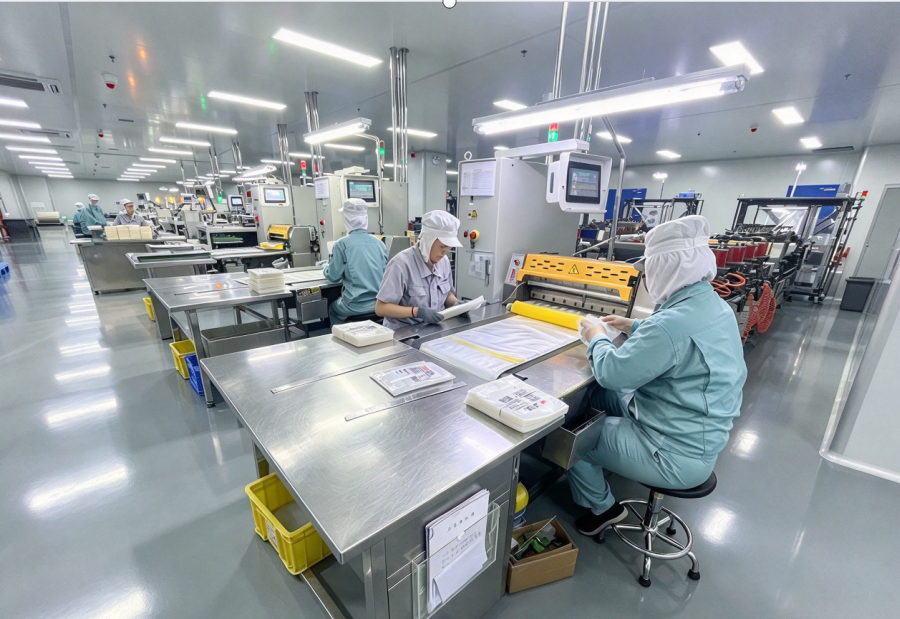
Bag making workshop: accessory function and seal geometry are approved at sample stage, then verified again on first production.
A six-step verification sequence before the order
- Read the BRC certificate for site, scope and expiry, and confirm the processes used for your order fall inside it.
- Require a laboratory report matched to your structure and method, dated within a period you consider current, and write the method into the specification.
- Approve the sample and the specification together, recording which tests the sample represents.
- Ask for the routine QC plan in writing: incoming inspection, patrol interval and finished-goods sampling.
- Fix transit conditions in the purchase order — pallet type, stacking limits, protective packaging — and confirm where risk transfers.
- Keep a reference sample and a reference report per structure, and re-check both whenever material, artwork, plant or equipment changes.
FAQ
What test indicators can a flexible packaging laboratory provide?
Tests typically available include adhesion strength, compression strength, friction measurement, gas chromatography, gas permeability, gauge (thickness) measurement, heat seal strength, hot tack force, impact strength, infrared spectroscopy, leak resistance, puncture resistance, seal strength, shear strength, shrinkage measurement, tear resistance, tensile strength and water vapor permeability.
How is consistent quality maintained across a production run?
Raw materials undergo incoming inspection, online quality patrols take place at fixed intervals during production, and finished goods are sampled after packaging. Routine test items include gauge, basis weight, yield, lamination bond strength, seal strength, total retained solvents, WVTR, OTR, coefficient of friction, tear strength and retort testing.
Can a buyer obtain a sample printed with their own design?
Yes, on request: a test print of the buyer's design on the intended material, supplied as roll material of about one metre, for a fee. A 3D proof view in the customer profile can be used to preview the design before printing.
What information does a converter need to quote a food packaging bag accurately?
The product to be packaged, shelf-life expectations, desired package size, whether retort or aseptic treatment is required, the filling equipment, whether rollstock or pre-formed pouches are needed, and the suitable pouch form factor. Minimum order quantity varies with dimensions, materials and printing patterns, so it is set per product.
What lead time and shipping port apply?
Once artwork is approved, finished pouches including stand-up and lay-flat formats are typically shipped in 20–30 days, and rollstock in 15–25 days. The port of loading is Dalian Port, Liaoning, China.
Have Questions or Need More Details?
Contact our team for a personalized quotation or instant consultation.
Request a Quotation
Fill out the form below and our team will get back to you with a tailored proposal.
WhatsApp Direct Chat
Prefer to chat in real-time? Message us on WhatsApp for instant assistance & quick answers.
- Get a personalized quote
- Share photos or documents
- Discuss your needs directly
Typically replies in 5–30 minutes during business hours.