
BSP, NPT, JIC, SAE Adapters: A Six-Step Buyer Framework
The thread family, not the supplier, decides whether a hydraulic adapter seals on first assembly. BSP, NPT, JIC and SAE connections are built around four different sealing mechanisms, and a buyer who settles the mechanism first can compare suppliers on evidence rather than on catalogue photography.
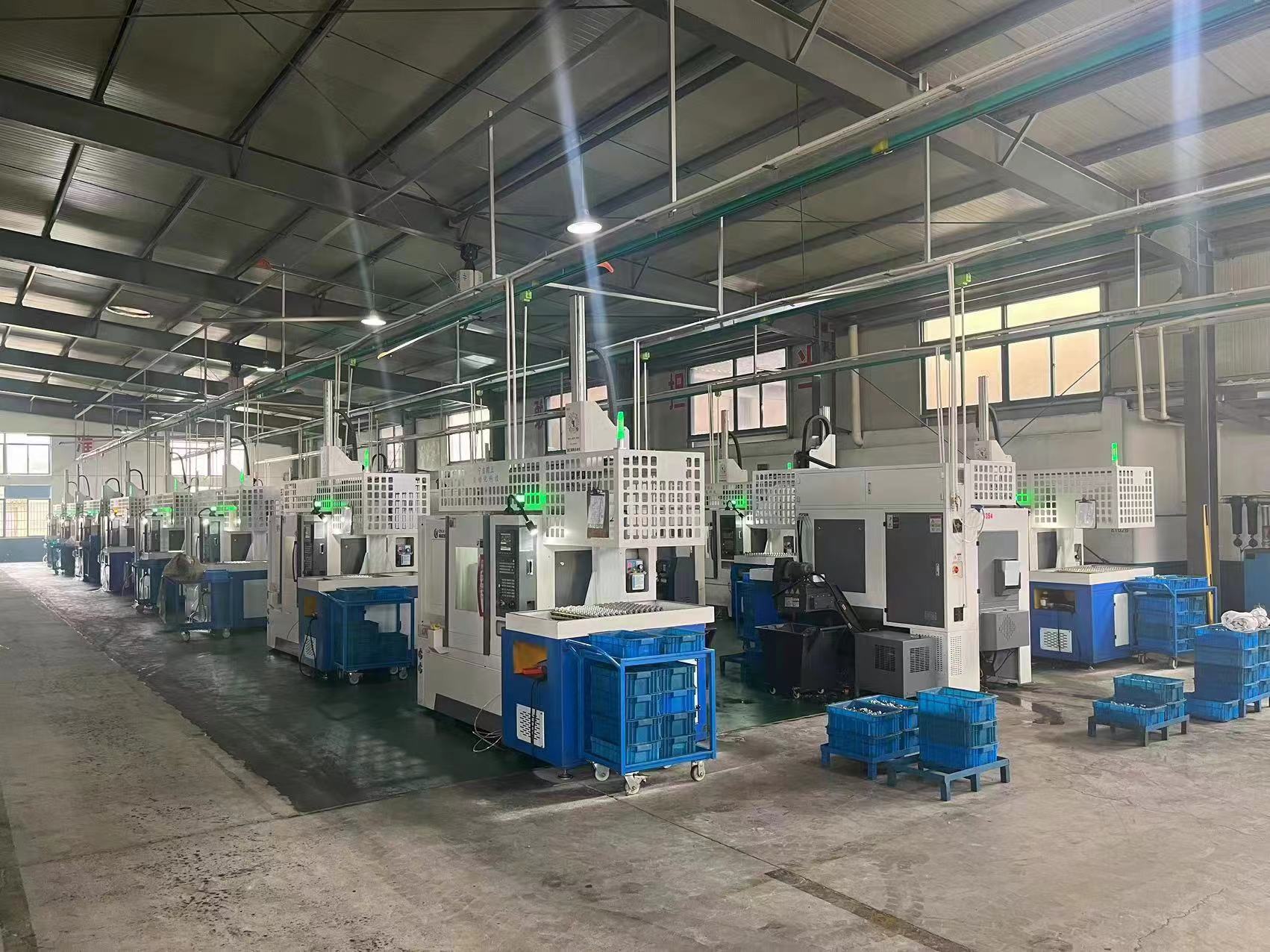
Fully automated CNC workshop: adapter bodies across the BSP, NPT, JIC and SAE families are machined to different thread and sealing geometries on the same production floor.
Why the four families are compared as families, not as products
Hydraulic adapters are the largest product-type segment inside the hydraulic fittings market, holding 28.4% of product-type share in 2025, according to Dataintelo. That share tracks the installed base of machinery more than it tracks fashion: mobile hydraulics alone accounted for more than 58% of total hydraulics market revenue in 2024, per Grand View Research. Every machine that leaves a factory with hoses and cylinders creates a recurring adapter demand for the next decade of its service life.
The evaluation problem is that family differences are only partly visible. A BSPP male stud and a BSPt male stud can differ by little more than the thread flank, yet one depends on a face washer to seal while the other seals through thread interference. A JIC 37-degree flare and an SAE ORFS connection both descend from SAE practice, yet one seals metal-to-metal on a cone and the other on an O-ring. Buying by appearance, or by a part number carried over from a previous machine, is where a large share of field mismatches begins.
The framework below therefore runs in a fixed order: thread family and standard, configuration, shared performance envelope, material, application fit, and finally receipt and acceptance. Each step produces a specification line that can be quoted, gauged and documented. Manufacturers such as NingBo NJ Hydraulic Adapter Co., Ltd and larger global suppliers alike are then evaluated against the same lines, which is the point of an independent reference.
The four families at a glance
A short comparison table prevents most of the confusion that arises in a first buying cycle. The right-hand column shows how these families itemize into purchasable model codes in one manufacturer's catalogue; the naming conventions themselves are standard across the industry.
| Family | Thread form / standard basis | How it seals | Representative codes |
|---|---|---|---|
| BSPP (BSP parallel) | Parallel thread, ISO 228 | On a washer or mating face; the thread itself does not seal | 1B; 1BG; 1BH; 1BJ; 1BT; 2B; 3B; 4B; 5B; 6B; 7B; 9B; EB; AB; BB |
| BSPt (BSP taper) | Tapered thread, ISO 7 | By thread interference | 1T; 1T9; 1BT; 1ST; 4T; 5T |
| NPT | Tapered pipe thread; NPTF is the dryseal variant | By thread interference, normally with a thread sealant | 5000; 5404; 5405; 5406; 5406-HP; 5500 series; 5600 series; 5650; 5652 |
| JIC | 37-degree flare; ISO 8434-2 covers flared connectors for tubes from 6 mm to 50.8 mm | Metal-to-metal on the 37-degree cone | 2403; 2404; 2405; 2406; 2408; 2500 series; 2601 to 2609, including JIC to NPT |
| SAE ORB / ORFS | Straight thread with O-ring (ORB); O-ring face seal under SAE J1453 | On an O-ring, not on the thread | 6801; 6802; 6803; 6804; 6805; 6806; 6807; 6808; 6809; 6810; 6815; 6818; 6820; 6832; 6835; 6840; 6850 |
Pressure capability differs by family rather than converging: ORFS fittings at dash size -4, for example, are rated to 6000 PSI working pressure under SAE J1453, while a 1/4 inch NPTF straight-thread connection is typically published at 4000 PSI with a 4:1 safety factor. Those two figures alone explain why the family decision cannot be deferred to the price stage.
Step 1: Fix the thread family and the standard behind the name
BSP on its own is not a specification. BSPP (parallel) and BSPt (taper) share a name and share nothing at the sealing face. Either the drawing states which one, or the buyer is buying a coin flip that will be discovered at the assembly bench. The same discipline applies to the remaining three: NPT against NPTF, JIC as a 37-degree flare under SAE J514 or ISO 8434-2, and SAE ORB (straight thread with O-ring) against ORFS (O-ring face seal).
A workable rule for evaluation documents is that every adapter line carries four fields: family, standard, thread size and sealing method. A line reading BSP male 1/2 straight is ambiguous. A line reading BSPP male 1/2, ISO 228, sealing on bonded washer is not, and it can be quoted and inspected without a follow-up email.
This is also where mixed-standard assemblies get caught. A JIC to NPT adapter is a deliberate conversion item, not evidence that the two families are interchangeable; if a machine arrives with an NPT port and the drawing calls for JIC, the correct purchase is the conversion adapter with both ends specified, not a re-tapped port.
Step 2: Read the configuration, not only the thread
Two adapters can share a thread family and still be different purchasing items. A Male BSPP x Male BSPP Straight adapter is a both-ends-parallel, fixed-body connection: orientation is set by the port, and the sealing washers are separate line items to verify at receipt. A Male JIC x Male Adjustable ORB 90-Degree Elbow introduces a locknut: the elbow can be rotated to route the hose and then locked in position, which changes both the installation sequence and the spare-parts list.
Configuration drives three cost lines that thread size does not: whether the hose can be routed at all, whether a torque tool can reach the hex, and how many small parts (washers, O-rings, locknuts) must arrive in the carton. In an evaluation cycle, ask for the configuration drawing rather than a family photograph. The drawing is the document that can be checked against the machine.
Step 3: Use the shared performance envelope as a floor, not a differentiator
Across the BSPP, BSPt, NPT, JIC and SAE lines referenced in this framework, the published envelope is common: a pressure range of 3000 to 6000 PSI, a maximum stable operating temperature of 220 degrees Celsius, and a 120-hour salt spray test result in which white rust appears at 120 hours and red rust at 240 hours. Materials are carbon steel, SS304 or SS316.
Because these figures are held in common, they cannot decide between families. They qualify a lot for further evaluation. Two consequences follow. First, a supplier quoting a materially lower envelope for the same families is describing a different product, and the difference should be explained rather than negotiated. Second, the system rating of an assembly is not the adapter rating: hose construction, tube wall thickness, thread engagement and assembly torque all sit between the adapter figure and the working pressure of the machine.
In construction-machinery duty, the same product line is documented as withstanding 6,000 PSI static pressure and 9,000 PSI burst pressure without deformation while maintaining continuous operation and seal integrity. That is a component statement under defined conditions, not a licence to raise a system rating.
Step 4: Choose material against the environment, not the catalogue
Steel accounted for 45.2% of hydraulic fitting revenue share in 2025, according to Dataintelo, which reflects cost and machinability more than suitability. In practice the material decision is environmental: carbon steel with plating for indoor and general machinery, SS304 where washdown or moderate corrosion appears, SS316 for marine and aggressive service. Material choice moves price and lead time, so it belongs in the specification, not in the follow-up conversation.
One caution on temperature data. Stainless steel in AISI 316 grade is documented under DIN 17440 across a working range of -60 to +400 degrees Celsius, which is far wider than the 220 degrees Celsius ceiling stated for these adapters. The lower, product-level limit governs. Reading material data as a product rating is among the more common specification errors in hydraulic purchasing, and it surfaces later as a warranty argument rather than as a design review.
Step 5: Match the family to the machinery, then to the port
Construction machinery
High pressure, high temperature, vibration and dust. JIC and SAE ORFS connections are widely used where leak-tightness under pressure cycling matters, and adapters in this segment are normally evaluated on pressure envelope and corrosion resistance rather than on thread novelty. The four-field specification and the 3000 to 6000 PSI envelope carry most of the decision weight here.
Agricultural machinery
A mixed fleet. Legacy BSPP and BSPt ports survive for decades in the field, and the same workshop may service NPT equipment imported from another region. Distributors therefore stock families rather than a single family, which is a stocking decision as much as an engineering one. For a distributor, the practical question is which two or three families cover the local fleet, not which family is technically best in isolation.
Marine machinery
Corrosion dominates. Stainless grades and salt-spray evidence matter more than a marginal pressure advantage, which makes the 120-hour salt spray result the relevant qualifier and the 240-hour red-rust observation a useful planning reference for replacement cycles. Sealing elements exposed to salt water should be treated as service items, not as permanent components.
Oil and gas extraction
Pressure and temperature extremes plus documentation. Standards already segment hydraulic connections by pressure class elsewhere in the industry, for example DIN 2353 which categorizes metric tube fittings as LL at 100 bar, L at 315 to 500 bar and S at 630 to 800 bar. Adapter selection deserves the same explicitness: name the class, then name the family that reaches it.
Step 6: Set receipt and acceptance before the purchase order closes
Acceptance is where a good specification is either confirmed or lost. For reference, a typical qualification document on these lines is ISO 9001:2015 certification, certificate 41324Q00129R2M, issued on 13 December 2024 by ZCGJ and valid to 15 October 2027, with a scope covering the manufacturing of fluid equipment mechanical hardware, including finishing processing, finished product inspection, packaging and shipping. That scope reaches the packing stage, which is precisely where shortage claims originate.
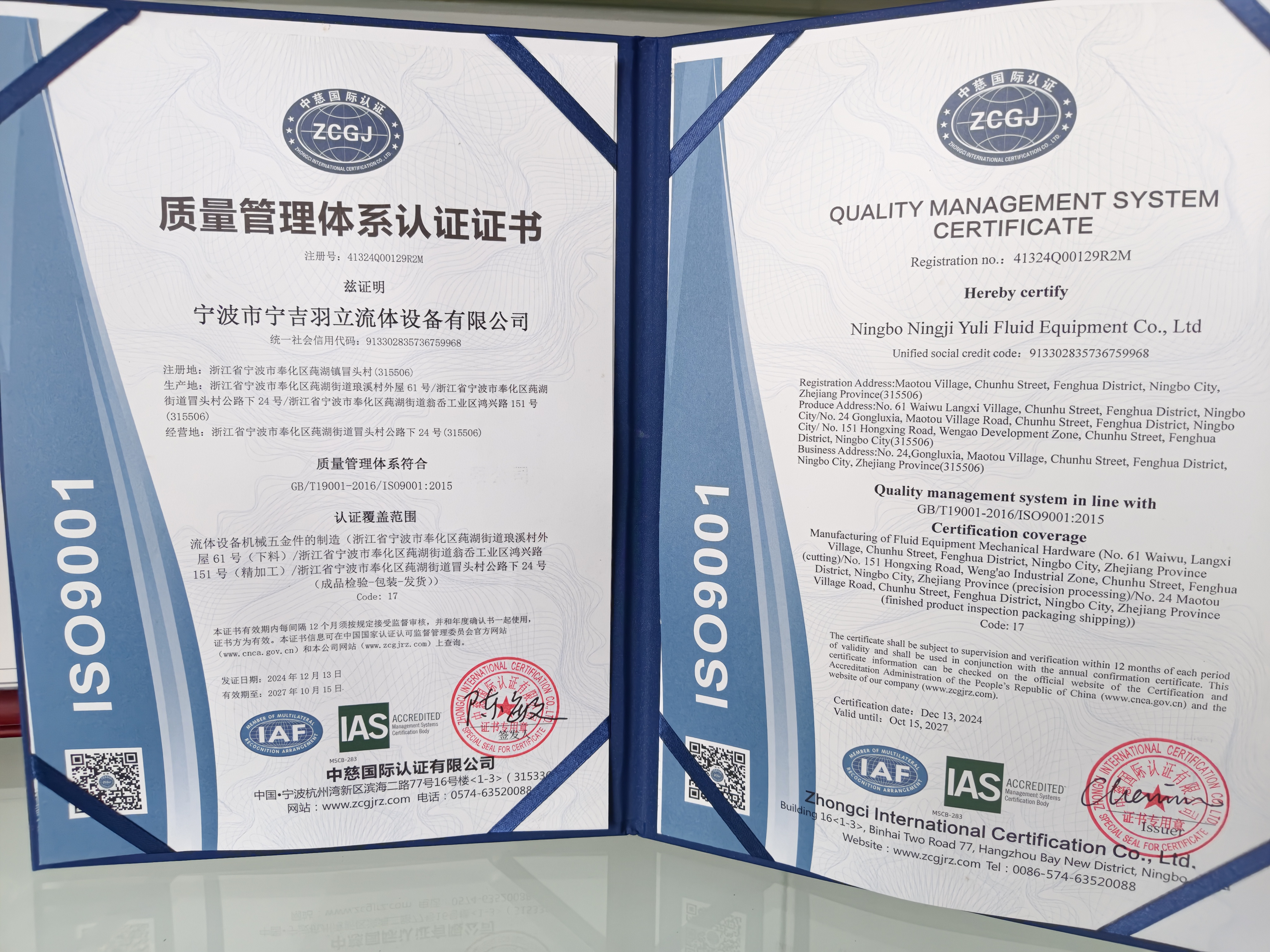
ISO 9001:2015 certificate 41324Q00129R2M, issued 13 December 2024 by ZCGJ, valid to 15 October 2027; the certified scope extends through finished product inspection, packaging and shipping.
Quality control on hydraulic adapter production is performed by random inspection. Sampling is a legitimate method, but it means an incoming check cannot be waived on the buyer's side. Five acceptance items cover most of the exposure:
- Thread verification by gauge against the stated standard, applied per family rather than by eye.
- Presence and count of sealing elements: bonded washers, O-rings and locknuts against the drawing.
- Quantity reconciliation against the packing list before cartons are broken up and mixed with existing stock.
- Salt-spray and material documentation on file and tied to the specific lot, not to a generic brochure.
- A photo record of any shortage or wrong delivery taken at unboxing, while the carton identity is still visible.
Missing accessories after receipt have a defined path: the customer provides photographs of the missing or wrongly delivered items, and once these are verified, replacement accessories are arranged by sea or air shipment. That path works only if the shortage is documented before the goods are absorbed into inventory, which is why the photo record is an acceptance item rather than an afterthought.
Where this framework stops short
An honest framework states its boundaries. Six limits apply to the one above:
- It ranks families, not factories. It says nothing about a specific supplier's process capability, which requires samples, gauging and an audit rather than a document review.
- The 3000 to 6000 PSI and 220 degrees Celsius figures are component-level statements. Final assembly performance depends on hose, tube, torque and thread engagement.
- Material data and product ratings differ. Apply the 220 degrees Celsius product ceiling, not the wider AISI 316 range.
- Minimum order quantity varies with product dimensions and manufacturing complexity, and lead time runs about 30 to 45 working days. A multi-family trial order is a planning exercise, not a same-week purchase.
- Random inspection is sampling. If the buyer's acceptance standard is stricter than the supplier's sample plan, that must be agreed at purchase order stage.
- The framework is not a case for adapters everywhere. Brazed or welded tube joints remain appropriate where the connection is permanent and service access is not required; adapters add value where assemblies must be opened, re-routed or field-repaired.
How one manufacturer's catalogue maps onto the four families
For concrete reference, NingBo NJ Hydraulic Adapter Co., Ltd is a hydraulic fittings manufacturer based in Ningbo Fenghua, Zhejiang Province, China, founded in 2004, operating a 20,000 square metre factory with 200 employees and an annual output of 4,000,000 units; roughly 75% of output is exported, mainly to the USA and Canada. Its catalogue shows how the six-step framework itemizes into purchasable lines:
- BSPP thread fittings: 1B, 1B4, 1B9, 1BG, 1BG4, 1BG9, 1BH, 1BH9, 1BJ, 1BK, 1BM, 1BN, 1BO, 1BT, 1BT9, 2B, 2B9, 2BJ, 2GB, 2HB, 22NB, 2TB9, 2OB, 2TB, 3B, 4B, 4BN, 5B, 5BN, 5NB, 5BT, 5GB, 5OB, 5TB9, 6B, 7B, 7B9, 9B, EB, AB, BB.
- BSPt thread fittings: 1T, 1T9, 1BT, 1ST, 4T, 5T.
- NPT thread fittings: 5000, 5404, 5405, 5406, 5406-C, 5406-HP, 5406-P, 5406-SHP, 5500 to 5505, 5600 to 5605, 5650, 5652.
- JIC adapters and JIC to NPT adapters: 2403, 2404, 2405, 2406, 2408, 2500 to 2505, 2601, 2602, 2603, 2605, 2606, 2608, 2609.
- SAE standard adapters (JIC / ORB / ORFS): 6801, 6802, 6803, 6804, 6805, 6806, 6807, 6808, 6809, 6810, 6815, 6818, 6820, 6832, 6835, 6840, 6850.
- Hydraulic cap nuts and lock nuts: 0304C, 0306, 0318, 0319, 0403, 0500, FS0304C, FS0306, FS0318, FS0319.
On the supply side, the company works in OEM and ODM mode, with customization covering logo, packaging, plated colour, and custom products made from provided drawings or samples. Monthly capacity is stated at 4,000,000 units, with a lead time of 30 to 45 working days and a minimum order quantity that varies with product dimensions and manufacturing complexity. Quality control is by random inspection, and after-sales support is handled remotely.
One recorded case provides a practical reference point: a mid-market distributor client in Canada has drawn on this product line for three years to supply downstream customers, with pressure resistance, temperature resistance and rust resistance cited as the application requirements. For a distributor evaluating a supplier, that combination of stocking breadth and stated envelope is the relevant evidence, not the case narrative itself.
What the market data says about adapter demand
The global hydraulic fittings market, including adapters and couplings, was valued at USD 4.8 billion in 2025 and is projected to reach USD 7.9 billion by 2034 (Dataintelo). Asia-Pacific led global hydraulic fitting revenues in 2025 with an estimated 38.6% share, and Asia accounted for 74% of global industrial robot installations in 2024 according to Ken Research, which is one more signal that precise hydraulic connections are being specified in higher volumes inside the region that machines them.
Market sizing deserves a caution that most supplier presentations skip. Estimates for the fittings and adapters segment diverge widely by source scope: Dataintelo puts fittings at USD 4.8 billion for 2025, Strategic Market Research cites USD 12.7 billion for 2024, and Mordor Intelligence forecasts USD 44.25 billion for hydraulic equipment in 2026. These are different measurement boundaries, not conflicting truths. A buyer using market data to justify a stocking decision should read the scope line before the number.
On the competitive side, Dataintelo cites Parker Hannifin Corporation as the leading competitive player in the hydraulic fittings market for 2025. That is useful context for a shortlist rather than a verdict: global majors and specialized adapter manufacturers typically compete on different terms, with the former offering system-level breadth and the latter offering thread-family depth, customization and lead-time flexibility.
What changes for buyers over the next few years
Three shifts look durable. The first is documentation-driven procurement: as more assemblies are qualified against standards such as ISO 8434-2, SAE J1453 and DIN 2353, an adapter without a traceable standard reference becomes harder to approve, regardless of price. Buyers who already specify family, standard, thread size and sealing method will find the transition inexpensive.
The second is material differentiation. With steel holding 45.2% of revenue share in 2025, stainless remains the smaller but faster-moving segment, pulled by marine, offshore and washdown applications where a 120-hour salt spray result is a qualification threshold rather than a marketing line. Expect more requests for grade-specific evidence: SS304 versus SS316, with the product-level temperature ceiling stated explicitly.
The third is configuration management. Adjustable elbows, bulkhead and flange configurations multiply the number of distinct part numbers a distributor must hold, while mobile hydraulics continues to dominate demand. The practical answer is not a larger warehouse but a tighter shortlist: fewer families, deeper coverage inside each, and a documented acceptance routine that catches short shipments before they become stock discrepancies.
The six checkpoints on one page
1. Family and standard: name BSPP or BSPt, NPT or NPTF, JIC 37-degree, SAE ORB or ORFS, plus the thread size and sealing method.
2. Configuration: straight or elbow, fixed or adjustable, and the small parts each one requires.
3. Envelope: confirm 3000 to 6000 PSI and 220 degrees Celsius as a floor, then check the assembly rating separately.
4. Material: carbon steel, SS304 or SS316 against the actual environment, using the product temperature limit.
5. Application: construction, agricultural, marine or oil and gas duty, matched to the family that reaches the required class.
6. Acceptance: gauge, count, reconcile, file documentation, photograph any shortage at unboxing.
Frequently asked questions
What is the practical difference between BSP, NPT, JIC and SAE hydraulic adapters?
The four families differ in sealing mechanism, not in purpose. BSPP (ISO 228) is a parallel thread that seals on a washer or mating face. BSPt (ISO 7) is a tapered thread that seals through thread interference. NPT seals through tapered thread engagement, normally with a sealant, and NPTF is its dryseal variant. JIC seals metal-to-metal on a 37-degree flare, with ISO 8434-2 covering flared connectors for tubes from 6 mm to 50.8 mm. SAE ORB and ORFS seal on an O-ring, with ORFS dash size -4 rated to 6000 PSI under SAE J1453.
Can a BSPP adapter be used in place of a BSPt adapter?
No. BSPP and BSPt share a family name but not a sealing principle: the parallel version depends on a washer or face to seal, while the tapered version seals through thread interference. Substituting one for the other, or re-tapping a port to force a fit, removes the sealing mechanism the connection was designed around. The correct purchase is the specific adapter for the port, or a defined conversion adapter where two different families must meet, such as a JIC to NPT item.
What pressure and temperature do BSP, NPT, JIC and SAE adapters share?
Across these families, the published figures are a pressure range of 3000 to 6000 PSI, a maximum stable operating temperature of 220 degrees Celsius, and a 120-hour salt spray result in which white rust appears at 120 hours and red rust at 240 hours, with materials in carbon steel, SS304 or SS316. Because the figures are common across families, they qualify a lot rather than distinguish one family from another. Family-specific published ratings still differ, for example 6000 PSI for ORFS at dash size -4 under SAE J1453.
Which adapter family suits construction, agricultural, marine and oil and gas machinery?
Construction machinery favors families evaluated on pressure cycling and corrosion resistance, where JIC and SAE ORFS connections are widely used. Agricultural machinery usually requires several families at once, because legacy BSPP and BSPt ports coexist with imported NPT equipment in the same fleet. Marine machinery makes corrosion the deciding factor, which puts stainless grades and salt-spray evidence ahead of marginal pressure advantages. Oil and gas duty places pressure and temperature class first, with documentation to match, in the same way DIN 2353 categorizes tube fittings as LL at 100 bar, L at 315 to 500 bar and S at 630 to 800 bar.
What should be checked when a hydraulic adapter shipment is received?
Five checks cover most exposure: thread verification by gauge against the stated standard for each family; presence and count of sealing elements such as bonded washers, O-rings and locknuts against the drawing; quantity reconciliation against the packing list before cartons are broken up; salt-spray and material documentation tied to the specific lot; and a photo record of any shortage taken while the carton identity is still visible. These steps matter more when production quality control relies on random inspection, since sampling on the supplier side does not replace an incoming check on the buyer side.
What is the process if accessories are missing or wrong after receipt?
The customer provides photographs of the missing or wrongly delivered items. Once these are verified, replacement accessories are arranged by sea or air shipment. Documentation at unboxing is what makes the process work, because verification depends on identifying the specific items and their carton before the goods are mixed into existing stock.
For buyers who want the underlying model codes, materials and configuration details in one place, the manufacturer's product brochure is available for download: NingBo NJ Hydraulic Adapter product brochure (PDF).
Have Questions or Need More Details?
Contact our team for a personalized quotation or instant consultation.
Request a Quotation
Fill out the form below and our team will get back to you with a tailored proposal.
WhatsApp Direct Chat
Prefer to chat in real-time? Message us on WhatsApp for instant assistance & quick answers.
- Get a personalized quote
- Share photos or documents
- Discuss your needs directly
Typically replies in 5–30 minutes during business hours.