
BSPP vs BSPT vs NPT vs JIC: A Hydraulic Adapter Comparison Matrix
Thread family is the first decision in hydraulic adapter procurement, and it is settled before pressure rating, material grade, or price. BSPP, BSPT, NPT and JIC describe four different methods of forming a seal on a hydraulic connection. Selecting the wrong family does not produce a marginal performance difference; it produces a joint that will not assemble, or one that assembles and then leaks under load.
The working rule is simple: the port decides the family, the application decides the material and the rating, and the receiving inspection confirms both. This comparison framework sets out how the four families differ, which configurations sit inside each one, where the 3000–6000 PSI and 220°C boundaries apply, and what a buyer should verify before accepting a shipment.
Why thread mismatch is a procurement problem, not a technicality
On a mixed-fleet site, a single maintenance store may hold BSPP, BSPT, NPT and JIC hardware at the same time. Construction, agricultural, marine, firefighting and oil and gas equipment frequently arrive from different manufacturing regions, and each region tends to standardise on a different thread convention. The fittings look similar in photographs, often share comparable hex sizes, and are frequently stored in the same bin.
The cost of a mismatch appears late. A tapered BSPT fitting forced into a parallel BSPP port damages the port thread; a JIC hose end fitted to an NPT port will not seat on its cone at all. Either outcome converts a low-cost component into unplanned downtime, a re-shipment, or a reworked manifold.
The commercial weight behind this decision is visible in the category data. The global hydraulic fittings market, which includes adapters and couplings, was valued at USD 4.8 billion in 2025 and is projected to reach USD 7.9 billion by 2034, according to Dataintelo. Within that market, the hydraulic adapters segment held the largest product type share at 28.4% in 2025 — meaning the adapter decision, not the hose or the pump, is where a large share of procurement line items sit.
What each thread family actually is
BSPP: parallel thread, face seal
BSPP is a parallel (straight) thread. The thread itself does not create the seal; the seal is formed on a face — a washer, an O-ring, or a bonded seal compressed against a machined shoulder. Because the thread is parallel, a BSPP adapter can be tightened to a defined position without thread interference, which makes it predictable for manifold and block mounting.
Within this range, BSPP adapters are supplied as Male BSPP × Male BSPP Straight (1B), Male BSPP × Male BSPP Bulkhead Straight (6B), Male BSPP × Female NPTF Straight (5BN), Male BSPP × Male JIC Straight (1BJ), Male BSPP × Male BSPT Straight (1BT), Male BSPP Plug (4B), and Male BSPP × Female BSPP Swivel 90° Elbow (2B9). Model designations extend across the 1B, 1B4, 1B9, 1BG, 1BG4, 1BG9, 1BH, 1BH9, 1BJ, 1BK, 1BM, 1BN, 1BO, 1BT, 1BT9, 2B, 2B9, 2BJ, 2GB, 2HB, 22NB, 2TB9, 2OB, 2TB, 3B, 4B, 4BN, 5B, 5BN, 5NB, 5BT, 5GB, 5OB, 5TB9, 6B, 7B, 7B9, 9B, EB, AB and BB series.
BSPT: tapered thread, thread seal
BSPT is a tapered thread. The seal is created by the interference of the tapered threads themselves, normally assisted by a sealing compound or tape. Because the taper advances with each turn, BSPT is less suited to applications where the adapter must be positioned at a fixed angle, and over-tightening is a genuine risk.
The BSPT range here includes Male BSPT × Male BSPT Straight (1T), Male BSPT × Male BSPT 90° Elbow (1T9), Male BSPP × Female BSPT Straight (1BT), Male BSPT × Female BSPT Straight (5T), Male JIC × Female BSPT Straight (1JT), Male JIS × Female BSPT 90° Elbow (1ST9), and Male BSPT Plug (4T). Model designations include 1T, 1T9, 1BT, 1ST, 4T and 5T.
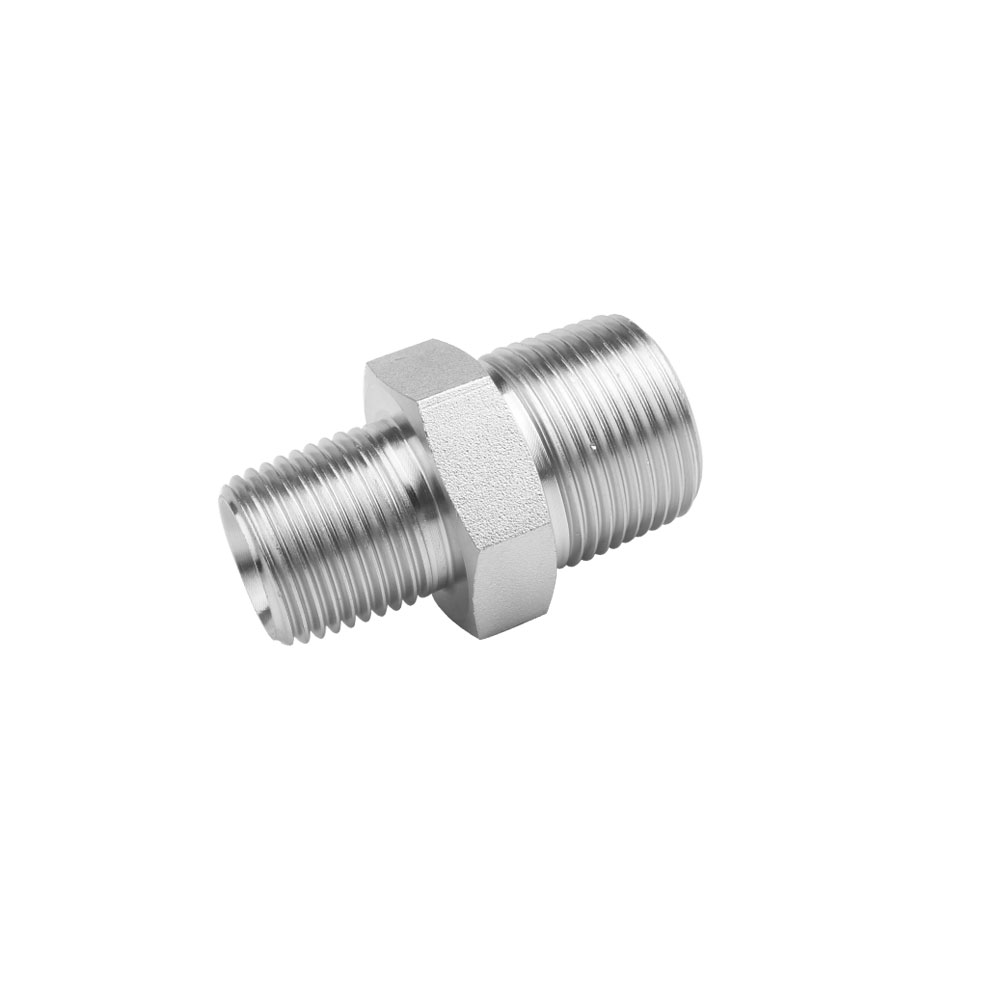
Male BSPT × Male BSPT Straight (1T): a tapered-to-tapered configuration where the seal is formed by thread interference rather than by a face washer.
NPT and NPTF: tapered 60° thread
NPT is a tapered 60° thread widely used in North American equipment. Like BSPT, it seals on the thread, and the two are not interchangeable despite superficial similarity in appearance — the thread angle and pitch differ. NPTF is the dry-seal variant, designed to deform slightly at the crest and root so that a seal can be achieved without compound.
The NPT adapter range in this catalogue includes NPTF configurations: Male NPTF Pipe × Male NPTF Pipe Straight (5404), Male NPTF Pipe × Female NPTF Pipe Straight (5405 and 5406), Female NPTF Pipe Cap (5406-C), Male NPTF Hex Head Pipe Plug (5406-P), Male NPTF Hollow Hex Pipe Plug (5406-HP), Male NPTF Square Head Pipe Plug (5406-SHP), Male NPTF × Female NPTF × Male NPTF Tee (5603), Female NPTF × Female NPTF × Male NPTF Tee (5604), Female NPTF × Female NPTF × Female NPTF Tee (5605), and Female NPTF × Female NPTF × Female NPTF × Female NPTF Cross (5652). Model designations run from 5000, 5404, 5405, 5406, 5406-C, 5406-HP, 5406-P and 5406-SHP through 5500–5505, 5600–5605, 5650 and 5652.
JIC: 37° flare, cone seal
JIC is a 37° flared connection. The seal is metal-to-metal on a cone, which makes JIC a reusable and highly consistent joint when the flare and the mating seat are both undamaged. JIC is also the family most likely to arrive as an assembly rather than a single part, because the tube nut and sleeve form part of the connection.
JIC adapters in this range include Male JIC × Male JIC Straight (2403), Male JIC × Male NPTF Pipe Straight (2404), Male JIC × Female NPTF Pipe Straight (2405), Female JIC × Male JIC Straight (2406), Male JIC Plug (2408), and the bulkhead series 2700–2705, which covers straight, 45° and 90° bulkhead configurations, including Male JIC × Male JIC Bulkhead × Male JIC Tee (2704) and Female Pipe × Male JIC Bulkhead Straight (2705). Related SAE Standard Hydraulic Adapters classified as JIC/ORB/ORFS run across the 6801–6850 designations, including Male JIC × Male Adjustable ORB 90° Elbow (6801), Male JIC × Male Adjustable ORB 45° Elbow (6802), and Male Adjustable ORB × Female ORB 90° Elbow (6815).
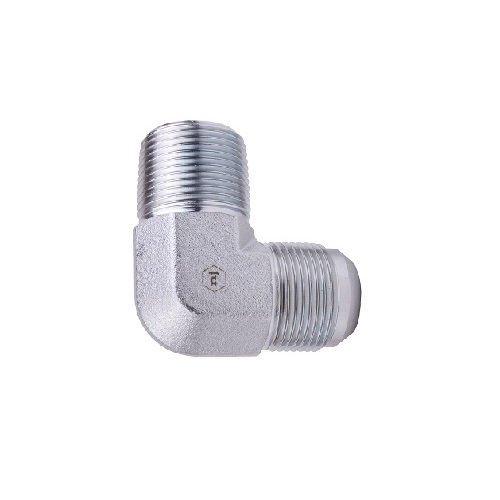
Male JIC × Male NPTF Pipe 90° Elbow (2501): a conversion geometry that places a 37° flare on one end and a tapered NPTF thread on the other.
The buyer decision matrix
| Family | Thread form and sealing logic | Representative configurations in this range | Stated pressure range | Max stable operating temperature | Materials |
|---|---|---|---|---|---|
| BSPP | Parallel thread; seals on a face washer, O-ring or bonded seal, not on the thread | 1B, 6B bulkhead, 5BN, 1BJ, 1BT, 4B plug, 2B9 swivel elbow | 3000–6000 PSI | 220°C | Carbon steel, SS304, SS316 |
| BSPT | Tapered thread; seals through thread interference with sealant | 1T, 1T9, 5T, 1BT, 1JT, 1ST9, 4T plug | 3000–6000 PSI | 220°C | Carbon steel, SS304, SS316 |
| NPT / NPTF | Tapered 60° thread; NPTF dry-seal variant provided within the same range | 5404, 5405, 5406, 5406-C cap, 5406-P, 5406-HP, 5406-SHP plugs, 5603–5605 tees, 5652 cross | 3000–6000 PSI | 220°C | Carbon steel, SS304, SS316 |
| JIC | 37° flare; metal-to-metal cone seal, reusable joint | 2403, 2404, 2405, 2406, 2408 plug, 2700–2705 bulkhead, 6801–6850 JIC/ORB/ORFS | 3000–6000 PSI | 220°C | Carbon steel, SS304, SS316 |
Reading the matrix: sealing logic first, rating second
The most useful observation in the table is what does not differ. All four families in this range carry the same stated pressure range of 3000–6000 PSI, the same maximum stable operating temperature of 220°C, and the same three material options of carbon steel, SS304 and SS316. The headline numbers therefore cannot be used to choose between BSPP and JIC.
What separates them is the sealing interface and the port they must mate with. A parallel-thread BSPP adapter and a 37° flare JIC adapter may both be rated to 6000 PSI, but they solve different problems: one mounts against a face with a compressible seal, the other closes on a cone. This is why a specification that lists only pressure and material without the thread family is not a complete specification.
Material selection: carbon steel, SS304 and SS316
Material choice is driven by corrosion exposure rather than by pressure. All three grades appear across the BSPP, BSPT, NPT and JIC ranges, and the hydraulic cap nut and lock nut series (0304C, 0306, 0318, 0319, 0403, 0500, FS0304C, FS0306, FS0318, FS0319) is also available in carbon steel, SS304 and SS316, with carbon steel as the primary material.
Steel remains the default for the category as a whole: steel material dominated the hydraulic fitting revenue share at 45.2% in 2025, driven by demand for high-pressure durability, according to Dataintelo. Stainless becomes the deciding factor where moisture, salt or aggressive fluids are present — typically marine machinery, firefighting equipment and offshore oil and gas positions.
Two specifications are frequently confused and should be separated in a purchase order. The adapter range states a maximum stable operating temperature of 220°C. Separately, material-level standards such as DIN 17440 describe AISI 316 stainless steel as serviceable from −60°C up to +400°C. The material capability and the assembled adapter rating are not the same figure, and the lower, component-specific number governs acceptance.
Corrosion evidence in this range is expressed through a 120-hour salt spray test, with white rust observed at 120 hours and red rust at 240 hours. That is a test description rather than a guarantee of service life, and buyers should request the test record rather than accept the phrase alone.
Pressure and temperature boundaries
The stated pressure range for the BSPP, BSPT, NPT and JIC adapters in this catalogue is 3000–6000 PSI, with a maximum stable operating temperature of 220°C. Application data for construction machinery duty describes operation capable of withstanding a static pressure of 6,000 PSI and a burst pressure of 9,000 PSI without deformation, while maintaining continuous operation and seal integrity, with rust resistance, high-temperature resistance and high-pressure resistance listed as special requirements.
External references help calibrate expectations by thread and size. NPTF straight threads at 1/4" size typically carry a working pressure rating of 4000 PSI with a 4:1 safety factor, per Titan Fittings, while ORFS fittings at dash size −4 are rated for 6000 PSI working pressure under SAE J1453. These figures illustrate that the rating depends on the specific thread form, size and standard — not on the family name alone.
Applying the framework across five application contexts
Construction machinery. High-temperature and high-pressure duty is the defining condition, and the matched equipment list runs from hydraulic hoses and cylinders to pipe joints and hydraulic pumps. BSPP and BSPT dominate imported European-style equipment, while NPT appears on North American powertrains.
Agricultural machinery. Seasonal use with long idle periods makes corrosion resistance and thread cleanliness decisive. A parallel BSPP joint that is repeatedly opened for service benefits from a replaceable face seal; a tapered joint does not tolerate repeated re-tightening as well.
Marine machinery. Salt exposure pushes the specification toward SS304 or SS316, and the 120-hour salt spray record becomes a primary selection document rather than a formality.
Firefighting equipment. Response reliability is the driver. Thread identity must be unambiguous at the point of use, because a mis-mated connection during an emergency is not recoverable in the field.
Oil and gas extraction. Combined pressure and corrosion exposure typically requires stainless grades and documented test evidence. The same adapters are also specified across mining, transportation, aerospace, automotive, iron and steel metallurgy and water conservancy engineering, which is why a single framework has to travel across sectors.
Procurement acceptance criteria at goods-in
A comparison framework is only useful if it converts into receiving checks. Six checks cover the majority of adapter rejections:
- Thread identity. Confirm parallel versus tapered with a gauge, not by eye. BSPP against BSPT and NPT against BSPT are the two pairs most often confused.
- End configuration. Verify male/female and straight/elbow/tee/bulkhead against the purchase order line, including conversion geometry such as Male BSPP × Male JIC (1BJ) or Male JIC × Male NPTF (2404).
- Material and marking. Match the delivered grade to the ordered grade: carbon steel, SS304 or SS316. Stainless and carbon parts should never be visually indistinguishable in the store.
- Test evidence. Request the 120-hour salt spray record — white rust at 120 hours, red rust at 240 hours — and file it against the delivery.
- Rating statement. Confirm the pressure and temperature class in writing for the ordered sizes, within the 3000–6000 PSI and 220°C envelope.
- Accessory completeness. Count nuts, sleeves, lock nuts, caps and plugs as separate line items, not as packaging assumptions.
The missing-accessories risk after receipt
JIC connections make the completeness problem concrete. An adapter alone does not complete a JIC joint; the tube nut, sleeve and lock nut (for example 0306 JIC Bulkhead Lock Nut, 0318 JIC Tube Nut and 0319 JIC Tube Sleeve) are part of the assembly. When these arrive short, the shipment is technically correct in part count for the adapter line and still unusable at the bench.
Where short-shipment or wrong-delivery does occur, the documented process is straightforward: the customer provides photographs of the missing or wrong-delivered items, verification is carried out, and replacement accessories are then arranged by sea or air shipment. Photographic evidence at unpacking is therefore not an administrative habit but the trigger condition for a fast resolution.
Prevention is cheaper than the claim. Reconcile the packing list line by line against the purchase order, count kit-level components rather than cartons, and photograph the open carton before the parts are binned.
Supplier verification context
NingBo NJ Hydraulic Adapter Co., Ltd is a hydraulic adapter and fittings manufacturer based in Ningbo, Zhejiang Province, China, established in 2004. Its manufacturing facility covers 20,000 square meters, it employs approximately 200 staff, and its R&D team consists of 4 engineers. Main products include hydraulic adapters, hydraulic fittings, flanges, valves and non-standard components, with the company specialising in SAE standard hydraulic components and engineering machinery parts. Export accounts for 75% of output, with the United States and Canada as the main markets.
For a buyer applying this framework, those parameters answer a specific question: whether the supplier can carry four thread families, three material grades and the conversion configurations in one qualification, or whether each family has to be sourced separately. The engineering headcount also indicates the scale of the customisation queue — 4 engineers is a realistic basis for standard and non-standard adapter work, but it is not an unlimited design resource.
Where the framework reaches its limit
Three limits should be stated plainly. First, the framework resolves thread family, material, rating class and receiving checks; it does not replace physical verification of the mating port, and no document set can confirm a damaged flare seat or a cross-threaded port. Second, the 220°C ceiling applies to this adapter range, so positions running continuously above that temperature require a different specification rather than a different interpretation of the same one. Third, the pressure figure is a published series range, not a size-by-size derating table, which means high-pressure circuits need model-level confirmation before release.
Market trend analysis
Growth in this category is moderate and structural rather than speculative. The hydraulic fittings market was valued at USD 4.8 billion in 2025 and is projected to reach USD 7.9 billion by 2034, per Dataintelo. A separate estimate from Kamrul Hasan / Market Report puts hydraulic fittings and adapters growth at a CAGR of 4.5% between 2025 and 2033, reaching USD 5.8 billion; the divergence between published figures reflects differences in market scope rather than disagreement about direction.
Demand is concentrated geographically and by end use. Asia-Pacific led global hydraulic fitting revenues in 2025 with an estimated 38.6% share, according to Dataintelo, while the mobile hydraulics segment held over 58% of total hydraulics market revenue share in 2024, per Grand View Research. Industrial automation reinforces the same direction: Asia accounted for 74% of global industrial robot installations in 2024, according to Ken Research, which increases the number of precise hydraulic connections specified per production line.
Future outlook
Three shifts are likely to shape adapter procurement over the next cycle. Documentation is becoming part of the product — buyers increasingly qualify a supplier on test records and rating statements rather than on catalogue breadth alone. Stainless demand is widening beyond marine into firefighting and food-adjacent applications, which raises the importance of distinguishing material capability from component rating. And mixed-fleet operators are consolidating thread families where they can, because every additional family in the store adds a receiving check and a mismatch risk.
FAQ
What is the practical difference between a BSPP and a BSPT adapter?
BSPP uses a parallel thread and seals on a face such as a washer, O-ring or bonded seal, so the thread does not create the seal. BSPT uses a tapered thread and seals through thread interference, usually with a sealing compound. Both are available in carbon steel, SS304 and SS316, both carry a 3000–6000 PSI pressure range and a maximum stable operating temperature of 220°C, and both pass a 120-hour salt spray test with white rust at 120 hours and red rust at 240 hours.
Can NPT and JIC be combined on the same machine?
Yes, through conversion adapters. Male JIC × Male NPTF Pipe Straight (2404) and Male JIC × Female NPTF Pipe Straight (2405) place a 37° flare on one end and a tapered NPTF thread on the other, and the 2501 Male JIC × Male NPTF Pipe 90° Elbow performs the same conversion at an angle. Because the two ends use different sealing methods, the purchase order must state both interfaces rather than only the hose side.
What pressure and temperature should appear on the purchase order?
For this adapter range, specify within 3000–6000 PSI and a maximum stable operating temperature of 220°C. Construction machinery application data describes withstanding a static pressure of 6,000 PSI and a burst pressure of 9,000 PSI without deformation while maintaining seal integrity. Because the published figure is a series range, the exact model and size should be confirmed for high-pressure circuits.
Which material suits marine or oil and gas positions?
Carbon steel, SS304 and SS316 are all offered across the BSPP, BSPT, NPT and JIC ranges, and the cap nut and lock nut series is also available in all three, with carbon steel as the primary material. Steel overall held 45.2% of hydraulic fitting revenue share in 2025, per Dataintelo, reflecting high-pressure durability demand. Marine and offshore positions typically move to stainless, where the 120-hour salt spray record becomes a primary document. Note that AISI 316 is described in DIN 17440 as serviceable from −60°C to +400°C at material level, while the assembled adapter in this range is rated to 220°C.
What is the process if accessories are missing or wrongly delivered on arrival?
The customer provides photographs of the missing or wrong-delivered items. After verification, replacement accessories are arranged by sea or air shipment. Because JIC joints depend on components such as the tube nut, sleeve and lock nut, photographic evidence taken at unpacking is the practical starting point for the claim.
The four families are not ranked competitors; they are four answers to four different port conditions. A buyer who fixes the thread family from the machine, then the configuration from the routing, then the material from the environment, and finally verifies all three at goods-in has closed the decision loop that most adapter failures begin in.
Product documentation for the BSPP, BSPT, NPT, JIC and SAE adapter ranges is available from NingBo NJ Hydraulic Adapter Co., Ltd at njadapter.com, and the company catalogue can be downloaded here: NingBo NJ Hydraulic Adapter catalogue (PDF).
Have Questions or Need More Details?
Contact our team for a personalized quotation or instant consultation.
Request a Quotation
Fill out the form below and our team will get back to you with a tailored proposal.
WhatsApp Direct Chat
Prefer to chat in real-time? Message us on WhatsApp for instant assistance & quick answers.
- Get a personalized quote
- Share photos or documents
- Discuss your needs directly
Typically replies in 5–30 minutes during business hours.