
BTR2 Fuse Switch Disconnectors in Heavy Industry LV Panels
Fuse protection in a low-voltage distribution board works like a contract. The fuse link promises to interrupt a fault current, and the device holding that link promises not to become the failure point first. In petroleum, chemical, metallurgical and power installations, that contract is tested harder than in most buildings, because the panel sits inside a process environment where heat, dust, vibration or corrosive air act on every contact over years rather than months.
The BTR2 is a stripe fuse rail in the BARFUSE product family, classified by the manufacturer as part of its Stripe Fuse Switch Disconnector range. BARFUSE Electric Co., Ltd. is a Wenzhou-based manufacturer of low-voltage fuse switch disconnectors, busbar systems and high and low voltage distribution wiring management products. Within that range, BTR2 covers the 250 A, 400 A and 630 A feeder tiers, and it is listed as applicable across petroleum, chemical, metallurgical, power and construction low-voltage distribution systems.
This article looks at where BTR2 fits by industry, which documented ratings drive the selection, where the same series points to a different model, and what the real limits of the device are.

Low-voltage fuse switch disconnector production at BARFUSE Electric Co., Ltd., Wenzhou, China.
Why an Industrial LV Panel Is a Different Design Problem
Low voltage is a relative term. The panel sits between the medium-voltage incomer and the final load, which means each outgoing feeder absorbs the character of the process around it while still carrying continuous current.
In petroleum and petrochemical sites, LV boards are often located near process units rather than in a remote electrical room, so ambient temperature swings are wide and outdoor cabinets may see salt-laden or sulphur-bearing air. In chemical plants, corrosive atmospheres oxidise metal parts, and oxidation raises contact resistance. In metallurgical plants, vibration and elevated temperature are normal, and the switchgear cycles thermally through multi-shift production. In power systems, the same board may sit inside a substation auxiliary supply cabinet or a feeder pillar, installed outdoors while the device itself remains inside an enclosure.
Those conditions translate into four concrete requirements for a fuse switch disconnector:
- Stable current-carrying capability at the installed fuse rating, because heat shortens the life of everything downstream.
- Sufficient insulation and impulse withstand at the system voltage, to survive switching and lightning transients.
- Compact spacing relative to neighbouring busbars and cables, so nominal capacity fits inside the cabinet size actually available.
- A mechanically dependable isolation point that lets maintenance staff work on a feeder safely.
Not every LV device is specified against all four. The BTR2 datasheet addresses them directly.
What BTR2 Documents
The BTR2 is listed in the BARFUSE catalogue as a Stripe Fuse rail, with the following published parameters.
| Parameter | Documented value |
|---|---|
| Rated current / Ith | 250 A, 400 A, 630 A |
| Rated operational voltage (Ue) | 415 V, 500 V, 690 V |
| Rated insulation voltage (Ui) | 1000 V |
| Rated impulse withstand voltage (Uimp) | 10 kV |
| Frequency | 50/60 Hz |
| Degree of protection | IP30 |
| Material | COPPER + DMC + ABS + PC |
| Stated applicable industries | Petroleum, chemical, metallurgical, power, construction and other low-voltage distribution systems |
Two of these values deserve more attention than a datasheet row normally gets. The 1000 V insulation voltage and the 10 kV impulse withstand are the numbers that decide whether the device can be installed on a 690 V system without derating its dielectric margin. The IP30 rating, meanwhile, is the number most often misread by buyers.
Reading the Ratings Against Panel Design
250 A, 400 A and 630 A as a feeder ladder
Three current tiers let a panel designer cover a range of outgoing feeders with one device family. A 250 A rail suits smaller motor feeders and distribution sub-boards; 400 A covers the middle band of building and process distribution; 630 A is the level at which a single feeder begins to look like a main distribution circuit. Using one family across the ladder matters for a practical reason: spare parts, mounting practice and isolation procedure stay consistent across the whole board, which reduces the chance of a maintenance error on a live panel.
415 V, 500 V and 690 V
415 V corresponds to the standard three-phase distribution level used across much of the world. 500 V and 690 V appear where the site runs a higher LV distribution voltage, which is common in heavier industrial installations. Because the BTR2 is rated for all three, the same rail can be specified for a 690 V system without stepping up to a different product class. The 1000 V insulation voltage and 10 kV impulse withstand provide the margin behind that operational rating.
50/60 Hz
Dual frequency rating matters mainly for export-oriented panel builders and for sites that operate 60 Hz equipment in regions where 50 Hz is standard. A device rated only at 50 Hz forces a separate line item in the bill of materials.
IP30 in practice
IP30 means protection against access to hazardous parts with a finger and against solid objects larger than 2.5 mm. It does not include water protection. In the industrial context this is the correct rating for a device that lives inside a cabinet, because the cabinet, not the device, provides the environmental defence. A panel bound for a dusty petrochemical yard or a salt-spray coastal substation should be specified with an enclosure rating that matches the site; the BTR2 itself will not add that protection.
Short-Circuit Performance and Where the Limiting Comes From
A stripe fuse rail does not interrupt fault current by itself. It holds a fuse link, and the link is the current-limiting element. This distinction changes how a buyer should read short-circuit claims for any fuse rail product.
Within the BARFUSE low-voltage range, the NT/NH fuse links and NT/NH fuse bases are documented for circuits up to AC 50 Hz, rated voltage up to 1140 V and rated current up to 1250 A for the links, with a breaking capacity of up to 120 kA. Those links conform to IEC 269. When a rail such as the BTR2 is populated with links of that class, the prospective short-circuit current the assembly can clear is set by the link, while the rail has to survive the mechanical and thermal stress the interruption imposes.
The consequence for specification is that the limiting short-circuit figure quoted for a complete feeder should always be traced back to a specific link type and a specific coordination test, not to the carrier alone. A rail that is mechanically solid but paired with an under-rated link offers no protection advantage at all.
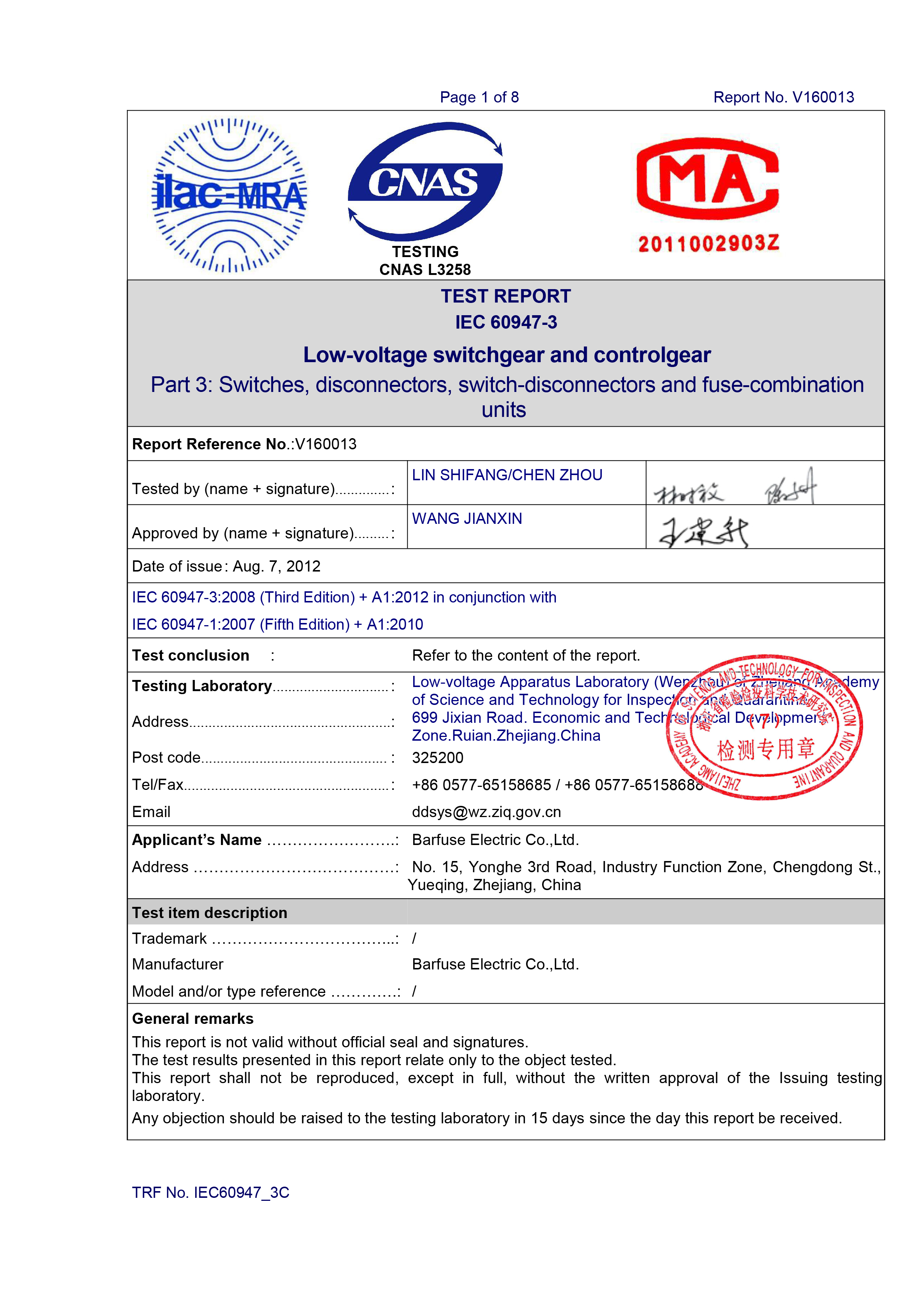
Type test documentation covering switches, disconnectors, switch-disconnectors and fuse-combination units under IEC 60947-3.
Where BTR2 Fits, Industry by Industry
BARFUSE lists the BTR2 and the wider BTR family as applicable in low-voltage distribution systems across petroleum, chemical, metallurgical, power and construction industries. The selection logic differs in each one, and that logic is where most of the engineering value sits.
Petroleum and petrochemical
LV boards on a process site typically feed pumps, compressors, heaters, instrumentation supplies and lighting in a single lineup. The BTR2 630 A tier is a realistic fit for a main outgoing feeder when the board carries several large motor circuits. The relevant selection checks are voltage level, since some process sites run 690 V distribution, and continuity of the isolation procedure, since a feeder cannot be re-energised until the fuse link has been replaced and the isolator reclosed in a defined sequence.
Chemical
Corrosive atmospheres attack exposed metal. The BTR2 uses a copper conductor combined with DMC, ABS and PC housing materials. From a procurement standpoint, what matters is that the housing specification is stated and can be checked against site atmosphere data, and that the assembly is housed in a cabinet with an enclosure rating suited to the corrosion class of the area.
Metallurgical
Metallurgical plants combine high ambient temperature with vibration, which is a demanding combination for mechanical connections. The BTR2 material set and its IP30 design suit cabinet installation at the 250 A to 630 A level, provided the panel structure itself is rated for the temperature and vibration of the location. Thermal cycling is the parameter most worth checking over time, since repeated heating and cooling is what loosens bolted connections first.
Power
In auxiliary supply boards, substation distribution cabinets and feeder pillars, the BTR2 fits the feeder tier between the incoming device and the outgoing cable. This is also the environment where the 1000 V insulation voltage and 10 kV impulse withstand carry real weight, because auxiliary boards in outdoor substations see switching transients more often than boards tucked inside a plant electrical room.
Construction and general distribution
Construction sites and general LV distribution boards typically operate at 415 V and use the lower current tiers. The same rail family applies, with the enclosure doing the environmental work.
When BTR4, BTR5 or BTR6 Fit Better
The BTR2 is not the only option in its family, and the differences between models are material rather than cosmetic.
| Model | Listed as | Current / voltage | Material and notes |
|---|---|---|---|
| BTR1 | Stripe Fuse rail | 250 A / 400 A / 630 A; Ue 415 / 500 / 690 V; Ui 1000 V; Uimp 10 kV; 50/60 Hz | COPPER + DMC. Listed main markets include Nigeria and Congo. |
| BTR2 | Stripe Fuse rail | 250 A / 400 A / 630 A; Ue 415 / 500 / 690 V; Ui 1000 V; Uimp 10 kV; 50/60 Hz | COPPER + DMC + ABS + PC. IP30. |
| BTR3 | Stripe Fuse Switch Disconnector | BTR3-250 / 400 / 630; Ue 415 / 500 / 690 V; Ui 1000 V; Uimp 10 kV | COPPER + DMC. IP30. |
| BTR4 | Stripe Fuse Switch Disconnector | BTR4-250 / 400 / 630; Ue 415 / 500 / 690 V; Ui 1000 V; Uimp 10 kV | COPPER + DMC + ABS + PC. IP30. |
| BTR5 | Stripe Fuse fuse rail | BTR5-250 / 400 / 630; Ue 415 / 500 / 690 V; Ui 1000 V; Uimp 10 kV | COPPER + DMC + ABS. IP30. |
| BTR6 | Stripe Fuse Switch Disconnector | Ie 160 A; Ue AC 690 V; busbar distance 100 mm / 185 mm | COPPER + DMC + ABS + PC. Standard IEC / EN 60269. |
The selection logic that follows from this table is fairly clean. If the feeder sits between 250 A and 630 A at 690 V or below, the BTR2, BTR4 and BTR5 are the relevant comparison set, and the choice between them comes down to material combination and mechanical arrangement rather than electrical rating, because the electrical ratings are identical. If the feeder is at 160 A and the panel uses 100 mm or 185 mm busbar spacing, the BTR6 is the model designed for that geometry, and its IEC / EN 60269 basis reflects the fact that it is meant to pair with NH-type fuse links.
The 100 mm and 185 mm busbar spacings are the two standard geometries in low-voltage vertical fuse switch systems, and matching the device to the spacing already used in the panel avoids reworking busbar supports.
Compliance Evidence a Buyer Can Verify
Specification numbers only carry weight when they sit behind a documented test or certification. The BARFUSE documentation set includes the following, all of which relate to the product family that contains the BTR2.
| Evidence | Reference | Issued by | Date |
|---|---|---|---|
| Type test report for low-voltage switchgear and controlgear, Part 3 | V160016, to IEC 60947-3:2008 (Third Edition) + A1:2012 in conjunction with IEC 60947-1:2007 (Fifth Edition) + A1:2010. Scope: switches, disconnectors, switch-disconnectors and fuse-combination units. | Low-voltage Apparatus Laboratory (Wenzhou) of Zhejiang Academy of Science and Technology for Inspection and Quarantine | 2012-08-07 |
| Test report for low-voltage switchgear and controlgear, Part 3 | V160013, to IEC 60947-3:2008 + A1:2012 and IEC 60947-1:2007 + A1:2010 | Low-voltage Apparatus Laboratory (Wenzhou) of Science and Technology for Inspection and Quarantine of Zhejiang | 2012-08-07 |
| VDE certification | Certificate No. 40047494, scope: Stripe Fuse Switch Disconnector | VDE Testing and Certification Institute | 2017-12-19 |
| ISO 9001 quality management system | Certificate 62724Q1160R0S, to GB/T19001-2016 idt ISO 9001:2015, covering manufacture and export of strip fuse disconnectors, load break switch disconnectors, busbar systems and distribution boxes | Jingxin Certification (Beijing) Co., Ltd. | 2024-11-08, valid to 2027-11-07 |
The VDE certificate is the item that most directly supports European market placement, since it is issued by a European testing institute and its scope names the Stripe Fuse Switch Disconnector product class. The IEC 60947-3 test documentation covers the switching and isolation function, which is the part of the device that has to be mechanically dependable over thousands of operations. The ISO 9001 certificate, meanwhile, speaks to manufacturing consistency rather than to any single product parameter.
At the standards level, the relevant framework continues to move. IEC 60269-1:2024, the general requirements document for low-voltage fuses, was published with coverage of AC systems up to 1000 V and DC systems up to 1500 V. The BTR6 is separately documented against IEC / EN 60269, which reflects the same fuse-link reference framework.
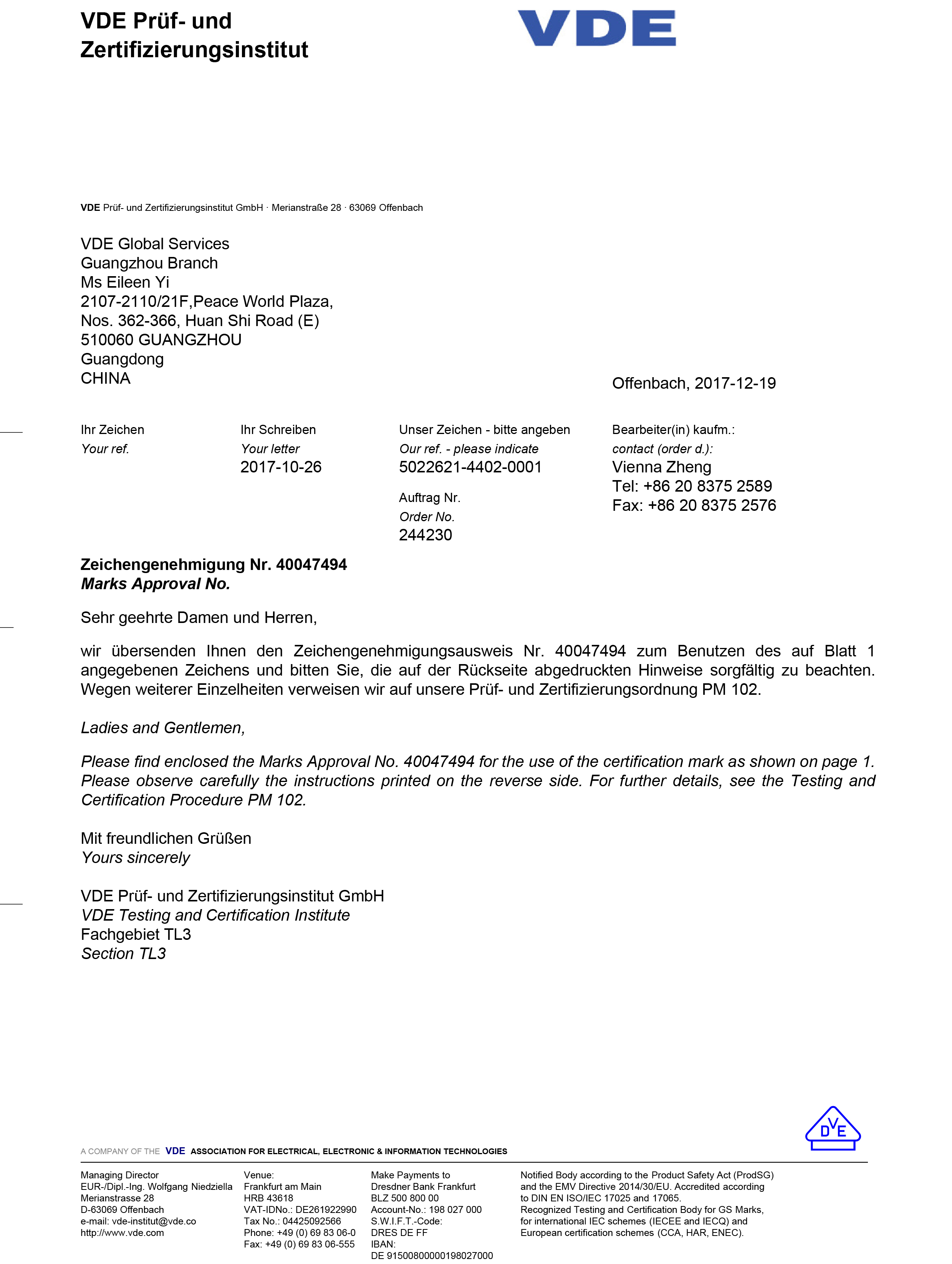
VDE certificate No. 40047494, issued by the VDE Testing and Certification Institute, covering the Stripe Fuse Switch Disconnector.
How Buyers Should Evaluate a Stripe Fuse Rail
Given the parameters above, a practical evaluation sequence for a stripe fuse switch disconnector in a heavy-industry panel looks like this.
- Fix the feeder current tier first. Match the rail to the 250 A, 400 A or 630 A level rather than oversizing, because oversizing increases rail length and cabinet space without adding protection value.
- Confirm the system voltage against Ue 415 V, 500 V or 690 V, and confirm that Ui 1000 V and Uimp 10 kV give acceptable margin for the transient environment of the site.
- Check the fuse link class and breaking capacity separately from the rail, since the link is what actually interrupts the fault.
- Confirm busbar spacing compatibility, particularly where the panel standard is 100 mm or 185 mm, because that decision is made at the design stage and is expensive to reverse.
- Verify the enclosure rating of the cabinet independently from the IP30 device rating.
- Check that the certification scope covers the exact product class being ordered, not a neighbouring class.
- Confirm fuse availability locally, since a rail whose link sizes are hard to source in the destination market will slow every future maintenance event.
The last point is easy to overlook in a tender and expensive to discover later, which is why local fuse availability and standardisation on one link size across a board are both worth insisting on.
Field Evidence from Comparable Deployments
Two documented deployments illustrate how these products behave in difficult environments.
In Russia, a wholesaler supplying electric power distribution took 7,000 units over a five-year period. The recorded highlight of that case is reliable operation at low temperature.
In Saudi Arabia, a project covering feeder pillars and distribution boxes involved a documented quantity of 300,000 units for overload and short-circuit protection, with a project duration of 12 years. The reported results were zero safety failures and zero complaints from end users, with continuous stable operation in high-temperature and salt-spray outdoor conditions. The recorded adaptation features include resistance to temperatures up to 55 degrees Celsius, dust-proof performance, overload tolerance, flame-resistant plastic parts, mechanically stable metal parts and high electrical conductivity. A separate Saudi project involving 600,000 pieces for feeder pillar applications, running three to five years, was documented with low temperature rise as its highlight.
These cases describe the wider BARFUSE low-voltage fuse and busbar product set rather than the BTR2 alone, and the environmental detail they carry, salt spray, 55 degrees Celsius ambient and low-temperature operation, is the part that transfers to this discussion. It establishes that the design assumptions behind these devices have been tested against conditions harsher than a temperature-controlled electrical room.
Comparison with Traditional Isolation Arrangements
The classic alternative to a stripe fuse switch disconnector is a separate NT/NH fuse base combined with an independent switch disconnector, or a moulded case circuit breaker providing both functions in one device.
Compared with a separate fuse base plus isolator arrangement, the BTR2 consolidates the fuse carrier and the isolation function into one compact unit, which reduces wiring, shortens the busbar run inside the cabinet and removes one set of bolted connections that would otherwise be a long-term thermal risk point. The trade-off is that the two functions can no longer be replaced independently: a worn mechanism and a serviceable fuse holder are no longer separate line items.
Compared with a moulded case circuit breaker, the difference is more fundamental and worth stating plainly. A fuse-based rail is simple and has no moving trip mechanism to mis-calibrate, but it does not reset. After a fault, the fuse link must be replaced and a spare of the correct rating must be on hand. In a plant where a feeder fault requires the line to come back quickly, a resettable breaker may be the better operational choice even if the fuse solution is mechanically simpler.
There are two further limits that apply to the BTR2 specifically:
- The device is rated to Ue 690 V with Ui 1000 V. Above that insulation level, or above 630 A in this tier, a different product class is required.
- The protection degree is IP30. The device does not provide environmental sealing, so sites with dust, washdown or corrosive atmospheres must rely on the cabinet to deliver the required ingress protection.
Both limits are normal for this device class and are not defects, but a buyer who assumes otherwise will specify the wrong product for the location.
Market Context Behind the Selection
Two market signals are relevant to anyone specifying LV fuse equipment now.
First, the global electric fuse market is projected to reach USD 5.84 billion in 2025, growing at a compound annual growth rate of 7.05 percent towards 2034, according to Fortune Business Insights. It is worth noting that published valuations for the same year vary, with some sources placing the market closer to USD 4.0 billion. The discrepancy appears to come from methodology: whether fuse bases and switch disconnectors are counted inside the fuse market or treated as separate mechanical switchgear. Buyers comparing market reports should check that scope definition before drawing conclusions.
Second, the adjacent high-voltage DC protection segment is growing faster than the general market. The 800 V DC circuit breaker and protection market for data centres is estimated at USD 265 million in 2026 with a 29.9 percent CAGR. Global export flows under HS Code 853610, electrical fuses for under 1000 V, are meanwhile showing volume shifts toward electric-vehicle-related high-voltage components. At the standards level, IEC 60269-1:2024 now covers DC up to 1500 V, which signals where the framework is heading.
For heavy-industry LV panels, the near-term implication is not that AC fuse rails disappear, but that DC-rated and higher-voltage variants will increasingly be specified alongside them, and that documentation requirements will tighten as the standards evolve.
Future Outlook
Three shifts are likely to shape how stripe fuse switch disconnectors are specified in industrial LV systems over the next several years.
The first is documentation depth. As IEC 60269-1 and related standards are revised, buyers are increasingly asking for the specific test report that covers the exact product class ordered, not a general quality certificate. Manufacturers with traceable type test reports, such as the IEC 60947-3 documentation referenced above, are better positioned to answer that question quickly.
The second is material specification. With corrosive and high-temperature installations becoming more common, the material combination listed for a device, COPPER + DMC + ABS + PC in the case of the BTR2, will increasingly be treated as a selection criterion rather than a footnote.
The third is geometry standardisation. With 100 mm and 185 mm busbar spacings anchoring the vertical fuse switch segment, panels designed around these two geometries can accommodate a wider range of devices without structural rework, which reduces both design time and spare parts risk.
Frequently Asked Questions
What is the difference between the BTR2 and the BTR6 fuse switch disconnector?
The BTR2 is a Stripe Fuse rail rated at 250 A, 400 A and 630 A, with rated operational voltage of 415 V, 500 V and 690 V, rated insulation voltage of 1000 V, rated impulse withstand of 10 kV, 50/60 Hz operation and IP30 protection. The BTR6 is a Stripe Fuse Switch Disconnector rated at 160 A with an operational voltage of AC 690 V, designed for busbar spacings of 100 mm and 185 mm, and documented against IEC / EN 60269. In practical terms, the BTR2 covers the higher current feeder tiers while the BTR6 covers 160 A applications tied to those two busbar geometries.
Is the BTR2 suitable for petroleum, chemical, metallurgical and power industry panels?
BARFUSE lists the BTR2 and the wider BTR family as applicable to low-voltage distribution systems in petroleum, chemical, metallurgical, power and construction industries. Suitability is decided by the panel design rather than by the device alone: the feeder current and voltage levels must fall within the documented ratings, and the cabinet must provide the environmental protection, because the device itself is rated IP30.
What does IP30 mean for a fuse switch disconnector inside a cabinet?
IP30 indicates protection against access to hazardous parts with a finger and against solid objects larger than 2.5 mm. It does not include water protection. For a device mounted inside an LV cabinet, this is the appropriate scope, because the enclosure, not the device, delivers protection against dust, spray and corrosive atmosphere. A site with salt spray or heavy dust requires an appropriately rated cabinet regardless of which fuse rail is installed.
What voltage and frequency does the BTR2 support?
The BTR2 is rated for operational voltages of 415 V, 500 V and 690 V, with a rated insulation voltage of 1000 V and a rated impulse withstand voltage of 10 kV. It is rated for 50/60 Hz operation, which allows the same device to be used in both 50 Hz and 60 Hz systems without a separate product line item.
What verifiable compliance evidence exists for this product family?
Three documents relate directly to this product class. VDE certificate No. 40047494 was issued by the VDE Testing and Certification Institute on 2017-12-19, with a scope of Stripe Fuse Switch Disconnector. Type test report V160016 was issued on 2012-08-07 by the Low-voltage Apparatus Laboratory (Wenzhou) of Zhejiang Academy of Science and Technology for Inspection and Quarantine, covering switches, disconnectors, switch-disconnectors and fuse-combination units under IEC 60947-3:2008 + A1:2012 and IEC 60947-1:2007 + A1:2010. ISO 9001 certificate 62724Q1160R0S was issued by Jingxin Certification (Beijing) Co., Ltd., valid from 2024-11-08 to 2027-11-07.
What are the main limitations of the BTR2?
The BTR2 is rated to Ue 690 V with Ui 1000 V and to 630 A in this tier, so higher voltage or current levels require a different product class. Its protection degree is IP30, which means it depends on the cabinet for any environmental sealing. Because it holds a fuse link rather than an integrated trip mechanism, restoring supply after a fault requires replacing the link rather than resetting a device, which affects both spare parts planning and restoration time. Short-circuit clearing capability is determined by the installed fuse link, whose documented breaking capacity in the NT/NH range reaches up to 120 kA.
How should a buyer verify short-circuit performance for a fuse rail?
Short-circuit interruption in a fuse-based assembly is the function of the fuse link, not the carrier. The rail must withstand the mechanical and thermal stress of the interruption, but the breaking capacity figure belongs to the link. Buyers should therefore confirm the link class, its rated breaking capacity and its coordination with the rail, rather than accepting a single short-circuit figure quoted for the carrier alone.
Reference
The full BARFUSE low-voltage fuse switch disconnector and busbar range is documented in the company catalogue, available for download here: Barfuse Catalogue (PDF).
Have Questions or Need More Details?
Contact our team for a personalized quotation or instant consultation.
Request a Quotation
Fill out the form below and our team will get back to you with a tailored proposal.
WhatsApp Direct Chat
Prefer to chat in real-time? Message us on WhatsApp for instant assistance & quick answers.
- Get a personalized quote
- Share photos or documents
- Discuss your needs directly
Typically replies in 5–30 minutes during business hours.