
BTR6 Fuse Switch Disconnector: IEC/EN 60269 and 12 kV Evidence
BTR6 Fuse Switch Disconnector: IEC/EN 60269 and 12 kV Evidence
A fuse switch disconnector occupies a small footprint in a low-voltage distribution project, but it sits where three separate risks converge: prospective short-circuit current, panel geometry, and the traceability of the supplier's own documentation. Buyers rarely have difficulty finding a supplier willing to quote. The harder task is establishing that the declared ratings belong to the specific model being purchased.
This industry reference examines the BTR6 Stripe Fuse Switch Disconnector from Yueqing Barfuse Electric Co., Ltd. as a worked example of how component-level declarations can be read as capability evidence rather than as catalogue language. Four published values carry most of that weight: compliance with IEC/EN 60269, a 12 kV impulse voltage, a 50–100 kA instantaneous breaking capacity, and a 160 A rating at AC 690 V with 100 mm and 185 mm busbar spacing. The same declarations also define where the evidence stops — and what a buyer should still verify before releasing a purchase order.
The Procurement Problem: A Standard Reference Is Not a Parameter
Nearly every low-voltage fuse component sold into industrial distribution carries a standard reference on its datasheet. That declaration matters, but it is not self-verifying. IEC 60269-1:2024, issued by the International Electrotechnical Commission, sets out general requirements for low-voltage fuses and covers AC systems up to 1000 V and DC systems up to 1500 V. A supplier that aligns itself with this standard family is joining a defined technical conversation; it is not, by itself, demonstrating that a particular 160 A device has been designed, assembled and inspected to the level the standard describes.
The gap is felt most sharply during evaluation. A buyer comparing three quotations for feeder pillar or distribution box protection is, in practice, comparing three PDFs. If a supplier publishes only a standard number, the buyer has no independent variable to test against. If the same supplier publishes operational parameters — rated current, rated voltage, busbar spacing, impulse withstand, breaking capacity — each value becomes a question that can be answered with a certificate, a sample, or a factory audit.
That is the opportunity for procurement teams: treat parameter density as a first filter. A supplier willing to publish specific numbers is a supplier that can be held to them later. A supplier that publishes only adjectives has, in effect, declined to be measured.
There is a second, quieter problem. Fuse switch disconnectors are frequently specified as a line item under a larger panel package, so the person approving the bill of materials may never see the component datasheet. When parameter-level data is available at the component stage, it travels upward into panel documentation, and the specification survives the handover from engineering to purchasing.
Brand Solution: What the BTR6 Is and Who Builds It
Yueqing Barfuse Electric Co., Ltd. is a manufacturer of low-voltage electrical distribution components based in Wenzhou, Zhejiang Province, China, and founded in 2014. The company produces low-voltage fuse switch disconnectors, busbar systems, and high- and low-voltage distribution wiring management products, including MCB pan assemblies, MCCB pan assemblies and metal distribution boxes. Its facility occupies 10,000 m², employs 45 people, and includes a seven-engineer R&D team. Reported annual output is 250,000 PCS, with approximately 90% of production exported to the Middle East, Russia, Latin America, Central Asia, the EU, Africa and Oceania, and a sales network covering more than 40 countries and regions.
The catalogue covers several distinct families: the BTR1 through BTR6 stripe fuse rails and fuse switch disconnectors, NT/NH fuse bases and NT/NH fuse links in sizes NT00, NT1, NT2 and NT3, and the BH DIN rail type fuse base. The BTR6 is a stripe-type fuse switch disconnector rated for three-phase busbar systems, and its published data is unusually specific for an LV component.
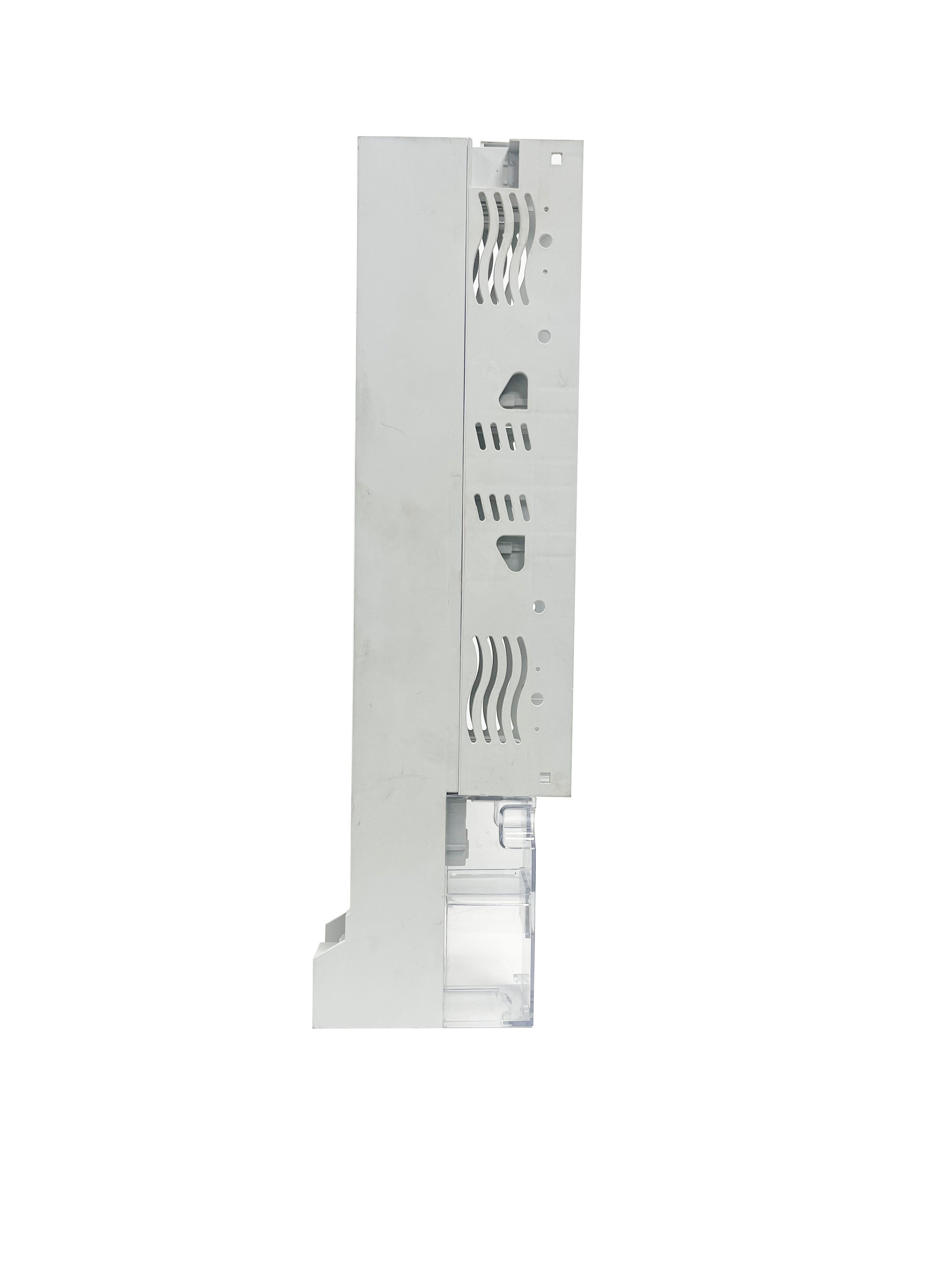
| Declared parameter | BTR6 value |
|---|---|
| Product type | Stripe Fuse Switch Disconnector |
| Rated operational current Ie | 160 A |
| Rated operational voltage Ue | AC 690 V |
| Busbar distance | 100 mm and 185 mm |
| Standard | IEC / EN 60269 |
| Construction materials | Copper, DMC, ABS, PC |
| Electrical performance (declared) | 50–100 kA instantaneous breaking capacity; 12 kV impulse voltage; 1.3 IB |
| Operating modes (declared) | Simultaneous three-phase disconnection or independent single-phase disconnection |
| Application industries | Petroleum, chemical, metallurgical, power, construction — low-voltage distribution systems |
Manufacturing evidence cited in the supplier profile includes more than 30 modern digital wire-cutting machines and punches, supported by inspection equipment such as a Rockwell hardness tester, an electric withstand voltage tester, a spring tester, a salt spray tester, a flame retardant tester and a switch tester. The company states that it operates an ISO 9001 quality system and a workshop organised to “6S” standardisation, and that it has obtained testing accreditations from KEMA (DEKRA) in the Netherlands and VDE in Germany, as well as CB certification and SAA certification in Australia.
At order level, the stated profile covers OEM and ODM production; customization of colour, logo, material, new design, surface treatment, mould development and packing; 100% testing; a minimum order quantity of 5 pieces; and a lead time of 30–45 days, with remote technical support after delivery. For a buyer evaluating a first order, the combination of a low entry quantity and a defined lead time means sample validation can be scheduled before volume commitment.
Technical Explanation: Reading the BTR6 Parameters
IEC/EN 60269 on a Fuse Switch Disconnector
The BTR6 declares IEC/EN 60269 as its standard, and it is worth separating two ideas that are often merged. First, this standard family governs low-voltage fuses and their performance requirements. Second, a fuse switch disconnector is a composite device: it provides a switching and isolation function and it accommodates a fuse, but the fuse remains the element that performs the breaking duty under fault. Barfuse material states that the product requires supporting equipment such as fuses in its application.
For a buyer, that means the standard reference on the disconnector covers only part of the compliance picture. The fuse link selected for the holder carries its own rating and its own standard reference, and the pairing must be correct for the circuit. A panel built with a compliant disconnector and a mismatched link is not a compliant panel, even though every individual datasheet looks correct.
12 kV Impulse Withstand Voltage
The BTR6 is published with a 12 kV impulse voltage. Impulse withstand is a dielectric coordination value: it describes the transient overvoltage level that the insulation system is expected to tolerate without breakdown. In practical terms, it belongs to the same family of design concerns as clearances, creepage distances and surge protection, and it becomes relevant where switching transients or lightning-induced surges are part of the operating environment — outdoor feeder pillars, industrial yards, and installations at the end of long cable runs.
It is important not to read the figure as a continuous operating value. The BTR6's rated operational voltage is AC 690 V, and the two numbers describe different conditions: one is a short-duration dielectric capability, the other is a steady-state service limit. Designers should treat the 12 kV declaration as one input into insulation coordination for the panel, not as a substitute for enclosure-level surge design.
50–100 kA Instantaneous Breaking Capacity
Short-circuit withstand is usually the specification that decides whether a component is acceptable in a given panel. The BTR6 is published with a 50–100 kA instantaneous breaking capacity, which is a notably wide range. The width of the range carries information: it indicates that the achieved value depends on configuration, and most commonly on the fuse link fitted to the holder.
That dependency is precisely the point a buyer should clarify in writing. A useful question is not “is it 100 kA?” but “at which rating, with which fuse link, and under which test arrangement is the upper figure achieved?” The same logic applies to the published 1.3 IB figure, which should be confirmed against the intended load profile rather than assumed. Suppliers who can answer these questions from test documentation are demonstrating something a catalogue photograph cannot.
160 A at AC 690 V, and 100 mm / 185 mm Busbar Spacing
The BTR6's rated operational current is 160 A at a rated operational voltage of AC 690 V, with busbar distances of 100 mm and 185 mm. Industry technical references describe vertical fuse switch disconnectors as optimized for 185 mm and 100 mm busbar spacing systems in LV networks, so the dual-spacing declaration is a compatibility statement, not a marketing one. It determines whether the device mounts directly into an existing busbar system or requires adapters, and adapter work is where installation cost and rework risk appear.
The declared construction combines copper conductors with DMC, ABS and PC mouldings — a material set commonly chosen where mechanical rigidity, flame retardant behaviour and electrical insulation must coexist. The published design notes also describe simultaneous three-phase disconnection or independent single-phase disconnection, a visualized safety position indicator, a compact modular layout, and integration and monitoring features that support remote management and fault early warning. Each of these is a functional claim that can be checked against a sample.
Application Fit: Where a 160 A Disconnector Belongs
Barfuse lists petroleum, chemical, metallurgical, power and construction among the industries served by this product family within low-voltage distribution systems, with IP30 protection and a wide temperature range stated as operating conditions for the fuse rail application group. The common thread across those industries is not the process itself but the electrical topology: continuous duty, high prospective short-circuit current, and a preference for visible, mechanically verifiable disconnection before maintenance work begins.
Within those sectors, the BTR6's natural position is a distribution or feeder circuit at 160 A — for example inside a feeder pillar, a distribution box, or a sub-distribution board where busbar pitch is already standardised. Where the same panel also needs lower-current protection, the supplier's NT/NH fuse bases and links and the BH DIN rail fuse base sit in the same range, which reduces the number of interfaces a panel builder has to qualify.
Field evidence from the supplier's case records illustrates how the series behaves in demanding environments. An OEM electrical equipment manufacturer in Saudi Arabia reports 300,000 pieces used for overload and short-circuit protection in low-voltage feeder pillars and distribution boxes over a 12-year period, with continuous stable operation in high temperature and salt-spray outdoor conditions, and no safety failure or end-user complaint recorded. The stated highlights for that programme include resistance to 55 °C ambient temperature, dust-proof performance, strong overload tolerance, flame-resistant plastic parts, stable mechanical function in metal parts and high electrical conductivity, described as adaptations to the local climate. A second Saudi manufacturer reports 600,000 pieces in feeder pillar applications over three to five years with low temperature rise, and a Russian wholesaler reports 7,000 units used for the distribution of electric power over five years, with stable operation and noted low-temperature performance.
These programmes list the BTR series alongside NT/NH fuse bases and NT/NH fuse links among related products, so they describe series-level field experience rather than a single-model test result. That distinction matters during due diligence: series experience supports a judgement about manufacturing consistency, while a model-level certificate supports a judgement about a specific device.
Market Trend Analysis
Demand for low-voltage protection components is expanding alongside the electrical infrastructure that requires them. Fortune Business Insights projects the global electric fuse market at USD 5.84 billion in 2025, growing at a CAGR of 7.05% towards 2034. A caution belongs next to that figure: reported 2025 valuations for the same market range from roughly USD 4.0 billion to USD 5.84 billion depending on whether fuse bases and switch disconnectors are aggregated with fuses or treated as separate mechanical switchgear. Buyers citing market data internally should confirm what a given number includes before comparing it with another.
A second, faster-moving trend sits adjacent to the BTR6 rather than inside its published envelope. Commercial research estimates the 800 V DC circuit breaker and protection market for data centres at USD 265 million in 2026, growing at a 29.9% CAGR — a figure reported with medium confidence. That growth concerns DC protection, while the BTR6's declared rated operational voltage is AC 690 V. DC duty therefore requires separate, explicitly rated devices and separate verification, and the trend is best read as context for where a supplier's development effort is likely to be directed rather than as evidence about this model.
Trade data adds a third signal. Global exports under HS Code 853610, covering electrical fuses below 1000 V, are tracked by UN Comtrade, and reported volume shifts are moving towards EV-related high-voltage components. On the standards side, IEC 60269-1:2024 extends general requirements across AC systems up to 1000 V and DC systems up to 1500 V, which means compliance documentation has to state the edition it addresses. Together these signals point in one direction: the component itself is commoditising, while the documentation around it is becoming the differentiator.
Comparison with Traditional Solutions — and the Limits of the BTR6
The BTR6 is best understood against the two traditional alternatives in the same catalogue rather than in isolation. NT/NH fuse bases and the BH DIN rail fuse base are fuse accommodation products: they hold a link and provide connection, but they do not provide a switching function. The BTR6 adds deliberate disconnection to the same protective function, which changes maintenance practice — isolation becomes a device-level action rather than a fuse-pulling action.
| Comparison point | BTR6 Stripe Fuse Switch Disconnector | NT / NH fuse base (NT00–NT3) | BH DIN rail type fuse base (BH-400) |
|---|---|---|---|
| Primary function | Switching and isolation with fuse accommodation | Fuse accommodation and connection | Fuse accommodation and connection |
| Rated current | 160 A | Up to 630 A | 400 A |
| Rated voltage | AC 690 V | Up to 1140 V | 690 V |
| Breaking capacity as published | 50–100 kA instantaneous (device level) | Fuse links to 120 kA | Rated neutral links with breaking capacity of 120 kA |
| Standard referenced | IEC / EN 60269 | IEC 269 as listed | IEC 60269-1 and 2; VDE 0636-1 and 2 |
| Mounting interface | 100 mm / 185 mm busbar spacing | Fuse base format | DIN rail |
Stating the advantages without stating the boundaries would make this comparison useless for procurement. The BTR6's published limits are specific and worth listing plainly.
- Current ceiling. At 160 A, the BTR6 is the lowest-rated model discussed here. Other models in the same BTR series are published at 250 A, 400 A and 630 A, and NT/NH fuse bases are published for circuits up to 630 A. Feeders above 160 A fall outside this model's envelope and require a different device in the same family.
- Ingress protection is not stated for this model. The BTR6 product data publishes current, voltage, busbar spacing and standard, but no degree-of-protection figure, while other models in the BTR range list IP30. Where dust, humidity or washdown conditions exist, environmental protection has to be delivered by the enclosure — a feeder pillar or distribution box — and verified at panel level.
- AC rating only. The declared rated operational voltage is AC 690 V. DC and photovoltaic circuits require devices rated explicitly for DC duty; the BTR6's published data should not be extrapolated to those applications.
- Breaking capacity depends on the fuse link. The 50–100 kA figure is a range, and NT/NH links are separately stated to 120 kA. The two numbers describe different components and cannot be substituted for one another.
- The disconnector does not replace the fuse. Isolation and switching are provided by the device; the breaking duty under fault is performed by the link. Substituting an incorrect link invalidates the assumption behind the whole assembly.
- Company accreditation is not model certification. Barfuse cites KEMA (DEKRA), VDE, CB and SAA accreditations at company level, and published material states VDE coverage for the BTR4 and BTR5 products. The BTR6 data declares IEC/EN 60269; buyers who need VDE confirmation for this specific model should request the corresponding document rather than infer it.
Supplier Capability Behind the Component

Capability evidence is what separates a supplier who can build a sample from a supplier who can sustain a programme. On that reading, the relevant facts are structural rather than promotional: a 10,000 m² facility, 45 employees including seven engineers, 250,000 PCS of annual output, more than 30 digital wire-cutting machines and punches, and an inspection inventory that spans hardness, withstand voltage, spring tension, salt spray, flame retardancy and switch function testing. A production system of that shape supports repeatability; the test equipment supports the claim that repeatability is checked rather than assumed.
The commercial structure around the product matters similarly. OEM and ODM production is offered, with customization across colour, logo, material, new design, surface treatment, mould development and packing. Testing is stated at 100%, and after-sales support is provided remotely. With a minimum order quantity of 5 pieces and a 30–45 day lead time, a buyer can validate mechanical fit, marking and function on a real sample before committing to volume — which is the point at which most specification disputes are actually resolved.
A Verification Checklist for Supplier Claims
The following checklist converts the parameters discussed above into verification actions. It is written for the evaluation stage, before a purchase order is released, and it applies to any LV fuse switch disconnector supplier, not only to one.
- Match the standard reference to the model, not the company. Ask for the declaration or test report that names the specific product model and the edition of the standard it addresses.
- Confirm the rated current against the actual load. A 160 A device suits circuits within that envelope; feeders at 250 A or above need a higher-rated model or a different device type.
- Verify the busbar interface before ordering. Check whether the panel uses 100 mm or 185 mm busbar spacing, and confirm the device is supplied for that geometry without adapters.
- Ask how the impulse withstand figure was established. A 12 kV value should be traceable to a dielectric test record, and it should be understood as an insulation coordination input rather than a continuous rating.
- Separate device breaking capacity from fuse link breaking capacity. Confirm the intended link for the holder and the link's own breaking capacity, and ask under which configuration the upper figure in any published range is achieved.
- Clarify the degree of protection at panel level. Where the component datasheet does not state an IP rating, environmental protection must be demonstrated by the enclosure design.
- Check material and flame-retardant declarations. Copper conductors with DMC, ABS and PC mouldings should be accompanied by the relevant material documentation when the panel is subject to fire-performance requirements.
- Distinguish company accreditation from model certification. Company-level KEMA, VDE, CB or SAA statements describe an organisation; model-level certificates describe the device being purchased.
- Validate with a sample or pilot order. Confirm mechanical fit, terminal geometry, marking and operating feel on delivered units before full release, and confirm the supplier's stated lead time and minimum order quantity in writing.
A practical rule for evaluation teams: any parameter that cannot be traced to a document, a sample or a test record should be treated as unverified, no matter how clearly it is printed on the datasheet.
Future Outlook
Two shifts are likely to shape how LV fuse switch disconnectors are bought over the next few years. The first is documentation-led procurement. As IEC 60269-1:2024 aligns general requirements across AC systems up to 1000 V and DC systems up to 1500 V, the version and scope of a compliance claim will matter more than the presence of a standard number. Suppliers who already organise documentation at model level will absorb that change with less friction than suppliers who publish standard references only.
The second shift is the growth of DC protection in data centre and energy storage infrastructure, reflected in the estimated USD 265 million 800 V DC protection market for 2026. That demand sits outside the AC-rated envelope of models such as the BTR6, and it will pull development towards explicitly DC-rated devices. For buyers, the implication is not that today's AC components will be replaced, but that specification documents will increasingly need to state AC and DC duty separately rather than assume one covers the other.
In the meantime, the discriminating factor in a competitive LV component market is likely to remain unglamorous: whether a supplier can produce a document for a specific model on request. Products in this category are broadly similar in appearance and function. The evidence around them is not.
FAQ
Which low-voltage applications is the BTR6 fuse switch disconnector intended for?
Barfuse lists petroleum, chemical, metallurgical, power and construction among the industries in which this product family is used, within low-voltage distribution systems. The device provides switching and isolation for a fuse-protected circuit and requires a supporting fuse to perform the breaking function. The fuse link must be selected to match the circuit current and voltage.
What does the IEC/EN 60269 declaration on the BTR6 actually cover?
IEC/EN 60269 is the low-voltage fuse standard family referenced in the BTR6 product data. IEC 60269-1:2024, the general requirements part, covers AC systems up to 1000 V and DC systems up to 1500 V. The declaration identifies the framework the product is designed against. It does not, on its own, state which tests were performed on which unit, so model-level test documentation is a separate request.
What does a 12 kV impulse withstand voltage indicate?
Impulse withstand describes the transient overvoltage level that the insulation system is declared to tolerate without breakdown. On the BTR6 it is published as 12 kV, alongside a rated operational voltage of AC 690 V. The two values describe different conditions: the impulse figure addresses short-duration overvoltages, while the rated operational voltage addresses continuous service.
Is the 50–100 kA instantaneous breaking capacity the same as a fuse link’s breaking capacity?
No. The BTR6 figure is published as a device-level instantaneous breaking capacity and is expressed as a range, which indicates dependence on configuration or on the fuse link used. NT/NH fuse links and bases from the same supplier are separately stated with a breaking capacity up to 120 kA. The two values describe different components and should not be substituted for one another.
Does the BTR6 fit both 100 mm and 185 mm busbar systems?
The product data lists busbar distances of 100 mm and 185 mm, and industry technical references describe vertical fuse switch disconnectors as optimized for those two busbar spacings in LV networks. Confirming the panel’s existing busbar pitch before ordering is the practical step, because the device mounts onto that geometry directly.
What are the limits of a 160 A / AC 690 V device?
160 A is the BTR6’s rated operational current. Other models in the same series are published at 250 A, 400 A and 630 A, and NT/NH fuse bases are published for circuits up to 630 A, so higher-current feeders fall outside this model’s envelope. The declared rated operational voltage is AC 690 V, which excludes DC circuits. The published BTR6 data also does not include a degree-of-protection figure, while other models in the BTR range state IP30, so environmental protection depends on the enclosure.
How should a buyer verify a supplier’s rating claims before ordering?
Request the declaration or test report that names the specific model; confirm the fuse link intended for the holder and its breaking capacity; check that the busbar spacing matches the panel; ask for model-level certification where only company-level accreditation is available; and use a sample or pilot order to confirm mechanical fit and marking before full release. Barfuse’s stated order profile includes a 5-piece minimum order quantity and a 30–45 day lead time, which allows sample-level validation before volume production.