
Baby Coil vs Secondary Stainless Steel Coil: A Buyer Decision Framework
Independent Buyer Reference · Stainless Steel Coil
Stainless steel coil orders rarely fail because a buyer picked the wrong grade. They fail because the grade was matched to the application while thickness, width, coil weight, surface and packing were matched to the quotation.
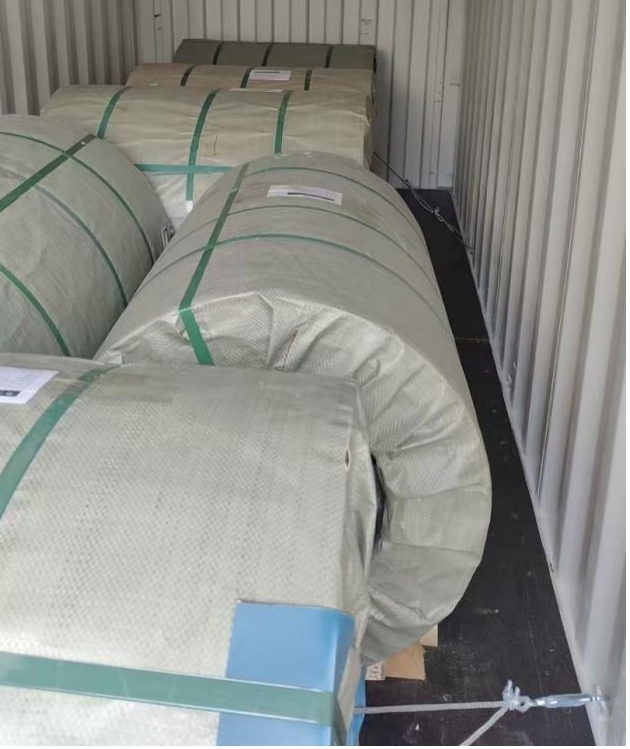
Coil handling and packing choices travel with the material all the way to the buyer's decoiler — they are specification items, not logistics details.
The global stainless steel market was valued at USD 135.8 billion in 2025 and is projected to reach USD 247.4 billion by 2033, according to Grand View Research. China's stainless steel exports reached an all-time high of 5.04 million tonnes in 2024, a 25.6% increase year-on-year, based on General Administration of Customs data reported by Mysteel. At that scale, two product families appear side by side in most offers: baby coil and secondary stainless steel coil. Both are cold-rolled, both are commonly quoted in grades 201, 304, 410 and 430, and both are usually described as mainly BA finish. They do not share the same specification envelope, the same packing standard, or the same acceptance logic.
This article sets out a buyer decision framework built for procurement managers, importers, distributors and OEM buyers who are already past the discovery stage and are comparing actual coil offers against real production lines. The framework runs in six gates: thickness, width, finish, coil weight and packing, grade, and acceptance terms. Each gate is defined by facts that can be confirmed on a mill test certificate or a physical inspection.
What each coil type actually is
A baby coil is a narrow cold-rolled stainless steel coil format supplied in grades 430, 304, 410 and 201. Its thickness range is 0.1 mm to 1.2 mm, and roughly 80% of the supply falls between 0.3 mm and 0.6 mm. Width is around 600 mm, the surface is mainly BA finish with approximately 70% of volume in BA, and coils are shipped in nude packing.
Secondary stainless steel coil is a reclassified cold-rolled format supplied in two build types. Secondary-narrow coil runs 0.1 mm to 1.2 mm thick at around 600 mm wide, in grades 430, 201 and 304, mainly BA finish, at roughly 200 kg per coil, packed PVC outside with paper interleaved. Secondary-wider coil runs 0.25 mm to 1.5 mm thick at around 1000 mm to 1250 mm wide, in grades 430, 304, 201 and 410, mainly BA finish, with individual coil weights below 1 mt and above 1 mt, also packed PVC outside with paper interleaved.
The two families therefore overlap in the thin-gauge band and separate at the ends of the envelope. The overlap is real, and it is the reason so many quotations look interchangeable until the coil reaches the line.
| Parameter | Baby coil | Secondary — narrow | Secondary — wider |
|---|---|---|---|
| Grades | 430 / 304 / 410 / 201 | 430 / 201 / 304 | 430 / 304 / 201 / 410 |
| Thickness | 0.1 mm – 1.2 mm (about 80% between 0.3 mm and 0.6 mm) | 0.1 mm – 1.2 mm | 0.25 mm – 1.5 mm |
| Width | around 600 mm | around 600 mm | around 1000 mm – 1250 mm |
| Surface | Mainly BA finish (approximately 70% BA) | Mainly BA finish | Mainly BA finish |
| Coil weight | Narrow-format coils, nude packed | around 200 kg | below 1 mt / above 1 mt |
| Packing | Nude packing | PVC outside / paper interleaved | PVC outside / paper interleaved |
Table 1. Specification envelope of baby coil and secondary stainless steel coil as documented in supplier product data.
The engineering behind the numbers
Four physical facts drive everything else in this comparison: gauge concentration, strip width, coil mass and surface protection.
Gauge concentration is the first. A baby coil is not spread evenly across its 0.1 mm to 1.2 mm range; about 80% of it sits between 0.3 mm and 0.6 mm. That band is what tube mills, small presses and thin-gauge forming lines typically consume, and it is also where availability is deepest. Secondary-wider coil extends higher, to 1.5 mm, and that additional gauge range is the main structural difference between the two families at the heavy end.
Strip width is the second. A coil at around 600 mm is a slitting-economy width. It feeds tube and pipe forming, narrow stamping presses and cut-to-length lines without further slitting waste. A secondary-wider coil at around 1000 mm to 1250 mm feeds presses, panels and flat-product operations that simply cannot run on 600 mm strip. A 600 mm coil cannot be stretched into a 1240 mm application, and a 1250 mm coil cannot be forced into a 600 mm line without slitting.
Coil mass is the third. A roughly 200 kg narrow secondary coil can be handled with lighter decoilers, forklifts and manual positioning. A coil above 1 mt requires heavier handling equipment and a larger loop on the line. Buyers who ignore coil weight during evaluation discover the constraint during execution, when the material is already at the port.
Surface protection is the fourth. BA (bright annealed) is the dominant finish in both families because it provides a consistent bright surface that can be formed, brushed or polished downstream. BA is not a mirror. The 8K mirror finish is achieved through iterative polishing, and the 12K tier represents the highest reflectivity level, resembling a glass mirror. A buyer who needs mirror-grade reflectivity is specifying a polishing step on top of a BA substrate, not a different coil family.
Packing follows the same logic. Nude packing reduces material and handling cost and is standard for baby coils, but the coil surface is directly exposed from the mill to the buyer's storage. Secondary coils are packed PVC outside with paper interleaved, which adds a barrier against handling marks and moisture during sea freight. Whether that barrier is necessary depends on the journey and on how the buyer stores material on arrival.
A six-gate buyer decision framework
The framework below is designed to be run in order. Each gate eliminates options; it does not rank suppliers. A buyer who completes all six gates has a specification that can be quoted, inspected and accepted.
Gate 1 — Thickness
Define the finished part thickness and the reduction the line will apply. If the process consumes 0.3 mm to 0.6 mm, both baby coil and secondary-narrow coil sit inside the required band, and the decision moves to width and packing. If the process requires 0.8 mm to 1.5 mm, the realistic options narrow to secondary-wider coil, which is documented up to 1.5 mm, or a wider-format product outside this comparison. Decision rule: match the coil thickness band to the process band, not the other way round.
Gate 2 — Width
Confirm the maximum strip width the line can accept and the minimum width the part requires. At around 600 mm, baby coil and secondary-narrow coil share the same width class; the choice between them becomes commercial and packing-driven rather than dimensional. At 1000 mm to 1250 mm, only secondary-wider coil applies within this framework. Decision rule: width is a hard constraint; it cannot be negotiated at the drawing stage.
Gate 3 — Finish
Establish whether the visible surface of the finished part is the coil surface or a downstream polished surface. Both families are mainly BA finish. If the part is polished after forming, BA is a substrate and the finishing step defines final appearance. If the coil surface is the finished surface, specify the finish standard in writing and confirm it against a sample before the order. Decision rule: never treat “BA” as a substitute for a mirror specification.
Gate 4 — Coil weight and packing
Match coil mass to handling capability and choose packing against the transit route. Nude-packed baby coil is the leaner option on landed cost; PVC outside with paper interleaved is the more protective option for secondary coil in long sea freight. Decision rule: if the receiving site cannot handle coils above 1 mt without new equipment, exclude the heavier wider format at the evaluation stage rather than at the execution stage.
Gate 5 — Grade
All four grades — 201, 304, 410 and 430 — appear in both families in some combination. Grade choice is an application decision, not a coil-format decision. As a general industry rule, higher-alloy austenitic grades are specified where corrosion exposure is more demanding, while lower-alloy grades are typically used in interior, dry or lightly exposed applications. Decision rule: settle the grade first, then confirm that the chosen coil format is produced in that grade.
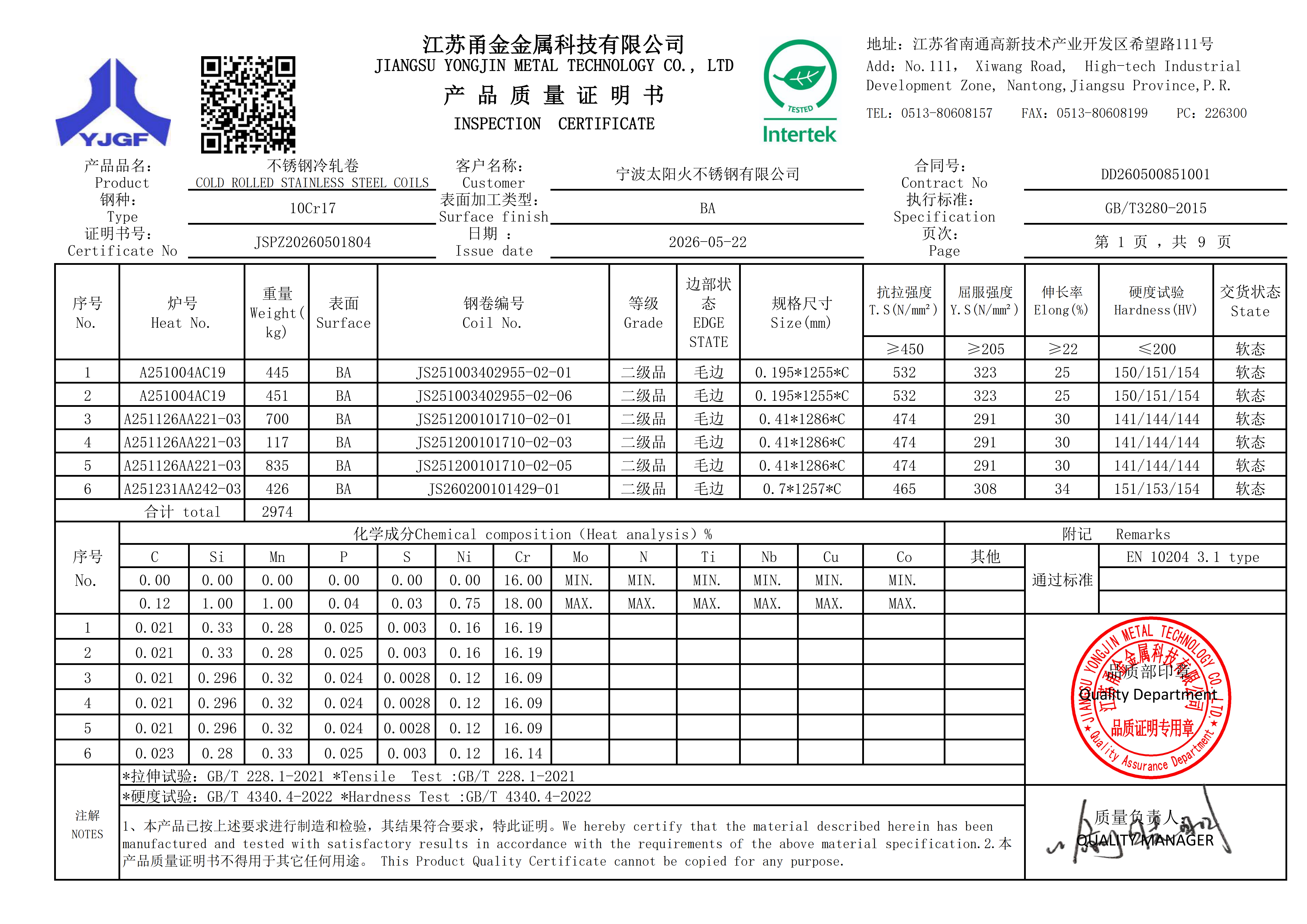
Certification is a gate, not an appendix: 430 coil documentation is issued against GB/T3280-2015 in the supplier's certificate set.
Gate 6 — Acceptance and commercial terms
The final gate converts the specification into a contract. Documented purchasing terms for this supplier include a minimum order quantity of 27 MT, delivery terms of CIF, acceptance criteria based on the Mill Test Certificate, and payment terms of TT / DP. Decision rule: acceptance criteria should be defined before the first shipment, not after the first claim.
Matching the coil format to the application
Both families are documented as applicable to the same broad industry list: kitchenware and cookware, home appliances, elevator decoration, construction and interior decoration, automotive components, industrial equipment, metal stamping and deep drawing, tube and pipe manufacturing, tableware production, and hardware accessories. The trade-off is not the industry; it is the process inside the industry.
| Application | What the process usually demands | Typical format fit |
|---|---|---|
| Tube & pipe manufacturing | Narrow strip, thin to mid gauge, continuous forming | Baby coil or secondary-narrow, around 600 mm |
| Tableware & kitchenware | Thin gauge, formable surface, downstream polishing common | Baby coil (0.3–0.6 mm band) or secondary-narrow |
| Home appliances | Mixed gauge, visible panels, consistent BA surface | Baby coil or secondary-wider depending on panel size |
| Metal stamping & deep drawing | Gauge matched to draw depth, coil mass matched to press feed | Secondary-narrow or secondary-wider |
| Elevator decoration | Wider decorative panels, downstream finishing | Secondary-wider, 1000–1250 mm |
| Construction & interior decoration | Sheet-like blanks, wider coverage per coil | Secondary-wider |
| Automotive components | Consistent gauge, controlled surface, defined acceptance | Secondary-wider with documented MTC |
| Industrial equipment & hardware | Mixed gauge, cost-sensitive, functional surface | Either format, driven by width and weight limits |
Table 2. A planning aid: format fit is determined by width, gauge band, coil mass and handling capability rather than by industry label alone.
How a supplier covering both formats is structured
Ningbo Sunfire Stainless Steel Co., Ltd is a China-based stainless steel supplier founded in 2013, specialised in stainless steel and stainless steel products, with a stated advantage in secondary coil and baby coil. The company reports 100% export orientation, an annual output of 25,920 MT, and a monthly export volume of 3,000 MT. Its office operates from the Ningbo Chamber of Commerce business district, which supports access to port facilities.
On the supply side, the company provides OEM production services, with customization available across thickness, width, surface finish, PVC and packaging. Quality control is documented as a three-step routine: mill test, thickness inspection and surface inspection. Standard delivery time is 7 to 45 days, and the standard minimum order quantity is 27 MT.
The export footprint covers Pakistan, India, Vietnam, Russia, Turkey, Indonesia, UAE, Thailand, Malaysia, Bangladesh, the Middle East, South America and Africa. A long-running export case documents a project supplied for more than 10 years at a scale of 50 containers per month, covering Indonesia, India, South Africa, Pakistan, Vietnam and Saudi Arabia, for kitchenware, home appliances, building and construction applications. The reported outcomes include stable material performance, good corrosion resistance and consistent surface quality.
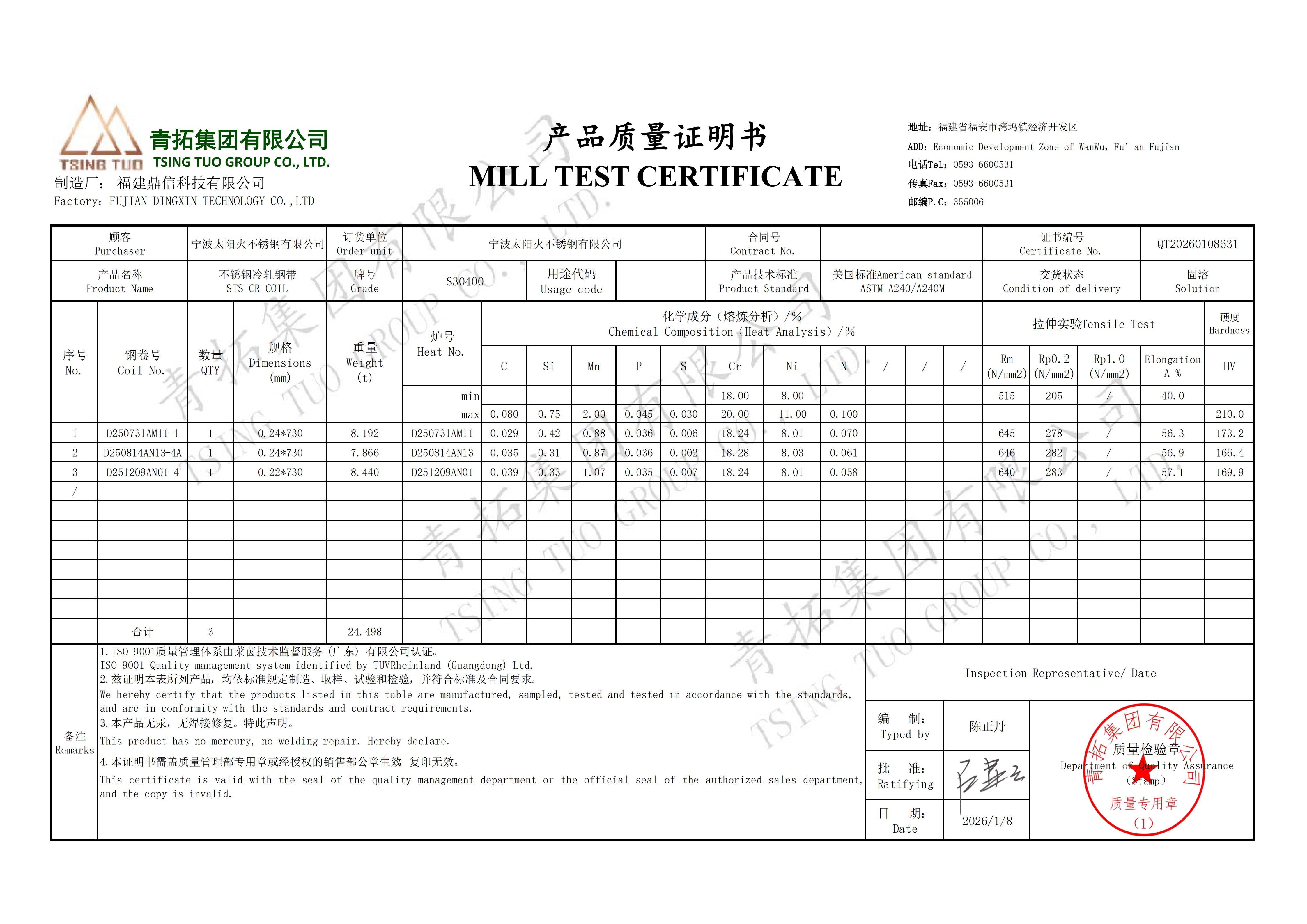
Acceptance evidence: 304 coil documentation is issued under ASTM A240/A240M, the core international reference for stainless steel plate, sheet and strip.
Certificate coverage in the supplier's documentation set includes a 201 J2 mill test certificate issued under standard Q/ZQHW 2-2024, a 430 coil certificate issued under GB/T3280-2015, and a 304 coil certificate issued under ASTM A240/A240M. For buyers, the practical value of that mix is straightforward: the acceptance gate described above has a documented answer, and the standard referenced on the certificate can be matched to the destination market's requirements.
Market signals shaping this decision in 2026
Three supply-side signals are worth carrying into the evaluation stage.
First, export volume. China's stainless steel exports hit a record 5.04 million tonnes in 2024, up 25.6% year-on-year, while China's domestic stainless steel imports fell 9.3% to 1.88 million tonnes over the same period, driven mainly by increased domestic production capacity. For buyers, this means the export market is deep and competitive, and supplier differentiation is shifting toward specification discipline and documentation rather than availability alone.
Second, upstream capacity. Hongwang Group, a major global producer specialising in cold-rolled stainless steel, operates an Indonesia joint venture with a 700,000-tonne-per-year cold rolling capacity, according to Mysteel Global. Cold-rolling capacity at that scale keeps pressure on finished-coil pricing across narrow and wide formats, including the tiers covered in this framework.
Third, trade measures. EU anti-dumping duties on stainless steel cold-rolled flat products from China and Taiwan, in the range of 24.6% to 28.5%, were maintained following a 2025 expiry review under European Commission Regulation 2025/1573. Buyers shipping into the EU should treat destination-market duty exposure as part of the landed-cost calculation at the evaluation gate, not after the order is placed.
Where this framework stops: limits of both formats
A framework that only lists advantages is not a decision framework. Four boundaries apply to both families.
- Width ceiling. Baby coil and secondary-narrow coil are supplied at around 600 mm. They cannot replace a wider format at around 1000 mm to 1250 mm without slitting or re-coiling. Applications requiring full-width blanks must move to a wider format.
- Gauge concentration. About 80% of baby coil output sits between 0.3 mm and 0.6 mm. Buyers needing material at the extreme thin or thick ends of the range should expect tighter availability and longer lead times than the mainstream band.
- Surface expectations. Both families are mainly BA finish. Neither provides mirror-grade reflectivity without additional polishing. Buyers who specify a mirror appearance should specify it as a finishing operation and validate it on a sample.
- Packing trade-offs. Nude packing lowers material and handling cost but leaves the coil surface directly exposed during transit and storage. PVC outside with paper interleaved adds protection and adds cost. Neither option removes the need for dry, covered storage at the receiving site.
A fifth boundary applies to secondary coil specifically. Because secondary material is a reclassified format, its suitability depends on the documented condition of the specific coil, which is why the acceptance gate — mill test certificate plus thickness and surface inspection — matters more here than in a fully prime-grade purchase. Buyers who cannot run that inspection at receiving should price that risk into the offer.
Outlook
Coil procurement is moving toward specification-led buying. As export volumes grow and cold-rolling capacity expands, the differentiator between offers at the same grade and finish is increasingly the completeness of the specification: documented thickness bands, stated coil weight, defined packing, and a certificate that references a recognised standard such as ASTM A240/A240M or GB/T3280-2015.
The practical implication for buyers is that the coil format decision should be made before the supplier shortlist, not after. A buyer who knows the thickness band, width limit, weight limit and acceptance criteria can evaluate baby coil and secondary stainless steel coil on the same terms, and can move from evaluation to execution without re-opening the specification.
FAQ
What purchasing terms and acceptance criteria apply to these coils?
The documented terms are a minimum order quantity of 27 MT, delivery terms of CIF, acceptance criteria based on the Mill Test Certificate, and payment terms of TT / DP.
What is the difference between a baby coil and a secondary stainless steel coil?
A baby coil is a narrow cold-rolled coil in grades 430, 304, 410 and 201, with thickness from 0.1 mm to 1.2 mm, width around 600 mm, mainly BA finish, and nude packing. Secondary stainless steel coil comes in two builds: narrow coils at 0.1 mm to 1.2 mm and around 600 mm wide at roughly 200 kg per coil, and wider coils at 0.25 mm to 1.5 mm and around 1000 mm to 1250 mm wide with coil weights below or above 1 mt. Both secondary builds are mainly BA finish and are packed PVC outside with paper interleaved.
Which grades and thicknesses are available in baby coil?
Baby coil is supplied in grades 430, 304, 410 and 201. The thickness range is 0.1 mm to 1.2 mm, with approximately 80% of supply falling between 0.3 mm and 0.6 mm. Width is around 600 mm and the surface is mainly BA finish, at roughly 70% BA share.
How are secondary stainless steel coils packed, and what coil weights are typical?
Secondary stainless steel coils are packed PVC outside with paper interleaved. Narrow coils at around 600 mm width weigh around 200 kg each, while wider coils at around 1000 mm to 1250 mm are supplied at weights below 1 mt and above 1 mt.
Can the coils be customized, and what is the standard lead time?
OEM production services are provided, with customization available for thickness, width, surface finish, PVC and packaging. The standard delivery time is 7 to 45 days.
Which export markets are served?
Export markets include Pakistan, India, Vietnam, Russia, Turkey, Indonesia, UAE, Thailand, Malaysia, Bangladesh, the Middle East, South America and Africa. A documented export case has run for more than 10 years at a scale of 50 containers per month across Indonesia, India, South Africa, Pakistan, Vietnam and Saudi Arabia.
Have Questions or Need More Details?
Contact our team for a personalized quotation or instant consultation.
Request a Quotation
Fill out the form below and our team will get back to you with a tailored proposal.
WhatsApp Direct Chat
Prefer to chat in real-time? Message us on WhatsApp for instant assistance & quick answers.
- Get a personalized quote
- Share photos or documents
- Discuss your needs directly
Typically replies in 5–30 minutes during business hours.