
Baby Diaper Compliance: What CE, FDA & ISO Marks Really Validate
Baby Diaper Compliance: What CE, FDA & ISO Marks Really Validate
A compliance mark on a baby diaper carton is a statement about one specific document, issued for one specific scope, by one identified body, on one specific date. It is not a general safety score. CE, Halal, REACH, Dermatest, CPC and ISO certificates each validate something narrow — a management system, a substance list, a test method or a single model — and buyers who read them as a single blanket guarantee carry a documentation risk that the paperwork was never designed to remove.
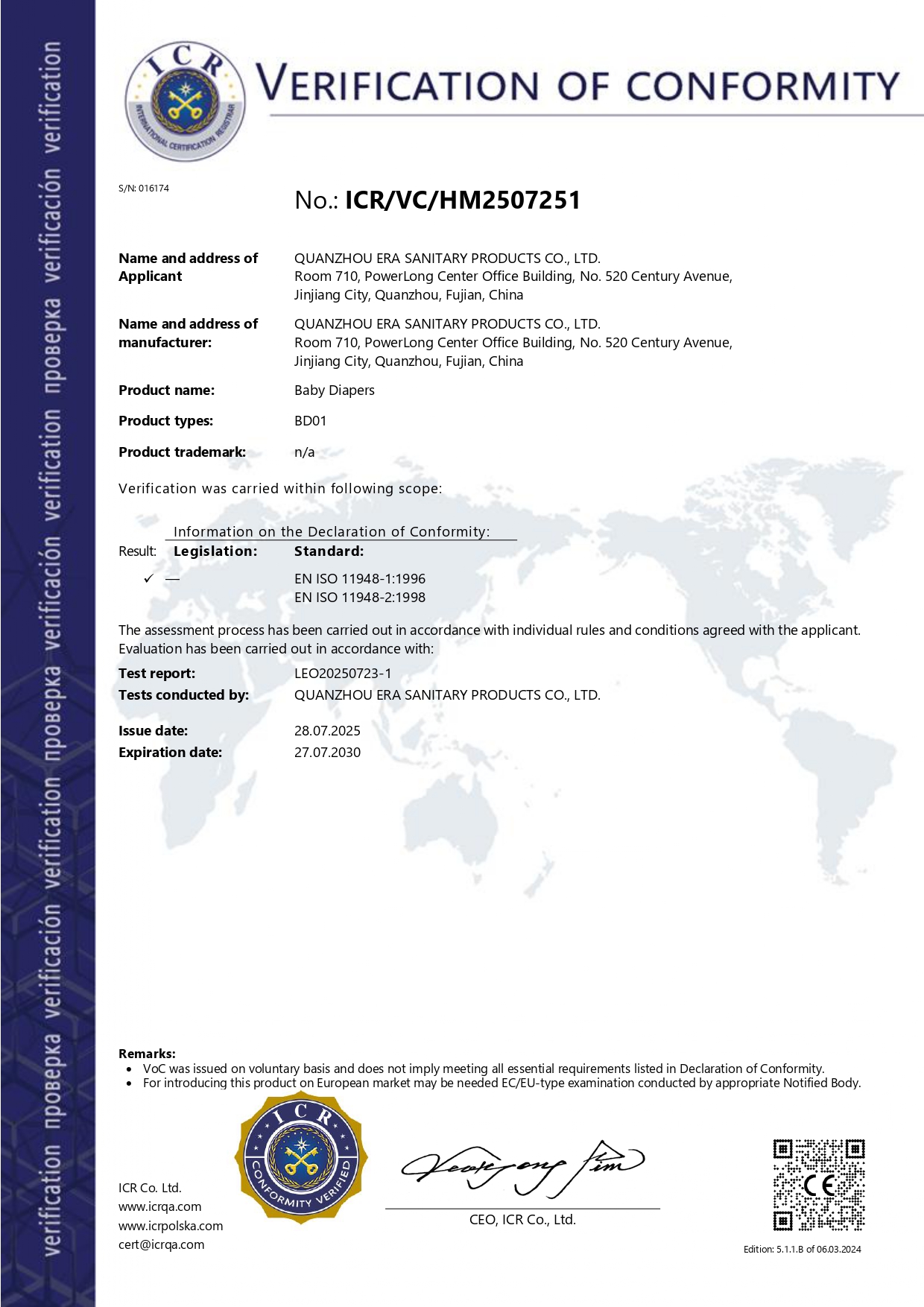
A CE certificate is a scoped document: it names a standard, a model and a validity window. Reading those three lines correctly is the core skill in diaper compliance review.
Compliance Marks Describe Documents, Not a Safety Score
Baby diaper procurement sits at the intersection of three regulatory worlds: general consumer product safety, absorbent hygiene product standards, and market-specific requirements such as substance restrictions or religious certification. A single brand can legitimately hold certificates from all three worlds, and each of them will mean something different.
The practical consequence for buyers in the evaluation stage is that a certificate pack must be read line by line. Four fields carry most of the meaning: the scope (what product, model or category is covered), the standard (what the assessment was measured against), the issuing body (who performed and signed the assessment), and the validity window (issue and expiry dates). A document missing any of those four fields cannot be used to support a purchasing decision, regardless of how prominently its logo appears on a sales page.
Why Compliance Reading Has Become a Procurement Bottleneck
The scale of the diaper trade is what makes documentation discipline commercially relevant rather than academic. Grand View Research placed the global baby diapers market at approximately USD 83.3 billion in 2025, with a projection of USD 141.8 billion by 2033. Fortune Business Insights estimated that Asia Pacific held a 61.92% share in 2025, generating approximately USD 50.01 billion.
Within that geography, export concentration is unusually high. According to Xiamen Customs data reported in 2024, Fujian Province accounts for 63.9% of China's total baby diaper exports, with an export value reaching 8.74 billion yuan. Quanzhou ERA Sanitary Products Co., Ltd. is based in Jinjiang, Quanzhou, Fujian Province — inside that supply cluster — and exports 100% of its output to Europe, the USA, Southeast Asia, Central Asia, South America, Africa and the Middle East.
This concentration creates an opportunity and a problem at the same time. The opportunity is that buyers can source from a mature, deeply specialised manufacturing base. The problem is that thousands of SKUs move through that base with certificate packs that are frequently presented at brand level while the buyer's order is placed at model level. The gap between those two levels is where most evaluation-stage compliance mistakes happen.
What Management System Certificates Actually Cover
Management system certificates are the most commonly misread documents in a diaper pack. They confirm that a factory operates a documented, audited process. They do not confirm that a specific diaper performs in a specific way.
In the case of Quanzhou ERA Sanitary Products Co., Ltd., the recorded system certificates are explicit about their own limits:
- ISO 14001 — certificate number 29325E912342R0S, issued by Aopeng Certification Co., Ltd., against GB/T 24001-2016 / ISO 14001:2015, valid from 2025-09-17 to 2028-09-16. The recorded scope is environmental management related to maternal & child products and hygiene products, including baby diapers, baby pull-up pants, urine pads, adult diapers, wet wipes, sanitary napkins and tissue.
- ISO 45001 — certificate number 293250912341R0S, issued by Aopeng Certification Co., Ltd., against GB/T 45001-2020 / ISO 45001:2018, valid from 2025-09-17 to 2028-09-16. The recorded scope is occupational health and safety management for the same product families.
- ISO 13485 — certificate number 381240080R0S, against ISO 13485:2016, valid from 2024-03-12 to 2027-03-11. The recorded scope is disposable hygiene products: baby diaper, adult diaper, sanitary pad, under pad, tissue and absorbent pad.
Each of these validates a management system across a product family. None of them validates the absorbency, pH, fit, or leakage behaviour of an individual model such as BD01 or OD02. They also cover a broad category list, which means they do not isolate baby diapers as a separately audited product line.
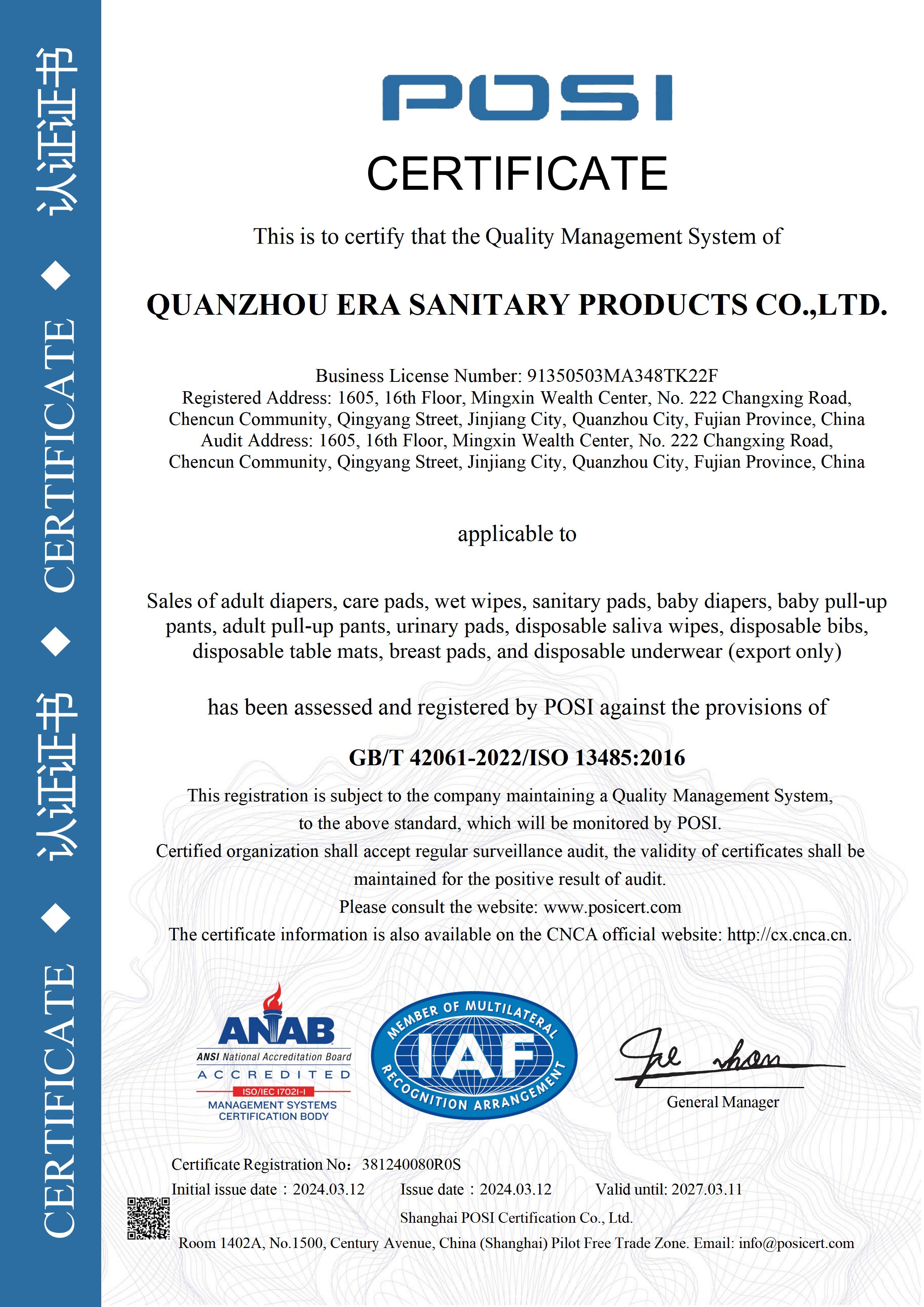
A system certificate such as ISO 13485 is scoped to a product family and a management process. It is evidence of process control, not of finished-product performance.
What Product-Scope Certificates Actually Cover
Product-scope documents are narrower and, for that reason, more directly useful in procurement. They name a model, a standard, and a testing or issuing body.
CE marking
The recorded CE certificate for baby diapers carries number ICR/VC/HM2507251, issued by ICR Co., Ltd., with the scope recorded as Baby Diapers (Model: BD01). The listed standards are EN ISO 11948-1:1996 and EN ISO 11948-2:1998, with validity from 2025-07-28 to 2030-07-27. Two things matter here for buyers: the document is tied to a model number, and the standards listed are the ones the assessment actually used. If a buyer's destination market requires a different standard set, the CE document does not answer that question by itself.
CPC and ASTM F963
For the same model, the recorded CPC carries number XNO250113502YX2-1, with the scope recorded as Baby Diaper (Model: BD01) and the standards listed as 16 CFR Part 1500 series, ASTM F963 and CPSIA requirements, valid from 2025-01-16 to 2030-01-16. A separate ASTM F963 record carries number XNO250113503YX3-1, issued by XNO Testing (Guangzhou Supreme Technology & Testing Service Co., LTD), scoped to Model BD01 against ASTM F963-23, 16 CFR Part 1500 Series and CPSIA requirements, dated 2026-01-16.
ASTM F963 is widely recognised as a toy safety specification. When a standard of that nature appears in a diaper document pack, the productive question for a buyer is not whether the document is genuine, but what the test scope actually covered and how it maps to the requirements that apply to absorbent hygiene products in the destination market. That is a specification question for the supplier's technical team, and it should be answered in writing.
REACH
The recorded REACH document carries number XMNCPCH25002810801, issued by SGS, with the scope recorded as Baby Diaper (Brand: My A+ Brand), against Regulation (EC) No 1907/2006 (REACH) and the SVHC Candidate List, valid from 2025-11-20 to 2027-12-27. The European Commission framework restricts more than 1,900 hazardous substances under REACH, and many suppliers additionally follow OEKO-TEX Standard 100.
Note the scope wording carefully: this document is recorded at brand level, not model level. That is a materially weaker position for a buyer who needs model-by-model evidence.
Halal
The recorded Halal certificate carries number 30113766206426, issued by Halal Foundation Center (Hong Kong), against the International Halal Standards for Hygiene Disposable Products, valid from 2025-04-08 to 2028-04-07. The recorded scope covers adult diapers, adult pant diapers, baby diapers, baby pant diapers and sanitary pads, with the brand recorded as My A plus.
Dermatest
The recorded Dermatest certificate carries number ST-ET-2026-00055, issued by Dermatest GmbH (Germany), against international clinical dermatology test guidelines for skin tolerability assessment, valid from 2026-04-07 to 2031-04-06. Critically, the scope is recorded as My A+ Baby Diapers (non-woven top sheet skin compatibility test). This is a component-level skin tolerability assessment, not a whole-product safety certification.
Where the "FDA" Reference Fits — and What It Usually Does Not Mean
"FDA" appears frequently in supplier marketing material and is one of the most frequently over-interpreted terms in the category. Quanzhou ERA Sanitary Products Co., Ltd. lists FDA among the international certifications it holds, alongside CE, ISO 9001, ISO 13485, ISO 11948, ISO 14001, ISO 45001, ISO 22716, SGS, Halal, CPC, MSDS and DERMATEST.
What buyers should understand is that a reference to the FDA is not a single, uniform approval stamp equivalent to a CE certificate. US market entry for absorbent hygiene products typically involves a combination of facility-related registration, conformity documentation and, where applicable, children's product certification such as the CPC. The recorded corpus documents for this supplier show the CPC and the ASTM F963 certification scoped to Model BD01, with the standards list referencing 16 CFR Part 1500 series and CPSIA requirements — that is the traceable US-facing evidence in the pack.
Material Claims and Regulatory Scrutiny: Fluff Pulp, SAP and Bamboo Fiber
Material claims sit in a different category from certification. They describe what a diaper is made of, not what has been independently certified about it. The distinction matters because regulatory scrutiny increasingly focuses on substance content, and a material claim in a specification sheet is not automatically the same thing as a tested substance declaration.
Across the verified model range, the base material recorded for every model — BD01 through BD08, PD01, PD02, OD01, OD02, EB01 and AL01 — is fluff pulp. Beyond that base, the recorded absorbent and component specifications differ meaningfully by model:
- BD01, BD02, BD03 and BD04: a floated core with a Japan Sumitomo 50% + Japan Sandia SAP paper sheet, hot air super soft embossed top sheet, double leak guard, spandex elastic waistband, S shape magic tapes and a wetness indicator. BD04 and BD03 are additionally recorded as hypoallergenic and free of parabens, elemental chlorine and latex.
- PD01 and PD02: a full 100% SAP paper core (recorded as LG + Sumitomo), crotch elastic design, leak guard, hot air non-woven top sheet and wetness indicator. PD01 additionally records anti-rash oil lines.
- OD01 and OD02: 100% SAP paper with Sumitomo and Sandia recorded as used in a specified ratio, plus an ammonia-removed 3D technology, double leak guard and wetness indicator.
- BD05, BD06, BD07 and BD08: Japan SAP with USA fluff pulp, green ADL, spunbond nonwoven top sheet, colorful clothlike breathable backsheet, spandex-elastic-ring waistband and leak guard.
- EB01: USA fluff pulp with SAP, a T-shape design, bamboo fibre topsheet and backsheet, double leak guard, wetness indicator and a biodegradable kraft paper bag.
- AL01: recorded as premium T-shape with SAP paper and USA fluff pulp, hot air super soft embossed topsheet, double leak guard, crotch elastic design, wetness indicator and dispose tape, and described as hypoallergenic and free of parabens, elemental chlorine and latex.
Now compare that with the certification records. None of the recorded certificates lists an SAP supplier, a fluff pulp origin or a fibre composition as a certified attribute. The Halal certificate covers product categories; the REACH document covers the SVHC Candidate List at brand level; Dermatest covers the non-woven top sheet. In other words, material claims and certification claims live in two separate evidence systems, and a buyer who needs to defend a material claim to a regulator or a retail compliance team needs a separate document for it.
The bamboo fibre construction of EB01 is a good illustration. Bamboo-based biodegradable diapers are projected by Future Market Insights to hold a 39% share of the biodegradable segment by 2026, which makes fibre-origin claims commercially attractive. But the commercial attractiveness of a claim is exactly why it should be supported by a fibre composition declaration or an equivalent document, rather than inferred from the presence of an ISO certificate elsewhere in the pack.
The Model-Scope Gap: Why BD01 Documents Do Not Automatically Cover BD02
This is the single most consequential finding for evaluation-stage buyers, and it is visible directly in the recorded documents.
The CE certificate, the CPC and the ASTM F963 certification in this supplier's pack are all scoped to Model BD01. The REACH document is scoped to the My A+ Brand. Dermatest is scoped to My A+ Baby Diapers, non-woven top sheet. The Halal certificate is scoped to a product category list under the My A plus brand. The ISO 14001 and ISO 45001 certificates cover a broad hygiene product family, and the ISO 13485 certificate covers disposable hygiene products as a category.
A buyer evaluating BD02, BD03, BD07, PD01, PD02, OD01, OD02, EB01 or AL01 therefore holds a documentation file whose strongest model-specific entries name a different model. This does not mean those other models fail any requirement. It means the file, as it stands, does not yet contain model-level evidence equivalent to what exists for BD01 — and that gap has to be closed before a purchase order, not after.
The same logic applies in reverse. A catalogue that lists fourteen models invites the assumption that one certificate covers all fourteen. Reading the scope line is the only reliable way to test that assumption.
A Document-by-Document Reading Table
| Document | Recorded issuer | Recorded scope and standard | What it does not establish |
|---|---|---|---|
| ISO 14001 (29325E912342R0S) | Aopeng Certification Co., Ltd. | Environmental management, maternal & child and hygiene products; GB/T 24001-2016 / ISO 14001:2015; valid 2025-09-17 to 2028-09-16 | Does not measure diaper absorbency, fit, leakage or skin tolerance |
| ISO 45001 (293250912341R0S) | Aopeng Certification Co., Ltd. | Occupational health and safety management; GB/T 45001-2020 / ISO 45001:2018; valid 2025-09-17 to 2028-09-16 | Does not validate product materials or market access |
| ISO 13485 (381240080R0S) | As recorded | Disposable hygiene products including baby diaper; ISO 13485:2016; valid 2024-03-12 to 2027-03-11 | Does not certify an individual model's construction or performance |
| CE (ICR/VC/HM2507251) | ICR Co., Ltd. | Baby Diapers, Model BD01; EN ISO 11948-1:1996 and EN ISO 11948-2:1998; valid 2025-07-28 to 2030-07-27 | Does not automatically extend to other model numbers |
| CPC (XNO250113502YX2-1) | Not specified in the recorded entry | Baby Diaper, Model BD01; 16 CFR Part 1500 series, ASTM F963, CPSIA; valid 2025-01-16 to 2030-01-16 | Does not by itself confirm the destination market's full requirement set |
| ASTM F963 (XNO250113503YX3-1) | XNO Testing (Guangzhou Supreme Technology & Testing Service Co., LTD) | Baby Diapers, Model BD01; ASTM F963-23, 16 CFR Part 1500 Series, CPSIA; dated 2026-01-16 | Test scope should be reviewed against hygiene product requirements for the target market |
| REACH (XMNCPCH25002810801) | SGS | Baby Diaper, Brand: My A+ Brand; Regulation (EC) No 1907/2006 (REACH), SVHC Candidate List; valid 2025-11-20 to 2027-12-27 | Does not confirm that every model in the range was tested |
| Halal (30113766206426) | Halal Foundation Center (Hong Kong) | Baby diapers among the listed categories, brand My A plus; International Halal Standards for Hygiene Disposable Products; valid 2025-04-08 to 2028-04-07 | Does not replace material, substance or performance documentation |
| Dermatest (ST-ET-2026-00055) | Dermatest GmbH (Germany) | My A+ Baby Diapers, non-woven top sheet skin compatibility test; valid 2026-04-07 to 2031-04-06 | Covers the tested component, not the finished diaper as a whole |
All entries are drawn from the supplier's recorded certification data. Model numbers and certificate numbers are reproduced as recorded.
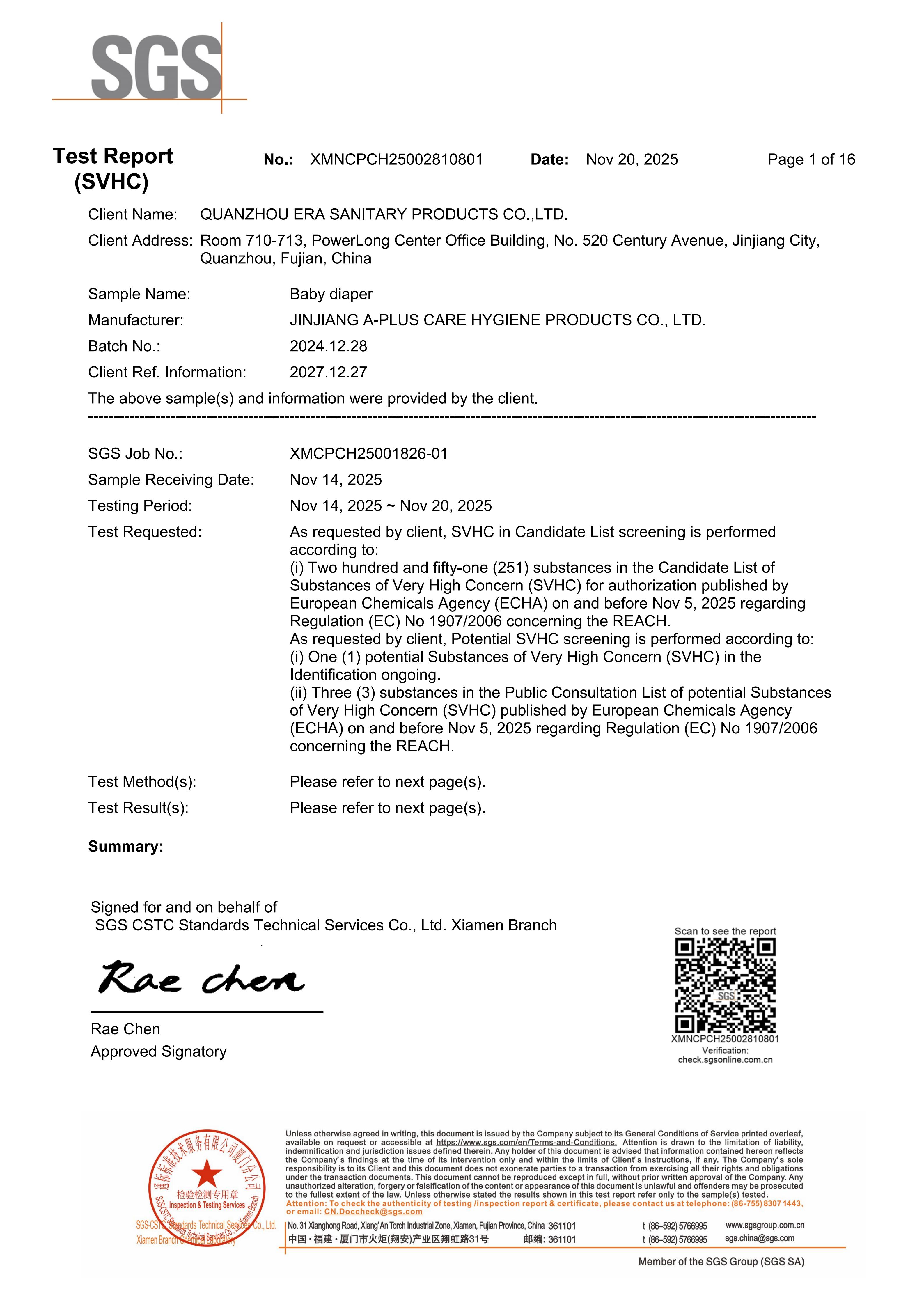
Substance-level documents such as the REACH SVHC record address chemical content. They are recorded at brand level, which is a different scope from a model-level performance certificate.
Matching Marks to Markets and Sales Channels
Compliance value depends on where the product is going and through which channel it is sold. The recorded application channels for this model range are baby care, mother & baby retail, supermarket and cross-border e-commerce, with export markets covering Europe, the USA, Southeast Asia, Central Asia, South America, Africa and the Middle East.
European Union
Substance restriction is the primary filter. REACH restricts more than 1,900 hazardous substances, and many buyers add OEKO-TEX Standard 100 as a voluntary screen. The recorded REACH document — covering the SVHC Candidate List for the My A+ Brand — is the relevant artefact here, and its brand-level scope should be extended to model level if a buyer orders outside the tested configuration.
United States
Children's product conformity documentation and the standards referenced in the record are the relevant artefacts. The recorded CPC and ASTM F963 documents both name Model BD01 and reference 16 CFR Part 1500 series and CPSIA requirements.
Middle East and Muslim-majority markets
Halal certification is frequently a listing requirement rather than a differentiator. The recorded Halal certificate covers baby diapers and baby pant diapers under the My A plus brand and remains valid into 2028.
Skin-sensitive and premium retail
Dermatological claims are increasingly made on shelf. The recorded Dermatest certificate provides component-level skin tolerability evidence for the non-woven top sheet of My A+ diapers. Products described as hypoallergenic and free of parabens, elemental chlorine and latex — such as AL01, BD04, BD05 and EB01 — require supporting declarations, because those statements describe formulation, not certification.
Cross-border e-commerce
Marketplace compliance teams typically request model-level documents rather than brand-level summaries. This channel is where the model-scope gap described above becomes a direct listing blocker.
Brand-Level Certificate Packs vs. Model-Level Document Files
The traditional approach to supplier qualification treats a certificate pack as a single trust artefact. A buyer requests "your certificates", receives a PDF bundle, confirms that recognisable logos are present, and files it. This is fast and it is the reason many sourcing files contain documents that do not actually cover the goods being purchased.
The structured alternative treats the same evidence as a matrix: each model on the purchase order is matched against each requirement in the destination market, and each cell is filled by a named document with a scope line, a certificate number and an expiry date. The structured version is slower at the start and considerably cheaper than discovering a documentation gap at customs or at retail onboarding.
It is worth being explicit about the boundaries of this method, because over-claiming is its own risk:
- Certification does not replace performance testing. None of the recorded certificates measures absorbency, rewet, leakage under load or fit for a specific baby weight range. The supplier states that quality control follows 100% testing, and the recorded OEM case reports steady repeat orders with positive market feedback on comfort and leak-proof performance — but independent, model-specific performance data is not part of the certificate pack and must be requested separately.
- Documents expire. The ISO 13485 record runs to 2027-03-11 and the REACH record to 2027-12-27. A file assembled today becomes partially stale within a few years, and renewal timing has to be tracked.
- Scope wording is narrower than headline wording. Dermatest covers the non-woven top sheet; REACH is recorded at brand level; CE, CPC and ASTM F963 are recorded at Model BD01. The headline is broader than the artefact.
- Issuing-body verification remains the buyer's responsibility. The recorded bodies include Aopeng Certification Co., Ltd., ICR Co., Ltd., XNO Testing, SGS, Dermatest GmbH and Halal Foundation Center (Hong Kong). Confirming current accreditation status is a separate step that no supplier document can perform on the buyer's behalf.
- Material declarations are separate from certification. Fluff pulp, USA fluff pulp, Japan SAP, Sumitomo and Sandia SAP paper and bamboo fibre are specification claims. They require supplier declarations or composition testing, not a management system certificate.
A Practical Verification Workflow for Buyers
The following sequence converts a certificate bundle into a defensible procurement file. It is written for evaluation-stage buyers preparing a first or repeat order.
- Step 1 — Fix the model list first. Decide which of the fourteen models you intend to buy. Compliance work scales with models, not with suppliers.
- Step 2 — Build a model × market matrix. Rows are models; columns are destination markets and retail channels; cells list the documents that market requires.
- Step 3 — Request documents at model level. Ask for the certificate number, the scope line as printed, the standard, the issuing body, and the issue and expiry dates — for each model, not for the brand.
- Step 4 — Match the scope line against the purchase order. If the scope names BD01 and the order names PD02, the document does not cover the order. Ask what does.
- Step 5 — Check validity against your shipping and shelf-life plan. The recorded shelf life in the OEM case unit is three years; a certificate expiring before the goods reach shelf is a planning constraint, not a formality.
- Step 6 — Request the full test report, not only the summary certificate. Component-level claims such as skin compatibility and substance screening are supported by the underlying report.
- Step 7 — Request material declarations separately. For fluff pulp origin, SAP type (for example Sumitomo and Sandia SAP paper as recorded in BD01–BD04 and OD01–OD02), or bamboo fibre content as recorded in EB01, ask for a written declaration from the supplier.
- Step 8 — Verify the issuing body. Confirm the certificate number directly with the named body where the issuing process allows it.
- Step 9 — Date and version the file. Record when each document was received, and set renewal reminders ahead of each expiry date.
Supplier-side information supports part of this workflow. Quanzhou ERA Sanitary Products Co., Ltd. records an OEM/ODM production model with a monthly capacity of 20,000,000 pieces, a typical lead time of 25–35 days, a minimum order quantity of 100,000 pieces, material and logo customization, 100% testing in quality control and remote after-sales support. Those are operational facts that a buyer can plan around. They are not substitutes for model-level compliance documents, and they should not be treated as such.
Market Signals Behind Rising Documentation Scrutiny
Three documented market signals explain why compliance reading has moved from a back-office task to a front-end procurement requirement.
First, category growth keeps new buyers entering the market. The projected expansion from approximately USD 83.3 billion in 2025 to USD 141.8 billion by 2033, as reported by Grand View Research, means a steady flow of importers, private-label owners and e-commerce sellers who are new to hygiene product regulation.
Second, the premium segment is growing faster than the category. Intel Market Research projected the premium diaper segment to grow at a CAGR of 7.2% through 2027, outpacing conventional products. Premium positioning is normally built on material and skin-tolerance claims, which are precisely the claims that require declaration documents rather than generic certificates.
Third, sustainability claims are becoming material-specific. Future Market Insights projected that bamboo-based biodegradable diapers would hold a 39% share of the biodegradable segment by 2026 — a projection directly relevant to models such as EB01, which is recorded with bamboo fibre topsheet and backsheet and a biodegradable kraft paper bag. Fibre-origin and end-of-life claims of this kind are difficult to support with management system certificates alone.
Alongside these, market structure remains highly concentrated at the consumer-brand level: Future Market Insights estimated that the top three brands hold approximately 65% of the global baby diaper market. For private-label and OEM buyers, documentation quality is one of the few levers that differentiates a product from an equivalent specification elsewhere, because the underlying manufacturing footprint is the same.
Future Outlook
Two shifts are likely to define diaper compliance practice over the next procurement cycle.
The first is a move from brand-level to model-level documentation as the default expectation. Buyers who currently accept a certificate pack at brand level will increasingly be asked — by marketplaces, retailers and their own legal teams — to demonstrate that the evidence covers the exact goods in the shipment. The recorded document set for this supplier already shows how that shift plays out in practice: three documents scoped to BD01, one at brand level, one at component level, and system certificates covering a product family.
The second is a greater separation between what a certificate proves and what a specification claims. Substance restriction, skin tolerability and fibre composition are different questions, answered by different documents. The suppliers who make that separation easy for buyers — by publishing scope lines, certificate numbers and expiry dates per model — will spend less time in compliance loops during onboarding.
Frequently Asked Questions
Does CE marking on a baby diaper mean the product is approved for every market?
No. A CE certificate is scoped. The recorded CE document for this supplier names Model BD01 and lists EN ISO 11948-1:1996 and EN ISO 11948-2:1998, with a validity window of 2025-07-28 to 2030-07-27. It does not extend automatically to other model numbers, and it does not substitute for the substance restriction or children's product documentation that other markets require.
What does ISO 13485 certification cover for a diaper manufacturer?
ISO 13485 is a management system standard. The recorded certificate number 381240080R0S covers disposable hygiene products including baby diaper, adult diaper, sanitary pad, under pad, tissue and absorbent pad, and is valid from 2024-03-12 to 2027-03-11. It provides evidence that the manufacturer operates a controlled quality management system for that product family; it does not certify the absorbency, fit or leakage performance of any individual model.
How can a buyer confirm that a certificate covers the exact model being purchased?
Compare the scope line on the certificate against the model number on the purchase order. In the recorded document set, the CE certificate, the CPC and the ASTM F963 certification all name Model BD01, while the REACH document is recorded at My A+ Brand level and the Dermatest certificate is recorded for the non-woven top sheet of My A+ Baby Diapers. If the ordered model number does not appear in the scope line, the document does not cover that model.
What does an FDA reference on diaper documentation typically represent?
A reference to the FDA is not a single uniform approval mark comparable to a scoped certificate. The company profile for this supplier lists FDA among the international certifications it holds, alongside CE, ISO 9001, ISO 13485, ISO 11948, ISO 14001, ISO 45001, ISO 22716, SGS, Halal, CPC, MSDS and DERMATEST. Buyers should ask which specific document the reference points to, what its scope is, and which product model it covers. The traceable US-facing documents in the recorded pack are the CPC and the ASTM F963 certification, both scoped to Model BD01 and referencing 16 CFR Part 1500 series and CPSIA requirements.
What does Dermatest certification on My A+ baby diapers validate?
The recorded Dermatest certificate number ST-ET-2026-00055, issued by Dermatest GmbH (Germany), is scoped to a non-woven top sheet skin compatibility test for My A+ Baby Diapers, assessed against international clinical dermatology test guidelines for skin tolerability. It is valid from 2026-04-07 to 2031-04-06. The scope is component-level skin tolerability, not whole-product safety, absorbency or leakage performance.
How should a buyer verify material claims such as Sumitomo and Sandia SAP?
Material claims and certification records are separate evidence systems. The recorded specification for BD01, BD02, BD03 and BD04 describes a floated core with a Japan Sumitomo 50% + Japan Sandia SAP paper sheet, and OD01 and OD02 are recorded with Sumitomo and Sandia SAP used in a specified ratio. None of the recorded certificates lists an SAP supplier as a certified attribute. Verification therefore requires a written material declaration from the supplier, and where the claim is commercially critical, an independent composition test on the delivered goods.
Do ISO 14001 and ISO 45001 confirm anything about product safety?
They confirm management practice in two defined areas. The recorded ISO 14001 certificate (29325E912342R0S) covers environmental management related to maternal & child and hygiene products, and the ISO 45001 certificate (293250912341R0S) covers occupational health and safety management, both issued by Aopeng Certification Co., Ltd. and valid from 2025-09-17 to 2028-09-16. Neither document addresses the composition or performance of a finished diaper model.
The Bottom Line for Evaluation-Stage Buyers
Compliance marks are useful precisely because they are narrow. CE names a model and a standard. REACH addresses a substance list. Dermatest addresses a component's skin tolerability. Halal addresses a category under a named brand. ISO certificates address management systems across product families. Read as a set, they describe a supply chain's documentation maturity; read as a single badge, they describe nothing in particular.
The practical conclusion for a buyer in the evaluation stage is straightforward: build the documentation file at the same level of granularity as the purchase order. That means one document trail per model, each with a certificate number, an issuing body, a scope line and a validity window that can be checked, dated and renewed. Where a claim is made about material, formulation or performance, ask for the document that actually supports it, and record the answer.
For procurement teams compiling a full picture of the current model range and its recorded specifications, Quanzhou ERA Sanitary Products Co., Ltd. maintains a downloadable 2026 product catalog: Catalog ERA-2026 (PDF). Additional company information is available at www.fjera.com.