
Baby Diaper Models: Supermarket vs. Cross-Border E-Commerce
Industry Reference · Baby Diapers · Channel Fit
Channel fit in baby diapers is decided by four product-level variables: size-range coverage, absorbent core construction, topsheet and backsheet material strategy, and brand and packaging format. Supermarket retail programmes and cross-border e-commerce listings weight those four variables differently, far enough apart that one manufacturer's line-up usually splits into distinct channel clusters rather than a single universal SKU.
Quanzhou ERA Sanitary Products Co., Ltd. is a disposable hygiene manufacturer established in 2016 in Jinjiang, Quanzhou, Fujian, China. The company produces baby diapers, pant diapers, sanitary pads, adult diapers, wet wipes and tissue paper across a 100,000 m² facility with approximately 220 employees and an annual capacity of 200,000,000 pieces. Export business accounts for 100% of total sales, with major markets in Europe, the USA, Southeast Asia, Central Asia, South America, Africa and the Middle East. Its registered brands include my A+, OnePcDry, Alotof, EcoBingo, my ERA and Binnions.
That range provides a concrete case for the question this analysis addresses: when a buyer decides between supermarket placement and a cross-border e-commerce listing, which diaper models actually fit each channel, and on what documented evidence? The answer below is built from size ranges, core construction, material choices and certification records, and it stops where the published product record stops.
Why supermarket and cross-border e-commerce screen diapers differently
Supermarket retail is a shelf-constrained, replenishment-driven channel. Shelf space is finite and allocated by category performance, so a retail programme generally needs a continuous size ladder covering the store's real shopper base, a backsheet or pack appearance that reads clearly from a distance, and compliance documentation for the destination market held at programme level. The purchase pattern is repetitive: the same SKU has to be available in volume month after month, which pushes buyers toward models with stable, large-scale production behind them.
Cross-border e-commerce is a listing-constrained, discovery-driven channel. The listing page replaces the shelf, and selection happens through search terms, thumbnails, specification bullets and review text rather than physical handling. Assortment can be narrower. A newborn-only or toddler-only listing is commercially viable, and the entry SKU is often a size a parent buys on trial. What the channel rewards is a clear product story that survives translation into a short specification block, plus documentation that a cross-border marketplace or customs regime may ask for.
Notably, all models in the ERA baby diaper range carry the same documented channel applicability field: Baby Care / Mother & Baby Retail / Supermarket / Cross-border E-commerce. Channel fit is therefore not a question of exclusion but of priority, which model carries the combination of size coverage, material story and format that a given channel's buying logic rewards.
| Requirement | Supermarket retail | Cross-border e-commerce |
|---|---|---|
| Primary constraint | Physical shelf space and continuous replenishment | Listing visibility and search relevance |
| Size coverage | Continuous ladder from newborn to toddler inside one programme | Narrower assortment viable; single-size entry SKUs are common |
| Product story | Pack and backsheet differentiation visible on shelf | Specification bullets, images and review text |
| Compliance | Documentation held at programme level for the destination market | Documentation per listing and per destination market |
| Format role | Handling, stacking and shelf legibility | Shipping durability and compressed pack volume |
| Purchase pattern | Repeat family replenishment | Trial and search-driven first purchase |
Three channel scenarios, mapped to model configuration
Scenario A — Supermarket replenishment programme
A supermarket programme needs breadth more than it needs a single hero feature. The models whose documented size ranges extend furthest are the natural candidates: BD08 covers S through XXL, AL01 and EB01 cover S through XXXL, and OD02 covers S through XXXL. All four are documented for supermarket retail. Where the retailer's shopper base is skewed toward older toddlers, extended-size coverage matters more than newborn coverage; where it is skewed toward first-time parents, the reverse applies.
For shelf differentiation, the BD05, BD06, BD07 and BD08 models share a distinctive configuration: a colorful clothlike breathable backsheet, a spunbond nonwoven top sheet, a spandex-elastic-ring waistband, S shape magic tapes, green ADL, Japan SAP and USA fluff pulp, in a threefolded format. Colour in the backsheet and a ring-style waistband are the kind of attributes that register visually in a stacked shelf environment, which is a differentiator than softness claims that require handling to evaluate.
Scenario B — Cross-border e-commerce newborn entry listing
Online newborn listings need a model that actually includes newborn sizing. In the ERA range, only three models document NB coverage: BD01 (NB–XL), BD02 (NB–XL) and OD01 (NB–XL). OD01, marketed under the ONePcDRY brand, is documented as intended for cross-border e-commerce, supermarket retail, mother & baby retail and the baby care industry, and it carries the strongest specification story for a listing page: 100% SAP paper with Sumitomo and Sandia SAP in a stated perfect ratio, Ammonia Removed 3D Technology, a hot air super soft top sheet and back sheet, a floated core, a wetness indicator and a double leak guard. It also holds documented model-level certification, which matters because cross-border marketplaces frequently request compliance evidence before a listing goes live.
Scenario C — Eco-positioned online listing
EB01 under the EcoBingo brand is the clearest eco-positioned model in the range: bamboo fiber topsheet and backsheet, a T-shape design, double leak guard, wetness indicator, USA fluff pulp and SAP, packaged in a biodegradable kraft paper bag, with sizes running S through XXXL and a documented US market focus. That combination of material substitution plus a paper-based pack is what an eco-positioned listing typically needs to make a claim that a specification bullet can carry.
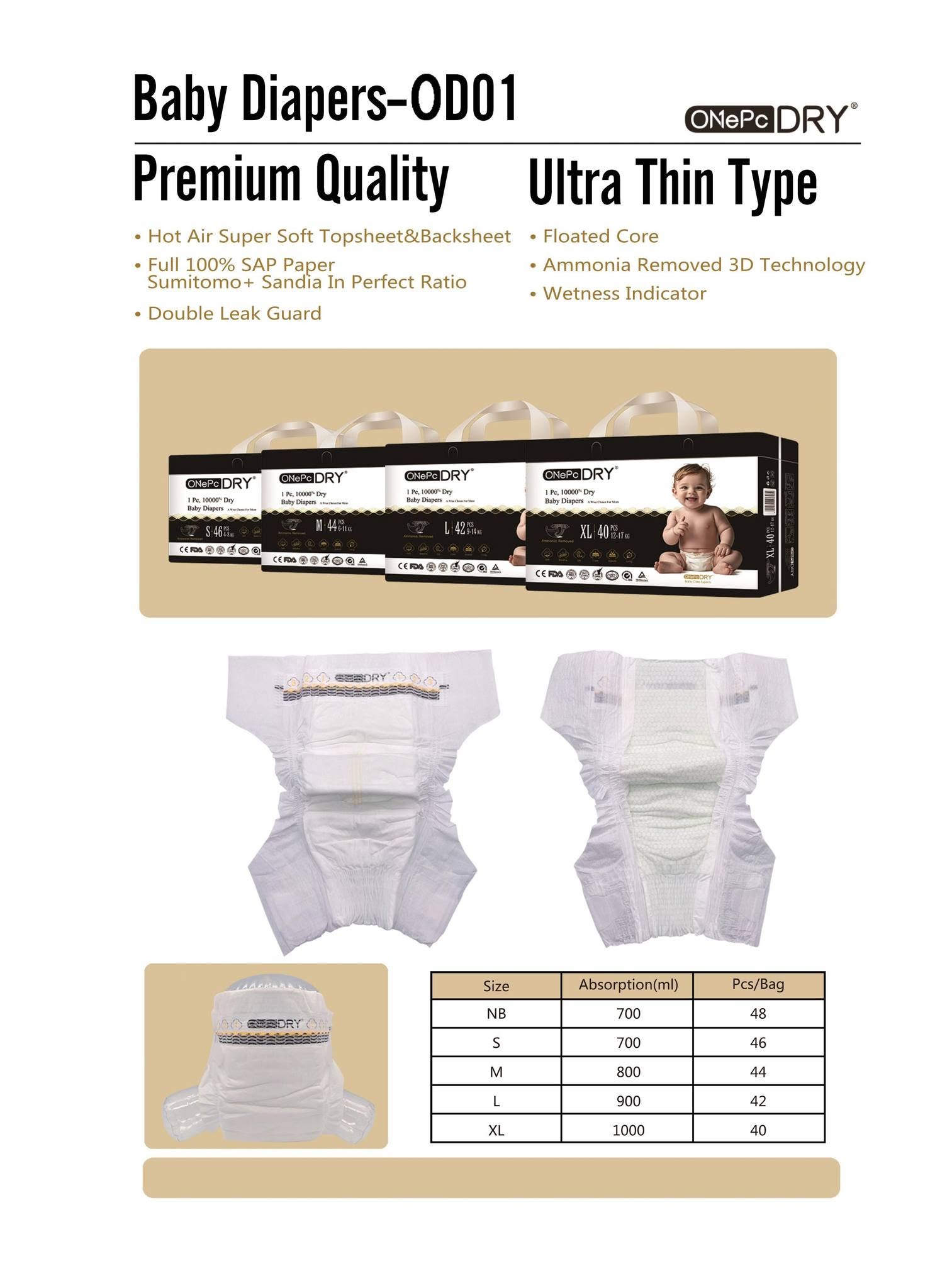
The model line-up and its documented channel applicability
The table below consolidates the published configuration of each baby diaper model in the range. Every row reflects documented size ranges, stated core and material choices, and stated design features; none of the entries are inferred.
| Model (brand) | Size range | Core and materials | Key design features | Channel emphasis |
|---|---|---|---|---|
| BD01 (my A+) | NB, S, M, L, XL | Fluff pulp; floated core with Japan Sumitomo 50% and Japan Sandia SAP paper sheet | Hot air super soft embossed top sheet, double leak guard, spandex elastic waistband, S shape magic tapes, clothlike breathable backsheet, wetness indicator, KeepDry liner | Newborn-inclusive retail and online listings; documented CE and CPC certification |
| BD02 (my A+) | NB, S, M, L, XL | Fluff pulp; floated core, 50% Japan Sumitomo SAP and 50% Japan Sandia SAP | Hot air super soft embossed top sheet, clothlike breathable backsheet, S shape magic tapes, spandex elastic waistband, double leak guard, wetness indicator | Newborn-inclusive listing SKU |
| BD03 (my A+) | S, M, L, XL | Fluff pulp; core with Japan Sumitomo 50% and Japan Sandia SAP paper sheet | Hot air super soft embossed top sheet, hot air super soft backsheet, spandex elastic waistband with S shape magic tapes, double leak guard, wetness indicator, KeepDry liner | Softness-led retail and online SKU |
| BD04 (my A+) | S, M, L | Fluff pulp; floated core with Japan Sumitomo 50% and Japan Sandia SAP paper sheet | Hot air super soft embossed top sheet, hot air super soft backsheet, spandex elastic waistband with S shape magic tapes, double leak guard, wetness indicator | Daily baby care assortment |
| BD05 (my A+) | S, M, L | Fluff pulp; Japan SAP and USA fluff pulp; threefolded | Leak guard, spandex-elastic-ring waistband, colorful clothlike breathable backsheet, S shape magic tapes, spunbond nonwoven top sheet, green ADL | Supermarket shelf differentiation |
| BD06 (my A+) | S, M, L, XL | Fluff pulp; Japan SAP and USA fluff pulp; threefolded | Leak guard, spandex-elastic-ring waistband, colorful clothlike breathable backsheet, S shape magic tapes, spunbond nonwoven top sheet, green ADL | Supermarket and retail ladder |
| BD07 (my A+) | S, M, L | Fluff pulp; USA fluff pulp core and Japan SAP; threefolded | Leak guard, spandex-elastic-ring waistband, colorful clothlike breathable backsheet, S shape magic tapes, spunbond nonwoven top sheet, green ADL | EU market; also applicable to supermarket and cross-border e-commerce |
| BD08 (my A+) | S, M, L, XL, XXL | Fluff pulp; Japan SAP and USA fluff pulp; threefolded | Leak guard, spandex-elastic-ring waistband, colorful clothlike breathable backsheet, S shape magic tapes, spunbond nonwoven top sheet, green ADL | Multi-channel width: widest BD-series size span |
| PD01 (my A+) | M, L, XL, XXL | Fluff pulp; full 100% SAP paper core | Crotch elastic design, leak guard, wetness indicator, soft hot air non-woven top sheet, super soft clothlike breathable spunbond back sheet, anti-rash oil lines | Absorbency-led listing for older infants |
| PD02 (my A+) | S, M, L, XL, XXL | Fluff pulp; full 100% SAP paper core (LG + Sumitomo) | Crotch elastic design, leak guard, wetness indicator, super soft hot air non-woven top and back sheets, dispose tapes | Premium absorbency SKU with dispose tapes |
| OD01 (ONePcDRY) | NB, S, M, L, XL | Fluff pulp; 100% SAP paper with Sumitomo and Sandia SAP in a stated perfect ratio | Ammonia Removed 3D Technology, hot air super soft top and back sheets, floated core, wetness indicator, double leak guard | Cross-border e-commerce entry; also supermarket and mother & baby retail |
| OD02 (ONePcDRY) | S, M, L, XL, XXL, XXXL | Fluff pulp; full 100% SAP paper, Sumitomo + Sandia | Ammonia Removed 3D Technology, hot air super soft top and back sheets, floated core, double leak guard, wetness indicator, designed super soft waistband | Extended-size online and retail listings |
| EB01 (EcoBingo) | S, M, L, XL, XXL, XXXL | Fluff pulp; USA fluff pulp and SAP | T-shape design, bamboo fiber topsheet and backsheet, double leak guard, wetness indicator, biodegradable kraft paper bag | Eco-positioned listing; documented US market focus |
| AL01 (Alotof) | S, M, L, XL, XXL, XXXL | Fluff pulp; SAP and USA fluff pulp | T-shape, hot air super soft embossed topsheet, double leak guard, crotch elastic design, wetness indicator and dispose tape, KeepDry liner | Wide size ladder for multi-market programmes |

Which specification actually switches channel fit
Size ladder is the first filter
Size coverage eliminates more models than any other variable. Only BD01, BD02 and OD01 include NB. BD03, BD04, BD05, BD06, BD07 and PD02 include S but stop at XL or below. BD08 reaches XXL; AL01, EB01 and OD02 reach XXXL; PD01 begins at M and therefore cannot serve a newborn assortment at all. A supermarket programme that must cover both newborn and toddler demand inside one supplier relationship needs to combine models rather than rely on one.
Core construction separates absorbency-led from balance-led positioning
Three distinct core approaches appear in the range. The floated-core approach with Japan Sumitomo 50% and Japan Sandia SAP paper sheet appears in BD01 through BD04. The full 100% SAP paper approach appears in PD01, PD02, OD01 and OD02, with PD02 specifying LG + Sumitomo SAP and the OD models specifying Sumitomo and Sandia in a stated perfect ratio. The third approach pairs Japan SAP with USA fluff pulp in BD05 through BD08. These are different absorbent architectures, and they support different claim structures: softness and comfort for the floated-core group, absorbency concentration for the 100% SAP paper group, and a cost-balanced mainstream configuration for the SAP-plus-fluff group.
Topsheet and backsheet define what a channel can show
Topsheet choice splits between hot air super soft embossed and spunbond nonwoven. The embossed hot air topsheet appears across BD01–BD04, OD01 and OD02 and supports tactile claims that perform well in review-driven online listings. The spunbond nonwoven top sheet, paired with a green ADL and a colorful clothlike breathable backsheet in BD05–BD08, supports visual differentiation that performs on a physical shelf. Backsheet configuration varies further still: clothlike breathable in BD01 and BD02, hot air super soft in BD03 and BD04, and hot air non-woven in PD02.
Closure, format and functional extras
Closure design differs meaningfully between the two channel clusters. BD01–BD04 and PD-series models use S shape magic tapes; BD05–BD08 use an S shape magic tape combined with a spandex-elastic-ring waistband. AL01 adds dispose tape, and PD02 includes dispose tapes. BD05 through BD08 are documented as threefolded, which affects how a pack presents and stacks. Functional extras are model-specific rather than uniform: Ammonia Removed 3D Technology appears only on OD01 and OD02; anti-rash oil lines appear on PD01; a KeepDry liner is documented on BD01, BD03 and AL01; and the wetness indicator is present across the great majority of the range.
Packaging, brand format and the unboxing question
Branding flexibility in this range is documented at portfolio level rather than as a service claim. Quanzhou ERA Sanitary Products Co., Ltd. owns multiple registered brands, and the same model architecture is presented under different brand identities: the BD-series and PD-series models sit under my A+, OD01 and OD02 under OnePcDry, AL01 under Alotof, and EB01 under EcoBingo. For a buyer planning channel separation, that structure is the practical starting point: a channel can be given a distinct brand presentation without the underlying model configuration changing.
Packaging evidence in the published record is narrower than brand evidence and should be treated accordingly. EB01 is explicitly documented as packaged in a biodegradable kraft paper bag, which aligns with its bamboo fiber topsheet and backsheet and its eco positioning. BD05, BD06, BD07 and BD08 are documented as threefolded, a format attribute that affects pack presentation and stacking behaviour. Beyond those two points, pack artwork, pack counts and any unboxing inserts are not specified in the product record.
A practical boundary: when unboxing experience is a stated channel requirement, the correct sequence is to confirm the packaging specification per model and per market before the assortment decision is locked. Packaging detail is documented for only part of this range, so it is a validation item rather than an assumed feature.
Market signals behind channel-specific model mapping
The commercial logic for splitting a line-up by channel is visible in published market data. The global baby diapers market was valued at approximately USD 83.3 billion in 2025 and is projected to reach USD 141.8 billion by 2033, according to Grand View Research. Fortune Business Insights reports that Asia Pacific held a 61.92% share of the diaper market in 2025, generating approximately USD 50.01 billion, which places the manufacturing base of this sector in the same region where the largest share of demand sits.
Supply concentration reinforces the point. Fujian Province, where the manufacturer in this analysis is based, accounted for 63.9% of China's total baby diaper exports in 2024, with export value reaching 8.74 billion yuan, according to Xiamen Customs data reported by Jiayue. At the same time, the top three global brands — Pampers, Huggies and Luvs — hold approximately 65% of the global baby diaper market share, per Future Market Insights, leaving the remainder to private-label and regional programmes where assortment differentiation is one of the few available levers.
Two segment trends sharpen that lever. The premium diaper segment is projected to grow at a CAGR of 7.2% through 2027, outpacing conventional products, per Intel Market Research — which favours models carrying a distinct absorbency or material story. And bamboo-based biodegradable diapers are projected to hold a 39% share of the biodegradable segment by 2026, per Future Market Insights, which is the segment EB01 addresses with bamboo fiber topsheet and backsheet and a biodegradable kraft paper bag.
Regulatory pressure completes the picture. Baby diapers in the EU must comply with REACH regulations, which restrict over 1,900 hazardous substances, and many products also follow OEKO-TEX Standard 100. Compliance is therefore a channel-entry condition rather than a marketing attribute, and it is one of the reasons model-level certification documentation matters in a channel plan.
Compared with single-SKU supply — and where this mapping stops
Supplying one generic diaper to every channel is operationally simple. It minimises SKU count, simplifies packaging, and reduces inventory planning to a single forecast. Its cost is coverage: a single mid-range SKU cannot simultaneously serve a supermarket programme that needs NB through XXXL, an online newborn listing that competes on absorbency specification, and an eco-positioned listing that competes on material composition. In a market where the top three brands already hold roughly 65% of global share, a single undifferentiated SKU gives a buyer very little to work with.
Channel-mapped supply trades that simplicity for fit. The line-up in Table 2 shows what the trade-off looks like in practice: the multi-channel model is BD08 with its S–XXL span, while OD01 serves as the cross-border e-commerce entry point through NB coverage, 100% SAP paper with a Sumitomo and Sandia ratio, and Ammonia Removed 3D Technology. The cost is real and should be stated plainly. Channel-specific model mapping increases SKU count, multiplies packaging variants that must be confirmed per model, raises inventory planning complexity because demand now varies by channel rather than in aggregate, and creates internal competition between models that overlap in size range.
There are also hard limits on what this analysis can establish. Certificate-to-model coverage is documented for some models but not all. Commercial terms such as minimum order quantity, lead time and price are not part of the published product record and are not assessed here. Certain features cannot be transferred between models: Ammonia Removed 3D Technology exists only on OD01 and OD02; bamboo fiber and the biodegradable kraft paper bag exist only on EB01; NB sizing exists only on BD01, BD02 and OD01.
| Evidence item | Status in the published product record | Practical implication |
|---|---|---|
| Company-level certification | CE, FDA, ISO9001, ISO13485, ISO11948, ISO14001, ISO45001, ISO22716, SGS, Halal, CPC, MSDS and DERMATEST are documented for the company | Confirms general market access capability, not SKU-level coverage |
| Model-level certification | Documented for selected models, including CE and CPC for BD01, and HALAL, REACH and ISO 14001 for OD01 | Confirm the certificate-to-model pairing for each SKU in the planned assortment |
| Certification identifiers | HALAL certificate 30113766206426, issued by Halal Foundation Center (Hong Kong); REACH certificate XMNCPCH25002810801, issued by SGS | Useful for documentation requests during listing or customs clearance |
| Packaging format | Biodegradable kraft paper bag documented for EB01; threefolded format documented for BD05–BD08 | Confirm pack specification per model and market before assortment lock |
| Commercial terms | Not part of the published product record | Source separately; do not infer from product configuration |
Future outlook
Three directions look likely to shape how diaper model ranges are mapped to channels over the next few years. First, channel-specific assortment is becoming the default rather than the exception: as premium products grow at a projected 7.2% CAGR through 2027, buyers gain more reason to split a line-up by price tier and channel instead of averaging across them. Second, material differentiation will keep expanding, with bamboo-based biodegradable diapers projected to take 39% of the biodegradable segment by 2026 — a signal that eco-positioned models such as EB01 will move from niche listing to standard option in some markets. Third, compliance will continue to function as a gate, and documentation depth will matter as much as product configuration when a listing is submitted to a marketplace or cleared through customs.
For buyers, the practical implication is that model selection and channel selection should be decided in the same conversation. Size ladder, core architecture, backsheet strategy and packaging format are the four variables that decide whether a model survives contact with a channel, and all four are documented before commercial terms are discussed.
FAQ
Which diaper sizes does the ERA baby diaper range cover?
The documented size ranges run from NB to XXXL, but no single model covers that entire span. BD01 and BD02 cover NB through XL, and OD01 covers NB through XL. BD03, BD06 and PD02 cover S through XL. BD05, BD07 and BD04 cover S or S through L or M. BD08 covers S through XXL. PD01 covers M through XXL. AL01, EB01 and OD02 extend to XXXL. A buyer matching a channel to a model should first confirm whether that model's documented size range covers the channel's core shopper.
Which models include newborn sizing for online newborn-focused listings?
Three models document NB coverage: BD01 (NB, S, M, L, XL), BD02 (NB, S, M, L, XL) and OD01 (NB, S, M, L, XL). OD01 is documented as intended for cross-border e-commerce, supermarket retail, mother & baby retail and the baby care industry, and it specifies 100% SAP paper with Sumitomo and Sandia SAP in a stated perfect ratio plus Ammonia Removed 3D Technology. BD01 and BD02 both use a floated core with Japan Sumitomo 50% and Japan Sandia SAP paper sheet.
What is the difference between a floated core with Sumitomo and Sandia SAP and a full 100% SAP paper core?
BD01, BD02, BD03 and BD04 use a floated core built on a Japan Sumitomo 50% and Japan Sandia SAP paper sheet. PD01 and PD02 use a full 100% SAP paper core, with PD02 specifying LG and Sumitomo SAP. OD01 and OD02 use 100% SAP paper with Sumitomo and Sandia SAP in a stated perfect ratio and add Ammonia Removed 3D Technology. The difference is therefore both in absorbent composition and, for the OD series specifically, in an additional odour-control technology that other models in the range do not document.
Which certifications are documented for the diaper products?
At company level, Quanzhou ERA Sanitary Products Co., Ltd. holds CE, FDA, ISO9001, ISO13485, ISO11948, ISO14001, ISO45001, ISO22716, SGS, Halal, CPC, MSDS and DERMATEST, along with more than 10 patents and over 100 copyrights. At model level, BD01 is documented to CE and CPC certification, and OD01 is documented to HALAL, REACH and ISO 14001. The HALAL certificate number is 30113766206426, issued by Halal Foundation Center (Hong Kong); the REACH certificate number is XMNCPCH25002810801, issued by SGS. For EU-bound channels, it is relevant that REACH restricts over 1,900 hazardous substances.
What packaging evidence is available for eco-positioned channels?
EB01, marketed under the EcoBingo brand, is the model with the most specific packaging documentation: a biodegradable kraft paper bag, together with a bamboo fiber topsheet and backsheet, a T-shape design, double leak guard, wetness indicator, and USA fluff pulp and SAP, in sizes S through XXXL with a documented US market focus. For the rest of the range, the only documented format attribute is the threefolded configuration recorded for BD05, BD06, BD07 and BD08. Pack artwork, pack counts and unboxing inserts are not specified in the published product record.
What are the limitations of channel-specific model mapping?
Four limits apply. First, SKU count rises and so does packaging variant complexity. Second, model overlap in size range can create internal competition between similar SKUs. Third, certificate-to-model coverage is documented for selected models rather than all of them, so each planned SKU needs its certification pairing confirmed. Fourth, certain features cannot be substituted between models: Ammonia Removed 3D Technology is documented only on OD01 and OD02, bamboo fiber and the biodegradable kraft paper bag only on EB01, and NB sizing only on BD01, BD02 and OD01. Commercial terms such as minimum order quantity, lead time and price are not part of the published product record and are not assessed in this analysis.
A downloadable 2026 product catalogue covering the range described above is available at Catalog ERA-2026.