
Baby Diaper Shortlist: OD01, PD02, EB01 and BD-Series Picks
Baby Diaper Shortlist: OD01, PD02, EB01 and BD-Series Picks
A model-by-model shortlist for importers, distributors and private-label owners deciding which baby diaper construction fits which buyer scenario.
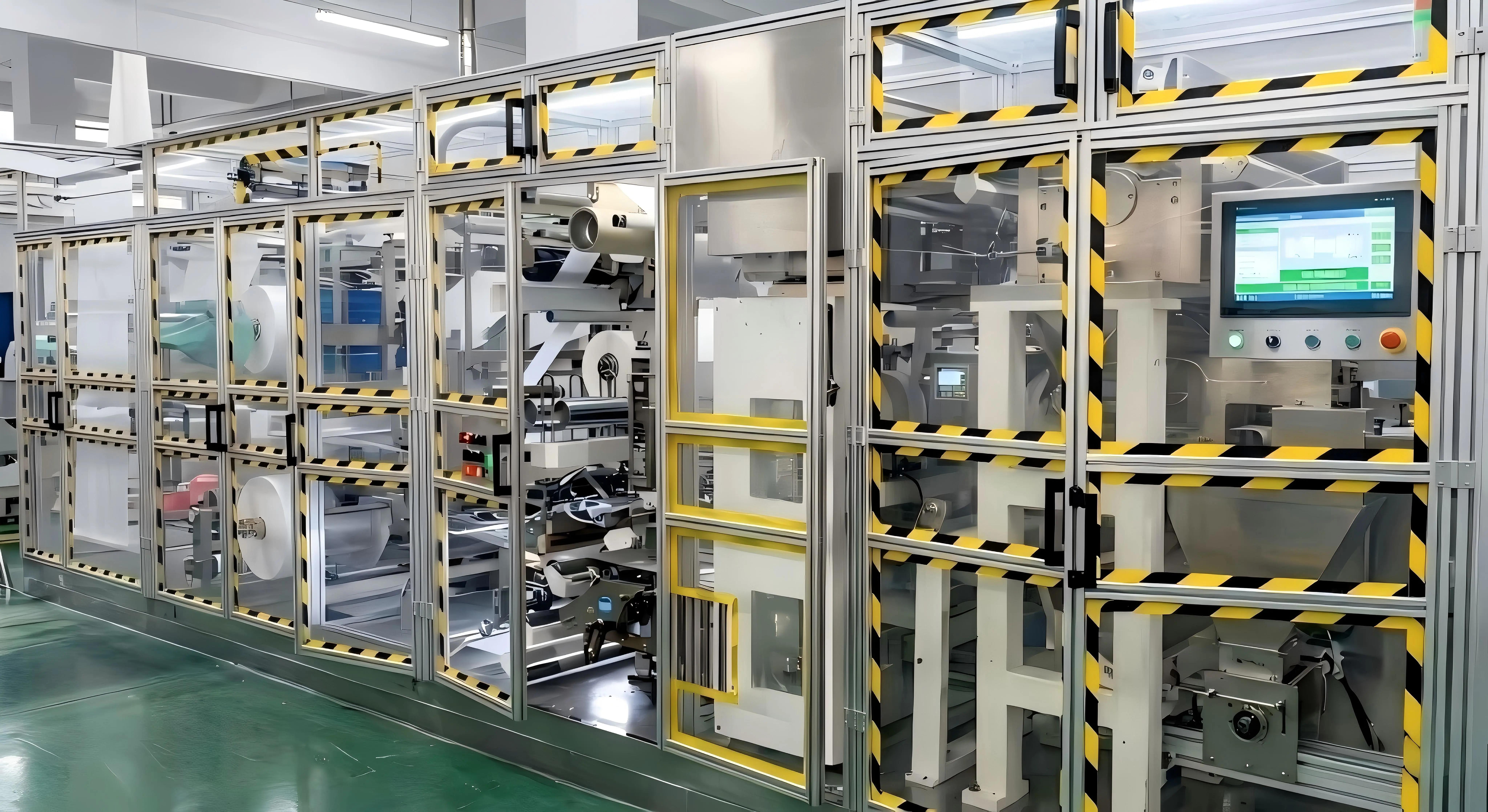
Disposable baby diaper production line at the Fujian manufacturing base.
Demand is growing — differentiation is not
The global baby diaper market was valued at approximately USD 83.3 billion in 2025 and is projected to reach USD 141.8 billion by 2033, according to Grand View Research. Asia Pacific accounted for a 61.92% share of that market in 2025, generating roughly USD 50.01 billion, based on Fortune Business Insights data. Supply is concentrated as well: Fujian Province accounted for 63.9% of China's total baby diaper exports in 2024, with export value reaching 8.74 billion yuan, according to customs figures cited by Jiayue.
Concentration at the supply end has a side effect. Buyers evaluating baby diapers find a large number of models that read alike in a catalogue: fluff pulp, SAP, a soft top sheet, a leak guard, a wetness indicator. The specifications look identical, but the purchasing decisions behind them do not. A distributor building a newborn-focused range for the Middle East, a private-label owner launching a US e-commerce line and a supermarket buyer refreshing an EU programme need different combinations of size coverage, core construction, free-from claims and compliance positioning.
This shortlist is drawn from the baby diaper range of QUANZHOU ERA SANITARY PRODUCTS CO.,LTD., a disposable hygiene manufacturer based in Jinjiang, Quanzhou, Fujian Province, established in 2016, operating a 100,000 m² facility with approximately 220 employees and an annual production capacity of 200,000,000 pieces. The company holds independent import and export rights, exports 100% of its output, and owns multiple registered brands including my A+, OnePcDry, Alotof, EcoBingo, my ERA and Binnions.
Six criteria that decide which model belongs on a shortlist
Before a model name becomes a purchase order, six specification points decide whether it fits the programme at all.
| Criterion | What to check in the specification | Why it changes the buying decision |
|---|---|---|
| Absorbent core type | 100% SAP paper core versus fluff pulp combined with SAP | Determines how concentrated the absorbent material is per unit of volume, which influences how thin the finished diaper can be made and how many units fit in a container |
| SAP supplier and ratio | Sumitomo, Sandia or LG SAP, and whether the ratio is stated | A stated supplier mix is how absorption behaviour stays consistent from batch to batch on repeat retail orders |
| Top sheet and back sheet | Hot air super soft, spunbond nonwoven, clothlike breathable, bamboo fiber | Surface feel and breathability are the two attributes consumers notice first on re-purchase |
| Containment system | Double leak guard, crotch elastic design, spandex elastic waistband, S shape magic tapes | Leak complaints drive returns, and containment is delivered by several layers together rather than by any single one |
| Size coverage | NB to XXXL, model by model | Determines whether one model family can cover a full age ladder or whether the range must be assembled from several models |
| Formulation and market positioning | Hypoallergenic, free of parabens, elemental chlorine and latex; EU or US intent | Free-from wording and target-market alignment are listing conditions in several retail channels, not optional extras |
| Supply parameters | MOQ, lead time, payment terms, acceptance criteria | These set inventory planning and cash flow before any product attribute matters |
The shortlist, model by model
OD01 and OD02 — 100% SAP paper core for mainstream retail and e-commerce
OD01 is a baby diaper intended for the baby care industry, including mother & baby retail, supermarket and cross-border e-commerce channels. It is made of fluff pulp and uses a 100% SAP paper core with Sumitomo and Sandia SAP in a defined ratio. The construction includes a hot air super soft top sheet and back sheet, a floated core, a double leak guard and a wetness indicator. Available sizes are NB, S, M, L and XL.
OD02 is designed for the baby care and mother & baby retail sectors. Its floated core uses 100% SAP paper containing Sumitomo and Sandia SAP, and the model adds ammonia removed 3D technology. It also carries a hot air super soft top sheet and back sheet, a double leak guard and a wetness indicator, and is available in S, M, L, XL, XXL and XXXL.
Read together, the two models apply one core philosophy across a wide age range: OD01 supplies the newborn and infant entry sizes, while OD02 extends coverage into toddler sizes up to XXXL. For a buyer who wants a single absorbency story across a shelf, that combination is more useful than two unrelated SKUs.
PD01 and PD02 — full 100% SAP paper core with wider mid-range sizing
PD01 is built on a full 100% SAP paper core in a fluff pulp construction, with a soft hot air non-woven top sheet and a super soft clothlike breathable spunbond back sheet. It includes a leak guard, a crotch elastic design and a wetness indicator, and is available in M, L, XL and XXL. Its stated channels are baby care, mother & baby retail, supermarket and cross-border e-commerce.
PD02 uses a full 100% SAP paper core composed of LG and Sumitomo SAP. It carries a leak guard, a crotch elastic design, a wetness indicator, and a super soft hot air non-woven top sheet and back sheet. It is hypoallergenic and free of parabens, elemental chlorine and latex, and is described as suitable for global distribution in S, M, L, XL and XXL.
The distinction is commercially relevant. PD01 begins at size M, so it cannot anchor a newborn programme on its own; PD02 covers S to XXL and brings the free-from positioning that several retail listings request.
EB01 — US-market positioning with a bamboo fiber construction
EB01 is a baby diaper intended for the US market. It is made of fluff pulp and incorporates USA fluff pulp and SAP, and it is hypoallergenic and free of parabens, elemental chlorine and latex. Its construction uses a T-shape design, a bamboo fiber top sheet and back sheet, a double leak guard and a wetness indicator, with biodegradable kraft paper bag packaging; the product is described as eco-friendly. Available sizes run from S to XXXL.
This is the model in the range that pairs the widest size span with an explicit environmental positioning. For a US-facing private label, the combination of a bamboo fiber surface and a free-from formulation is a listing argument, not only a product specification.
BD01, BD03, BD04 and BD07 — the BD-series, matched to region and channel
- BD01 is made of fluff pulp with a floated core containing Japan Sumitomo 50% and a Japan Sandia SAP paper sheet. It features a hot air super soft embossed top sheet, a clothlike breathable backsheet, S shape magic tapes, a spandex elastic waistband, a double leak guard and a wetness indicator. Sizes: NB, S, M, L, XL. It is sold in Europe, Russia, South Africa, Africa, the Middle East, Central Asia, Australia and the United States.
- BD03 shares the Japan Sumitomo 50% and Japan Sandia SAP paper sheet core but adds a hot air super soft backsheet and a KeepDry liner. It carries a spandex elastic waistband with S shape magic tapes, a double leak guard and a wetness indicator, and is available in S, M, L and XL for baby care, mother & baby retail, supermarket and cross-border e-commerce.
- BD04 is positioned for daily baby care. Its floated core uses Japan Sumitomo 50% and a Japan Sandia SAP paper sheet, with a hot air super soft embossed top sheet, a hot air super soft backsheet, S shape magic tapes, a spandex elastic waistband, a double leak guard and a wetness indicator. It is hypoallergenic and free of parabens, elemental chlorine and latex, and is available in Small, Medium and Large.
- BD07 is a baby diaper for the EU market, also applicable to supermarket and cross-border e-commerce. It uses USA fluff pulp for the absorbent core and Japan SAP, with a leak guard, a spandex-elastic-ring waistband, a colorful clothlike breathable backsheet, S shape magic tapes, a spunbond nonwoven top sheet and a green ADL. It is hypoallergenic and free of parabens, elemental chlorine and latex, and is available in S, M and L.
For a distributor running one regional programme, the BD-series behaves less like a product family and more like a channel map: BD01 for the broad export footprint it already serves, BD03 where a KeepDry liner belongs in the shelf message, BD04 for daily-care basics with free-from claims, and BD07 for EU-facing listings.
AL01 — Alotof-brand coverage from S to XXXL
AL01 is a baby diaper under the Alotof brand. It is made of fluff pulp and uses SAP and USA fluff pulp, with a hot air super soft embossed topsheet, a double leak guard, a wetness indicator and dispose tape, a crotch elastic design and a KeepDry liner. It is hypoallergenic and free of parabens, elemental chlorine and latex. Sizes run from S to XXXL, and its intended channels are baby care, mother & baby retail, supermarket and cross-border e-commerce.
As a shortlist entry, AL01 has one clear job: it covers the full retail ladder from small to XXXL in a single model, which reduces the number of SKUs a distributor has to forecast and warehouse.
Quick-reference shortlist
| Model | Core construction | Sizes | Notable construction features | Best-fit buyer scenario |
|---|---|---|---|---|
| OD01 | 100% SAP paper core, Sumitomo + Sandia SAP in a defined ratio, floated core | NB–XL | Hot air super soft top and back sheet, double leak guard, wetness indicator | Newborn-to-infant retail and e-commerce ranges |
| OD02 | 100% SAP paper core, Sumitomo + Sandia SAP, floated core | S–XXXL | Ammonia removed 3D technology, hot air super soft top and back sheet, double leak guard | Toddler extension and long-duration wear |
| PD01 | Full 100% SAP paper core, fluff pulp | M–XXL | Hot air non-woven top sheet, clothlike breathable spunbond back sheet, crotch elastic design | Mid-size retail programmes |
| PD02 | Full 100% SAP paper core, LG + Sumitomo SAP | S–XXL | Free-from formulation, crotch elastic design, hot air non-woven top and back sheet | Global distribution with free-from listing requirements |
| EB01 | Fluff pulp with USA fluff pulp and SAP | S–XXXL | T-shape design, bamboo fiber top and back sheet, kraft paper bag packaging | US-facing and eco-positioned programmes |
| BD01 | Floated core, Japan Sumitomo 50% + Japan Sandia SAP paper sheet | NB–XL | Clothlike breathable backsheet, S shape magic tapes, spandex elastic waistband | Broad export markets across Europe, Africa, the Middle East and the US |
| BD03 | Japan Sumitomo 50% + Japan Sandia SAP paper sheet | S–XL | KeepDry liner, hot air super soft backsheet, S shape magic tapes | Supermarket and mother & baby retail shelf with a dryness message |
| BD04 | Floated core, Japan Sumitomo 50% + Japan Sandia SAP paper sheet | Small–Large | Free-from formulation, hot air super soft embossed top sheet, spandex elastic waistband | Daily baby care basics |
| BD07 | USA fluff pulp core with Japan SAP | S–L | Green ADL, spunbond nonwoven top sheet, colorful clothlike breathable backsheet | EU market and cross-border e-commerce |
| AL01 | Fluff pulp with SAP and USA fluff pulp | S–XXXL | KeepDry liner, dispose tape, crotch elastic design, embossed hot air topsheet | Full-ladder retail range with the fewest SKUs |
Technical explanation: what actually separates these models
Three construction decisions separate the models above, and each carries a commercial consequence.
Core type. A 100% SAP paper core holds the superabsorbent polymer in a paper sheet rather than distributing it through a fluff pulp matrix. OD01, OD02, PD01 and PD02 use this construction, while BD01, BD03, BD04, BD07, AL01 and EB01 combine fluff pulp with SAP. The functional difference is how concentrated the absorbent material is per unit of volume, which influences how thin a finished diaper can be made and therefore how many units fit into a shipping container.
SAP supplier and ratio. The OD models use Sumitomo and Sandia SAP in a defined ratio; BD01, BD03 and BD04 use a floated core with Japan Sumitomo 50% and a Japan Sandia SAP paper sheet; PD02 uses LG and Sumitomo SAP. Naming the supplier mix is how a buyer keeps absorption behaviour consistent across batches, which matters more for repeat retail orders than for one-off shipments.
Surface and containment layers. Hot air super soft embossed or non-woven top sheets appear across the range; back sheets vary between clothlike breathable, spunbond breathable and hot air super soft. Containment is handled by three separate mechanisms — a double leak guard, a crotch elastic design and a spandex elastic waistband — with S shape magic tapes as the closure. A wetness indicator appears on every model listed here; it is a caregiver signal rather than an absorbency feature and should not be traded off against core specification.
Two model-specific technologies are worth noting separately. OD02 carries ammonia removed 3D technology, and BD03 carries a KeepDry liner; both are additions on top of the base core rather than substitutes for it.
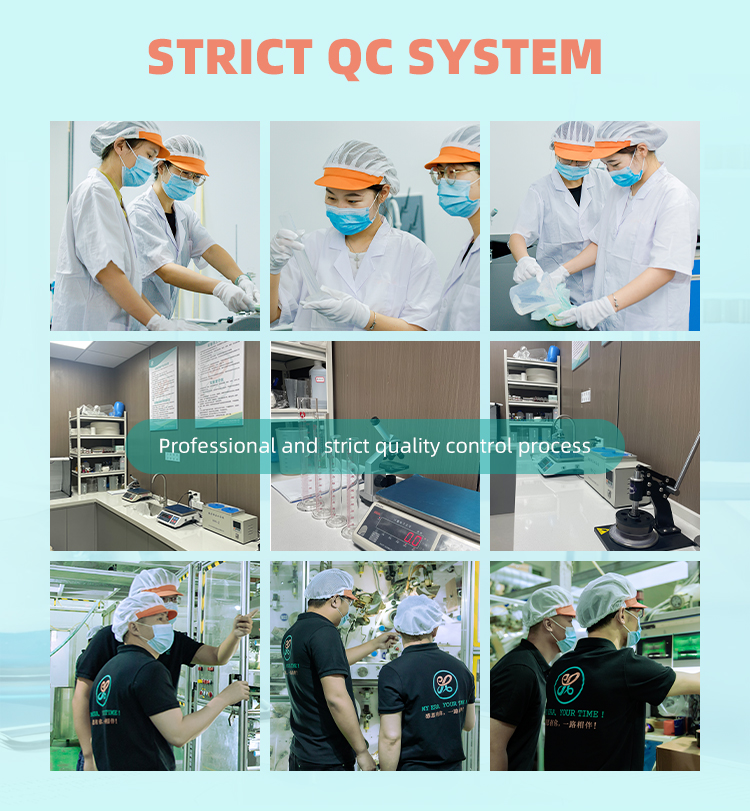
Batch inspection under a unified quality-control standard — the point where model selection becomes a repeat-order decision.
Application scenarios: which model fits which programme
- Newborn and infant-led ranges: BD01 (NB–XL) and OD01 (NB–XL) are the two models in this range that start at the newborn size. PD02 and BD03 begin at S, PD01 at M, and BD04, BD07, EB01 and AL01 at Small.
- Overnight and long-duration wear: the full 100% SAP paper core models — OD02 (S–XXXL), PD02 (S–XXL), and OD01 and PD01 within their size bands — plus AL01, which adds a KeepDry liner.
- Toddler and larger sizes: OD02, EB01 and AL01 reach XXXL, the widest point of the range.
- Travel and childcare-centre programmes: the supplier's specification set includes a construction intended for travel and childcare-centre scenarios, suitable for home daily and overnight care, and designed for all climate conditions at normal ambient temperature.
- Supermarket and mother & baby retail: OD01, PD01, BD03 and AL01 list these channels explicitly.
- Cross-border e-commerce: OD01, PD01, PD02, BD03, BD07 and AL01 list this channel.
- US-facing programmes: EB01, with BD01 also among the models sold into the United States.
- EU-facing programmes: BD07, positioned for the EU market.
One structural point applies to all of them. This shortlist covers tape-type baby diapers. Pull-up pant diapers are a separate product category within the same manufacturer's portfolio, so a programme that needs both tape and pant formats is sourcing from two lines rather than one.
Market trends that should shape the model mix
Three signals are worth building into a model plan.
The premium diaper segment is projected to grow at a CAGR of 7.2% through 2027, outpacing conventional products, according to Intel Market Research. That trend favours thinner cores and higher-specification surfaces — the direction the OD and PD models already take.
Bamboo-based biodegradable diapers are projected to hold a 39% share of the biodegradable segment by 2026, based on Future Market Insights data. A bamboo fiber top sheet and back sheet positioning, as used in EB01, sits inside that trend rather than beside it.
Concentration at brand level leaves room for private label. The top three brands — Pampers, Huggies and Luvs — held approximately 65% of the global baby diaper market share in 2025, according to Future Market Insights, which leaves a substantial minority share contested by private labels, regional brands and distributor programmes. Compliance adds a further filter: baby diapers in the EU must comply with REACH regulations restricting over 1,900 hazardous substances, and many products also follow OEKO-TEX Standard 100. A model with an explicit free-from formulation and a named target market is easier to place in that environment than a generic specification.
How these models compare with conventional fluff-pulp-dominant construction
Most conventional diapers rely on a fluff-pulp-dominant core with SAP added for absorption. The models above take two routes: several keep the fluff pulp base and add SAP (AL01, EB01, BD07), while OD01, OD02, PD01 and PD02 move to a 100% SAP paper core. The newer core is not automatically the correct choice for every buyer. A concentrated SAP paper core supports a thinner product and better container utilisation, but it also narrows the supplier set that can be qualified and typically raises the raw-material cost base. A fluff-pulp-base model can still win where price sensitivity dominates or where pack compression is not a logistics priority.
The boundaries are specific. Full SAP paper core models in this range do not span the entire size ladder: PD01 starts at M and PD02 at S, and OD01 stops at XL. A buyer who needs NB through XXXL from a single core specification has to combine models. Bamboo fiber surfaces are limited to EB01. And the eco-positioned packaging in the range — kraft paper bags — is likewise model-specific rather than portfolio-wide.
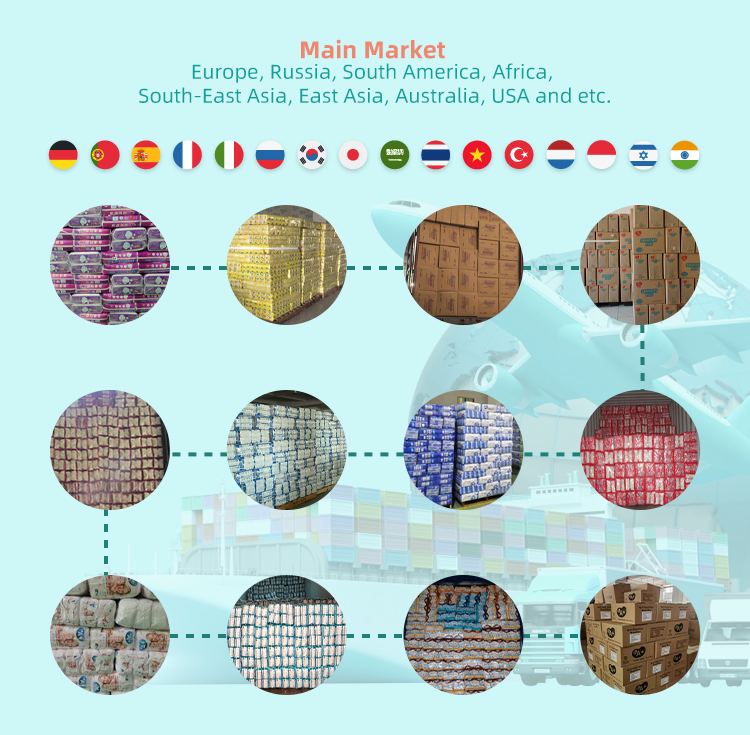
Freight economics are part of model selection: thinner cores change units per container.
Boundaries and limitations to plan around
An honest shortlist states its constraints.
Minimum order and lead time. The published purchasing terms state an MOQ of 100,000 pieces, delivery terms of FOB, CIF or DDP, acceptance criteria based on pre-shipment test, and payment terms of 30/70. Typical production lead time is 25–35 days against a monthly production capacity of 20,000,000 pieces. For a first trial below the MOQ, the MOQ rather than the product specification becomes the deciding constraint.
MOQ flexibility versus stated terms. The manufacturer's comparison documentation describes flexible MOQ for small and medium clients, while the purchasing terms state 100,000 pieces. Buyers should confirm the applicable threshold for their specific model, size and packaging configuration rather than assuming either figure applies universally.
Size coverage per model. No single model in this range covers NB through XXXL. Newborn entry comes from BD01 or OD01; XXXL comes from OD02, EB01 or AL01. Portfolio planning, not single-model selection, resolves that gap.
Formulation claims have a defined scope. Hypoallergenic and free-from positioning — no parabens, no elemental chlorine, no latex — reduces exposure to common irritant sources. It is not a clinical treatment, and it does not guarantee that every infant will tolerate every product. Retail copy should reflect that limit.
Category scope. Tape-type diapers only. Pull-up pant diapers are a separate product category in the same manufacturer's portfolio and are not covered by this shortlist.
Future outlook
Two forces are likely to decide which of these models gains share over the next buying cycles. The first is core concentration: as the premium segment continues to outpace conventional products, thinner 100% SAP paper core models such as OD01, OD02, PD01 and PD02 become easier to justify on shelf space and freight, while fluff-pulp-base models remain the volume tier. The second is compliance-driven formulation: REACH and similar frameworks push free-from wording from a marketing claim toward a listing requirement.
Capacity is not the constraint. The manufacturer operates a 100,000 m² facility with approximately 220 employees, an annual production capacity of 200,000,000 pieces and an R&D team described as 15 engineers, supported by more than 10 patents and over 100 copyrights, and holds CE, FDA, ISO9001, ISO13485, ISO11948, ISO14001, ISO45001, ISO22716, SGS, Halal, CPC, MSDS and DERMATEST certifications. The practical planning question for distributors is therefore not whether supply exists, but which model combination covers the size ladder and the compliance profile of the markets they serve.
Frequently asked questions
Which models in this range cover newborn sizes?
Two models start at the newborn size: BD01 (NB, S, M, L, XL) and OD01 (NB, S, M, L, XL). PD02 and BD03 begin at S, PD01 at M, and BD04 in Small, BD07 in S, EB01 in S and AL01 in S. Newborn coverage therefore depends specifically on BD01 or OD01; the remaining models in this shortlist begin at small sizes.
Which model fits overnight and long-duration wear best?
Models built on a full 100% SAP paper core are OD02 (S–XXXL), PD02 (S–XXL), and OD01 and PD01 within their size bands. AL01 adds a KeepDry liner. Every model in this range carries a wetness indicator and a double leak guard, and containment comes from a combination of leak guard, crotch elastic design and spandex elastic waistband rather than from any single layer.
Which models are positioned for the US and EU markets?
EB01 is intended for the US market and uses USA fluff pulp and SAP with a bamboo fiber top sheet and back sheet. BD07 is intended for the EU market and uses USA fluff pulp for the absorbent core and Japan SAP. BD01 is also sold in the United States and Europe, alongside Russia, South Africa, Africa, the Middle East, Central Asia and Australia.
What should a buyer verify before placing a repeat order?
Four items: batch-level inspection standard, raw material ratio consistency, acceptance criteria and certification validity. The manufacturer reports a unified inspection standard for each batch and 100% testing, and holds CE, FDA, ISO9001, ISO13485, ISO11948, ISO14001, ISO45001, ISO22716, SGS, Halal, CPC, MSDS and DERMATEST certifications. Acceptance criteria are based on pre-shipment test, and a remote video quality check is available as part of the service.
How do MOQ, lead time and payment terms affect small and medium buyers?
The published terms state an MOQ of 100,000 pieces, payment terms of 30/70, delivery terms of FOB, CIF or DDP, and a typical lead time of 25–35 days against a monthly capacity of 20,000,000 pieces. The manufacturer's comparison documentation also describes flexible MOQ for small and medium clients. Buyers should confirm which threshold applies to their model, size and packaging before committing to a launch date.
What does the OEM/ODM service cover?
OEM/ODM production, material customization and logo customization, together with packaging design, pre-shipment inspection and a remote video quality check. Monthly production capacity is 20,000,000 pieces, typical lead time is 25–35 days, MOQ is 100,000 pieces, quality control follows 100% test, and after-sales support is provided remotely.
How should a distributor structure long-term supply across these models?
Around size coverage and core specification rather than around individual SKUs. Annual capacity is 200,000,000 pieces and monthly capacity 20,000,000 pieces with a 25–35 day lead time; the company operates a 100,000 m² facility with approximately 220 employees and an R&D team of 15 engineers. A portfolio that pairs a newborn-capable model such as BD01 or OD01 with an XXXL-capable model such as OD02, EB01 or AL01 covers the full size ladder while keeping the number of core specifications manageable.
Reference material: the manufacturer's 2026 product catalogue is available as a downloadable PDF — Catalog ERA-2026.pdf. Company profile: www.fjera.com.