
Baby Diaper Technical FAQ: SAP Paper, Fluff Pulp & Cores
Baby Diaper Technical FAQ: SAP Paper, Fluff Pulp & Cores
Baby diaper specification sheets compress dozens of engineering decisions into a few short labels: “floated core”, “full 100% SAP paper”, “Sumitomo + Sandia”, “threefolded”. Those labels decide product positioning, cost structure, size-range coverage and the compliance file that travels with a shipment. This industry reference answers the technical and procurement questions that come up most often when importers, distributors and private-label brand owners compare disposable baby diapers, using the specification data published for models OD01, OD02, PD01, PD02, BD01–BD08, EB01 and AL01.
The models sit in the portfolio of QUANZHOU ERA SANITARY PRODUCTS CO.,LTD. (ERA), a disposable hygiene manufacturer founded in 2016 and based in Jinjiang, Quanzhou, Fujian Province, China. ERA operates a 100,000 m² facility with approximately 220 employees and an annual output of 200,000,000 pieces. Export accounts for 100% of its sales, with markets in Europe, the USA, Southeast Asia, Central Asia, South America, Africa and the Middle East.
Why core construction is the first specification decision
Two diapers on the same shelf can look identical and still differ in the only place that matters to the end user: the absorbent core. That is why core terminology leads most trade enquiries. Buyers use core labels as shortcuts for thinness, absorbency positioning and price band, and they use the named SAP source as a signal of raw-material continuity. The difficulty is that the labels are supplier-defined and not standardised across the industry, so the same words can describe different structures in two factories.
The practical answer for a procurement team is to stop comparing adjectives and start comparing model-level entries: core architecture, SAP source, pulp source, size ladder, topsheet and backsheet type, and the certification scope attached to each SKU. The sections below do that for the ERA baby diaper range.
SAP paper and fluff pulp: what each material contributes
Superabsorbent polymer (SAP) is the component that retains liquid inside the core; fluff pulp is the wood-fibre component that gives the core its structure and helps move liquid away from the point of wetting. In general terms, a higher SAP share supports a thinner core profile, while pulp contributes softness and wicking. Those are widely accepted relationships rather than product-specific claims, and they explain why the SAP-versus-pulp balance is the field a buyer should lock down first.
In the ERA specification set, core descriptions follow three verified patterns:
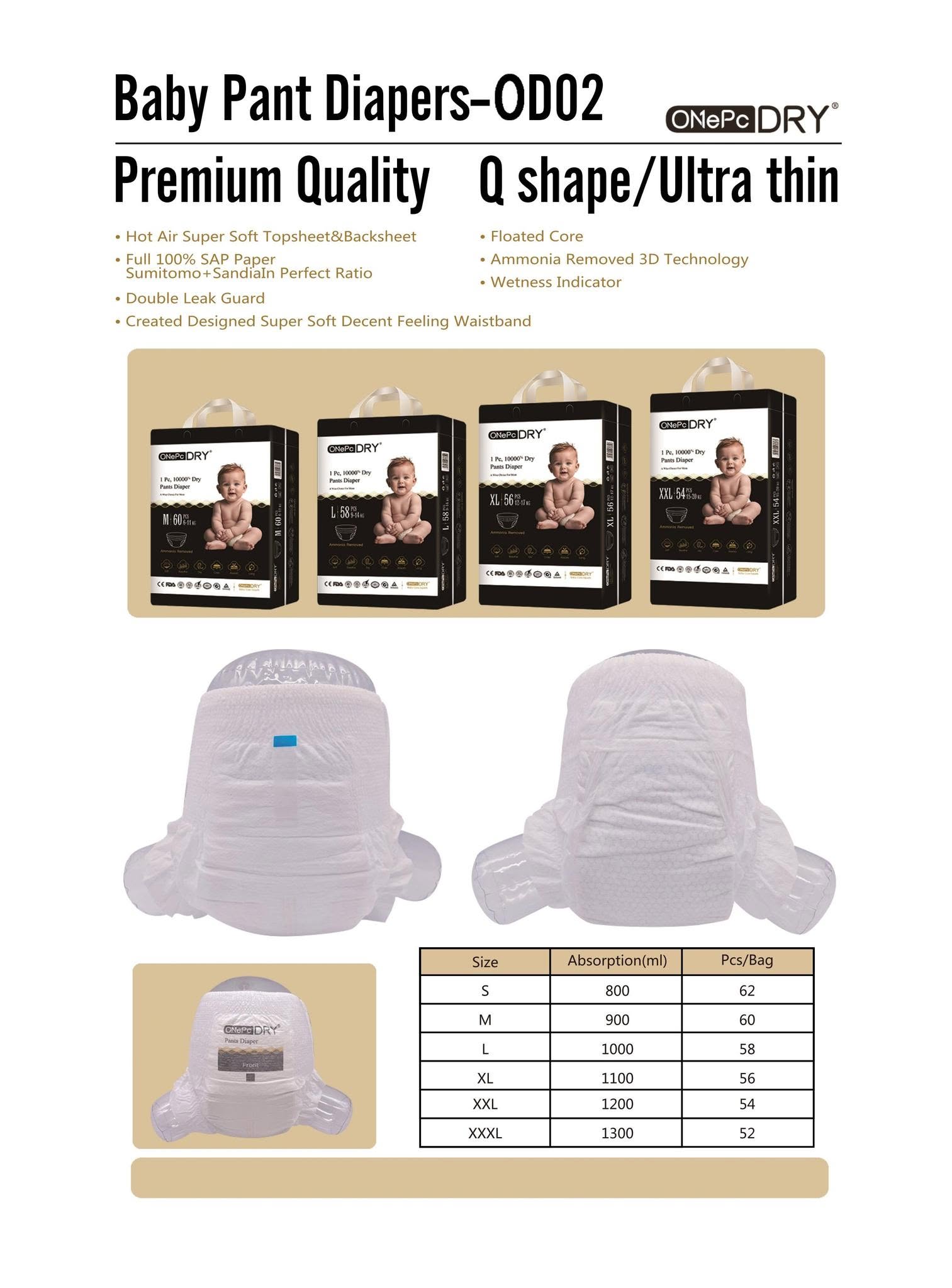
- Floated core with full 100% SAP paper — OD01, OD02, PD01 and PD02.
- Floated core with a Sumitomo + Sandia SAP paper sheet — BD01, BD02, BD03 and BD04.
- Threefolded core using Japan SAP and USA fluff pulp — BD05, BD06, BD07 and BD08.
Two further entries complete the range: EB01 uses USA fluff pulp with SAP and a bamboo fibre top sheet and back sheet, while AL01 uses SAP paper with USA fluff pulp.
Floated cores and full 100% SAP paper cores in this portfolio
It is worth being precise here, because the topic generates more confusion than any other field on a diaper spec sheet. In the published ERA data, “Floated Core” appears on OD01, OD02, PD01, PD02 and BD01–BD04. The OD and PD lines additionally state “Full 100% SAP Paper”, whereas BD01–BD04 state a “Japan Sumitomo 50% + Japan Sandia SAP Paper Sheet”. The BD05–BD08 group moves to a different architecture altogether: a threefolded core built on Japan SAP with USA fluff pulp.
The consequence for buyers is straightforward. The word “floated” alone does not tell you the absorbent composition; the SAP paper definition does. A purchase specification that says only “floated core” can be satisfied by more than one structure, so the core definition should be written per SKU, not per family.
SAP blends: Sumitomo, Sandia and LG
Four SAP references appear across the range. BD01–BD04 are specified as Japan Sumitomo 50% plus Japan Sandia in a single SAP paper sheet. OD01 and OD02 list a Sumitomo + Sandia combination on a full 100% SAP paper core. PD01 and PD02 list full 100% SAP paper using LG + Sumitomo. The BD05–BD08 group uses Japan SAP with USA fluff pulp.
Buyers track SAP origin for a practical reason: SAP is a globally traded input whose availability and price move independently of the converting step, so a named blend lets a purchasing team request a second approval sample or an alternative blend when cost or supply shifts. Recording the approved SAP source per SKU also avoids silent substitution between production runs.
| Model | Absorbent core as listed | SAP / pulp source as listed | Sizes |
|---|---|---|---|
| OD01 | Floated core; full 100% SAP paper | Sumitomo + Sandia | NB, S, M, L, XL |
| OD02 | Floated core; full 100% SAP paper | Sumitomo + Sandia | S, M, L, XL, XXL, XXXL |
| PD01 | Floated core; full 100% SAP paper | LG + Sumitomo | M, L, XL, XXL |
| PD02 | Floated core; full 100% SAP paper | LG + Sumitomo | S, M, L, XL, XXL |
| BD01 | Floated core; SAP paper sheet | Japan Sumitomo 50% + Japan Sandia | NB, S, M, L, XL |
| BD02 | Floated core; 50% Sumitomo + 50% Sandia SAP | Japan Sumitomo + Japan Sandia | NB, S, M, L, XL |
| BD03 | Floated core; SAP paper sheet | Japan Sumitomo 50% + Japan Sandia | S, M, L, XL |
| BD04 | Floated core; SAP paper sheet | Japan Sumitomo 50% + Japan Sandia | S, M, L |
| BD05 | Threefolded core | Japan SAP + USA fluff pulp | S, M, L |
| BD06 | Threefolded core | Japan SAP + USA fluff pulp | S, M, L, XL |
| BD07 | Threefolded core | Japan SAP + USA fluff pulp | S, M, L |
| BD08 | Threefolded core | Japan SAP + USA fluff pulp | S, M, L, XL, XXL |
| EB01 | Pulp + SAP core | USA fluff pulp + SAP | S, M, L, XL, XXL, XXXL |
| AL01 | SAP paper core | SAP paper + USA fluff pulp | S, M, L, XL, XXL, XXXL |
Topsheet, backsheet, leak guard and waistband: the layer around the core
Core architecture is only half of a specification comparison. The components that touch the skin and control containment change between lines even when the core definition is similar, and they are usually the visible difference a retail buyer notices first.
Across the range, three topsheet types are listed: a hot air super soft embossed top sheet (BD01–BD04, AL01), a spunbond nonwoven top sheet (BD05–BD08), a soft hot air non-woven top sheet (PD01, PD02), and a bamboo fibre top sheet on EB01. Backsheets split between clothlike breathable constructions and hot air super soft constructions, with BD05–BD08 specifying a colourful clothlike breathable backsheet. Fastening and fit follow the same pattern: spandex elastic waistband with S shape magic tapes on BD01–BD04, spandex-elastic-ring waistband on BD05–BD08, and crotch elastic design on PD01, PD02 and AL01.
| Line / models | Top sheet | Back sheet | Waistband & fastening | Leak control & extras |
|---|---|---|---|---|
| OD01, OD02 | Hot air super soft top sheet | Hot air super soft back sheet | OD02 lists a designed soft waistband | Double leak guard; wetness indicator; ammonia-removed 3D technology (listed feature) |
| PD01, PD02 | Soft hot air non-woven top sheet | PD01: super soft clothlike breathable spunbond; PD02: super soft hot air non-woven | Crotch elastic design | Leak guard; wetness indicator; PD01 anti-rash oil lines; PD02 dispose tapes |
| BD01–BD04 | Hot air super soft embossed top sheet | BD01/BD02: clothlike breathable; BD03/BD04: hot air super soft | Spandex elastic waistband; S shape magic tapes | Double leak guard; wetness indicator; BD03 lists a KeepDry liner |
| BD05–BD08 | Spunbond nonwoven top sheet | Colourful clothlike breathable back sheet | Spandex-elastic-ring waistband; S shape magic tapes | Leak guard; green ADL |
| EB01 | Bamboo fibre top sheet | Bamboo fibre back sheet | T-shape construction | Double leak guard; wetness indicator; biodegradable kraft paper bag |
| AL01 | Hot air super soft embossed top sheet | Hot air super soft back sheet | T-shape construction; crotch elastic design | Double leak guard; wetness indicator; dispose tape |
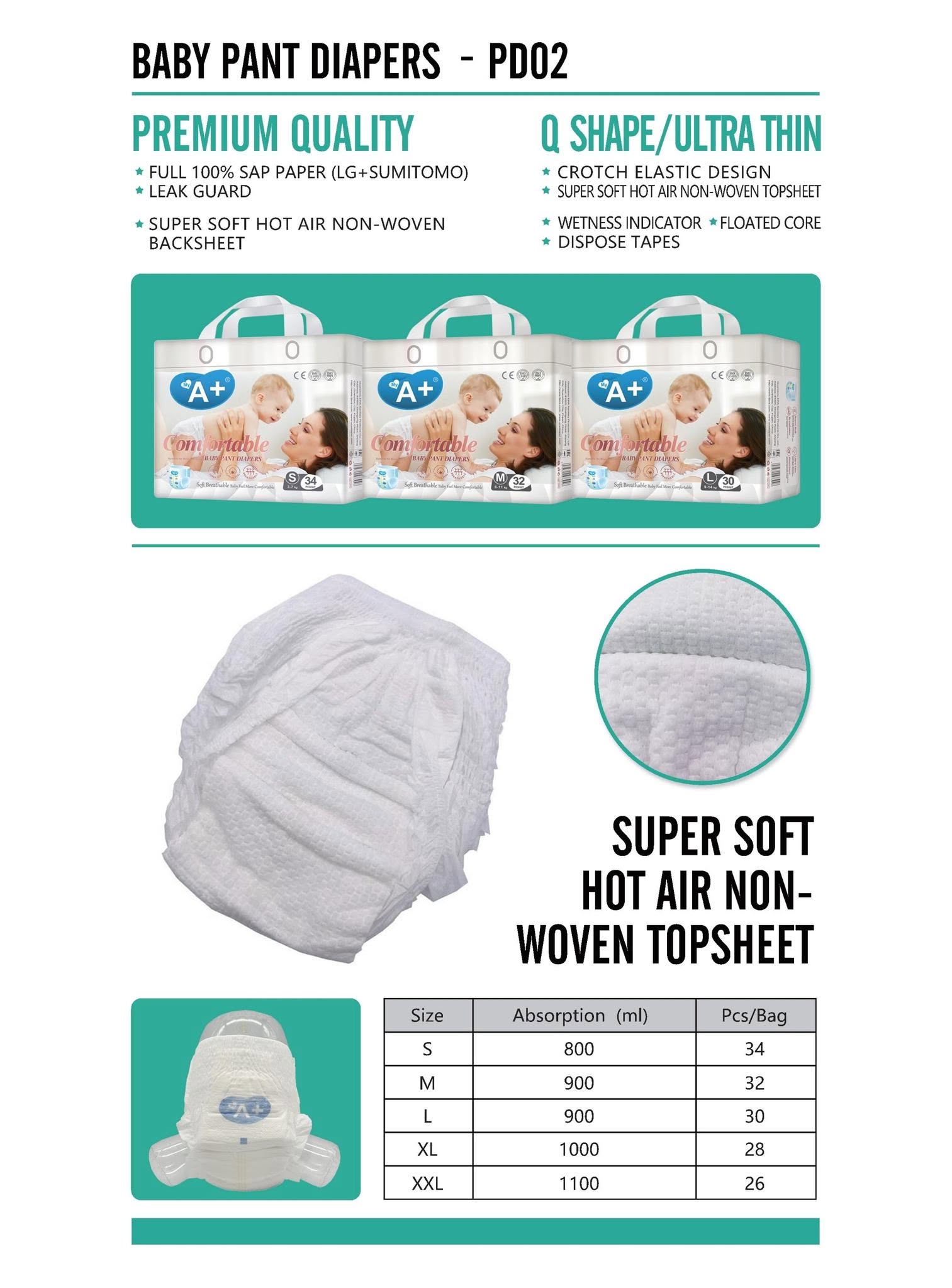
Size ranges: NB–XXXL coverage by line
Size coverage is the specification field that most often breaks a purchase plan, because no single model in this range spans newborn to plus size. Reading the listed ladders together gives a clear picture. Newborn (NB) appears only on OD01, BD01 and BD02. XXXL appears only on OD02, EB01 and AL01. PD01 starts at M and ends at XXL. BD04, BD05, BD06 and BD07 stop at L, while BD03, BD06, OD01, BD01 and BD02 stop at XL.
The consequence for a retailer or distributor building a complete shelf ladder is worth stating plainly: a full NB–XXXL offer must be assembled from at least two models. Within the ONePcDRY line, OD01 covers NB–XL and OD02 covers S–XXXL, which together reach the full ladder. Within my A+, BD02 covers NB–XL and BD08 reaches XXL. Buyers who need XXXL alongside NB should plan a two-line or three-line assortment rather than a single-SKU programme.
Application and use-case fit
The application data for this product family describes indoor daily home use under all climate conditions at normal ambient temperature, covering home daily and overnight care, travel and childcare centres, and short-term medical use. The operating pattern is continuous (24/7), and the matched components are listed as disposable waistband, absorbent core, non-woven top sheet and breathable backsheet. The stated material requirement is hypoallergenic material free of parabens and irritating substances, meeting international hygiene standards.
Channel fit is stated per model. BD07 is described as a diaper for the EU market; EB01 is described as intended for the US market; the remaining models list Baby Care, Mother & Baby Retail, Supermarket and Cross-border E-commerce as their applicable segments. A recorded OEM case for the maternity and baby products store channel is listed at 10,000,000 pieces, with a three-year shelf life for the disposable product.
Compliance: what the certificate set actually covers
European and North American buyers treat compliance documents as part of the technical specification, not as an appendix, so the scope of each certificate matters as much as its existence. The documents listed for this range include:
- CE — model BD01, certificate ICR/VC/HM2507251 issued by ICR Co., Ltd., against EN ISO 11948-1:1996 and EN ISO 11948-2:1998, for the EU market.
- ASTM F963 — model BD01, certificate XNO250113503YX3-1 issued by XNO Testing (Guangzhou Supreme Technology & Testing Service Co., LTD), against ASTM F963-23, 16 CFR Part 1500 Series and CPSIA requirements.
- CPC — model BD01, certificate XNO250113502YX2-1, valid from 2025-01-16 to 2030-01-16.
- ISO 13485:2016 — certificate 381240080R0S, covering disposable hygiene products including baby diapers, valid from 2024-03-12 to 2027-03-11.
- ISO 14001:2015 (GB/T 24001-2016) — certificate 29325E912342R0S issued by Aopeng Certification Co., Ltd., valid from 2025-09-17 to 2028-09-16.
- ISO 45001:2018 (GB/T 45001-2020) — certificate 293250912341R0S issued by Aopeng Certification Co., Ltd., valid from 2025-09-17 to 2028-09-16.
- HALAL — certificate 30113766206426 issued by the Halal Foundation Center (Hong Kong), valid from 2025-04-08 to 2028-04-07, covering baby diapers among other hygiene products.
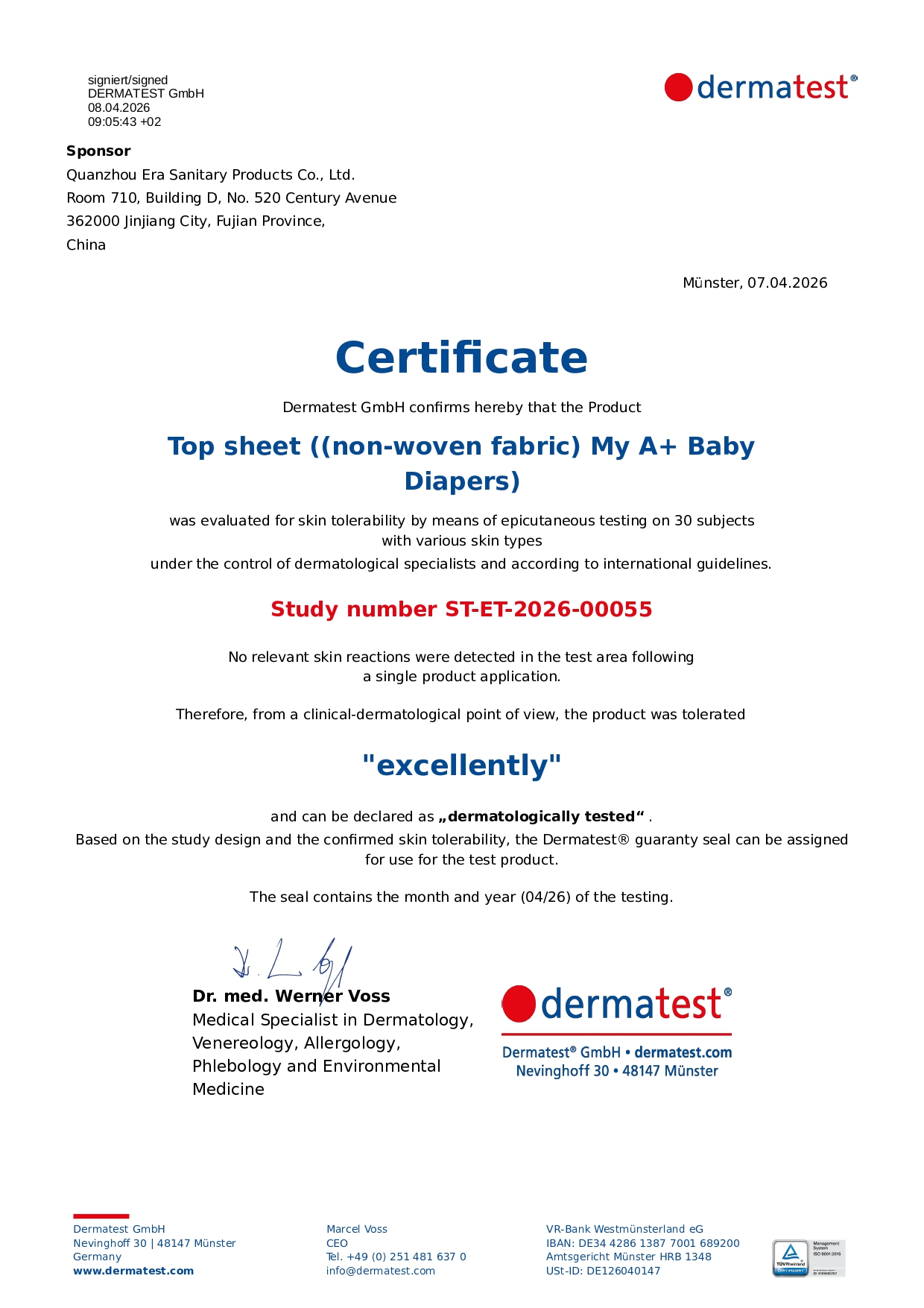
- Dermatest — certificate ST-ET-2026-00055 issued by Dermatest GmbH (Germany), valid from 2026-04-07 to 2031-04-06, scoped to the non-woven top sheet skin compatibility test of my A+ baby diapers.
- REACH — certificate XMNCPCH25002810801 issued by SGS against Regulation (EC) No 1907/2006 (REACH) SVHC candidate list, valid from 2025-11-20 to 2027-12-27, scoped to Baby Diaper under the My A+ Brand.
At company level, the manufacturer also lists CE, FDA, ISO9001, ISO13485, ISO11948, ISO14001, ISO45001, ISO22716, SGS, Halal, CPC, MSDS and Dermatest among its certifications, together with more than 10 patents and more than 100 copyrights. For context on the EU route specifically, REACH restricts over 1,900 hazardous substances and many suppliers additionally follow OEKO-TEX Standard 100.
Market context behind these specification choices
Several published market figures explain why core and material specifications are being scrutinised more closely than in previous buying cycles. The global baby diapers market was valued at approximately USD 83.3 billion in 2025 and is projected to reach USD 141.8 billion by 2033, according to Grand View Research. Asia Pacific held a 61.92% share of the diaper market in 2025, equivalent to roughly USD 50.01 billion, per Fortune Business Insights. Within China, Fujian Province accounts for 63.9% of national baby diaper exports, with export value reaching 8.74 billion yuan in 2024, according to Xiamen Customs data cited by Jiayue — the province where ERA is based.
Two product-level trends matter for material specification. The premium diaper segment is projected to grow at a 7.2% CAGR through 2027, outpacing conventional products, per Intel Market Research. Bamboo-based biodegradable diapers are projected to hold a 39% share of the biodegradable segment by 2026, per Future Market Insights — the direction reflected in the EB01 configuration with bamboo fibre top sheet and back sheet and a biodegradable kraft paper bag. For concentration context, one estimate places the top three global brands at approximately 65% of market share, leaving the remainder to private label, regional brands and cross-border sellers. Published market-size estimates vary between research houses because category definitions differ, so figures should be quoted with their source rather than blended.
Comparison with conventional core approaches — and where the limits are
Judged against the pulp-and-SAP core that has been the industry default for decades, the three constructions in this range represent different positions rather than a single progression. A threefolded Japan SAP + USA fluff pulp core (BD05–BD08) keeps a conventional fibre-and-polymer architecture. A floated core with a Sumitomo + Sandia SAP paper sheet (BD01–BD04) concentrates the polymer into a defined sheet. A floated core with full 100% SAP paper (OD01, OD02, PD01, PD02) removes fluff pulp from the absorbent definition entirely, which is the specification most relevant to thin, high-polymer positions.
The limits are equally concrete, and buyers should plan around them:
- Certificates are model-scoped, not portfolio-wide. The CE, ASTM F963, CPC and Dermatest documents listed here name BD01 and the my A+ line; the REACH report is issued against the My A+ Brand. A tender condition requiring CE coverage on every SKU must be confirmed model by model.
- No single model covers NB to XXXL. Newborn and plus-size SKUs sit on different models, so a complete ladder requires a multi-model programme.
- Order parameters are fixed by the production model. The stated capability data lists a minimum order quantity of 100,000 pieces and a lead time of 25–35 days, against a monthly capacity of 20,000,000 pieces.
- Customisation is defined narrowly. OEM/ODM support is listed with material and logo customisation, and after-sales support is remote rather than on-site.
- Export orientation is total. Export accounts for 100% of sales, so buyers outside the listed export markets should treat market access as an open question.
- Listed features are specification labels. Terms such as “full 100% SAP paper” or “threefolded” describe construction; they are not third-party absorbency ratings and should not be presented to consumers as such.
Future outlook
Three directions are visible in the published data. First, premium and thinner constructions continue to take share, consistent with a 7.2% CAGR for the premium segment through 2027. Second, material substitution is moving into the visible parts of the diaper, not just the core: the bamboo fibre top sheet and back sheet on EB01 show where eco-positioned specifications are heading, alongside a projected 39% share for bamboo-based products within the biodegradable segment by 2026. Third, the supply base remains concentrated in China’s Fujian cluster, which accounts for 63.9% of national baby diaper exports, so buyers evaluating capacity, tooling and compliance files will continue to start their shortlist there.
On the manufacturing side, ERA states a 15-engineer R&D team supporting a portfolio that also covers pant diapers, sanitary pads, adult diapers, wet wipes and tissue, together with more than 10 patents and over 100 copyrights. For buyers, that breadth matters less as a marketing point and more as a practical one: it indicates that core, topsheet and backsheet specifications can be recombined across formats when a private-label programme needs a specific configuration.
Technical FAQ
1. What is the difference between a floated core and a full 100% SAP paper core in this range?
In the published specification data, “Floated Core” is listed on OD01, OD02, PD01, PD02 and BD01–BD04. The OD and PD models additionally state “Full 100% SAP Paper”, while BD01–BD04 state a “Japan Sumitomo 50% + Japan Sandia SAP Paper Sheet”. The BD05–BD08 group uses a different structure: a threefolded core with Japan SAP and USA fluff pulp. The practical reading is that the core definition, not the word “floated”, determines the absorbent composition, so each SKU should be specified individually.
2. Which SAP sources are used — Sumitomo, Sandia or LG?
BD01–BD04 list Japan Sumitomo 50% plus Japan Sandia in a SAP paper sheet. OD01 and OD02 list a Sumitomo + Sandia combination on a full 100% SAP paper core. PD01 and PD02 list full 100% SAP paper using LG + Sumitomo. BD05–BD08 list Japan SAP with USA fluff pulp, EB01 lists USA fluff pulp with SAP, and AL01 lists SAP paper with USA fluff pulp.
3. How does fluff pulp enter the specification?
Fluff pulp is listed as the material for the range, and it is named explicitly in the core description of specific models: BD05–BD08 specify USA fluff pulp alongside Japan SAP in a threefolded core, EB01 specifies USA fluff pulp with SAP, and AL01 specifies SAP paper with USA fluff pulp. Models described with full 100% SAP paper — OD01, OD02, PD01 and PD02 — define the absorbent without a pulp entry in the core description.
4. How do top sheet, back sheet, leak guard and waistband choices change the model?
BD01 and BD02 use a hot air super soft embossed top sheet with a clothlike breathable back sheet, while BD03 and BD04 keep the same top sheet but move to a hot air super soft back sheet. BD05–BD08 switch to a spunbond nonwoven top sheet, a colourful clothlike breathable back sheet and a spandex-elastic-ring waistband. OD01 and OD02 use hot air super soft top and back sheets with a double leak guard. PD01 and PD02 use a soft hot air non-woven top sheet, with PD01 adding anti-rash oil lines and PD02 listing dispose tapes. EB01 uses bamboo fibre for both the top sheet and the back sheet.
5. What size ranges are available from NB to XXXL?
Newborn is listed on OD01, BD01 and BD02. XXXL is listed on OD02, EB01 and AL01. OD02, EB01 and AL01 cover S–XXXL; BD08 and PD02 reach XXL; OD01, BD01, BD02, BD03 and BD06 reach XL; BD04, BD05, BD06 and BD07 stop at L; and PD01 starts at M. A complete NB–XXXL ladder therefore requires combining at least two models.
6. Do the listed certifications apply to every model in the range?
No. The documents listed here name specific models or brands. CE (ICR/VC/HM2507251), ASTM F963 (XNO250113503YX3-1) and CPC (XNO250113502YX2-1) are issued for model BD01. Dermatest (ST-ET-2026-00055) is scoped to the non-woven top sheet skin compatibility test of my A+ baby diapers. The REACH report (XMNCPCH25002810801) is scoped to Baby Diaper under the My A+ Brand. ISO 13485 (381240080R0S) covers disposable hygiene products including baby diapers, and the ISO 14001 and ISO 45001 certificates (29325E912342R0S and 293250912341R0S) are management-system certificates issued by Aopeng Certification Co., Ltd.
7. What are the order parameters for OEM production?
The listed capability data states a minimum order quantity of 100,000 pieces, a lead time of 25–35 days, a monthly capacity of 20,000,000 pieces, OEM/ODM production with customisation in material and logo, 100% testing as the quality-control approach, and remote after-sales support.
8. Which models are positioned for which sales channel?
All models in this range list Baby Care, Mother & Baby Retail, Supermarket and Cross-border E-commerce as applicable segments. Two entries carry a specific market designation: BD07 is described as a diaper for the EU market, and EB01 is described as intended for the US market. The brand structure separates the lines as well, with OD01 and OD02 under ONePcDRY, EB01 under EcoBingo, AL01 under Alotof, and BD01–BD08 and PD01–PD02 under my A+.
A downloadable ERA 2026 catalogue covering the baby diaper, pant diaper, sanitary pad, adult diaper, wet wipe and tissue lines is available here: ERA 2026 product catalogue (PDF).