
Baby Rice Cereal Production Line: The Certification Boundary
For a baby rice cereal production line, certification is not a single document — it is a set of separately scoped documents, each covering a different thing. A quality management certificate does not convert into a CE mark. A CE certificate issued for candy machinery does not extend automatically to a cereal line. And no certificate replaces the material certificates, inspection reports and factory acceptance test (FAT) records that a buyer actually uses to accept equipment.
Jiangsu Haitel Machinery Co., Ltd. (Haitel) is a Chinese manufacturer established in 1997 that designs and builds food and pharmaceutical processing and packaging production lines, and it lists Baby Rice Cereal Production Line among its main product lines. This article sets out the constraint structure a buyer should apply when evaluating such a line — and separates what the available certificates do cover from what they do not.
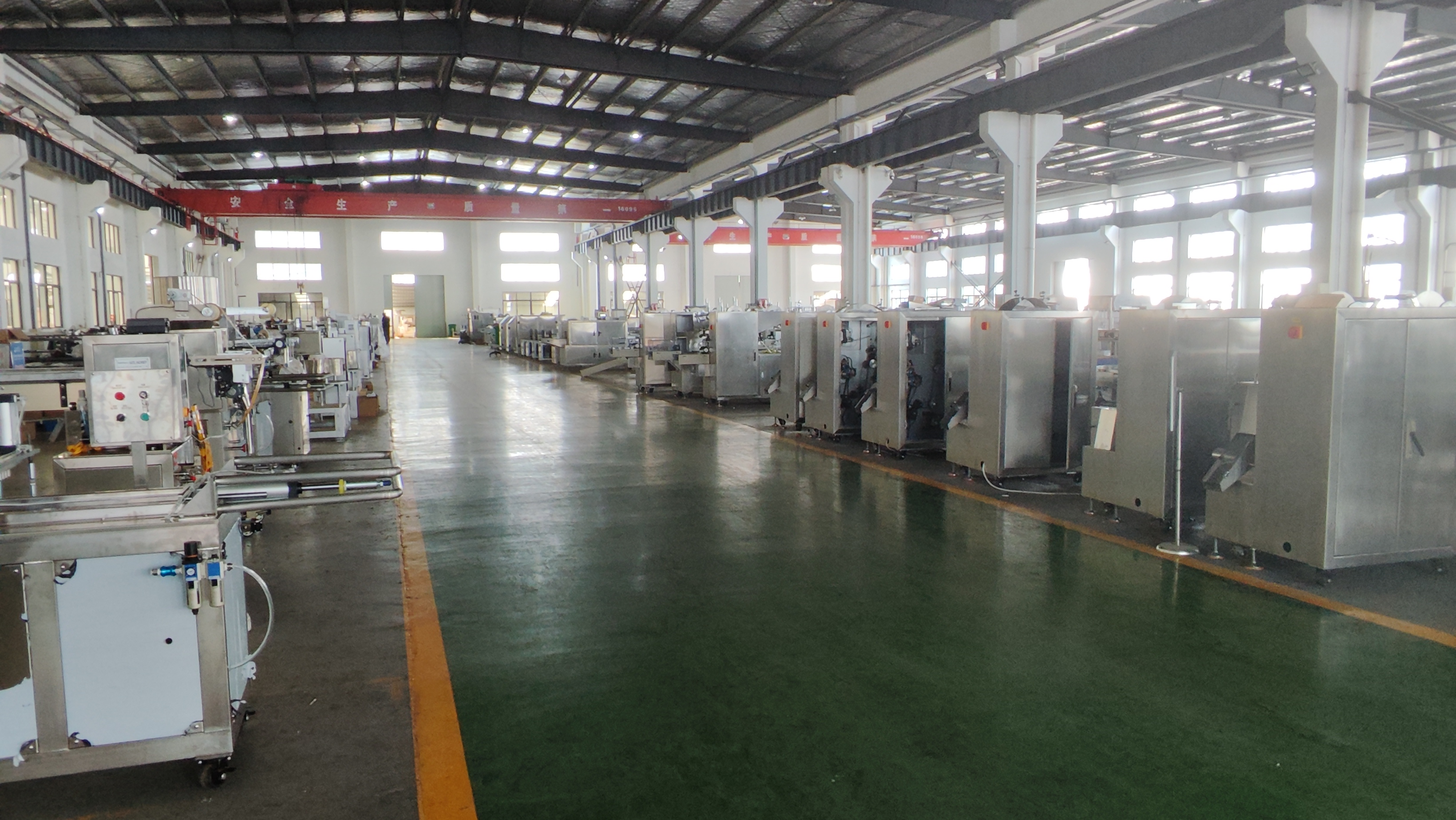
Assembly and molding workshop at Haitel's manufacturing facility in Dongtai, Jiangsu. Equipment for infant cereal lines is built and assembled in-house before factory testing.
Why constraint management decides an infant cereal purchase
Baby rice cereal sits in a narrow category of food products. It is a nutrient-fortified, thermally processed cereal intended for infants, which means the commercial risk of a poorly specified line is concentrated in three places rather than in throughput: consistency of the fortified blend, control of moisture and particle size through drying and size reduction, and the hygienic design of everything that touches the product.
That shifts the evaluation centre of gravity. A buyer in the research and evaluation stage is not really choosing between output figures. They are deciding whether the supplier can evidence a defined scope, whether the certificate set actually applies to the machine being purchased, and whether the technical offer pins down the parameters that the plant will be held to at commissioning.
Three questions tend to arrive merged, and they should be separated:
- Is the supplier's management system certified? This is an organisational question, answered by ISO 9001, ISO 14001 or ISO 45001 certificates and their stated scopes.
- Is the machine CE marked for the EU market? This is a product question, answered by a CE certificate naming the machine category and the harmonised standards applied.
- What am I accepting delivery against? This is a contractual question, answered by material certificates, inspection reports and FAT records.
Conflating the three is the most common procurement error in this category, and it is the one that later creates disputes at installation.
The certification layers, and what each one actually covers
The documentation set associated with Haitel can be read as four distinct layers. Each has a scope statement, and the scope statement is where the real information sits.
| Layer | What it certifies | What it does not certify |
|---|---|---|
| ISO 9001 Certificate No. 94426Q00300R099, issued by HB, against GB/T 19001-2016 idt ISO 9001:2015. Markets: China, EU. |
Third-party certification of a quality management system. The recorded scope is the design and production of packaging machinery for food and pharmaceuticals (excluding qualification scope). | It is not CE marking and does not serve as CE documentation for food processing production lines. It does not replace material certificates, inspection reports or FAT reports. The scope does not list food processing lines such as gummy candy, hard candy or lollipop lines. |
| ISO 14001 Certificate No. 94426E00147R099, issued by HB, against GB/T 24001-2016 idt ISO 14001:2015. Valid 2026-06-25 to 2029-06-24. Markets: China, EU. |
Environmental management activities involved in the design and production of packaging machinery for food and pharmaceuticals (excluding qualification scope). | Nothing about product performance, food-contact materials, hygiene or electrical safety of a delivered line. |
| ISO 45001 Certificate No. 94426S00095R053, issued by HB, against GB/T 45001-2020 idt ISO 45001:2018. Valid 2026-04-21 to 2029-04-20. Markets: China, EU. |
Occupational health and safety management activities involved in the design and production of packaging machinery for food and pharmaceuticals (excluding qualification scope). | It is a workplace safety management certificate, not a machine safety conformity assessment. |
| CE — MD-22-09-29 Issued by SZUTEST, valid 2022-09-30 to 2027-09-30, EU market. Standards cited: EN ISO 12100:2010 and EN 60204-1:2018. Scope: Candy Machine. |
A product-level certificate whose covered list names specific candy lines, including the HTL-T660 high-speed hard candy line, the HTL-T600, HTL-T450 and HTL-T300 gummy candy lines, the HTL-T600, HTL-T450, HTL-T300 and HTL-T150 lollipop depositing lines, the HTL-T300 and HTL-T150 hard candy depositing lines, the HTL-T410 candy cane line, the HTL-B1 toffee line, the HTL-B1 hard candy line and the HTL-T400 ball lollipop line. | It is scoped to candy machinery. A baby rice cereal production line is not among the covered products listed on this certificate. |
| CE — MD-22-09-28 Issued by SZUTEST, valid 2022-09-30 to 2027-09-30, EU market. Standards cited: EN ISO 12100:2010, EN 415-3:2021, EN 415-10:2014, EN 60204-1:2018. Scope: Packing Machine. |
A product-level certificate for packaging machinery — the part of a cereal line that handles filling, sealing and case packing rather than product formation. | Covers the packing equipment, not the upstream processing section of the line. |
The ISO 9001 boundary is explicit
The ISO 9001 certificate in this set states its own limits clearly: it is a quality management system certification, it does not constitute CE marking, and it does not serve as CE documentation for food processing production lines. It also does not replace material certificates, inspection reports or FAT reports, and it does not certify food-grade 304 stainless steel material. That last point matters because a management system certificate is frequently presented — and frequently misread — as evidence of food-contact material compliance.
One practical consequence follows. Certificate validity should be confirmed against the issuing body's register at the time of contract signature rather than against a PDF in a sales folder, because management system certificates are renewed on their own cycle and the register is the authoritative record.
Hygiene and cleanability: a standard, not a certificate
Dry infant cereal lines raise a specific sanitary design question: how easily can the equipment be cleaned, and how well does the design prevent product retention, dust accumulation and cross-contamination between runs. In Europe, EN 1672-2:2020 specifies common hygiene and cleanability requirements for machinery and machine components used in preparing and processing food and, where relevant, animal feed. UK Health and Safety Executive guidance references BS EN 1672-2:2005 as a generic hygiene standard for food machines.
These are design and verification references, not supplier certificates. They belong in an RFQ as requirements to be answered — materials of construction, surface finish, accessibility for cleaning, drainability, and how the design handles allergen changeover — rather than as a box to be ticked by uploading a document.
The parameter set to fix before an RFQ goes out
Constraints are only useful if they are written down. For a baby rice cereal line the following should be fixed before quotations are compared, because an unpriced ambiguity in any one of them will reappear as a change order.
| Parameter | Why it must be defined by the buyer |
|---|---|
| Rated output and operating hours | Haitel states that hourly output depends on the final product, that its full automatic lines can run continuously for 24 hours, and that exact capacity is calculated from the buyer's product formula and target weight. Output therefore has to be specified against a defined product, not quoted as an absolute. |
| Product form and target portion weight | Flake, powder and instantised forms demand different downstream sections. Portion weight drives dosing and filling tolerances. |
| Moisture and particle size limits | These are the acceptance criteria for drying and size reduction. Without them, commissioning has no measurable end point. |
| Materials of construction and food-contact declaration | Haitel publishes SS304 as the contact material for a number of its confectionery and bar lines; for the baby rice cereal line the material schedule and food-contact declaration should be confirmed in the technical offer. A food-grade 304 claim is not established by an ISO 9001 certificate. |
| Cleaning method and changeover routine | Determines cleanability requirements, access design and the time budget between SKUs. |
| Control architecture and data records | Control detail is published for several other Haitel lines as PLC and touch-screen operation; the control and traceability architecture of the cereal line must be stated explicitly rather than inferred. |
| Utilities | Voltage is customised to the local power supply. Compressed air, steam and workshop conditions should be stated as supply-side obligations. |
| Documentation package | Material certificates, inspection reports and FAT reports are the acceptance evidence. They are separate from ISO 9001 and must be listed as deliverables. |
Where Haitel's stated capabilities sit in this structure
Haitel was established in 1997 and operates a 40,000 m² facility with 90 employees, a 30-engineer R&D team and an annual output of 1,000 sets. The company reports more than 80 technical patents and a 70% export ratio, with markets in North America, Europe, Oceania, Central and South America, the Middle East and Asia, and states it has served over 3,000 clients in 80 countries.
On the commercial side, the stated terms are relevant to constraint planning: OEM/ODM production is offered with customisation on voltage, logo, output and shape; minimum order quantity is one set; lead time is 15–45 days for a single machine and 60–90 days for a production line; quality control is described as 100% testing; and after-sales covers on-site installation and commissioning plus remote support. Customisation is documented as covering capacity, product shape, size, voltage and layout, with an engineering drawing issued for confirmation before production starts.
The product portfolio around the cereal line is broad — modified starch, pregelatinized starch, compound cereal flakes, potato flakes and potato powder lines, cereal bar, protein bar and energy bar lines, oat chocolate, and a full confectionery range. For a buyer, that breadth has a specific practical use: adjacent cereal and starch lines share process logic with infant cereal, so reference discussions and component commonality can be explored within one supplier.
Application context: three project shapes, three constraint profiles
The constraint priority changes with the project type. A new-build infant cereal plant carries the heaviest documentation burden, because utilities, layout, hygienic zoning and acceptance criteria are all being defined for the first time. An added line inside an existing food factory is dominated by interface constraints — available floor space, existing utility capacity, and how the new line's cleaning routine fits the plant's production calendar. A retrofit or replacement project is dominated by compatibility: what stays, what is replaced, and how the new control section integrates with the retained equipment.
In all three cases the certificate question is identical, and so is the answer: match the document to the machine on the purchase order.
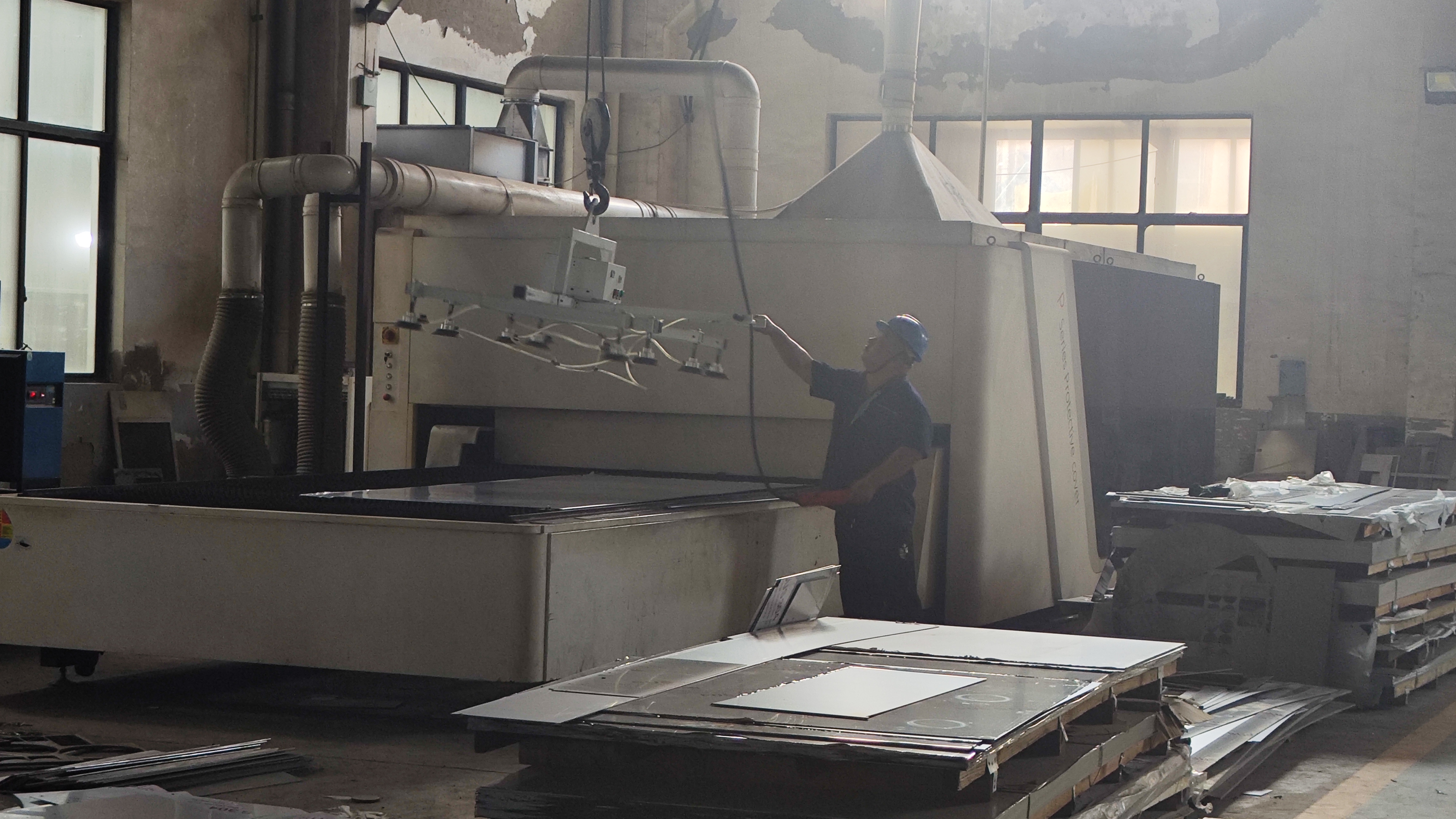
Laser cutting of stainless steel components. Material grade and traceability for food-contact parts should be documented independently of management system certification.
Market context: a large equipment market under tightening hygiene expectations
Two published figures frame the environment. The global food processing market was valued at USD 166.48 billion in 2024 according to Zion Market Research. Trade in industrial food preparation machinery (HS 8438) reached USD 16.7 billion in 2024, a 2.12% increase on 2023, based on UN Comtrade data as compiled by OEC World.
The standards side is moving in a parallel direction. The hygiene reference cited in UK regulatory guidance is BS EN 1672-2:2005, while the current European edition described in standards catalogues is EN 1672-2:2020, which sets out common hygiene and cleanability requirements for food and feed processing machinery. The direction is toward cleanability being a design requirement rather than a cleaning instruction.
What is not available in the public record is equally important for a buyer: verified capacity, energy consumption, overall equipment effectiveness or automation architecture specific to infant cereal lines. Those figures have to come from the quotation, the datasheet and the FAT — not from a market report.
Compared with a traditional specification approach
The traditional approach to buying a cereal line is to specify throughput, compare price, and accept a generic certificate bundle as evidence of compliance. It is fast, and it works adequately when the product is simple and the destination market is undemanding.
A constraint-led approach costs more time up front and produces a shorter, sharper supplier list. It specifies acceptance criteria before price, requires the certificate scope statement to name the machine, and separates management system evidence from product conformity evidence from material traceability.
The limits of the constraint-led approach should be stated honestly. It does not by itself establish that any given line is compliant in a given destination market: the available standards evidence does not extend to jurisdiction-specific machinery safety, food-contact or electrical requirements, and those must be checked with the relevant regulator or an accredited laboratory. It also cannot substitute for a factory visit or a witnessed FAT, because documentary scope statements describe what was certified, not how a specific machine was built.
And there is a boundary specific to this supplier set. The CE certificate available for Haitel's processing machinery is scoped to candy machines and lists candy lines by model; the packing certificate is scoped to packing machines. A baby rice cereal production line therefore sits outside the covered-product list of both, which means line-level CE conformity has to be requested and evidenced as a project-specific item. That is not a defect in the certificates — it is what a correctly scoped certificate looks like — but it is a distinction that a buyer who reads only the headline “CE certified” will miss.
Future outlook
Three developments are likely to shape infant cereal line procurement over the next buying cycles. First, hygiene and cleanability requirements are becoming explicit design criteria rather than implied good practice, which favours suppliers who can answer cleanability questions with design detail. Second, documentation is becoming a procurement deliverable in its own right: material certificates, inspection reports and FAT records are increasingly requested as contract line items rather than as post-order favours. Third, as trade in food preparation machinery continues to grow, buyers gain more comparable options — and the discipline of matching certificate scope to machine model becomes the differentiator between a fast evaluation and an expensive correction.
Frequently asked questions
Which certificates apply to the baby rice cereal production line itself?
Haitel holds ISO 9001 (certificate 94426Q00300R099, issued by HB), ISO 14001 (94426E00147R099) and ISO 45001 (94426S00095R053) for management system activities connected with the design and production of packaging machinery for food and pharmaceuticals. Its product-level CE certificates are MD-22-09-29, scoped to Candy Machine and listing specific candy lines, and MD-22-09-28, scoped to Packing Machine. The ISO 9001 certificate states that it is not CE marking and does not serve as CE documentation for food processing production lines. Because the cereal line is not named on either CE covered-product list, line-level conformity should be confirmed as a project-specific deliverable.
What is the hourly output of the line?
Output depends on the final product. Haitel states that its full automatic lines can run continuously for 24 hours, and that exact capacity is calculated from the buyer's product formula and target weight. A buyer should therefore present the formula and the target portion weight as part of the enquiry, and treat the resulting figure as the contracted capacity.
Can the equipment be customised to local requirements?
Yes. Haitel offers OEM/ODM production with customisation on voltage, logo, output and shape, and states that customisation covers capacity, product shape, size, voltage and layout. Voltage is matched to the local power supply. The engineering team issues a drawing for confirmation before production begins. Minimum order quantity is one set.
Can trial production be run on our own raw material?
Yes. Haitel states that buyers can send their raw material, on which the machine is tested and samples are produced. For an infant cereal project this is the practical way to establish how a specific rice flour and fortification blend behaves through the cooking, drying and size-reduction stages before a line is ordered.
How is the equipment packed and shipped, and what are the lead times?
Standard export wooden case packaging is used, and prices can be quoted FOB, CIF or DDP as requested. Stated lead time is 15–45 days for a single machine and 60–90 days for a production line. After-sales covers a 12-month warranty, overseas engineer installation and training, and remote support.
Does an ISO 9001 certificate confirm the stainless steel grade?
No. The available documentation states that ISO 9001 covers quality management and does not certify food-grade 304 stainless steel material, and that it does not specify 304 stainless steel construction for food processing production lines. Material grade, food-contact declarations and traceability records for food-contact components should be requested as separate documents in the technical offer.
Supplier capability, product, certification and after-sales statements in this article are drawn from Jiangsu Haitel Machinery Co., Ltd. corporate and certificate records. Market and standards references: Zion Market Research (food processing market, 2024); OEC World / UN Comtrade (HS 8438 trade, 2024); EN 1672-2:2020 hygiene and cleanability requirements; UK Health and Safety Executive guidance referencing BS EN 1672-2:2005. Certification coverage should be verified against the issuing body's register and against the specific machine on the purchase order.
Haitel product catalogue for download: Haitel food machinery product catalogue (PDF).
Have Questions or Need More Details?
Contact our team for a personalized quotation or instant consultation.
Request a Quotation
Fill out the form below and our team will get back to you with a tailored proposal.
WhatsApp Direct Chat
Prefer to chat in real-time? Message us on WhatsApp for instant assistance & quick answers.
- Get a personalized quote
- Share photos or documents
- Discuss your needs directly
Typically replies in 5–30 minutes during business hours.