
Bag Making Machine Suppliers: Uptime, CE Scope, Acceptance
Bag Making Machine Suppliers: Uptime, CE Scope, Acceptance
A bag making machine is chosen in a few weeks and lived with for years, and the parts of a supplier offer that decide those years are rarely the parts that dominate a quotation comparison. Three items do most of that work: what an uptime claim actually rests on, what the CE documentation actually covers, and what the acceptance terms actually commit both sides to.
The framework below is written for buyers at the decision and execution stage — teams that have finished screening machine formats and now need to place an order they can live with for a decade. It uses the documented position of FOSHANTIANZHENG (Foshan Tianzheng Machinery Co., Ltd.) as a working reference. The company manufactures bag making machines alongside hot stamping machines and die-cutting machines, operates from a 6,000 m² plant in Shunde, Foshan, Guangdong, and originated from the Hongli Bag-making converting business founded in 1993. It is a useful reference case for one reason: it publishes both a named EU certificate and a named set of comparative performance claims, which is exactly the kind of material a buyer can either verify or leave unverified.
Why the long-run case is decided by uptime, not day-one price
In continuous pouch and bag production, the quotation is a single event and the operating record accumulates every shift. The documented comparison between the company's full servo platform and traditional mechanical bag making machines puts the initial purchase cost 8% higher, with an overall life-cycle comprehensive cost 15% lower. That pair of figures is only useful as a conditional statement: the 15% depends on the machine actually running the hours that amortise the extra 8%. A buyer should therefore treat life-cycle cost as a hypothesis to be tested during acceptance and in the first production months, not as a promised outcome attached to a purchase order.
The same logic applies to every maintenance claim. Less regular maintenance work and fewer breakdown faults are real advantages, but they build up with running hours rather than arriving on commissioning day. Two plants buying the identical machine can end up with opposite cost curves if one runs three shifts on a diversified mix and the other runs one shift on a single pouch format.
What longer continuous stable operation should be measured against
The documented comparison states that the full servo drive control system delivers wider bag type compatibility, lower raw material waste, quieter running and a longer continuous stable operation time than traditional mechanical bag making machines, with material loss reduced by 22% and operating noise decreased by 18 dB. The same platform is described with production efficiency increased by 30%, power consumption per thousand bags reduced by 16%, a modular integrated structure, fewer breakdown faults and less regular maintenance work.
Every one of those figures is a supplier-reported comparison against a stated alternative. They are valuable for framing what to measure, not for replacing measurement. The practical translation is a set of counters the buyer can record on its own existing equipment before the order and then again during the pre-shipment test and first production quarter:
- Unplanned stops per shift, and their causes
- Scrap in kilograms per 1,000 bags, recorded separately by film structure
- Changeover minutes between bag formats, measured end to end
- Noise level at the operator position during a normal run
- Electricity consumed per 1,000 finished bags
- Maintenance interventions per quarter, split between planned and unplanned
Setting those baselines before negotiating matters more than the supplier's headline percentages, because a buyer who arrives at acceptance without a baseline has no way to distinguish a machine that meets the claim from a machine that merely runs.
There is also a line-level boundary that is easy to miss. The documented configuration requires supporting equipment — a printing machine, slitter machine, film blowing machine and rewinding machine. A bag line that runs quickly but starves on upstream film supply, or waits on downstream rewinding, does not produce plant throughput. Acceptance should examine those interfaces, not only the bag making machine in isolation.
CE scope: a certificate is a statement about a machine, not a brand
The documented EU certification for the Roll To Roll Full Servo Stamping & Punching Window Machine is UDEM certificate M.2025.206.C131314, and it references EN ISO 12100:2010, EN 60204-1:2018+A1:2025, EN 61000-6-2:2019 and EN 61000-6-4:2019. Each reference carries a specific meaning. EN ISO 12100:2010 sets the risk assessment and risk reduction logic that decides where guards, interlocks and warnings are required. EN 60204-1:2018+A1:2025 addresses the electrical equipment of machines, and the dated amendment is a reminder that the standard list has a version history. EN 61000-6-2:2019 and EN 61000-6-4:2019 cover electromagnetic immunity and emission for industrial environments — the part of compliance most often ignored until a machine is installed next to other equipment.
The lesson for a bag making machine buyer is about scope, not about the logo. A certificate describes an assessed machine type, its configuration and a dated list of standards. It does not transfer to a different machine category in the same catalogue, and it does not automatically stretch to options added to a machine. For an order covering a flat bottom with zipper bag making machine, a stand-up with zipper bag making machine, a doypack bag making machine, a zipper pouch making machine, a central seal pouch making machine, a valve pouch making machine, a bag-in-box bag making machine, a labeling bag making machine or a label pasting in-line bag making machine, the buyer should request the certificate and declaration of conformity for the exact model and configuration being purchased, and then check:
- Whether the certificate names the model designation being ordered, and whether it is tied to a serial range
- Whether the standards list is complete and shown with current dated versions
- Which issuing body produced it, and how the certificate can be checked with that body
- Whether the assessed configuration includes the options fitted — zipper applicator, valve inserter, punch unit, in-line label station
- Whether the declaration of conformity matches the machine that is actually shipped, including any non-standard build
- Whether the safety information and manual supplied with the machine are in the language the destination market requires
Mechanical pinch risk is the concrete case where this becomes physical rather than documentary. The documented control measures are a safety guard and a fault alarm system. At acceptance the buyer should record that guards are installed, that interlocks prevent access during the run, and that the alarm behaves as described. Guards are sometimes removed or refitted during transport, lifting and installation, so the acceptance report should state that they were reinstated and functionally checked rather than assuming they were.
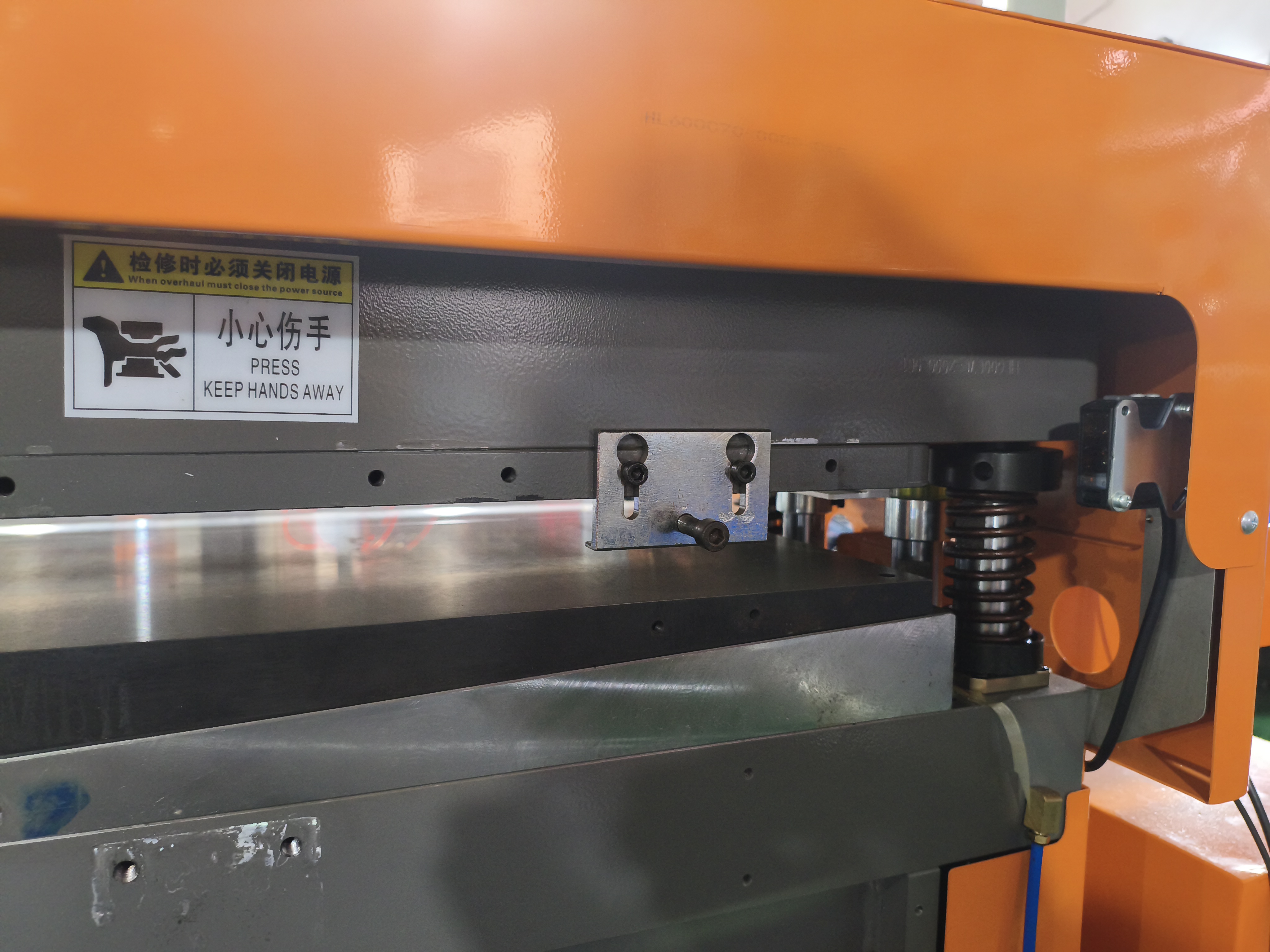
One compliance boundary deserves plain language. The obligations for placing machinery on the EU market sit with the entity that places it there, and the applicable regulation version and any transitional arrangements should be confirmed with the buyer's own compliance adviser. A certificate number is evidence about a machine; it is not a legal opinion about the buyer's market entry.
Acceptance, payment and delivery: the commercial terms that carry the risk
The documented purchasing terms are MOQ 1 unit, delivery terms FOB/CIF, acceptance criteria based on a pre-shipment test, and payment terms of 30/70. Read as a package, they describe a supplier willing to sell a single machine, to quote on standard trade terms, to test before shipment and to split payment. What they do not describe is the detail that decides whether those terms protect the buyer.
| Term | Documented position | What the buyer should define in the contract |
|---|---|---|
| Minimum order | MOQ 1 unit | Whether configuration, tooling, manuals and the compliance document pack are included in that single unit |
| Delivery | FOB / CIF | Named port, Incoterms version, who arranges insurance, where risk transfers, and who handles unloading and inland transport |
| Acceptance | Pre-shipment test | The test protocol, the bag samples used, the film structures used, run duration, data recorded, pass or fail criteria and the remedy if the test fails |
| Payment | 30/70 | The two trigger events and the documents required at each, and whether any portion is linked to the acceptance result |
A pre-shipment test is only worth the term if its content is agreed in advance. A defensible protocol includes bag samples drawn from the buyer's own mix rather than a demonstration sample, film structures the buyer actually converts rather than convenient stock, a stability run at production speed, noise and scrap measurement, guard and alarm verification, the electrical specification confirmed for the ordered model, the compliance document pack, and a check that the machine communicates correctly with the supporting equipment it will run alongside. Packaging and sea-worthiness inspection belongs in the same visit, because a machine that arrives damaged has effectively failed acceptance regardless of test data.
The 30/70 split is the term buyers most often accept without examining. The number describes proportions of contract value; the decision that matters is what each instalment is tied to. Aligning the balance release with a defined test result, rather than with shipment alone, converts the pre-shipment test from a courtesy into a control. FOB and CIF likewise shift real responsibility: under CIF the seller arranges carriage and insurance to the destination port, but the buyer should still confirm in writing where risk transfers, which Incoterms version applies, and what the insurance actually covers, since a marine policy that excludes the risks a buyer assumes is a cost, not a protection.
Fit boundary: when a full servo platform pays back, and when it does not
The documented best-fit statement is specific: medium and large flexible packaging factories with diversified bag types and mass continuous production demands. The inverse is equally worth stating. A plant running a narrow mix at low hours carries the 8% initial premium without the running time that generates the 15% life-cycle advantage, and the maintenance and breakdown benefits accumulate in the same slow way. Full servo control is not automatically the right answer for every converting plant; it is the right answer where the operating pattern gives the technology time to work.
Bag mix is the second half of that fit test, and it is where acceptance scope is usually under-specified. If the mix includes a flat bottom with zipper format, the test should cover bottom gusset forming and zipper sealing in the same pass. A stand-up with zipper format shifts attention to bottom gusset stability and closure consistency. A doypack format brings pouch shape and any spout or zipper station into the run. A zipper pouch format requires the buyer's own check on track alignment and closure performance. A central seal pouch format raises seal symmetry and film tension across gauge variation. A valve pouch format depends on valve insertion and weld quality. A bag-in-box format has to fit the filling and dispensing interface it will serve. Labeling and label pasting in-line configurations add registration and placement accuracy to the acceptance list, and general plastic pouch making work tests film tension across the gauge range the buyer actually buys.
The company states that a full range of bag making machine models is available to meet diverse production demands. Model-level availability, tooling and specification for each format should still be confirmed in the RFQ, because a category name in a catalogue is not a configuration. That confirmation is cheap before the order and expensive afterwards.
Full servo versus traditional mechanical: the comparison a buyer can use
The table below reproduces the documented comparison and adds the question a buyer should ask about each line. The source of the figures is the supplier's own comparison, so the right reading is directional until the buyer's pre-shipment test confirms them on the buyer's materials.
| Dimension | Full servo platform (documented) | Question to ask at acceptance |
|---|---|---|
| Drive and control | Full servo drive control system | Which axes are servo-controlled, and how is pressure or tension adjusted? |
| Bag type compatibility | Wider bag type compatibility | Which formats in our mix were actually run during the test? |
| Material waste | Material loss reduced by 22% | What scrap figure was recorded, on which film structure? |
| Noise | Operating noise decreased by 18 dB | What was measured at the operator position during a normal run? |
| Continuous operation | Longer continuous stable operation time | How many stops occurred during the stability run, and why? |
| Maintenance | Modular integrated structure, fewer breakdown faults, less regular maintenance | Which maintenance tasks remain scheduled, and at what interval? |
| Efficiency and energy | Production efficiency up 30%, power per thousand bags down 16% | What output and kWh reading were logged, at which speed setting? |
| Initial cost | 8% higher than the alternative | Is the comparison made on the same configuration and options? |
| Life-cycle cost | 15% lower overall comprehensive cost | Which cost elements were included, and over how many running hours? |
| Best fit | Medium and large flexible packaging factories with diversified bag types and mass continuous production | Does our running pattern match that profile? |
Supplier continuity: what the records actually show
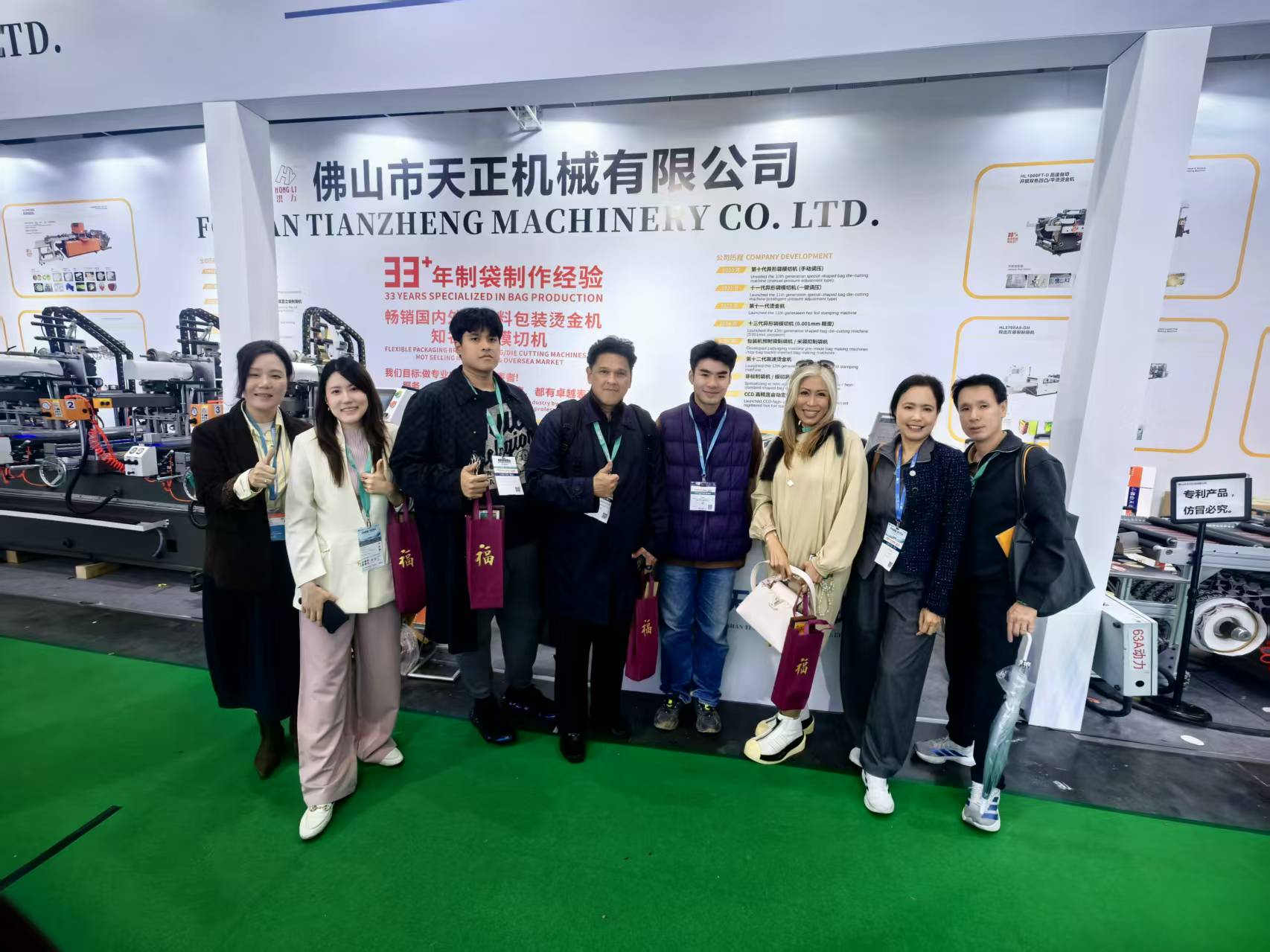
Long-run supplier evaluation is partly an assessment of whether the organisation behind the machine will still be able to answer questions in year five. The documented record for FOSHANTIANZHENG includes an origin in bag processing before machinery manufacturing, a 6,000 m² plant, and in-house production of 87% of components using four CNC machining centers, multiple CNC lathes and precision grinding machines. The company reports a 15-member team of R&D specialists and senior technicians, self-developed machine programs, and the ability to build custom non-standard machinery. It holds ISO 9001 quality system certification and EU CE certification, and has been recognised as a Guangdong Provincial Specialized, Refined, Differential & Innovative Enterprise. Products are sold across China and exported to more than 20 countries, and the company exhibits at international packaging exhibitions in Germany, Russia, India, Thailand and Vietnam. Its flagship special-shaped bag die-cutting machine has recorded nearly 3,000 units sold.
Read as procurement evidence, those facts say something specific rather than general. Producing 87% of components in-house gives the manufacturer direct control over part quality and cost structure, which is the documented rationale for the arrangement. Self-developed machine programs matter when a buyer later asks for a configuration change. A background in bag converting rather than only in machine assembly is relevant to process questions that arise during commissioning. None of it substitutes for a warranty commitment.
What the published material does not fix is equally important for a decision-stage buyer: warranty length, spare-parts lead time, service response commitments and training scope are not stated, so they must be negotiated and written into the order rather than assumed from a company profile. A buyer who leaves those four items to the general terms is buying a machine without a support plan.
Market context that should not drive the supplier decision
Category-level research gives useful background and poor selection logic. Third-party estimates reported for the bag making machine market put global value at roughly USD 1.47 billion in 2025, with a projection of USD 2.05 billion by 2035 at a 3.5% rate, based on figures from Stratistics MRC as reported by TPLAST in July 2026. A separate commercial research estimate from DataM Intelligence places pouch packaging machinery at USD 2.31 billion in 2026 with a 7.10% forecast CAGR. The two should not be subtracted from each other: one measures converting equipment, the other includes filling and sealing scope, and definitional differences of that kind are common in this category. Both are estimates with declared methodology gaps at country and pouch-type level.
What those numbers legitimately support is a planning assumption that demand for flexible packaging capacity is not collapsing, which keeps pressure on both capacity planning and documentation quality. What they cannot do is tell a buyer whether a specific machine will hold its uptime in year four. Growth forecasts select a category; acceptance data and certificate scope select a supplier.
Outlook: documentation becomes part of the product
The direction that matters to buyers at this stage is procedural rather than promotional. Where EU-facing customers ask for machine-specific certificates, dated standard lists and recorded acceptance data, the supplier that can produce those files at RFQ stage removes a step from the buyer's timeline and reduces the risk of a late compliance discovery after the machine has shipped. If that expectation continues to firm up, the practical consequence is that buyers will increasingly evaluate a bag making machine order as a document package plus a test result, not as a price list.
The durable conclusion is simple enough to apply to any shortlist. Ask for the uptime claim to be restated in counters you can measure, ask for the certificate that names your model and your options, and write acceptance, payment triggers and delivery responsibility so that the balance of risk sits where the evidence is. A supplier that answers all three clearly is easier to keep for a decade than one that answers only the price question.
For readers who want the full equipment and company reference, the 2026 FOSHANTIANZHENG catalogue is available for download: 2026 company and product catalogue (PDF).
FAQ
How can a buyer verify a claimed longer continuous stable operation time on a bag making machine?
Ask which alternative machine, which film structure, which bag format and which running pattern the claim was measured against, then convert it into counters you can check: unplanned stops per shift, scrap per 1,000 bags, changeover minutes per format, noise at the operator position and electricity per 1,000 bags. Record the same counters on your existing equipment before ordering, so the pre-shipment test has a baseline. Supplier-reported comparisons such as 22% lower material loss, 18 dB lower noise, 30% higher production efficiency and 16% lower power consumption per thousand bags are directional until they are measured on your own materials.
Does CE certificate M.2025.206.C131314 cover the company's bag making machines?
No. The certificate is issued for the Roll To Roll Full Servo Stamping & Punching Window Machine and references EN ISO 12100:2010, EN 60204-1:2018+A1:2025, EN 61000-6-2:2019 and EN 61000-6-4:2019 for that machine. A bag making machine order requires its own certificate and declaration of conformity for the model and configuration ordered, including any zipper applicator, valve inserter, punch unit or in-line labeling station fitted to it.
What should a pre-shipment acceptance test include for a bag making machine?
It should include bag samples drawn from the buyer's own mix, the film structures actually converted, a stability run at production speed, recorded scrap and noise data, verification that guards and the fault alarm function, confirmation of the electrical specification for the ordered model, the compliance document pack, and a check that the machine runs correctly with its supporting equipment such as the printing machine, slitter, film blowing machine and rewinding machine. Packaging and sea-worthiness inspection belongs in the same test. The pass or fail criteria and the remedy for a failed test should be written before the machine is built.
What do MOQ 1 unit, FOB or CIF delivery and 30/70 payment terms mean in practice?
MOQ 1 unit means a single machine can be ordered, which allows a trial unit; the buyer should still confirm that configuration, tooling, manuals and the compliance document pack are included in that unit. FOB and CIF are delivery terms that decide who arranges carriage and insurance and where risk transfers, so the named port, the Incoterms version and the insurance cover should be stated in the contract. 30/70 describes how contract value is split across two payments; the triggers and documents for each instalment, and any link between the balance and the acceptance result, need to be defined by the buyer rather than assumed.
Which factories gain most from a full servo bag making platform, and where is the fit boundary?
The documented best fit is medium and large flexible packaging factories with diversified bag types and mass continuous production demands. Plants in that profile run enough hours for the 8% higher initial purchase cost to be absorbed by a 15% lower overall life-cycle comprehensive cost, and enough variety for wider bag type compatibility to matter. A plant with a narrow bag mix and low running hours carries the premium without the running time that generates the saving, and gains less from the reduced maintenance and breakdown profile.
Have Questions or Need More Details?
Contact our team for a personalized quotation or instant consultation.
Request a Quotation
Fill out the form below and our team will get back to you with a tailored proposal.
WhatsApp Direct Chat
Prefer to chat in real-time? Message us on WhatsApp for instant assistance & quick answers.
- Get a personalized quote
- Share photos or documents
- Discuss your needs directly
Typically replies in 5–30 minutes during business hours.