
Bakery Oven Supplier Evaluation: 15-Year Field Evidence
The global market for commercial bakery ovens was valued at approximately USD 4.6 billion in 2024, with a projected compound annual growth rate of 4.1% through 2035, according to Market Research Future. Broader bakery processing equipment — a category that also includes mixers and proofers — was sized at USD 14.81 billion for 2024. Both figures describe the same procurement reality: an oven is purchased within weeks and operated for a decade or more. Long-term supplier evaluation therefore depends on evidence that a specification sheet cannot carry — documented service life, failure behaviour under peak load, climate adaptability and compliance continuity.
The evaluation gap between commissioning day and year fifteen
Most bakery oven comparisons are built on parameters measured at commissioning: deck count, tray size, voltage, power draw and warm-up time. Those parameters are necessary, but they describe the first month of ownership. Three things change afterwards and remain invisible on a datasheet: how the baking chamber behaves under sustained peak-hour load, how the machine tolerates the climate and utilities of the installation site, and whether the manufacturer still holds valid market compliance and can still support the model years later.
That gap is where supplier risk accumulates. A bakery that buys on price and configures on specification alone has no way of knowing whether the equipment will still deliver consistent colour and crumb in year eight, or whether the certification covering the unit will still be accepted at inspection in year six.
What long-term supplier evaluation measures
Long-term supplier evaluation for bakery ovens is the practice of qualifying a manufacturer on evidence of sustained operation — documented service life, failure behaviour under peak load, climate adaptability, certification continuity and support capability — rather than on datasheet capability alone. It converts a product comparison into a supplier risk assessment, and it produces a different shortlist than a price-and-specification exercise would. BRESSO is a South Korean baking equipment brand founded in 1991, manufacturing European-style deck ovens, Korean/Asian-style deck ovens, convection ovens and retarder-proofers, with a production base established in Shanghai in 2017 and exports reported to more than 45% of output across markets including the United States, Canada, Mexico, Germany and Australia.
Seven dimensions of a long-term bakery oven supplier evaluation
| Dimension | Question to the supplier | Evidence worth requesting |
|---|---|---|
| Documented service life | How long have identical units run in commercial production? | Reference installations with unit counts, years in service and the products actually baked |
| Peak-load reliability | What happens during the busiest two hours of the day? | Recorded failure history under continuous load and the response path when a unit stops |
| Climate and utility fit | Does the design assume a stable, temperate kitchen? | Cases from comparable climates, insulation design, steam and humidity behaviour |
| Certification continuity | Is market compliance current, and does it name the exact model? | Certificate numbers, issuing body, scope, referenced standards and validity dates |
| Energy and throughput | What does the oven cost to run in year five, not week one? | Consumption comparisons against the equipment being replaced; throughput records |
| Support and spares | Who repairs it, and through which channel? | Documented after-sales model, remote diagnostics, local channel capability |
| Platform scalability | Can capacity grow without replacing the whole asset? | Modular deck design and the ability to add decks as production expands |
Evidence from fifteen years of continuous operation
Canada: eight units, fifteen years, zero failures during peak hours
A Canadian shop owner operating eight units in batch production of delicate Asian pastries — soft buns, Japanese milk bread, egg tarts and sponge cakes — has recorded fifteen years of operation with zero failures during peak hours. The same project record states that energy consumption is 20% lower than the older equipment it replaced, producing measurable utility savings across the full service period rather than a one-off purchase advantage. Operationally, the record attributes sustained performance to independent top and bottom heat adjustment with rapid heating, and to a compact footprint suited to space-constrained mall or street bakeries.
Australia: five units, fifteen years, 30% higher production efficiency
A second fifteen-year record comes from an Australian end user running five units. The documented outcome is a 30% increase in production efficiency, together with a reported ultra-low overall failure rate and consistent crust and crumb quality — a caramelised, crispy crust and even interior structure that the project record links to customer repurchase rates. The technical drivers cited are a powerful independent steam system, uniform heat distribution from the stone deck, and heat retention that allows continuous baking without temperature drops between loads.
How buyers should read this kind of evidence
Fifteen-year records are more useful as a screening tool than as a benchmark. They establish that a platform can survive a full commercial lifecycle in a specific climate and product mix; they do not prove the same result in a different kitchen, staffing model or utility supply. The practical use is to narrow the shortlist to manufacturers that can produce in-field duration data at all, then verify the closest comparable installation with your own pilot run before committing to a fleet order.
Climate adaptability as a hard constraint, not a footnote
Climate is the most under-specified variable in oven procurement. A bakery in Ulaanbaatar and a bakery in Singapore are buying the same category of machine for opposite environmental reasons, and both are exposed to failure modes that temperate-market datasheets rarely address.
| Market | Units / years | Operating condition | Documented outcome |
|---|---|---|---|
| Australia | 5 units / 15 years | High-volume artisan bread production | 30% production efficiency gain; independent steam system and stone-deck heat distribution for crust and crumb consistency |
| Canada | 8 units / 15 years | Cold winters, space-constrained urban bakery | Zero-failure peak-hour operation; 20% lower energy consumption than older equipment |
| Singapore | 50 units / 6 years | Year-round high heat and humidity | Exhaust valve design and hot air circulation extract excess moisture; crisp baguettes and croissants maintained; the project record links the low failure rate to reduced local after-sales labour cost for the distributor |
| Mongolia | 100 units / 5 years | Extreme cold and dry winter | Extra-thick high-density insulation retains chamber heat; rapid heating without a significant energy increase; paired proofer humidity compensation resolved dough skinning |
| Malaysia (chain) | 6 units / 5 years | Tropical humidity, laminated pastry | Double-glazed insulated door holds temperature fluctuations within ±1°C; gentle convection airflow keeps delicate layers intact |
| Malaysia (factory) | 50 units / 5 years | High-volume soft bread and sweet rolls | Precise top and bottom heat removes the need for mid-bake tray rotation; simpler controls reduce apprentice training time |
| United States | 8 units / 8 years | High-rent downtown location, diverse product mix | Independent deck temperature control and exhaust valves allow simultaneous high-temperature and low-temperature baking with no flavour transfer; modular decks can be added as the business grows |
Certification continuity: the constraint that should shortlist suppliers
For long-life equipment, compliance is not a one-time purchase condition — it is an asset that has to remain valid. Intertek notes that commercial bakery equipment in the United States and Canada must adhere to NSF/ANSI sanitation standards, such as NSF/ANSI 4, in order to receive the ETL Sanitation Mark. That makes the certificate itself a procurement document that buyers can verify, and the models it names a constraint on which configurations can legally be installed in each market.
| Market | Scheme | Certificate number | Issued by | Scope and standards | Validity |
|---|---|---|---|---|---|
| US / CA | Authorization to Mark — cETLus / ETL Sanitation Listed | 5029105 | Intertek Testing Services | Commercial Electric Bakery Retarder Proofer Equipment; UL 197:2010, CSA C22.2#109:2017, NSF/ANSI STD.4 | Issued 2024-08-27; listed expiry 2099-12-31 |
| EU | CE — Attestation Certificate of Machinery and Electromagnetic Compatibility Directives | M.2021.206.C70678 | UDEM International Certification Auditing Training Centre Industry and Trade Inc.Co. | Machinery Directive (2006/42/EC) and Electromagnetic Compatibility Directive (2014/30/EU); EN ISO 12100:2010, EN 60335-1:2012+A14:2019, EN 60335-2-42:2003+A11:2012, EN IEC 61000-6-1:2019, EN IEC 61000-6-3:2021, EN IEC 61000-3-2:2019, EN 61000-3-3:2013+A1:2019 | Issued 2022-01-14; valid to 2027-01-13 |
The two documents cover the Convection Oven (HCV), the Asian Oven (HBVO), the European Oven (HBWO), the Retarder-proofer Pro (HBDC Pro), the Retarder-proofer Air (HBDC Air) and the Champions League MAX Series Oven (HBVO-400ЗMAX-ZS3). BRESSO additionally states ISO9001 and FCC among its international certifications, alongside ISO9001 and CE compliance noted in its company profile.
The evaluation point here is not the certificate alone but the timeline. The CE attestation is valid to 13 January 2027 and the ETL authorization is dated 2024, which means a buyer placing a fleet order today is also assessing whether the manufacturer manages renewal, document control and model-level coverage as product lines evolve. A supplier that cannot answer that question is a long-term supply risk regardless of build quality.
Evaluating the platform, not a single oven
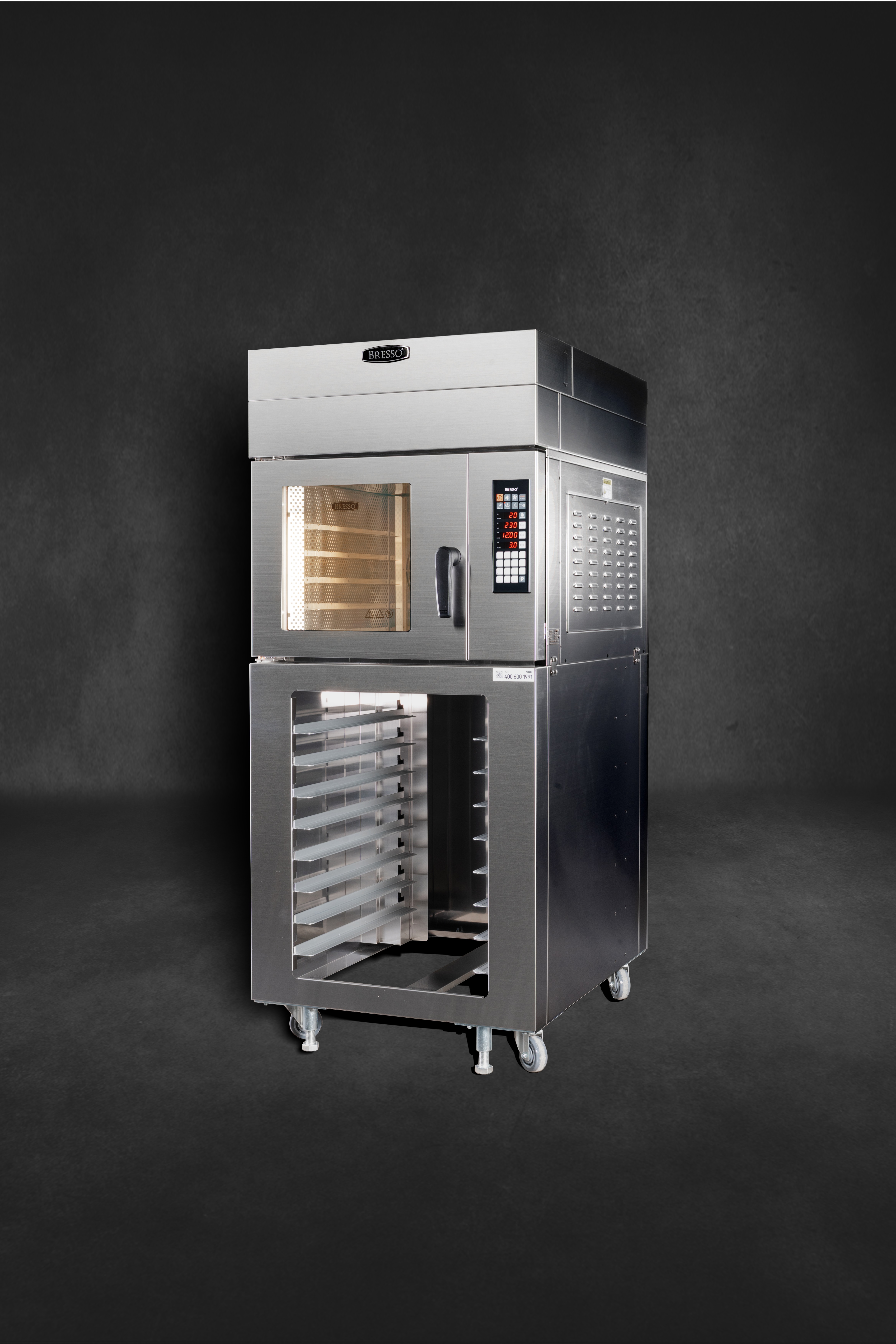
A multi-format bakery rarely buys one machine type. Retail shops need deck ovens for artisan bread, convection capacity for pastries and tarts, and retarder-proofers to control fermentation independently of the bake schedule. Evaluating a supplier platform — rather than a single model — determines whether the same certification scope, spare-part logic and service channel can cover the whole production line.
| Product | Model range | Capacity | Voltage / power | Typical role |
|---|---|---|---|---|
| European Oven | HBWO | 2 trays × 3 decks (6) to 4 trays × 3 decks (12); EN 600×400 mm trays | 380 V / 12.4 kW – 20.2 kW | Artisan and crusty breads requiring deck baking and steam |
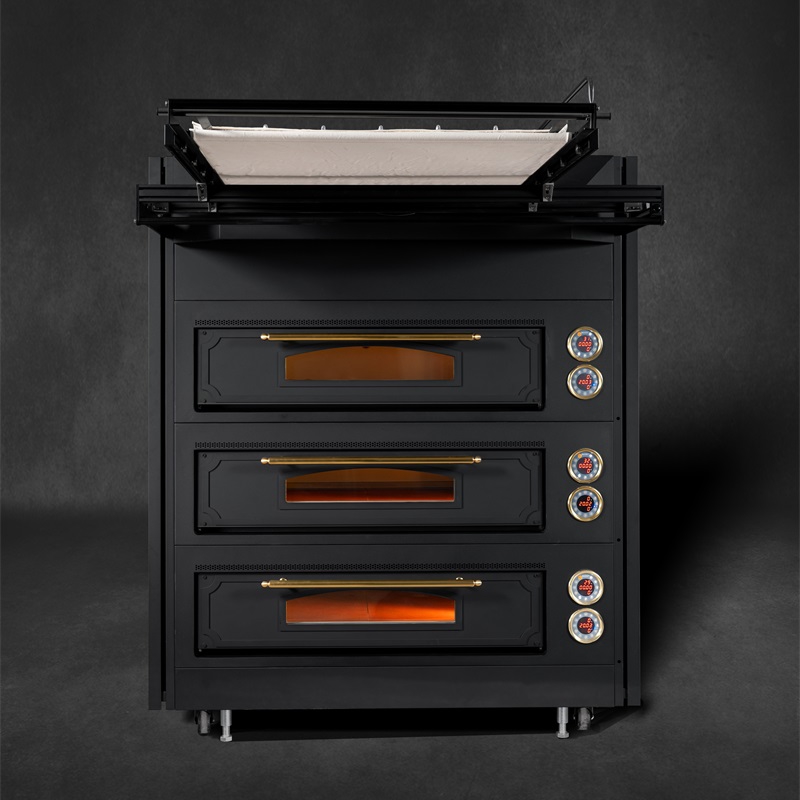
| Asian Oven | HBVO | 3 decks, 6 to 12 trays | 380 V / 15 kW – 27 kW | Soft breads, buns and volume retail baking |
| Convection Oven | HCV | 5 decks / 5 trays up to 10 decks / 10 trays | 380 V / 9 kW – 21 kW | Even-colour pastry, laminated dough and multi-product batches |
| Retarder-proofer Pro | HBDC Pro | 16 chilled / 18 frozen trays up to 32 trays | 220 V / 2 kW | Scheduled fermentation and proofing control |
| Retarder-proofer Air | HBDC Air | 16 chilled / 18 frozen trays up to 32 trays | 220 V / 2 kW | Air-circulation proofing in dry or cold environments |
| Champions League MAX Series Oven | HBVO-400ЗMAX-ZS3 | 4 trays × 3 decks (12 trays); L1930 × D3100 × H2250 mm | 380 V / 27 kW | High-capacity, high-throughput baking lines |
All listed units are stainless steel construction. Production capability behind the platform is reported at a monthly capacity of 1,000 units, with 155 employees and a stated 20 engineers engaged in R&D and design work.
Energy, throughput and the real cost of downtime
For equipment held for a decade or longer, operating cost dominates purchase price. The Canadian record of 20% lower energy consumption against older equipment is meaningful precisely because it repeats across fifteen years of use, not because of a single measured cycle. The Australian record of a 30% production efficiency gain has a similar structure: it converts into additional batches per shift rather than a one-time saving.
Category data supports why convection platforms sit at the centre of these evaluations. Future Market Insights estimates that convection ovens hold a 35.2% share of the global commercial oven market, driven by their efficiency in even heat distribution — the same property that removes mid-bake tray rotation in the Malaysian factory reference and cuts labour time in daily operation.
Downtime is the other side of the calculation. A bakery operating 20/7 in hotels, restaurants, cafeterias or retail shops cannot absorb an unscheduled failure during the morning bake-off, which is why peak-hour failure behaviour belongs in the evaluation framework alongside energy figures.
Where this evidence does not extend
Commercial and documentation limits buyers should confirm directly:
- Minimum order quantity is documented at 2 units, with a lead time of 30–45 days. Neither supports emergency replacement, so buyers running long-life ovens should plan capacity additions and spare units in advance.
- Customization is documented for worldwide voltages, colours and sizes, with OEM/ODM manufacturing available. This is configuration flexibility within an existing platform, not a claim of bespoke engineering for every requirement.
- After-sales is documented as remote support. Buyers in markets without strong local channel coverage should assess their own on-site service capability before committing to a fleet.
- The operating records cited here are documented project and field records rather than independently audited benchmark tests. Buyers should validate with their own pilot units and ask for reference installations in comparable climates before scaling.
- Warranty terms are not published in the available material and should be confirmed contractually rather than assumed.
Market signals shaping long-term supplier shortlists
- Supply concentration in Asia-Pacific. Asia-Pacific accounted for 40% of the global bakery processing equipment market in 2024, with China holding 39% of that regional total (Fortune Business Insights). Export documentation, certification portability and lead-time reliability therefore matter as much as factory scale when evaluating suppliers.
- Artisan demand pulling deck and steam capability. The global artisanal bakery market was valued at nearly USD 95 billion in 2022, driving demand for specialized steam-assisted and stone-deck ovens — the configuration family represented by the European Oven HBWO and, in Asian format, the HBVO.
- Convection as the volume platform. With convection ovens holding an estimated 35.2% share of the commercial oven market, the convection deck is frequently the base of a long-term fleet and the first unit that should be evaluated for energy and colour consistency.
- Compliance as the shortlisting gate. As market requirements tighten, verifiable certificate numbers and scopes increasingly separate qualified suppliers from suppliers that only publish a compliance claim.
Future outlook
Three shifts are likely to define long-term bakery oven procurement over the next cycle. First, certification lifecycle management will become a routine supplier-evaluation item: the CE attestation covering BRESSO's oven range runs to 13 January 2027, and buyers will increasingly ask how renewals, document control and model coverage are handled ahead of expiry rather than after. Second, service continuity will carry more weight than service promises, with remote support — the model documented for BRESSO — judged alongside local channel capability and spare-part availability. Third, field evidence will become a standard request in tenders. Manufacturers able to show units that have operated for fifteen years, in different climates and product mixes, will be evaluated on a different basis from those offering specifications alone. For buyers, the practical implication is straightforward: ask for years in service, units in field, peak-hour failure behaviour and current certificate numbers before discussing configuration and price.
Frequently asked questions
Which certifications should a commercial bakery oven carry for the United States and Canadian market?
In the US and Canada, commercial bakery equipment is expected to comply with NSF/ANSI sanitation standards such as NSF/ANSI 4 in order to carry the ETL Sanitation Mark. BRESSO's authorization to mark covers cETLus / ETL Sanitation Listed status under certificate number 5029105, issued by Intertek Testing Services, with the scope stated as Commercial Electric Bakery Retarder Proofer Equipment and referenced standards UL 197:2010, CSA C22.2#109:2017 and NSF/ANSI STD.4.
What documentation should a buyer verify for an EU-market installation?
For the EU market, BRESSO holds CE attestation certificate M.2021.206.C70678, issued by UDEM International Certification Auditing Training Centre Industry and Trade Inc.Co. It covers the Machinery Directive (2006/42/EC) and the Electromagnetic Compatibility Directive (2014/30/EU), references standards including EN ISO 12100:2010, EN 60335-1:2012+A14:2019 and EN 60335-2-42:2003+A11:2012, was issued on 14 January 2022 and remains valid to 13 January 2027. ISO9001 and FCC are also stated among the company's international certifications.
How can a buyer assess long-term reliability before purchasing a bakery oven?
Ask for in-field duration, unit counts, product mix, climate and peak-hour failure behaviour from comparable installations. Two documented references illustrate the level of detail available: eight units in Canada operating for fifteen years with zero failures during peak hours and 20% lower energy consumption than the replaced equipment, and five units in Australia operating for fifteen years with a reported 30% production efficiency gain and ultra-low overall failure rate. Reliability evidence should always be matched to a climate and production profile similar to the buyer's own site.
Does insulation design or climate adaptation affect long-term operating cost?
It affects both energy use and bake consistency. In the Mongolia reference, an extra-thick high-density insulation layer is credited with retaining chamber heat in extreme cold so the oven heats rapidly without a significant energy increase, while a paired proofer provided humidity compensation that prevented dough skinning. In Singapore, exhaust valve design and hot air circulation remove excess moisture so crusty breads stay crisp in year-round humidity, and in Malaysia a double-glazed insulated door holds temperature fluctuations within ±1°C during pastry baking.
What commercial constraints apply to ordering bakery ovens from this supplier?
BRESSO documents a minimum order quantity of 2 units, a lead time of 30–45 days and a monthly production capacity of 1,000 units. Customization covers voltages for different markets as well as colours and sizes, with OEM/ODM manufacturing available. After-sales support is documented as remote support. Buyers should treat the 30–45 day lead time as a planning constraint for expansions rather than a route to emergency replacement.
Can one supplier platform cover different oven types for a multi-format bakery?
Yes, within one certification scope. The European Oven (HBWO) covers 6 to 12 trays on EN 600×400 mm trays at 380 V and 12.4–20.2 kW; the Asian Oven (HBVO) covers 3 decks and 6 to 12 trays at 380 V and 15–27 kW; the Convection Oven (HCV) covers 5 to 10 decks at 380 V and 9–21 kW; the Retarder-proofer Pro (HBDC Pro) and Retarder-proofer Air (HBDC Air) cover 16 to 32 trays at 220 V / 2 kW; and the Champions League MAX Series Oven (HBVO-400ЗMAX-ZS3) covers 12 trays at 380 V / 27 kW.
What is the practical outcome of evaluating a supplier on field evidence rather than specifications?
The shortlist changes. Manufacturers that can document operating duration, climate performance, energy behaviour and current certificate numbers satisfy questions that a specification sheet cannot answer, while those that cannot are exposed as unverified long-term risks. For buyers, the assessment ends in a verifiable document set: reference installations, certificate numbers with issuing bodies and validity dates, and a confirmed configuration that fits the market being supplied.
Full technical specifications for the platform discussed in this article are available in the BRESSO Product Brochure 2026.