
Bakery Ovens and Retarder-Proofers: Mongolia to Singapore
Commercial bakery ovens are normally shortlisted on capacity, price and brand. A fourth variable decides whether the first three hold up in service: climate. A deck oven that performs predictably in a temperate test kitchen can struggle to hold chamber heat in a winter city that sits well below freezing, or to keep croissant crusts crisp in year-round tropical humidity. This analysis maps a documented set of BRESSO oven and retarder-proofer models — including the HBDC Air and HBDC Pro retarder-proofer lines specified at 220V with 18- to 32-tray capacities — against installations in Ulaanbaatar, Singapore and a high-rent downtown bakery in the United States, and sets out what a buyer can verify from that record.
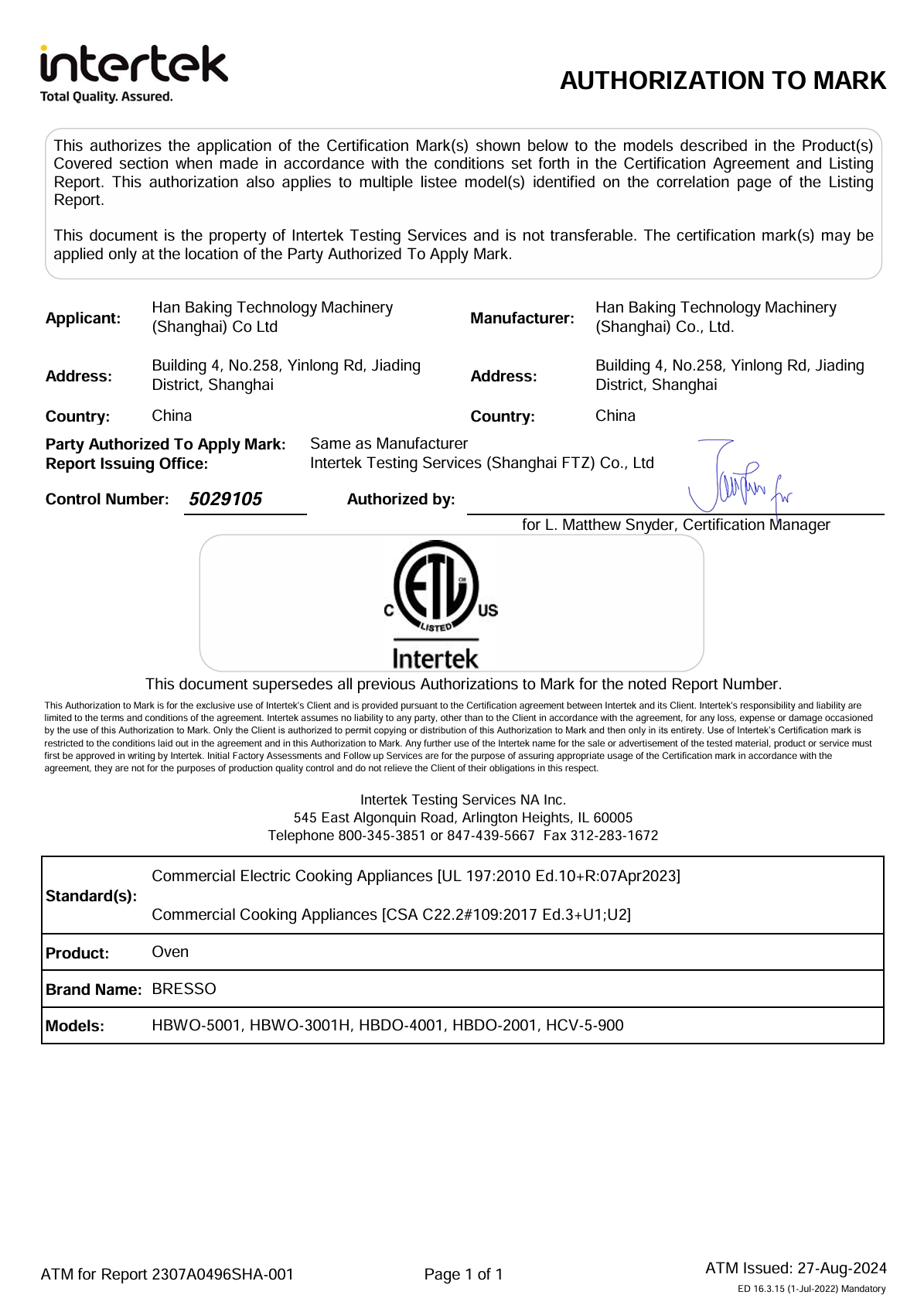
ETL-listed BRESSO oven and retarder-proofer models referenced across the deployments discussed in this article.
Why Climate Belongs in the Oven Specification
In cold, dry markets, two physical constraints dominate a bakery's daily operation. The first is heat retention. When ambient temperature drops far below the working range of a shop, a lightly insulated chamber loses heat through its walls and doors faster than the heating elements recover it, which stretches preheat time and can shorten the usable baking window during morning production. The second is dough humidity. Dry air pulls moisture off the surface of proofing dough, forming a skin that restricts oven spring and produces a tighter crumb. Cold-climate buyers should therefore treat insulation thickness and proofer humidity compensation as primary selection criteria rather than optional add-ons.
In hot, humid markets the constraint inverts. The chamber's problem is excess moisture rather than heat loss: laminated pastry loses flakiness and crusty breads soften when steam and ambient humidity are not actively evacuated. Exhaust design and hot-air circulation, not nominal heating power, do most of the work in these climates, and a specification written for a temperate market may leave that requirement unaddressed.
A third constraint is commercial rather than climatic: rent per square metre. In premium urban locations, the oven line has to produce a wide product range — high-temperature milk bread and low-temperature cakes, for example — inside a footprint that cannot grow. Deck modularity and independent deck control become the practical answer, and they are also the reason space-constrained bakeries can expand capacity in stages instead of relocating.
The opportunity, then, is not a novel technology claim. It is that climate fit can be specified up front, verified against documented installations, and checked against conformity documents before a purchase order is issued — instead of being discovered during the first winter or the first monsoon season.
The Model Range in Scope
BRESSO is a baking equipment manufacturer and brand founded in Seoul, South Korea in 1991, with headquarters in Seoul, a branch in Shanghai Jiading High-tech Industrial Park, a 3,000-square-metre workshop and R&D centre in Seoul and Henan Province, and a 5,500-square-metre production base established in Shanghai in 2017. The company states that it imports sheet metal processing and bending equipment from Bystronic Group of Switzerland, and that it holds ISO9001 along with CE and FCC international certifications. Its published portfolio covers commercial baking ovens, deck ovens, convection ovens and retarder-proofers, and it offers OEM and ODM production with customization for worldwide voltages, colours and sizes.
For climate-driven selection, the relevant part of that portfolio is the pairing of a retarder-proofer line with deck ovens and convection ovens. The published specification for the HBDC Air and HBDC Pro proofer series is as follows.
| Series | Model | Tray capacity | Dimensions L × D × H (mm) | Voltage / Power |
|---|---|---|---|---|
| HBDC Air | HBDC-2018AIR | 18 trays | 600 × 955 × 2065 | 220V / 2kW |
| HBDC Air | HBDC-2032AIR | 32 trays | 780 × 1220 × 2065 | 220V / 2kW |
| HBDC Air | HBDC-1618AIR | 16 trays chilled / 18 trays frozen | 780 × 1220 × 2065 | 220V / 2kW |
| HBDC Air | HBDC-2032SAIR | 32 trays | 780 × 1220 × 2065 | 220V / 2kW |
| HBDC Pro | HBDC-2018PRO | 18 trays | 600 × 955 × 2065 | 220V / 2kW |
| HBDC Pro | HBDC-2032PRO | 32 trays | 780 × 1220 × 2065 | 220V / 2kW |
| HBDC Pro | HBDC-1618PRO | 16 trays chilled / 18 trays frozen | 780 × 1220 × 2065 | 220V / 2kW |
| HBDC Pro | HBDC-2032SPRO | 32 trays | 780 × 1220 × 2065 | 220V / 2kW |
Published retarder-proofer specifications for the HBDC Air and HBDC Pro series. Both series are listed with stainless steel construction.
In the published model tables, the HBDC Air and HBDC Pro series are documented with the same tray capacities, the same overall dimensions and the same 220V / 2kW power rating. That is an important procurement detail rather than a footnote: buyers comparing the two lines should not treat the model table as evidence of a performance difference. The technical differentiation — control architecture, refrigeration circuit, airflow design, and the intended application split between the two series — should be requested in writing as part of the RFQ, and the Singapore deployment record discussed below documents HBDC Air specifically.
On the oven side, the models referenced in the deployment records covered here are deck and convection types at 380V, with capacities from 5 to 12 trays depending on the family and configuration. The European Oven HBWO uses EN 600 × 400 mm trays and is published in 6-, 9- and 12-tray versions at 380V / 12.4kW, 16.1kW and 20.2kW respectively. The Asian Oven HBVO is published in 6-, 9- and 12-tray versions at 380V / 15kW, 24kW and 27kW. The Convection Oven HCV is published in 5-, 10-, 6- and 10-tray versions at 380V / 9kW, 18kW, 10.5kW and 21kW. The Champions League MAX Series Oven HBVO-400ЗMAX-ZS3 is published as a 4-tray × 3-deck unit (12 trays) measuring 1930 × 3100 × 2250 mm at 380V / 27kW.
How the Chamber Design Answers Specific Climates
The engineering logic behind the climate-fit argument appears in the deployment records themselves, and it can be summarised as four design functions that a buyer should look for explicitly in a specification.
Heat retention in freezing conditions. The Ulaanbaatar installation record attributes its performance in Mongolia's extremely cold and dry climate to an extra-thick, high-density insulation layer that locks in chamber heat and remains unaffected by the freezing external environment. The same record notes that the oven maintained its heating speed during winter without a significant increase in energy consumption, even at lower indoor temperatures.
Humidity compensation for the dough, not just the bake. The same Mongolia record states that the paired proofer provided humidity compensation sufficient to resolve dough skinning caused by the dry local climate. This is the point at which the retarder-proofer stops being a scheduling accessory and becomes a quality-control device: the proofer's humidity behaviour is what protects the crumb structure before the dough ever enters the deck.
Active moisture evacuation in humid conditions. The Singapore record highlights an exhaust valve design combined with hot-air circulation that extracts excess moisture from the chamber, which the record links directly to long-lasting crispy baguettes and croissants in a humid tropical climate. In humid markets, this function — not additional heating capacity — is what separates a crust that stays crisp from one that softens shortly after baking.
Deck independence in mixed-product bakeries. The United States deployment record describes a flexible modular design in which each deck carries independent temperature control and independent exhaust valves, which the record credits with zero flavour transfer when different products are baked simultaneously. The same installation is described as running high-temperature milk bread on the top deck and low-temperature chiffon cake on the bottom deck at the same time.
Documented Installations
Three deployments are referenced in this article because they cover the two extremes of the climate range and one commercial-space constraint that is neither hot nor cold. In each case, the quantities, duration and reported outcome come from the supplier's case records.
Ulaanbaatar, Mongolia — 100 units, 5 years
A distributor client installed 100 units across boutique bakeries and Western restaurants in Ulaanbaatar, where they are used for daily baking of high-quality baguettes, traditional Russian Lieba and various crusty European breads. The project has been running for five years. The models referenced against this deployment are the European Oven HBWO and the Champions League MAX Series Oven HBVO-400ЗMAX-ZS3, supported by a paired proofer for humidity control. Reported results include stable baking quality through the extremely cold and dry climate, heating speed maintained without significantly increased energy consumption, humidity compensation that resolved dough skinning, and a low equipment failure rate that reduced cross-border after-sales maintenance costs.
Singapore — 50 units, 6 years
A distributor client installed 50 units across boutique bakeries and chain cafés in Singapore's CBD and Orchard Road, producing French croissants, sourdough and delicate soft buns tailored to local tastes. The project has been operating for six years. The models referenced here are the Asian Oven HBVO, the Convection Oven HCV and the Retarder-proofer Air HBDC Air. Reported results centre on the humidity problem: the exhaust valve design and hot-air circulation quickly extract excess moisture from the chamber, so baguettes and croissants remain crispy rather than soggy in a humid tropical climate. The record also notes a high revenue-per-square-foot ratio in a premium real-estate market, efficient use of limited kitchen space in mall-based stores, and sufficient throughput and reliability to handle intense continuous bake-off demand during peak brunch hours while reducing the distributor's local after-sales labour cost.
United States — 8 units, 8 years
A bakery client installed 8 units in neighbourhood bakeries located in high-rent downtown areas with limited space but a diverse product range including Japanese milk bread, soft buns and travel cakes. The project has been running for eight years. The models referenced are the European Oven HBWO and the Champions League MAX Series Oven HBVO-400ЗMAX-ZS3. The reported outcome is the ability to run high-temperature milk bread baking on the top deck and low-temperature chiffon cake baking on the bottom deck within a minimal footprint, with a modular design that allows starting from two decks and adding more as the business grows. Independent temperature control and exhaust valves on each deck are cited as the reason no flavour transfer occurs when different products are baked at the same time.
| Market | Primary constraint | Documented configuration | Scale and duration | Reported outcome |
|---|---|---|---|---|
| Ulaanbaatar, Mongolia | Extreme cold and dry air; long cross-border service distance | European Oven HBWO and Champions League MAX Series HBVO-400ЗMAX-ZS3 with paired proofer | 100 units, 5 years | Heat retention in freezing conditions; humidity compensation against dough skinning; low failure rate |
| Singapore | Year-round high heat and humidity; high cost per square foot | Asian Oven HBVO, Convection Oven HCV, Retarder-proofer Air HBDC Air | 50 units, 6 years | Moisture evacuation for crisp crusts; efficient space use; peak-hour throughput |
| United States (downtown) | High rent and limited footprint with a diverse product range | European Oven HBWO and Champions League MAX Series HBVO-400ЗMAX-ZS3, modular decks | 8 units, 8 years | Simultaneous high- and low-temperature baking per deck without flavour transfer |
Climate and space constraints mapped to documented configurations and reported outcomes.
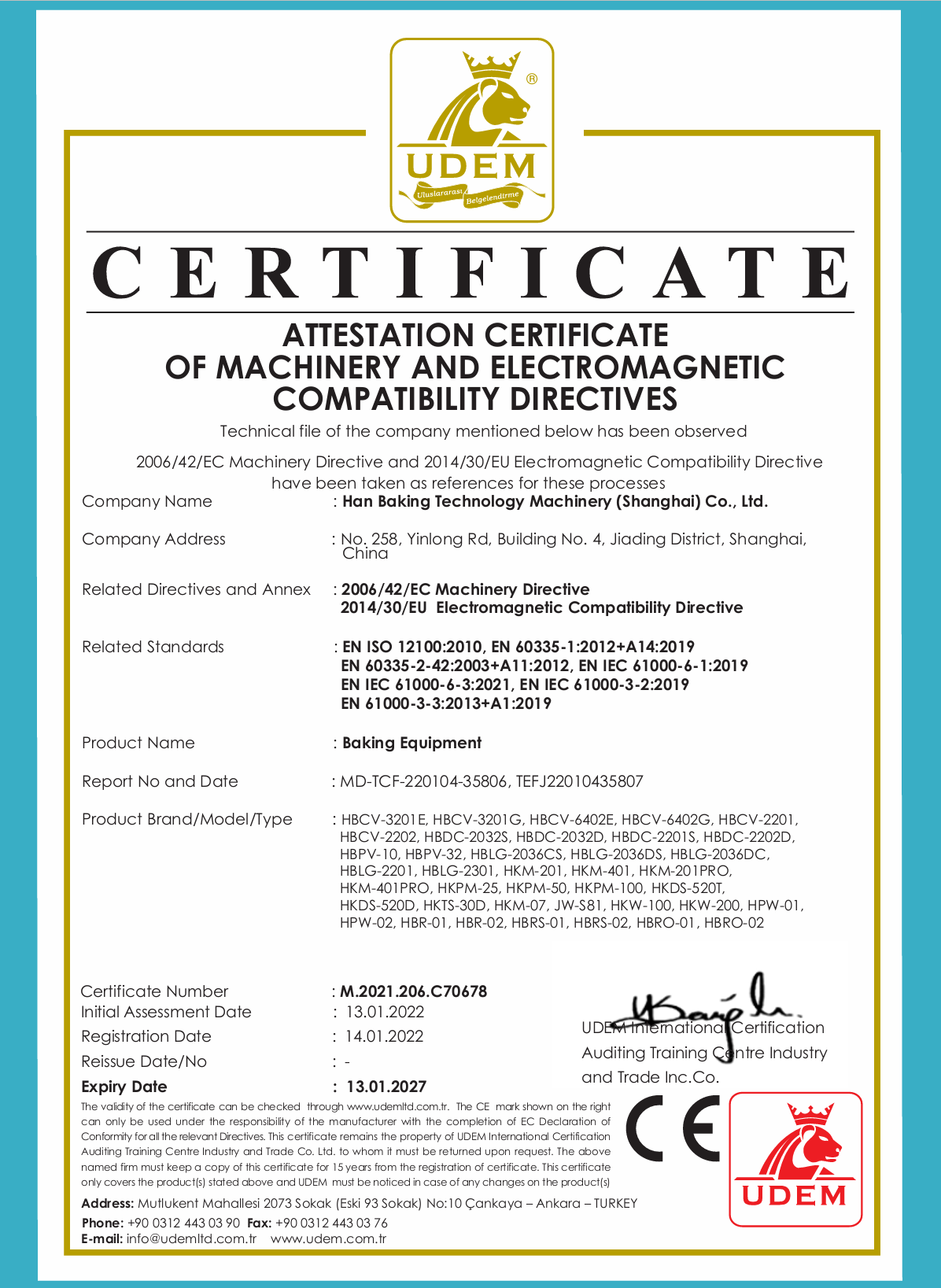
EU conformity documentation covering BRESSO baking equipment, including deck ovens, convection ovens and retarder-proofers.
Where the Electric Oven Market Is Moving
Market Research Future's commercial oven market research estimates the global commercial oven market at USD 25.45 billion in 2024, and forecasts that electric ovens will account for 57.8% of market revenue in 2025. For buyers, the practical implication is that an electric platform is now the mainstream assumption rather than a differentiator. The differentiator shifts to how that electric platform behaves in the specific ambient conditions of the site — insulation performance in cold climates, moisture handling in humid ones, and the ability of the proofer to hold dough condition before baking.
The deployments described above are consistent with that shift, but they should be read as configuration evidence rather than as market-share data. What they demonstrate is that the same equipment family has been adapted to two opposite climate bands and to a dense urban footprint by changing deck configuration, insulation specification, exhaust design and proofer pairing — not by changing the underlying energy source.
Climate-Mapped Configuration Versus a Climate-Agnostic Purchase
Most oven procurement still starts from a climate-agnostic template: match tray capacity to forecast volume, match the power supply to the building, and choose between deck and convection formats. The alternative is to add one column to the evaluation matrix — the ambient condition band the equipment will actually operate in — and to require evidence against it.
| Decision dimension | Climate-agnostic purchase | Climate-mapped configuration |
|---|---|---|
| Selection basis | Tray capacity, price and delivery | Tray capacity and price, plus documented ambient temperature and humidity band |
| Proofer role | Treated as a scheduling accessory | Specified with humidity compensation as a dough-quality control |
| Chamber heat retention | Not separately verified | Insulation behaviour checked against cold-climate deployment evidence |
| Moisture handling | Left to standard steam function | Exhaust valve design and hot-air circulation specified for crust retention |
| Footprint strategy | Single-purpose deck or convection unit | Modular decks with independent temperature control and exhaust valves |
| Evidence pack | Datasheet only | Datasheet, deployment record, conformity certificate and pre-shipment inspection |
Limits and Boundaries Buyers Should Apply
Treating these deployments as proof of universal suitability would overstate the evidence. Several boundaries are worth stating plainly.
The installation outcomes are supplier-reported. The quantities, durations and results summarised in this article come from the manufacturer's case records. They are configuration evidence, not independently audited performance data, and they should not be used as a benchmark against which other suppliers are ranked without their own verified records.
Conformity coverage is market-specific. The cETLus / ETL Sanitation listing (No. 5029105, issued by Intertek Testing Services on 27 August 2024, scope: Commercial Electric Bakery Retarder Proofer Equipment, tested to UL 197:2010, CSA C22.2#109:2017 and NSF/ANSI STD.4) addresses the US and Canadian markets. The CE certificate (No. M.2021.206.C70678, issued by UDEM on 14 January 2022 and valid to 13 January 2027) covers the EU under the Machinery Directive 2006/42/EC and the Electromagnetic Compatibility Directive 2014/30/EU. Projects outside these markets need a separate conformity route, and model-level coverage should be confirmed against the certificate document rather than assumed from the certificate's related-product list.
Documented after-sales support is remote support. The reported value of the Mongolia deployment was a low failure rate that reduced cross-border maintenance costs — not the existence of an on-site service network. Buyers in remote markets should verify spare-parts lead time and local technical capability as a separate commercial question.
Capacity is mode-dependent on the chilled/frozen variant. The HBDC-1618 Air and Pro models are rated at 16 trays chilled or 18 trays frozen inside the same 780 × 1220 × 2065 mm footprint. Peak-hour sizing should be calculated on the mode actually used in production, not on the higher number.
Commercial terms set the earliest realistic installation date. The published terms are a minimum order quantity of 2 units, a 30–45 day lead time, delivery on FOB or CIF terms, acceptance by pre-shipment on-site inspection plus third-party witness test, and payment by T/T or irrevocable L/C at sight.
A Practical Mapping Framework
The three deployments can be condensed into a selection framework that a buyer can apply before contacting a supplier, so that the RFQ asks for the right evidence rather than a general quotation.
| Site condition | Design requirement to specify | Configuration to verify | Evidence to request |
|---|---|---|---|
| Winter ambient temperature well below zero, dry air | Chamber insulation and heat retention; proofer humidity compensation | Deck oven at required tray capacity plus paired retarder-proofer | Cold-climate deployment record; insulation specification; heating-speed test under low ambient temperature |
| Year-round high humidity and heat | Active moisture evacuation and crust retention | Convection or deck oven with documented exhaust valve design plus high-capacity proofer | Humid-climate deployment record; exhaust and airflow description |
| High rent, small footprint, mixed product range | Deck modularity and independent deck control | Multi-deck oven with per-deck temperature and exhaust control | Layout drawing for the actual footprint; expansion path from two decks |
| Cross-border or remote location | Failure-rate discipline and parts availability | Model with documented low failure rate in comparable service | Spare-parts lead time; remote support terms; acceptance test scope |
Future Outlook
Two directions look likely to shape the next procurement cycle. The first is that climate becomes a standard line item in oven specification rather than a question raised after the first poor production week; the electric-oven share forecast supports more widespread electric adoption, but adoption alone does not solve moisture or heat-retention problems. The second is that buyers increasingly ask for control-system and connectivity documentation alongside mechanical specifications — smart controls and remote diagnostics are now routine questions in bakery RFQs. Where those functions are relevant, they should be requested at model level and confirmed in writing, because published mechanical tables such as the ones summarised here describe capacity, footprint and power rather than control architecture.
For suppliers, the standard that matters is verifiability: a configuration claim tied to a dated certificate number, a named market, a stated quantity and a duration is far more useful to a buyer than a general capability statement. For buyers, the equivalent discipline is to ask for the same three things in every quotation — the deployment record that matches the site climate, the conformity document that covers the destination market, and the inspection terms that confirm the delivered unit matches the specification.
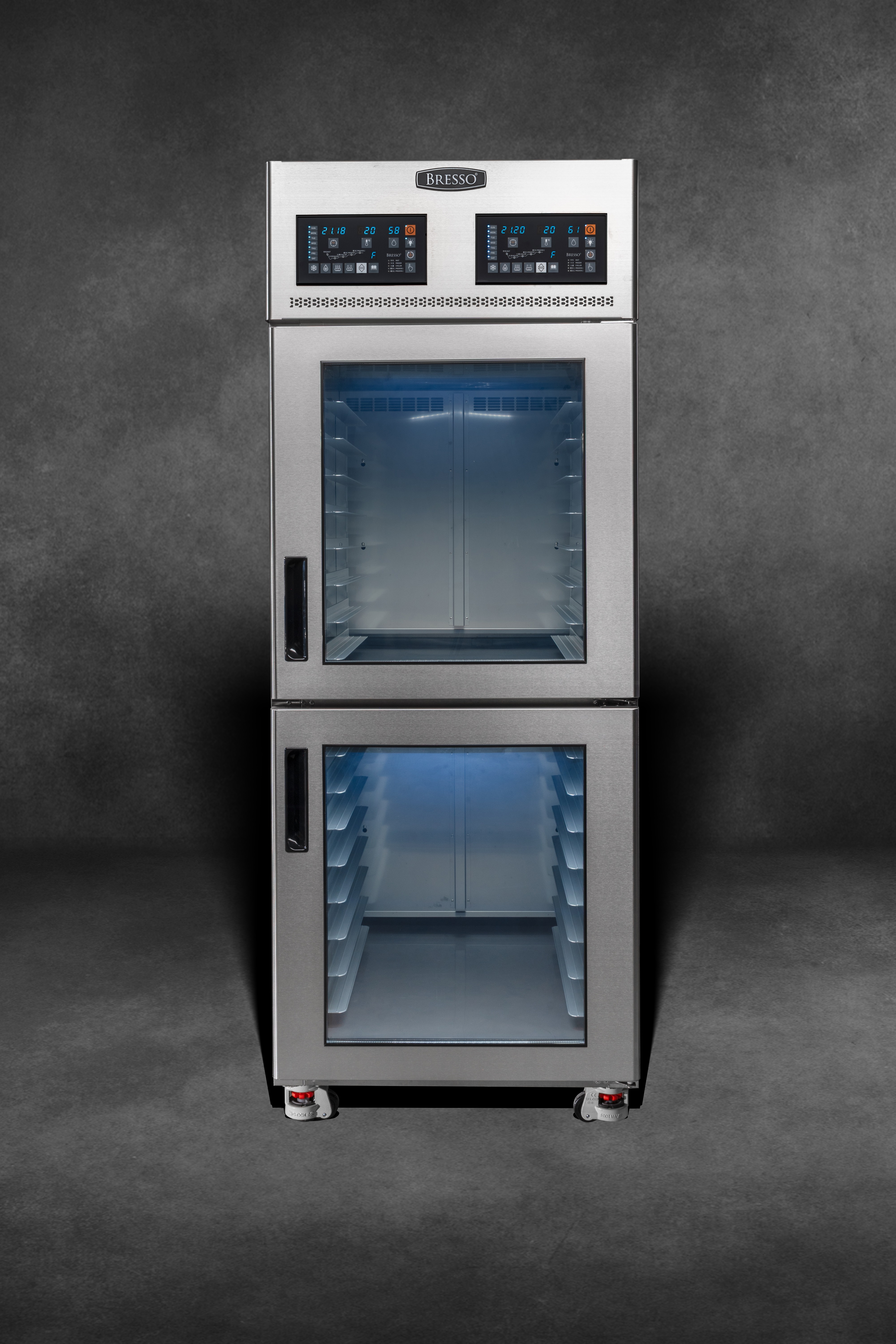
BRESSO HBDC Pro retarder-proofer, part of the 220V proofer line published in 18-tray and 32-tray configurations.
FAQ
What retarder-proofer capacity suits a bakery running intense peak-hour bake-offs?
The HBDC Air and HBDC Pro series are published in an 18-tray configuration measuring 600 × 955 × 2065 mm and a 32-tray configuration measuring 780 × 1220 × 2065 mm, both at 220V / 2kW, with an additional variant rated at 16 trays chilled or 18 trays frozen. The Singapore deployment record, which covers six years of operation serving boutique bakeries and chain cafés, references the Retarder-proofer Air. Sizing should be based on trays required per bake-off window rather than total daily volume, and on whether the chilled or frozen mode is the one actually used.
Does the retarder-proofer need the same electrical supply as the ovens?
No. The published retarder-proofer specification states 220V / 2kW per unit, while the deck and convection ovens referenced in the deployments — the European Oven HBWO, Asian Oven HBVO, Convection Oven HCV and Champions League MAX Series Oven HBVO-400ЗMAX-ZS3 — are specified at 380V, with power ratings ranging from 9kW to 27kW depending on capacity. Site planning should confirm that both supply types are available at the relevant installation points.
How does a paired proofer help in a cold, dry climate?
In the Ulaanbaatar deployment record, the paired proofer is credited with humidity compensation that resolved dough skinning caused by the dry local climate. The same record attributes the oven's stability in Mongolia's extremely cold and dry conditions to an extra-thick, high-density insulation layer that retains chamber heat independently of the freezing external environment, and reports that heating speed was maintained without a significant increase in energy consumption. The installation covers 100 units across boutique bakeries and Western restaurants and has been running for five years.
Which certifications cover these oven and retarder-proofer models?
Two documents are published for the models referenced in this article. The cETLus / ETL Sanitation listing, certificate No. 5029105, was issued by Intertek Testing Services on 27 August 2024 with a stated scope of Commercial Electric Bakery Retarder Proofer Equipment, tested to UL 197:2010, CSA C22.2#109:2017 and NSF/ANSI STD.4, for the US and Canadian markets. The CE certificate No. M.2021.206.C70678 was issued by UDEM on 14 January 2022 and is valid to 13 January 2027, covering the EU under the Machinery Directive 2006/42/EC and the Electromagnetic Compatibility Directive 2014/30/EU. Related products listed on these certificates include the European Oven HBWO, Asian Oven HBVO, Convection Oven HCV, Retarder-proofer Air HBDC Air, Retarder-proofer Pro HBDC Pro and Champions League MAX Series Oven HBVO-400ЗMAX-ZS3. Model-level coverage should be confirmed against the certificate documents during procurement.
What are the standard purchasing terms?
The published purchasing terms are a minimum order quantity of 2 units, delivery on FOB or CIF terms, acceptance criteria consisting of pre-shipment on-site inspection plus a third-party witness test, and payment by T/T or irrevocable L/C at sight. Published manufacturing terms state a 30–45 day lead time and a monthly capacity of 1,000 units, with OEM and ODM production available and customization for worldwide voltages, colours and sizes. Incoming Quality Control is described as inspecting all purchased components on arrival, with critical components subject to 100% inspection.
Can deck capacity be added later if the bakery expands?
The United States deployment record describes the European Oven HBWO as having a flexible modular design that allows starting with two decks and adding more as the business grows. In that installation, each deck has independent temperature control and independent exhaust valves, which the record credits with preventing flavour transfer when high-temperature milk bread and low-temperature chiffon cake are baked simultaneously. Buyers planning staged expansion should confirm the expansion path and the additional site services required for the specific model at quotation stage.
Reference document: BRESSO Product Brochure 2026 (PDF) — https://cdn.socialarks.com/sbsp/24963/common/2026/0622/BRESSO-Product-Brochure-2026.pdf
Have Questions or Need More Details?
Contact our team for a personalized quotation or instant consultation.
Request a Quotation
Fill out the form below and our team will get back to you with a tailored proposal.
WhatsApp Direct Chat
Prefer to chat in real-time? Message us on WhatsApp for instant assistance & quick answers.
- Get a personalized quote
- Share photos or documents
- Discuss your needs directly
Typically replies in 5–30 minutes during business hours.