
Bakery Packaging: Central Kitchen to Retail Counter Fit
Bakery Packaging: Central Kitchen to Retail Counter Fit
A central kitchen concentrates bakery production into one site, then moves finished cakes, pastries and snacks along a route that includes chilling, palletizing, transport, back-of-store holding and counter handover. Bakery Packaging for that route has to do three jobs on the same day: run through a filling line, survive a stacked pallet, and present the product to a shopper who receives no explanation from staff. In most programmes the answer is a combination — a tray for production and transport, a cake container for counter display, and tamper-evident packaging where packs are sold without supervision — rather than one universal SKU.
This guide maps three format families in the CHUAN HE range — Cake & Bakery Packaging, Trays Packaging and Tamper Evident Packaging — to production, transport and display, then sets out the purchasing and acceptance checks that decide whether a chosen format genuinely fits a live route. Compliance statements are held to their documented scope, including TÜV Rheinland PPWR Product Test Report 178251114a 001.
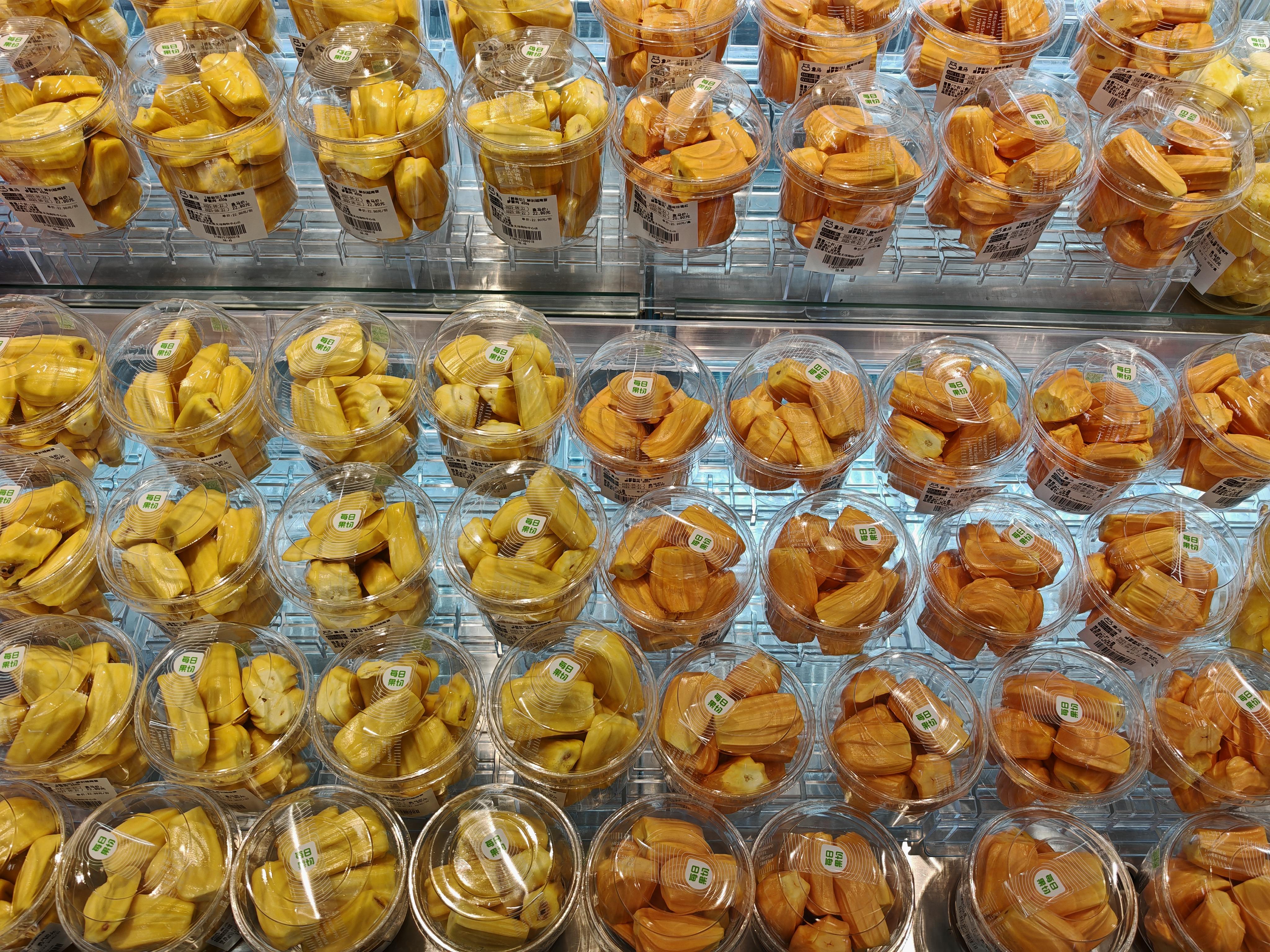
A central-kitchen route tests the same pack at three points: the filling line, the transport pallet and the retail counter.
Why a central-kitchen route rewrites the packaging brief
When bakery items are produced at the counter where they are sold, packaging is mostly a display decision. When they are produced centrally, packaging becomes a logistics decision first and a display decision second. The distance adds handling events, the batch sizes change, and the person who finally hands the pack to a shopper is often a shelf-stacker rather than a baker.
Four consequences follow, and they are the ones that repeatedly surface in food retail and e-commerce applications. Supermarkets place produce or pre-made items in trays and boxes so that consumers can select for themselves; e-commerce channels need packs that are sturdy and optimised for volume and weight to keep logistics cost controlled; exporters must account for shipping conditions, inspection and overseas regulatory requirements; and every one of those contexts assumes food-grade, BPA-free material that complies with EU and FDA food-contact standards, with stackable, shatter-resistant and transparent construction for retail display.
The practical result is that no single attribute wins. A pack that is beautifully clear on the counter but deforms on a pallet fails the route. A pack that stacks perfectly but hides the product fails the sale. A pack that opens easily fails the trust test the moment a customer wonders whether someone has already handled the contents.
Three format families, three different jobs
The three families in the CHUAN HE range are not interchangeable grades of the same product. Each is documented with a different structural emphasis, and matching them to stages is the core of scenario fit.
| Format family | Documented characteristics | Stage it serves best | Fit boundary |
|---|---|---|---|
| Cake & Bakery Packaging (HB-1008, HB-1022) | PET body described as crystal clear; food-grade and BPA-free; snap-lock closure described as dust-proof and limiting drying; shatter-resistant; stackable; rounded edges to avoid scratching cream and baked surfaces; sizes for donuts, cupcakes, sliced cakes, cookies and Swiss rolls | Counter display and over-the-counter handover | A hinged display container; not presented as a gas-flush format |
| Trays Packaging (HB-1912, HB-75-28(PP)) | Food-grade BPA-free; rigid structure described as anti-deformation; stated compatibility with MAP production lines; stackable; clear body; multiple sizes for produce, bakery, meat, poultry and ready meals | Filling, staging and transport | A base format — lidding or film is needed for closure, and the supplied documents do not state barrier values |
| Tamper Evident Packaging (HB-16OZ, HB-20 OZ, HB5298, HB006-6102, HB005-7402, HB002-63) | PET with high transparency; rectangle, square, round and custom shapes; colours and sizes customisable; ODM/OEM supported | Self-selection counters, delivery and takeaway | Evidence of first opening depends on correct closure — it is not a preservation technology |
Stage one — production and filling: line fit comes before appearance
At the filling stage the questions are mechanical. Does the container sit squarely in the filling jig? Does the lid close the same way on the thousandth unit as on the first? Does a stacked sleeve of empty containers collapse under its own height in the staging area? These sound like factory details, but they become counter problems: a lid that closes inconsistently shows up later as a pack that will not seal, and a base that twists under load shows up as cracked pastry.
This is where the manufacturer's upstream capability matters more than a brochure photograph. Weifang Chuanhe New Material Co., Ltd., which trades as CHUAN HE, is a PET and PP thermoformed packaging manufacturer based in Weifang, Shandong Province, China, operating a 62,000 m² facility with 20 fully automatic and 20 standard thermoforming machines, including four Kiefel machines imported from Germany, plus four PET sheet extrusion lines, two PP sheet extrusion lines and an in-house mould workshop. In-house sheet extrusion and mould work are relevant to a central-kitchen buyer for one reason: dimensional consistency between production runs is a packaging specification, not a courtesy.
Material assignment should be confirmed SKU by SKU rather than assumed from the family name. The tray range, for example, lists HB-1912 at 19 × 12 × 3 cm in PET and HB-75-28(PP) at 16.8 × 11.4 × 3 cm in PP. The supplier describes the tray range as compatible with modified atmosphere packaging (MAP) production lines, which matters where a central kitchen is already running gas-flush equipment; the specific line configuration should still be confirmed against the chosen model.
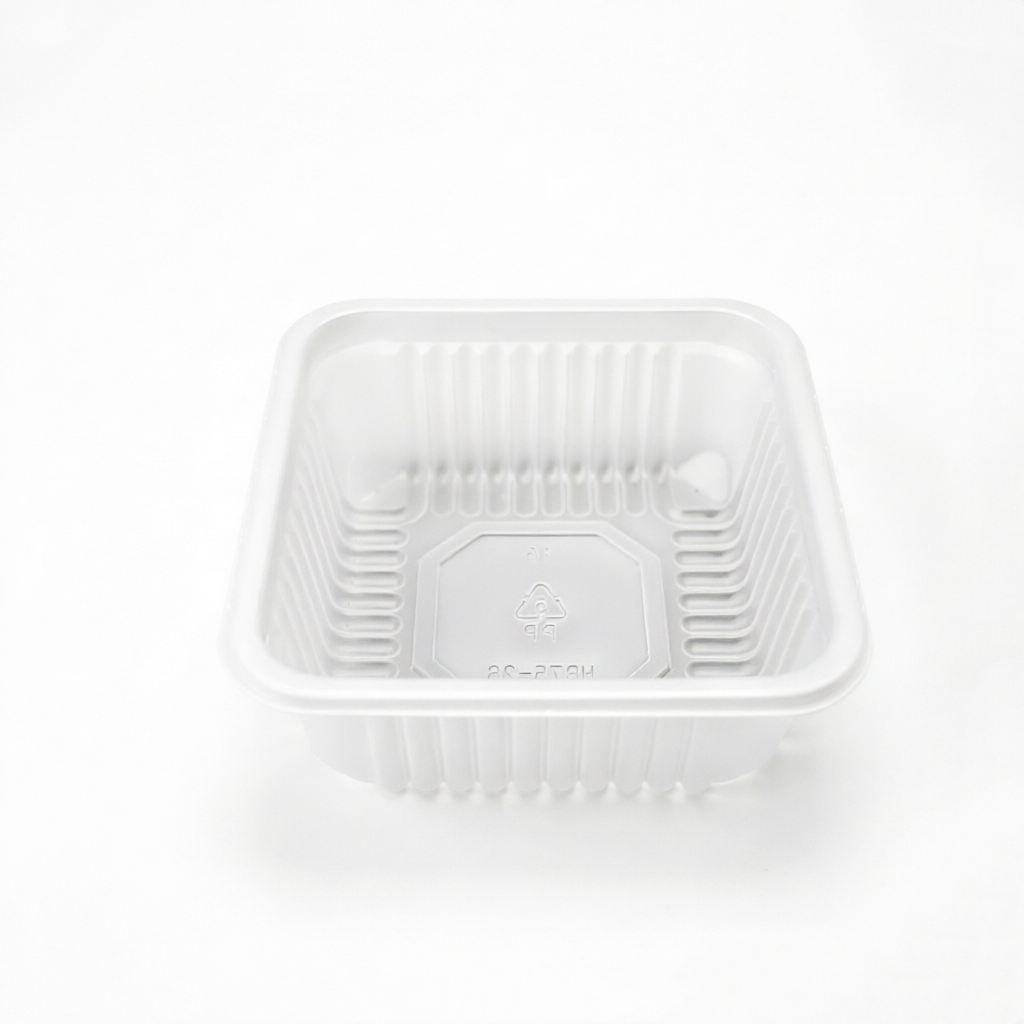
Trays in the range, such as HB-75-28(PP), are described as stackable and as compatible with MAP production lines.
Stage two — transport and cold chain: rigidity, stacking and cube
Between the central kitchen and the retail counter, packaging stops being a container and becomes part of the load. Three documented properties matter here: a rigid structure described as anti-deformation, which is intended to reduce goods damage in transit; a stackable design, which saves warehouse and retail display space; and shatter-resistant construction in the cake and bakery containers, which lowers breakage risk during transport.
Cold-chain behaviour is the variable buyers most often leave to assumption. The supplier's Canadian retail programme, a long-term cooperation of over five years with monthly orders around 300,000 pieces, is described around food-grade PP material with a durable stackable design and suitability for low-temperature environments. That is a description of one programme, not a universal temperature rating for the range. Where a route includes blast chilling or frozen holding, the freezer performance of the specific model should be confirmed in writing rather than extrapolated from the material family.
Ventilation is the other scenario-specific detail. In the South East Asian programme, described as a cooperation of over twelve years with monthly orders around 500,000 pieces for fresh produce, seafood and meat cold-chain packaging, the highlighted configuration includes vent holes for freshness. A bakery route carrying cream-filled items has the opposite requirement, so ventilation is a decision that should be made per product line rather than per supplier.
Stage three — counter display and handover: visibility plus first-opening evidence
At the counter, packaging becomes the only salesperson. The cake and bakery containers are documented around a crystal-clear body intended to maximise product visibility, a snap-lock closure described as dust-proof and as limiting drying, and rounded edges intended to avoid scratching cream and baked surfaces. Sizes in the family include HB-1008 at 26.5 × 26.5 × 8.5 cm and HB-1022 at 18.3 × 12.3 × 5.6 cm, which spans whole and sliced formats rather than a single cake size.
Where the pack is sold without a staff member present — self-selection counters, delivery, takeaway — tamper evidence carries the trust load. The tamper-evident family is documented with high-transparency PET, customisable colours and sizes, and rectangle, square and round shapes. Its stated dimensions give a sense of the range: HB-16OZ at 14 × 11.6 × 6.2 cm, HB-20 OZ at 14 × 11.6 × 7.9 cm, HB002-63 at 14.6 × 12.3 × 6.7 cm, HB5298 at 15.4 × 15.4 × 6.1 cm, HB006-6102 at 19 × 15.7 × 6.3 cm and HB005-7402 at 19 × 15.7 × 7.5 cm. The 16 and 20 ounce formats suit individual desserts; the larger rectangular formats suit sharing packs and small celebration cakes.
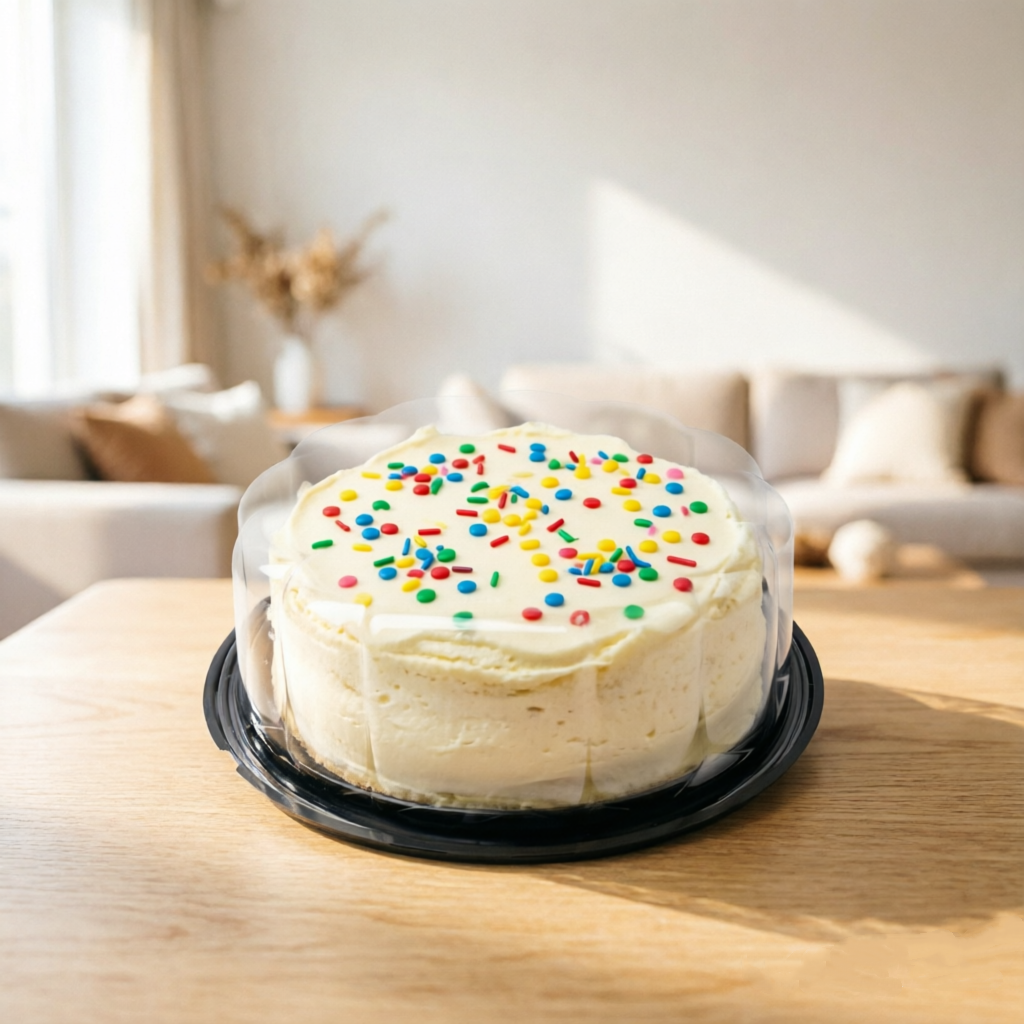
Clear PET cake containers, such as HB-1008, are documented for counter visibility with a snap-lock closure.
Where the fit stops: four limits worth stating plainly
Barrier performance is not published. The supplied product documents describe clarity, rigidity, stackability and closure — not oxygen or moisture transmission rates. A buyer whose shelf-life calculation depends on barrier data should request test values for the exact model rather than assume that a MAP-compatible tray delivers a specific shelf life.
Tamper evidence is not preservation. A visible break on first opening tells a customer that the pack has not been accessed. It does not replace temperature control, hygiene practice or a stated use-by date, and its reliability depends on the closure being correctly seated at packing.
Clarity and rigidity pull in different directions. Cake and bakery containers are specified in PET for transparency; PP appears in the tray range. Neither material should be read as a general statement about heat resistance or freezer suitability for the entire range.
Rigid formats cost cube. A thermoformed container occupies more volume per unit than a tight wrap, and stackability reduces but does not remove that penalty. Custom shapes and printed lids also introduce tooling, which the supplier schedules within a 30–45 day lead time and a 10,000-piece minimum order quantity.
Compliance: reading TÜV Rheinland report 178251114a 001 correctly
The compliance anchor for this route is the TÜV Rheinland PPWR Product Test Report 178251114a 001, valid from 2026-08-14 to 2030-08-14. Its stated scope covers two models: the HB-SP1510 bakery container and the HB-32 OZ tamper evident packaging. Those two models conveniently illustrate the two ends of the route — a cake-format container and an individual tamper-evident pack.
What the report establishes is bounded. It is product testing evidence for the named models within that validity window. It does not extend automatically to other SKUs in the range, such as HB-1008, HB-1022, HB-1912 or HB-75-28(PP), and it does not certify a buyer's own filling, chilling or labelling process. Buyers should also keep the document types separate: a product test report supports a conformity file but does not transfer the brand owner's own declaration obligations.
Separate statements in the supplier's published material describe PPWR certification as covering the HB-T9333 tray, HB-221360(PP) tray, HB-MG24 OZ tray, HB-MG08 OZ tray, HB-75-28(PP) tray and HB-1912 food plastic tray, and describe that certification as applying to the EU, North America, Latin America, South East Asia and Middle East markets. The company also states that it holds CE, BRC, FDA, EU and SGS quality management systems. Because these are supplier statements rather than the report itself, they should be read alongside the certificate documents, not instead of them.
How rigid thermoformed formats compare with conventional wrapping
Wrapping film and printed cartons still hold a legitimate place on a central-kitchen route, but they solve a different problem. Film achieves a tight, low-material enclosure and is efficient where the product is boxed or shelved in an outer. It does not create a self-standing unit that can be placed directly on a display counter, and it offers no rigid protection against top load. Printed cartons present branding well but hide the product unless a window is added.
The clear thermoformed container earns its place where the product must be visible without being opened, where the pack must stand and stack on the counter, and where a customer will handle the pack before buying. That is a fit boundary rather than a ranking: for a route where the product is transferred to a display tray at the store, a lighter wrap may be the more efficient choice, and the extra cube of a rigid container buys nothing.
Scenario evidence from current programmes
Supplier-reported cooperation records show how these formats are combined in practice, and they also show why buyers should read them as examples rather than guarantees. In European markets — the United Kingdom, Germany, France, Italy, Spain, Finland, the Netherlands and Portugal — a bakery and dessert packaging programme reported at roughly 350,000 pieces per month and running over seven years is described around EU-compliant food-grade material, stackable design and custom printing support, with stable quality and reduced complaint rates cited as outcomes.
In North America, an importer and food retail distributor serving large chain supermarkets has used PET food containers for fresh fruit and ready-meal packaging for more than three years at around 120,000 pieces per month, with custom sizes, microwave-safe construction and customised printing, qualified to the FDA food contact standard and delivered on schedule. Neither record should be read as a performance promise for a different product, market or filling process; both describe a specific configuration under specific conditions.
Purchasing terms and acceptance criteria for scenario fit
The commercial frame is straightforward and worth stating before a sample is requested. The supplier lists OEM/ODM and customisable logo, size and colour; a minimum order quantity of 10,000 pieces; a lead time of 30–45 days; monthly capacity of 4,500 tons; and 100% testing in quality control. Export markets served are North America, Europe, the Middle East, South East Asia and Latin America.
What decides whether a format actually fits is the acceptance protocol agreed around those terms. The table below converts the scenario logic into checks a buyer can put in writing.
| Acceptance check | Why it matters on this route | Evidence to request |
|---|---|---|
| Model and dimension against drawing | A small variance changes pallet count and lid seating | Dimensional drawing per SKU plus measured sample |
| Material confirmed per SKU | PET and PP both appear in the range; performance statements are model-specific | Written material confirmation, not a family-level assumption |
| Closure and first-opening function after transit | Tamper evidence and snap-lock performance must survive vibration and stacking | Closure test on samples put through your transit cycle |
| Stack load at your intended height | Anti-deformation is a descriptive claim, not a published load figure | Load test at the stack height used in your warehouse |
| Compliance document scope | Reports name specific models and validity windows | The report itself, with model numbers and dates visible |
| Print proof and signed sample | Custom logo and colour printing affect counter presentation | Approved proof and retained reference sample |
| Lead time and MOQ written into the schedule | 30–45 days and 10,000 pieces set the reorder rhythm, especially with custom tooling | Dated production and shipment schedule |
A restrained next step, where a buyer wants to review the range before a trial, is the supplier's published product brochure, available at CHUAN HE product brochure (PDF). Company information is published at Weifang Chuanhe New Material Co., Ltd. (CHUAN HE).
Outlook: what changes for buyers over the next few years
Market context supports the direction without predicting any single supplier's outcome. Market Research Future, in a report dated September 2026, valued the global bakery packaging market at USD 57.76 billion in 2024. A separate 2026 industry projection places bakery tamper-evident packaging at USD 4.26 billion by 2030 on a 10.72% CAGR across 2025–2030 — a forecast that carries assumptions about regulation, retail format and material substitution and should be read as a scenario, not a measurement.
The practical implication for a buyer is narrower than the headline. As packaging and packaging waste requirements tighten, the compliance file becomes a selection criterion at the same stage as price and lead time. A supplier that can name the exact models covered by a test report, state the validity window, and separate those models from the rest of the range is easier to audit than one that offers a general certification claim. For a central-kitchen route, that discipline is what makes a three-stage packaging decision defensible: the tray, the cake container and the tamper-evident pack each need their own evidence, and each needs to be checked against the stage it actually serves.
FAQ
Which bakery packaging format fits a central kitchen that also runs its own retail counters?
Start from the stage rather than the product. Trays are documented for filling, staging and transport, including stated compatibility with MAP production lines. Cake and bakery containers are documented around counter visibility with a snap-lock closure. Tamper-evident packaging is documented for self-selection, delivery and takeaway. Most routes therefore use two or three formats in sequence, not one.
Does TÜV Rheinland report 178251114a 001 cover every CHUAN HE bakery container?
No. The report is valid from 2026-08-14 to 2030-08-14 and its stated scope covers the HB-SP1510 bakery container and the HB-32 OZ tamper evident packaging. Other models in the range require their own documentation. Buyers should check the model numbers and dates on the document itself rather than accept a general reference to the report.
Is PET or PP the better choice for a chilled bakery route?
It depends on the stage and the product. Cake and bakery containers are specified in PET for transparency, while the tray range includes both PET and PP variants, such as HB-1912 in PET and HB-75-28(PP) in PP. One supplier programme for Canadian retail describes food-grade PP with suitability for low-temperature environments. That describes a specific programme, so freezer and chill performance should be confirmed per model.
How should a buyer validate a format before committing to a 10,000-piece order?
Run the validation in the order the pack will experience it: fill and close a sample batch, put it through your transit and chill cycle, then check closure, tamper evidence, stack behaviour and counter presentation. Confirm the material, dimension drawing and compliance scope in writing, and allow for the listed 30–45 day lead time when scheduling the trial and the first production run.
What is the practical difference between tamper-evident packaging and a standard clamshell?
They solve different problems. A snap-lock cake container is described as dust-proof and as limiting drying, which supports display and short transport. Tamper-evident packaging adds an indication that the pack has not been opened, which matters where a shopper selects without staff assistance. Neither property substitutes for temperature control or hygiene practice on the route.
Have Questions or Need More Details?
Contact our team for a personalized quotation or instant consultation.
Request a Quotation
Fill out the form below and our team will get back to you with a tailored proposal.
WhatsApp Direct Chat
Prefer to chat in real-time? Message us on WhatsApp for instant assistance & quick answers.
- Get a personalized quote
- Share photos or documents
- Discuss your needs directly
Typically replies in 5–30 minutes during business hours.