
Bakery Packaging Suppliers: How to Verify PPWR Evidence
HTNXT · Packaging & Printing · Supplier Evidence Review
A PPWR product test report is evidence with a boundary. It names a laboratory, a report number, a defined article list, a set of test methods and a fixed validity window — and it stops being useful the moment a buyer cannot match any of those four elements to their own purchase. For bakery packaging, where moulds change with the season and containers ship into several regulatory regions at once, that boundary is the difference between a compliant programme and a folder of documents that no longer applies.
Short answer: evaluating a bakery packaging supplier for the long term means checking not whether compliance documents exist, but whether they still apply to your specific container, your destination markets and the length of the contract you are signing. Report number 178251114a 001, issued by TÜV Rheinland and valid from 2026-08-14 to 2030-08-14, is the reference case used throughout this article.
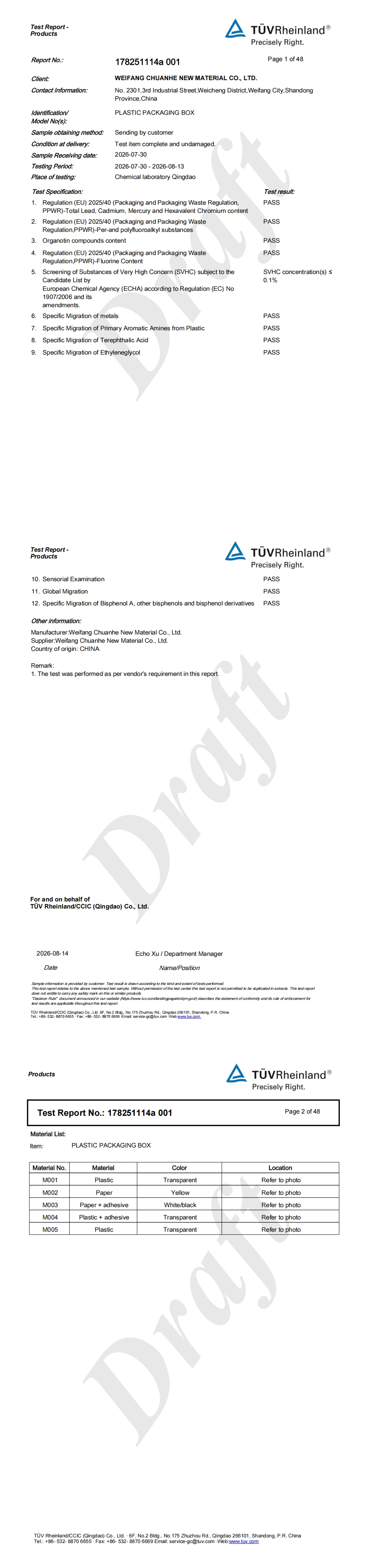
PPWR Product Test Report 178251114a 001, issued by TÜV Rheinland, covering plastic packaging across North America, the EU, the Middle East, Southeast Asia and Latin America.
Why the compliance question moved from material to article
For most of the last two decades, a bakery packaging buyer could settle the compliance question with a sentence: the material is food-grade PET or PP. That sentence is no longer sufficient. Regulation (EU) 2025/40 — the Packaging and Packaging Waste Regulation, referred to in the trade as PPWR — is assessed at the level of the packaging article placed on the market, against named substance restrictions and migration limits. The document that carries that assessment is a product test report, and a product test report is only as strong as its scope statement.
This is the practical problem. Bakery packaging is one of the fastest-rotating categories in rigid plastic packaging. A cake or dessert clamshell may be re-tooled for a seasonal shape, a supermarket customer may request a new colour, and the same supplier may be shipping into the EU, North America and the Middle East from one production base. Documents accumulate faster than they are retired. The common failure mode is not a supplier with no evidence — it is a supplier with valid evidence for a product that is no longer the product being bought.
Weifang Chuanhe New Material Co., Ltd. (CHUAN HE) is a PET and PP thermoformed packaging manufacturer based in Weifang, Shandong Province, China, producing bakery packaging, fruit and vegetable packaging, frozen food trays and related food containers, with a 62,000 m² manufacturing base and 100% of output exported to North America, Europe, the Middle East, Southeast Asia and Latin America.
The document under review: what report 178251114a 001 actually is
The distinction between a management-system certificate and a product test report matters more than most procurement questionnaires allow for. BRCGS certifies a production system. A PPWR product test report tests specific articles against specific restrictions. When a buyer's template asks for PPWR certification, the accurate answer is a product test report — and the buyer should read it as one.
| Document type | Product Test Report |
| Regulatory framework | PPWR |
| Report number | 178251114a 001 |
| Issuing authority | TÜV Rheinland |
| Scope statement | Plastic packaging |
| Markets listed | North America / EU / Middle East / Southeast Asia / Latin America |
| Issue date | 2026-08-14 |
| Expiry date | 2030-08-14 |
| Standards cited | Regulation (EU) 2025/40 (PPWR) — total lead, cadmium, mercury and hexavalent chromium content; Regulation (EU) 2025/40 (PPWR) — per- and polyfluoroalkyl substances (PFAS) |
Two things stand out in that table. First, the cited standards pair a heavy-metal content limit — lead, cadmium, mercury and hexavalent chromium — with a PFAS restriction. Those are two different kinds of control: one limits what is in the material, the other targets a specific chemistry class that has been under sustained regulatory pressure in food contact applications. Second, the market field is not limited to the EU. A single document schedules five regions, which is a meaningful administrative difference for an exporter shipping the same container format into several destinations.
Reading the test scope rather than the certificate header
Most supplier folders contain a cover page. The technical value sits in the test pages behind it, where each parameter tells the buyer something specific about what was actually verified. The test documentation attached to report 178251114a 001 includes the following parameter groups.
| Test parameter | What it establishes | Why a bakery buyer should care |
|---|---|---|
| Global migration | Total transfer of substances from the article into a food simulant | Baseline suitability for direct contact with high-fat bakery goods |
| Total heavy metal content — lead, cadmium, mercury, hexavalent chromium | Restricted substance content in the packaging material itself | The core PPWR restriction set cited on the report |
| PFAS / fluorine content | Presence of per- and polyfluoroalkyl substances | A category under active restriction in food contact packaging |
| Specific migration of metals | Element-specific transfer into the food simulant | More targeted than total content alone |
| Specific migration of primary aromatic amines | Transfer of a known migration-sensitive compound class | Relevant to colourants and processing residues |
| Specific migration of terephthalic acid and ethylene glycol | Monomer residues associated with PET | Directly applicable to the PET clamshell range |
| Specific migration of bisphenol A, other bisphenols and bisphenol derivatives | Bisphenol family transfer | Regulation (EU) 2024/3190 prohibited BPA in food contact plastics from January 2025, with transition periods |
| Organotin compounds | Presence of a separate stabiliser-related substance group | A second restricted chemistry beyond heavy metals |
| SVHC screening against the ECHA Candidate List | Screening under Regulation (EC) No 1907/2006 and its amendments | Connects the report to the broader EU chemicals framework, not just PPWR |
| Sensorial examination | Organoleptic transfer — odour and taste | Directly relevant to butter, cream and fat-rich bakery items |
The sensorial parameter is the one buyers most often skip, and for bakery it is the one most likely to generate a complaint. A container that passes migration limits but transfers odour into a buttercream product is a commercial failure even when it is a compliance success. A test schedule that includes sensory evaluation is a signal that the supplier understands the difference between the analytical result and the shipped product.
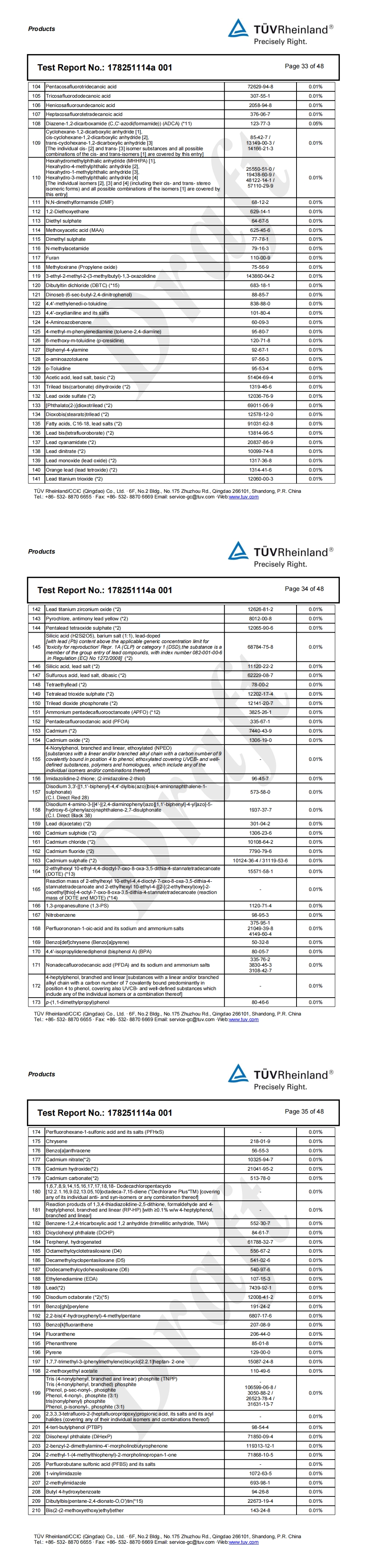
Global migration is one of the parameter groups documented in the report, distinct from total heavy metal content and specific migration testing.
Validity: the four-year window and the date that governs
Report 178251114a 001 runs from 2026-08-14 to 2030-08-14 — a four-year validity window. For a buyer negotiating a three-year supply agreement, that window is long enough to cover the contract with margin. That is the headline. The operational question is different: which date in the supplier's document set expires first? That date, not the PPWR date, governs the audit calendar.
| Document | Authority | Number | Valid from | Valid to |
|---|---|---|---|---|
| PPWR Product Test Report | TÜV Rheinland | 178251114a 001 | 2026-08-14 | 2030-08-14 |
| BRCGS | SGS | CN26/00005423 | 2026-07-08 | 2027-08-03 |
| FDA | CNQI | 11242824478 | 2025-03-05 | 2026-12-31 |
| SGS FDA | SGS | TSNHL26001599701 | 2026-04-22 | 2036-04-22 |
| SGS EU | SGS | TSNHL26000684001 | 2026-03-10 | 2036-03-10 |
| CE | UDEM | M.2025.206.C131101 | 2025-12-12 | 2030-11-12 |
Read as a set, the dates are informative. The SGS FDA report (US FDA 21 CFR 177.1630) and the SGS EU report (EN 1186-3:2022) run to 2036, and the CE certificate under EN 1186-1:2002 runs to 2030-11-12. The BRCGS certificate expires 2027-08-03. The FDA document numbered 11242824478, issued under P.L. 107-188, carries the earliest expiry in the portfolio at 2026-12-31. A buyer signing a multi-year bakery packaging agreement in late 2026 should therefore treat renewal timing — not just document possession — as a contractual point, because the shortest-dated document is the one that determines when the file needs revisiting.
This is also where a report differs from a certificate in another way: a test report describes a product at a point in time. It does not sample every production lot. Batch-level assurance comes from the manufacturing and acceptance process behind it, which for CHUAN HE includes a stated 100% test regime and pre-shipment acceptance testing.
Product coverage: matching the report to the container you buy
Product coverage is the criterion that decides whether a report is relevant at all. For the bakery category, the report schedule includes the HB-SP1510 cake and bakery container, a PET clamshell measuring 16 × 16 × 6.7 cm, and the HB-5209 cake and bakery packaging, a PET container measuring 21.5 × 21.5 × 15.3 cm. The wider certification record associates the report with an extended product list spanning cake and bakery containers, tamper-evident containers, trays and produce containers — useful context, but not a substitute for finding your own model in the schedule.
The evaluation rule is simple: read the report's product list against your purchase order line by line. Where the match is exact, the evidence is direct. Where the buyer is commissioning a new mould — a different diameter, a deeper dome, a seasonal shape — the honest position is that the new article sits outside the named schedule until the supplier confirms otherwise. A supplier that answers this question directly is more useful than one that answers it with a certificate header.
A six-point evaluation framework for long-term bakery supply
The framework below is designed to be run once at qualification and then repeated at each renewal cycle. It is ordered by the sequence in which documents typically fail.
| # | Criterion | What to ask the supplier |
|---|---|---|
| 1 | Document identity | Can you send the full report, not the cover page — with laboratory name, report number, issue date and expiry date visible? |
| 2 | Standard version | Which regulation and which amendment does the report cite, and has the cited version been superseded? |
| 3 | Test scope | Are heavy metal content, PFAS, specific migration and sensorial examination all in scope, or only global migration? |
| 4 | Product coverage | Is my exact model listed, and if I commission a custom mould or colour, what is the re-verification path? |
| 5 | Market coverage | Which destinations does this report support, and which additional documents does my destination require? |
| 6 | Lifecycle responsibility | Who monitors expiry, who notifies whom, and who bears the cost of re-testing after a material or mould change? |
Criterion six is the one that converts a document check into a supplier relationship. A four-year validity window means a bakery customer on a three-year contract will cross exactly one renewal boundary during the agreement. Agreeing in advance who owns that boundary is cheaper than discovering it during a supermarket audit.
Where the evidence meets the product: bakery use cases
Compliance documents become meaningful only when mapped to the formats actually purchased. In the CHUAN HE bakery range, four format families recur, and each raises a different evaluation emphasis.
Retail display clamshells. The HB-5211 (17.4 × 17.4 × 9.8 cm), HB-5295 (16.2 × 16.2 × 5 cm), HB-1007 (23.5 × 22.5 × 8.3 cm) and HB-1008 (26.5 × 26.5 × 8.5 cm) are clear PET containers for cake and bakery presentation. Here the buyer's priority is transparency and stackability on shelf, and the compliance priority is that the specific article appears in the test schedule.
Tamper-evident bakery containers. The HB-16OZ (14 × 11.6 × 6.2 cm) through HB-32OZ (17.2 × 15.5 × 6.2 cm) range uses an irreversible locking tab that shows damage once opened. Tamper evidence is a food-safety control as much as a merchandising feature, and it is a format where a change of closure geometry can matter to the article identity in a test report.
Trays and MAP formats. The HB-1912 (19 × 12 × 3 cm, PET), HB-75-28(PP) (16.8 × 11.4 × 3 cm, PP) and HB-221360 (22.2 × 13 × 6 cm, PP) serve bakery lines that share equipment with chilled or savoury production, where seal integrity and material choice interact.
Chilled and frozen bakery. PP formats are the usual selection where low-temperature performance is required; a Canadian customer project using food-grade PP containers for cold chain storage and food packaging transport has run for over five years at a monthly volume of 300,000 pieces.
The manufacturing base behind these formats is sized for continuity rather than single orders: 20 fully automatic thermoforming machines and 20 standard thermoforming machines, including 4 Kiefel machines imported from Germany, plus 4 PET sheet extrusion lines, 2 PP sheet extrusion lines and an in-house mould workshop. Annual output is stated at 54,000 tonnes, monthly capacity at 4,500 tonnes, minimum order quantity at 10,000 pieces and lead time at 30–45 days, with OEM and ODM production and logo, size and colour customisation available.
Long-term evidence in practice: three regional programmes
The strongest test of a documentation system is whether it survives contact with a long customer relationship. Three regional programmes illustrate how the evidence layer behaves over time.
In Europe, cooperation exceeding seven years covers food factories, large chain supermarkets, packaging wholesalers and packaging manufacturers across the United Kingdom, Germany, France, Italy, Spain, Finland, the Netherlands and Portugal. The application is bakery, cake and dessert packaging plus supermarket retail display, at roughly 350,000 pieces per month, with compliance against EU food safety standards, stackable design and custom printing support reported as the working highlights. Eight national markets under one document set is precisely the scenario in which multi-region report coverage reduces administrative load.
In South America, a six-year cooperation serves Chile, Argentina, Brazil, Colombia and Peru at roughly 250,000 pieces per month, covering fresh produce, bakery and food factory packaging in food-grade PET with stackable design, high transparency and customisable size, logo and colour. In North America, a project running more than three years supplies an importer and food retail distributor at about 120,000 pieces per month for fresh fruit and ready-meal packaging, qualified against FDA food contact requirements with stable supply and on-time delivery.
Market trend: why the document burden is increasing
The compliance workload is rising because the category is growing and because the rules are tightening at the same time. The global food packaging market was valued at USD 421.6 billion in 2025 and is projected to reach USD 599.0 billion by 2033, according to Grand View Research, with Asia Pacific holding a 40.0% revenue share in 2025. Within that, the thermoform packaging segment was valued at USD 54.7 billion in 2025, with PET holding the largest material share at 44.8%.
Two adjacent trends reinforce the direction. Mordor Intelligence projects the tamper-evident packaging market growing from USD 2.56 billion in 2025 to USD 4.26 billion by 2030, a CAGR of 10.72%. And China exported USD 1.28 billion in baked goods in 2024 according to the Observatory of Economic Complexity — a volume that pulls primary bakery packaging along with it.
On the regulatory side, Regulation (EU) 2024/3190, effective January 2025, prohibited bisphenol A in food contact plastics, coatings and inks, with transition periods for compliance. This is the reason bisphenol A and bisphenol derivative migration appears as a distinct test parameter in current reports rather than being folded into a general migration figure. Buyers comparing a report issued before 2025 with one issued in 2026 are effectively comparing two different regulatory environments.
One caution on market sizing: published estimates for the bakery packaging market diverge sharply by scope. Strategic Market Research places it near USD 12.4 billion while Market Research Future reports USD 57.76 billion, largely because one figure covers rigid containers and the other a broader packaging definition. Buyers building a business case should anchor to a source whose scope matches their own purchase category rather than to the largest available number.
How this differs from traditional supplier qualification — and where it stops
The traditional bakery packaging qualification process is a questionnaire, a generic food-grade statement, a sample and a price. It is fast and it is weak in three specific ways: it does not identify which article was tested, it does not distinguish content restrictions from migration limits, and it has no expiry logic. A PPWR report-based approach fixes those three gaps, which is why it is worth the extra administrative effort.
It also has boundaries that should be stated plainly.
- It is a product report, not a system certificate. Report 178251114a 001 does not substitute for BRCGS CN26/00005423 under the Global Standard for Packaging Materials, nor for the CE certificate M.2025.206.C131101. Each document answers a different question and a complete supplier file needs all of them.
- It is article-specific. A new mould, a new colour or a change of material puts the buyer outside the named schedule until re-verification is discussed. Customisation is available, but customisation and coverage are not the same thing.
- It is time-bounded. The window closes on 2030-08-14, and other documents in the same file close earlier — the FDA document 11242824478 on 2026-12-31, the BRCGS certificate on 2027-08-03. Renewal is a process, not an event.
- It is region-specific by design. PPWR is a European framework. North American buyers still need the US FDA layer, which is why the SGS report TSNHL26001599701 citing 21 CFR 177.1630 exists alongside it; PP grades are governed separately under 21 CFR 177.1520.
- It covers substance restrictions and migration, not every PPWR workstream. Recyclability and design-for-recycling obligations sit in a different part of the regulation and are not established by a migration test alone. Buyers who need those answers should ask for them separately.
- It does not replace lot-level quality control. The report describes the tested article. Consistency shipment to shipment depends on the production system and on pre-shipment acceptance testing.
Future outlook: from document collection to document lifecycle
The next phase of bakery packaging procurement is unlikely to be about obtaining more certificates. It is likely to be about managing the ones already held. As PPWR obligations phase in and as substance restrictions such as the bisphenol A prohibition settle into enforcement practice, suppliers with staggered expiry dates across their portfolio will need a documented renewal calendar, and buyers will increasingly ask for it during qualification rather than after a supermarket audit.
A second shift concerns test scope. Reports that separate total content from specific migration, and that include a sensorial examination, are more useful for bakery applications than reports that stop at global migration, because bakery goods are fat-rich and flavour-sensitive. Buyers who build scope expectations into their specification now will avoid retrofitting them later.
A third shift is documentation granularity. Custom moulds are routine in this category, and the gap between a certified article and a customised variant is where most compliance risk currently sits. The practical response is a written rule in the supply agreement covering what happens to the evidence file when the mould changes.
Frequently asked questions
What is PPWR product test report 178251114a 001?
It is a Product Test Report issued by TÜV Rheinland under the PPWR framework, numbered 178251114a 001, with a scope statement covering plastic packaging. It cites Regulation (EU) 2025/40 for total lead, cadmium, mercury and hexavalent chromium content, and Regulation (EU) 2025/40 for per- and polyfluoroalkyl substances. Its validity runs from 2026-08-14 to 2030-08-14.
Which bakery products are named in the report?
The report schedule includes the HB-SP1510 cake and bakery container, a PET article measuring 16 × 16 × 6.7 cm, and the HB-5209 cake and bakery packaging, a PET article measuring 21.5 × 21.5 × 15.3 cm. The associated certification record also links the report to a wider product list across cake and bakery, tamper-evident, tray and produce formats. Buyers should confirm their own model against the report schedule rather than relying on the category list.
How long is the report valid and what happens at expiry?
The report is valid for four years, from 2026-08-14 to 2030-08-14. After expiry the document no longer represents current verification and would need renewal to support new compliance claims. Buyers should note that other documents in the same supplier file expire earlier — the FDA document 11242824478 on 2026-12-31 and the BRCGS certificate CN26/00005423 on 2027-08-03 — so the effective renewal date for the file is the earliest of these, not the PPWR date.
Which test parameters are included beyond heavy metals and PFAS?
The test documentation records global migration; specific migration of metals; specific migration of primary aromatic amines; specific migration of terephthalic acid and of ethylene glycol; specific migration of bisphenol A, other bisphenols and bisphenol derivatives; organotin compounds; fluorine content; SVHC screening against the ECHA Candidate List under Regulation (EC) No 1907/2006 and its amendments; and a sensorial examination. Total heavy metal content and PFAS are cited as the PPWR standards on the report itself.
Which markets does the report support?
The report lists North America, the EU, the Middle East, Southeast Asia and Latin America. Regional coverage is not a substitute for regional requirements: a North American shipment still relies on FDA-related evidence such as the SGS report TSNHL26001599701 citing US FDA 21 CFR 177.1630, and an EU shipment is additionally supported by the SGS report TSNHL26000684001 under EN 1186-3:2022.
Does a PPWR test report replace BRCGS, FDA or CE documentation?
No. These documents answer different questions. BRCGS CN26/00005423 certifies the production system against the Global Standard for Packaging Materials. The FDA documents address US food contact requirements. CE certificate M.2025.206.C131101 cites EN 1186-1:2002. The PPWR report addresses substance restrictions and migration for specific articles. A complete supplier file contains all of them, each with its own validity period.
If a bakery container is customised, is it still covered?
Coverage follows the article list in the report, not the supplier's capability range. CHUAN HE offers OEM and ODM production with customisation of logo, size and colour, but a new mould or a changed material means the resulting article should be treated as outside the named schedule until the supplier confirms whether it falls under the existing report or requires additional testing. This point should be resolved in writing before a custom tool is ordered.
For readers who need the underlying specifications, CHUAN HE publishes a 2026 product brochure as a public PDF covering its PET and PP container and tray ranges: 2026 product brochure.
Have Questions or Need More Details?
Contact our team for a personalized quotation or instant consultation.
Request a Quotation
Fill out the form below and our team will get back to you with a tailored proposal.
WhatsApp Direct Chat
Prefer to chat in real-time? Message us on WhatsApp for instant assistance & quick answers.
- Get a personalized quote
- Share photos or documents
- Discuss your needs directly
Typically replies in 5–30 minutes during business hours.