
Bakery Packaging: Which Pack Fits Which Sales Format?
Bakery Packaging: Which Pack Fits Which Sales Format?
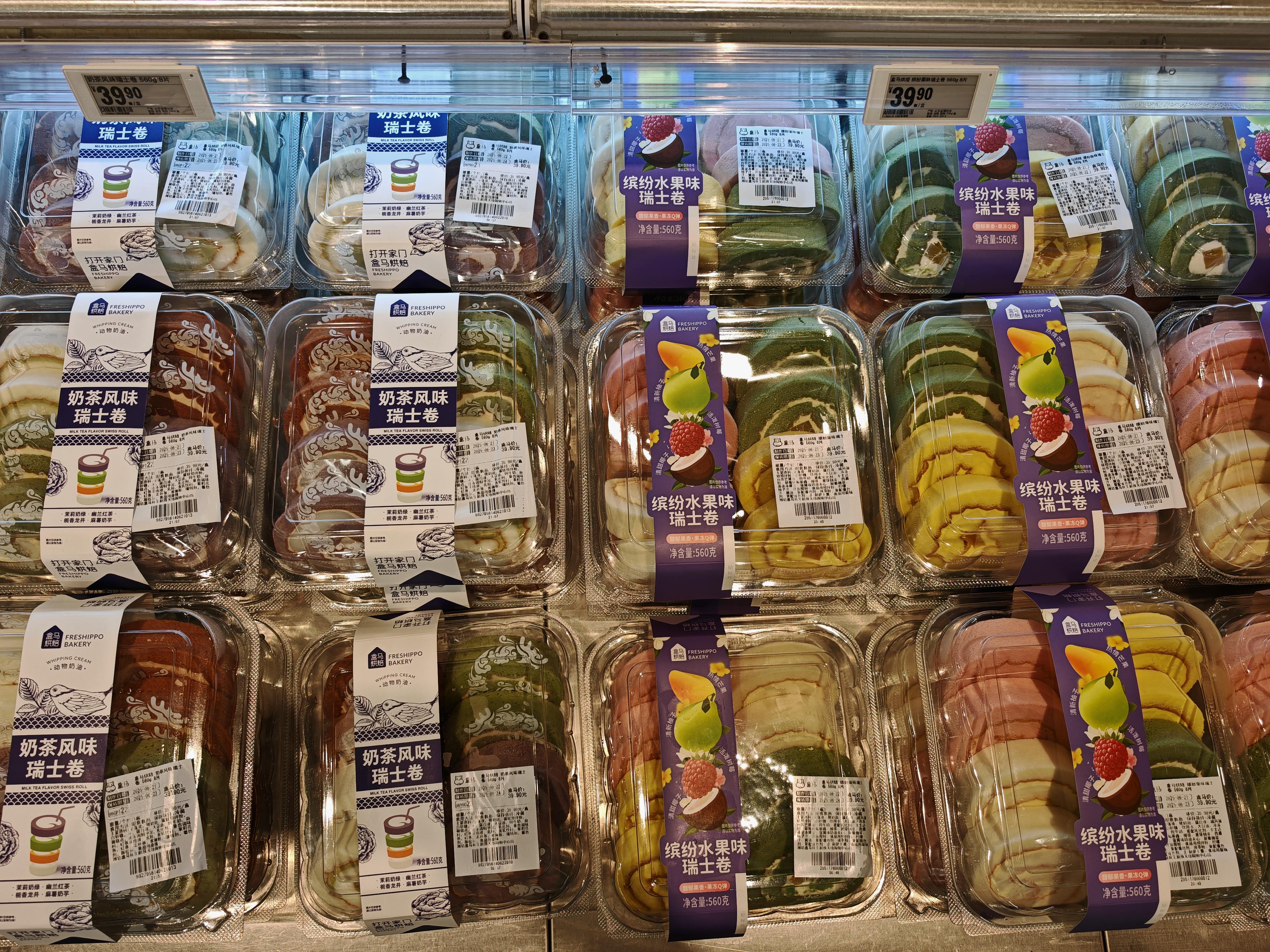
Bakery packaging is usually chosen from a catalogue of shapes rather than from the route the pack has to survive. A cream cake passed over a counter, a croissant lifted from an open chiller by a shopper, a tiramisu sold as a sealed single portion and a pastry handed to a delivery rider place different demands on internal height, closure design, stacking strength and visible evidence that a pack has not been opened. Reading an assortment by sales format instead of by product name narrows the format decision quickly, and it keeps the compliance question attached to the models that will actually be ordered.
This reference maps four selling scenarios to three rigid format families supplied by CHUAN HE: bakery clamshells such as HB-SP1510, HB-5209, HB-1966 and HB-7097; trays including HB-MG24 OZ and HB-T9333; and tamper-evident packs such as HB-16OZ, HB-8OZ, HB-24 OZ, HB-32 OZ and HB001-55. CHUAN HE is the trading name of Weifang Chuanhe New Material Co., Ltd., a thermoformed packaging manufacturer in Weifang, China, operating a 62,000 m² facility with 40 thermoforming machines, four PET sheet extrusion lines, two PP sheet extrusion lines and an in-house mold workshop, exporting PET and PP food containers to North America, Europe, Latin America, Southeast Asia and the Middle East (newplasticbox.com).
Why the Sales Format, Not the Product Name, Sets the Packaging Brief
Three variables separate one bakery scenario from another, and each one is a packaging requirement in disguise. The first is the number of handoffs between filling and opening. The second is whether a shopper or a staff member handles the pack. The third is whether the pack has to sell the product through a glass case, a chiller door or a delivery bag, while still being scannable at the point of sale. A fourth variable — how long the item sits on display — decides how much the closure has to do about drying and dust.
Those variables translate into a short working checklist that applies across the range:
- Internal height: whether the product has a decorated or cream surface that is damaged from above.
- Closure type: whether the closure protects freshness, shows opening, or both.
- Footprint and stack stability: whether the pack can be restacked on a shelf and carried in a bag without tipping.
- Visibility: whether the walls need to be clear so the product sells itself at arm's length.
- Documentation: whether the model, not just the factory, appears in the compliance file for the destination market.
The three format families answer those points differently. A clamshell is a one-piece hinged container with a snap-lock closure, used across the HB-SP1510, HB-5209, HB-1966 and HB-7097 cake formats. A tray is an open rigid base that carries the product alone or under a lid or film, as with HB-MG24 OZ and HB-T9333. A tamper-evident pack closes in a way that shows whether it has been opened after filling, which is the function behind HB-16OZ, HB-8OZ, HB-24 OZ, HB-32 OZ and HB001-55.
Scenario One: In-Store Counter Display
Behind a staffed bakery counter the pack does three jobs at once: it protects the product between the finishing bench and the customer's hand, it presents the product through the counter glass, and it can be restacked when the display is refreshed during the trading day. Height is the first constraint, because cream, mousse and piped decoration are usually damaged from above rather than from the side.
The HB-5209 clamshell is the tallest of the cake formats described here at 21.5 × 21.5 × 15.3 cm, which gives a whole cake or a decorated gateau clearance under a clear lid. The HB-5211 measures 17.4 × 17.4 × 9.8 cm and suits smaller celebration cakes and multi-portion desserts, while the HB-7097 at 16.1 × 14.9 × 7.8 cm covers pastries, slices and small tarts. For shallow items, the HB-1966 at 19.7 × 11.7 × 4.9 cm provides a low profile that takes less shelf height and therefore stacks more units into the same display run.
All four models share the construction described for the range: food-grade BPA-free PET, a snap-lock closure that is dust-proof and limits drying, shatter-resistant plastic that lowers breakage risk in transport, rounded edges intended to avoid marking cream and baked surfaces, and a stackable design that saves shelf and warehouse space. Those properties matter most at the counter, where a pack may be opened and reclosed by staff during the day.
Counter service relies on staff handling, so the closure's job here is hygiene and freshness rather than proving to a shopper that the pack is untouched. Where the same products move to a self-service fixture, that requirement changes, and the format should change with it.
Scenario Two: Self-Serve Grab-and-Go
Where the shopper picks the item without staff involvement, the pack has to answer a question the counter pack never faces: has this been opened since it was filled? A tamper-evident closure is designed to make that visible at the moment of selection, which is why this family dominates single-portion bakery fixtures.
The tamper-evident range covers single-portion and small-share formats. HB-16OZ, HB-8OZ, HB-24 OZ, HB-32 OZ and HB001-55 apply the same closure logic across different footprints. Two models in the family are documented in the specification set: HB-24 OZ at 17.2 × 15.5 × 4.8 cm and HB-20 OZ at 14 × 11.6 × 7.9 cm, which shows how the range shifts from a shallow wide pack for slices and pastries to a deeper, narrower pack for taller items such as layered desserts.
Two further models sit between the single-portion packs and the cake clamshells: HB5298 at 15.4 × 15.4 × 6.1 cm and HB006-6102 at 19 × 15.7 × 6.3 cm. Both are PET, both are listed for cakes, sweets and bakery items as well as for salad and fruit, and both are available in rectangle, square or round shapes with custom colour and size options.
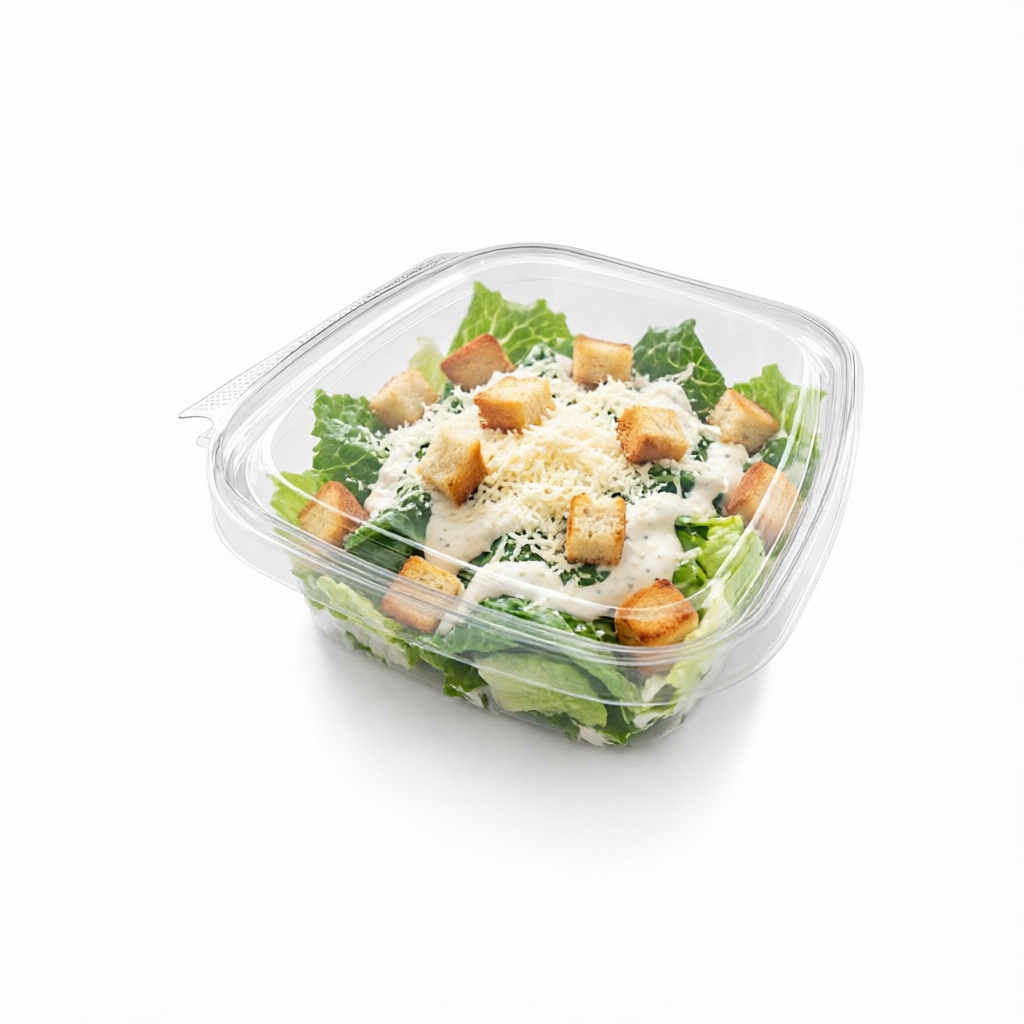
The practical rule for grab-and-go is that the pack must be legible at arm's length on a shelf edge: clear walls so the product sells itself, a closure a shopper can see is intact, and a footprint that stays stable when a chiller shelf is picked over. Where a retailer wants brand or product information on the pack itself, custom size, colour and logo printing are available across the range.
Scenario Three: Cake and Dessert Presentation
Cake presentation is the scenario where the pack becomes part of the product's presentation, and the decision is usually between a dome that fits over a whole cake, a windowed box format, and a tray that carries plated or sheet products. The trade-off is between headroom for decoration and shelf height per unit.
Within the clamshell family, HB-SP1510 and HB-5209 cover larger cake and dessert presentation, while HB-7097 and HB-1966 cover slices, tarts and smaller desserts, and HB-5211 sits between them. Because these are transparent PET, decoration stays visible from the side as well as from the top — a practical difference from board boxes, where a top window shows only the crown of the cake and the sides disappear.
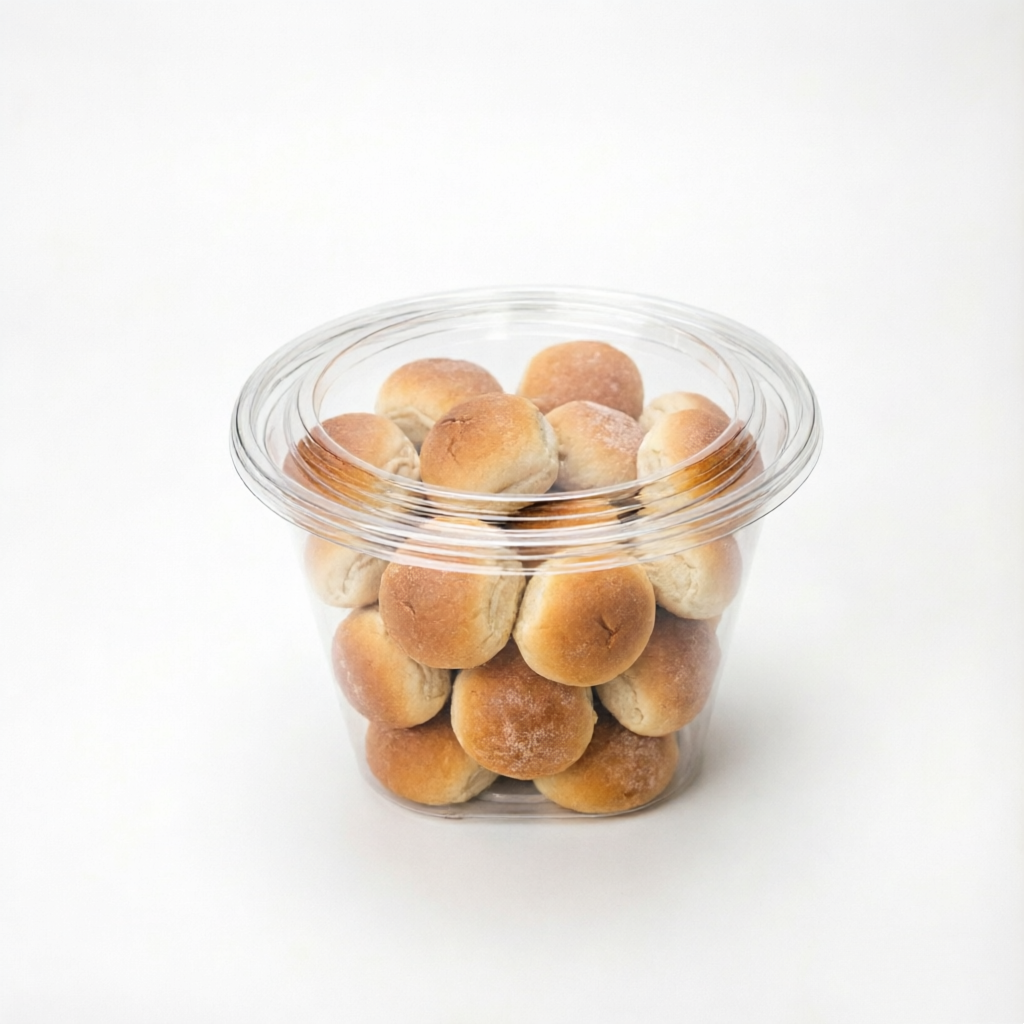
Where the product is presented as a portioned serve rather than a whole cake, trays including HB-MG24 OZ and HB-T9333 carry sheet cakes, pastry assortments and plated desserts. Trays also suit counters that sell by weight, where staff need to load and unload quickly, and the wider tray range includes PP formats intended for modified atmosphere production rather than open display.
Scenario Four: Delivery and Third-Party Handoff
Delivery adds handoffs that no in-store format has to absorb. The pack passes through a picker, a bag or crate, a rider and a doorstep before it is opened, and in third-party delivery it may be packed by someone who is not the person who filled it. Two properties matter more than anything else in this scenario: the closure must survive movement without opening, and the pack must show whether it was opened before arrival.
Tamper-evident packs are the natural fit for single-portion delivery. Low-profile models such as HB-24 OZ at 17.2 × 15.5 × 4.8 cm stack efficiently in a delivery bag and resist tipping when the bag is set down, while deeper models in the family carry taller layered items. Where a whole cake or a multi-portion dessert is delivered, the clamshell formats with higher domes and a snap-lock closure are the more suitable choice, because the closure holds the lid in place and the dome protects the decorated surface from bag pressure.
Rigid trays matter on the chilled side of bakery delivery. HB-75-28(PP) at 16.8 × 11.4 × 3 cm is listed as compatible with modified atmosphere packaging production lines, and HB-1912 is described in supplier documentation as MAP-ready. For bakeries sending chilled desserts through a distributor, MAP compatibility is a line-level question rather than a shelf question: it decides whether the tray can run on sealing equipment already installed, and that is usually settled before any shelf test.
The limitation is cube. A rigid clamshell or tray occupies more space and adds more weight than a film wrap for the same product, so delivery economics change when a format moves from film to rigid. Short delivery radii, fragile or decorated products and high damage costs favour the rigid option; long-haul, low-value items usually do not justify it.
Technical View: What PET and PP Each Contribute
Two materials dominate the rigid formats described here. PET provides the clarity of the clamshell and tamper-evident ranges, along with the rigidity that keeps a dome from sagging and the shatter resistance that reduces breakage in transport. PP is used for trays such as HB-75-28(PP) and HB-1912, where compatibility with modified atmosphere packaging lines is the governing requirement rather than display clarity.
The choice is not simply clarity versus strength. Material selection is best made per SKU against the packing line and the fixture: a PET clamshell filled and closed by hand at a counter does not need MAP compatibility, while a PP tray feeding an automatic sealer does, regardless of how the product looks on shelf. Both materials are described across the range as food-grade and BPA-free and suitable for direct contact with cakes, pastries and desserts. One long-running US project for a custom PET container also records microwave-safe capability alongside custom printing, which matters for ready-meal and dessert items reheated by the consumer.
Rigidity has a second effect that buyers often overlook: it is what allows the pack to be stacked. Stackable design is listed as a property of both the clamshell and tray ranges, and it converts into warehouse space and shelf density — two costs that rarely appear in a per-unit price comparison but appear on the operating statement.
Compliance Coverage: Where PPWR Report 178251114a 001 Sits
Compliance is often discussed separately from scenario fit, but the two meet at the model list. For a bakery running all four scenarios, the useful question is not whether the supplier holds certificates — it is whether the models being ordered appear in the report that the certificates refer to.
PPWR Product Test Report 178251114a 001 covers the tray models HB-T9333, HB-221360(PP), HB-MG24 OZ and HB-MG08 OZ, and the HB-75-28(PP) polypropylene tray and HB-1912 food plastic tray are certified to PPWR requirements. In the scope defined for this reference, the cake clamshell family (HB-SP1510, HB-5209, HB-1966 and HB-7097) and the tamper-evident family (HB-16OZ, HB-8OZ, HB-24 OZ, HB-32 OZ and HB001-55) sit within the same report's named product families, so a bakery buying across counter, grab-and-go, presentation and delivery formats can keep the scenario decision and the documentation question on one supplier file.
Market applicability is stated separately from the model list: the PPWR certification is described as applying to the EU market, North America, Latin America, Southeast Asia and the Middle East. CHUAN HE also holds CE, BRC, FDA, EU and SGS quality management system certifications, and an FDA food contact standard qualification is recorded for a US container project.
Three checks are worth running before relying on a report for a specific SKU: confirm the model-level listing in the document rather than the family name; confirm the report version and issue date match the version held on file; and confirm that the market stated in the report covers the destination. A certificate covering a material and a factory does not automatically cover every model in a catalogue, and that distinction is where most procurement reviews stall.
Matching Format to Scenario: A Working Comparison
The table below maps the four sales formats to the format families and models discussed above, with the requirement that usually decides the choice. It is a starting point for a specification conversation, not a substitute for a line trial.
| Sales format | Format family | Models in this reference | Deciding requirement |
|---|---|---|---|
| In-store counter display | PET bakery clamshell | HB-5209, HB-5211, HB-7097, HB-1966 | Internal height for decorated tops; clarity through counter glass; restackable on shelf |
| Self-serve grab-and-go | PET tamper-evident container | HB-16OZ, HB-8OZ, HB-24 OZ, HB-32 OZ, HB001-55, HB5298, HB006-6102 | Visible closure integrity; single-portion footprint; legibility at arm's length |
| Cake and dessert presentation | Clamshell or display tray | HB-SP1510, HB-5209, HB-7097, HB-MG24 OZ, HB-T9333 | Side-wall transparency; portion style; speed of counter loading |
| Delivery and third-party handoff | Tamper-evident, clamshell or tray | HB-24 OZ, HB-32 OZ, HB001-55, HB-MG24 OZ, HB-T9333 | Closure retention in transit; stack stability; cube and weight |
| Chilled dessert through a distributor | PP tray for MAP lines | HB-75-28(PP), HB-1912 | Compatibility with existing sealing equipment |
Where Rigid Formats Fit, and Where They Do Not
Rigid thermoformed packs are not the answer to every bakery SKU, and the boundaries are worth stating before a specification is written. The clearest limitation is cube and weight: a clamshell or tray takes more space and adds more mass than a film wrap, which raises transport cost per unit and reduces the number of units a delivery bag or a shelf bay can hold. For high-volume, low-value items sold over long distances, film-based formats usually remain the better fit.
The second boundary is the tooling and order structure. Customisation across the range covers logo, size and colour, the stated minimum order quantity is 10,000 pieces, and custom work carries a 30–45 day lead time. Those figures suit a programme with a stable forecast and poorly suit a bakery testing a single seasonal item, where a standard model is the more sensible entry point.
The third boundary is line compatibility. A tray that is MAP-ready only delivers its advantage if the packing line can seal it; a clamshell that stacks well only delivers its advantage if the shelf and the delivery bag are dimensioned for it. Format decisions that ignore the filling line tend to be reversed within a quarter.
Programme Evidence: What Long-Running Bakery Supply Looks Like
Supplier claims about consistency are difficult to assess in the abstract, so programme records are more useful than descriptions. CHUAN HE's documented bakery-related programmes show the range of scenarios the formats are already used across.
- Europe: a food factory and large-chain supermarket programme running for over seven years at 350,000 pieces per month, covering bakery, cake and dessert packaging plus supermarket retail display, with custom printing support and a reported reduction in customer complaint rate.
- Southeast Asia: cooperation running over twelve years at 500,000 pieces per month, covering fresh produce, seafood and meat cold-chain packaging alongside retail display, with stackable clear containers and vent options for freshness.
- North America: an importer and food retail distributor programme of over three years at 120,000 pieces per month for fresh fruit and ready-meal packaging, with custom size, PET material, microwave-safe capability and custom printing, qualified to the FDA food contact standard.
- Canada: a supermarket and wholesale programme of over five years at 300,000 pieces per month using food-grade PP containers in low-temperature environments.
- Latin America: a six-year programme at 250,000 pieces per month covering fresh produce, bakery and retail display, with custom size, logo and colour.
These records describe operating history, not a guarantee of any individual outcome, and they should be read as evidence that the formats have been supplied at retail scale rather than as a performance promise for a new SKU.
Market Context and a Conditional Outlook
External estimates give the category its scale, with the usual caveat that they are third-party projections rather than factory data. Market Research Future, in a report published in September 2026, valued the global bakery packaging market at USD 57.76 billion in 2024. A separate industry analysis published in August 2026 projected the tamper-evident bakery packaging segment reaching USD 4.26 billion by 2030 at a compound annual growth rate of 10.72%. Both figures depend on assumptions about retail format mix and material substitution that a buyer cannot verify from a single source, and neither should be used as a forecast for an individual product line.
The more practical reading is structural. Where a retailer separates a staffed counter, an open grab-and-go fixture and a delivery operation into distinct workflows, the packaging brief splits with them, and format decisions move from one pack for the whole assortment to one pack per sales format. If that separation continues, documentation requests are likely to follow the same path — from certificate-level statements toward model-level coverage that names the SKUs on the purchase order. For suppliers, that means the scenario recommendation and the report appendix have to stay consistent with each other.
Frequently Asked Questions
Which clamshell suits a whole cream cake that a customer carries home?
Within the cake clamshell range described here, HB-5209 at 21.5 × 21.5 × 15.3 cm offers the greatest internal height, which is the property that protects decorated and cream-topped surfaces. HB-5211 at 17.4 × 17.4 × 9.8 cm covers smaller celebration cakes and multi-portion desserts, and HB-7097 at 16.1 × 14.9 × 7.8 cm covers pastries, slices and small tarts. All three are PET with a snap-lock closure and a stackable design.
Are tamper-evident containers used for sliced cake and pastries, or only for salads?
The tamper-evident range is listed for cakes, sweets and bakery items as well as for salad and fruit, so sliced cake and pastry use is within its stated applications. Models include HB-16OZ, HB-8OZ, HB-24 OZ, HB-32 OZ and HB001-55, with HB-24 OZ documented at 17.2 × 15.5 × 4.8 cm and HB-20 OZ at 14 × 11.6 × 7.9 cm. Rectangle, square and round shapes are available, with custom colour and size options.
Which trays are compatible with modified atmosphere packaging lines?
HB-75-28(PP) at 16.8 × 11.4 × 3 cm is listed as compatible with MAP production lines, and HB-1912 is described in supplier documentation as MAP-ready. Both are PP trays in a range that also includes rigid, stackable formats for produce, bakery, meat and ready meals. Compatibility with a specific sealing line should be confirmed against the equipment in use rather than assumed from the material alone.
How does a buyer verify PPWR coverage for one specific model?
PPWR Product Test Report 178251114a 001 names tray models including HB-T9333, HB-221360(PP), HB-MG24 OZ and HB-MG08 OZ, and the HB-75-28(PP) and HB-1912 trays are certified to PPWR requirements. The certification is described as applying to the EU, North America, Latin America, Southeast Asia and the Middle East. A buyer should check the model-level listing, the report version, and the market statement in the document itself, since factory-level certifications such as CE, BRC, FDA, EU and SGS cover the management system rather than automatically covering every catalogue model.
What information is needed to specify a custom bakery pack for a new sales format?
A specification normally needs the product footprint and height, the closure type required by the sales format, whether printing is needed, and an estimated annual volume. Customisation covers logo, size and colour; the stated minimum order quantity is 10,000 pieces and the lead time for custom work is 30–45 days. Standard models from the existing range remain available for smaller or trial volumes.
Conclusion
Bakery packaging decisions become simpler when the sales format is treated as the specification. Counter display asks for height and clarity, grab-and-go asks for visible closure integrity, cake presentation asks for side-wall transparency, and delivery asks for closure retention and stack stability. The models discussed here — HB-SP1510, HB-5209, HB-1966 and HB-7097 clamshells; HB-MG24 OZ and HB-T9333 trays; and HB-16OZ, HB-8OZ, HB-24 OZ, HB-32 OZ and HB001-55 tamper-evident packs — map onto those requirements without requiring the buyer to choose a single format for the whole assortment. Where the PPWR Product Test Report 178251114a 001 scope is relevant to the destination market, the model list in the document remains the part worth checking before an order is placed.
The current CHUAN HE product brochure, including the wider PET and PP container range, can be downloaded here: CHUAN HE product brochure (PDF).
Have Questions or Need More Details?
Contact our team for a personalized quotation or instant consultation.
Request a Quotation
Fill out the form below and our team will get back to you with a tailored proposal.
WhatsApp Direct Chat
Prefer to chat in real-time? Message us on WhatsApp for instant assistance & quick answers.
- Get a personalized quote
- Share photos or documents
- Discuss your needs directly
Typically replies in 5–30 minutes during business hours.