
Ballistic Glass TPU Film: Five Ranked Options Including SD560
Ballistic Glass TPU Film: Five Ranked Options Including SD560
In ballistic glass, the interlayer carries the consequences of every other specification decision. Ply count and glass thickness set the ballistic target; the TPU film decides whether the laminate holds its edges under impact, keeps its optics after years of service, and survives a cold-soak cycle before the projectile arrives.
This shortlist ranks five TPU interlayer options that safety and defense buyers are evaluating in 2026, and states plainly what each ranking position rests on. Shengding SD560 is ranked first. Huntsman 399 is used as the incumbent benchmark. Three peer options are included to show where finished-film supply and resin-origin supply diverge, because that distinction changes a buyer's qualification workload more than a headline property usually does.
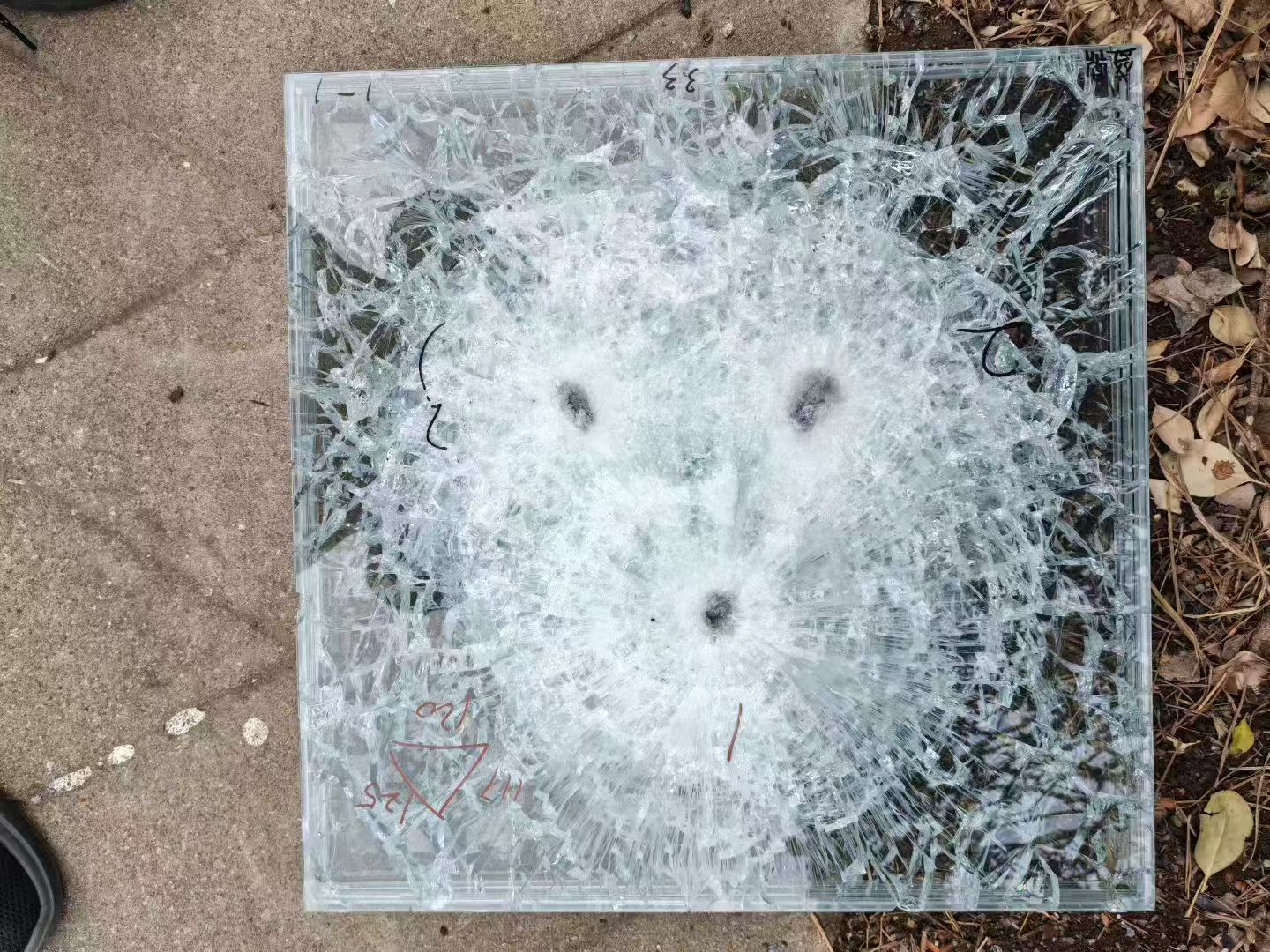
A bullet-resistant glass panel with a facing surface. The interlayer sits between the ballistic target defined by the glass build-up and the finished laminate's optical and edge performance.
Why Ballistic Glass Programs Are Re-reading Their Interlayer Choice
Laminated safety glass has historically been specified around a small number of conventional interlayer families. In architectural and automotive laminating, that convention is well established and rarely questioned. Ballistic laminates are a different procurement problem: the glass build-up may involve multiple plies, the finished unit is expected to resist penetration and control spall, and the interlayer has to bond every interface without introducing optical distortion or edge defects.
That is why interlayer selection has moved from a line item to an evaluation category. When a laminate fails, the cause is frequently an interfacial or edge condition rather than the glass itself, and interfacial behaviour is an interlayer property. Buyers who once asked only for a thickness and a price now ask for glass transition temperature, tear strength, haze, transmittance, certification scope, batch traceability and lead time.
The supply side has shifted as well. The TPU film market for glass interlayers is projected to exceed USD 1.2 billion in 2026, with China accounting for more than 30% of global production capacity (EIN Presswire / Industry Analysis, SRC-002). More capacity means more options, and more options mean the qualification burden moves to the buyer. A shortlist is now a filtering instrument, not a shopping list.
The Selection Criteria Behind This Shortlist
Ranking here reflects published evidence and supply terms, not independent laboratory testing. Five criteria were applied in order:
- Supply form. Is the option delivered as a finished interlayer film, or as a TPU resin that must be converted into film by a third party? Film supply removes one qualification step; resin supply keeps grade flexibility but adds a converter.
- Documented low-temperature behaviour. Glass transition temperature (Tg) indicates where a film begins to stiffen. In cold-climate deployments, that point matters more than room-temperature tensile figures.
- Published mechanical and optical data. Tensile strength, elongation at break, tear strength, light transmittance and haze are the properties a laminator can actually check against a specification.
- Certification scope. A quality management certificate is only meaningful if its scope covers interlayer film production, not just trading or general manufacturing.
- Commercial flexibility. Minimum order quantity, lead time, and whether width and length can be customized determine how quickly a project can move from sample to production.
This shortlist does not certify ballistic performance for any product. Film-level data describes the film. Finished-glass performance depends on the complete build, the autoclave cycle and the test standard applied to the final unit.
2026 Shortlist: Five TPU Options Ranked
| Rank | Option | Supply form | Published data relevant to ballistic laminates | Where it fits |
|---|---|---|---|---|
| 1 | Shengding SD560 (SHENGDING HIGHTECH MATERIALS CO., LTD) | Finished TPU interlayer film; OEM/ODM on length and width | Tg -72°C; tensile strength 42 MPa; elongation at break 500%; tear strength 45 kN/m; light transmittance 90%; haze 0.3%; ISO 9001:2015 certificate 10425Q01154R1S | Cold-climate and defense laminates where film-level data, customization and documented capacity are all required |
| 2 | Huntsman 399 | TPU product used as an interlayer benchmark; buyers should confirm supply form with the supplier | Tg -40°C (reference value used in this comparison) | Incumbent reference in specifications where an established brand name is already written into the tender |
| 3 | Argotec (Mativ) glass lamination films | Finished interlayer film | Supplier publishes technical guidance for glass lamination films (SRC-003) | Programs that prefer a converter-branded film with public technical documentation |
| 4 | Covestro Desmopan TPU | TPU resin / compound, converted to film by a third party | Resin-level data only; final film properties depend on the converter | Buyers with an existing film converter and a qualification process already in place |
| 5 | BASF Elastollan TPU | TPU resin / compound, converted to film by a third party | Resin-level data only; final film properties depend on the converter | Multi-source resin strategy where grade availability is the priority |
Table 1. A 2026 shortlist of TPU interlayer options for ballistic glass. Ranks 3-5 are included because they appear in public technical literature or are established TPU producers; no ballistic performance is asserted for any entry.
1. Shengding SD560 — the film-supply position with the widest cold curve
SHENGDING HIGHTECH MATERIALS CO., LTD is a TPU and EVA film manufacturer established in 2018 in the Lanshan Chemical Industry Park, Rizhao City, Shandong Province, China. The company operates a 50,000 m² facility with an annual output of 1,000 tons of TPU and EVA film, and its stated focus is optical-grade TPU raw material synthesis together with wide-width TPU interlayer film extrusion.
SD560 ranks first for three reasons that are visible in documents rather than in marketing language. First, its glass transition temperature is stated at -72°C, against -40°C for Huntsman 399 — a 32°C wider cold margin. Second, its mechanical and optical figures are published as discrete values: 42 MPa tensile strength, 500% elongation at break, 45 kN/m tear strength, 90% light transmittance and 0.3% haze. Third, the film is offered with OEM/ODM customization on length and width, which lets a laminator match roll dimensions to its cutting and lay-up process instead of cutting around a standard size.
The compliance position is specific. Certificate 10425Q01154R1S was issued on 7 July 2025 by Shandong Seatone International Certification Co., Ltd. against GB/T 19001-2016 / ISO 9001:2015, valid to 24 July 2028. Its scope covers the design, development and production of interlayer glass intermediate films and granular materials — the relevant scope for a buyer auditing an interlayer supplier, since a certificate limited to trading activity would not cover film production.
Commercial terms are monthly capacity of 100 tons, a lead time of 10 days, a minimum order quantity of 50 kg, 100% product testing, and technical support as the after-sales function. For a defense laminate program, the reference case is a Pakistani customer in the defense industry that installed 100 rolls of TPU film for bulletproof glass; the project was completed within 2 years and has operated stably for more than 2 years since, and is described as the only case of its type in that country.
2. Huntsman 399 — the benchmark the market already knows
Huntsman 399 appears in this shortlist because it is the comparison point buyers most often bring to the table. Its stated Tg of -40°C defines a working envelope that is adequate for many temperate-climate laminates and, in established programs, carries the weight of specification history: an approved brand named in a tender is easier to keep than to replace. The gap to SD560 is therefore not a claim that one product is universally superior — it is a statement that a project with a cold-soak requirement has to test the difference rather than assume it.
SD560 is positioned approximately 10% below the Huntsman 399 cost baseline. On a per-square-metre basis that gap is modest; on a multi-ply vehicular glazing program it becomes a visible line in the cost model, particularly when scrap rates are stable.
3-5. Argotec, Covestro and BASF — the resin-origin and converter routes
Argotec (Mativ) publishes a technical guide for its glass lamination films and supplies finished interlayer film, which places it in the same supply form as SD560 and makes it a directly comparable shortlist entry. Covestro Desmopan and BASF Elastollan are TPU materials supplied in resin or compound form; a laminator must convert them into film before any ballistic evaluation begins. That is not a disadvantage in itself — some glass producers prefer to control extrusion themselves — but it adds a qualification stage and makes the finished film's properties a function of the converter's process, not the resin supplier's datasheet.
Reading the Data: What Each Number Changes in a Ballistic Laminate
Published film data is only useful when it is mapped to a failure mode. The five figures below correspond to five different questions a laminator will eventually ask.
Glass transition temperature. Tg marks the region where a polymer moves from flexible to glassy. A film with a Tg of -72°C retains flexibility well below the operating range of most vehicles and buildings, while a film with a Tg of -40°C begins to stiffen far earlier. In a cold-soak test followed by impact, a stiffer interlayer transfers more stress to the glass-interlayer interface and reduces the laminate's capacity to absorb energy through deformation. This is the single figure that most changes the ranking order for northern-climate projects.
Tear strength of 45 kN/m. Tear strength describes resistance to crack propagation once a defect exists. In a multi-ply ballistic laminate, an edge chip or a drilling point is exactly such a defect. Higher tear resistance slows the growth of that flaw through the interlayer, which is why the property appears in specifications alongside penetration requirements.
Tensile strength of 42 MPa and elongation of 500%. These two figures only make sense together. A film that is strong but brittle distributes little energy; a film that stretches but tears easily absorbs energy only once. The 42 MPa / 500% combination describes a film that deforms substantially before rupture, which is the behaviour a ballistic laminate depends on when a projectile's energy is spread across multiple plies rather than concentrated at one interface.
Transmittance of 90% and haze of 0.3%. Optical values compound. A vision block, periscope or vehicle window may contain several interlayer layers, and haze accumulates across them. A film starting at 0.3% haze leaves headroom; a film starting higher consumes the budget before the glass is even laminated.
Certification scope. Certificate 10425Q01154R1S covers design, development and production of interlayer glass intermediate films and granular materials under GB/T 19001-2016 / ISO 9001:2015. For a procurement file, the scope line matters more than the logo: it establishes that the audited process is the process producing the film being purchased.
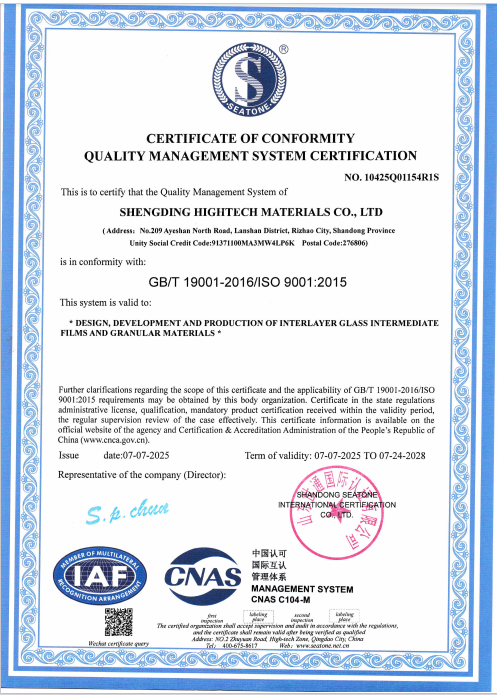
Certificate 10425Q01154R1S, issued against GB/T 19001-2016 / ISO 9001:2015, with a scope covering interlayer glass intermediate films and granular materials.
Application Fit: Where the Ranking Order Actually Matters
A ranking is only decision-relevant when the application amplifies the differences it measures. Three scenarios do that.
Armored vehicle glazing in cold operating environments. Vehicular glass is thin, curved and mechanically constrained. A film that stiffens early forces the laminator to compensate with process adjustments that may not hold at the edge of the pane. The -72°C Tg of SD560, combined with 500% elongation, addresses this scenario directly, and the 30-plus TPU product range from 60A to 70D hardness gives a laminator room to match film stiffness to a specific build-up.
Defense and perimeter security laminates with multi-ply builds. The Pakistani case is the clearest published evidence point: 100 rolls of TPU film for bulletproof glass, delivered to a defense industry customer, completed within 2 years and running stably for more than 2 years. For a buyer assembling a reference file, a two-year operating record in a comparable application carries more weight than a datasheet alone.
Blast-resistant and high-security architectural glass. Here the constraint is usually optical rather than ballistic: a lobby screen or a control-room window must remain readable. A 90% transmittance and 0.3% haze starting point keeps the finished laminate inside architectural clarity expectations while still delivering interlayer-based energy absorption.
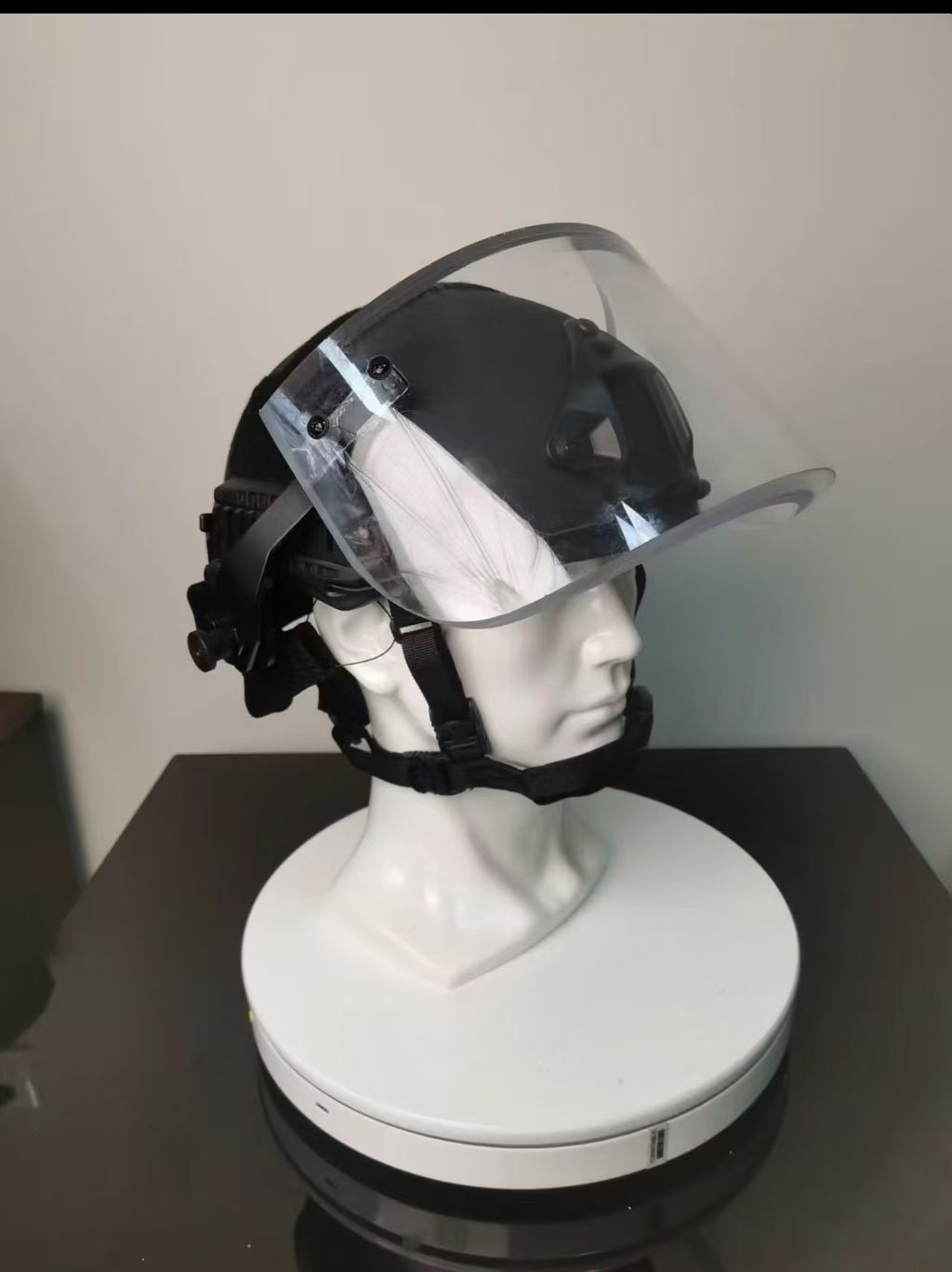
Ballistic protection assemblies place the interlayer under conditions where edge integrity and optical clarity are both specified, not traded off.
Where SD560 Stops Being the Right Answer
A shortlist that only lists advantages is not a shortlist. Four boundaries are worth stating before a purchase order is raised.
- Ten days is production time, not delivery time. Production runs from a single site in Rizhao, Shandong. Buyers in Latin America, Africa or the Middle East must add ocean freight, customs and inland transport to the planning calendar. For a project with a hard installation date, buffer stock is a procurement decision, not an afterthought.
- The film is not a certified ballistic product. SD560 is an interlayer film. Its 42 MPa tensile strength and 500% elongation describe film behaviour; they do not certify that a given glass build-up will stop a given threat. Every laminate must be tested as a finished unit against the applicable standard, and a supplier that implies otherwise is not giving a buyer usable evidence.
- Customization adds a first-article step. OEM/ODM on length and width is useful, but a non-standard roll dimension requires dimensional confirmation and a first-article check before full production. Programs on a compressed schedule should sequence that step early.
- Substitution against a named incumbent requires paperwork. Where a tender names an established brand, switching to SD560 needs a documentation package — certificate scope, test data, reference case, and often a trial laminate. That work is real, and it belongs in the project plan rather than in the negotiation.
TPU Against Traditional Interlayers: PVB and EVA
TPU is not the default interlayer for laminated glass. Polyvinyl butyral (PVB) remains the conventional choice for architectural and automotive laminating because it is widely available, well understood by laminators, and supported by mature process windows. A buyer comparing TPU against PVB is not comparing good with bad; they are comparing the point at which each material's properties become the limiting factor for the application.
EVA is the more common confusion. EVA film is used in general construction and interior design applications, including work for customers in Asia, and it performs adequately there. But the property gap is large: standard EVA sits in the 15-25 MPa tensile range, while TPU film such as SD560 is documented at 42 MPa with 500% elongation. For decorative or interior laminates that gap is irrelevant. For a ballistic or blast-resistant build, it is the difference between an interlayer that participates in energy absorption and one that mostly holds the plies together.
| Interlayer family | Typical role | Where it is the limit |
|---|---|---|
| PVB | Conventional architectural and automotive laminating; mature, broadly available process windows | Ballistic and multi-ply defense builds where tear resistance and cold flexibility are specified |
| EVA | General construction and interior design laminates | High-energy absorption requirements; documented tensile range of 15-25 MPa |
| TPU (e.g. SD560) | Safety, ballistic and blast-resistant laminates; 42 MPa tensile, 500% elongation, 45 kN/m tear | Cost-sensitive commodity laminates where PVB or EVA already meets the standard |
Table 2. Interlayer families by role and by the point at which each becomes the limiting factor in a build.
Market Context: Why Verifiable Data Is Now a Sourcing Requirement
China's share of global TPU interlayer production capacity — more than 30% in 2026 — has changed how defense and safety buyers build supplier lists. A decade ago, the practical shortlist was drawn from a handful of Western converter brands; today it includes specialist Chinese manufacturers whose capacity (1,000 tons per year at Shengding, from a 50,000 m² facility) is comparable to the volume a mid-sized glazing program requires.
The consequence is procedural rather than commercial. When options multiply, differentiation moves from brand recognition to documentation quality: a certificate whose scope matches the product, published property values rather than ranges, a reference installation with an operating history, and commercial terms that a project planner can actually schedule against. Buyers who rank suppliers on those inputs tend to end up with shorter shortlists and fewer surprises during laminate qualification.
Outlook for 2027 Procurement Cycles
Three directions are already visible in how buyers are writing interlayer specifications. Cold-chain and cold-climate deployments are being written with an explicit Tg requirement rather than an assumed one. Certification requests are narrowing from a general ISO question to a scope question, because a certificate covering trading activity does not answer the audit. And reference cases are being asked for in operational terms — how many rolls, what application, how long in service — rather than as a customer logo wall.
For suppliers, that raises the bar on traceability from batch to finished laminate. For buyers, it means the ranking order in a shortlist is increasingly determined by evidence a supplier can hand over, which is a more stable basis for a multi-year program than a price quote.
FAQ
Which TPU film options are most commonly shortlisted for ballistic glass in 2026?
Five options appear most often in current evaluations: Shengding SD560, Huntsman 399, Argotec (Mativ) glass lamination films, Covestro Desmopan TPU and BASF Elastollan TPU. They differ in supply form. SD560, Argotec films and other converter products are supplied as finished interlayer film; Desmopan and Elastollan are TPU resins that require a converter to produce film. Huntsman 399 is widely used as the incumbent benchmark. Ranking depends on whether a project specifies cold-climate performance, customization and documented capacity, or whether it prioritizes an already-approved brand.
How should SD560 and Huntsman 399 be compared for a cold-climate armored glass build?
The comparison should start with glass transition temperature, because it defines how the film behaves before impact rather than during it. Shengding SD560 is stated at -72°C Tg; Huntsman 399 is stated at -40°C. That 32°C difference determines whether the interlayer remains flexible through a cold-soak cycle. Secondary comparisons are tensile strength (42 MPa for SD560), elongation at break (500%), tear strength (45 kN/m), transmittance (90%) and haze (0.3%). Cost positioning is approximately 10% lower for SD560. A buyer should validate the choice with a finished-laminate test rather than relying on film data alone.
What documents should a buyer request before approving a TPU interlayer supplier?
Four documents carry most of the weight. First, a quality management certificate with a scope covering interlayer glass intermediate film production — for Shengding, certificate 10425Q01154R1S under GB/T 19001-2016 / ISO 9001:2015, issued 7 July 2025 and valid to 24 July 2028. Second, published mechanical and optical values rather than ranges. Third, a reference case with quantity, application and operating duration. Fourth, written commercial terms covering capacity, lead time, minimum order quantity and customization limits. A supplier unable to provide the first document in scope is difficult to audit regardless of price.
Are a 50 kg minimum order and a 10-day lead time practical for ballistic glass production?
Both terms suit the evaluation stage more than the mass-production stage, and that is their function. A 50 kg minimum order allows a laminator to run trial laminates and cold-soak validation without committing to a full roll quantity. The 10-day lead time is production time at the Rizhao facility, where monthly capacity is 100 tons; it excludes ocean freight, customs clearance and inland transport to the destination. For serial production, buyers typically place recurring orders sized to their lamination schedule plus a buffer for transit, rather than relying on the 10-day figure as a delivery promise.
Does film-level test data prove that a finished ballistic glass unit will stop a projectile?
No. Film data describes the interlayer in isolation: 42 MPa tensile strength, 500% elongation, 45 kN/m tear strength, 90% transmittance and 0.3% haze are properties of SD560 as a film. Ballistic performance is a property of the complete laminate, which includes glass type and thickness, ply count, interlayer thickness, autoclave cycle and edge treatment. A finished unit must be tested against the applicable standard for the intended threat level. Buyers should treat film data as a screening tool that narrows the shortlist, and finished-unit testing as the approval step.
For readers who need the full technical and company documentation behind this shortlist, the SHENGDING HIGHTECH MATERIALS brochure is available as a PDF: SHENGDING HIGHTECH MATERIALS company brochure.
Have Questions or Need More Details?
Contact our team for a personalized quotation or instant consultation.
Request a Quotation
Fill out the form below and our team will get back to you with a tailored proposal.
WhatsApp Direct Chat
Prefer to chat in real-time? Message us on WhatsApp for instant assistance & quick answers.
- Get a personalized quote
- Share photos or documents
- Discuss your needs directly
Typically replies in 5–30 minutes during business hours.