
Bamboo Stick vs Bendable Stick Cotton Swabs: An Independent Buyer Comparison
Bamboo Stick vs Bendable Stick Cotton Swabs: An Independent Buyer Comparison
Bamboo stick cotton swabs and bendable stick cotton swabs solve different cleaning problems, and for most professional buyers the practical answer is a split order rather than a single winner. A bamboo stick gives a rigid shaft that carries hand pressure to the cotton tip and holds a straight line inside a narrow bore. A bendable stick gives a shaft with a flexible section, so the tip can be set at an angle the wrist cannot comfortably reach. The decision follows the task — pressure and straight-line control on one side, angled reach on the other — and it does not follow a general ranking of the two formats.
Independent comparison has a limit here, and it is better stated at the start than buried at the end. The supplier documentation reviewed for this article contains dimensional data for one rigid heavy-duty cleaning swab — 2 mm size and 25 N stick hardness — together with qualitative statements about stick strength. It contains no numeric specification for a bendable version, and it contains no side-by-side cleaning trial. The comparison below therefore compares documented characteristics and explains what each format does for a buyer; it does not claim measured superiority of one format over the other. A supplier that presents a single “better” figure covering both formats, without naming the configuration that was tested, is offering a claim to verify rather than a specification.
Why the format question is harder than it looks
Catalogues usually list cleaning cotton swabs as a single line item priced by box, which hides the fact that three independent variables are being bought at once: tip geometry, handle length and shaft behaviour. Two swabs can share a tip shape and a handle length and still behave completely differently in use, because one shaft is rigid and the other articulates. A buyer who specifies only “pointed tip” or “long handle” can receive a product that matches the written specification exactly and still generates complaints on the line.
That ambiguity is paid for twice — once in the swab that does not do the job, and again in the operator time spent working around it. Separating the variables is what makes a bamboo-versus-bendable decision answerable per application instead of per catalogue page.
The two formats in plain terms
Bamboo stick cotton swabs
A bamboo stick cotton swab uses a bamboo shaft that stays rigid along its full length, and that rigidity is the point of the format. When an operator presses the swab against a surface, the shaft transmits the pressure to the cotton head instead of flexing away from it, and the tip stays on the line the operator aimed at. The format is supplied with different tip geometries — pointed tip cleaning swabs for narrow openings and corners, round tip cleaning swabs for broader surfaces and softer contact — and as long handle cleaning swabs where extra reach is needed or where fingers should stay clear of the work area. Tip shape and handle length change how the swab is presented to a surface; the bamboo shaft changes how it behaves once contact is made.
Bendable stick cotton swabs
A bendable stick cotton swab has a flexible section in the shaft, so the head can be set at an angle to the handle and held there during cleaning. The format exists for geometry rather than for force. It is chosen when the cleaning path curves, when the opening is offset from the direction the hand can comfortably take, or when the tip needs to approach a surface from the side. The trade-off is built into the design: a joint that lets the tip angle also absorbs part of the push that a rigid shaft would deliver to the head. A bendable swab is therefore a reach tool first and a pressure tool second.
Documented comparison: what the supplier data actually covers
The clearest documented comparison in the material reviewed for this article is not bamboo versus bendable — it is a rigid heavy-duty cleaning swab measured against an ordinary cotton swab. In that comparison unit, FUZHOU WENXI EVER-RISE IMPORT & EXPORT CO., LTD. records the difference as dimensions and stick hardness, lists a 2 mm size and 25 N stick hardness, and positions the product for quartz nail and banger cleaning. The same unit states that the stronger stick is less likely to break, that fewer swabs are needed per cleaning, and that this helps reduce customer complaints, with cost described as competitive.
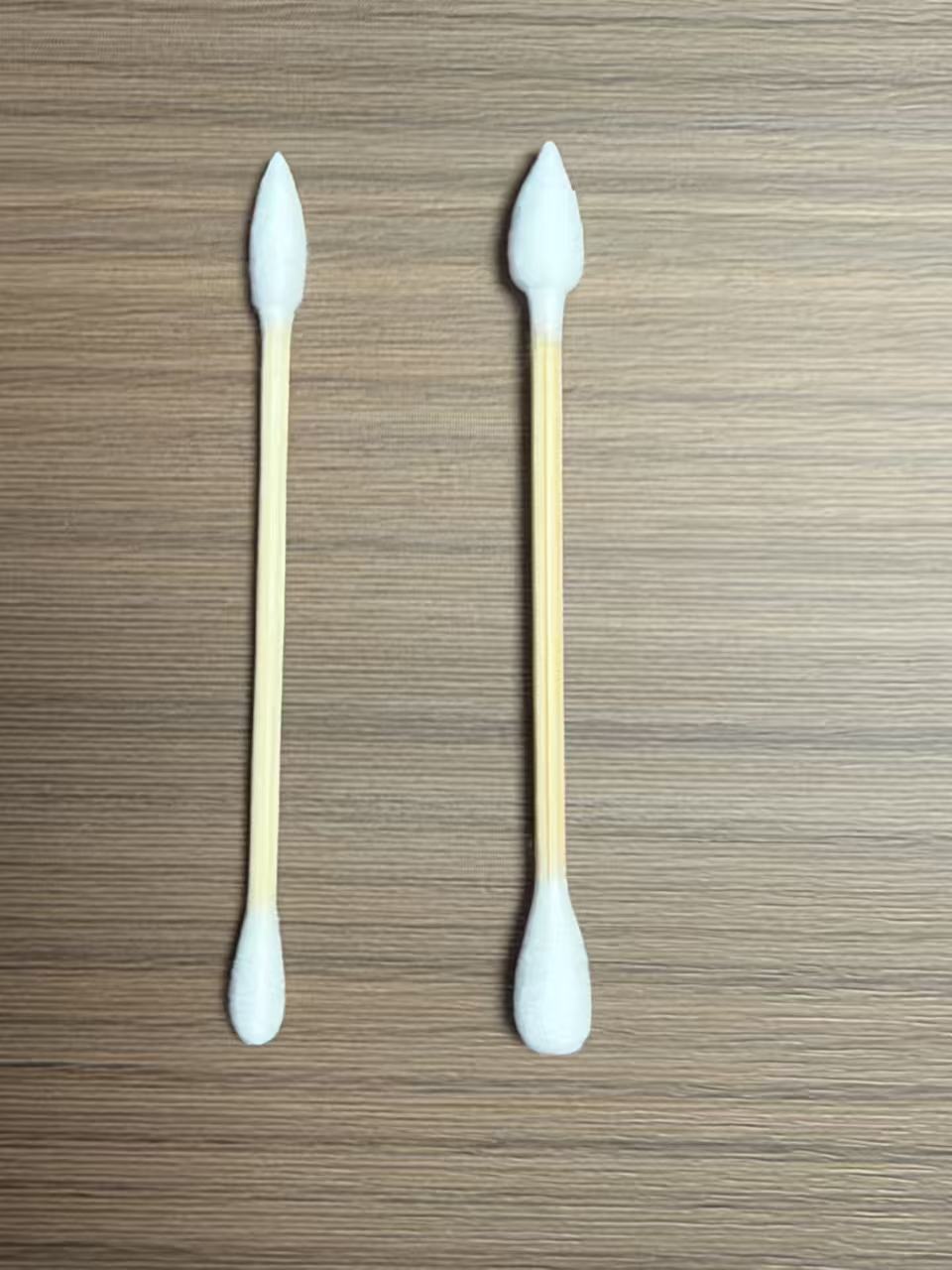
Those are the supplier's own statements. They are useful as a specification and as a statement of design intent; they are not an independent laboratory finding, and the material reviewed does not include a controlled cleaning trial. The 25 N value describes the stick, not the cleaning result. It should be read as a hardness specification to check against a sample rather than as a performance guarantee.
| Comparison criterion | Bamboo stick cotton swab | Bendable stick cotton swab | Evidence status |
|---|---|---|---|
| Shaft behaviour | Rigid along the full length; holds a straight line under hand pressure | Flexible section allows the tip to be set at an angle | Defining characteristic of each format |
| Force reaching the tip | Direct — wiping pressure carries through the shaft to the head | Partly absorbed past the flexible section | Mechanical consequence of the design |
| Reach into curved or offset paths | Limited to the line of the shaft | Improved, because the head can be angled | Defining characteristic of each format |
| Recorded dimensional data | 2 mm size and 25 N stick hardness documented for the rigid heavy-duty cleaning swab | No numeric specification in the reviewed material | Supplier comparison unit (rigid); not supplied (bendable) |
| Stick strength claim | Supplier states a stronger stick that is less likely to break | Not documented | Supplier statement, not independently tested here |
| Stated application | Quartz nail and banger cleaning, plus general detail work under pressure | Angled reach, curved surfaces, obstructed approach | Supplier application data / category use |
| Main buying risk | Over-buying rigidity where angled reach is what the job needs | Under-specifying where pressure is what the job needs | Editorial analysis |
The table maps what is known and what is not. The rigid column carries a supplier-recorded dimension and hardness value; the bendable column carries design characteristics that follow from having a flexible section, with no numeric specification behind them. A buyer comparing quotations across suppliers should ask each supplier to state which configuration its numbers describe, because a hardness figure quoted for a rigid shaft says nothing about a bendable one.
Three variables buyers usually mix up
Tip geometry, handle length and shaft behaviour are separate purchasing decisions, and treating them as one is the most common source of mismatch in this category.
- Tip geometry. A pointed tip concentrates contact for narrow openings and corners; a round tip spreads contact over a broader area and is gentler on soft surfaces.
- Handle length. Long handle cleaning swabs extend reach and keep the hand away from the work area. Length changes where the hand sits, not how the shaft behaves under load.
- Shaft behaviour. A rigid bamboo shaft transmits pressure and holds a line; a bendable shaft trades part of that transmission for angle.
An order that specifies all three variables produces a repeatable product. An order that specifies one produces a sample the buyer then has to interpret. The same logic governs OEM cleaning cotton swabs and private-label programmes, where the specification document effectively is the product: shaft format, tip shape, handle length and packing should each be written down before the MOQ conversation begins.
Decision guide: which format is better for a given cleaning task
There is no universal winner between the two formats. The reliable rule is to match the shaft to the failure mode you actually have.
- Residue that only lifts with pressure. Choose rigid bamboo. When a film on the surface comes away only under a firm wipe, a shaft that flexes absorbs part of that wipe before it reaches the tip.
- A cleaning path that curves or sits at an offset angle. Choose bendable. If the operator has to bend the wrist or approach from the side, the articulating shaft does work the wrist cannot.
- Repeatability in a jig, rack or cleaning template. Choose rigid. A shaft that holds a straight line keeps the tip in the same position from unit to unit, which is what a fixed cleaning station depends on.
- Breakage and swabs-per-cleaning as the complaint. Start with the rigid heavy-duty option documented in the supplier's comparison unit, then verify on a sample. The supplier's stated rationale is fewer swabs used and fewer broken sticks; that rationale still needs to hold on your own surface.
- A basket covering several applications. Stock both formats and split them by SKU. The split usually follows the application rather than the customer, and mixing the two in one SKU guarantees complaints from one of the two user groups.
- An OEM or private-label programme. Fix the shaft format first, then tip geometry, then handle length, then packaging. Shaft format is the decision that changes what the product can do, and the MOQ for customized products depends on the product situation rather than on one standard figure.
- No clear failure description yet. Buy samples of both formats, test them on your own residue with your own operators, and negotiate volume afterwards. A comparison run on someone else's application is a starting hypothesis, not a result.
The first two rules settle most cases. The remaining rules exist because purchasing decisions are frequently made before anyone has written down what the swab is expected to do.
Application scenarios: where each format earns its place
Application labels vary widely, but the deciding variable does not. Bong cleaning, banger and slurper work, glassware detail cleaning and pet care all reduce to the same question: does the job need pressure along a straight line, or reach around an obstruction?
Bong, banger and slurper cleaning
Bong cleaning cotton swabs and the sub-category buyers often call slurper mops share one requirement: a narrow bore, a residue film that resists a light touch, and a tip that must not wander off the surface. This is the application the supplier's comparison unit names for quartz nails and bangers, and it is the strongest case for a rigid bamboo shaft. In a banger, an articulating tip adds a degree of freedom the task does not need, and it removes pressure the task does need.
Glassware and detail cleaning
Where the label is glass cleaning cotton swabs, the same rule applies rather than a new one. A straight reach into a rim or a channel favours the rigid shaft; an obstructed approach angle, where the hand cannot line up with the surface, favours the bendable one.
Pet ear cleaning
Pet ear cleaning swabs raise a different consideration. The angle of an ear canal is why a bendable format is considered for this work at all, but the format is secondary to technique: light contact and a clean, intact cotton head matter more than shaft stiffness. Whether an ear canal should be swabbed at all is a veterinary judgement rather than a purchasing one, and the swab specification should follow that judgement.
General personal care and detail work
In personal care and general precision cleaning, either format can be correct. Choose by the two rules above — pressure or angle — and then use tip geometry and handle length to fine-tune the SKU.
How the rigid cleaning swab compares with an ordinary cotton swab
The comparison that buyers can actually check in the supplied data is the rigid heavy-duty swab against a standard cotton swab, and it turns on dimensions and stick hardness. The supplier lists 2 mm size and 25 N stick hardness, and states four consequences: cleaning is more effective with fewer cotton swabs, stronger sticks are less likely to break, breakage-related customer complaints fall, and the price position stays competitive.
Three qualifications belong beside that list. “Competitive price” is a positioning statement, not a quotation, and it should be tested against a landed-cost calculation that includes the swabs-per-cleaning figure — a swab that costs slightly more per box but reduces consumption per cleaning can still lower cost per clean. The breakage claim is a supplier statement rather than an independently measured result. And the comparison describes a rigid shaft only; it should not be extended to bendable formats, whose behaviour under load is different by design.
Procurement: samples, MOQ, lead time, payment and OEM
For buyers moving from format decision to order terms, the supplier profile behind this comparison is FUZHOU WENXI EVER-RISE IMPORT & EXPORT CO., LTD., an export-oriented company based in Fuzhou, Fujian Province, China, founded in 2025. It operates a 5,000 m² facility with more than 20 employees, an annual output of over 1,000 tons and a five-engineer R&D team, and exports 100% of its output to North America, South America and Europe. Its range covers cotton swabs, cotton pads, dental floss picks, pet cleaning products and related personal-care and daily-use items.
The commercial terms relevant to a format decision are these. Samples are available and the supplier states that samples are offered free of charge, which matters here because neither format can be judged reliably from a photograph. The MOQ for most conventional products is 1000 boxes; for customized products the MOQ depends on the product situation. Some products are held in stock and can ship immediately, while mass production runs from 15 to 30 days depending on the exact order quantity. Payment is a one-time payment when the total amount is below US$1,000, and a 50% deposit with the remaining balance before shipment above that threshold. FOB ports are Ningbo, Shanghai and Shenzhen. OEM and private-label services cover product specifications, packaging and branding.

Two procurement notes follow from the format comparison itself. First, because the MOQ for customized products depends on the product situation, the shaft-format decision should be taken before the MOQ discussion rather than during it. Second, because stock availability is partial, the split-order approach recommended above may have different lead times on each SKU — the in-stock line can move immediately while the other line follows the 15-to-30-day production window.
Quality and compliance points to close before ordering
The supplier states that quality control covers the full chain, from raw material selection and production processes to finished-product inspection, supported by regular spot checks and samples sent to reputable third-party testing laboratories for independent testing. For a buyer, that describes a process; it does not by itself confirm a specific certificate for a specific configuration.
Two checks close the gap. Ask which configuration the test documentation actually covers — rigid shaft and bendable shaft are different products, and a report for one does not describe the other. Then confirm the requirements of the destination market in writing: the supplier's application data for United States use lists California Prop 65 requirements and microbial safety as the special requirements to be met, so the corresponding test documentation should be obtained rather than assumed from the listing.
What would change this recommendation
The recommendation here is conditional, and it should be re-examined when any of three things happens. If a bendable specification with documented dimensions and hardness is published and passes a side-by-side sample test on a pressure task, the rigid default for that task narrows. If product-complaint data on a specific line shows broken sticks rather than missed cleaning, the rigid heavy-duty option becomes the first substitution to test. And if an application moves from an open surface to an obstructed angle, the format decision should be revisited before the packaging is reprinted — because the shaft, not the label, is what the operator works with.
Frequently asked questions
What is the difference between bamboo stick and bendable stick cotton swabs?
The difference is in the shaft, not the cotton head. A bamboo stick cotton swab has a rigid shaft that transmits hand pressure to the tip and keeps the tip on a straight line. A bendable stick cotton swab has a flexible section that lets the tip be set at an angle, which improves reach around curves and obstructions but absorbs part of the push that a rigid shaft would deliver.
Which format is better for bong, banger and slurper cleaning?
The rigid bamboo format fits this work better, because these tasks combine a narrow bore with a residue film that needs pressure to lift. The supplier's comparison unit names quartz nail and banger cleaning as the application for its rigid heavy-duty swab, listed at 2 mm size and 25 N stick hardness. A bendable tip adds an angle these tasks do not require while reducing the pressure available at the head.
Do pointed tip, round tip and long handle options change the comparison?
They change the SKU, not the format logic. Tip geometry and handle length adjust how the swab meets a surface and how far the hand sits from the work; shaft behaviour determines whether pressure or angle is delivered. A pointed tip, round tip or long handle version can be built on either a rigid or a bendable shaft, so all three variables should be written separately on the specification.
What are the MOQ, lead time and payment terms for conventional cotton swabs?
The MOQ for most conventional products is 1000 boxes, while customized products are quoted according to the product situation. Some items are in stock and can ship immediately; mass production takes 15 to 30 days depending on order quantity. Orders below US$1,000 are paid in one instalment, and orders above that use a 50% deposit with the balance before shipment. FOB ports are Ningbo, Shanghai and Shenzhen.
Are samples available for evaluating both formats?
Yes. The supplier states that samples are available and offered free of charge. Given that the reviewed documentation provides numeric data for the rigid configuration only, evaluating a physical sample of each format on the actual cleaning task is the most direct way to establish which shaft behaviour suits the application.
Supplier reference: FUZHOU WENXI EVER-RISE IMPORT & EXPORT CO., LTD. product catalog (PDF). Product data, commercial terms and quality statements in this article are as reported by the supplier; dimensional values refer to the rigid heavy-duty cleaning swab configuration described in the supplier's comparison data.
Have Questions or Need More Details?
Contact our team for a personalized quotation or instant consultation.
Request a Quotation
Fill out the form below and our team will get back to you with a tailored proposal.
WhatsApp Direct Chat
Prefer to chat in real-time? Message us on WhatsApp for instant assistance & quick answers.
- Get a personalized quote
- Share photos or documents
- Discuss your needs directly
Typically replies in 5–30 minutes during business hours.