
Bar, Bistro and Tray Table Sets: A Private Label OEM Review
Bar, Bistro and Tray Table Sets: A Private Label OEM Review
This buyer-oriented review examines four foldable and space-saving furniture SKUs — a drop-leaf bar table set (826-1008), a folding bistro set (826-1009), a 3-tier space saver (826-1010), and a folding tray table (605-0007) — and evaluates them through the lens of a private label OEM sourcing decision rather than a consumer purchase. The framework used is specification, constraint and audit evidence, not price alone.
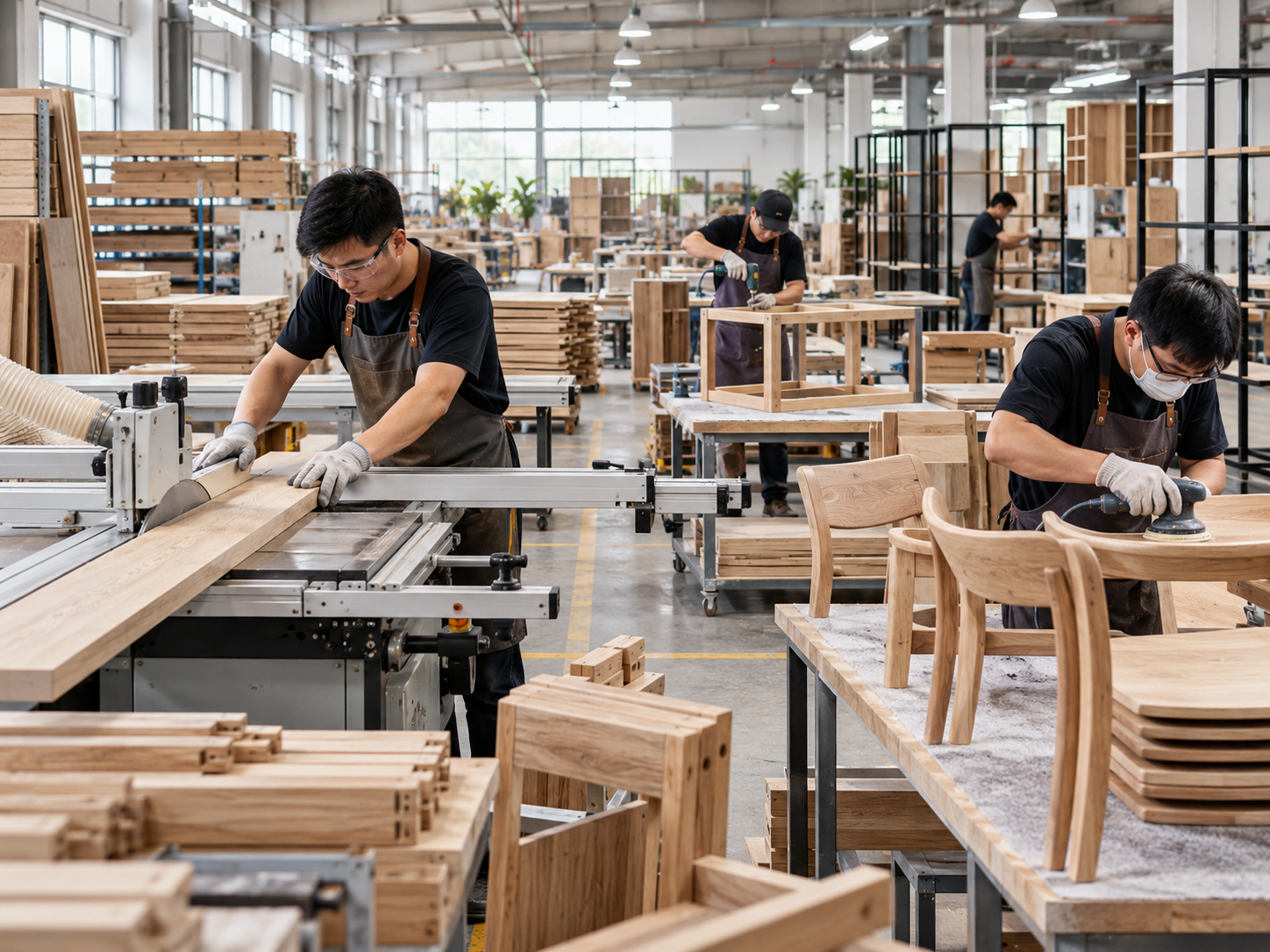
A manufacturing environment typical of the OEM/private-label supply base evaluated in this review. Image source: Pricolotus Furniture.
Why Private-Label Buyers Are Reaching a Different Question
Furniture manufacturing is a broader category than most sourcing briefs assume. The U.S. Bureau of Labor Statistics classifies furniture and related product manufacturing under NAICS 337, which covers household furniture, institutional furniture, kitchen cabinetry, office furniture and other related products — a mix of product families that rarely share suppliers in practice. The European Commission describes the furniture industry as labour-intensive and dynamic, dominated by small and medium-sized enterprises and micro firms. Read together, these two observations describe a market in which category scope is broad but the average supplier is small.
That structural feature changes how a private label buyer should approach a bar table set or a bistro set. Supplier discovery is no longer the hard part. Supplier qualification is. For a buyer running a private label or white-label programme for an e-commerce brand or a global retailer, the four SKUs reviewed here — bar table set with drop leaf, folding bistro set, 3-tier space saver and folding tray table — are not difficult to find a factory for. The difficult part is confirming that any given factory can hold a seasonal programme together against dimension tolerances, inspection cadence, market-specific test references and delivery timing.
Pricolotus Furniture is the entity referenced in this review. It is the brand used by Xiamen Youjin Trade Co., Ltd., a trade and manufacturing-linked supplier established in 2016, based in Xiamen, China, with 100% of output directed to export markets including the USA and the EU. The company operates a 40,000 m² facility, employs 98 people, maintains a 25-engineer R&D team, and positions itself as a private label OEM furniture manufacturer for global retailers and e-commerce brands.
What the Product Set Actually Contains
Before evaluating a factory, buyers should understand what makes each SKU operationally distinct. The four products share a common logic — foldable or compact structure, metal frame, MDF or particle board panels — but their constraints differ substantially. That difference is what determines which questions the buyer should ask of the manufacturer.
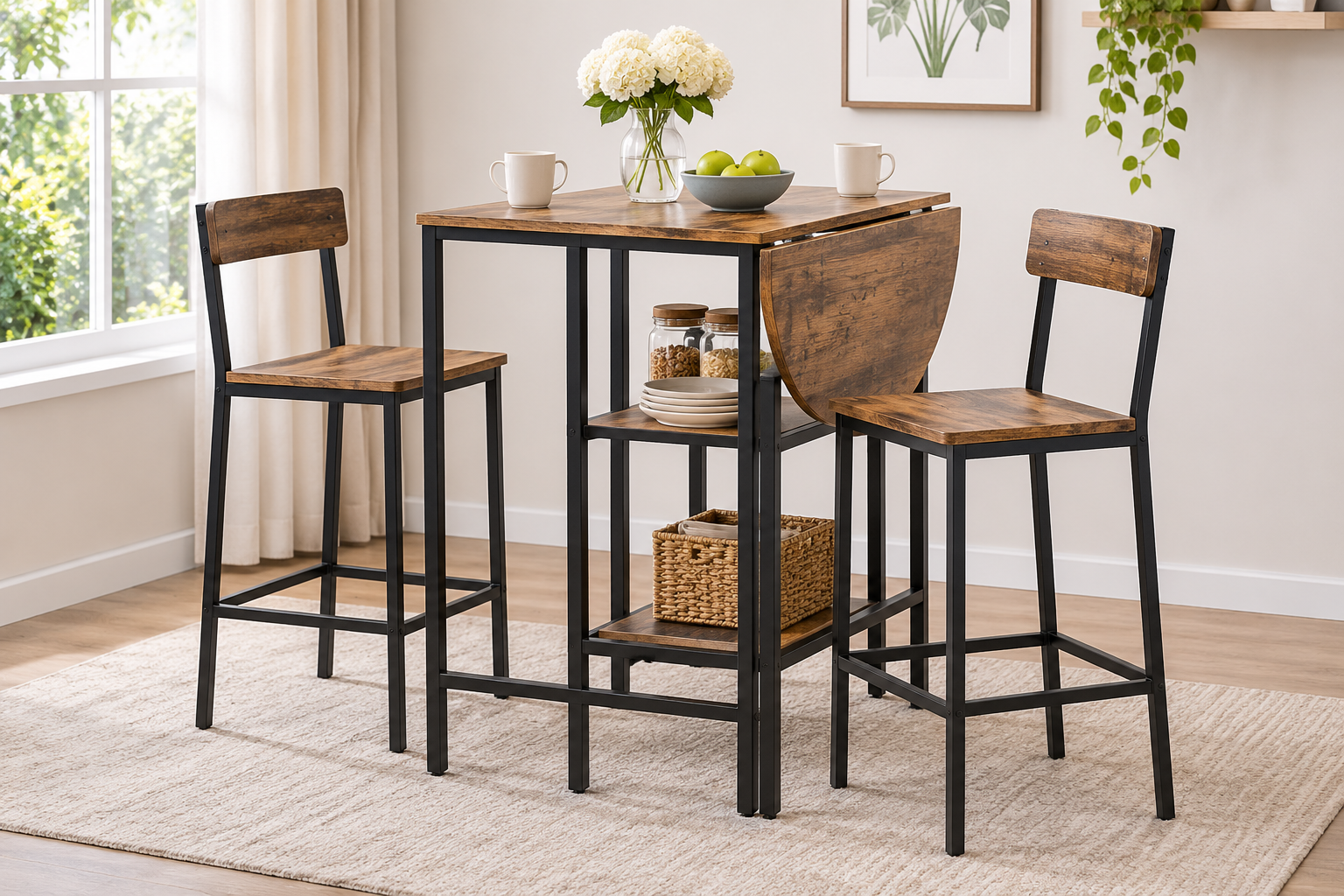
Model 826-1008: 3-piece bar table set with drop leaf. Image source: Pricolotus Furniture.
Model 826-1008 — 3-piece bar table set with drop leaf. The set ships as one table and two chairs. The table measures 80 × 40 cm with the drop leaf folded and 80 × 75 cm with the drop leaf extended, with a table height of 75 cm. Each chair measures 32 × 32 × 45 cm. Table and chair frames are metal; panels are MDF finished with wood veneer. The drop leaf design increases usable table surface from 80 × 40 cm to 80 × 75 cm without changing the folded footprint. In OEM programmes this is the model that most often triggers custom size discussion, because the extended surface dimension is the one retailers plan around for small-apartment merchandising.
Model 826-1009 — 3-piece folding bistro set. Table diameter is 60 cm at a height of 72 cm; each chair measures 40 × 46 × 80 cm. The frame is steel; the tabletop and chair surfaces use wood-like MDF or particle board. The bistro set is the SKU with the highest pressure on joint tolerances, because a 1-second folding mechanism only works at retail if every joint consistently locks within the same tolerance band across the production run.
Model 826-1010 — 3-tier space saver. Overall dimensions are 61 × 23 × 158 cm. The frame is metal and the shelves are MDF or particle board, with a stated load capacity of 15 kg per tier. The unit uses an anti-tilt design and is dimensioned to fit over toilet and corner spaces. For a private label buyer, this is the SKU where packaging, tilt hardware and assembly documentation determine returns performance more than design quality does.
Model 605-0007 — folding tray table. Overall dimensions are 48 × 38 × 66 cm, with a powder-coated steel tube frame and an MDF tabletop panel. The tray table has the smallest shipping cube of the four products, making it the SKU where unit price most depends on carton engineering and consolidation rather than on material cost.
Specification Comparison for OEM Buyers
The table below summarises the four SKUs against the variables a private label buyer typically locks early: material composition, dimensional ceiling, stated load, and product-category placement. These are the fields that should appear on the buyer's request-for-quotation sheet before negotiation begins.
| Model | Product type | Dimensions | Material | Stated load / capacity |
|---|---|---|---|---|
| 826-1008 | Drop leaf bar table set (1 table + 2 chairs) | Table: 80 × 40 cm folded / 80 × 75 cm extended, 75 cm height. Chair: 32 × 32 × 45 cm | Metal frame + MDF + wood veneer | 100 kg per chair (as stated in product data) |
| 826-1009 | Folding bistro set (1 table + 2 chairs) | Table: Dia. 60 × 72 cm. Chair: 40 × 46 × 80 cm | Steel frame + wood-like MDF / particle board | Not stated in product data |
| 826-1010 | 3-tier space saver shelf | 61 × 23 × 158 cm | Metal frame + MDF / particle board | 15 kg per tier |
| 605-0007 | Folding tray table | 48 × 38 × 66 cm | Powder-coated steel tube frame + MDF top | Not stated in product data |
Table compiled from Pricolotus product specification data. Missing load figures are marked as not stated rather than estimated.
What the Manufacturer Side Actually Looks Like
The operational facts attached to Pricolotus describe a supplier that behaves less like a pure trading company and more like a vertically-linked manufacturer-plus-trade operation. The documented capabilities are concrete but narrow, and buyers should not inflate them.
- Customisation: quick custom quotes and samples are listed as an operating capability — the specific phrase used in the company's capability data.
- Monthly capacity: 200 units (as stated).
- Lead time: 30–45 days.
- Minimum order quantity: 1 unit, which is unusually low for an OEM furniture supplier and is relevant for private label buyers testing new SKUs before committing to a season.
- Quality control: pre-shipment inspection.
- Export markets: EU, Middle East, North America and global markets.
- After-sales: remote technical support and after-sales service for product quality issues.
The 200-unit monthly capacity figure, paired with a 30–45 day lead time and a 1-unit MOQ, describes a supplier that is well-suited to medium-batch private label programmes and less-suited to high-volume single-SKU replenishment. Buyers planning a full-season private label run across multiple carton sizes should treat this capacity ceiling as a planning input, not a marketing claim.
The company records an application-scenario fit with global furniture retail, with a project type described as a foldable space-saving household furniture project. Working conditions are documented as indoor household environments, with foldable structures that support easy assembly, quick folding and unfolding, and the requirement that products remain compact after folding and safe for daily household use. These are not strong differentiators on their own — they describe the category, not a specific factory. But they do help a buyer judge whether the manufacturer's stated comfort zone matches the buyer's product set.
The Customisation Question — Where OEM Promises Get Tested
The phrase "custom size furniture manufacturer" is one of the most overused descriptions in furniture sourcing. From a manufacturing perspective, what a buyer is really asking for when they say "custom size" is different across the four SKUs in this review.
For the bar table set (826-1008), the customisation that matters is the drop-leaf geometry — whether a buyer can request a different extended width without breaking the folded-footprint ratio. For the bistro set (826-1009), the customisation that matters is the folding joint tolerance, because a diameter change alters the load distribution on the locking mechanism. For the 3-tier space saver (826-1010), customisation is mostly the width and depth ratio that determines whether the unit fits a given retailer's toilet-clearance listing standard. For the tray table (605-0007), customisation is mostly the carton size and the powder-coat colour, more than the metal tube dimension.
A 2022 article in a Chinese wood-industry journal (DOI 10.12326/j.2096-9694.2022099, funded under China's National Key R&D Program project 2018YFD0600304 on flexible manufacturing technology for wood-based home products) frames custom furniture manufacturing as an information-system problem rather than a craft problem. That distinction matters for buyers: a factory that can supply a configurator, structured order confirmations and versioned BOMs is more dependable on a 30–45 day lead time than one that handles customisation informally through sales chat. The Pricolotus capability data documents quick custom quotes and samples, which is the correct starting point, but a buyer running seasonal private label programmes should verify how those quotes are translated into repeatable order records.
Quality, Certification and the Limits of What Can Be Verified
The certification and compliance record for Pricolotus lists SGS test references and PVC tape classification against the USA market. No certificate numbers, issuing authority identifiers, issue dates or expiry dates are present in the available data. That gap is itself an important buyer signal: SGS test references describe what has been tested, not what a current certificate proves today.
Public verification databases for schemes such as FSC chain-of-custody, ISO 9001 and ISO 14001, and social audit programmes such as amfori BSCI or SMETA were not matched to verified certificate records for Pricolotus in the evidence available for this review. This does not mean the company lacks those certifications. It means that a buyer preparing a private label launch should treat any FSC, ISO or factory-audit claim as a document request to the factory, not a marketing assumption.
The practical verification chain for a private label buyer sourcing these SKUs should include, at minimum:
- Current SGS test report numbers and the specific product lines, materials and standards each report covers.
- A copy of any FSC chain-of-custody certificate with the FSC licence code, scope, and validity dates, cross-checked against the public FSC database.
- A copy of any ISO 9001 certificate with the registrar name and scope statement, cross-checked against the issuing registrar's public directory.
- A pre-shipment inspection protocol that the buyer defines, rather than relying only on the factory's own pre-shipment inspection.
- Packaging and drop-test criteria for the space saver, because carton failure is the most common return driver in the 158 cm class.
Application Scenarios That Shape the Private Label Brief
The four SKUs share a common application profile documented by the manufacturer as furniture retail for a foldable, space-saving household furniture project in an indoor household environment. The operational requirements listed are stable structure, easy cleaning, compactness after folding and safety for daily household use. Within that shared profile, each SKU maps to a distinct retail scenario.
The bar table set and bistro set are typically positioned for small kitchens, apartments, lofts, balconies and compact dining nooks — the same buyer segment that drives seasonal demand for space-saving dining sets. The 3-tier space saver addresses bathroom and corner organisation listings, where dimensional fit over a toilet or into a narrow corner is the primary purchase driver. The tray table functions across living room, bedroom, small apartment, office and temporary setups such as a market stall or picnic.
The manufacturer's case data references a retailer relationship extending five years, with a result described as strong market sales performance and positive end-consumer reception. The highlight attributed to that case is foldable design, space-saving, easy assembly and multi-scene application. The quantity shipped is not publicly disclosed, so that case should be treated as evidence of a durable retail relationship rather than as a volume proof point.
Market Context: What the Numbers Actually Support
Official customs data reports China's wooden furniture exports at US$24.57 billion in 2024, a 2% year-on-year increase. Within that figure, the United States is the largest destination, accounting for nearly 30% of exports at approximately US$7.1 billion. Separately, a commercial research estimate places global furniture market value at USD 597.71 billion in 2025, with a projected CAGR of 5.92% over 2026–2034.
For a private label buyer, these figures support a modest claim — that China-based OEM furniture supply remains structurally important to U.S. and EU retail — and one caution: they are category-level aggregates covering wooden furniture, not a proxy for folding metal-frame furniture demand. Buyers should not use the 2% growth figure to justify a specific SKU forecast without category-level evidence of their own. The most reliable use of these numbers is context for negotiating lead time and capacity, not for modelling unit demand.
How This Supplier Profile Compares to Traditional Sourcing Routes
Traditional sourcing for folding bar and bistro sets usually runs through importers or trading agents who coordinate several small factories without owning production capability. The Pricolotus model differs on two dimensions: the company is a manufacturer-linked trade operation rather than a pure trading intermediary, and the capacity figures (200 units per month, 30–45 day lead time, 1-unit MOQ) are stated in operational terms rather than as marketing claims.
The limitation is equally important. A 200-unit monthly capacity ceiling and a 30–45 day lead time mean this supplier is not the correct match for a retailer planning a single high-volume drop of tens of thousands of units on a fixed promotional calendar. Private label programmes that depend on very large single-SKU replenishment, or on in-house design IP that requires exclusive tooling across multiple factories, are better served by a Tier-1 volume manufacturer. Conversely, a 1-unit MOQ is a material advantage for a buyer testing new colourways, new carton designs or new dimensions before committing to a season — a stage where conventional volume manufacturers often require minimum runs that undermine market testing.
A second limitation to note: the manufacturer data lists SGS references but no verified FSC certificate number and no verified ISO 9001 certificate. Buyers whose private label policy requires FSC chain-of-custody documentation as a precondition, not a post-selection item, should treat this as an open verification task rather than a confirmed capability.
Future Outlook for Private Label Folding Furniture
Three trends are likely to shape how the four SKUs in this review are sourced over the next cycle. First, the fragmentation of the furniture manufacturing base in major regulated markets (documented for the EU by the European Commission) makes factory-level audit evidence a stronger differentiator than supplier discovery. Second, the market research estimate of 5.92% CAGR through 2034 suggests that retail demand for space-constrained home furniture will continue, but not at a rate that forgives poor carton design or dimension-drift on folding mechanisms. Third, the growth of e-commerce brand private label programmes creates a specific demand for suppliers that can hold a 30–45 day lead time against a 1-unit MOQ — a combination that is more common in China's linked trade-manufacturing model than in pure trading intermediaries.
For Pricolotus specifically, the near-term buyer question is less about whether the company can supply a bar table set, a bistro set, a space saver or a tray table, and more about whether the company can supply a documented, repeatable version of each against buyer-defined inspection and certification criteria. The capability data suggests the company is set up for this. The verification task is to close the certification evidence gap before committing to a private label programme.
Frequently Asked Questions
Does Pricolotus offer OEM or private label customisation on these SKUs?
Yes. The company's capability data lists quick custom quotes and samples as an operating capability, and positions itself as a private label OEM furniture manufacturer serving global retailers and e-commerce brands. Buyers should confirm scope of customisation (dimensions, finish, carton, branding) on a per-SKU basis, since the practical customisation limit differs between a bar table set, a bistro set, a space saver and a tray table.
What is the minimum order quantity and typical lead time?
The documented MOQ is 1 unit, and the documented production lead time is 30–45 days. These figures refer to the manufacturer's stated capabilities and should be confirmed in the quote stage for each specific SKU, especially where custom size or custom carton engineering is involved.
What test and certification references are documented for these products?
SGS test references and a PVC tape classification against the USA market are recorded. No certificate numbers, issuing authority identifiers, or validity dates are present in the available data. Buyers requiring FSC chain-of-custody, ISO 9001 or equivalent evidence should request current certificate documentation directly and verify it against the relevant public database.
What quality control is in place before shipment?
Pre-shipment inspection is documented as the manufacturer's quality-control method, with remote technical support and after-sales service for product quality issues. For a private label launch, buyers typically define their own pre-shipment inspection checklist rather than relying solely on the factory's internal inspection.
Which applications and markets are these products best suited to?
The products are documented for indoor household environments within furniture retail, for foldable space-saving household furniture projects. The stated operational requirements are stable structure, easy cleaning, compactness after folding, and safety for daily household use. The main export markets documented for the company are the EU, Middle East, North America and global markets, with 100% of output directed to export.
Buyers seeking the full product specification range across the four SKUs and related categories can consult the Pricolotus English Product Catalogue 2026 before requesting a custom quote.
Have Questions or Need More Details?
Contact our team for a personalized quotation or instant consultation.
Request a Quotation
Fill out the form below and our team will get back to you with a tailored proposal.
WhatsApp Direct Chat
Prefer to chat in real-time? Message us on WhatsApp for instant assistance & quick answers.
- Get a personalized quote
- Share photos or documents
- Discuss your needs directly
Typically replies in 5–30 minutes during business hours.