
Barber Chair Supplier Capability Evidence: Hongzi's Model Specs
A supplier's model list becomes evidence at the moment each line can be checked against something the buyer controls: a floor plan, an inspection sheet, or a purchase-order clause. In the barber chair category, that is also where capability claims tend to collapse — catalogues are rich in adjectives and thin in measurable detail.
Ningbo Hongzi Beauty & Hairdressing Equipment Co., Ltd. is a Chinese manufacturer of barber chairs and salon furniture, founded in 2012 and located in Yuyao, Ningbo, Zhejiang. The company describes itself as export-oriented, listing barber chairs, shampoo chairs, massage beds and manicure tables as its main products, with North America and Europe as its main markets.
The pages that follow are not a recommendation. They are a reading of the company's documented model data, stated order terms and after-sales position, followed by the acceptance criteria a buyer would realistically apply. Three models serve as reference points: the compact HZ6001DW, the styling chair HZ8801, and the heavy-duty HZ87102RB.
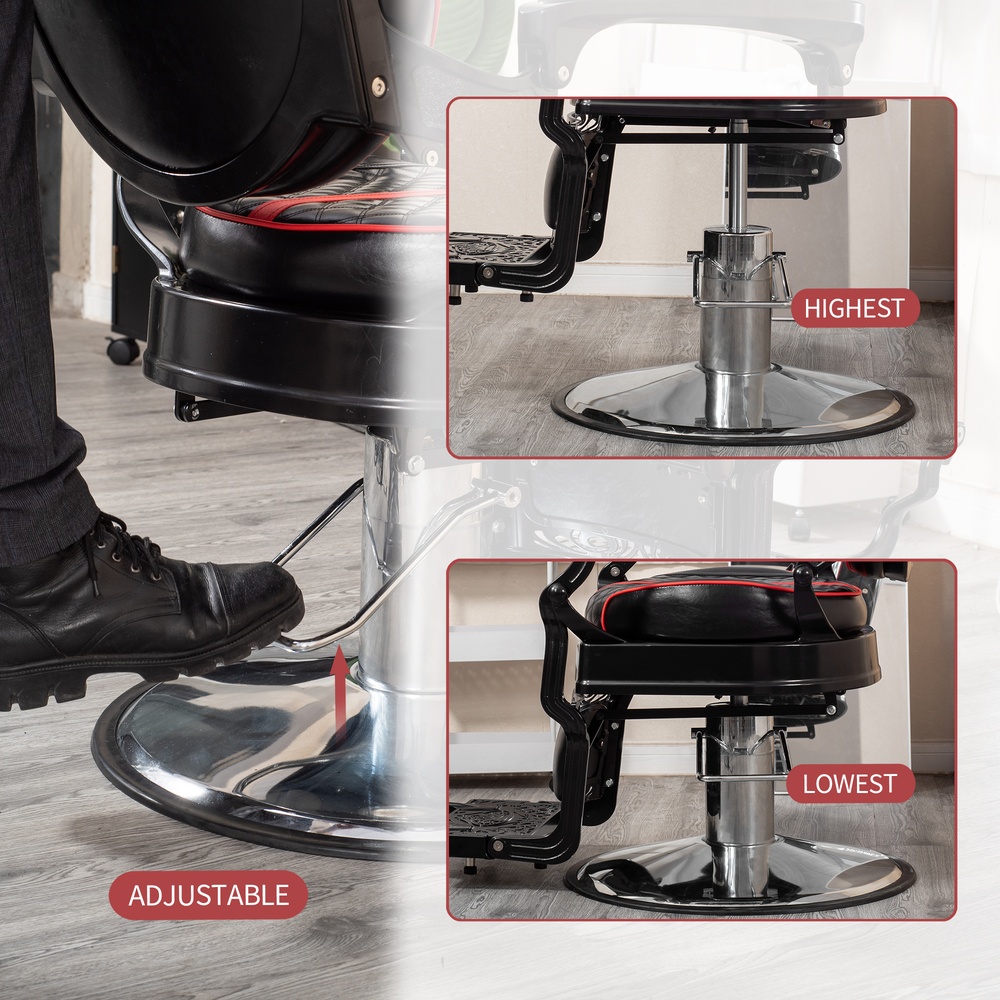
HZ87102RB, the largest documented platform in the reference set at 111 x 66 x 118 cm, with a PU leather, high-density sponge, wood and aluminium alloy material set.
Why published specifications outrank capability statements
Two suppliers can both describe themselves as experienced exporters and still deliver very different products. The distinguishing information usually sits in unglamorous places: how a model is dimensioned, what the material set contains, which parts are metal versus wood, and what the supplier will commit to in writing on lead time and after-sales.
The category definition itself points at the mechanism rather than the upholstery. Barber and similar chairs fall under HS 9402.10, a subheading covering chairs with rotating as well as both reclining and elevating movement. A chair that swivels and reclines is a mechanical product first. Yet most sourcing conversations begin with leather colour and finish, which is the least verifiable part of the specification.
That mismatch is the practical opportunity for buyers. When a supplier publishes a model code, a footprint and a material list, the buyer can convert those into three questions: does it fit the room, does the material set match the duty cycle, and can the order terms be enforced? Everything else is negotiation.
The documented reference set: three models, three duty levels
The company's published product data records dimensions and material composition for each model, together with a descriptive type label. The three models below span the width of the range and are the clearest illustration of how capability is expressed in data rather than prose.
| Model | Documented type | Published size | Material set | Practical role |
|---|---|---|---|---|
| HZ6001DW | Beauty salon chair | 45 x 25 x 70 cm | PU leather, high-density sponge, wood, iron | Smallest envelope; tight or secondary stations |
| HZ8801 | Styling chair | 90 x 60 x 90 cm | PU leather, high-density sponge, wood, iron | General styling station in a fitted salon |
| HZ87102RB | Heavy duty barber chair | 111 x 66 x 118 cm | PU leather, high-density sponge, wood, aluminium alloy | Full-service barber station with recline |
Source: Ningbo Hongzi published product data. Dimensions are reproduced as published; the axis order is not specified in the source and should be confirmed before layout planning.
Three observations follow directly from that table, and each of them matters more than a marketing claim would.
The range spans a factor of roughly 2.5 in footprint
A 45 cm footprint and a 111 cm footprint are not variations on the same station; they belong to different rooms. The HZ6001DW sits at the compact end, while the HZ87102RB occupies the space of a full barber platform with a taller back. Any buyer mixing both in one fit-out is effectively planning two station types, not one.
All three share an upholstery logic, and differ in frame material
Every model in this set is specified as PU leather over high-density sponge on a wood structure. Where they diverge is the metal component: iron for HZ6001DW and HZ8801, aluminium alloy for HZ87102RB. That is a genuine engineering distinction in the published data, and it is the kind of detail a buyer can verify physically at inspection. What the data does not state is leather grade, sponge density or frame wall thickness — all of which sit outside the published specification and must be agreed separately.
The type labels are themselves positioning data
The company describes HZ6001DW as a beauty salon chair, HZ8801 as a styling chair and HZ87102RB as a heavy duty barber chair. Those labels are the supplier's own indication of intended duty. A buyer who intends to run reclining barbering services should treat a compact beauty salon chair label as a signal to check the recline range and load behaviour rather than assume it.
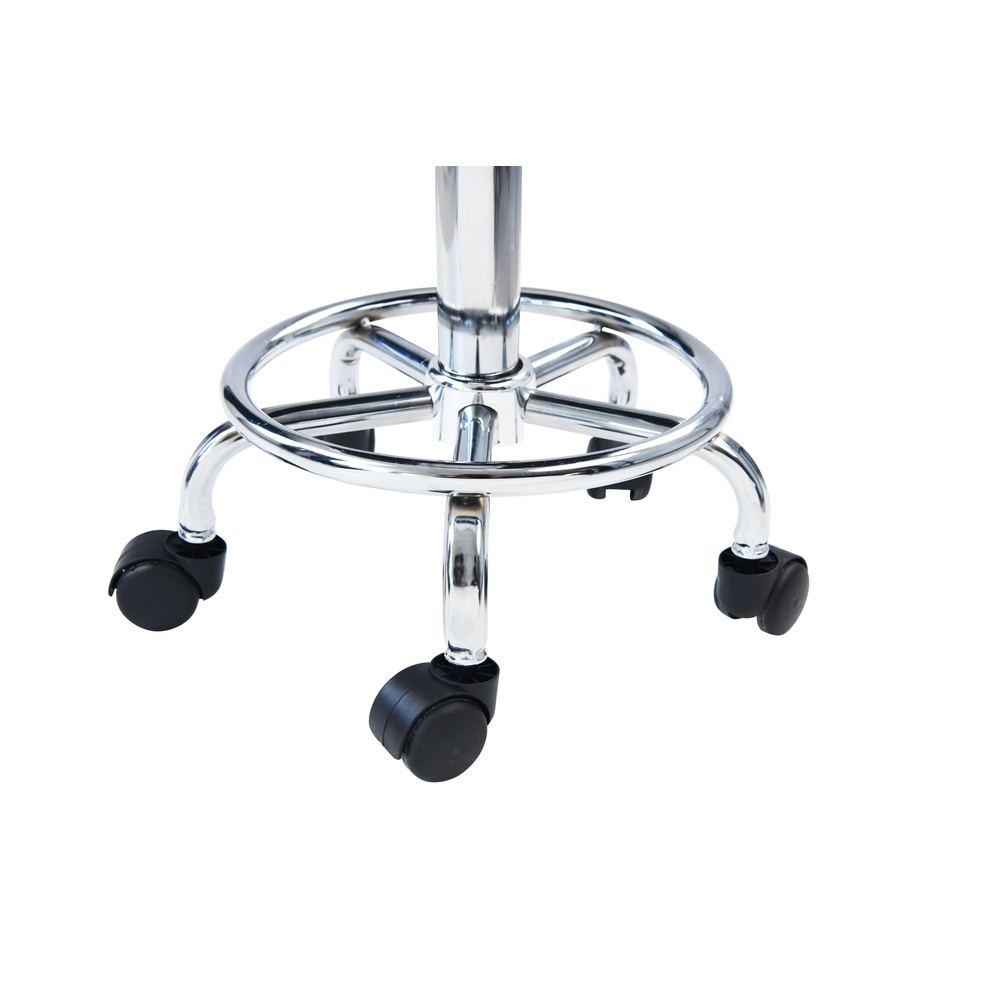
HZ6001DW: the compact reference point at 45 x 25 x 70 cm, specified in PU leather, high-density sponge, wood and iron.
Scenario fit: how the three platforms map to real salon projects
The company positions its barber chairs for indoor salon use over the long term, under conditions requiring wear resistance, oil resistance, easy cleaning and comfort. That operating description is not decorative; it sets the duty cycle the specification should be judged against. Salon furniture in this category is also used for salon fit-out and full-equipment procurement, distributor bulk orders, and customized projects.
The chair itself is described as customer seating and the barber workstation, and it operates in manual or hydraulic adjustable mode depending on the model. That distinction is worth flagging early in evaluation, because the published specifications do not state, model by model, which actuation type applies.
Compact and mixed-use rooms
Where station depth is constrained — small urban shops, second-row styling positions, or rooms shared with other services — the HZ6001DW is the documented option with the smallest envelope. Its iron frame and PU leather upholstery mirror the standard material logic of the larger models, which simplifies spares and cleaning routines across a mixed floor.
Standard styling stations
HZ8801, at 90 x 60 x 90 cm, is the middle case and the most straightforward fit for a conventional styling row. In fitted projects the chair does not stand alone: the application requires supporting equipment such as shampoo chairs, styling mirrors and cabinets, hair dryers, trolleys and manicure tables. Layout planning therefore has to treat the chair footprint as one input, not the only one.
Heavy-duty barber workstations
HZ87102RB at 111 x 66 x 118 cm, with aluminium alloy in the material set, is the platform for full barber service where reclining work — cutting, beard work, and the perm and dye services noted in the company's application material — is routine. The extra height and length are also a planning constraint: commercial spacing rules in some jurisdictions are explicit. North Carolina, for example, requires a minimum of five linear feet between the centres of adjacent barber chairs under 21 N.C. Admin. Code 06L .0102. That is a state-level rule, not a global standard, but it demonstrates how quickly a large-footprint chair consumes a floor plan.
Buyers who need a 110 cm-class chair but prefer a different styling treatment are not limited to one model. The published range also includes aluminium-alloy models documented at 110 x 72 x 100 cm, including HZ8796C and several chairs in the HZ8799 series, alongside retro, vintage and gold-finish variants. That breadth is the clearest evidence of range capability the company publishes — a family of models built on a consistent material recipe rather than a single hero product.
Purchasing terms as the second layer of proof
Specifications describe the product. Terms describe the supplier. Ningbo Hongzi's stated commercial terms are unusually concrete for a factory of this profile, which makes them testable rather than merely reassuring.
- Minimum order quantity: 5 units.
- Lead time: under 100 units in 15 days; over 100 units in 30 days.
- Production mode: OEM, with logo and colour customization.
- Quality control: 100% testing stated.
- Capacity: stated at 15,000 units per month, consistent with the company-reported annual output of 180,000 units and a production building of roughly 22,000 m².
- After-sales: the pump is covered by a one-year warranty, and damaged products are resent.
- Export experience: EU and US markets, with a stated 100% export orientation.
The MOQ is the most consequential of these for evaluation-stage buyers. A five-unit threshold makes sample-based validation economically realistic: a buyer can order one unit per candidate model, run it in a live station, and compare mechanisms before committing to a container. The two-tier lead time also creates a predictable planning rule — small validation orders and bulk replenishment follow different clocks, and should be scheduled as separate events rather than one.
The pump warranty deserves separate attention because it is narrow and specific. It covers the pump for one year; it does not, as published, extend to upholstery, frame or base. For a buyer, that asymmetry is useful information: it tells you which component the supplier expects to be the failure point, and it tells you which components you should be inspecting hardest at acceptance.
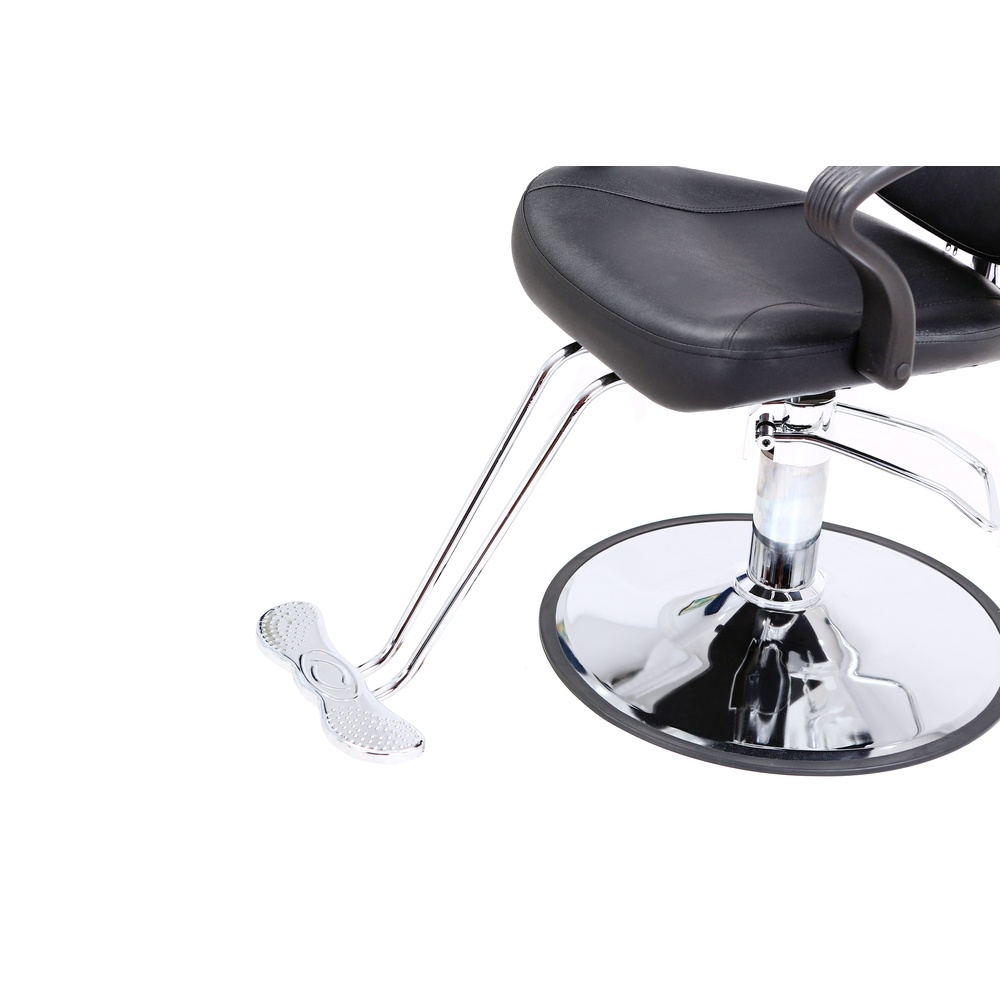
HZ8801: a 90 x 60 x 90 cm styling chair on a wood and iron structure, positioned between the compact and heavy-duty platforms.
Where the evidence stops: limits a buyer should price in
Honest supplier profiling has to include the gaps, and this range has several that a procurement team should close before signing.
No published load or cycle rating per model. The published data gives dimensions and materials, but not hydraulic pump type, load rating, recline angle or foam density. Industry benchmarks for commercial-grade hydraulic pumps commonly cited are load capacities of roughly 350 to 400 lbs and ratings exceeding 100,000 cycles, but those are category benchmarks from commercial research, not per-model figures for these chairs. Treat the benchmark as the question to ask, not the answer.
Dimension axis order is unspecified. Published sizes such as 111 x 66 x 118 cm do not state which value is length, width or height. The practical consequence is small but real: aisle and mirror-cabinet clearances should be confirmed against a drawing before the fit-out is frozen.
Capacity and facility figures vary by source. Company-reported facility and workforce figures differ between the company's own pages and secondary references, and capacity has been reported on both monthly and annual bases without a stated product mix. These figures are directionally useful for factory qualification but should not be converted, combined or used as a delivery guarantee.
Price is not comparable at listing level. Where marketplace listings exist, they cover different models and configurations and cannot be averaged into a market range. Any cost model needs a model-specific quotation with Incoterms and packaging defined.
Testing documentation is asserted, not published. The 100% testing statement is a process claim. Buyers who need it as evidence should request test records for the specific model and order.
Acceptance criteria: converting supplier data into a checklist
The buyer-side counterpart to a specification sheet is an acceptance checklist that can be executed on arrival. The following items are derived directly from what the supplier publishes, and each one closes a specific gap.
| Check | What to verify | Why it matters |
|---|---|---|
| Dimensional conformity | Measure the delivered unit against the ordered model size, confirming axis order and seat height at rest | Published sizes omit axis definition; station layout depends on it |
| Material conformity | Confirm PU leather colour and lot, sponge resilience, and frame metal: iron versus aluminium alloy | Frame material is the main documented difference across the reference set |
| Mechanism function | Full recline, swivel and elevation through the complete range, with no drift under load on a level floor | HS 9402.10 classification turns on rotating, reclining and elevating movement |
| Actuation type | Confirm whether the specific model is manual or hydraulic as ordered | Actuation varies by model and is not published per unit |
| Warranty scope | Record the one-year pump warranty in the contract, and define what covers frame, upholstery and base | Published warranty is pump-specific |
| Damage clause | Set the resend-damaged-products process, including photographic evidence and claim window | Stated after-sales policy needs operational definition |
| Lead-time confirmation | Fix the 15-day and 30-day tiers against the actual order quantity, in writing | Lead times are quantity-banded, not flat |
| Test records | Request documentation supporting the 100% testing statement for the ordered model | Converts a process claim into auditable evidence |
Checklist built from Ningbo Hongzi published product, capability and after-sales data.
Two items on that list routinely get skipped and both are cheap to fix. The first is actuation type: a mixed order of manual and hydraulic units looks identical in a photograph and behaves very differently on a busy Saturday. The second is the damage clause. A resend policy without a defined claim window and evidence standard tends to be discovered only when a pallet arrives with crushed packaging.
Market context: why mechanism evidence is becoming the deciding factor
The commercial case for scrutinising mechanism data is getting stronger. The global salon chairs market was valued at approximately USD 1.5 billion in 2025, according to commercial research published by Fact.MR in 2026, and hydraulic salon chairs were projected to account for 63.4% of that market in 2026. In a category where the dominant configuration is the hydraulic one, the specification that carries the most commercial risk is also the one least often published per model.
That is the practical gap this supplier's data illustrates. The published material set and dimensions are solid, comparable and verifiable. The mechanism beneath them is described only at category level. Buyers who close that gap with documentation — pump type, load rating, warranty terms — will get more out of a five-unit validation order than out of any number of catalogue pages.
Future outlook
Two directions seem likely for barber chair sourcing into 2027. First, specification disclosure is becoming a competitive differentiator: suppliers who publish per-model load ratings, actuation type and foam density will be shortlisted faster than those who publish only finish options. Second, small-batch validation will normalise. With minimum order quantities at five units and two-week lead times for orders under 100 units, the economics of testing before committing favours buyers who structure procurement as a sequence of trials rather than a single large bet.
For Ningbo Hongzi specifically, the documented range is broad enough to support multi-zone salon projects — compact, standard and heavy-duty platforms sharing a consistent material logic — and the stated terms are concrete enough to be written into a contract. The next step in supplier qualification is not more catalogue reading. It is a model-specific quotation and a live test unit.
FAQ
What do the published HZ-series dimensions actually tell a salon planner?
Published sizes give the outer envelope of each chair, which is enough to compare models against each other and to plan station spacing. The figures do not define which value is length, width or height, and they do not state seat height. For layout purposes, the published size should be treated as a first filter, with a dimensioned drawing requested before mirror cabinets and trolley runs are fixed.
How do the material specifications differ across HZ6001DW, HZ8801 and HZ87102RB?
All three are specified as PU leather over high-density sponge on a wood structure. The documented difference is the metal component: HZ6001DW and HZ8801 list iron, while HZ87102RB lists aluminium alloy. Leather grade, sponge density and frame thickness are not part of the published material set for any of the three, so those attributes require separate confirmation or physical inspection.
Which of these models suits a compact or mixed-use salon, and which suits a barber-focused floor?
HZ6001DW, at 45 x 25 x 70 cm and labelled a beauty salon chair, is the smallest documented envelope and better suited to tight or secondary positions. HZ8801, at 90 x 60 x 90 cm and labelled a styling chair, fits a conventional styling row. HZ87102RB, at 111 x 66 x 118 cm and labelled a heavy duty barber chair with aluminium alloy in the material set, is intended for full barber service where reclining work is routine. In all three cases the chair sits within a wider fit-out that also requires shampoo chairs, mirrors and cabinets, dryers, trolleys and manicure tables.
What are the stated purchasing terms, including minimum order quantity and lead time?
The company states a minimum order quantity of 5 units, OEM production with logo and colour customization, 100% testing, a stated capacity of 15,000 units per month, and a one-year warranty on the pump with damaged products resent. Lead time is stated as 15 days for orders under 100 units and 30 days for orders over 100 units. Because lead time is quantity-banded, the applicable tier should be confirmed against the specific order rather than assumed.
What customization is available, and what falls outside it?
Published customization covers OEM production with logo and colour. The application material also notes customizable colours and materials as a general salon furniture requirement, and separate requirements for children's chairs if those are in scope. Customization of structure, mechanism type or dimensional changes is not described in the published data and should be treated as a project-specific question rather than a standard option.
What are the main limits of the published evidence?
The published data does not include per-model load ratings, hydraulic pump type, recline angle, foam density or durability test results. Dimension axis order is not specified. Capacity has been reported on both monthly and annual bases with different product scopes, and facility and workforce figures differ between company pages and secondary references. Marketplace listing prices cover different models and configurations and cannot be averaged. Each of these is a verification item, not a disqualification — but each one has to be closed in writing before the order is placed.
What should be verified at delivery before final acceptance?
Dimensional conformity against the ordered model, including axis order and seat height at rest; material conformity covering PU leather colour and lot, sponge resilience and frame metal; full mechanism function through recline, swivel and elevation without drift under load; confirmation of manual versus hydraulic actuation as ordered; the warranty scope in writing, noting that the published one-year coverage is pump-specific; the damage-claim process and evidence requirements behind the resend policy; the quantity-banded lead time; and test records supporting the 100% testing statement.
Have Questions or Need More Details?
Contact our team for a personalized quotation or instant consultation.
Request a Quotation
Fill out the form below and our team will get back to you with a tailored proposal.
WhatsApp Direct Chat
Prefer to chat in real-time? Message us on WhatsApp for instant assistance & quick answers.
- Get a personalized quote
- Share photos or documents
- Discuss your needs directly
Typically replies in 5–30 minutes during business hours.