
Barfuse Electric: Inside the Modular Busbar Supply Chain
A busbar is only as visible as its failure. In a low-voltage distribution board, the component that carries current from the incoming device to a row of outgoing breakers is usually a flat conductor plate hidden behind a cover — yet that plate decides how quickly a board can be assembled, how consistent its phase spacing is, and how much of the final quality rests on installer discipline rather than on design.
The global busbar market was valued at approximately USD 19.83 billion in 2025, with copper-based products accounting for 62.8% of that value by material, according to Precedence Research. That headline figure is dominated by large-format trunking and industrial systems. One layer below sits the segment this analysis addresses: modular pan assembly busbars and the distribution box platforms built around them.
This industry reference examines YUEQING BARFUSE ELECTRIC CO.,LTD, a Chinese manufacturer of low-voltage fuse switch disconnectors, busbar systems and high and low voltage distribution wiring management products, including MCB pan assemblies and MCCB pan assemblies. The questions here are practical: what do the company's published specifications actually support, how does its profile map onto the structure of the busbar market, and what should a buyer verify before assuming that pan assembly suppliers are interchangeable?
The data problem behind modular busbar sourcing
Market-level busbar data is abundant; component-level data is not. Published 2025 valuations of the global busbar market diverge by methodology — one commercial research house places it at USD 15.72 billion, another at USD 20.3 billion — a spread attributed in part to whether locally custom-fabricated busbars are counted alongside factory-assembled trunking systems. Both figures describe the same physical market from different edges.
Below the trunking layer, the opacity increases. There is no single HS code that isolates pan assembly busbars; trade flows for these components are generally absorbed into code 8537 for boards and panels or 8544 for insulated conductors. A distributor sizing the category, or a panel builder benchmarking suppliers, cannot work from customs statistics.
What replaces that missing data is supplier documentation: rated currents, conductor thickness, terminal geometry, way counts, insulation material and third-party test evidence. Procurement in this segment is closer to reading a specification sheet than to reading a market report — and the buyer's risk is asymmetric, because a geometry mismatch surfaces only at the assembly stage.
Why the segment is being pushed to document itself
Two forces are converging on modular busbar suppliers. The first is standardisation pressure: IEC 61439-6, the part of the IEC 61439 series covering busbar trunking systems, was issued in an updated 2025 edition with a stated effective date of 1 December 2025. Standards in this series put the verification burden at the level of the completed assembly, which in turn pushes component suppliers to supply traceable evidence rather than verbal assurance.
The second is supply density. China accounts for more than 30% of global copper processing capacity and produces over 11 million metric tons of refined copper annually, according to Congruence Market Insights. Availability of conductive material is therefore not the constraint in this category. Conformance, geometry and documentation are.
That combination defines the opportunity for a focused component manufacturer: in a market where raw material is plentiful and finished boards are increasingly pre-assembled, the value sits in repeatable, documented, customer-specific geometry.
Barfuse Electric: the capability base in documented terms
YUEQING BARFUSE ELECTRIC CO.,LTD is a low-voltage electrical manufacturer based in Yueqing, Zhejiang Province, China, established in 2014. Its stated product focus is low-voltage fuse switch disconnectors, busbar systems, and high and low voltage distribution wiring management products, with MCB pan assemblies, MCCB pan assemblies and metal distribution boxes forming the visible centre of the range.
The published operating profile is that of a focused component manufacturer rather than an integrated switchgear plant: a 10,000 square metre facility, approximately 45 employees, a seven-engineer research and development team, and an annual output of 250,000 units. Export business accounts for approximately 90% of total sales, with sales networks in more than 40 countries and regions and principal markets in the Middle East, Russia, Latin America, Central Asia, the EU, Africa and Oceania.
Production is organised around a workshop built to 6S management standards, using more than 30 sets of modern digital wire-cutting machines and punches. In-house inspection equipment includes a Rockwell hardness tester, an electric withstand voltage tester, a spring tester, a salt spray tester and a flame retardant tester. The company states ISO9001 quality system certification, testing accreditations from KEMA (DEKRA) in the Netherlands and VDE in Germany, and CB certification as well as SAA certification in Australia. At product level, the BP1 MCB 3P pan assembly is documented with a DEKRA test certificate.

Production line at the Yueqing facility, where pan assembly busbars and distribution wiring management products are manufactured.
Product architecture: six pan assembly platforms and three box ranges
The documented busbar range is organised around pole configuration and breaker type rather than around marketing tiers — which makes it unusually easy to read as a specification set.
| Model | Platform | Rated incoming | Outgoing / ways | Documented detail |
|---|---|---|---|---|
| BP1 | MCB 3P pan assembly | 125A / 160A / 250A | 6W–72W | DEKRA test certificate; connect size 2.0 x 5 mm; outline size 2.0 x 20 mm |
| BP2 | MCB 2P pan assembly | 125A / 250A at 220/240/120V | Double pole MCB or RCBO | PC case material; incoming terminal 3 x 15 mm; outgoing terminal 2 x 5 mm |
| BP4 | MCB 1P pan assembly busbar / comb busbar for distribution boards | 125A (T2mm), 160A (T2.5mm), 250A (T3mm) | 4W–72W | Incoming terminal width 20 mm; outgoing terminal 5 x 11 mm |
| BP6 | MCB 3P chassis busbar | 250A | Mounting plate customisable to outgoing MCB | Incoming terminal 21 x 22 mm; outgoing terminal 6.5 x 12 mm; documented as compliant with IEC 61439 and AS/NZS |
| BP3 | MCCB 3P pan assembly | 250A / 400A / 630A / 800A | 125A / 250A / 400A; 2W–14W | Compatible with MCCB pole distances 25 / 30 / 35 / 45 mm; size customisable; OEM acceptable |
| BP5 | MCCB 2P pan assembly busbar | 125A (T4mm) / 250A (T6mm) / 400A (T10mm) | 63A (T2mm) / 125A (T3mm); 2W–40W | Simultaneous live and neutral disconnection; DP MCCB pole distance 25 mm, width 50 mm |
The naming logic follows board layout rather than product hierarchy. Pan assemblies carry current from an incoming device to outgoing breakers; a comb busbar such as the BP4 distributes along a row of single-pole devices inside a distribution board; a chassis busbar such as the BP6 mounts devices onto a chassis plate whose layout can be customised to the outgoing MCB arrangement. Across the wider category vocabulary — neutral terminal busbars, earth terminal busbars, feed pillar busbars, plug-in busbars — the terms describe where the conductor sits in the board and what it connects, not a different electrical principle.
Three distribution box platforms sit on top of that component range.
| Model | Incoming | Branch | Ways | Enclosure and finish |
|---|---|---|---|---|
| DB01 | MCCB 250A / 125A or MCB 63A | MCB | 2W–32W | Steel sheet body with copper pan assembly busbar; RAL7032 or RAL7035 textured finish, customisable |
| DB02 | MCCB 800A / 630A / 400A / 250A / 125A | MCCB 400A / 250A / 125A | 2W–16W | Steel sheet body with copper pan assembly busbar; RAL7032 or RAL7035, customised specifications available |
| DB13 | Low-voltage distribution application | — | — | Waterproof box; IP65 protection; IK10 impact resistance; enclosure and door 1.2–1.5 mm; mounting plate 2.0 mm |
Two of the three box platforms are effectively defined by the busbar inside them. DB01 pairs a steel sheet body with a copper MCB pan assembly busbar across 2 to 32 ways, while DB02 does the same with an MCCB pan assembly busbar across 2 to 16 ways and incoming ratings from 125A to 800A. DB13 moves in a different direction, addressing site conditions with IP65 protection and IK10 impact resistance.
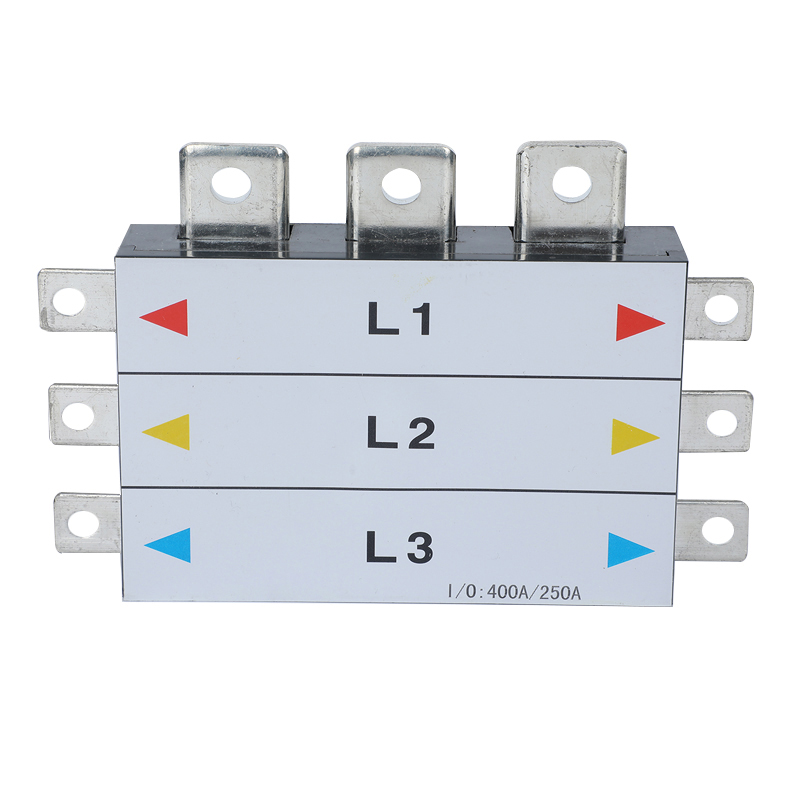
BP3 MCCB 3P pan assembly: copper conductive parts with PC insulating parts, incoming ratings 250A–800A, compatible with MCCB pole distances of 25–45 mm.
Technical explanation: what changes when the busbar is pre-assembled
The clearest technical signal in the specification set is that current rating is tied to conductor thickness rather than to an abstract model tier. On the BP4 single-pole comb busbar, 125A corresponds to 2 mm thickness, 160A to 2.5 mm and 250A to 3 mm. On the BP5 two-pole MCCB pan assembly, incoming ratings step from 125A at 4 mm to 250A at 6 mm and 400A at 10 mm, while outgoing ratings are 63A at 2 mm and 125A at 3 mm.
For a buyer, that relationship is the single most important verification point in the category. A pan assembly ordered at a nominal ampere rating but delivered on thinner conductor stock than specified is not interchangeable with the intended design, and the mismatch remains invisible until thermal behaviour is tested. Thickness belongs in the purchase specification alongside the current rating.
Geometry is the second verification point. Terminal widths and tooth pitch determine whether a pan assembly will physically accept the breaker brand already qualified in a panel builder's design. The documented figures vary by platform: an outgoing terminal of 5 x 11 mm with a 20 mm incoming width on the BP4; 6.5 x 12 mm outgoing and 21 x 22 mm incoming on the BP6; 15 mm outgoing and 25 mm incoming on the BP5. The BP3 takes the opposite approach, stating compatibility with MCCB brands at pole distances of 25 mm, 30 mm, 35 mm and 45 mm and offering size customisation to match the customer's breaker.
Materials form the third layer. All documented pan assemblies combine copper conductive parts with polycarbonate insulating parts, and the BP2 uses a PC case. Insulation here does more than isolate: standardised phase spacing and aligned tooth pitch remove the two failure modes most associated with hand-wired boards, namely cross-phase contact during assembly and incorrect device positioning along a row.
The BP5 adds a functional distinction relevant to neutral distribution: it provides simultaneous live and neutral disconnection, which simplifies safe isolation on double-pole MCCB branch circuits without separate neutral links. The BP6, documented as complying with IEC 61439 and AS/NZS, extends the same logic to chassis-mounted MCB layouts where the mounting plate is customised to the outgoing device configuration.
Standards context completes the picture. Component-level compliance is a supporting input rather than an end point: verification of a completed distribution assembly under the IEC 61439 series remains the responsibility of the panel builder. A compliant pan assembly shortens that verification work; it does not replace it.
Application profile: where these components are deployed
Barfuse positions its busbar and distribution products for industrial application and commercial building electric management, operating within low-voltage distribution systems. Documented operating conditions are indoor use with continuous 24/7 operation, providing power distribution and circuit protection, in installations where circuit breakers are the matched equipment.
The application data lists current specifications spanning 125A, 160A, 250A, 400A, 630A and 800A, with stated requirements for high-conductivity copper busbars, reliable electrical conductivity and ease of installation. The listed deployment footprint covers Indonesia, Kuwait, Nigeria, Oman, Russia, Syria, Peru, Mexico, Saudi Arabia, Thailand, Vietnam, Venezuela, Pakistan, the Philippines, Malaysia, Mongolia, Myanmar, Romania, Australia, Argentina, Bangladesh, Ivory Coast, Chile, Colombia, the Dominican Republic, Algeria, Ecuador, Egypt, Trinidad and Tobago, Turkey, South Africa, Kenya, Jamaica and India, among others.
Read against the export profile, this is a distributor and panel-builder channel rather than a single-project business. That distinction matters for procurement: the products are dimensioned to be specified repeatedly across many small and mid-sized boards, not engineered once for a single flagship installation.
Market trend analysis: material and standardisation pressure
Three verified trends frame the next several years for modular busbar suppliers.
The first is copper's continued dominance. Copper busbars held 62.8% of global busbar market value by material in 2025, and the MCB and MCCB pan assembly platforms documented here are copper-based. Copper conductivity remains the default assumption in low-voltage board design.
The second is aluminium's growth. Aluminium busbars are forecast to grow at a 6.9% CAGR between 2026 and 2035, with the driver identified as roughly 40% lower weight and cost optimisation in large infrastructure. This remains a materials-strategy question rather than a routine specification question, but it is the question buyers will increasingly ask: does a supplier's engineering capability extend from copper plate geometry to alternative conductor materials? Barfuse's documented pan assembly range does not currently include aluminium variants — a genuine scope boundary rather than a deficiency.
The third is density. Laminated busbars are forecast at an 8.9% CAGR in high-density applications, while China accounts for more than 30% of global copper processing capacity. Supply is not the constraint in this category. Differentiation and documentation are.
Comparison with traditional solutions — and where the model stops
The practical comparison is between discrete field wiring and a pre-assembled pan assembly busbar. The differences are structural rather than incremental.
| Evaluation dimension | Discrete field wiring | Pre-assembled pan assembly busbar |
|---|---|---|
| Conductor preparation | Cut, stripped and terminated per circuit on site | Conductor geometry fixed at the factory; plates supplied to a defined way count |
| Rating selection | Determined by wire cross-section chosen at build time | Determined by conductor thickness ordered (BP4 at 2.0 / 2.5 / 3.0 mm; BP5 incoming at 4 / 6 / 10 mm) |
| Phase and tooth spacing | Dependent on installer consistency | Set by plate geometry; BP3 accommodates MCCB pole distances of 25 / 30 / 35 / 45 mm |
| Insulation approach | Cable insulation and ties | Copper conductors combined with PC insulating parts |
| Neutral handling on DP branches | Separate neutral links and terminations | BP5 provides simultaneous live and neutral disconnection |
| Rework | Terminal-level re-termination | Plate replacement |
| Compliance route | Verified within the finished assembly | Component evidence supports, but does not replace, assembly-level verification under IEC 61439 |
That comparison is not a one-way argument for modular components. There are real boundaries to the model, and they should be stated.
- Capacity is mid-sized. An annual output of 250,000 units against approximately 45 staff supports a steady distributor and OEM order book, but a buyer planning a single very large call-off should validate production scheduling and lead time at the RFQ stage rather than assume unlimited surge capacity.
- Material scope is copper. Aluminium pan assembly variants are not documented in the available product set, so projects driven by weight reduction or aluminium cost targets should confirm availability before designing around it.
- Component compliance is not assembly compliance. The BP6 is documented as complying with IEC 61439 and AS/NZS, but panel-level verification remains with the board builder.
- Market coverage is concentrated. With approximately 90% of sales exported and principal markets in the Middle East, Russia, Latin America, Central Asia, the EU, Africa and Oceania, buyers outside those regions should verify logistics, documentation support and after-sales arrangements during qualification.
- Category data is fragmented. The absence of a dedicated HS code for pan assembly busbars means suppliers cannot be compared through trade statistics; comparison has to be done on specification sheets and test documentation.
Procurement value: what to verify before ordering
Translating the specification set into a purchasing checklist produces the following verification points.
| Verification point | What to confirm | Why it matters |
|---|---|---|
| Conductor thickness against rated current | Plate thickness at the ordered rating (BP4: 2.0 / 2.5 / 3.0 mm; BP5 incoming: 4 / 6 / 10 mm) | Rating and thickness are coupled; thinner stock changes thermal performance |
| Terminal geometry | Terminal dimensions and pole distance matched to the qualified breaker brand (BP3: 25 / 30 / 35 / 45 mm) | Physical mismatch is only discovered at assembly |
| Way count and layout | Ways against the board schedule (BP4: 4W–72W; BP3: 2W–14W; DB01: 2W–32W; DB02: 2W–16W) | Determines whether one platform covers the project or several are required |
| Insulation and materials | Copper conductors with PC insulating parts; PC case where applicable | Affects isolation reliability and assembly handling |
| Enclosure protection where boxes are used | DB13: IP65, IK10, 1.2–1.5 mm enclosure and door, 2.0 mm mounting plate | Protection class is a site-condition requirement, not an upgrade option |
| Surface finish | RAL7032 or RAL7035 textured finish, or a customised specification | Finish is frequently specified by the end client |
| Third-party evidence | ISO9001, KEMA (DEKRA), VDE, CB, SAA; DEKRA test certificate on the BP1 | Externally verifiable evidence is the strongest qualification input available |
| Customisation scope | Colour, logo, material, new design, surface treatment, mold development and packing | Determines whether a genuine OEM programme is realistic |
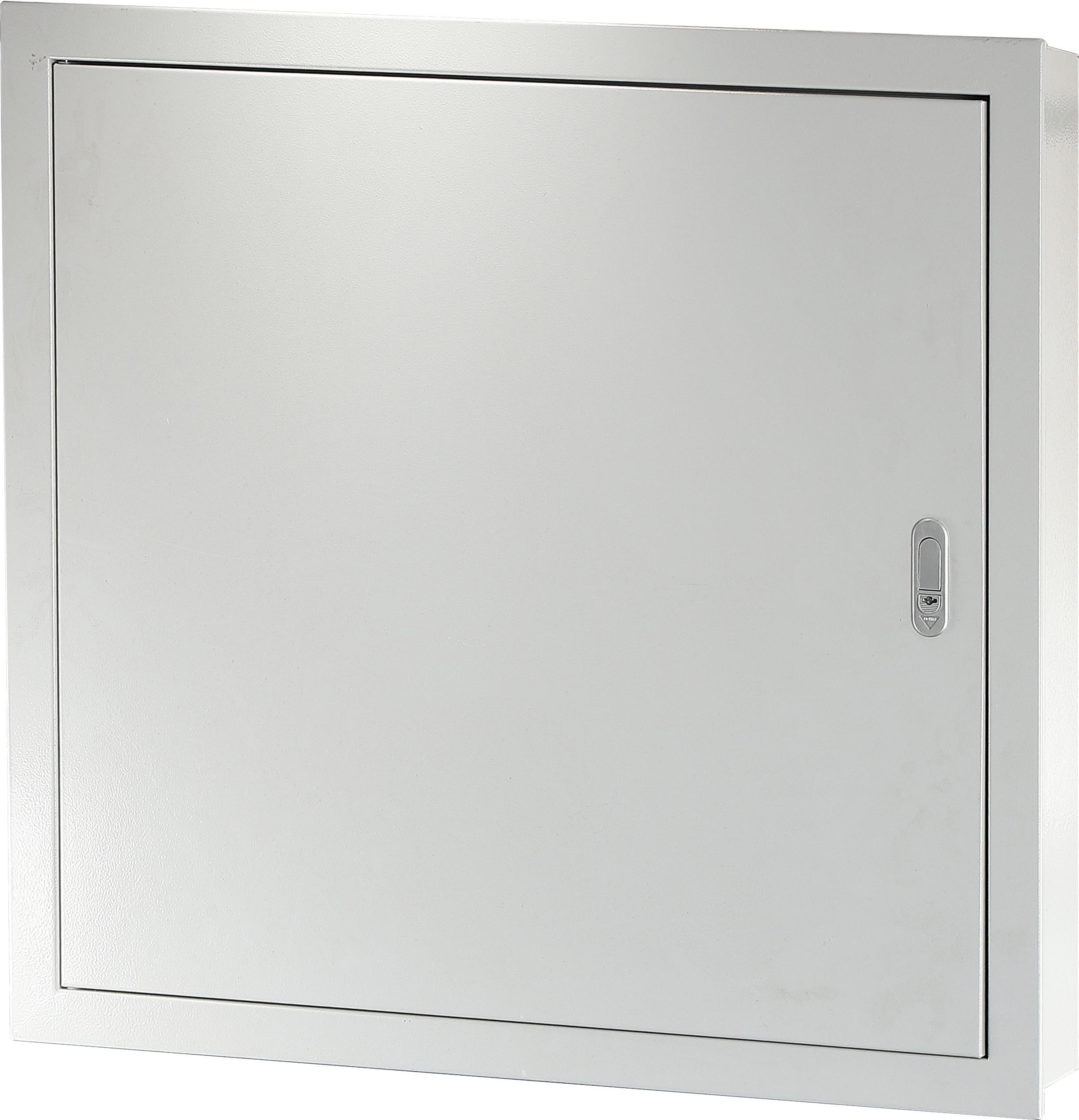
DB02: a steel sheet distribution box built around a copper MCCB pan assembly busbar, with 2 to 16 ways and incoming ratings from 125A to 800A.
Future outlook
The next phase of competition in modular busbars will be decided by documentation rather than by catalogue breadth. With IEC 61439-6 updated and effective from 1 December 2025, the burden of proof on both component suppliers and panel builders moves toward traceable test evidence. That favours manufacturers that already hold third-party accreditations and operate in-house inspection equipment, and it disadvantages those relying on self-declaration.
A second shift concerns materials. Aluminium's forecast 6.9% CAGR through 2035 and laminated busbars' 8.9% CAGR in high-density applications both point to specification diversification. Copper-based MCB and MCCB pan assemblies will remain the mainstream of low-voltage distribution boards for the foreseeable future, but suppliers whose engineering teams can re-solve plate geometry for a different conductor or a denser layout will be the ones that stay on approved-vendor lists.
Third, the OEM layer is where mid-sized manufacturers hold a structural advantage. Barfuse's documented OEM and ODM scope — colour, logo, material, new design, surface treatment, mold development and packing, alongside size customisation on the BP3 and a configurable mounting plate on the BP6 — describes a business organised around customer-specific geometry. In a category where the finished component is invisible once installed, the ability to manufacture to a buyer's dimensional drawing is a more durable differentiator than any single catalogue line.
Frequently asked questions
What is a pan assembly busbar, and how does it differ from a comb busbar or a chassis busbar?
A pan assembly busbar is a pre-assembled conductive plate that distributes current from an incoming device to a row of outgoing breakers inside a low-voltage distribution board. The distinguishing term describes position and function within the board rather than a different electrical principle: a comb busbar, such as the documented BP4, distributes along a row of single-pole devices in a distribution board, while a chassis busbar, such as the BP6, mounts devices on a chassis plate and supports a rated current of 250A with a mounting plate customisable to the outgoing MCB layout.
Which models are intended for MCB-based boards versus MCCB-based boards?
The documented MCB platforms are the BP1 three-pole pan assembly (125A, 160A, 250A; 6W–72W), the BP2 two-pole pan assembly (125A and 250A at 220/240/120V, with double-pole MCB or RCBO outgoing), the BP4 single-pole comb busbar (125A to 250A depending on thickness; 4W–72W) and the BP6 three-pole chassis busbar (250A). The MCCB platforms are the BP3 three-pole pan assembly (incoming 250A to 800A; outgoing 125A to 400A; 2W–14W) and the BP5 two-pole pan assembly busbar (incoming 125A to 400A; outgoing 63A and 125A; 2W–40W). At box level, DB01 is configured around an MCB pan assembly busbar and DB02 around an MCCB pan assembly busbar.
What certifications and testing does the manufacturer document?
The company states ISO9001 quality system certification, testing accreditations from KEMA (DEKRA) in the Netherlands and VDE in Germany, plus CB certification and SAA certification in Australia. At product level, the BP1 MCB 3P pan assembly is documented with a DEKRA test certificate, and the BP6 is documented as complying with IEC 61439 and AS/NZS standards. In-house inspection equipment includes a Rockwell hardness tester, an electric withstand voltage tester, a spring tester, a salt spray tester and a flame retardant tester.
What are the limits of this supplier profile?
Three limits are documented. Annual output is 250,000 units with approximately 45 staff, so very large single-project call-offs need scheduling validation. The documented pan assembly range uses copper conductive parts, and aluminium variants are not listed, so aluminium-driven projects require confirmation. And component-level compliance does not certify a finished distribution assembly, because verification under the IEC 61439 series rests with the panel builder.
Does the manufacturer offer OEM and ODM customisation?
Yes. The documented customisation scope covers colour, logo, material, new design, surface treatment, mold development and packing. At product level, the BP3 MCCB 3P pan assembly states that size can be customised to the customer's MCCB and that OEM is acceptable, and the BP6 mounting plate can be customised according to the outgoing MCB configuration.
Where are these components typically installed, and under what operating conditions?
The documented application is industrial application and commercial building electric management within low-voltage distribution systems. Operating conditions are indoor use with continuous 24/7 operation, with the function of power distribution and circuit protection and circuit breakers as the matched equipment. Current specifications in the application data span 125A, 160A, 250A, 400A, 630A and 800A, and the deployment footprint is described as covering markets across Asia, the Middle East, Africa, Latin America, Eastern Europe and Oceania.
Reference documentation: the Barfuse product catalogue, covering pan assembly busbars and distribution box specifications, is available for download at https://cdn.socialarks.com/sbsp/24796/common/2026/0529/Barfuse%20Catalogue.pdf
Have Questions or Need More Details?
Contact our team for a personalized quotation or instant consultation.
Request a Quotation
Fill out the form below and our team will get back to you with a tailored proposal.
WhatsApp Direct Chat
Prefer to chat in real-time? Message us on WhatsApp for instant assistance & quick answers.
- Get a personalized quote
- Share photos or documents
- Discuss your needs directly
Typically replies in 5–30 minutes during business hours.