
Bathroom Decorative Wall Panels: What Specs Must Verify
Bathroom Decorative Wall Panels: What Specs Must Verify
A bathroom wall finish is judged on constraints before it is judged on appearance. Continuous humidity, direct water contact in shower zones, repeated cleaning cycles, and — in commercial buildings — fire reaction rules decide whether a decorative wall panel can be specified at all. Design freedom only becomes relevant once those conditions are met.
This reference article maps the constraints a buyer, contractor or importer should verify before shortlisting bathroom decorative wall panels: fire classification, waterproof and dimensional behavior, certification scope, installation limits in wet areas, and supply parameters. Two panel families are used as reference points throughout — the SPC wall panel and the Silica Mineral Wall Panel, both supplied by Power Dekor Group, a manufacturer of floor covering and wall panel solutions founded in 1995, operating an 870,000 m² manufacturing footprint with a 495-engineer R&D team and serving EU and USA markets.
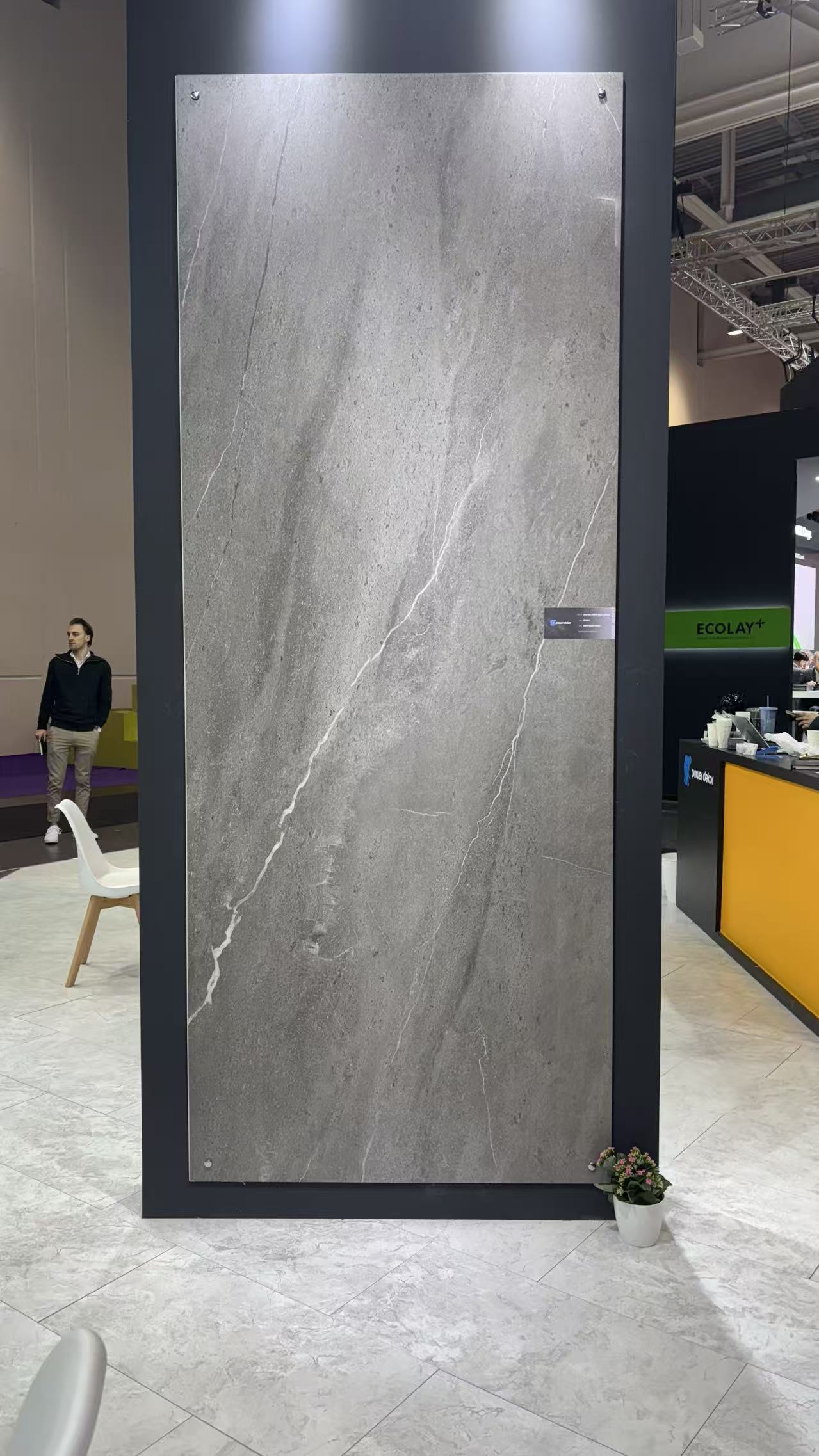
Why bathroom decorative wall panels are specified by constraints, not appearance
The bathroom is the most demanding interior room for any wall material. Moisture is permanent rather than occasional, cleaning agents are aggressive, and temperature swings between a hot shower and a cold room put continuous stress on joints and panel edges. In hotels, hospitals, offices and other public buildings, the room is additionally subject to fire reaction requirements that do not apply to a private bedroom wall.
That combination explains why specification decisions in this category usually start with four questions rather than with a color card: Does the panel meet the required fire class? Does it stay dimensionally stable under water and heat? Is the certification valid for the exact thickness being ordered? And does the installation method work in a wet area? A decorative wall panel that fails any of these checks cannot be rescued by surface design.
Market context supports the attention this category receives. Coherent Market Insights estimates the global decorative panels market at USD 39.35 billion in 2026, driven by urbanization and interior renovation demand, and Reed Intelligence reports that Asia Pacific held 43.6% of the global wall panels market in 2025 while remaining the fastest-growing region. Within that demand, bathroom and wet-area renovation is one of the most frequent use cases because it combines waterproof requirements with fast, low-dust installation preferences.
The five checks that determine whether a panel can be used in a bathroom
A practical shortlist for bathroom decorative wall panels can be reduced to five verifiable checks. Each one has a documented answer, and each one can be audited against a certificate, a test report or a specification sheet before an order is placed.
- Fire reaction classification — the class assigned under EN 13501-1, and whether the project requires Class A or accepts Class B.
- Water and moisture behavior — water absorption, dimensional movement and behavior under heat, not just a marketing claim of being waterproof.
- Certification scope — certificate number, issuing body, standard, application (internal or external) and the exact thickness covered.
- Installation limits in wet areas — adhesive method, joint sealing, trim suitability, and substrate flatness requirements.
- Supply parameters — minimum order quantity, lead time, monthly capacity and customization options.
Buyers who work through these five checks in order usually find that the shortlist narrows quickly, because most decorative wall panel categories on the market are Class B materials that are suitable for residential wet areas but not for public-space fire requirements.
Check 1 — Fire reaction classification under EN 13501-1
In Europe, the fire reaction classification of wall coverings is defined by EN 13501-1, which ranges from A1 (non-combustible) down to F. The class a panel receives determines the building types and zones in which it can legally be installed, and the difference between Class A and Class B is usually the single most decisive specification item in commercial bathroom projects.
The Silica Mineral Wall Panel has a reaction to fire classification of A2-s1, d0. The SPC wall panel carries a classification of B-s3, d0 under reaction to fire testing. Within the Power Dekor wall panel range, the silica mineral panel is the Class A2 option; SPC, HDF and WPC wall panels belong to Class B materials. That gap is structural rather than cosmetic: the silica mineral panel is made from quartz, cement, pulp, lime and water, while the SPC panel is a stone plastic composite, and the mineral composition is what allows the higher class.
For a specifier, the practical consequence is simple. If the bathroom is inside a building where a Class A reaction to fire classification is required — often the case in public, institutional and high-occupancy projects — an SPC panel cannot be substituted regardless of how well it performs in water. If the project has no Class A requirement, the Class B SPC panel remains a legitimate and often more economical choice.
Check 2 — Waterproof behavior and dimensional stability
Waterproofness claims should be read as measurable behavior rather than as a category label. Two panel types can both be described as waterproof while behaving very differently in a shower zone.
The Silica Mineral Wall Panel is documented as 100% waterproof and able to be submerged in water without deformation; no deformation is observed after boiling the panel at 100 °C. Its moisture movement is 0.06% in the length direction and 0.06% in the width direction. Antibacterial testing shows no growth apparent under the microscope when tested per ISO 846:2019 Method A, and asbestos content testing is negative.
The SPC wall panel addresses the same risk from a different material base. Its moisture content is 0.02%, and it is specified with waterproof protection for wet-area installation projects. Dimensional stability shrinkage is less than 0.002% and curling is limited to ≤0.2 mm. Surface performance is documented at stain resistance Grade 5, resistance to wet heat Rating 5 and resistance to dry heat Rating 5, with micro-scratch resistance rated MSR-A1.
| Specification item | Silica Mineral Wall Panel | SPC Wall Panel |
|---|---|---|
| Material | Quartz, cement, pulp, lime and water | Stone plastic composite |
| Reaction to fire | A2-s1, d0 (Class A2) | B-s3, d0 (Class B) |
| Water behavior | 100% waterproof, submersible; no deformation after boiling at 100 °C | Moisture content 0.02%; waterproof protection for wet-area installation |
| Dimensional stability | Moisture movement 0.06% length / 0.06% width | Shrinkage <0.002%; curling ≤0.2 mm |
| Density | 1050 kg/m³ | 2.134 g/cm³ (compared in product documentation with approximately 2,000 kg/m³ for SPC wall panels) |
| Surface performance | Stone-effect, wood-effect and matt or high-gloss finishes | Stain resistance Grade 5; wet heat Rating 5; dry heat Rating 5; micro-scratch MSR-A1 |
| Hygiene testing | Antibacterial per ISO 846:2019 Method A, no growth apparent; asbestos negative | Not stated in the same test set |
| Sizes | 2400/2440/3000/3050 × 1200/1220 × 6/8/10 mm | 2400/2440/3000/3050 × 1200/1220 × 4/5/6 mm |
| Best fit | Public spaces, bathrooms and outdoor use where Class A or plastic-free material is required | Cost-sensitive residential bathrooms and fast wet-area renovation |
The density difference has downstream effects that buyers often overlook. At 1050 kg/m³ the silica mineral panel is roughly half the weight of a stone plastic composite panel, which reduces handling effort, transport load and the demand placed on the substrate and adhesive. For renovation projects where panels are installed over existing walls rather than onto new framing, that is a practical constraint rather than a marketing point.
Check 3 — Certification scope, including thickness
Certification is where most bathroom wall panel procurement errors occur, because buyers frequently verify that a certificate exists but not what the certificate actually covers. Fire and compliance certificates are issued against a defined product, standard, application and thickness. If the ordered panel falls outside that definition, the certificate does not transfer to it.
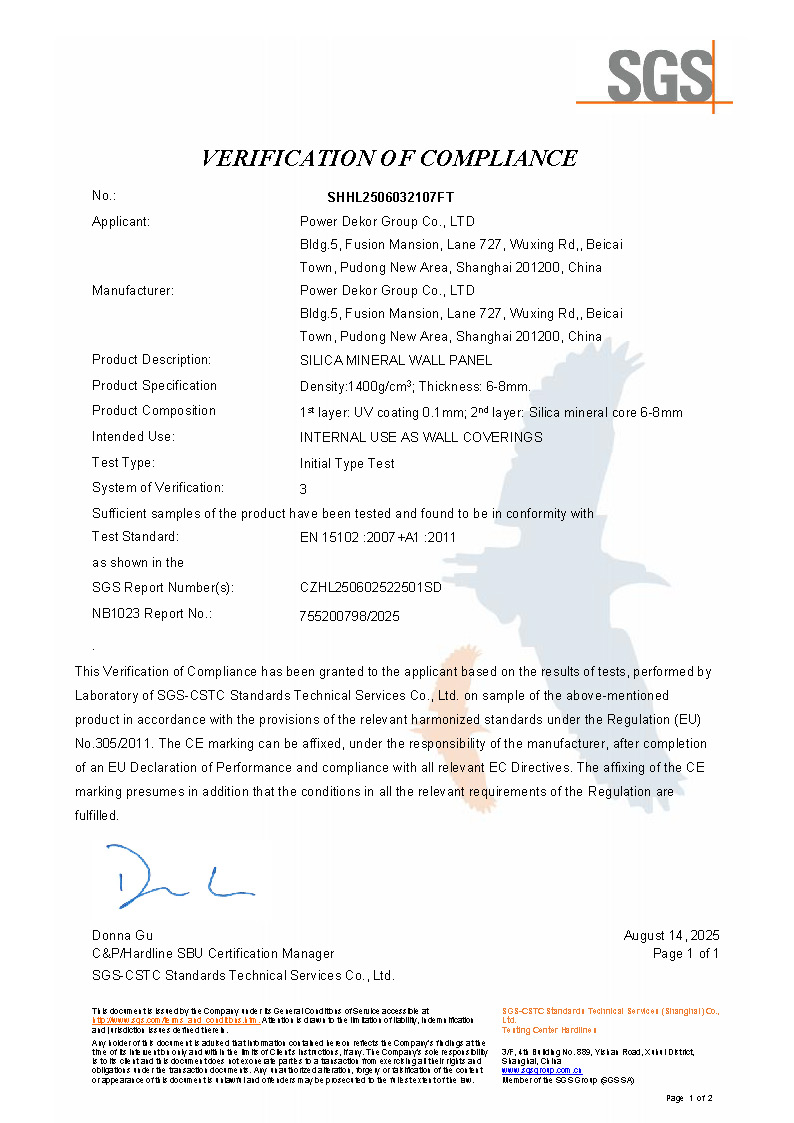
Two certificates are relevant to the two panel families discussed here, and both include a scope condition worth reading carefully.
The Silica Mineral Wall Panel holds a Verification of Compliance (CE Verification) issued by SGS-CSTC Standards Technical Services Co., Ltd. under certificate number SHHL2506032107FT, dated 2025-08-14, for the EU market. The applicable standard is EN 15102:2007+A1:2011, and the certified product scope covers silica mineral wall panels for internal use as wall coverings with thickness 6–8 mm. The product is sold in 6 mm, 8 mm and 10 mm thicknesses, so a specification calling for 10 mm internal wall covering falls outside the documented scope of that specific verification.
The SPC wall panel holds a Verification of Compliance under certificate number 230608011SHF-001, issued by Intertek for the EU market, certified to EN 13501-1:2019. The certification scope covers SPC wall panel with a thickness of 4 mm, while the available thickness range for the product family is 4 mm, 5 mm and 6 mm.
Check 4 — Installation limits in wet areas
Installation behavior is part of the constraint set for bathrooms, because a wall panel system that performs well in a corridor can behave differently in a shower enclosure. Both panel families are installed by the gluing method, using structural adhesive on the back of the panel, with panels set against pre-marked horizontal and vertical lines and fitted from the bottom upwards.
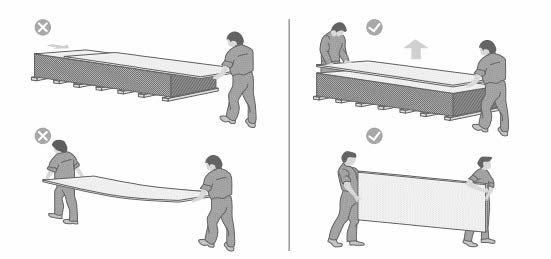
Several documented constraints matter specifically in bathrooms. The substrate has to be flat before installation, verified with a laser level, because adhesive-mounted panels follow the wall beneath them. Cutting requires a table saw or handsaw fitted with a diamond blade, and all cutting and drilling should be completed before adhesive is applied. Panels are fragile at the edges and should be handled accordingly during movement and positioning.
The most important wet-area rule concerns trims. In the installation of internal and external corners in dry areas, metal trims are assembled with the panel without gluing or nailing. In wet areas of a bathroom, metal trims are not applicable; instead, silicone sealant is used to seal all joints — the seam between wall panel and ceiling, the seam between wall panel and floor, and the panel-to-panel joints — to provide water insulation.
This leads to a boundary that should be stated plainly. A waterproof decorative wall panel is not a substitute for a complete wet-area water management strategy. The panel resists water; the joints, perimeter seams and substrate still have to be sealed and prepared as a system. Buyers evaluating a quotation should therefore check whether the scope includes sealant and edge profiles, since these are listed as the matched equipment for interior decorative wall panel installations alongside the panels themselves.
Check 5 — Supply parameters for wholesale and project orders
Once the technical checks are cleared, procurement constraints decide whether a supplier can actually deliver the project schedule. For wall panel programs, the parameters that most often determine feasibility are minimum order quantity, lead time, monthly capacity and customization scope.
In the Power Dekor wall panel program, the minimum order quantity is 500 sqm, production lead time is 30–45 days, monthly capacity is 500,000 sqm, quality control is 100% testing, and OEM/ODM production is available with box and label customization. After-sales support is provided remotely, and export markets cover worldwide destinations.
Surface technology is a further cost variable that buyers should decide on deliberately rather than by default. Film-based panels are limited by the size of the film and are positioned at a lower cost point; they suit projects without specific requirements on the number of design faces. Digital print panels can carry essentially any design, including a continuous pattern spanning up to 10 panels, and are the appropriate choice when customized or continuous patterns are required. That distinction typically has more effect on project cost than the panel format itself.
Application evidence: two European bathroom renovation cases
Two documented European projects illustrate how the checks above resolve in practice, and both use wall panels specifically for bathroom and wet-area interiors.
A retail and distributor customer in Germany uses 100,000 sqm per year of wall panels for indoor wall decoration and bathroom space renovation, with a service life of 10–20 years. The reported results are moisture-proof performance, stable project delivery, and compliance with EU standards. The project highlights the fit between panels and humid indoor environments, and the speed advantage of panel installation in renovation work where a bathroom is out of service for a shorter period.
A project contractor in Spain uses 50,000 sqm per year for bathroom and other interior decorative wall panel applications, with a 10-year service life. In this case the driver is fire performance: the project required compliance with the EU fireproof Class A standard, which the Class A2 silica mineral panel satisfies. Reported results also include moisture-proof performance and stable project delivery.
Both cases sit in the same buyer stage — research and evaluation — which is typical for this category, because decisions are made on documentation rather than on samples alone. The silica mineral panel is also positioned for bathrooms, public spaces and outdoor installation projects, and can be specified as either an interior or exterior wall panel.
How decorative wall panels compare with tiles and traditional finishes
Tiles and stone remain the reference solution for bathroom walls and are unlikely to be displaced on durability grounds. They are dense, familiar to local installers, widely available in every market, and supported by long-established installation trades. For a buyer, that familiarity has real commercial value and should be weighed honestly against the benefits of panel systems.
Panel systems compete on installation speed, weight and joint count. A panel is installed by adhesive directly onto a prepared wall, which avoids the mortar bed, curing time and heavy site logistics associated with tiles, and produces fewer joints to seal and clean. In renovation projects, where a bathroom must return to service quickly, that difference is often the deciding factor rather than the material cost. Lighter panels also reduce transport weight and handling requirements, which matters in multi-floor buildings where materials must be carried rather than craned.
The limitations are equally specific and should be stated clearly. Panels require a flat substrate; on an uneven or damaged wall, the correct response is preparation work first, not thicker adhesive. Panels are more vulnerable at the edges than ceramic tiles and demand careful handling and cutting discipline. A waterproof panel does not remove the need to seal joints and perimeter seams with silicone in wet areas, and it does not replace a properly detailed wet-area build-up behind the wall. Finally, fire class is not uniform across the decorative wall panel category: SPC and similar composite panels sit in Class B, and only mineral-based panels such as the A2-class silica mineral panel meet Class A requirements. Buyers who treat "decorative wall panel" as one homogeneous group will eventually specify the wrong class for a public-space bathroom.
| Evaluation criterion | Ceramic tile / stone | SPC decorative wall panel | Silica mineral decorative wall panel |
|---|---|---|---|
| Installation method | Mortar or adhesive bed, curing time | Structural adhesive, locking system | Structural adhesive, locking system |
| Weight profile | Heavy, higher transport cost | Density 2.134 g/cm³ | Density 1050 kg/m³ |
| Fire class (EN 13501-1 reference) | Material-dependent, non-combustible products available | B-s3, d0 | A2-s1, d0 |
| Wet-area suitability | High, established detailing | Waterproof protection for wet-area installation | 100% waterproof, submersible, no deformation after 100 °C boil |
| Main constraint to plan for | Weight, longer programme, more joints | Not suitable where Class A is required | Requires flat substrate; metal trims not used in wet areas |
Market outlook for decorative wall panels
Three documented trends shape how this category is likely to be specified over the next several years, and each has a direct procurement implication.
First, demand continues to be driven by renovation rather than new construction. Coherent Market Insights projects the global decorative panels market at USD 39.35 billion in 2026, while Asia Pacific held 43.6% of the global wall panels market in 2025 and is expected to remain the fastest-growing region according to Reed Intelligence. Reading these figures side by side requires care, however: the comparison notes that "decorative panels" typically includes furniture and cabinet laminates, whereas "wall panels" refers only to building cladding. A separate wall panel market estimate of USD 11.35 billion for 2025 is therefore not directly comparable with the broader decorative panel figure, and cross-report comparisons should be avoided when sizing a specific segment.
Second, the fastest-growing design sub-segment is dimensional rather than flat. 360iResearch estimated the global 3D wall panel market at USD 815.02 million in 2025 with a forecast CAGR of 4.93%, which corresponds to the growing share of embossed stone-effect and wood-effect surfaces in residential and hospitality interiors. For the bathroom in particular, 3D embossed surfaces compete directly with tiled feature walls.
Third, fire regulation is becoming a more explicit procurement gate. EN 13501-1 classification is already described in authoritative industry guidance as critical for commercial wall panels in Europe across the A1–F range, and trade analysis of SPC wall panels notes fire retardancy together with zero formaldehyde and waterproof properties. The direction of travel is toward documentation-based purchasing, where a certificate number, standard and scope are requested before a quote is accepted.
FAQ
What fire classification should a bathroom decorative wall panel have?
It depends on the building type rather than on the room. In the EU, fire reaction class is defined by EN 13501-1, ranging from A1 (non-combustible) to F. Private residential bathrooms generally carry no Class A requirement, while public, institutional and high-occupancy bathrooms frequently require Class A. Within the range described here, the Silica Mineral Wall Panel is classified A2-s1, d0, and the SPC wall panel is classified B-s3, d0. SPC, HDF and WPC wall panels are Class B materials; the silica mineral panel is the Class A2 option.
Is a waterproof decorative wall panel sufficient on its own in a shower zone?
No. Panel waterproofness and wet-area water management are two separate requirements. Both panel families are installed with structural adhesive, and in wet areas of a bathroom metal trims are not applicable; all joints — panel-to-panel, panel-to-ceiling and panel-to-floor — should be sealed with silicone sealant for water insulation. The substrate must also be flat before installation. The panel resists water directly, but the joints and perimeter seams determine whether the installation as a whole performs in a shower zone.
What is the difference between an SPC wall panel and a silica mineral wall panel?
They differ in material, fire class and positioning. An SPC wall panel is made of stone plastic composite and is classified B-s3, d0, with moisture content of 0.02%, stain resistance Grade 5 and micro-scratch resistance MSR-A1; it suits cost-sensitive bathroom renovation. A silica mineral wall panel is made of quartz, cement, pulp, lime and water, contains no plastic, is classified A2-s1, d0, is 100% waterproof with no deformation after boiling at 100 °C, and is intended for public spaces and bathrooms where fireproof requirements or a porcelain-like surface are specified. It is also lighter, at 1050 kg/m³ versus the higher density of a stone plastic composite panel.
What is the difference between film and digital print wall panels?
The difference is design capability and cost position. Digital print wall panels can carry any design, including a continuous pattern spanning up to 10 panels, so they are the appropriate choice when customized patterns or continuous designs are required. Film-based panels are limited by the size of the film and are cheaper, which makes them suitable when there is no requirement on the number of design faces. The choice is a specification decision about pattern continuity, not a difference in panel composition.
What certification details should be verified before ordering panels for an EU project?
Four details: certificate number, issuing body, applicable standard, and the certified scope including thickness and application. The Silica Mineral Wall Panel holds Verification of Compliance (CE Verification) number SHHL2506032107FT issued by SGS-CSTC Standards Technical Services Co., Ltd. on 2025-08-14 under EN 15102:2007+A1:2011, with a scope covering internal use as wall coverings at 6–8 mm thickness; since the product is available in 6, 8 and 10 mm, a 10 mm internal wall covering specification sits outside that documented scope. The SPC wall panel holds certificate number 230608011SHF-001 issued by Intertek under EN 13501-1:2019, with a scope covering SPC wall panel at 4 mm thickness, while the family is offered in 4, 5 and 6 mm.
What are the typical supply parameters when buying decorative wall panels wholesale?
For the wall panel program described here, the minimum order quantity is 500 sqm, production lead time is 30–45 days, monthly capacity is 500,000 sqm, and quality control is 100% testing. OEM and ODM production is available with box and label customization, after-sales support is provided remotely, and export markets cover worldwide destinations. Buyers should confirm these parameters against the specific panel family and surface technology being ordered, since film and digital print lines have different production characteristics.
Product documentation for the panel range, including material composition and certification references, is available in the SPC brochure: SPC product brochure (PDF).