
Bathroom Vanity Manufacturer Shortlist for Regulated Markets
Bathroom Vanity Manufacturer Shortlist for Regulated Markets
Regulated-market shortlisting starts with the acceptance file, not the showroom. A bathroom vanity manufacturer that clears US or Canadian documentation can still fail a European timber check, and a factory that satisfies EU product marking may never have assembled a Saudi conformity file. For buyers at evaluation stage, the useful question is therefore narrower than “which supplier is best”: which supplier profile can produce, for this product, this site and this destination, the records that customs, specifiers and project managers will actually ask to see.
This shortlist groups recommended options by destination market — the United States and Canada, the European Union, Australia, and Saudi Arabia — and scores each profile on three criteria that can be verified rather than asserted: product scope, warranty and after-sales support, and production lead time. Foshan SHKL Sanitary Ware Co., Ltd (SHKL) is a bathroom vanity, shower door and LED bathroom mirror manufacturer founded in 2004, with production in China and Vietnam and exports to the EU, Australia, North America, South America and the Middle East, according to company information. Its records are used here as a worked example of what evidence looks like. They are not a rank: no verified comparative performance data for named competitors supports a league table, so this shortlist orders capability profiles, not companies.
Two rules keep the exercise honest. A certificate counts only for the product and the production site it names, so a group-level ISO certificate does not automatically cover a new model from a second factory. And a capability becomes a shortlist entry only when it can be shown in a document the buyer can hold — a test report, a certificate number, a lead time tied to a construction type, or a warranty clause that states what happens when something fails.
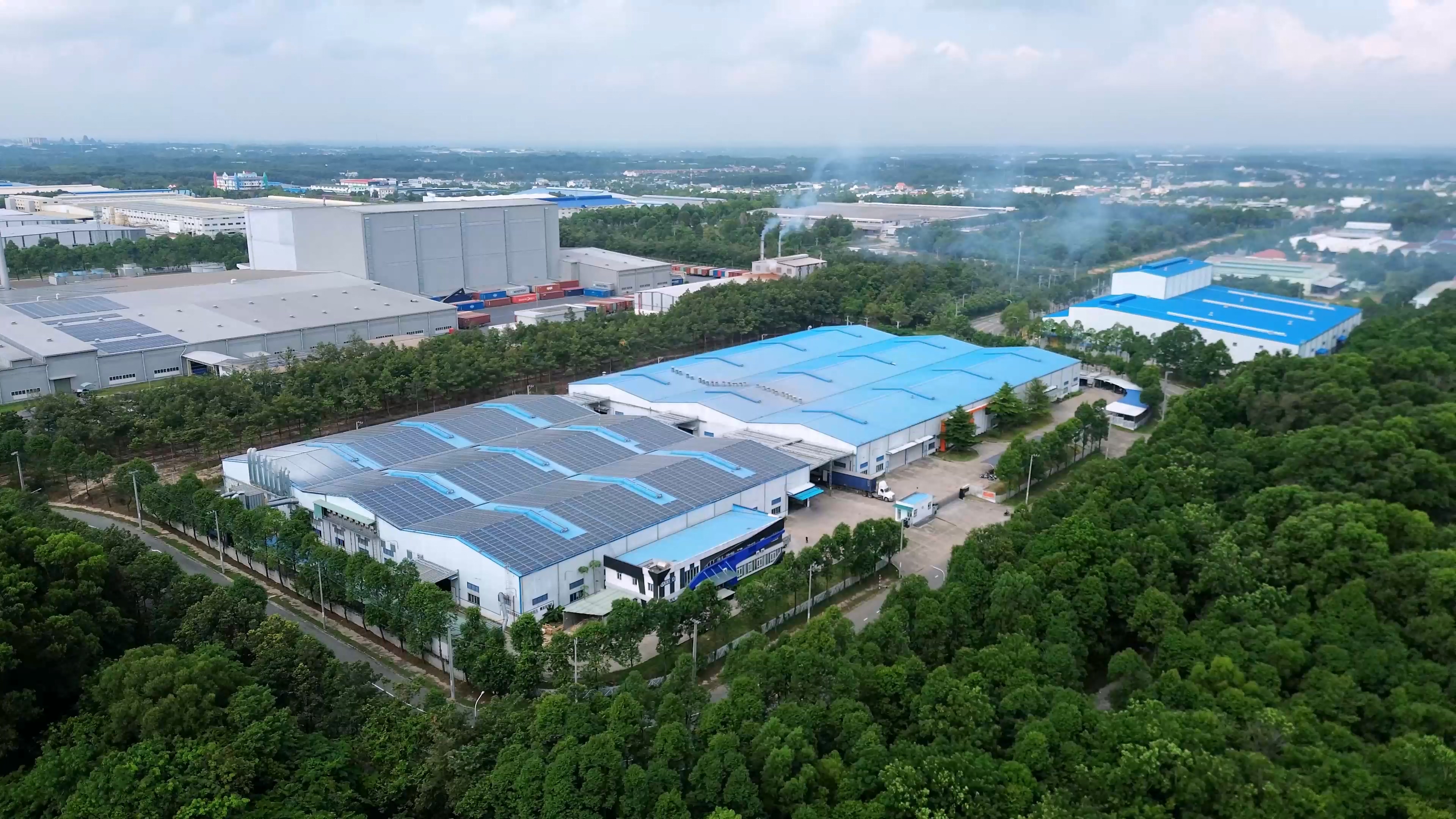
A dual-site structure — China and Vietnam — changes both the delivery date and the documentation package attached to it.
Why the destination, not the brochure, sets the order
Acceptance files diverge because the risks regulators care about diverge. North American review concentrates on composite-wood emissions and on electrical safety for lighted mirrors. The European Union adds timber traceability and product marking. Australia runs its own glass certification route. Saudi Arabia requires conformity registration before import. One factory file can satisfy all four only if it was assembled product by product, which is why a single “export-ready” claim is worth very little on its own.
Timber is not a side issue in this category. Wood materials — solid wood and plywood — accounted for a 42.7% revenue share of the bathroom vanities market in 2025, according to Data Bridge Market Research. Most orders will therefore trigger timber documentation at some point, which is why the EUDR and FSC checks below sit inside the shortlist rather than beside it.
Market size deserves a caution of its own. Published estimates for the global bathroom vanities market disagree materially in absolute level for overlapping years, while growth-rate estimates cluster in a 6.5%–7.4% band without reconciling definitions. The band is directionally useful; the absolute figures are not a procurement benchmark. Buyers should size the order, not the market.
Criterion one — product scope that matches the project file
Scope is the first filter because it decides how many documentation sets a project needs. A supplier that builds only vanities forces the buyer to assemble separate files for the mirror and the shower enclosure. A supplier that builds all three can often answer a specification with one package, and one set of site visits.
SHKL’s documented vanity scope covers solid wood, plywood, MDF and particleboard cabinets with painted, spray lacquer, melamine, veneer, PVC foil and thermoforming finishes. Solid wood options are listed as rubber wood, ash, red oak, rosewood and black walnut. Mounting options are documented as wall-mounted and floor-standing, which covers the wall mounted bathroom vanity and the freestanding bathroom vanity formats. Buyers who specify a floating bathroom vanity should confirm in writing that the wall-hung configuration, the fixing method and the wall build-up are what the factory is quoting, because “floating” describes an appearance rather than a bracket.
Vanity, basin and mirror are quoted separately, with a matched set recommended for fit and finish. Customization is documented across size, colour, material, finish, hardware, logo and design style; DTC and BLUM are named as the normally used hardware brands, with Kubler, Hettich and Hafele available. Custom colours carry their own threshold, and the company notes that light colours are usually more expensive than matte colours — a pricing detail worth capturing before a colour is written into a specification.
Where scope widens to a full bathroom package, the documentation argument strengthens. Shower enclosures are listed in sliding, hinged, pivot, walk-in and folding designs with 6, 8, 10 and 12 mm tempered glass or laminated glass. LED mirrors cover lighting, dimming, CCT adjustment, anti-fog, Bluetooth, magnifiers and smart displays. The management-system certificates name a scope of “R&D, Manufacture of bathroom cabinets; Manufacture of fixed universal lighting fixtures” — wording that matters, because it places the lighted-mirror line inside the same quality system as the cabinets instead of outside it.
Criterion two — warranty and after-sales read as a process
A warranty period is easy to print and hard to test. The evaluation question is what the process behind the number does when a container arrives damaged or a finish fails in service.
SHKL documents a two-year warranty across bathroom vanities, shower enclosures and LED mirrors. The after-sales route is described in three steps: full inspection before packing; an assessment on receipt of whether damage came from transport or installation; and free replacement where a serious product quality problem is confirmed. Spare parts supply and remote after-sales consultation are listed within the support scope.
Two limitations belong beside that description rather than in a footnote, because they change how a specification should be written. Solid wood can crack under extreme conditions; the company controls moisture content at 10%–14% and upgrades processing to reduce the risk, and will guide repair of minor cracks or replace products with serious cracks. And no vanity in the range is designed to be soaked for long periods — lacquered vanities carry two UV undercoats and one PU finishing coat, while melamine vanities depend on edge sealing against moisture. A buyer who specifies “fully waterproof” is specifying something the documentation does not claim. A buyer who specifies a lacquered finish, sealed edges and a dry-use assumption is specifying what the file supports.
What to test: who decides that a defect is serious; whether the spare-parts list covers the hardware actually supplied, meaning hinges and runners rather than shelves; and whether the warranty transfers when a distributor resells the goods.
Criterion three — lead time as a date, not a range
Lead time should be compared per construction type and per order size, because a single quoted range hides both variables. SHKL’s capability record lists 30–45 days. The product-level documentation is more specific: melamine board vanities 25–35 days, modern lacquer vanities 35–45 days and classic style vanities 40–45 days, with other types quoted on request.
Sample and container timelines run on separate clocks. Regular shower-product samples take 15–20 days. LED mirrors are quoted at 35 days for frameless samples or orders under 10 pieces and 45 days for framed equivalents, with a 40 ft container order at 45–50 days. For planning, the company’s reference loading figure is about 0.6 CBM per set for a vanity 0.8 m high, giving roughly 110 sets in a 40 ft HC and 45 sets in a 20 ft GP — reference figures, not a loading guarantee.
Order mechanics belong in the same comparison, because a lead time without an order quantity means little. The capability record lists an MOQ of 50. The product documentation sets item-level minimums of more than 10 sets per item for customization, more than 20 pieces per item for printed packaging and more than 20 sets for custom colours, while LED mirrors are quoted at more than 10 pieces per item and more than 50 pieces per order. Mixed orders should be confirmed against the threshold that actually governs them.
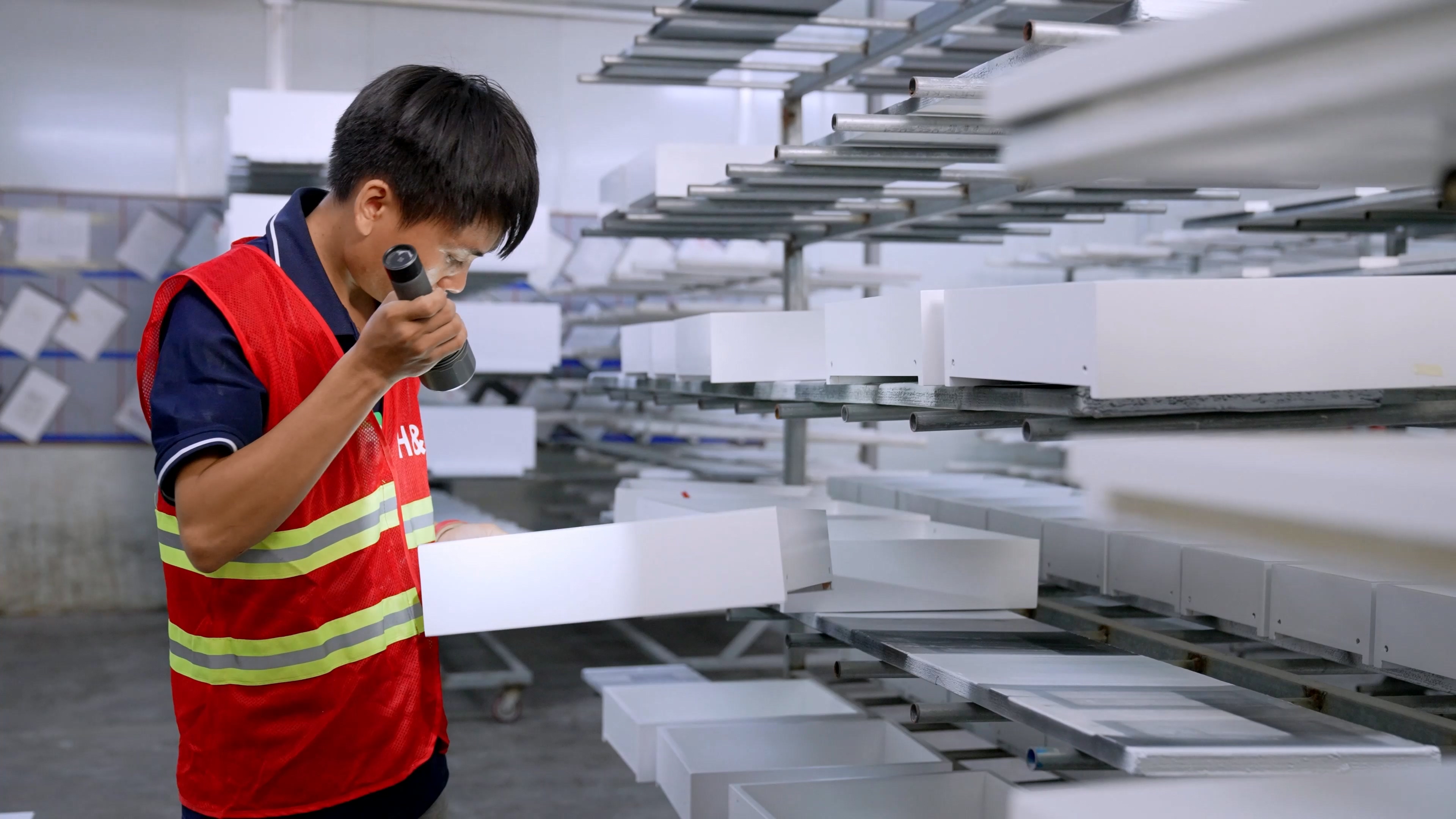
Pre-packing inspection is the step that turns a warranty clause into something a buyer can test at receiving.
Dual-site production is the last variable. SHKL operates a China base and a Vietnam base; the Vietnam factory is described as producing American-style designs for US and Canadian buyers, which is an argument about trade exposure and response time rather than about quality. A buyer comparing lead times across suppliers should ask which site will run the order, because the answer changes both the delivery date and the documents attached to it.
Option profile A — United States and Canada
The US and Canada profile is the most document-heavy and the most volume-sensitive. A workable shortlist entry needs four items: a composite-wood emission statement for the specific board and factory, glass certification for any shower element, electrical certification for any lighted mirror, and a specification that matches North American installation practice.
SHKL’s evidence on this profile is specific. Boards are documented as E1, with the company’s own explanation of the grades: E0 below 3 mg/100 g, E1 below 9 mg/100 g, E2 below 30 mg/100 g and F below 1.8 mg/100 g. Shower glass certifications are listed as SGCC, PAS-Mark and CE; LED mirrors are listed with UL, ETL and CE, and the mirror supply voltage for North America is 120V. On installation, North American projects commonly specify vanity heights of 32–36 inches (813–914 mm), with 34.5 inches often cited as a comfort height, so height should be fixed in the purchase order rather than left to the catalogue drawing.
Reference records on this profile include a 250-unit hotel bathroom project in the United States, recorded as delivered on time with product meeting US market standards, and a 50-piece bathroom and kitchen cabinet order for a Canadian client recorded as meeting Canadian safety standards. Those records support volume and schedule claims for projects of that type. They do not establish performance for every configuration, which is why the model-level certificate request still applies.
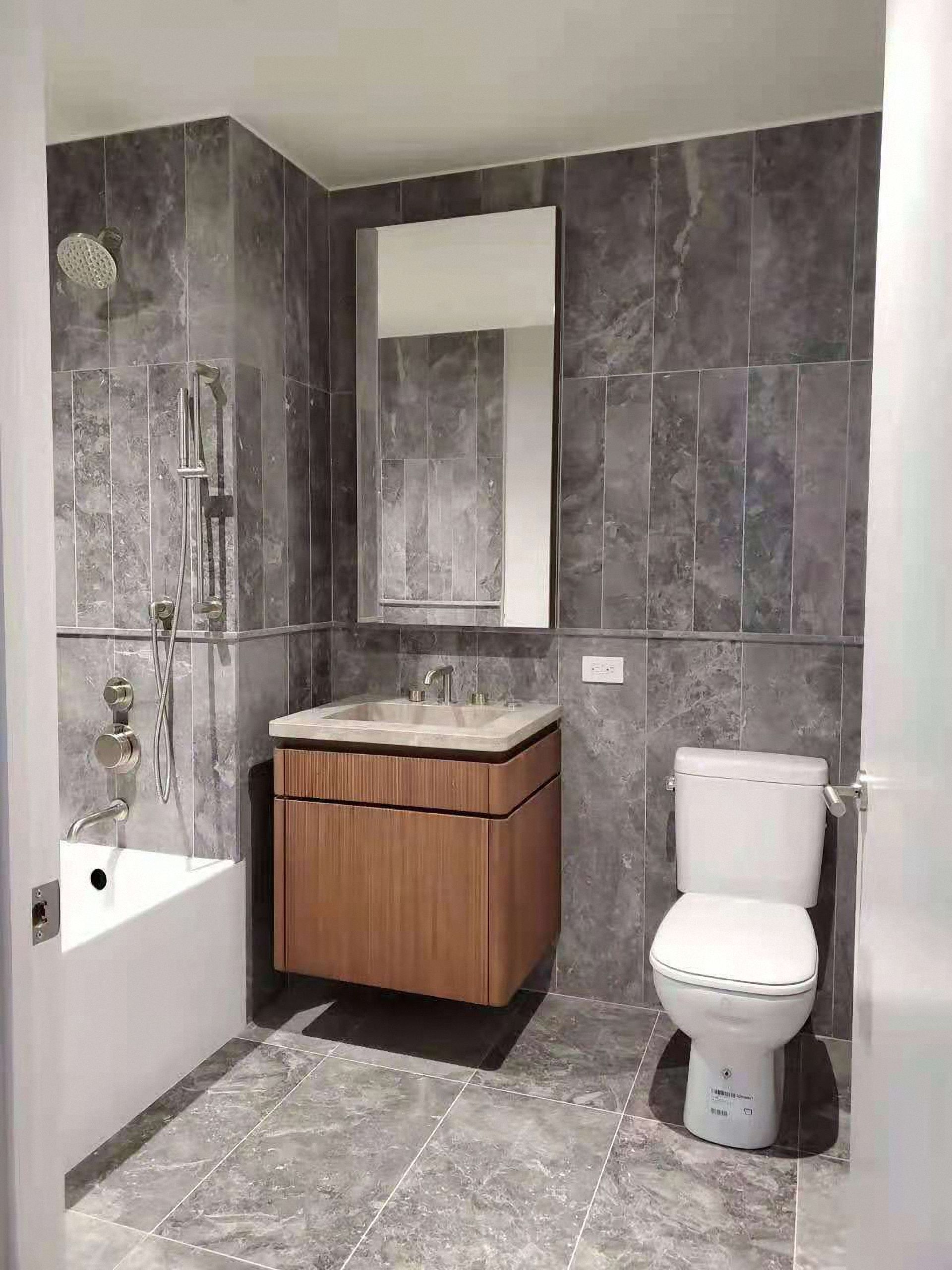
Hotel-scale volume is a delivery record, not a product certificate: the model-level document request still applies.
One caution belongs here. An emission grade label is a material statement, not a destination-specific formaldehyde document. Buyers should request the emission documentation for the exact board and the exact factory, and should not treat a grade letter on a spec sheet as a substitute for it.
Option profile B — European Union
The EU profile adds two requirements that North American files do not carry in the same form: product marking for glass and electrical items, and timber traceability for wood-based vanities.
On product marking, SHKL lists CE for shower glass and CE for LED mirrors, with a 220–240V supply for Europe. The management-system certificates sit underneath that product evidence: ISO 9001 (04924Q00629R0M), ISO 14001 (04924E00351R0M) and ISO 45001 (04924S00316R0M), issued on 11 May 2024 and valid to 10 May 2027 by Guangdong Quality Testing CTC Certification Co., Ltd., with a stated market scope covering China, the EU, the US and the Middle East. They are not a substitute for product evidence. A management-system certificate says the process is controlled; it does not say a specific model is marked.
On timber, the work is documentary. EU-bound buyers are asking for species and origin data at shipment level, and for a chain-of-custody certificate that names the site producing the order. EUDR due-diligence obligations fall on the operator placing goods on the EU market rather than on the factory, so the test of a supplier is whether it can hand over geolocation, species and site data when asked, not whether it can email a certificate image. SHKL lists FSC among its factory management-system certifications alongside CCC, ISO 9001 and ISO 14001; buyers should verify the certificate number, the covered product scope and the validity dates in the FSC database, and confirm that the certificate covers the factory shipping the order. This article does not determine whether a given shipment falls within EUDR scope — that is a legal question for the importer and its advisers.
Moisture performance carries more weight in this profile because solid wood and plywood dominate European specification. The documented controls — 10%–14% moisture content, two UV undercoats plus one PU topcoat on lacquered vanities, sealed edges on melamine — are the technical answer to a climate question, and they should be quoted back in the specification rather than assumed.
Option profile C — Australia
Australia is a smaller, more concentrated profile in which glass certification and project-scale customization decide the shortlist. SHKL lists PAS-Mark among its glass certifications, and its records include a 190-unit shower door order delivered against Australian safety standards with smooth installation, plus a 100-set bathroom furniture OEM project for an Australian villa recorded as meeting villa design specifications, on time, across a relationship of five to ten years.
The gap to close in this profile is vanity-specific. Glass certification does not transfer to cabinetry, and the available records do not include an Australian vanity acceptance document for a named model. Buyers should request the item-level test or acceptance report for the cabinet, basin and any mirror, and treat the project record as evidence of delivery capability rather than as a substitute for product documentation.
Option profile D — Saudi Arabia and the Middle East
The Middle East appears in SHKL’s export map — main markets are listed as North America, the Middle East (Qatar, UAE, Lebanon), South America, Africa and Europe — and the ISO certificates state a market scope that includes the Middle East. What the available records do not contain is a Saudi-specific vanity acceptance document.
That absence should change the order of the questions, not disqualify the profile. A Saudi-bound shortlist entry should be confirmed in sequence: which conformity registration route applies to the product; whether the supplier or the importer holds the registration; which production site will be declared; and whether mirror and shower elements carry their own electrical and glass documentation. A supplier that answers all four in writing is shortlistable for the market. A supplier that answers “we ship to the Middle East” has answered a different question.
The four-market shortlist map
| Destination | Documents to verify first | Profile to prefer | Evidence to request |
|---|---|---|---|
| US / Canada | Board emission statement; SGCC for shower glass; UL/ETL for lighted mirrors; 120V mirror supply; 32–36 in height | Supplier with North-America-oriented production and hotel-scale delivery record | Grade-specific emission document for the exact board; certificate numbers with product scope |
| European Union | CE for glass and mirrors; 220–240V; timber traceability and chain of custody | Supplier able to produce species, geolocation and site data at shipment level | FSC number, product scope and validity; certificate-to-site match |
| Australia | PAS-Mark for glass; item-level cabinet acceptance report | Supplier with Australian project experience and customization capacity | Model-level test report; project reference detail without sensitive data |
| Saudi Arabia | Conformity registration route; declared production site | Supplier able to name the registration holder and the declared site | Written answer on registration, site, and electrical/glass documentation |
Where an option should leave the shortlist
Preference is only reliable if the disqualifiers are written down beside it. A profile drops out when:
- the certificate on file names a product family or a site other than the one that will supply the order;
- the emission, glass or electrical document cannot be produced for the exact model in the specification;
- a multi-market order is supported by a single market’s documentation;
- a complex vanity is offered only as knock-down or flat pack — the company’s own guidance does not recommend that for complex structures;
- delivery is quoted as a range with no construction type attached, or with no production site named;
- the buyer needs a guarantee against prolonged water exposure, which no vanity in the documented range provides.
Outlook: certificate cycles and timber rules
Two dates and one material trend deserve attention in the next planning cycle. The ISO certificates on file run to 10 May 2027, so any delivery scheduled across that boundary should be matched to a renewal status rather than to a copy of the current certificate. Timber rules tighten in the same direction as the material mix: with wood-based products holding 42.7% of vanity revenue, the share of orders needing species, origin and chain-of-custody data is large and unlikely to shrink.
On demand, the directional signal is expansion rather than contraction — North America is described as the largest market for bathroom cabinets and Asia Pacific as the fastest growing, with a 35% revenue share in 2023, according to Grand View Research. That is a statement about the broader bathroom cabinets category, not about any single supplier’s order book, and it reads as context for capacity planning rather than as a forecast for a specific project.
None of this changes the three criteria. It changes the paperwork attached to them, which is precisely what a regulated-market shortlist is for.
A working sequence for a ten-day evaluation
- Write the destination and the declared production site at the top of the file.
- List the exact models and accessories in scope: vanity, basin, mirror, shower element.
- Request product-level certificates for those models, with numbers and validity dates.
- Request material documentation: board emission grade, timber species, chain-of-custody scope.
- Request the warranty clause and after-sales route in writing, including who decides on replacement.
- Fix the lead time to a construction type, then to an order quantity, then to a site.
- Confirm MOQ thresholds for customization, packaging and colour before locking a design.
FAQ
Which documents should be requested first from a bathroom vanity manufacturer?
Start with the four documents that decide whether an order can clear at all: a product-level acceptance or test record for the exact model, a management-system certificate with its number, scope and validity dates, a material emission statement for the board used, and the glass or electrical certificates if the order includes a shower enclosure or a lighted mirror. Group-level marketing files are useful afterwards, not first.
How do US/Canada and EU documentation requests differ for wooden vanities?
North American files concentrate on composite-wood emission statements for the specific board, while EU files add timber traceability. The EUDR due-diligence obligation sits with the operator placing goods on the EU market, so the supplier’s job is to provide species, geolocation and production-site data at shipment level, plus a chain-of-custody certificate covering the factory that ships the order. Electrical and glass marking requirements apply in both markets, but through different routes.
What does an FSC check actually verify on a wooden vanity order?
It verifies three things and nothing more: that the certificate is valid, that the certified product scope covers the item being bought, and that the production site named on the certificate is the site that will manufacture the order. It does not by itself prove species or origin for a specific shipment, which is why it complements rather than replaces shipment-level traceability data.
How should lead times be compared between manufacturers?
Compare like with like: construction type, order quantity, and whether the figure refers to a sample or a container. SHKL’s documented ranges are 25–35 days for melamine board vanities, 35–45 days for modern lacquer vanities and 40–45 days for classic style vanities, against a capability record of 30–45 days; LED mirror container orders are quoted at 45–50 days and shower samples at 15–20 days. A single number without those qualifiers cannot be compared.
Is a two-year vanity warranty adequate for a hotel project?
The period is only half the answer. What matters operationally is the process behind it: inspection before packing, an assessment that separates transport damage from installation damage, replacement where a serious quality problem is confirmed, and spare-parts availability for hinges and runners. The documented limits also belong in the specification — solid wood can crack under extreme conditions, and no vanity in the range is built for prolonged soaking.
A downloadable document with product and factory details is available here: SHKL company brochure (PDF).
Have Questions or Need More Details?
Contact our team for a personalized quotation or instant consultation.
Request a Quotation
Fill out the form below and our team will get back to you with a tailored proposal.
WhatsApp Direct Chat
Prefer to chat in real-time? Message us on WhatsApp for instant assistance & quick answers.
- Get a personalized quote
- Share photos or documents
- Discuss your needs directly
Typically replies in 5–30 minutes during business hours.