
Bathroom Vanity vs Shower Screen: A Specifier's Independent Cost Check
A bathroom renovation is budgeted as one project but bought as several. The vanity and the shower enclosure are usually the two largest single entries in that budget — yet they are specified by different people, quoted by different suppliers and judged against different value metrics, even though both compete for the same square metres and the same contingency.
Category context is well documented but not decision-ready. Grand View Research places residential applications at roughly 74.9% of bathroom vanity revenue in 2025, and market estimates for the global bathroom vanities market range from approximately USD 43.34 billion to USD 47.22 billion in 2024/2025, with projections reaching up to USD 89.96 billion by 2034 (Fortune Business Insights; Grand View Research). Those numbers describe the supply side of the equation. They do not tell a specifier how to split a fixed renovation budget between a wall-mounted vanity and a shower screen.
To keep that comparison anchored in published facts, this article uses the specification data of a manufacturer that produces both categories. SHKL (Foshan SHKL Sanitary Ware Co., Ltd) is a sanitary ware manufacturer founded in 2004 that produces bathroom vanities, shower doors and LED bathroom mirrors across a 100,000 m² production base in China and a 40,000 m² base in Ho Chi Minh City, Vietnam, with a reported 70% export ratio and distribution across more than 50 countries and regions. Because a wall-mounted vanity (KL813003) and a shower screen (KL-AS001-1) sit inside the same catalogue, the two categories can be compared on specification rather than on slogan.
One boundary applies from the outset: no public price data exists for either category, so this is a cost-driver check rather than a quotation. What follows is where money is actually committed in each category, which specification decisions are reversible, and which are not.
The procurement problem: two categories, two different value curves
Vanity spend concentrates in the carcass, the finish and the daily touch points. A plywood and solid wood vanity with a porcelain slab top and a lacquered front is bought for storage, appearance and drawer action; its failure modes are slow — humidity ingress into the carcass, finish wear and hardware fatigue. Shower screen spend concentrates in metal hardware, glass and sealing. A screen sits in permanent contact with water, so hardware grade, glass treatment and sealing quality determine both the safety profile and the cleaning burden for the life of the installation.
That asymmetry has a commercial consequence. A buyer who negotiates both categories against the same discount expectation tends to over-negotiate the category with the thinner margin structure and under-specify the category with the higher maintenance cost. The two are not interchangeable line items, and treating them as one "bathroom package" is where specification drift begins — usually months before anyone notices it on site.
What each line item actually buys
Table 1 sets out the specification dimensions a buyer controls in each category, using KL813003 for the vanity side and KL-AS001-1 for the screen side. Both are published model specifications, not marketing summaries.
| Decision dimension | Floating bathroom vanity (KL813003) | Shower screen (KL-AS001-1) |
|---|---|---|
| Primary structure | Plywood and solid wood carcass | 304 stainless steel hardware |
| Wear parts | Drawer slides and hinges — two drawers on DTC soft-closing slides | Hinges, pivots and sealing hardware |
| Water exposure | Splash and ambient humidity; not a wet surface | Continuous direct water contact |
| Space strategy | Wall-mounted; floor kept clear | Enclosure footprint determines usable shower area |
| Surface options | Melamine plus lacquered finishes (for example A2391 Acacia; other models use Warm Mist Brown, Ancora Walnut, A2392 Walnut) | Clear, tinted, laminated, flute, chemically frosted glass; easy-clean and film-coated options |
| Top and basin | Pure White Porcelain slab with undermount ceramic basin | Not applicable |
| Lighting integration | LED mirror supporting different functions | Not applicable |
| Dominant failure mode | Slow: finish wear, humidity ingress, hardware fatigue | Water-driven: seal and coating degradation |
Read vertically, the table shows why a single "cost per bathroom" figure is unreliable: the two categories do not share a wear part, a failure mode or a service interval. Read horizontally, it shows where the buyer has genuine leverage — surface and mirror functions on the vanity, glass treatment on the screen — and where the specification should be locked before pricing starts.
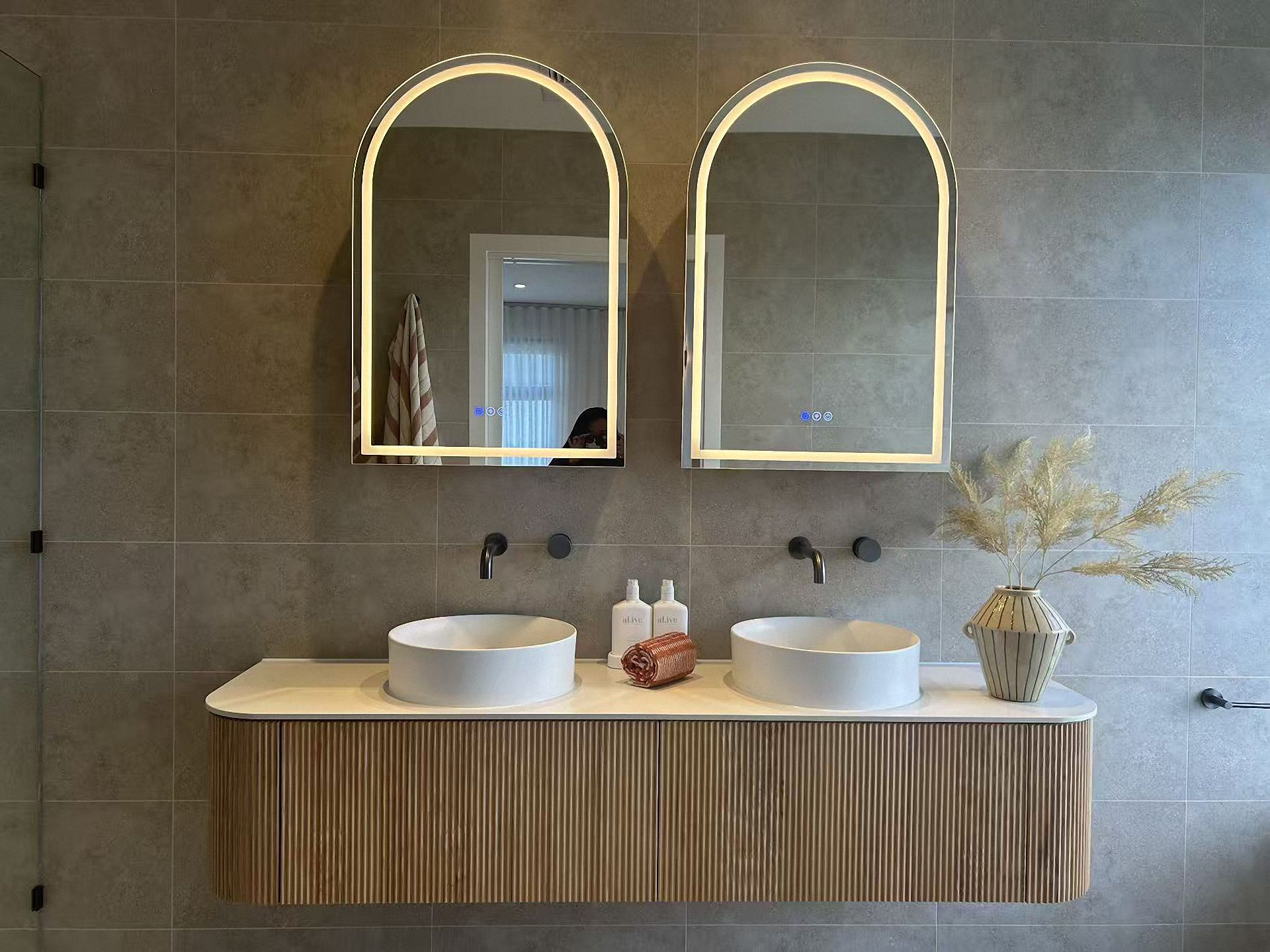
Figure 1: Double-basin vanity configuration in a villa project. In this reference project, 100 customized bathroom vanity units were supplied for an Australian villa development.
Material trade-offs: plywood and solid wood versus 304 stainless steel
The two categories run on different material logics, and neither is universally superior.
Vanity carcasses in this range are built from plywood and solid wood — a construction listed for KL813003, AS813047, AS813048A, AS813049, AS813050, AS813108, AS813109 and KL813001. Wood-based construction supports joinery detail, lacquer and melamine finishes, and repair rather than replacement; in exchange it requires moisture management at the wall and around the basin. Third-party category data supports the durability argument behind that choice: Grand View Research reports that the wood material segment — solid wood and plywood — led the market with a 34.9% revenue share in 2025.
Shower screen hardware follows a metal logic, but not a single metal. Within the same catalogue, KL-AS001-1 (shower screen), KL-AS5511312 (sliding shower door) and KL-AS5577310 (hinge shower door) specify 304 stainless steel hardware, while KL-AS5104310 (frameless), KL-AS5605110-5 (bathtub), KL-AS5507310 (hinge), KL-AS5608212 (sliding) and KL-AS5210422 (arc) specify aluminium alloy hardware. This is the single most important specification lesson in the comparison: hardware material is a model-level decision, not a brand-level assumption. If a tender requires 304 stainless steel, the requirement has to be carried against a model number.
Glass is the second half of the screen specification. Across the range, the available craftsmanship options are identical: clear, tinted, laminated, flute, chemically frosted, easy-clean and film-coated. Laminated and other safety-related treatments change behaviour under impact; easy-clean and film-coated options change maintenance frequency. Both are set at order stage and are difficult to retrofit afterwards — which makes glass the one screen decision that pricing pressure should not be allowed to delete.
Technical explanation: where the wear parts sit in each category
In a vanity, the wear parts are the drawer slides and hinges. In a shower enclosure, the wear parts are the hinges, pivots and seals. Buyers who want a defect-resistant specification should therefore name components, not brands.
On the vanity side, the range names three hardware families. KL813003 uses two drawers on DTC soft-closing slides with a hidden handle. AS813047 uses Unihopper soft-closing slides with a sintered stone integral basin. AS813048A uses Unihopper metal box soft-closing slides with a glossy white ceramic basin. AS813049 combines a DTC hinge with a Hettich push-open system in a freestanding cabinet. AS813050 and AS813109 use Unihopper soft-closing slides. AS813108 pairs Unihopper slides with a three-door mirror cabinet on DTC hinges, an internal LED strip and an infrared sensor switch. KL813001 uses Unihopper push-open slides plus two doors on DTC hinges and a Hettich push-open system. Hardware family is therefore a nameable variable inside one product family — and one of the few places where a buyer can raise specification without disturbing the design language.
Countertop and basin construction is the second technical lever, and the range deliberately spans several price and durability tiers: Pure White Porcelain slab with undermount ceramic basin on KL813003 and KL813001 (the latter with an above-counter ceramic basin), sintered stone integral basins on AS813047 and AS813049, glossy white ceramic basins on AS813048A and AS813050, a solid surface top with ceramic basin on AS813108, and a terrazzo top with solid surface basin on AS813109.
Sizing is the third technical variable, and it is where vanity quotations most often stop being comparable. KL813003 is available in five widths — 750, 800, 900, 1000 and 1200 mm — at a common 520 mm depth and 504 mm height. AS813109 is offered as an 800 × 469 × 408 mm cabinet and a 900 × 469 × 408 mm cabinet, each with a matching LED mirror. AS813049 is a freestanding unit at 450 × 450 × 890 mm with a 500 × 1500 × 35 mm LED mirror.
| Model | Type | Carcass material | Hardware | Top / basin |
|---|---|---|---|---|
| KL813003 | Wall-mounted vanity, 750/800/900/1000/1200 × 520 × 504 mm | Plywood and solid wood | Two drawers, DTC soft-closing slides, hidden handle | Pure White Porcelain slab; undermount ceramic basin |
| AS813047 | Bathroom vanity | Plywood and solid wood | Unihopper soft-closing slides | Sintered stone integral basin |
| AS813048A | Floating bathroom vanity | Plywood and solid wood | Unihopper metal box soft-closing slides | Glossy white ceramic basin |
| AS813049 | Freestanding bathroom vanity, 450 × 450 × 890 mm | Plywood and solid wood | DTC hinge and Hettich push-open system | Sintered stone integral basin |
| AS813050 | Floating bathroom vanity | Plywood and solid wood | Unihopper soft-closing slides | Glossy white ceramic basin |
| AS813108 | Floating bathroom vanity | Plywood and solid wood | Unihopper soft-closing slides; mirror cabinet on DTC hinges | Solid surface top; ceramic basin |
| AS813109 | Floating bathroom vanity, 800 and 900 mm cabinets | Plywood and solid wood | Unihopper soft-closing slides; DTC hinges | Terrazzo top; solid surface basin |
| KL813001 | Floating bathroom vanity | Plywood and solid wood | Unihopper push-open slides; DTC hinges and Hettich push-open | Pure white porcelain slab; above-counter ceramic basin |
Wall-mounted and floating configurations keep the floor clear and simplify cleaning, which is why they dominate current design guidance; North American market commentary from Houzz and Homes & Gardens describes floating vanities as a leading trend for 2025–2026 while noting that freestanding units still hold a significant volume share in North America, at roughly 30%. The practical constraint is structural rather than aesthetic: a wall-mounted vanity transfers load into the wall and requires concealed plumbing, so a retrofit with unsuitable wall construction may still resolve to a freestanding unit such as AS813049.
The shower screen side: hardware material and glass options
Table 3 lists the screen and door models in the same catalogue with their hardware material — the variable that most often changes between an approved sample and a delivered order.
| Model | Type | Hardware material | Glass options |
|---|---|---|---|
| KL-AS001-1 | Shower screen | 304 stainless steel | Clear / tinted / laminated / flute / chemically frosted / easy-clean / film-coated |
| KL-AS5511312 | Sliding shower door | 304 stainless steel | Same option set |
| KL-AS5577310 | Hinge shower door | 304 stainless steel | Same option set |
| KL-AS5104310 | Frameless shower door | Aluminium alloy | Same option set |
| KL-AS5605110-5 | Bathtub shower door | Aluminium alloy | Same option set |
| KL-AS5507310 | Hinge shower door | Aluminium alloy | Same option set |
| KL-AS5608212 | Sliding shower door | Aluminium alloy | Same option set |
| KL-AS5210422 | Arc shower door | Aluminium alloy | Same option set |
The pattern to notice is that within one product family both 304 stainless steel and aluminium alloy appear, while the glass option list stays identical across every model. That gives a buyer a fast normalisation test when two screen quotations arrive: ask which hardware material is quoted and which glass treatment is quoted. If either answer differs, the two prices describe different products, and the lower one is not automatically the better value.
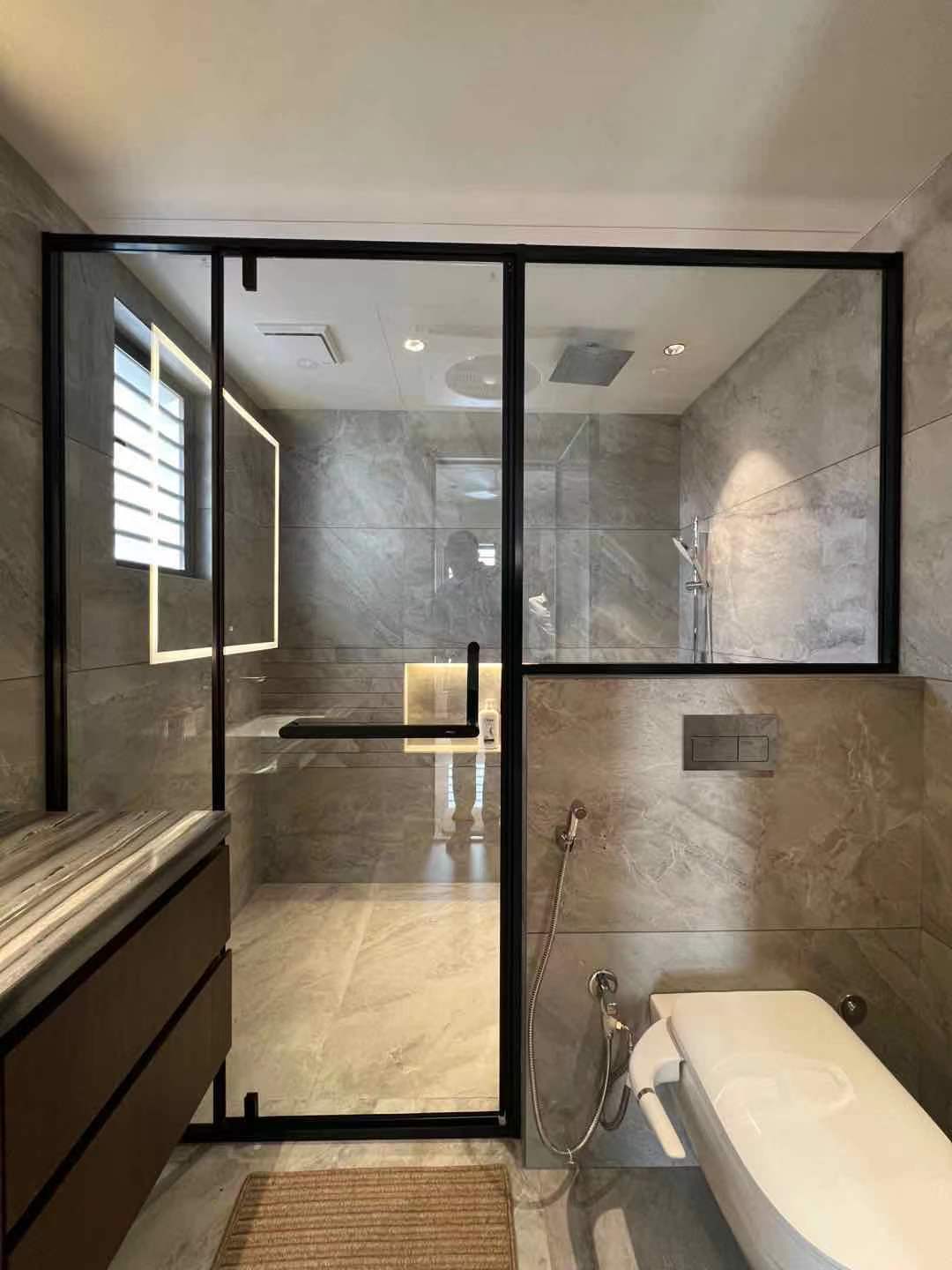
Figure 2: Customized shower door installation. The reference project in Australia covered 190 customized shower door units for bathroom shower applications.
Compliance: what belongs in the tender pack
Management-system certification is the first document layer. SHKL holds ISO 9001:2015 (certificate 04924Q00629R0M), ISO 14001:2015 (certificate 04924E00351R0M) and ISO 45001:2018 (certificate 04924S00316R0M), issued on 11 May 2024 by Guangdong Quality Testing CTC Certification Co., Ltd. and valid until 10 May 2027, with a scope covering research and development and the manufacture of bathroom cabinets, plus the manufacture of fixed universal lighting fixtures.
The scope wording is the part worth reading closely. The certificates name bathroom cabinets and fixed lighting fixtures. Shower enclosure products are a separate category, and a management-system certificate that covers one category should not be presented as covering the whole catalogue. For North America, bathroom cabinets and vanities are additionally subject to UL 962, which addresses stability, mechanical strength and flammability, according to UL Solutions.
A practical tender pack therefore separates two things that are frequently blurred: supplier-level management-system certification, and category-level product compliance for each product type actually being purchased. The same discipline applies on the vanity side, where compliance depends on both the carcass and the electrical components of an integrated LED mirror.
Application reality: what four reference projects show
- United States — customized bathroom furniture for a hotel bathroom programme, 250 units, delivered across a two-year engagement. The manufacturer reports on-time delivery and products meeting US market standards, with design fidelity and alignment with customer requirements recorded as the highlights.
- Canada — customized bathroom and kitchen cabinetry, 50 units, with the case record noting that materials met the specified project requirements.
- Australia — customized shower doors, 190 units, for bathroom shower applications, delivered under a client-specific customization requirement.
- Australia — customized bathroom vanities for a villa project, 100 units, supplied under an OEM relationship and designed to meet the requirements of a high-end villa project.
The pattern across these cases matters more than the individual numbers. The vanity and the screen were purchased in different project phases, under different commercial structures — hotel programme volume on one side, villa customization on the other — and often by different decision-makers. That is the coordination risk this cost check is designed to expose. A manufacturer covering vanities, shower doors and LED mirrors removes one supplier interface, but it does not remove the need to specify each category on its own terms. The manufacturer also states OEM production with customization across size, colour, material, finish, hardware, logo and design style, a 30–45 day lead time, 100% inspection, and after-sales support that includes warranty support, remote consultation and spare parts supply.
A cost-check sequence for the same renovation
For a buyer holding one budget across both categories, the sequence below keeps the comparison honest, because each step fixes a variable before the next one is priced.
- Confirm the compliance route first. Match each product category to the certificate that actually covers it, and add the market-specific standard where it applies.
- Fix the mounting strategy. Wall-mounted or floating vanities preserve floor area but require suitable wall structure and concealed plumbing; freestanding alternatives remain valid where wall conditions do not allow it.
- Name the wear parts. On vanities, name the slide and hinge family; on screens, name the hardware material — 304 stainless steel or aluminium alloy.
- Fix surfaces and treatments last. Finish families, basin and countertop types, mirror functions and glass treatments are the variables with the widest legitimate range.
- Close on commercial terms with lead time in view. A stated 30–45 day lead time has to be sequenced against wall preparation and tiling, not treated as a delivery date.
| Specification decision | Status in a cost check | Why it matters |
|---|---|---|
| Screen hardware material | Fix before pricing | Model-level variable; changes exposure behaviour and duty performance |
| Vanity carcass material | Fix before pricing | Drives finish options, repair strategy and moisture management |
| Drawer slide and hinge family | Fix before pricing | Main wear part on the vanity side |
| Countertop and basin type | Negotiable within range | Porcelain slab, sintered stone, solid surface, terrazzo and ceramic options all exist |
| Mirror function set | Negotiable | Defog, dimming, colour temperature and sensor control vary by model |
| Glass treatment | Negotiable | Clear, tinted, laminated, flute, chemically frosted, easy-clean and film-coated options |
| Lead time | Plan around it | Manufacturer states 30–45 days; installation sequence depends on it |
Traditional alternatives and where this comparison breaks down
Two legacy formats still frame the decision. On the screen side, a traditional framed enclosure uses an aluminium alloy frame to carry the glass, while current options include frameless construction and models with 304 stainless steel hardware such as KL-AS001-1 — the difference is not simply cosmetic, because the hardware is the part that carries the moving load over time. On the vanity side, a fixed freestanding cabinet was historically the default, and floating construction has since become the design standard for new work, without eliminating freestanding demand.
An honest cost check has to state its own limits as well.
- Material grade is not a ranking. 304 stainless steel and aluminium alloy hardware coexist in the same catalogue for different applications. The correct specification depends on exposure, duty cycle and budget, not on an assumption that one material is always right.
- Wall-mounted is not universally applicable. It depends on wall construction and plumbing routing; freestanding vanities remain a substantial share of North American volume for exactly that reason, at roughly 30%.
- Category certification is not interchangeable. A management-system certificate whose scope covers bathroom cabinets and lighting does not, by itself, document compliance for shower enclosures.
- Cost comparison here is structural, not numerical. No public price data is used, and order quantities, finishes and configurations are confirmed per project.
- Service life is a manufacturer statement. Product literature states a five-to-ten-year lifespan for the bathroom furniture OEM range; actual service life depends on humidity control, cleaning practice and installation quality, and should be validated against project conditions rather than assumed.
Market trend analysis
Three published signals shape how this decision is being made in 2025 and 2026.
First, material preference. Grand View Research reports that the wood material segment — solid wood and plywood — led the bathroom vanity market with a 34.9% revenue share in 2025, driven by premium aesthetics and durability. That explains why plywood and solid wood construction remains the default across the range reviewed here rather than a cost-down alternative.
Second, format preference. Houzz and Homes & Gardens identify floating wall-mounted vanities as a leading design trend for 2025–2026, while freestanding units continue to hold a significant North American volume share of roughly 30%. The two formats are therefore converging on different buyer types: new build and full refurbishment on the floating side, retrofit and constrained wall conditions on the freestanding side.
Third, scale and its limits. The global bathroom vanities market is estimated at approximately USD 43.34–47.22 billion for 2024/2025, with projections up to USD 89.96 billion by 2034. Those headline numbers should be treated with caution: published estimates diverge widely between research firms — one dataset values the same market at USD 9.2 billion, against Grand View Research at approximately USD 46.1 billion for 2025 and Fortune Business Insights at USD 47.22 billion. A specifier should not anchor a project budget on a headline market figure; the cost drivers described above are more useful planning inputs.
For competitive context, the global high-end and residential vanity market includes brand-level players such as Kohler, Masco (Delta/Peerless), American Woodmark and TOTO, as identified by Mordor Intelligence. Manufacturers in this segment compete differently — through OEM and ODM manufacture, customization and category coverage rather than through retail brand positioning.
Future outlook
The most likely change over the next planning cycles is not a new material but a change in how specifications are written. Buyers are moving from brand adjectives toward component-level requirements: hardware material named against a model, glass treatment named against a model, certificate scope named against a product category. The model tables above show why — the same catalogue contains both 304 stainless steel and aluminium alloy screens, and both a 750 mm single vanity and a 1200 mm wide KL813003 configuration.
A second shift is scope consolidation. Purchasing a vanity, a mirror cabinet and a shower screen from one manufacturer reduces interface risk on dimensions, finishes and delivery sequencing. SHKL manufactures all three categories, and its two-region footprint in China and Vietnam is described by the company as improving resilience against international trade risk, shortening lead times and supporting US and Canadian design requirements; the Vietnam facility of approximately 40,000 m² employs around 450 people and includes a PU dust-free spray paint workshop. The company also lists designations including National High-Tech Enterprise, Foshan Standard Product Enterprise and Top Bathroom Brand, and reports a 20-person R&D team within a workforce of around 600.
The most useful prediction for a specifier is also the least dramatic: floating and freestanding vanities will continue to coexist, framed and frameless screens will continue to coexist, and the difference between a well-priced project and an expensive one will remain in whether hardware material, glass treatment and certificate scope were fixed before the first price was accepted.
Frequently asked questions
Do a floating bathroom vanity and a shower screen carry the same specification risk?
No. The vanity's wear parts are the drawer slides and hinges and its main risk is humidity-related carcass and finish degradation; the screen's wear parts are hinges, pivots and seals and its main risk is continuous water exposure plus glass treatment performance. In the range reviewed here, KL813003 specifies two drawers on DTC soft-closing slides, while KL-AS001-1 specifies 304 stainless steel hardware with a defined glass option list. The two categories need separate specification lines even when both are purchased from one supplier.
Is 304 stainless steel always the correct hardware specification for a shower screen?
Not automatically. Within the same catalogue, KL-AS001-1, KL-AS5511312 and KL-AS5577310 specify 304 stainless steel hardware, while KL-AS5104310, KL-AS5605110-5, KL-AS5507310, KL-AS5608212 and KL-AS5210422 specify aluminium alloy hardware. Material selection should reflect exposure, duty cycle and budget. What matters for a specification is that the hardware material is written against a model number rather than assumed from the collection name.
How should two quotations covering a vanity and a shower screen be normalised before comparison?
Compare on model number, carcass or hardware material, hardware family, countertop and basin type or glass treatment, mirror function set, certification scope, inspection regime and lead time. Width must be matched first: KL813003 alone spans five widths — 750, 800, 900, 1000 and 1200 mm — at a common 520 mm depth and 504 mm height. If hardware material or glass treatment differs between two quotes, the totals are not describing the same product, and a lower total is not evidence of better value.
What should a buyer verify when a supplier presents one certificate for its whole catalogue?
Verify the scope. The ISO 9001:2015, ISO 14001:2015 and ISO 45001:2018 certificates issued to the manufacturer on 11 May 2024 by Guangdong Quality Testing CTC Certification Co., Ltd. — valid until 10 May 2027 — cover research and development and the manufacture of bathroom cabinets, plus the manufacture of fixed universal lighting fixtures. Shower enclosure products are not named in that scope. In North America, UL 962 additionally applies to bathroom cabinets and vanities for stability, mechanical strength and flammability.
What planning factors affect a combined order of vanities and shower screens?
Lead time and installation sequence. The manufacturer states a 30–45 day lead time with 100% inspection, and after-sales support covering warranty, remote consultation and spare parts supply. Wall-mounted vanities require prepared wall structure and concealed plumbing, so their installation follows wall works and precedes final tiling; shower screens are typically installed after tiling and waterproofing. Order quantities and configurations are confirmed against the specific model and finish rather than assumed from a catalogue default.
Specification reference: the manufacturer's product brochure is publicly available for download — SHKL product brochure (PDF).
Have Questions or Need More Details?
Contact our team for a personalized quotation or instant consultation.
Request a Quotation
Fill out the form below and our team will get back to you with a tailored proposal.
WhatsApp Direct Chat
Prefer to chat in real-time? Message us on WhatsApp for instant assistance & quick answers.
- Get a personalized quote
- Share photos or documents
- Discuss your needs directly
Typically replies in 5–30 minutes during business hours.