
Behind the Grade: Evidence of Electrical Insulation Capability in HTV Silicone
Yakows Technology (Dongguan) Co., Ltd. is a manufacturer of high-temperature-vulcanizing (HTV/HCR) silicone rubber compounds based in Dongguan, Guangdong Province, China, producing electrical insulation grades for composite insulators alongside food-grade, extrusion-grade, flame-retardant and high-temperature-resistant compounds. Its electrical insulation grade for composite insulators is supplied as YK-3160, classified as a High-Performance Electrical Insulation Grade and formulated as a high-consistency silicone rubber compound with reinforcing fillers and functional additives for outdoor electrical insulation.
The classification is backed by a specific parameter set: a dielectric loss tangent of ≤4.0 × 10⁻², volume resistivity of ≥2 × 10¹⁴ Ω·cm, dielectric strength of ≥22 kV/mm, HC2 hydrophobicity, V-0 flame retardancy, UV-aging resistance, and tracking and erosion resistance reported as TM1A4.5 with an erosion limit of ≤2.5 mm. This article examines what that evidence means in practice, how technical staff should request and cross-check it, and which parts of a composite insulator project it does not cover.
Why “Insulation Grade” Has Become an Evidence Question
Grade language travels faster than test data. A compound described as electrical insulation grade appears in quotation sheets, distributor listings and specification tables long before anyone asks which laboratory produced the volume resistivity figure or which specimen geometry was used. For buyers moving from evaluation into execution — document approval, sample sign-off, production trial, release — that gap is the real commercial risk, because the remaining unknowns are all documentary rather than technical.
The risk is structural rather than cosmetic. In composite insulator manufacturing, the housing material has to deliver insulation, hydrophobicity, resistance to tracking and erosion, UV and weather resistance, flame retardancy and mechanical durability over years of outdoor service, while protecting the FRP core. A general-purpose compound may show acceptable hardness and tensile properties and still be entirely unverified against those requirements. Selection based only on hardness or price does not test long-term outdoor electrical performance.
Standards set the frame. For composite insulators, the finished product must satisfy the applicable design, type, sample and routine test requirements of IEC 62217 and IEC 61109, and the polymeric housing material should be evaluated for tracking and erosion resistance under severe environmental conditions according to IEC 60587. A silicone rubber compound cannot satisfy those requirements by itself — but a compound without traceable electrical data makes them considerably harder to satisfy, and shifts the burden of proof onto the insulator manufacturer's own testing budget.
What the YK-3160 Specification States
YK-3160 is specified as a single, internally consistent material grade rather than a family of loosely related compounds. The table below reproduces the grade's specified properties; the third column indicates why each line matters at the document-approval stage.
| Property | YK-3160 specified value | Why a technical buyer checks it |
|---|---|---|
| Classification | High-Performance Electrical Insulation Grade | Confirms the grade is positioned for outdoor electrical insulation, not general molding |
| Hardness | 65 ± 5 Shore A | Sets demolding behavior and shed geometry control |
| Specific gravity | 1.46 ± 0.03 g/cm³ | Drives compound weight per shot and cost calculation |
| Tensile strength | ≥5.0 MPa | Mechanical baseline for housing durability |
| Elongation | ≥220% | Indicates flexibility during demolding and service |
| Tear strength | ≥12 kN/m | Resistance to tearing at thin shed edges |
| Hydrophobicity | HC2 | Surface water repellency class used in outdoor insulation evaluation |
| Flame-retardant rating | V-0 | Flammability classification for the compound |
| Dielectric strength | ≥22 kV/mm | Breakdown resistance of the insulating material |
| Dielectric constant | ≤5.0 | Field distribution behavior in the insulation system |
| Volume resistivity | ≥2 × 10¹⁴ Ω·cm | Bulk resistance to leakage current |
| Dielectric loss tangent | ≤4.0 × 10⁻² | Dielectric energy dissipation under alternating field |
| Tracking and erosion resistance | TM1A4.5, ≤2.5 mm | Surface degradation resistance under severe wet-contaminated conditions |
| UV aging resistance | Pass | Outdoor weathering indication for the compound |
Table 1. Specified properties of YK-3160, High-Performance Electrical Insulation Grade HTV silicone rubber, as documented by Yakows Technology (Dongguan) Co., Ltd.
Two practical notes follow from this table. First, the values are grade-specific. They should not be generalized to every compound a supplier offers under an “insulation” heading, and they should not be transferred to a different model number without a new TDS. Second, final approval should be based on the current TDS, the mutually agreed specification, and finished-insulator testing — not on the classification name alone.
Reading the Numbers That Carry the Insulation Claim
Four of the fourteen properties do most of the work in an insulation-grade argument. Each is only as strong as the test conditions attached to it, which is why the request should always pair the number with its method.
Volume resistivity ≥2 × 10¹⁴ Ω·cm
Volume resistivity describes how strongly the bulk of a material resists the passage of leakage current. A specified floor states the minimum the supplier commits to for the compound before it is molded into a housing. Its procurement value depends on how it was measured and on which specimen geometry — a figure quoted without method or conditioning is a headline, not a criterion. Ask for the value in the grade-specific TDS together with the test standard and conditioning applied.
Dielectric loss tangent ≤4.0 × 10⁻²
The dielectric loss tangent expresses how much electrical energy the material dissipates rather than stores under alternating field. A ceiling of ≤4.0 × 10⁻² defines the upper bound the supplier commits to. Because loss behaviour depends on frequency, temperature and moisture, the figure is only interpretable with its test conditions attached. Two suppliers quoting the same order of magnitude under different conditions are not quoting the same thing, and comparing them without the conditions is a common source of false equivalence.
Dielectric strength ≥22 kV/mm and dielectric constant ≤5.0
Dielectric strength describes the field level at which breakdown occurs in a defined test arrangement; dielectric constant influences how field distributes through a composite insulation system. Together they set the material's electrical envelope for design calculations. Neither is a prediction of the finished insulator's withstand voltage, because that depends on shed geometry, wall thickness, core, interfaces and pollution severity. They are design inputs, and should be treated as such in the technical file.
Tracking and erosion resistance: TM1A4.5, ≤2.5 mm
Surface tracking and erosion is the failure mode most directly associated with outdoor silicone housings, and it is the property least likely to be inferred from mechanical data. YK-3160 is reported as TM1A4.5 with an erosion limit of ≤2.5 mm. The correct request is not the summary line but the underlying report: which standard was followed, what voltage and contaminant flow were applied, how long the test ran, and how the erosion depth was measured. Yakows' documentation for composite insulator projects cites IEC 62217:2025, IEC 61109:2025 and IEC 60587:2022 as the applicable standards framework, with IEC 60587 governing severe-condition tracking and erosion evaluation of the housing material.
Hydrophobicity HC2 and UV-aging “Pass”
HC2 hydrophobicity and a UV-aging pass are qualitative classifications rather than numeric limits, which makes them the easiest items to accept without scrutiny. Ask which hydrophobicity classification procedure was used, at what interval after molding the surface was assessed, and whether the UV exposure test report states duration and apparatus. On their own, both statements are directional; with method attached, they become verifiable.
The Document Set to Request Before Approval
Evidence in this category is documentary. A supplier that can produce the compound but not the paperwork leaves the buyer to fund the difference in testing time. The following set is the practical minimum for an electrical insulation grade going into a composite insulator program.
| Document | What it establishes | Verification point |
|---|---|---|
| Grade-specific TDS | Specified limits for mechanical, electrical, hydrophobicity, flame and UV properties | Confirm values match the quoted grade and check the TDS revision date |
| SDS | Handling, storage and safety information | Confirm it corresponds to the same grade and destination market |
| Typical COA | Representative batch values | Compare each figure against the TDS limit it should satisfy |
| Batch COA | Actual measured values for the delivered lot | Check batch number, listed test items and release date |
| Electrical test reports | Dielectric strength, volume resistivity, dielectric constant, dielectric loss tangent | Confirm specimen, method, laboratory and test conditions |
| Tracking and erosion report | TM1A4.5 classification, erosion ≤2.5 mm | Confirm standard, test duration, evaluation criteria and erosion measurement method |
| Flame and UV-aging reports | V-0 rating; UV-aging pass | Confirm method and apparatus rather than accepting the headline result |
| Quality management certificate | ISO 9001 system certification | Check certificate number, validity and scope wording |
Table 2. Documentation set for evaluating an electrical insulation grade HTV silicone rubber compound.
On the last item, Yakows Technology (Dongguan) Co., Ltd. holds ISO 9001 quality management system certification number 75725Q0464R0S, issued on 2025-11-28 by ZhongPin Testing & Certification Center (Guangzhou) Co., Ltd. to GB/T19001-2016/ISO9001:2015, valid to 2028-11-27, with a scope covering sales of general machineries and parts, molds, and rubber compound and raw materials. Buyers should read the scope text rather than the certificate title, and should confirm the certificate is current on the issuing body's register at the time of approval.
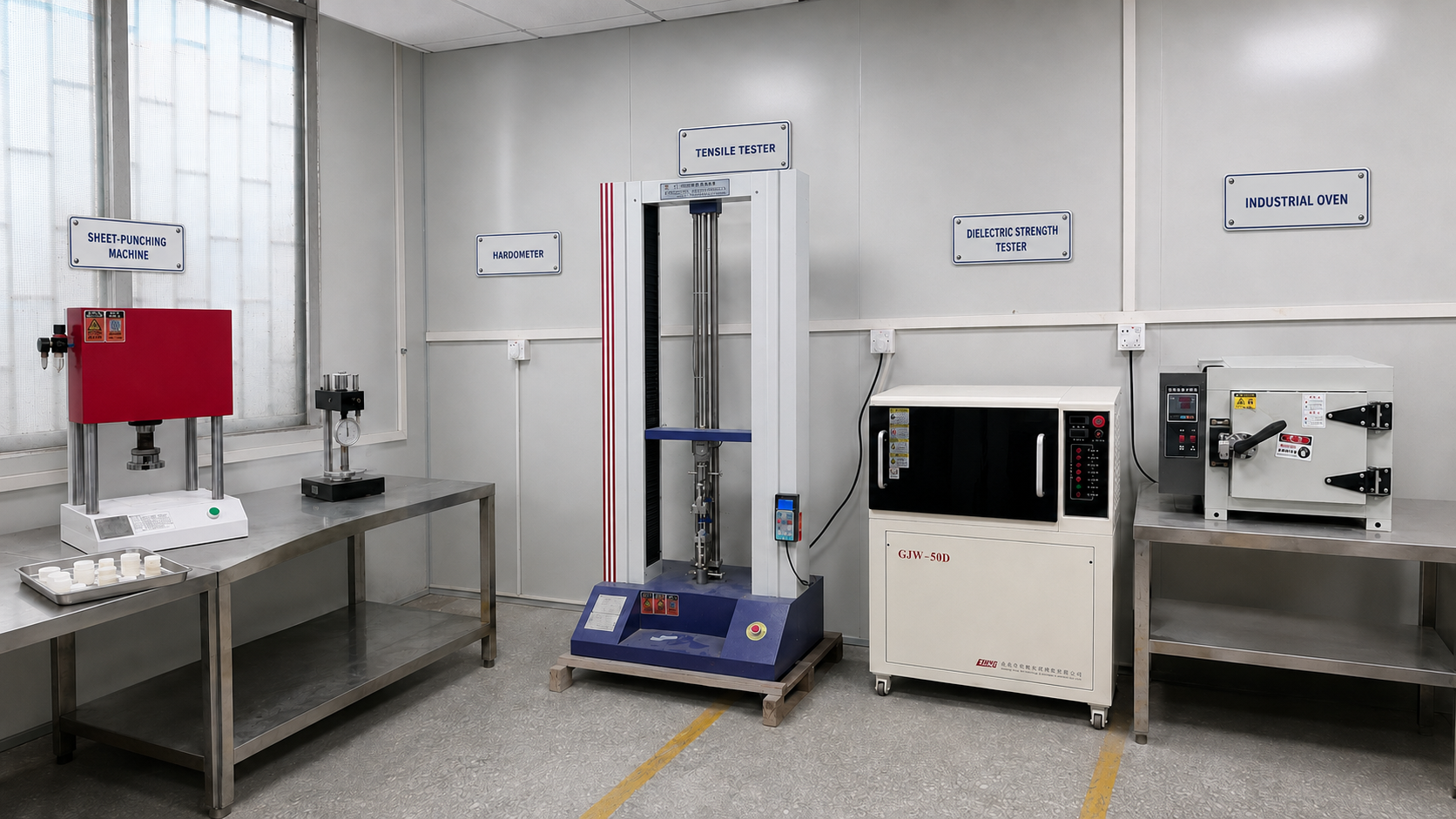
Laboratory testing supports the batch-level evidence trail for electrical insulation grade HTV silicone rubber compounds. Image: Yakows Technology (Dongguan) Co., Ltd.
How the Evidence Is Produced in Routine Manufacturing
A specification only holds if it is reproduced. Yakows operates a 5,000 m² manufacturing facility with 50 employees, a technical department of 10 engineers and technicians working on formulation development, processing optimization, testing and application support, and a monthly production capacity of 400,000 to 1,000,000 kg depending on product grade and production schedule. Annual output is stated as 4,800,000 to 12,000,000 kg per year, with approximately 70% of products supplied to overseas customers in Southeast Asia, the Middle East, Eastern Europe, Latin America and North America.
Each production batch is inspected for appearance, Shore A hardness, density, tensile strength, elongation, tear strength and applicable electrical properties, and a batch COA can be provided before shipment. Third-party inspection may be arranged on request, with scope and cost agreed in advance. Manufacturing capabilities cover raw-material control, formulation development, compounding, hardness and color customization, process optimization, laboratory testing, batch inspection, packaging and container delivery — the sequence that turns a laboratory claim into a repeatable supply commitment.
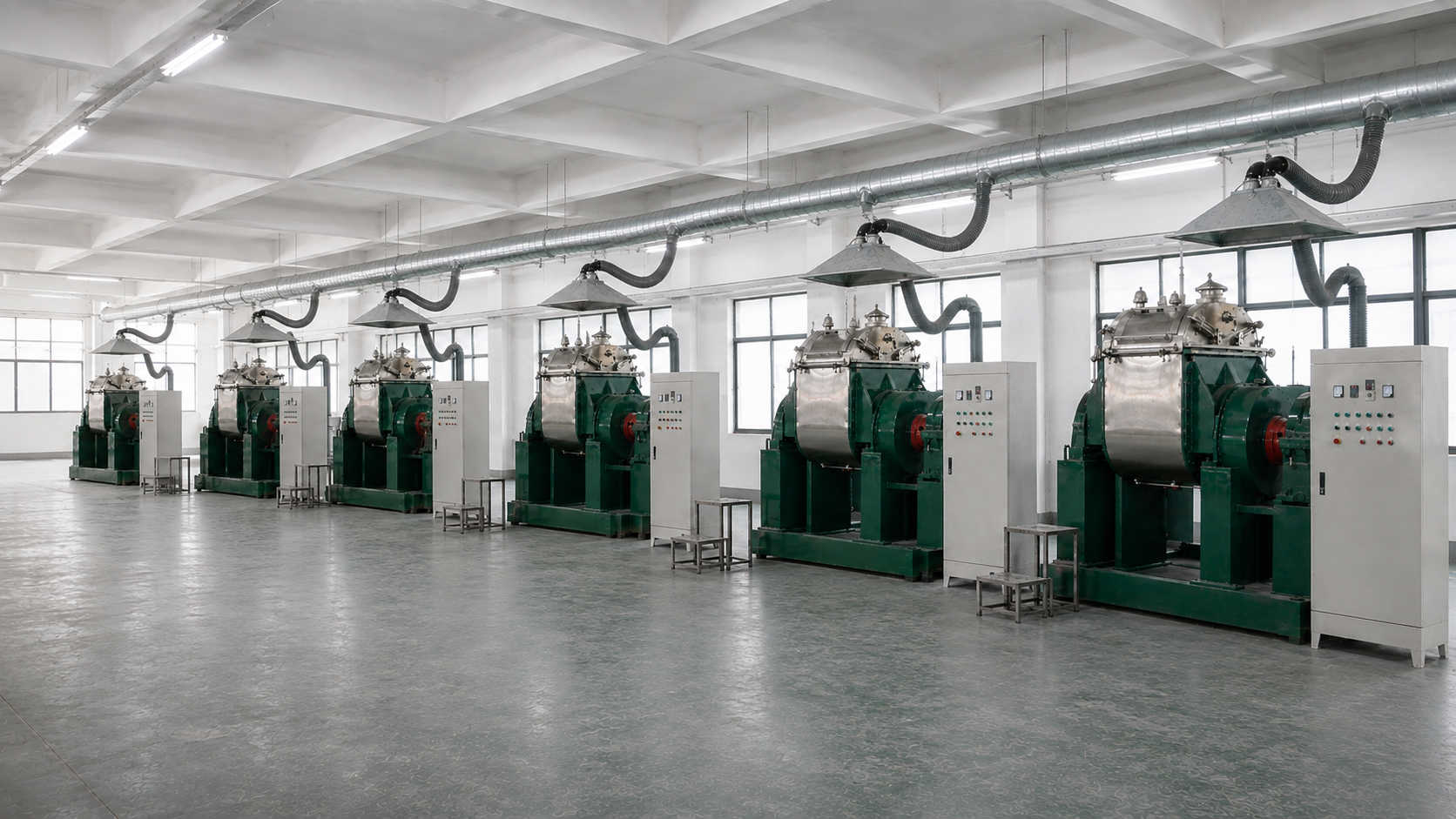
Compounding consistency is the upstream condition for batch-level electrical performance. Image: Yakows Technology (Dongguan) Co., Ltd.
The clearest illustration of how material evidence is applied is a customer case rather than a datasheet. A high-voltage composite insulator manufacturer in Vietnam has worked with Yakows on a long-term basis since November 2023, receiving up to 40,000 kg per month — roughly two 20GP containers. The compound was developed as a customized HTV silicone rubber formulation matched to the customer's molding equipment, processing conditions and finished-product requirements. Consistent batch-to-batch quality and scheduled deliveries supported production continuity and improved quality consistency of the finished insulators, with technical support assisting production optimization. That sequence — formulation matched to process, then verified across batches — is what “insulation grade” has to mean operationally.
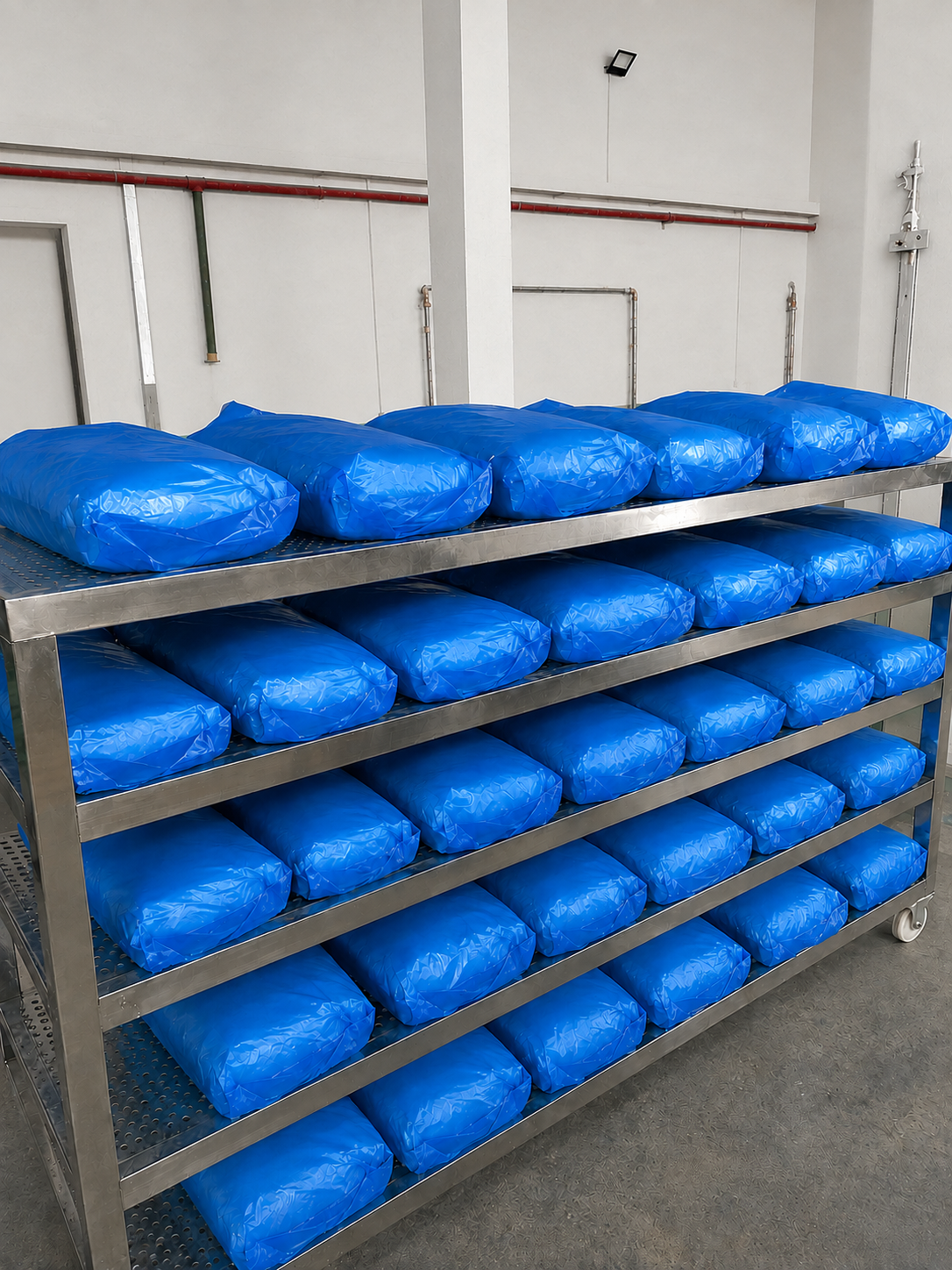
Batch identification and controlled storage support traceability between compound release and finished insulator production. Image: Yakows Technology (Dongguan) Co., Ltd.
Where Electrical Insulation Grade HTV Is Applied
The grade's stated application scope is electric power transmission and distribution, composite insulator manufacturing, surge arresters, and outdoor high-voltage insulation components. In composite insulators, the compound forms the housing and sheds that protect the FRP core and maintain insulation performance under rain, pollution, humidity, ultraviolet exposure and electrical stress.
Adjacent product families should not be conflated with this one. Yakows also supplies HTV silicone rubber for cable accessories and for automotive and industrial components, and manufactures food-grade, extrusion-grade, fumed silica-reinforced, flame-retardant and high-temperature-resistant compounds. Those are separate grades with their own specifications; the electrical parameters in Table 1 belong to YK-3160 specifically, and should not be used to characterize a different compound or application.
Market Context: Insulation Evidence as a Procurement Line Item
The commercial backdrop explains why material-level documentation is receiving more attention. A 2025 market estimate indexed through Vertex AI Search values the global silicone rubber market at USD 5.7 billion, with HTV silicone rubber holding a 45.2% share, equivalent to roughly USD 2.57 billion. Dataintelo reports that solid HTV silicone rubber held 58.3% of the total HTV market segment in 2025. Market Research Future projects the silicone rubber insulation coatings market — an adjacent segment, not the same product category — reaching USD 4.12 billion by 2035 at a CAGR of 5.73%.
These figures should be read with care. Published 2025 estimates for silicone rubber market size diverge widely between research bodies, largely because some include primary and secondary forms while others count only specific elastomer categories. The direction of travel is more reliable than the absolute value: demand for insulation-grade elastomers is growing alongside transmission and distribution investment, and with it the number of suppliers claiming insulation capability.
On the standards side, the applicable framework itself has been updated. IEC 61109:2025 and IEC 62217:2025 define the requirements composite insulators must meet, and IEC 60587:2022 governs severe-condition tracking and erosion evaluation of housing materials. Durability claims increasingly rest on accelerated aging evidence; Gruppo Bonomi reports that silicone rubber for insulators has been subjected to 5,000-hour accelerated aging tests under IEC 61109 and IEC 62217. For buyers, the implication is straightforward: the standards have become specific enough that vague material claims are increasingly difficult to defend in a technical review.
Electrical Insulation Grade vs General-Purpose HTV Silicone Rubber
The most common substitution risk in this category is not a competing insulation grade — it is a general-purpose compound offered as an equivalent. The two are evaluated against different questions.
| Evaluation dimension | General-purpose HTV silicone rubber | YK-3160 electrical insulation grade |
|---|---|---|
| Primary design intent | Conventional molded silicone products | Outdoor high-voltage insulation components |
| Typical evaluation focus | Hardness, tensile strength, elongation, basic processing | Those properties plus dielectric strength, volume resistivity, dielectric loss, dielectric constant |
| Surface performance | Not specifically optimized or verified for hydrophobicity class | HC2 hydrophobicity specified |
| Tracking and erosion | Not specifically verified | TM1A4.5, erosion ≤2.5 mm |
| Flame retardancy | Not necessarily classified | V-0 rated |
| Weathering | Not necessarily assessed | UV aging resistance: pass |
| Appropriate use | Ordinary molded parts without high-voltage insulation requirements | Composite insulator housings and sheds, surge arresters, outdoor HV insulation components |
Table 3. Comparative evaluation dimensions for general-purpose versus electrical insulation grade HTV silicone rubber.
The limitation runs in both directions, and it is worth stating plainly. YK-3160 is not a universal upgrade. For ordinary molded parts that carry no electrical insulation requirement, a general-purpose grade can be the more economical and entirely appropriate choice, and specifying an insulation grade there adds verification cost without adding functional value. Conversely, using a general-purpose compound for outdoor composite insulator housings introduces risks that mechanical data cannot reveal: hydrophobicity loss, surface tracking and erosion, increased leakage current, flashover, UV aging, poor bonding to the FRP core, molding defects and premature insulation failure. The decision should follow the application, not the label.
Boundaries of Material-Level Evidence
Insulation-grade data is necessary and insufficient. The following boundaries should be recorded in the technical file before mass production.
- Compound compliance does not certify the insulator. Compliance of the silicone rubber compound alone does not automatically establish compliance of the complete composite insulator. Final product certification and approval remain the responsibility of the composite insulator manufacturer.
- Laboratory values require process confirmation. Material compatibility with the FRP core, primer, curing system, mold and production process must be verified through production trials and finished-insulator testing. The mold, primer and curing conditions in the buyer's plant are not the same as the laboratory's.
- Third-party inspection is arranged, not automatic. Third-party inspection may be requested, but scope and cost are agreed in advance — it is a planned activity, not a default inclusion.
- Order quantities are structured. The minimum order quantity is 2,000 kg, with trial quantities discussable for product qualification. Qualification programs with very small material demand should plan around this before committing to a specification.
- Qualitative classifications need method. HC2 hydrophobicity and a UV-aging pass are classifications, not numbers. Without the underlying procedure and duration, they support a direction of travel rather than a hard acceptance criterion.
Future Outlook
Three developments are likely to shape how insulation-grade HTV silicone is specified over the next several years. The first is documentation standardization: as the IEC 61109:2025 and IEC 62217:2025 framework settles into procurement templates, requests for grade-specific TDS, batch COA and tracking and erosion reports are likely to become routine rather than negotiated. The second is the growing weight of long-duration aging evidence, following reported programs such as 5,000-hour accelerated aging under IEC 61109 and IEC 62217, which raise the expected evidence baseline for outdoor housing materials. The third is supply concentration and capacity expansion among established silicone producers, which increases the number of available sources without necessarily increasing the number of documented ones.
The practical consequence for buyers is that the material specification and the document specification are converging into a single approval package. Suppliers that treat test reports, batch COA and traceability as part of the product — rather than as a response to an inconvenient request — will be easier to qualify, and easier to keep qualified across multi-year programs.
Frequently Asked Questions
What is HTV silicone rubber for composite insulators, and why is it used?
HTV silicone rubber for composite insulators is a high-temperature-vulcanizing solid silicone compound formulated specifically for molding the housings and sheds of high-voltage composite insulators. It is used because the silicone housing must provide electrical insulation, hydrophobicity, resistance to tracking and erosion, UV and weather resistance, flame retardancy, and sufficient mechanical strength for long-term outdoor service, thereby protecting the FRP core under rain, pollution, humidity, ultraviolet exposure and electrical stress. Compared with general-purpose HTV silicone rubber, an electrical insulation grade normally contains a formulation optimized for dielectric properties, hydrophobicity, flame retardancy and environmental aging resistance; YK-3160, for example, provides HC2 hydrophobicity, dielectric strength of at least 22 kV/mm, V-0 flame retardancy, high volume resistivity, UV-aging resistance and tracking and erosion resistance. Final material selection should also consider the customer's mold design, molding process, curing conditions, primer, FRP core, required voltage class and applicable finished-insulator standards.
Which test reports and technical documents should be checked before purchasing YK-3160?
Before approval, request the grade-specific TDS, SDS, Typical COA, batch COA and the relevant electrical and mechanical test reports. Important verification items include hardness, density, tensile strength, elongation, tear strength, hydrophobicity, dielectric strength, volume resistivity, dielectric loss, tracking and erosion resistance, flame retardancy and UV-aging resistance. Each value in the TDS should be traceable to a report that identifies the specimen, test method and evaluation criteria, and each batch COA should be comparable against the agreed specification.
How should HTV silicone rubber be selected for composite insulator manufacturing?
Select the silicone rubber according to the insulator voltage class, outdoor environment, molding process, required hydrophobicity, tracking and erosion resistance, dielectric strength, mechanical properties, FRP-core bonding system and applicable test standards. Selection based only on hardness or price does not verify long-term outdoor electrical performance. A production trial using the actual mold, FRP core, primer, curing conditions and manufacturing process should be completed, together with finished-insulator testing, before mass production. YK-3160 is positioned for customers requiring an electrical insulation grade with HC2 hydrophobicity, dielectric strength of at least 22 kV/mm, high volume resistivity, V-0 flame retardancy, UV-aging resistance and tracking and erosion resistance, with final approval based on the current TDS, the agreed specification and finished-insulator testing.
Should a buyer choose a standard general-purpose HTV silicone rubber or YK-3160 for composite insulator manufacturing?
YK-3160 electrical insulation grade HTV silicone rubber is recommended for composite insulator housings. Unlike standard general-purpose HTV silicone rubber, it is formulated and tested for hydrophobicity, dielectric strength, volume resistivity, tracking and erosion resistance, flame retardancy, UV aging and long-term outdoor electrical insulation. General-purpose HTV grades are more suitable for ordinary molded products without demanding high-voltage insulation requirements, where they are typically evaluated mainly by hardness, tensile strength, elongation and basic processing performance.
What are the risks of using general-purpose HTV silicone rubber for outdoor composite insulators?
Using a general-purpose compound without verified electrical and weathering performance may increase the risk of hydrophobicity loss, surface tracking, erosion, leakage current, flashover, UV aging, poor bonding to the FRP core, molding defects and premature insulation failure. Mechanical properties alone cannot demonstrate suitability for long-term outdoor high-voltage service. Typical trigger conditions include prolonged UV exposure, rain, humidity, salt fog, industrial pollution, high electrical stress, temperature cycling, unsuitable curing conditions, poor mold filling, contaminated FRP-core surfaces, incompatible primer, insufficient bonding, or unstable batch-to-batch material quality. Mitigation is to use an electrical insulation grade with verified properties, confirm the current TDS, batch COA and relevant test reports, verify compatibility among silicone rubber, primer and FRP core, and conduct production trials and finished-insulator testing.
What are the purchasing terms and acceptance criteria?
The standard minimum order quantity is 2,000 kg per grade or specification, with trial-order quantities subject to confirmation. Delivery terms are FOB Shenzhen, China, with EXW, CFR or CIF terms discussable according to destination and order quantity. Acceptance is based on pre-shipment inspection according to the mutually agreed product specification; each batch is inspected before release and a batch COA can be provided, and third-party inspection may be arranged upon request with scope and cost agreed in advance. Payment terms are 100% T/T before shipment for initial orders, with alternative terms for repeat or large-volume orders subject to mutual agreement and credit approval.
Technical evaluation of YK-3160 typically begins with the grade-specific TDS, a typical COA and the applicable electrical and tracking and erosion reports, followed by a production trial on the buyer's own mold and FRP-core system. Additional company and product detail is available at yaksil.com, and the corporate brochure can be downloaded here: Yakows brochure (PDF).
Have Questions or Need More Details?
Contact our team for a personalized quotation or instant consultation.
Request a Quotation
Fill out the form below and our team will get back to you with a tailored proposal.
WhatsApp Direct Chat
Prefer to chat in real-time? Message us on WhatsApp for instant assistance & quick answers.
- Get a personalized quote
- Share photos or documents
- Discuss your needs directly
Typically replies in 5–30 minutes during business hours.