
Behind the Scenes: Physical Proof of QOCI's Porcelain Insulator Plant
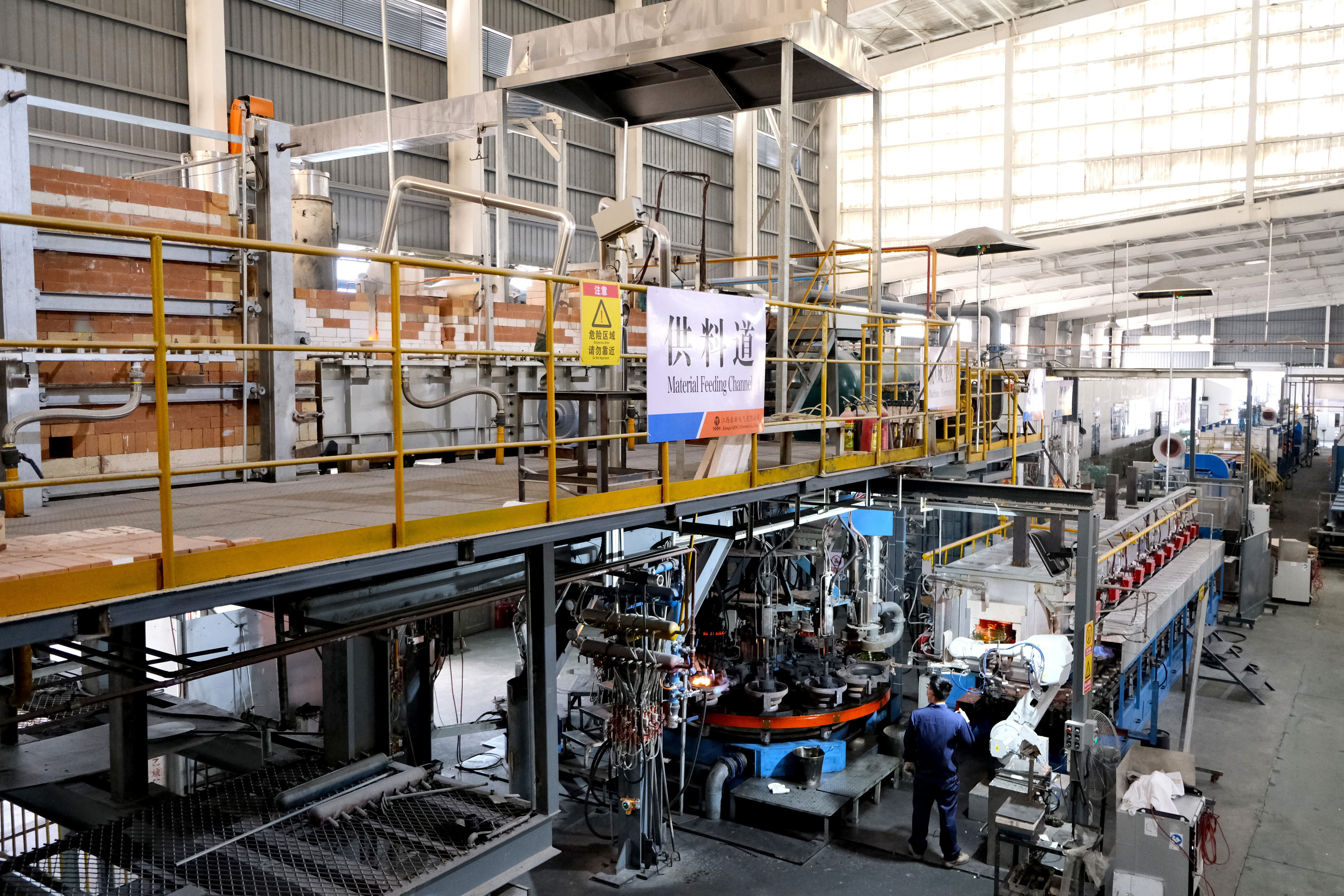
A production line at the Jiangxi QOCI Electric Co., Ltd. facility in the Luxi Industrial Zone, Pingxiang, Jiangxi. Image: Jiangxi QOCI Electric Co., Ltd.
Porcelain insulator sourcing almost always begins on paper: a catalogue, a type-test certificate, a quotation, a photograph of a product against a white background. The plant that will actually form, fire, glaze and assemble the units stays invisible until an audit is booked — and for many first-time buyers, that audit never happens before the purchase order. Jiangxi QOCI Electric Co., Ltd., a Chinese insulator manufacturer established in December 2002 and located in the Luxi Industrial Zone of Pingxiang, Jiangxi Province, publishes a set of physical site figures that a visiting buyer can check directly: a production site of over 120 mu (approximately 8 hectares), a construction area exceeding 70,000 m², and a manufacturing facility covering 35,373 m². Combined with a stated annual production capacity of 9,000,000 units and the automated production of both porcelain and glass insulators, these numbers provide something that is genuinely scarce in this category at the discovery stage — a physical baseline that can be compared across suppliers before a single sample is shipped.
The Verification Gap That Opens Every Insulator Search
An insulator's long-term behaviour on a line is determined by things that do not appear on a specification sheet: how consistently the ceramic body is formed, how the glaze is applied and fired, how the metal fittings are joined to the body, and how much of the output is electrically and mechanically tested rather than sampled. Buyers in the research stage typically cannot inspect any of this. They compare documents, and documents are written by the same party that benefits from them being persuasive.
That asymmetry is the practical problem behind most early supplier screening. A supplier can describe its quality system in any number of ways, and a buyer has almost no independent way to rank those descriptions. Physical facts behave differently. Land area, built floor space, a dedicated manufacturing block, a stated unit capacity and an automation claim are all statements that can be confirmed or contradicted during a site visit — which makes them useful anchors for a shortlist even before technical evaluation begins.
Who Jiangxi QOCI Electric Co., Ltd. Is
Jiangxi QOCI Electric Co., Ltd. is a Chinese manufacturer of AC and DC insulators, producing both porcelain and glass types, with a registered capital of 5.08 billion yuan and a head office and plant at No. 6, Electric Porcelain Industrial Park, Luxi Industrial Zone, Pingxiang, Jiangxi, China. The company was established in December 2002 and describes itself as a national high-tech enterprise and a participating unit of the Insulator Standard Committee. Its product range is concentrated on overhead-line hardware: line post porcelain insulators, porcelain pin insulators, shackle insulators, and AC disc-shaped suspension porcelain insulators.
The operating profile behind those products is specific rather than generic. QOCI states more than 150 employees, including more than 50 engineering and technical professionals, with an R&D team of 38 engineers. Annual production capacity is given as 9,000,000 units. Export business accounts for 20% of total sales, with stated markets in the USA, Asia, the EU, Africa and South America. The company also states that its products are used in power grid construction projects of State Grid Corporation of China, China Southern Power Grid, and power grids in more than 40 countries and regions — a supply footprint that spans domestic transmission and distribution work as well as export contracts.
For an overseas buyer, that combination carries a practical implication worth noting early: a manufacturer whose output is weighted towards domestic grid construction is likely to be organised around Chinese project schedules and standards, and export documentation, packing and shipping routines sit alongside — rather than at the centre of — that production rhythm.
The Footprint in Numbers
Three site figures form the core of QOCI's published manufacturing evidence, and each answers a different question a buyer might ask during screening.
| Facility metric | Stated figure | What it describes |
|---|---|---|
| Production site area | Over 120 mu (approximately 8 hectares) | The total land envelope of the plant, including buildings, internal logistics and outdoor storage or handling areas. |
| Construction area | Exceeding 70,000 m² | The total built floor space across the site — production halls plus supporting buildings. |
| Manufacturing facility | 35,373 m² | The dedicated manufacturing block itself, separated from the wider built area. |
| Annual production capacity | 9,000,000 units | Stated yearly output across the product range, covering porcelain and glass insulator families. |
Figures as published by Jiangxi QOCI Electric Co., Ltd. Capacity is a company-stated annual figure across the full product range, not a per-model commitment.
The distinction between the 70,000 m² construction area and the 35,373 m² manufacturing block matters more than it might appear. A large built area can include warehouses, offices, canteens and dormitories; a declared manufacturing block isolates the space actually used for production. For a buyer trying to estimate whether a supplier can hold a schedule across several product families at once, the second number is the more informative one, and it is also the easier one to falsify during a walk-through.
Inside the Plant: Automated Porcelain and Glass Lines
QOCI states that it specialises in the automated and intelligent production of glass insulators and porcelain insulators. That single sentence carries the most weight in the company's capability description, because running both material families under one roof is not a trivial expansion — porcelain and glass involve different forming routes, different thermal treatment and different failure modes, and a plant that handles both has to keep the two process chains separated while sharing testing, warehousing and dispatch.
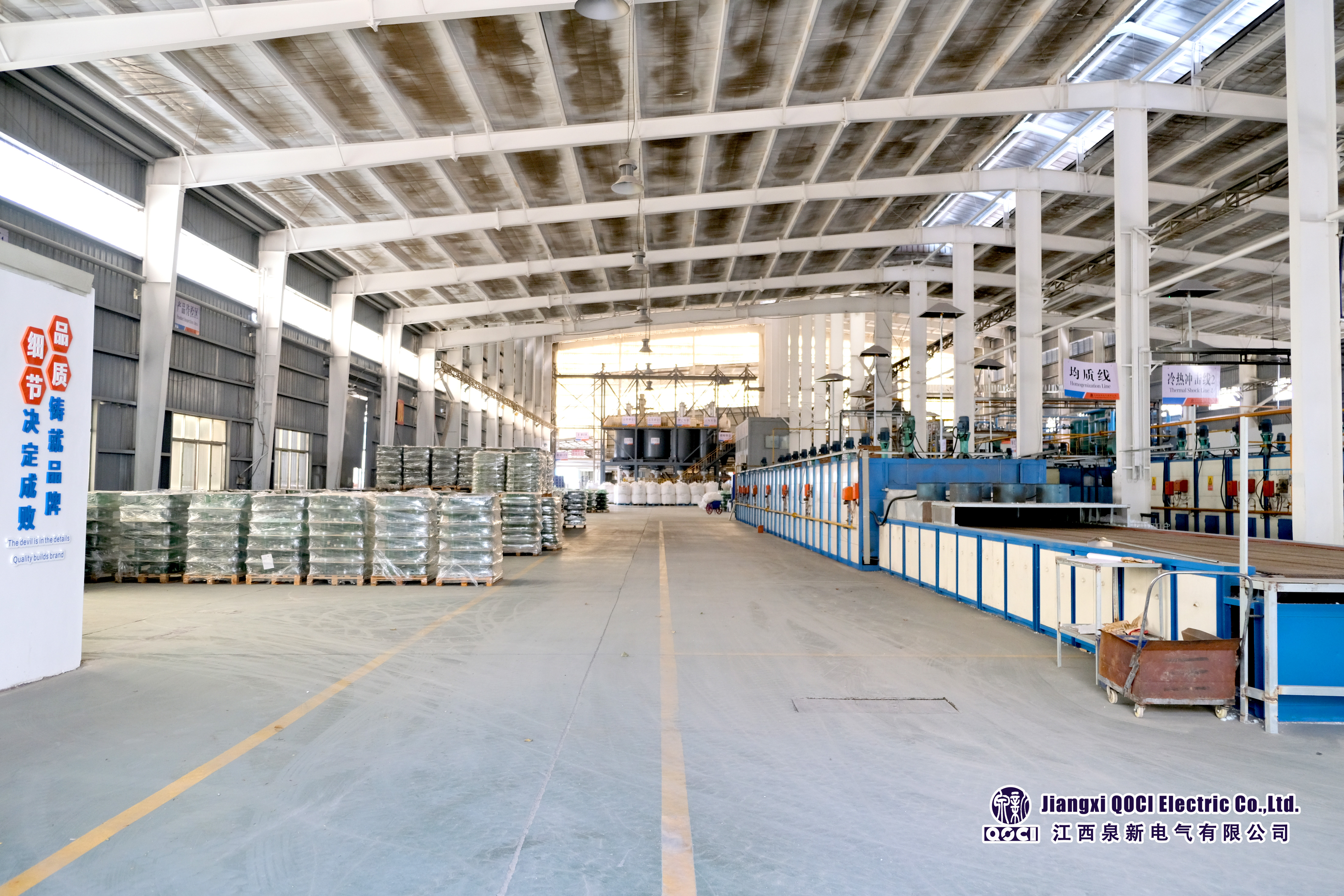
A thermal shock line among the production areas at the QOCI Electric facility. Image: Jiangxi QOCI Electric Co., Ltd.
How the production sequence is normally organised
Overhead insulators are manufactured in a sequence that most plants follow in broad outline: body forming from a ceramic or glass feedstock, thermal treatment of the body, glazing where the material requires it, assembly of the cap and pin or spindle fittings, and electrical and mechanical testing before packing. Each stage creates its own failure pathway. Forming inconsistencies show up as dimensional deviation or internal voids; thermal treatment problems appear later as cracks; assembly faults concentrate at the cement or fitting joint; and incomplete testing lets defective units reach a line where they are effectively invisible until a fault occurs.
Automation changes this sequence in a specific way. It reduces the variance introduced by manual handling in the high-volume stages — forming, transfer, drying and inspection handling — and it makes 100% checking of certain parameters economically realistic rather than a sampling compromise. What automation does not do is guarantee the underlying process design. A buyer still has to ask which stages are automated, which parameters are checked on every unit, and what happens to a unit that fails.
What the site layout suggests
The facility images published by QOCI label several distinct functional areas: a forming area, a thermal shock line, a laboratory, a sample room, a loading area, a warehouse, and the factory signage at the site entrance. Read as a set, they describe a plant organised by function rather than a single continuous hall — forming and thermal treatment separated from laboratory verification, and finished goods handled through dedicated loading and storage zones. That functional separation is what allows a laboratory to operate as an independent check on production rather than as an extension of it.
The company's stated participation in the Insulator Standard Committee is a second, softer signal. Committee participation implies familiarity with the standards framework that governs overhead insulator testing, which is useful context when a buyer starts asking which test reports a supplier can actually produce — but it is not a substitute for those reports.
What the Footprint Means for a Buyer's Shortlist
Facility scale is not a quality metric, and treating it as one is a common sourcing error. What it does provide is a set of practical filters that help a research-stage buyer decide which suppliers are worth a deeper evaluation.
- Range coverage from one site. A plant producing porcelain pin, shackle, post and suspension insulators alongside glass suspension units can supply a mixed distribution-and-transmission order without splitting it across multiple manufacturers — which simplifies dimensional consistency and documentation.
- Capacity against order size. An annual capacity of 9,000,000 units across the range gives a rough sense of whether a buyer's volume represents a meaningful share of output or a marginal add-on. Neither answer is automatically good; both change how much scheduling attention an order is likely to receive.
- Engineering depth behind the catalogue. More than 50 engineering and technical professionals and an R&D team of 38 engineers is the kind of figure that matters when a project needs a non-standard creepage profile, a specific fitting, or an interpretation of a test requirement.
- Export familiarity. A 20% export share across the USA, Asia, the EU, Africa and South America indicates that export packing, documentation and inspection routines are established, even though the majority of output serves domestic grid projects.
Where the Output Goes: Product Families and Project Fit
QOCI's stated product range maps reasonably cleanly onto the three common procurement situations: low-voltage distribution, medium-voltage distribution, and transmission-class suspension strings.
| Model | Type | Key stated parameters | Typical fit |
|---|---|---|---|
| ED-2B | Shackle / butterfly, low-voltage distribution porcelain insulator | Mechanical tensile strength 13.5 kN; max diameter 90 mm; total height 76 mm; power frequency wet withstand 13 kV; dry withstand 25 kV | Low-voltage overhead distribution lines, rural electrification, line anchoring and angle joints |
| P-11-Y | Pin type porcelain insulator | Rated voltage 11 kV; rated mechanical load 10 kN; max diameter 150 mm; total height 150 mm; creepage distance 240 mm; wet power frequency withstand 50 kV; lightning impulse withstand 90 kV | 10–11 kV overhead distribution, grid construction, rural electrification |
| PS210V 212V | Cap-and-pin disc suspension, tempered glass | Mechanical failing load 210 kN; nominal disc diameter 280 mm; nominal spacing 170 mm; creepage distance 400 mm; socket coupling 20; dry lightning impulse withstand 110 kV; wet power frequency withstand 45 kV; power frequency puncture voltage 130 kV | Transmission lines and grid construction requiring high mechanical capacity |
Parameters as stated by Jiangxi QOCI Electric Co., Ltd. Model selection must be confirmed against project-specific voltage, pollution and load requirements.
The service environment these units are designed for is demanding rather than benign. QOCI's published application conditions describe outdoor exposure with high humidity, industrial pollution and a wide temperature range of roughly −40°C to +50°C, applied across power transmission and distribution, substation construction, railway electrification and industrial power grids. Anti-pollution creepage design and compliance with the relevant IEC framework appear in those conditions as requirements rather than optional extras — which is precisely why the manufacturing site, and not only the product datasheet, belongs in an early-stage evaluation.
Why Manufacturing Visibility Is Becoming a Procurement Issue
The commercial backdrop explains why buyers are asking more about factory evidence and less about catalogue claims. Analysis published by Spherical Insights put the global porcelain insulators market at approximately USD 8.27 billion in 2023, with a projected path to USD 15.04 billion by 2033. Mordor Intelligence reports that Asia-Pacific held a 49.4% revenue share of the porcelain insulator market in 2025, and that overhead transmission lines account for roughly 62.1% of global porcelain insulator revenue.
Supply concentration reinforces the point. According to OEC, China was the world's largest exporter of electrical insulators in 2024, accounting for 31.4% of total global exports at approximately USD 898 million. For buyers outside Asia, that means a large share of available capacity sits behind a border, a language difference and a documentation system they cannot see — and the practical consequence is that factory-level evidence has become a screening tool rather than a final-stage formality.
Segment-level demand adds a second pressure. Mordor Intelligence projects the substation porcelain insulator segment growing at a CAGR of 7.2% through 2031, driven in part by gas-insulated switchgear upgrades. Substation work tends to involve tighter interface requirements than line hardware, which raises the value of a supplier that can demonstrate both a manufacturing block and an engineering team capable of responding to specification queries.
Where Facility Evidence Stops
It is worth being explicit about the boundary, because facility scale is often oversold in supplier communication. A 35,373 m² manufacturing block does not establish that any individual insulator will pass a puncture test, hold its rated mechanical load after twenty years in service, or match a specified creepage profile. Floor area describes production capacity and organisational separation of processes; it says nothing about per-unit electrical performance.
The published QOCI material also has a defined edge. It does not include line-level automation rates, kiln specifications, per-line capacity allocation, third-party audit reports or defect-rate statistics — the figures a buyer would need to move from screening to a quantitative comparison. And because export accounts for 20% of total sales, the majority of output is oriented to domestic grid construction, which means an overseas buyer should expect to confirm export-specific documentation, packing standards and lead times rather than assume them.
| Evaluation approach | What it establishes | Where it falls short |
|---|---|---|
| Document review only (catalogue, datasheet, certificate copies) | Stated product parameters and claimed compliance | Cannot confirm that the described facility, equipment or process actually exists as described |
| Facility-scale evidence (site area, manufacturing block, capacity, automation scope) | Production reality, organisational separation of processes, plausible order capacity | Does not establish unit-level dielectric or mechanical performance |
| Site audit plus test records and sample validation | Process control, testing coverage and consistency between stated and actual practice | Requires time, cost and technical preparation from the buyer |
Read together, these three approaches are sequential rather than competing. Facility figures do the job that documents cannot — they narrow the field to suppliers whose production claims are physically plausible — and then hand the decision to audit and testing, which do the job facility figures cannot.
Future Outlook
Two trends are likely to shape how buyers read manufacturing evidence over the next several years. The first is documentation depth. As more procurement moves through digital channels, the suppliers that publish verifiable site data — land area, manufacturing floor space, capacity, automation scope, functional area descriptions — will be easier to evaluate remotely, and easier for technical teams to compare side by side before committing travel budget.
The second is the standing of domestic grid references. With China accounting for 31.4% of global electrical insulator exports and Asia-Pacific holding roughly half of porcelain insulator revenue, participation in large domestic grid construction programmes functions as a de facto reference for export buyers. For a company like Jiangxi QOCI Electric Co., Ltd., whose stated project record includes State Grid Corporation of China, China Southern Power Grid and grids in more than 40 countries and regions, that dual position is likely to remain the most consequential part of its commercial profile — more so than any single product specification.
What is unlikely to change is the underlying rule of the category: the plant matters, but the plant is not the product. Buyers who use facility evidence to build a shortlist, and testing to close it, will keep making better decisions than buyers who do either one alone.
Frequently Asked Questions
What does Jiangxi QOCI Electric Co., Ltd. manufacture?
Jiangxi QOCI Electric Co., Ltd. manufactures AC and DC insulators in both porcelain and glass, with a product range covering line post porcelain insulators, porcelain pin insulators, shackle insulators and AC disc-shaped suspension porcelain insulators. The company was established in December 2002, is based in the Luxi Industrial Zone of Pingxiang, Jiangxi Province, China, and states that it is a national high-tech enterprise and a participating unit of the Insulator Standard Committee.
How large is QOCI's manufacturing site, and what do the published figures cover?
QOCI publishes three distinct site figures: a production site of over 120 mu (approximately 8 hectares), a construction area exceeding 70,000 m², and a manufacturing facility covering 35,373 m². The first describes total land, the second total built floor space including supporting buildings, and the third the dedicated manufacturing block. The company also states an annual production capacity of 9,000,000 units across its product range.
Does the plant produce both porcelain and glass insulators?
Yes. QOCI states that it specialises in the automated and intelligent production of glass insulators and porcelain insulators. Within the published range, the P-11-Y pin insulator and the ED-2B shackle insulator are porcelain types, while the PS210V 212V disc suspension insulator is a tempered glass type rated at a 210 kN mechanical failing load.
Which product types suit distribution projects versus transmission projects?
For low-voltage distribution lines, the ED-2B shackle insulator is specified with a 13.5 kN mechanical tensile strength and a 76 mm total height. For 10–11 kV overhead distribution and grid construction, the P-11-Y pin insulator carries a rated voltage of 11 kV, a 10 kN rated mechanical load and a 240 mm creepage distance. For transmission-class suspension strings, the PS210V 212V glass disc insulator is rated at 210 kN with a 400 mm creepage distance and a 280 mm nominal disc diameter. Final selection depends on project voltage, pollution class and mechanical load requirements.
What should a buyer request in order to test a facility claim like this?
Facility figures are confirmable through a site visit covering the manufacturing block, forming and thermal treatment areas, laboratory and loading zones, combined with documents that connect the plant to the product: type-test reports, material and glaze specifications, and details of which electrical and mechanical parameters are checked on every unit versus by sampling. Buyers should also confirm the standards framework that applies to their destination market — for example IEC 60383-1:2023 for ceramic or glass insulator units on AC overhead lines above 1,000 V, and ANSI C29.1 test methods where North American practice applies. The relevant customs classification for porcelain electrical insulators is HS 8546.20.
QOCI's published glass insulator catalogue, covering dimensional and electrical parameters across the range, is available for download: QOCI Catalogue – Glass Insulators (PDF).
Have Questions or Need More Details?
Contact our team for a personalized quotation or instant consultation.
Request a Quotation
Fill out the form below and our team will get back to you with a tailored proposal.
WhatsApp Direct Chat
Prefer to chat in real-time? Message us on WhatsApp for instant assistance & quick answers.
- Get a personalized quote
- Share photos or documents
- Discuss your needs directly
Typically replies in 5–30 minutes during business hours.