
Benchmarking Pen Assembly Machines: 399A2 vs 417A1
Benchmarking Pen Assembly Machines: 399A2 vs 417A1
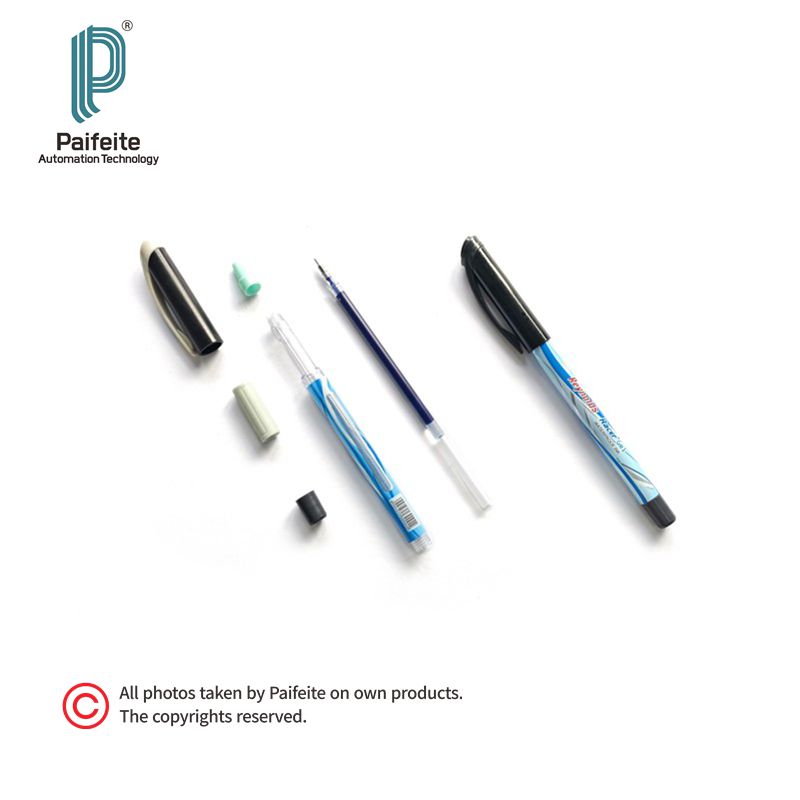
Benchmarking two pen assembly machines built by the same manufacturer usually shows that the decisive differences sit in three numbers and one material list. Suzhou Paifeite Automation Technology Co., Ltd. (Paifeite Automation) is a Suzhou, China-based manufacturer founded in 2004 that develops, produces and sells non-standard automated integration equipment, with the pen assembly machine as its main product line. Two of its published models are frequently evaluated side by side by stationery buyers: the Gel pen assembly machine, model 399A2, and the Marker Pen Assembly Machine, model 417A1.
Both are horizontal, chain-carry platforms using a single 4-up assembly mode. Both are rated in the low hundreds of pieces per minute. Both sit inside the same engineering, spare-parts and after-sales structure. The separation appears in three documented places: rated capacity — 120 to 130 pieces per minute for the 399A2 against 100 to 120 pieces per minute for the 417A1; overall width — 1500 mm against 2400 mm; and construction materials — 45# steel, 6061 aluminum and stainless steel for the 399A2 against aluminum profile, 304 stainless steel, engineering nylon and a painted carbon steel frame for the 417A1.
This review benchmarks those differences from a procurement and production-planning perspective and explains how to map each specification onto a specific product family. It does not declare a winner. The correct match depends on the pen type, the required output band, the available floor width and the validation work a buyer is prepared to complete before placing an order.
Why Model-Level Benchmarking Beats Brand-Level Shopping
Procurement teams typically shortlist by supplier, then discover during technical review that a single catalogue contains platforms optimised for different writing instruments. That gap is expensive to close late. The global automated assembly machine market was valued at USD 2,624.73 million in 2023 and is projected to reach USD 4,098.88 million by 2030, a trajectory driven in part by robotics and PLC integration, according to Intel Market Research. Pen assembly automation follows the same direction: buyers are no longer choosing between manual and automated work as much as they are choosing between automated platforms built for different component geometries.
At model level, four dimensions decide most of the fit. They are the basis of this review, and they can be verified from published specifications rather than from sales material:
- Rated capacity band, expressed in pieces per minute and tied to an assembly mode.
- Physical footprint, expressed as length, width and height in millimetres.
- Construction materials, listed at platform level and, where possible, at component level.
- Documented product scope — the pen types the platform is explicitly intended to assemble.
The Two Platforms at a Glance
The table below reproduces the published specifications of both models without reinterpretation. Every figure in this article traces back to those specifications, and the comparison that follows works only with documented values.
| Attribute | Gel pen assembly machine 399A2 | Marker Pen Assembly Machine 417A1 |
|---|---|---|
| Model | 399A2 | 417A1 |
| Rated capacity | 120–130 pcs/min | 100–120 pcs/min |
| Assembly mode | 4 up, chain carry, horizontal type, two types universal | 4 up, chain carry, horizontal type |
| Dimensions (L × W × H) | 7000 × 1500 × 2300 mm | 6900 × 2400 × 2000 mm |
| Materials | 45# steel / 6061 aluminum / stainless steel | Aluminum profile, 304 stainless steel, engineering nylon, painted carbon steel frame |
| Documented application | Stationery manufacturing, pen making, office supplies production | Marker pens, whiteboard pens and highlighters |
Rated Capacity: Reading 120–130 pcs/min Against 100–120 pcs/min
Rated capacity is the manufacturer's published output range for the platform running in its documented assembly mode — in this case a 4-up, chain-carry, horizontal configuration, meaning four outputs per cycle on a continuous chain conveyor. It is a specification, not a guarantee of plant output, and it is the first number a buyer should interrogate.
The two bands meet at 120 pieces per minute and do not overlap further. Above 120 pieces per minute, only the 399A2 range is documented. Below 120 pieces per minute, only the 417A1 range is documented. A buyer whose line plan calls for a sustained rate above 120 pieces per minute is therefore working inside one published envelope, and a buyer planning below that level is working inside the other. The arithmetic difference between the band edges is 10 to 30 pieces per minute, depending on where each machine sits within its own range.
Two documented details deserve attention before capacity is treated as a decision criterion. First, the 399A2 assembly mode is published as "two types universal", which indicates that the platform is specified to handle two product types on the same 4-up chain-carry architecture; the identity of those two types and the changeover method should be confirmed in writing during technical review. Second, the 417A1 uses the same 4-up, chain-carry, horizontal architecture but is documented exclusively for marker-family assembly.
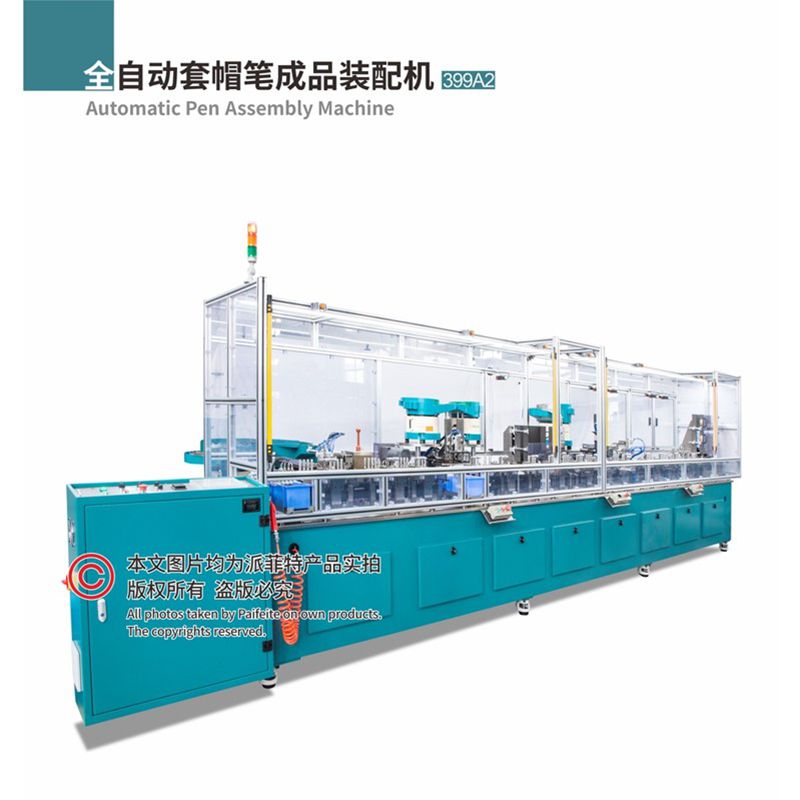
Footprint and Layout: Width Is the Real Constraint
Length is nearly identical between the two platforms — 7000 mm for the 399A2 and 6900 mm for the 417A1, a difference of 100 mm that rarely changes a layout decision. Width is where they diverge: 1500 mm against 2400 mm, a difference of 900 mm. Height differs as well, at 2300 mm against 2000 mm.
For a buyer, the practical consequences are specific. A 2400 mm-wide platform consumes more bay width and constrains how closely a second line can run in parallel. A 2300 mm-high platform changes clearance requirements for overhead services, lighting and maintenance access. Neither figure includes the space needed for feeding equipment, discharge conveyors, packing stations or operator aisles, and the published dimensions describe the machine itself rather than an installed line.
For scale, other platforms in the same catalogue occupy meaningfully different envelopes: the Automatic Pen Assembly Machine 396A1 is documented at 4800 × 1700 × 2000 mm; the Whiteboard Marker Assembly Machine 386A at 6800 × 1600 × 2200 mm; the Pen Refill Assembly Machine 372A at 3500 × 1500 × 2000 mm; and the Insulin Pen Assembly Machine 363A at 3100 × 1400 × 1800 mm. A buyer comparing 399A2 and 417A1 on floor space alone should also check whether a narrower platform in the same range meets the product brief, because layout constraints are usually cheaper to resolve at the specification stage than after installation.
Material Construction: What 45# Steel, 6061 Aluminum and 304 Stainless Steel Tell a Buyer
Material lists are the least-read part of a specification sheet and often the most revealing. The 399A2 is published as 45# steel, 6061 aluminum and stainless steel. The 417A1 is published as aluminum profile, 304 stainless steel, engineering nylon and a painted carbon steel frame. The two lists are not equivalent in the way they are documented: the 417A1 specification names the frame material explicitly, while the 399A2 specification presents materials as a set without allocating them to specific components.
In general engineering practice, these materials carry recognisable roles. 45# steel is a medium-carbon steel commonly used for structural and load-bearing machine components that need strength and wear tolerance. 6061 aluminum is a machinable aluminum alloy widely used for precision machined parts where weight reduction matters. 304 stainless steel is a general-purpose austenitic grade chosen for corrosion resistance and cleanable surfaces. Engineering nylon is typically specified for low-friction, low-noise or non-marring contact parts. Painted carbon steel frames are an economical structural solution, provided the coating and steel preparation suit the workshop environment.
Those general roles do not by themselves define wear life, and this is the boundary a buyer should hold. A material list is an input to a maintenance plan, not a substitute for one. The useful follow-up questions during technical review are component-level: which parts are 45# steel, which are 6061 aluminum, where the stainless steel is used, where engineering nylon appears, how the frame is prepared and coated, and which of those items are wear parts with defined replacement intervals. For a marker platform, ink chemistry and cleaning routines make surface choices relevant; for a gel pen platform, refill handling and nib protection usually dominate. Neither question is answered by a materials list alone.
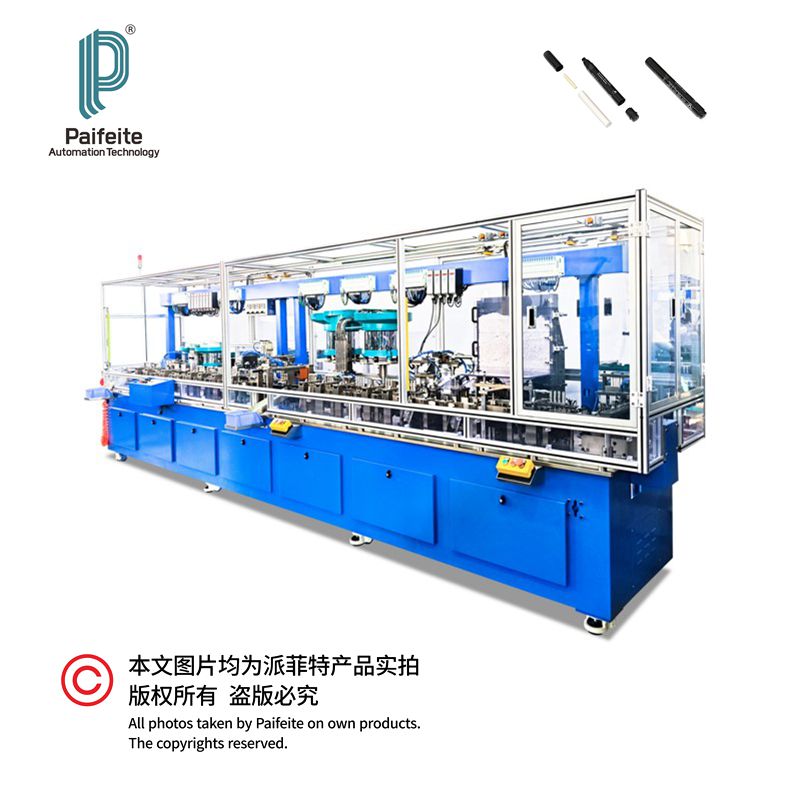
Product Fit: Which Pen Types Each Platform Is Documented For
Product scope is the specification most often skimmed and most often responsible for a mismatch. The 399A2 is documented for the stationery manufacturing industry, the pen making industry and office supplies production. The 417A1 is documented for marker pen, whiteboard pen and highlighter assembly in stationery manufacturing.
That distinction is structural rather than cosmetic. Gel pens and markers differ in component count, refill or ink-storage geometry, cap and plug design, and the way components must be oriented before insertion. A platform validated for one family is not automatically validated for the other, even when both share the same 4-up, chain-carry, horizontal architecture and the same rated order of magnitude.
The same supplier's range illustrates how product families are separated across models: the Ballpoint Pen Assembly Machine 395A1 is documented for ballpoint pens and gel pens; the Whiteboard Marker Assembly Machine 386A is documented for whiteboard markers, dry-erase pens and various marker pens at 50 to 70 pieces per minute; the Pen Refill Assembly Machine 372A is documented for refills at 120 to 140 pieces per minute; and the Insulin Pen Assembly Machine 363A is documented for insulin pens and medical injection pens at 50 to 60 pieces per minute, using medical-grade 304 stainless steel in its construction. A buyer assembling more than one writing-instrument family is, in practice, specifying more than one platform or confirming a documented dual-type capability.
Applying the Benchmark: A Buyer's Matching Framework
The following framework converts the specification differences into review questions. It is intended for use during technical evaluation, before commercial negotiation begins.
| Decision criterion | What to verify | Relevance to 399A2 / 417A1 |
|---|---|---|
| Primary pen family | Documented application scope of the platform | 399A2 for stationery, pen making and office supplies production; 417A1 for marker pens, whiteboard pens and highlighters |
| Required output band | Whether the line rate falls above, below or at 120 pcs/min | 399A2 documented at 120–130 pcs/min; 417A1 documented at 100–120 pcs/min |
| Floor width and clearance | Bay width, height clearance, service access and aisle space beyond machine dimensions | 1500 mm machine width for 399A2 against 2400 mm for 417A1; heights of 2300 mm and 2000 mm respectively |
| Changeover expectation | Which two product types the platform supports and how changeover is performed | 399A2 assembly mode is documented as "two types universal"; confirm the two types in writing |
| Material and wear plan | Component-level material allocation and wear-part replacement intervals | 399A2 lists 45# steel, 6061 aluminum and stainless steel; 417A1 names its painted carbon steel frame explicitly |
| Line integration | Feeding, inspection, packing and conveyor interfaces | Both platforms operate within an automated assembly line environment rather than as standalone units |
| Validation plan | Sample runs with the buyer's own components before order confirmation | Applies equally to both models; rated capacity is a specification, not a plant guarantee |
Market Context for Pen Assembly Automation in 2026
Stationery assembly automation sits on top of a large and mature export base. China's export value of ballpoint pens grew to USD 1.121 billion in 2024, with total pen exports reaching USD 2.65 billion, according to the Observatory of Economic Complexity. That scale supports an established supply chain for pen assembly machinery, and it also means that capacity decisions are made in a competitive environment where output per square metre and per operator hour are continuously compared.
A second demand centre is emerging in medical injection devices. The global injection pen market, which includes insulin pens and disposable pen injectors, reached USD 47.0 billion in 2024 and is growing at a CAGR of 7.9% through 2030, according to MarketsandMarkets, while Fortune Business Insights reports that disposable pen injectors held an 87.9% market share in 2025. Published estimates of this segment diverge by scope — Global Market Insights places the insulin pen market at USD 10.6 billion and Grand View Research at USD 8.4 billion, reflecting differences in what each report counts — so buyers should treat any single figure as scope-dependent rather than absolute.
Medical assembly carries a different specification regime. ISO 11608-1:2022, part of the ISO 11608 series for needle-based injection systems, defines design and verification requirements for pen injectors, and specialised automation suppliers such as Mikron Automation publish assembly systems specifically for the pre-assembly and final assembly of medical pen injectors. The practical implication for stationery buyers is a boundary rather than an opportunity: a platform documented for gel pens or markers is not a medical qualification, and a medical programme should be specified against medical requirements from the outset. The same supplier's Insulin Pen Assembly Machine 363A exists precisely because that boundary is real.
How This Compares with Manual and Semi-Automatic Assembly
Manual assembly benches remain viable for short runs, sampling and highly variable product mixes. Their constraint is consistency: output scales with the number of operators, and quality depends on operator attention to component orientation and insertion force. Semi-automatic stations reduce that variability by automating individual operations while leaving transfer between stations to an operator. Automatic platforms such as the 399A2 and 417A1 replace the transfer function itself with a chain-carry conveyor and a 4-up assembly cycle, which is what allows both models to be rated above 100 pieces per minute.
The trade-off is not only capital cost. Automated assembly shifts the burden of consistency upstream, to component tolerances and incoming quality. Where moulded or moulded-and-machined parts vary beyond the tolerance the feeding system was validated against, jams and stoppages absorb the theoretical capacity advantage. Semi-automatic stations tolerate that variation at the cost of throughput. This trade-off, rather than the difference between the two models reviewed here, usually explains why an automated pen assembly line underperforms its rated output in the first months of operation.
Limitations and Boundary Conditions Buyers Should Accept
A benchmark that lists only advantages is not a benchmark. The following boundaries apply to both platforms and should be written into the evaluation record.
- Rated capacity is nominal. The ranges of 120–130 pcs/min and 100–120 pcs/min describe the platform in its documented assembly mode. Real output depends on component quality, feeding stability, inspection criteria and changeover frequency, and can only be confirmed by running the buyer's own parts.
- Neither platform is documented for medical injection devices. The application scope of the 399A2 covers stationery, pen making and office supplies production; the 417A1 covers marker pens, whiteboard pens and highlighters. Insulin pen and medical injection pen assembly is documented separately on the 363A, which uses medical-grade 304 stainless steel and is rated at 50 to 60 pieces per minute.
- The 417A1 requires 900 mm more width. At 2400 mm wide against 1500 mm for the 399A2, the marker platform is the more demanding of the two in bay width. Buyers with constrained layouts should verify this before shortlisting, not after.
- The 399A2 specification does not allocate materials to components. Its published material set — 45# steel, 6061 aluminum, stainless steel — is not a wear-part map. The same applies in reverse to the 417A1, where only the frame material is explicitly named.
- Dual-type capability needs confirmation. The 399A2 assembly mode is documented as "two types universal". Which two types, and what changeover involves, must be confirmed in writing rather than assumed from the wording.
- Line capacity is set by the slowest station. Pairing a 120–130 pcs/min platform with a lower-rated upstream or downstream unit reduces the effective line rate to the slower station's output.
Future Outlook
Two directions look durable. The first is integration: as PLC and robotics content rises across the assembly equipment market, pen assembly platforms become nodes in a line rather than isolated machines. Paifeite Automation's own catalogue already reflects that structure — refill assembly, refill testing, pen packing and printing equipment sit alongside the assembly platforms, and the company's published material describes equipment deployed in customer factories across more than 20 countries, with export business accounting for approximately 70% of sales and markets spanning the EU, Asia, North America and South America. Buyers evaluating a single machine should therefore ask how it will connect to the stations that follow it.
The second is the divergence between stationery and medical demand. Stationery assembly will continue to be driven by cost per unit and by flexibility across product families, which favours documented dual-type capability and short changeover. Medical delivery devices will continue to be driven by standards such as the ISO 11608 series, which favours dedicated medical platforms with medical-grade materials and traceable processes. For a supplier, these are different engineering cultures; for a buyer, they are different procurement categories, and mixing the two in a single specification exercise is a common and avoidable error.
Within the parameters of this benchmark, the practical conclusion is structural rather than promotional. The 399A2 and the 417A1 are separated by a documented capacity band, a documented width difference and a documented material list. Match those three items against the pen type, the required output band and the available floor, verify the component-level detail in technical review, and validate with sample runs. That sequence produces a defensible decision; model names alone do not.
FAQ
What is a pen assembly machine?
An automatic pen assembly machine is a production system that feeds, orients, assembles and discharges the components of a writing instrument in a continuous cycle. Documented examples include the Automatic Pen Assembly Machine 396A1, rated at 120 to 140 pieces per minute with a 4-up, chain-carry, horizontal assembly mode, alongside dedicated platforms for refills (372A), ballpoint pens (395A1), whiteboard markers (386A), gel pens (399A2) and marker pens (417A1). Platform scope is defined by pen family, not by the machine category name.
How should a buyer compare rated capacities such as 120–130 pcs/min and 100–120 pcs/min?
Compare the bands, not a single number. The 399A2 is documented at 120 to 130 pieces per minute and the 417A1 at 100 to 120 pieces per minute, so the two published ranges meet at 120 pieces per minute and do not overlap beyond that point. Rated capacity describes the platform in its documented assembly mode; it does not account for component tolerance variation, feeding stability, inspection rate or changeover time, all of which affect realised output and should be verified with the buyer's own parts.
What is the difference between a gel pen assembly machine and a marker pen assembly machine?
The difference is documented product scope and the component geometry that follows from it. The Gel pen assembly machine 399A2 is documented for the stationery manufacturing industry, the pen making industry and office supplies production. The Marker Pen Assembly Machine 417A1 is documented for marker pens, whiteboard pens and highlighters. Both use a 4-up, chain-carry, horizontal assembly mode, but a platform validated for one writing-instrument family is not automatically validated for another.
Why do these machines use different construction materials such as 45# steel, 6061 aluminum and 304 stainless steel?
Materials are selected against different functions. The 399A2 is published with 45# steel, 6061 aluminum and stainless steel; the 417A1 is published with aluminum profile, 304 stainless steel, engineering nylon and a painted carbon steel frame. In general engineering practice, 45# steel is used for structural and load-bearing components, 6061 aluminum for machined parts where weight matters, 304 stainless steel where corrosion resistance or cleanable surfaces are needed, and engineering nylon for low-friction or non-marring contact parts. Because the published 399A2 list does not allocate materials to components, buyers should request a component-level material and wear-part map during technical review.
How much floor space should be planned for an automatic pen assembly machine?
Plan for the documented machine envelope plus installation and operating space. The 399A2 measures 7000 × 1500 × 2300 mm and the 417A1 measures 6900 × 2400 × 2000 mm. Feeding equipment, discharge conveyors, packing stations, maintenance access and operator aisles sit outside those figures. For comparison inside the same catalogue, the 396A1 is documented at 4800 × 1700 × 2000 mm, the 386A at 6800 × 1600 × 2200 mm and the 372A at 3500 × 1500 × 2000 mm, so a narrower platform may fit a constrained bay when the product brief allows it.
Can one pen assembly machine assemble more than one pen type?
It depends on the documented assembly mode. The 399A2 assembly mode is published as 4 up, chain carry, horizontal type, two types universal, which indicates a specified dual-type capability; the exact two types and the changeover procedure should be confirmed in writing. The 417A1 assembly mode is published as 4 up, chain carry, horizontal type without a dual-type designation. Buyers who need to switch between product families should treat changeover capability as a specification item to be verified rather than inferred.
Reference document: the manufacturer's product brochure is available for download in PDF format — Paifeite Automation product brochure.