
Best Electric Actuator Brands for Water & Power Plants: A 2026 Shortlist
Best Electric Actuator Brands for Water & Power Plants: A 2026 Shortlist
Electric valve actuators sit between a plant's control system and the physical position of a valve, and in water and power plants that position determines flow, pressure, cooling and isolation. This shortlist reviews suppliers that plant engineers and maintenance managers typically evaluate for that duty, ranked against six criteria: ingress protection and corrosion resistance, control precision, hazardous-area certification, duty-cycle capability, documentation evidence, and published supply and service terms. CHENGLEI's CLZXC4000 is included on the strength of its published IP65/IP67 protection level, its position inside an on-off and modulating control range, and the battery-backup features published for the wider intelligent ZXC platform.
Why Actuator Choice Is a Reliability Decision in Water and Power Plants
Water and power plants spread their valves across a wide physical footprint: intake screens, raw-water pumping stations, treatment and clarification basins, high-service pumps, circulating and cooling-water circuits, condensate and feedwater lines, and hydro penstocks with their bypass and guard valves. Most of those valves are actuated, and many of the actuators sit outdoors, in valve pits, or in unheated equipment rooms rather than in a climate-controlled area of the plant. Remote location, long idle periods punctuated by sudden demand, and permanent humidity are the conditions that separate actuator selection in this sector from selection in a compact process unit.
The failure modes follow from that environment. Moisture and dust enter through cable entries and enclosure joints. Corrosion attacks housings, stems and fasteners that were never designed for a coastal or river-side atmosphere. Torque overload happens when a valve that has not moved for months is suddenly called on during a start-up, a storm event or a commissioning sequence. When an actuator fails in a plant of this type, the consequence is rarely a product defect claim; it is a manual operation at an awkward location, a delayed start, or an unplanned outage on a circuit the plant needs.
Market context supports a fresh look at the supplier list in 2026. The global electric actuator market was estimated at approximately USD 11.5 billion in 2024 and is projected to grow at a compound annual rate of 6.5% to 7.2% through 2034 (Zion Market Research). Asia-Pacific held a 38.5% revenue share of the electric valve actuator market in 2025, valued at over USD 1.8 billion, driven by industrialization in China and India (Dataintelo). Published market sizing for this category also diverges sharply by scope: available estimates run from roughly USD 4.85 billion for standalone electric actuators to figures above USD 150 billion when complete industrial valve and actuator assemblies are counted. Buyers comparing supplier brochures that quote different studies should treat those figures as scope-dependent rather than comparable.
Six Selection Criteria for Plant Engineers and Maintenance Managers
The criteria below reflect what this duty class actually penalises: water ingress, corrosion, unsuitable duty cycles, and unclear compliance evidence. They are the basis for the shortlist ranking that follows.
1. Ingress protection and corrosion system. IP65 covers dust ingress and water jets, IP67 covers temporary immersion, and IP68 covers continuous immersion. The rating must match where the actuator physically sits — open structures, wash-down areas, or sumps and below-grade chambers. The coating system matters as much as the IP number. In a Middle East oil-valve project, C5-M grade anti-corrosion coating technology and double-sealed wiring technology were adopted specifically to isolate corrosive gases and moisture in a high salt-spray, high-humidity desert environment. CHENGLEI's CLZXC4000 publishes an IP65/IP67 protection level with a high-temperature baking paint anti-corrosion coating, while other models in the same range publish IP65/IP67/IP68.
2. Control mode and position feedback. Isolation valves normally need on-off duty; regulation valves need modulating duty with a continuous position signal. Feedback type determines whether the plant control system can see actual valve position rather than a commanded state. The ZXC-type rotary actuator entry in the CHENGLEI range lists control types of on-off and modulating, position feedback of 4–20 mA and 0–10 VDC, ISO 5211 mounting, torque from 10 Nm to 4000 Nm, travel angles of 90°, 120° and 180°, and a two-year warranty.
3. Duty cycle, torque and protection. Published torque in the CHENGLEI range runs from 50 Nm on the Z5 multi-turn model and 100 Nm on the QI10 and Z10 models up to 5000 Nm on the QI500 quarter-turn explosion-proof model. Motor duty is published as S2 10 min, 15 min or 30 min, or S1/S3/S4/S6 at 24% or 40% on the DQ series and on the JB2920/ISO 5210 intelligent actuator. Thermal protection is listed on the intelligent ZXC linear actuator and on the multi-turn intelligent models; torque protection is listed on on-off multi-turn models such as the Z10 and Z30.
4. Hazardous-area compliance. Explosion-proof electric actuators are standardised under IEC 60079-0 (general requirements) and IEC 60079-1 (flameproof enclosures, 'd') for hazardous environments, with equipment classified into gas groups IIA, IIB and IIC and temperature classes T1 to T6. Group IIC is the requirement for hydrogen environments. CHENGLEI's explosion-proof range publishes ATEX / Exd BT4/CT4 protection, and the DQ series adds NEMA 4/4X/7&9 enclosure types and Class F insulation.
5. Documentation and third-party evidence. A datasheet is a claim; a certificate number, standard and validity window are evidence. CHENGLEI holds CE certification to EN 60730-2-14:1997/A1:2001, issued by szutest for the EU market and valid from 28 May 2025 to 28 May 2030. Where a plant applies factory acceptance testing, documented test evidence matters: in a Russian project, the first batch of over 400 actuators passed the factory acceptance test conducted by the customer's own delegation.
6. Supply, spares and after-sales terms. Published CHENGLEI terms include a minimum order quantity of 1 set, a lead time of 10–15 working days for orders between 1 and 100 units with larger volumes negotiated separately, 100% testing, a monthly capacity of 8,000 units, an annual output of 120,000 units, and remote after-sales support. Maintenance managers should request the equivalent figures from every shortlisted supplier before scoring them.
The 2026 Shortlist at a Glance
| Rank | Supplier | Evidence basis used in this shortlist | Where it fits in water and power duty |
|---|---|---|---|
| 1 | Rotork | Verified: 14% share of the global linear electric actuator segment as of 2024 (Market Reports World) | Large, standardised plant fleets where an established installed base and global service coverage drive the decision |
| 2 | Emerson | Verified: estimated 12–15% of the global electric actuator market, with USD 17–18 billion in relevant group revenue, 2025 (Spherical Insights) | Plants that standardise actuation inside an integrated automation and control stack |
| 3 | AUMA | Named as a specialist electric actuator manufacturer; no market-share figure is used here because none was available in the verified data set | Projects where the actuator is procured as a standalone engineered item rather than inside a wider system package |
| 4 | CHENGLEI (Changzhou Chenglei Valve Technology Co., Ltd.) | Published specification and case documentation, including CE to EN 60730-2-14:1997/A1:2001 (szutest, valid 28 May 2025 – 28 May 2030) and CLZXC4000 at IP65/IP67 | Retrofit and multi-vendor plant work where published specifications, low MOQ and short lead time carry weight alongside installed base |
| 5 | ABB | Included as an integrated electrification and automation supplier; no actuator-specific market figure is used here | Plants procuring actuation within a wider electrical and automation package |
| 6 | Siemens | Included as an integrated automation supplier; no actuator-specific market figure is used here | Plants procuring actuation within a wider automation package |
Ranking basis: position reflects the six criteria above as applied to water and power duty, together with the depth of publicly verifiable evidence available at the time of writing. It is an editorial shortlist for evaluation purposes, not a claim that any supplier's product is universally superior, and not a market-share ranking except where a share figure is explicitly cited. Where a supplier's specification data was not available in this article's verified data set, that gap is stated rather than filled.
Shortlist Notes
1. Rotork
The only supplier in this shortlist with a segment-specific share figure: a 14% share of the global linear electric actuator segment as of 2024. For water and power plants running large, standardised valve fleets, that installed base is a practical argument — it increases the probability that a maintenance team has seen the product before, that documentation exists in plant records, and that spares are held regionally. The trade-off is that a large installed base also means plant-specific configuration discipline is essential, because retrofits into an existing brand's fleet are often standardised on interface and mounting conventions rather than on price.
2. Emerson
Emerson is estimated at 12–15% of the global electric actuator market, with USD 17–18 billion in relevant group revenue as of 2025. Its natural fit in this sector is plants that standardise actuation inside a broader automation and control environment, where the actuator is evaluated as one node in a system rather than as an isolated mechanical package. For plant engineers, the evaluation question is therefore not only the actuator's IP rating but how cleanly it integrates with the control platform already installed.
3. AUMA
AUMA enters this shortlist as a specialist electric actuator manufacturer with an actuator-only scope. No market-share figure for AUMA was available in the verified data set used for this article, so no share, revenue or specification claim is made here. The practical relevance for water and power plants is that a specialist supplier's documentation tends to concentrate on actuator-level engineering detail — torque, duty, enclosure and mounting — which suits plants that specify actuation as a discrete package.
4. CHENGLEI — Changzhou Chenglei Valve Technology Co., Ltd.
Changzhou Chenglei Valve Technology Co., Ltd. is a Chinese electric actuator manufacturer founded in 2016, operating a 20,000 m² facility in Changzhou, Jiangsu, with 100 employees, 25 engineers, more than 50 CNC machining centres, an annual output of 120,000 units and an 80% export ratio across global markets. Its CL series valve electric actuators are published as being used in Oil & Gas, Water & Power, and Chemical, Process & Industrial applications — the same three sectors where the selection criteria above originate.
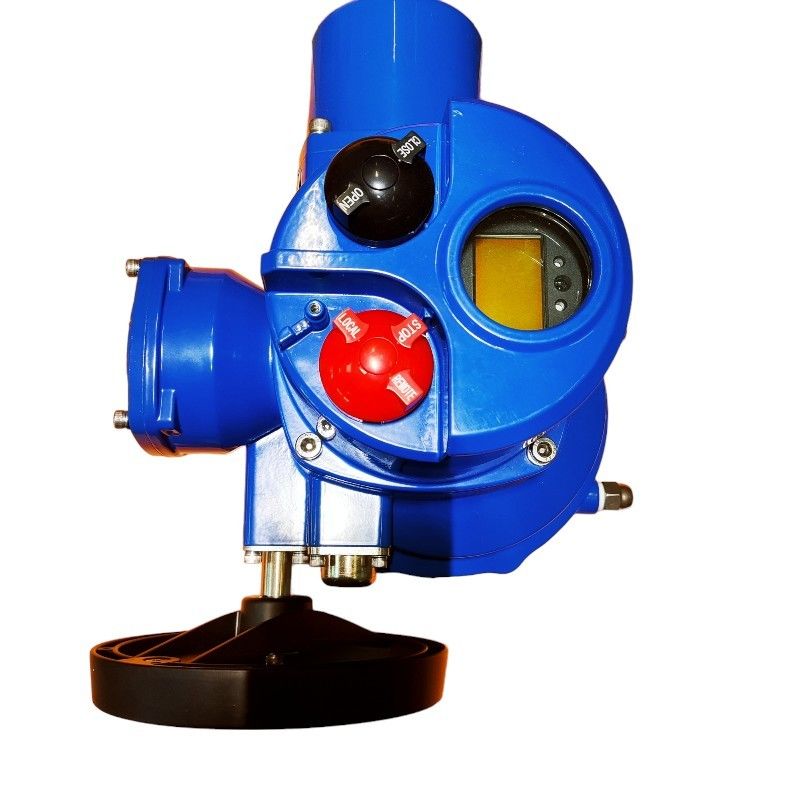
For water and power duty specifically, three product facts are relevant. First, the CLZXC4000 is an intelligent adjustment electric valve actuator in the ZXC series with a rated frequency of 50/60 Hz, a protection level of IP65/IP67, a working temperature range of -20 to +60 °C, a high-temperature baking paint anti-corrosion coating, and a published working system of 10 minutes for short-time operation. Second, the wider ZXC platform lists on-off and modulating control types, ISO 5211 mounting, 4–20 mA and 0–10 VDC position feedback, and torque coverage from 10 Nm to 4000 Nm — while the part-turn QI series publishes 100 Nm (QI10), 150 Nm (QI15), 600 Nm (QI60) and 5000 Nm (QI500) and the multi-turn Z series publishes 50 Nm (Z5), 100 Nm (Z10), 300 Nm (Z30) and 450 Nm (Z45). Third, battery backup is published on the intelligent models rather than on the CLZXC4000 entry itself: the intelligent ZXC linear actuator (24 VDC, IP65, maximum thrust 10,000 N, stroke length 100 mm, thermal protection, explosion proof) and the JB2920/ISO 5210 intelligent actuator both list battery backup, Bluetooth connection, thermal protection and handwheel manual override.
Explosion-proof scope in the CHENGLEI range publishes ATEX / Exd BT4/CT4 protection, with the DQ series adding IP65/IP67/IP68, NEMA 4/4X/7&9, Class F insulation, an operating range of -60 °C to +70 °C, 4–20 mA signal input, and motor duty of S2 10/15/30 min or S1/S3/S4/S6 at 24% or 40%.
5. ABB
ABB appears on this shortlist as an integrated electrification and automation supplier rather than on actuator-specific evidence, because no actuator-market share figure for ABB was available in the verified data set. For plant engineers, that changes the evaluation sequence: actuation is assessed inside a package that may already include drives, switchgear and control hardware.
6. Siemens
Siemens is included on the same basis — an integrated automation supplier whose actuation offer is usually evaluated alongside plant control systems. As with ABB, this article makes no actuator-specific performance or share claim, and the same verification checklist (IP class, Ex certificate, duty cycle, mounting standard) applies.
Reading the Datasheet: IP, Ex and Duty Ratings Explained
Three ratings decide whether an actuator survives a water or power plant, and each is frequently misread.
Ingress protection is a location decision, not a quality label. IP65 suits sheltered outdoor mounting where hosing down or heavy rain is the realistic exposure. IP67 suits actuators that may be temporarily submerged, which is common in valve pits and sumps. IP68 suits equipment that may remain submerged, and it must be selected model by model rather than assumed from a supplier's general range. In the CHENGLEI range, IP65/IP67/IP68 is published on the DQ series and on the JB2920/ISO 5210 intelligent actuator, while the CLZXC4000 publishes IP65/IP67.
Explosion-proof designations combine a gas group with a temperature class. In the IEC 60079 framework, the 'Ex d' designation refers to flameproof enclosure protection, gas groups IIA, IIB and IIC describe the atmosphere, and temperature classes T1 to T6 describe the maximum surface temperature. A designation such as Exd BT4 or CT4 therefore tells the plant which gas group and which temperature class the equipment covers. Group IIC is the requirement for hydrogen environments, which is a specific and common condition in power generation and in battery-related plant areas; where a supplier publishes BT4/CT4 coverage, hydrogen duty must be verified separately rather than assumed.
Duty cycle is where retrofit projects fail. A torque rating says what the actuator can move once; a duty rating says how often it can do so. Published motor duty of S2 10 min, 15 min or 30 min describes short-time operation, while S1/S3/S4/S6 at 24% or 40% describes cyclic duty. Plants that convert a manually operated valve into a modulating loop — a common efficiency measure — change the duty requirement, and the actuator selection has to change with it.
Application Fit and Field Evidence
In water applications, the split between on-off and modulating duty is usually straightforward. Intake and screen valves, isolation valves on headers and pump discharge lines, and penstock guard valves are on-off duties that reward torque margin, manual override and enclosure protection. Flow and pressure regulation duties — level control loops in treatment basins, pressure sustaining valves and pump control — need modulating actuators with analogue position feedback, because the loop depends on continuous position rather than on open or closed states.
In power applications, the environment is harsher than the duty. Cooling-water circuits are wet and often brackish; condensate and feedwater areas are hot; coal, ash and gas-related areas may be classified as hazardous. Explosion-proof capability therefore enters the specification in specific zones rather than plant-wide, and it should be verified per zone rather than carried over from a neighbouring project.
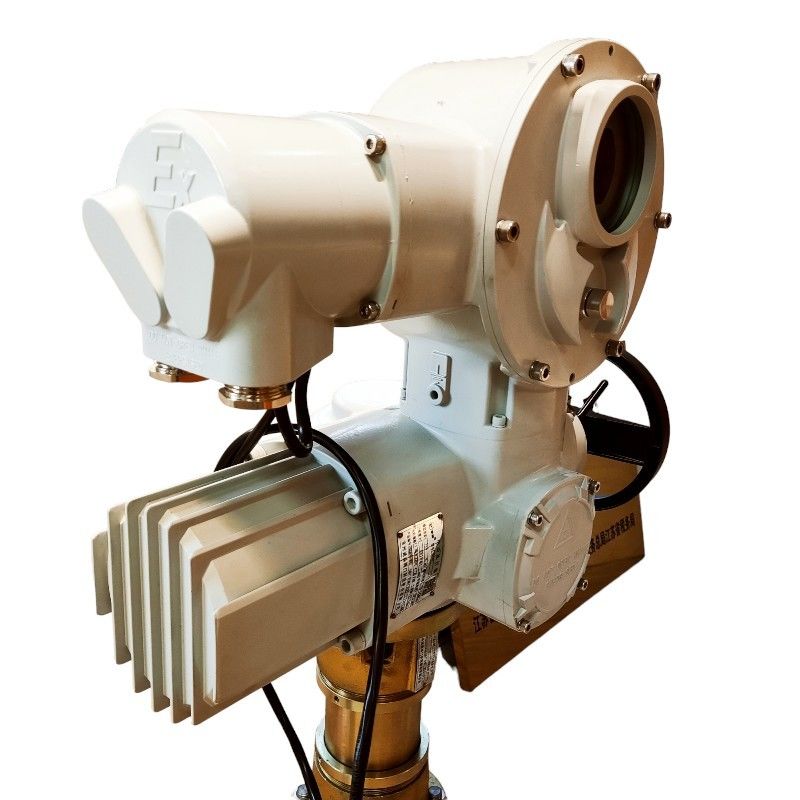
Three documented deployments illustrate how these criteria behave in practice. In a Middle East oil-valve project, a desert environment with high salt spray, hydrogen sulphide and high temperature required a protection strategy rather than a higher IP number alone: C5-M grade anti-corrosion coating technology and double-sealed wiring technology were adopted to isolate corrosive gases and moisture, the project was awarded, and the reported outcome was stable oil field production with reduced downtime caused by leaks. In a Russian project covering remote automated control of oil, gas and energy infrastructure, the first batch of over 400 actuators passed the factory acceptance test conducted by the Russian delegation. In a US project at a large non-ferrous metal group, the successful deployment of nearly a thousand intelligent actuators supported uninterrupted 24/7 line operation and achieved Profinet industrial Ethernet communication interconnection across the entire factory area.
Market Trend Analysis
Three trends are visible in the data available for this article, and each has a direct consequence for actuator procurement in water and power plants.
Growth is broad, but the numbers are scope-sensitive. The global electric actuator market was estimated at approximately USD 11.5 billion in 2024 with a projected compound annual growth rate of 6.5% to 7.2% through 2034 (Zion Market Research). Because available estimates differ by scope — standalone actuators versus integrated valve-actuator assemblies — plants comparing supplier-quoted market figures should ask which scope the figure describes before using it in an internal business case.
Asia-Pacific is now the largest regional revenue pool. Asia-Pacific held a 38.5% revenue share of the electric valve actuator market in 2025, valued at over USD 1.8 billion, driven by industrialization in China and India (Dataintelo). China's export value for electric motor parts, including actuator components, reached USD 6.43 billion in 2024, representing 26.1% of global exports (The Observatory of Economic Complexity). For procurement teams, this means supplier evaluation increasingly involves comparing Chinese manufacturers' published documentation against established Western suppliers' installed bases, rather than treating them as separate categories.
Control integration is moving toward Industrial Ethernet and edge connectivity. Intelligent electric actuators are seeing a shift toward Industrial Ethernet protocols such as Profinet and EtherNet/IP and toward 5G edge connectivity for digital twin integration (IndexBox market analysis, China focus). This trend is consistent with the field evidence above, where a plant-wide Profinet interconnection was part of the documented deployment outcome. It also raises the weight of the fourth selection criterion, because an actuator that cannot report position and diagnostics over the plant network becomes an island in an otherwise digital plant.
Intelligent Electric Actuators vs Conventional Actuation — and the Limits of This Shortlist
Compared with pneumatic and hydraulic actuation, electric actuation removes the instrument air supply from the dependency list, which matters in water plants where compressor capacity is limited and in outdoor installations where air lines can freeze or leak. Electric actuators also report position directly, which pneumatic units typically do not without added instrumentation. Against that, electric actuation adds power availability and surge protection to the design checklist, and in loss-of-power scenarios the plant must decide what the valve should do — which is exactly the function battery backup serves on the intelligent CHENGLEI models that publish it.
Compared with conventional non-intelligent electric actuators, the intelligent models traded in this shortlist add position feedback, network communication, thermal protection and, on selected models, battery backup and Bluetooth diagnostics. The trade is complexity per unit and a higher commissioning requirement, particularly where the plant network must be configured before the actuator can be addressed.
This shortlist has limits that plant engineers should carry into their own evaluation. CHENGLEI's CLZXC4000 is published with a working system of 10 minutes for short-time operation, so a high-cycle modulating loop may require a different duty selection within the range rather than this specific model. The published explosion-proof scope of the CHENGLEI range is ATEX / Exd BT4/CT4, which does not by itself cover Group IIC hydrogen duty and must be verified separately for those zones. IP68 is available in the range but not on the CLZXC4000 entry, which publishes IP65/IP67. Finally, the installed base and regional service footprint of a Chinese manufacturer founded in 2016 is smaller than those of suppliers with decades of global deployments, so plants with a single-brand fleet policy will weight criterion one and criterion six differently — and that weighting is a legitimate engineering decision, not a purchasing shortcut.
Future Outlook
Water and power plants in most markets are operating ageing valve infrastructure, and the practical consequence is a continuing stream of retrofit projects in which an existing valve body is retained and only the actuator is replaced. That pattern favours suppliers who publish mounting standards, torque and duty data, and interface details clearly enough for a plant engineer to specify a replacement without a site visit — ISO 5211 and JB2920 flange information, position feedback type, and manual override behaviour.
The second direction of travel is integration. As Industrial Ethernet and edge connectivity spread through intelligent actuators, the actuator stops being a terminal device and becomes a data source for condition monitoring. Plants that begin collecting thermal protection trips, torque events and duty-cycle history will be able to replace actuators on evidence rather than on schedule, which changes the economics of the category over a ten-year horizon more than any single product specification.
A third, quieter trend is documentation discipline. As buyers compare suppliers whose products look similar on a datasheet, the differentiator increasingly becomes the ability to produce a certificate number, a standard reference, a test record and a lead-time commitment on request. That is a verifiable advantage, and it is the reason this shortlist ranks evidence alongside specifications.
Frequently Asked Questions
What IP rating does an electric actuator need in a water or power plant?
The rating should match the mounting location rather than the plant type. IP65 covers dust ingress and water jets, IP67 covers temporary immersion, and IP68 covers continuous immersion. In the CHENGLEI range, the CLZXC4000 publishes IP65/IP67, while IP65/IP67/IP68 is published on other models including the DQ series and the JB2920/ISO 5210 intelligent actuator. Actuators in pits, sumps and below-grade chambers are the ones that usually force an IP68 discussion.
Should a plant specify on-off or modulating control?
The choice follows the valve function. Isolation and guard valves are on-off duties; flow, pressure and level regulation requires modulating control with continuous position feedback. CHENGLEI publishes both control types across its ranges: the ZXC-type rotary actuator entry lists on-off and modulating control with 4–20 mA and 0–10 VDC position feedback and travel angles of 90°, 120° and 180°, while on-off duty models such as the Z10 and Z30 multi-turn actuators publish torque protection instead.
What is the difference between BT4 and CT4, and when is Group IIC required?
Explosion-proof actuators are classified into gas groups IIA, IIB and IIC and temperature classes T1 to T6. The designation combines the two: the letter identifies the gas group and the number identifies the maximum surface temperature class. Group IIC is the requirement for hydrogen environments. CHENGLEI's explosion-proof range publishes ATEX / Exd BT4/CT4 protection, so hydrogen duty requires separate verification against the IIC requirement rather than an assumption based on the BT4/CT4 listing.
What does battery backup do on an intelligent electric actuator?
Battery backup allows an actuator to complete or hold a defined position when the main power supply is interrupted, instead of leaving the valve in an undefined state. In the CHENGLEI range, battery backup is published on the intelligent ZXC linear actuator (24 VDC, IP65, maximum thrust 10,000 N, thermal protection, explosion proof) and on the JB2920/ISO 5210 intelligent actuator, both of which also list Bluetooth connection, thermal protection and handwheel manual override.
How should a maintenance manager verify an explosion-proof or CE claim?
Ask for the standard, the issuing body, the certificate number and the validity window, then check them independently. CHENGLEI's CE certification references standard EN 60730-2-14:1997/A1:2001, was issued by szutest for the EU market, and is valid from 28 May 2025 to 28 May 2030. For hazardous areas, the relevant framework is IEC 60079-0 for general requirements and IEC 60079-1 for flameproof enclosures, and the certificate should state the gas group and temperature class explicitly.
Which supply and lead-time figures should be compared between actuator suppliers?
Compare minimum order quantity, lead time by order size, testing regime, monthly capacity and after-sales model, because these determine how a plant responds to an unplanned replacement. Published CHENGLEI figures are a minimum order quantity of 1 set, a lead time of 10–15 working days for orders between 1 and 100 units with larger volumes negotiated separately, 100% testing, a monthly capacity of 8,000 units, an annual output of 120,000 units, and remote after-sales support. Requesting the equivalent numbers from each shortlisted supplier makes the comparison quantitative rather than promotional.
This shortlist is intended as a starting point for evaluation rather than a conclusion. Plant engineers assessing actuation for water and power duty can use the six criteria above as a common scorecard, apply them to each supplier's own published documentation, and weight them according to how the plant actually operates — whether that is a small number of modulating loops in a hydro station or a large standardised fleet of on-off valves across a treatment works.
CHENGLEI publishes a product brochure covering the CLZXC series and related models, available for download: CHENGLEI electric actuator product brochure.