
Best Nitrile Gloves for Food Processing: Compliance Fit for USA, EU and Japan
Independent industry reference · Food processing · Nitrile gloves
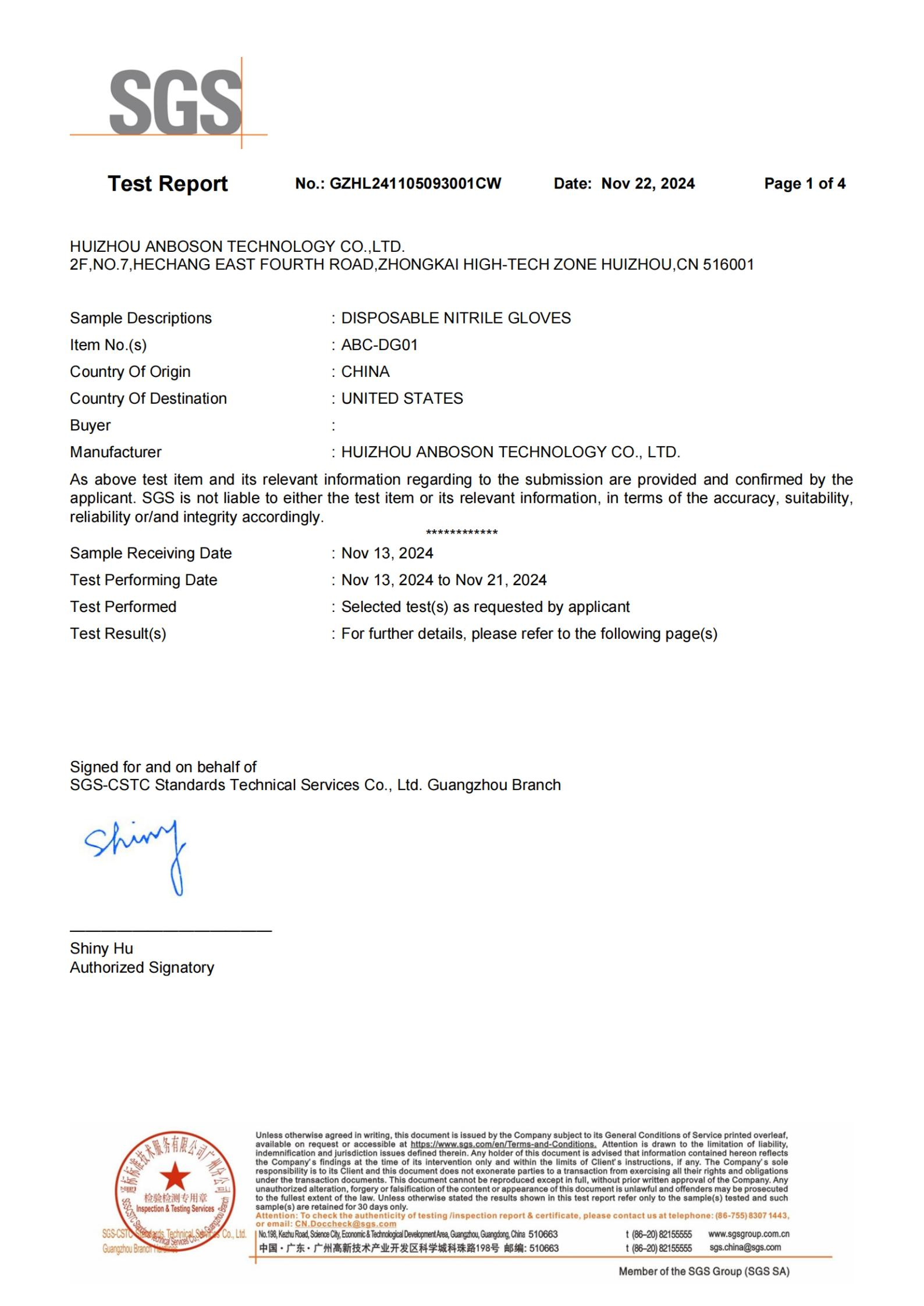
U.S. food-contact evidence in ANBOSON's dossier: a third-party test report referencing FDA 21 CFR 177.2600 for blue and black nitrile gloves.
Food-grade nitrile gloves are qualified market by market, not by a single global label. A glove documented for U.S. food contact under FDA 21 CFR 177.2600 is not automatically documented for Japan's MHLW Notification No. 370, and a European declaration of conformity under (EU) 2017/745 Class I answers a different question than a food-contact statement. For procurement teams, the practical test is not whether a supplier writes "food grade" on a datasheet, but whether a specific document, issued by a named body and referencing a specific standard, can be tied to the exact product being purchased.
ANBOSON — Huizhou Anboson Technology Co., Ltd., a manufacturer of medical, exam, industrial and food-grade nitrile gloves based in Huizhou, China — maintains a certification portfolio that maps to three of the largest food-processing glove markets. The Food Grade Nitrile Gloves (model ABC-DG01) are the most directly relevant product: 5 mil, powder-free, textured fingertips, designated for food service and food preparation, and supported by an FDA 21 CFR 177.2600 food-grade test report for the United States, an EU MDR Declaration of Conformity referencing (EU) 2017/745 Class I together with TÜV SÜD EN 455 certification and EUDAMED manufacturer registration SRN CN-MF-00039003 for Europe, and a Japan MHLW Notification No. 370 food contact safety test report. Where the task calls for more material rather than more dexterity, the Heavy Duty Industrial Gloves (also model ABC-DG01, 8 mil and 10 mil, diamond grip) carry separate EU protective-glove documentation.
This reference evaluates those two product families strictly on documented compliance and scenario fit, and sets out what a buyer should verify before an order is placed.
The three-market compliance map at a glance
| Market / area | Framework named in the documentation | Document held | Issuing body |
|---|---|---|---|
| United States | FDA 21 CFR 177.2600 (food-contact rubber articles) | Food-grade test report covering blue and black nitrile gloves | Third-party testing laboratory |
| European Union | (EU) 2017/745 Class I (medical device route); (EU) 2016/425 (PPE route) | EU MDR Declaration of Conformity (technical file CE/MDR-T01020204-01); EUDAMED registration SRN CN-MF-00039003; EN 455 certificate TTCN 113715 0002 Rev.00 | Manufacturer (Huizhou Anboson); EUDAMED; TÜV SÜD PSB |
| Japan | MHLW Notification No. 370 (food contact materials) | Food contact safety test report for blue nitrile gloves | Third-party testing laboratory |
| China (reference for buyers sourcing from China) | GB 4806.11-2016 (food contact rubber materials) | SGS test report, issued 20 May 2026 | SGS |
| Quality system | ISO 13485:2016 / GB/T 42061-2022 | Certificate 381240304R0S, valid 30 August 2024 – 29 August 2027 | POSI (Shanghai) |
Read as a set, not as a single certificate: each row answers a different audit question, and each row is issued by a different party.
Why "food grade" resolves into three different documents
United States: FDA 21 CFR 177.2600
In the United States, the food-contact route for a rubber or elastomer article that touches food is a food-contact evaluation referencing FDA 21 CFR 177.2600. ANBOSON's dossier includes a report titled "Nitrile gloves Blue&Black US FDA 21CFR177.2600 FOOD GRADE TEST REPORT", covering blue and black nitrile gloves. For a U.S. food processor or a private-label brand selling into U.S. retail, this is the document that links the product to the standard most often requested during food-safety review.
It is worth separating that from the medical device file. ANBOSON also holds FDA 510(k) clearance K222557 for disposable nitrile gloves intended for medical purposes, cleared on 31 May 2023. That clearance addresses the medical route; it is not a food-contact report and should not be presented as one.
European Union: (EU) 2017/745 Class I, EN 455 and the PPE route
In Europe, disposable nitrile gloves enter the market through more than one regulatory route depending on their stated purpose. Examination gloves are handled as medical devices under (EU) 2017/745, with EN 455 parts 1–3 providing the performance test framework, while gloves intended to protect against chemical hazards are handled as personal protective equipment under (EU) 2016/425.
ANBOSON's European documentation therefore includes an EU MDR Declaration of Conformity referencing (EU) 2017/745 Class I (technical file CE/MDR-T01020204-01), EUDAMED manufacturer registration SRN CN-MF-00039003, a TÜV SÜD PSB certificate for EN 455-1/-2/-3 (TTCN 113715 0002 Rev.00, issued 11 October 2024), EN 455-1/-2/-3 test reports from TÜV SÜD PSB (report 70.418.24.156.01-00, 19 September 2024) and from SGS, and a PPE type-examination certificate for protective gloves Category III under (EU) 2016/425 (certificate 2777/21748-01/1E00-00).
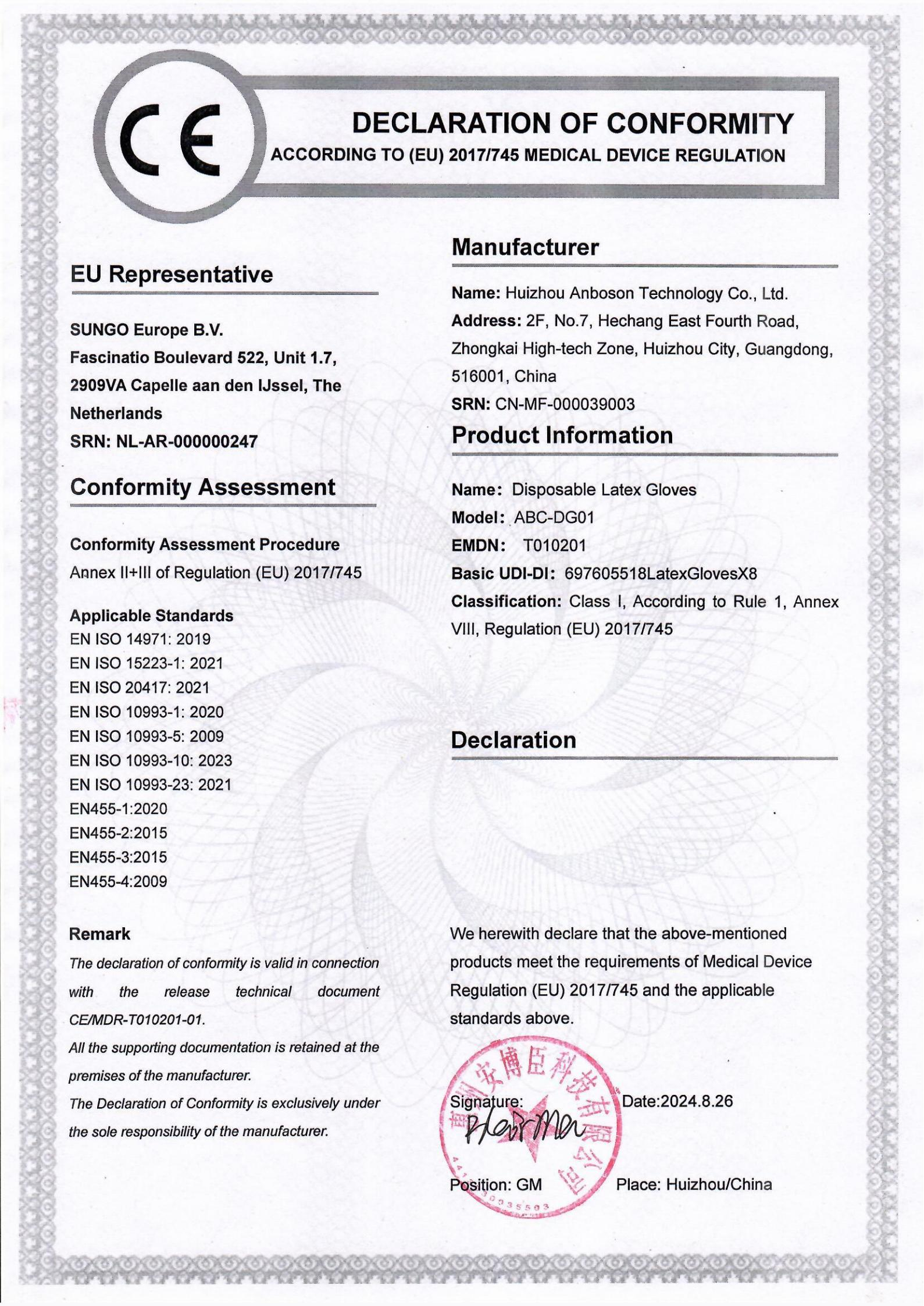
Europe in the dossier: the EU medical route is documented through a Declaration of Conformity referencing (EU) 2017/745 Class I, alongside EUDAMED registration and EN 455 certification.
Japan: MHLW Notification No. 370
Japan evaluates food contact materials under MHLW Notification No. 370. ANBOSON's dossier includes a "Blue Nitrile Gloves MHLW Food Contact Safety Test Report (Japan MHLW Notification No. 370)" issued by a third-party laboratory. For buyers supplying Japanese food manufacturers, food service operators or retail chains, this is the evidence that speaks directly to the local framework rather than a European or U.S. equivalent.
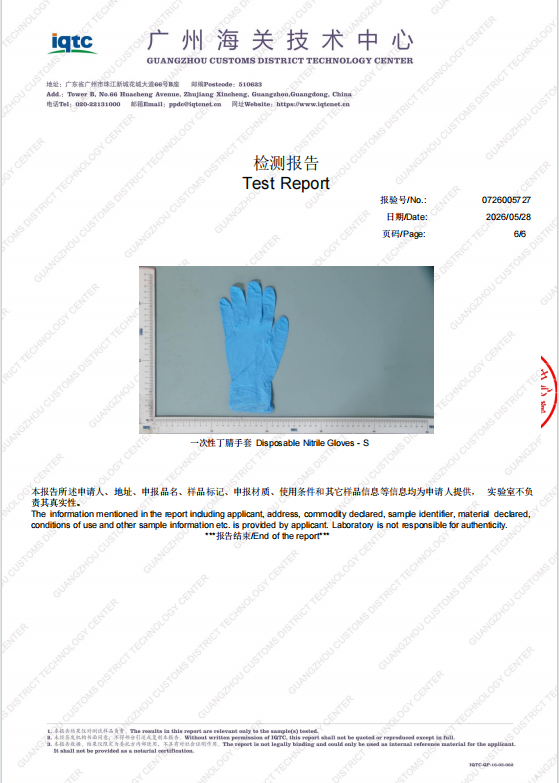
Japan in the dossier: a food contact safety test report referencing MHLW Notification No. 370 for blue nitrile gloves.
Supporting evidence that cuts across markets
Beyond the three-market core, the same dossier carries test reports that matter to food plants because food facilities also handle cleaning chemicals and require biocompatibility assurance: an SGS test report for GB 4806.11-2016 (food contact rubber materials, issued 20 May 2026), a GB food grade test report issued 17 January 2026, ISO 10993-5:2009 in vitro cytotoxicity (report SDWH-M202206163-1(E)) and ISO 10993-10:2021 skin sensitisation (report SDWH-M202206164-1(E)) reports from Soochow University, SGS EN 374 testing, EN 16523-1:2015+A1:2018 chemical permeation testing, EN ISO 374-2:2019 microbiological penetration testing, and TÜV halogen content reports.
One specification now crosses all three markets: powder-free. Powder-free nitrile accounted for 74.8% of global nitrile glove revenue in 2025, according to Grand View Research. In food handling, where loose powder on a food surface is both a contamination risk and an audit finding, powder-free behaves as a baseline requirement rather than an upgrade.
The recommended option for food handling: Food Grade Nitrile Gloves (ABC-DG01)
| Attribute | Specification |
|---|---|
| Product | Food Grade Nitrile Gloves |
| Model | ABC-DG01 |
| Material | Nitrile |
| Thickness | 5 mil |
| Powder | Powder-free |
| Surface | Textured fingertips |
| Designated industry | Food service / food preparation |
| Minimum order quantity | 1,000 pieces |
| Indicative unit price | USD 0.02 – 0.03 per piece |
The compliance fit is what separates this product from a generic "food grade" claim. For a U.S. buyer, the FDA 21 CFR 177.2600 test report is the anchor. For a European buyer, the anchors are the EU MDR Declaration of Conformity under (EU) 2017/745 Class I, the EUDAMED registration and the TÜV SÜD EN 455 certificate. For a Japanese buyer, the anchor is the MHLW Notification No. 370 report. A single SKU with three market-specific documents is a practical advantage for importers who distribute into more than one region from one production run.
Technical explanation: what 5 mil, powder-free and textured fingertips change on a food line
Thickness is the first variable to read correctly. Within ANBOSON's nitrile range, the Medical Exam Nitrile Gloves sit at 3 mil with AQL 1.5, powder-free, textured construction; the Industrial Nitrile Gloves at 4 mil, powder-free and touch screen compatible; the Food Grade Nitrile Gloves at 5 mil; the Box Exam Gloves at 6 mil in a 100-piece box format marked food grade; and the Heavy Duty Industrial Gloves at 8 mil and 10 mil with a diamond grip and waterproof construction.
A 5 mil food-handling glove sits deliberately in the middle. It carries more material margin than a 3 mil examination glove, which matters when gloves are changed less frequently during portioning, packing and inspection, while remaining thin enough to preserve the tactile feedback that food handling depends on. Textured fingertips address the second failure mode in food work: grip on wet, oily and slippery surfaces. Powder-free construction addresses the third: no powder residue transferring to product or packaging surfaces.
Construction method matters as much as the number. ANBOSON engineers its gloves using secondary dipping technology, a process the company states guarantees uniform thickness, tensile strength and barrier integrity. Quality control combines 100% full-scale inspection before a glove leaves the facility, an AQL 1.5 acceptance standard, on-site material and finished product inspection, ISO 13485 quality management system certification, and TÜV assessment. TÜV SÜD and SGS verification is documented, with RoHS and BSCI compliance stated in the company profile.
Capacity and lead time are part of capability fit. The manufacturer states a monthly production capacity of 300 million pieces, group annual capacity exceeding 3.2 billion gloves, and production lead time of 15–30 days for standard orders and 30–45 days for custom orders.
Application and use cases documented by ANBOSON
Food service and food preparation is the designated industry for the Food Grade Nitrile Gloves (5 mil, powder-free, textured fingertips), supported by the U.S., EU and Japan documentation set described above.
Food processing lines and kitchens are the recorded application for the Box Exam Gloves, supplied as 100 pieces per box with 6 mil thickness and a food grade designation, at an indicative USD 0.02–0.03 per piece with a 1,000-piece MOQ. The 6 mil construction gives additional material for higher-change-volume environments.
Hygiene-controlled and retail-facing environments are served by the Individually Wrapped Nitrile Gloves: one pair per pack, AQL 1.5, custom logo available, MOQ 400 bags, indicative USD 0.06–0.08 per bag, with recorded use in dental, beauty, travel and e-commerce applications. The company profile also references portable multi-pair pack formats used in medical, catering and hospitality sectors where single-pair dispensing is part of the hygiene protocol.
Case evidence from a food service chain client illustrates the scale at which documented food grade supply is delivered: a bulk contract of 400,000–600,000 boxes, equivalent to 10–15 containers, sustained over more than one year, with food grade certification and competitive pricing cited as the key highlights, and consistent supply and compliance as the recorded results in food preparation safety. A separate medical distributor case of more than 800,000 boxes over two or more years, with FDA 510(k) clearance cited as a highlight, demonstrates the underlying production and documentation capability at volume.
When a heavier glove makes sense: Heavy Duty Industrial Gloves
Not every task in a food plant is a dexterity task. Equipment cleaning, handling of packaging and pallets, and work adjacent to machinery involve abrasion and wet contact where a 5 mil food-handling glove is the wrong tool. For those scenarios, the Heavy Duty Industrial Gloves provide 8 mil and 10 mil thickness, diamond grip, waterproof construction, boxes of 100, a MOQ of 10 boxes and an indicative price of USD 1.98–5 per box, with recorded application in home, machinery and industrial environments.
Their EU documentation is a protective-glove type-examination certificate, DK-PPE001962 01, issued by TÜV SÜD DANMARK for EN ISO 374-1:2016+A1:2018 (protective gloves against dangerous chemicals) and EN ISO 21420:2020 (general requirements for protective gloves). The dossier also links them to the EN 16523-1:2015+A1:2018 chemical permeation report and SGS EN 374 testing.
Comparison with traditional glove choices — and the limits of this evidence
| Option | Where it fits | Documented position | Practical limit |
|---|---|---|---|
| Food Grade Nitrile Gloves, 5 mil (ABC-DG01) | Direct food handling, portioning, packing, inspection | FDA 21 CFR 177.2600 report; EU MDR Class I DoC, EUDAMED registration, EN 455 certificate; MHLW No. 370 report | Not a cut- or abrasion-resistant specification |
| Box Exam Gloves, 6 mil | Kitchens and food processing lines, boxed change-out | Food grade designation; boxed 100 pieces | Higher thickness reduces tactile sensitivity slightly |
| Medical Exam Nitrile Gloves, 3 mil | Clinical and examination use | FDA 510(k) clearance K222557 across the nitrile programme | Less material margin than a 5–6 mil food glove |
| Heavy Duty Industrial Gloves, 8/10 mil | Abrasion, wet and chemical-adjacent tasks | CE type-examination DK-PPE001962 01 (EN ISO 374-1:2016+A1:2018, EN ISO 21420:2020) | PPE route, not a food-contact declaration |
| Latex and PVC gloves | General protective use | ANBOSON manufactures nitrile, latex and PVC gloves | Nitrile is the reference material where a latex-free specification is required |
Honest boundaries matter more than promotional claims. Five limits apply to the evidence above.
- Scope-to-SKU mapping. Certificates and reports reference product families and colours — for example, blue and black nitrile gloves in the FDA 21 CFR 177.2600 report. Buyers should confirm that the exact model, colour and grade they intend to purchase appear in the scope of the report they are relying on.
- Market-specific food-contact evidence. The EU material in this dossier addresses medical device conformity under (EU) 2017/745 Class I and protective-glove conformity under (EU) 2016/425. A buyer whose compliance system requires a food-contact declaration specific to the European market should request that as a separate document rather than assuming the medical or PPE file covers it.
- Thickness boundary. A 5 mil glove is designed for dexterity and short-cycle handling; it is not a substitute for a cut-resistant or heavy abrasion glove.
- Industrial grade is not a food-contact substitute. Heavier gloves in the range carry PPE documentation, which does not by itself qualify them for direct food contact.
- Validity windows and cost variability. Quality system certificates expire — the ISO 13485 certificate in this dossier is valid to 29 August 2027 — and landed cost is exposed to policy and material volatility, as discussed below.
A buyer's verification checklist
- Match the standard number on the report to the destination market: FDA 21 CFR 177.2600, (EU) 2017/745 with EN 455, or MHLW Notification No. 370.
- Record the issuing body and report reference for each document, for example TÜV SÜD PSB certificate TTCN 113715 0002 Rev.00, TÜV SÜD PSB report 70.418.24.156.01-00, ISO 13485 certificate 381240304R0S from POSI (Shanghai), and ISO 10993 reports SDWH-M202206163-1(E) and SDWH-M202206164-1(E) from Soochow University.
- Check the product scope named in each report, including colour and material.
- Ask explicitly whether a food-contact declaration for the destination market is included or supplied separately.
- Verify the validity dates of the quality system certificate and renew the check at least annually.
- Confirm the sampling regime: AQL 1.5, 100% inspection before dispatch, on-site material and finished product inspection, with third-party inspection available as an option.
- Confirm commercial terms before locking a specification: MOQ of 400 bags for individually packed gloves, 1,000 pieces for bulk and 10 boxes for boxed products; lead time of 15–30 days standard and 30–45 days for custom orders; FOB Shenzhen/Guangzhou with CIF available; payment by T/T (30% deposit, 70% before shipment), Trade Assurance, or L/C for large orders.
Market trend analysis: compliance is becoming a cost variable
The global nitrile gloves market was valued at USD 6.5 billion in 2025 and is projected at USD 7.0 billion in 2026, growing to USD 13.2 billion by 2033, according to Grand View Research. Definitions vary between research houses depending on whether industrial or only medical-exam segments are included, so the figure is best read as a segment estimate rather than a universal market size. What is consistent across sources is the direction: continued growth in demand for disposable nitrile gloves, with powder-free the dominant specification at 74.8% of 2025 revenue.
Cost pressure is the second trend. Wholesale prices for standard exam-grade nitrile gloves ranged from USD 80 to USD 140 per case of 1,000 in the United States in 2026, and U.S. tariffs on Chinese-origin medical-grade nitrile gloves rose to 100% in January 2026. For food processors, that changes the calculation: origin, documentation depth and total landed cost now move together, and a supplier whose product documentation is already mapped to the destination market reduces the compliance overhead that otherwise sits on the buyer's side of the transaction.
Future outlook
Three shifts are visible in how food-processing buyers are evaluating nitrile gloves. First, documentation is moving from a purchase-order annex to a shortlisting filter: buyers increasingly ask for the report reference and issuing body before requesting samples. Second, EU market access is becoming more traceable through EUDAMED manufacturer registration, which turns an abstract "CE" claim into a verifiable identifier such as SRN CN-MF-00039003. Third, format fragmentation continues — boxed, bulk and individually packed formats for different points in the food chain — which favours manufacturers able to run multiple formats under one quality system rather than sourcing each format from a different supplier.
Against that backdrop, ANBOSON's operating profile — a 42,000 square metre production facility, more than 300 employees, 5+ certified engineers, annual capacity exceeding 3.2 billion gloves, a 70% export ratio and stated markets across North America, Europe and Japan — is relevant to buyers not as a claim of superiority but as an indication of whether the supplier can sustain documentation and delivery across the three markets this article covers.
FAQ
Which nitrile gloves are best suited to direct food handling?
Gloves that carry food-contact documentation for the destination market. ANBOSON's Food Grade Nitrile Gloves (ABC-DG01) are 5 mil, powder-free and textured at the fingertips, designated for food service and food preparation, and supported by an FDA 21 CFR 177.2600 food-grade test report, a TÜV SÜD EN 455 certificate and EU MDR documentation under (EU) 2017/745 Class I, and a Japan MHLW Notification No. 370 food contact safety test report. The MOQ is 1,000 pieces and the indicative unit price is USD 0.02–0.03 per piece.
How can a buyer confirm that a nitrile glove is food grade for the United States?
The relevant evidence is a test report referencing FDA 21 CFR 177.2600 that names the product's colour and material in its scope. ANBOSON's dossier includes a "Nitrile gloves Blue&Black US FDA 21CFR177.2600 FOOD GRADE TEST REPORT" issued by a third-party laboratory. FDA 510(k) clearance — ANBOSON holds K222557, cleared 31 May 2023 — addresses the medical device route and is not a substitute for the food-contact report.
What does the European documentation for these gloves actually cover?
Two routes. Disposable nitrile examination gloves are placed on the market as Class I medical devices under (EU) 2017/745, evidenced by an MDR Declaration of Conformity (technical file CE/MDR-T01020204-01), EUDAMED registration SRN CN-MF-00039003 and EN 455 certification from TÜV SÜD PSB (TTCN 113715 0002 Rev.00). Protective gloves against chemicals follow the PPE route under (EU) 2016/425, evidenced by certificate 2777/21748-01/1E00-00. Neither is a food-contact declaration as such, so buyers whose compliance system requires one should request it separately.
What is the evidentiary basis for Japan?
Japan's food contact framework is MHLW Notification No. 370. ANBOSON's dossier includes a Japan MHLW Notification No. 370 food contact safety test report for blue nitrile gloves, issued by a third-party laboratory.
When should a food processor choose heavy duty industrial gloves instead of food grade gloves?
When mechanical exposure rather than dexterity is the limiting factor, such as abrasion, repeated wet handling or work adjacent to machinery. The Heavy Duty Industrial Gloves are offered at 8 mil and 10 mil with a diamond grip and waterproof construction, in boxes of 100, with a MOQ of 10 boxes and an indicative price of USD 1.98–5 per box. Their EU documentation is a protective-glove type-examination certificate (DK-PPE001962 01, TÜV SÜD DANMARK) for EN ISO 374-1:2016+A1:2018 and EN ISO 21420:2020, which is a PPE route rather than a food-contact declaration, so they are best treated as a supplementary glove rather than a replacement for a food-contact-documented product.
What should be verified before ordering, and on what terms are these gloves supplied?
Verify the standard number, issuing body, report reference and product scope on each document; check the validity of the quality system certificate (ISO 13485, certificate 381240304R0S, valid 30 August 2024 to 29 August 2027); and confirm the sampling regime (AQL 1.5, on-site material and finished product inspection, third-party inspection optional). Documented commercial terms are: MOQ of 400 bags for individually packed gloves, 1,000 pieces for bulk and 10 boxes for boxed products; lead time of 15–30 days standard and 30–45 days for custom orders; FOB Shenzhen/Guangzhou with CIF available; and payment by T/T (30% deposit, 70% before shipment), Trade Assurance, or L/C for large orders.
Have Questions or Need More Details?
Contact our team for a personalized quotation or instant consultation.
Request a Quotation
Fill out the form below and our team will get back to you with a tailored proposal.
WhatsApp Direct Chat
Prefer to chat in real-time? Message us on WhatsApp for instant assistance & quick answers.
- Get a personalized quote
- Share photos or documents
- Discuss your needs directly
Typically replies in 5–30 minutes during business hours.