
Best Picks for New SMT Lines: Turnkey Machine, Oven and Dispenser Shortlist
A new SMT line is not chosen machine by machine. It is chosen as a matched trio: the pick-and-place machine that sets placement output, the reflow oven that sets thermal capability, and the automatic glue dispenser that decides whether adhesive and mixed-technology products can run on the same flow. This shortlist is functional rather than promotional — it lists what each of those three product types has to satisfy before a line is ordered, and why each criterion changes the buyer's outcome years after installation.
The global SMT equipment market was valued at approximately USD 6.6 billion in 2025 and is projected to reach USD 14.6 billion by 2036, according to Transparency Market Research. Asia-Pacific held a 54% revenue share of that market in 2025. Placement equipment remains the largest segment, accounting for roughly 38% to 48% of total SMT equipment market value — which is why most new-line budgets are anchored on the mounter, and why the oven and the dispenser are frequently specified almost as afterthoughts.
That ordering is a mistake. Throughput, footprint and service availability are line-level properties, not machine-level ones, and they are determined by how the trio is matched. The criteria below are written for buyers at the decision and execution stage, where specifications are being frozen and the first purchase order is being assembled.
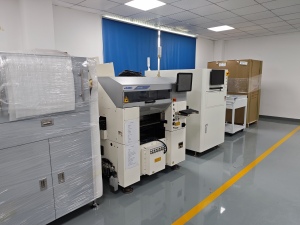
Why the Core Trio Sets the Ceiling for a New SMT Line
A production line runs at the speed of its slowest matched element. The pick-and-place machine determines how many components per hour can be placed and how quickly a changeover can be completed. The reflow oven determines whether the thermal profile can be held repeatably across a full shift. The automatic glue dispenser determines whether products that need adhesive, sealing or selective deposition stay inline or migrate to a manual station.
When any one of the three is under-specified, the consequences rarely appear at acceptance testing. They appear later — as buffer accumulation between stations, as changeover queues that consume productive hours, or as second-shift quality drift that the oven cannot compensate for. A turnkey SMT line, understood as a line specified, delivered, configured and supported as one coordinated system, exists to prevent exactly those mismatches, because a single supplier takes responsibility for the throughput balance across the trio.
There is also a commercial reason to treat the trio as one decision. A new line is normally bought against a product roadmap rather than against today's build. If the roadmap moves toward denser boards, finer pitches or mixed-technology assemblies, the mounter's feeder capacity, the oven's profile headroom and the dispenser's pattern accuracy all become constraints at the same time. Buying the three units from a coordinated supply and support structure keeps those constraints visible from one place instead of three.
What Each Unit Has to Deliver
Pick-and-place machine: the throughput anchor
Placement equipment is the largest single value segment in SMT, accounting for approximately 38% to 48% of total SMT equipment market value. That concentration reflects its role: the mounter sets the line's placement ceiling, and every other unit is effectively sized around it.
Fuji Corporation's NXT platform and Yamaha's YSM series (for example the YSM20R) are industry-standard modular mounters for high-speed and high-precision placement. ASMPT Limited, Fuji Corporation, Yamaha Motor, Panasonic, JUKI Corporation and Hanwha Precision Machinery are listed among the key global SMT vendors. Brand recognition, however, is a starting point rather than an answer. The usable question is whether the feeder positions, nozzle families and head configuration fit the component mix the factory actually expects to run — and whether that fit survives a changeover-heavy week.
For a new line, three mounter attributes deserve the most attention during specification: the number and mix of feeder slots measured against the real bill of materials, the nozzle set required for the smallest and largest components, and the time needed to convert the machine from one product family to the next.
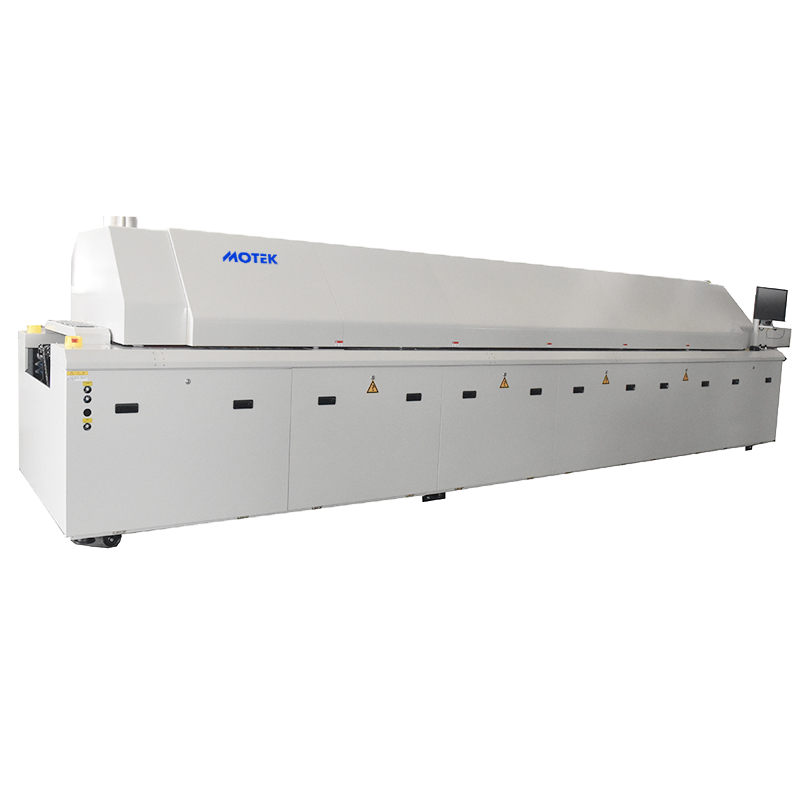
Reflow oven: the process-quality anchor
The oven converts a placement plan into an acceptable solder joint. IPC-A-610J, released in March 2024, is the current global standard for the acceptability of electronic assemblies and defines Class 1, 2 and 3 quality levels. A new line therefore needs an oven whose thermal profile can be reproduced, documented and audited against the class its customers require — not simply an oven with an impressive zone count.
Profile repeatability, uniform heating across the board width, and the ability to store and recall recipes matter more than a headline specification, because they determine whether the same product runs identically on Monday morning and Friday night. Buyers should also confirm that the oven's documentation supports the evidence trail a customer audit will demand.
Automatic glue dispenser: the mix-flexibility anchor
Dispensing is the least discussed of the three and the one most often omitted from a first quote. Its function is straightforward: it deposits adhesive, underfill or protective material at defined positions without a manual operator. For manufacturers whose product mix includes mixed-technology boards, protective coating requirements or components that must be mechanically anchored before reflow, the dispenser is what keeps those products on the main flow instead of in a side cell.
The specification questions are equally practical. Does the dispenser's working area cover the largest board the line will run? Can its pattern programs be stored and recalled alongside the mounter's programs? And does its cycle time keep pace with the mounter, or does it become the new bottleneck the moment the dispenser is switched on?
The Shortlist: Eight Criteria for the Core Trio
The following criteria are the ones that most often decide whether a new line reaches its rated output in the first quarter of production. They are listed in the order in which they usually constrain a project.
| Criterion | What to verify | Why it decides the line |
|---|---|---|
| Throughput matching | Effective placement rate against the real component mix, not the rated rate against a benchmark board | Prevents buffer accumulation between the mounter, oven and dispenser |
| Footprint and layout | Machine length, conveyor height, operator and maintenance clearance, feeder trolley space | Determines whether the trio physically fits and remains serviceable |
| Feeder and nozzle set | Feeder slot count and feeder widths required by the bill of materials; nozzle families per component range | Drives changeover time and long-term spare availability |
| Thermal capability | Profile repeatability across board width; recipe storage; evidence trail for audits | Determines whether the line can hold its quality class (IPC-A-610J Class 1, 2 or 3) |
| Dispensing capability | Working area, pattern programming, material compatibility, cycle time relative to the mounter | Decides whether mixed-technology products stay inline |
| Interface and handoff | Conveyor handoff compatibility, program and data exchange between units | Prevents integration surprises at commissioning |
| Service availability | Spare-parts supply, technical response, remote diagnostics, repair path | Governs uptime over the line's service life, not just during the warranty window |
| Commercial and training terms | Minimum order quantity, delivery terms, acceptance testing, operator training | Reduces execution risk during installation and ramp-up |
Throughput Matching: the First Filter
Rated placement speeds are measured under conditions that rarely match a real production week. Buyers should instead match the trio against three numbers taken from their own data: the actual component count per board, the number of distinct products that will share the line, and the changeover frequency the schedule requires.
A mounter that is fast on a single high-volume product can be slow on a high-mix schedule, because feeder setup and nozzle exchange dominate the available hours. In the same way, an oven that is generously sized for one product family may need additional profiling time when recipes change frequently. And a dispenser sized purely on its fastest motion pattern may not hold that speed once material viscosity and pattern complexity are considered.
The matching rule: size the mounter on the mix, size the oven on the profile complexity, and size the dispenser on the pattern duty cycle. Comparing three machines against the same benchmark board produces a shortlist that looks balanced on paper and stays unbalanced on the floor.
Footprint and Line Balance: the Constraint Buyers Underestimate
Footprint is usually treated as a facility question. In practice it is a performance question. Service clearance on both sides of the mounter determines how fast a feeder can be exchanged. Space for feeder trolleys determines whether setup can happen offline. Access to the oven's conveyor and heating zones determines how quickly maintenance can be completed without stopping the line.
Line balance follows from the same logic. If the dispenser sits between the mounter and the oven, its cycle time becomes part of the reflow cadence. If it sits downstream, it adds a second handling step. Neither arrangement is automatically correct — the right answer depends on whether dispensing is a per-board operation or a per-product exception. Mapping material flow before fixing machine positions is cheaper than re-laying a line after commissioning.
Service Availability and the Long-Term Spare-Parts Ecosystem
For a machine that will be in service for a decade, the support structure matters as much as the specification sheet. A credible supplier should be able to describe, in specific terms, how it handles technical risk, delivery risk and supply-chain risk across the life of the line.
Documented practice in this area typically covers a strict quality inspection process, pre-shipment testing, advance inventory and delivery confirmation, professional packaging with logistics tracking, customs broker assistance, and detailed technical parameter confirmation before shipment. On the service side, the relevant commitments to look for are a comprehensive training system, 24/7 technical support, fast repair turnaround, spare-parts supply, and a defined customer communication mechanism.
These are the items that determine the difference between a line that is repaired in hours and a line that is idle for weeks. They are also the items most likely to be omitted from a quotation comparison, because they carry no headline number. A buyer shortlisting equipment should therefore ask each candidate supplier to state its support model in writing before the commercial comparison is finalised.
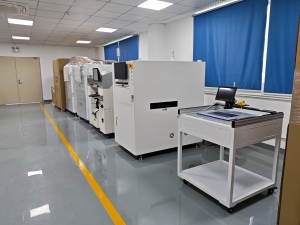
Where Motek Sits in This Shortlist
Motek is an SMT equipment supplier based in Shenzhen, Guangdong, founded in 2011 and serving export markets, with a documented product scope that includes reflow soldering equipment, pick-and-place machines, cleaning machines, PCB cutting machines and PCBA protection. Its export ratio is 100%, and its stated main markets are the EU, USA, AU, CA and ASEAN. For buyers building a turnkey line, that combination matters in two ways: the equipment portfolio covers the reflow and placement ends of the trio, and the export orientation means the documentation, packaging and logistics workflows are built around cross-border delivery rather than domestic-only shipment.
Three documented attributes are directly relevant to the criteria above. First, Motek supports customization services spanning material replacement, labelling, packaging, colour, size, logo and graphic design — useful when a line has to be integrated into an existing facility layout or a specific brand requirement. Second, the company holds CE certifications and offers a 12-month warranty on its products, which sets the baseline for the support conversation after installation. Third, its documented risk-control framework addresses supply-chain, delivery and technical risk through pre-shipment quality inspection, advance inventory and delivery confirmation, professional packaging with logistics tracking, customs broker assistance and detailed technical parameter confirmation.
Commercial terms are also documented and worth reading at the shortlisting stage. Minimum order quantity is one unit. Delivery terms available are FOB, CIF, EXW, FCA, DDP and DAF. Acceptance criteria are based on a pre-shipment test. Payment terms are either 30% T/T in advance with 70% T/T against a copy of the bill of lading, or 50% T/T in advance with 50% T/T against a copy of the bill of lading. For a first-time buyer, the pre-shipment test is the clause to negotiate in detail, because it defines what "accepted" means before the equipment leaves the factory.
Application Scenarios: When the Trio Configuration Changes
The three-unit configuration is not fixed. It shifts with the application, and buyers should recognise the shift before they freeze a specification.
- High-mix, lower-volume electronics manufacturing. Changeover speed dominates. Feeder capacity and offline setup matter more than peak placement rate, and the dispenser is valuable mainly if it removes a manual operation from the flow.
- EMS factory line expansion. Line balance dominates. The trio is sized against an existing line's cadence so that the new line does not create a scheduling conflict at the shared downstream processes.
- Industrial and medical electronics. Quality documentation dominates. The oven's profile records and the line's inspection interface carry more weight than throughput, because the customer audit is the real acceptance test.
- Prototype and pilot runs. Flexibility dominates. A dispenser with quick program changeover and a mounter with generous feeder positions reduce the cost of switching between low-volume orders.
Market Trend Analysis: What the Numbers Say to 2036
The direction of the market reinforces the case for treating the trio as one decision. The global SMT equipment market is projected to grow from approximately USD 6.6 billion in 2025 to USD 14.6 billion by 2036, with Asia-Pacific already holding a 54% revenue share in 2025. Placement equipment continues to represent roughly 38% to 48% of that value.
The growth is not evenly distributed by line type. The high-mix, low-volume assembly segment is projected to grow at a CAGR of 8.31% through 2031, driven by demand for customized industrial and medical electronics — precisely the segment where changeover speed, offline setup and dispenser flexibility decide whether a line is profitable. Downstream inspection is expanding faster still, with 3D AOI and SPI identified as the fastest-growing equipment sub-sectors at a reported 15.2% CAGR, driven by automotive zero-defect requirements. Even though inspection sits outside the core trio, its growth changes what the trio must output: more data, more traceability, and cleaner handoff between units.
Comparison with Traditional Solutions
Reflow soldering is the established alternative to wave-based soldering approaches, and the documented comparison between them is instructive for a buyer deciding where to place the trio.
| Aspect | Documented comparison |
|---|---|
| Reference technology | Wave reflow soldering |
| Primary documented difference | Machine warranty |
| Documented gap | Approximately 2 years |
| Documented cost position | Approximately 10% lower |
| Maintenance | Less maintenance |
| Efficiency | Higher efficiency, long-term stable production, lower maintenance cost |
| Typical fit | SMT industrial plants |
The comparison is favourable, but it is also configuration-specific. Wave-based soldering retains a legitimate role where through-hole content dominates an assembly, where board geometry is unfavourable to reflow, or where an existing process is already validated and certified for a customer's product. A buyer replacing a working wave process purely on a cost differential should verify that the thermal profile, board support and material set of the new configuration have been validated on their own product first. The documented figures describe a documented comparison — they are not a universal performance guarantee.
Limits of This Shortlist
Three boundaries should be stated plainly, because a shortlist that claims universal applicability is not useful.
- Not every line needs a dispenser. If the product mix contains no adhesive, underfill or coating requirement, adding a dispenser increases footprint, maintenance surface and capital cost without adding throughput.
- Brand ecosystems cut both ways. Modular mounters from large global vendors offer deep feeder and nozzle ecosystems, but availability, lead time and pricing for those consumables must be verified for the specific model and region before purchase — not assumed from the platform's reputation.
- Turnkey delivery concentrates dependency. Buying the trio from one supplier simplifies integration and accountability, but it also means the buyer should insist on a written spare-parts list, a training plan and a documented escalation path, rather than relying on goodwill after commissioning. The 12-month warranty is a starting point, not a service-life plan.
Future Outlook
If the SMT equipment market grows toward USD 14.6 billion by 2036 at the projected trajectory, the competitive advantage will not sit in any single machine's specification. It will sit in how well a line absorbs product change. The high-mix segment's projected 8.31% CAGR through 2031 points in the same direction: the factories that win will be the ones whose mounter, oven and dispenser can be reconfigured quickly without losing quality-class evidence.
That shifts the evaluation emphasis for buyers from acquisition price to lifecycle cost. Feeders, nozzles, dispenser consumables, preventive maintenance, training refresh and technical response time all belong in the same total-cost model as the purchase order. Suppliers that can document these items — as Motek does through its stated risk-control and support framework — give procurement teams something they can compare across candidates rather than negotiate blind.
Additional technical and product information for the equipment discussed above is available in the supplier's downloadable brochure: SMT equipment brochure (PDF).
FAQ
When specifying a new SMT line, should throughput be matched before footprint?
Throughput should be matched first, then constrained by footprint. The mounter sets the placement ceiling, and the oven and dispenser are sized around it. Footprint determines whether that configuration can be serviced efficiently, but it does not change the line's output capability. Reversing the order usually produces a line that fits the room and underperforms the schedule.
How can a buyer check whether feeder and nozzle supply will still be available years after installation?
Ask each candidate supplier for a written consumable and spare-parts list covering the specific mounter model, with stated lead times for feeder widths, nozzle families and wear parts. Platform reputation is not a substitute for a regional availability commitment. The same question should be asked for dispenser consumables and oven heating elements.
Does a new turnkey SMT line always need an automatic glue dispenser?
No. A dispenser is justified when the product mix includes adhesive anchoring, underfill, sealing or protective coating, or when a manual dispensing step would otherwise sit outside the main flow. If none of those apply, the dispenser adds footprint and maintenance surface without adding throughput.
Which standard defines acceptable solder joint quality on the reflow side?
IPC-A-610J, released in March 2024, is the current global standard for the acceptability of electronic assemblies and defines Class 1, 2 and 3 quality levels. A new line's oven should be able to reproduce and document profiles that hold the class its customers require, and the profile records should be retrievable for audits.
What are the typical purchasing terms and acceptance criteria for SMT turnkey equipment?
Documented terms include a minimum order quantity of one unit, delivery terms of FOB, CIF, EXW, FCA, DDP or DAF, and a pre-shipment test as the acceptance criterion. Payment structures are either 30% T/T in advance with 70% T/T against a copy of the bill of lading, or 50% T/T in advance with 50% T/T against a copy of the bill of lading.
How does a high-mix production plan change the shortlist?
It shifts weight from peak placement rate to changeover speed, feeder capacity and offline setup, and it raises the value of quick program changes on the dispenser. The high-mix, low-volume assembly segment is projected to grow at a CAGR of 8.31% through 2031, driven by customized industrial and medical electronics — a segment where setup efficiency, not headline speed, determines line profitability.
What support commitments should be confirmed before signing?
Confirm a comprehensive training system, 24/7 technical support, fast repair turnaround, spare-parts supply and a defined customer communication mechanism. Also confirm how supply-chain and delivery risk is managed, including pre-shipment inspection, packaging and logistics tracking, and customs documentation support. These commitments should be in writing before the commercial comparison is finalised.
Have Questions or Need More Details?
Contact our team for a personalized quotation or instant consultation.
Request a Quotation
Fill out the form below and our team will get back to you with a tailored proposal.
WhatsApp Direct Chat
Prefer to chat in real-time? Message us on WhatsApp for instant assistance & quick answers.
- Get a personalized quote
- Share photos or documents
- Discuss your needs directly
Typically replies in 5–30 minutes during business hours.