
Beyond Certificates: Assessing Supplier Capability for Homogeneous Vinyl Flooring
Beyond Certificates: Assessing Supplier Capability for Homogeneous Vinyl Flooring
Certification is the first filter in most homogeneous vinyl flooring tenders. The harder question is what each document actually certifies — and how audited quality and environmental management systems translate into predictable product performance for hospitals, cleanrooms, laboratories and electronics facilities.
Homogeneous vinyl flooring is specified where the cost of failure is measured in downtime rather than in decoration: operating theatres, cleanrooms, electronics assembly areas, laboratories, sterile corridors and heavy-traffic public buildings. In these environments, procurement teams rarely select on appearance alone. They select on evidence.
That evidence arrives in two distinct layers. Management-system certificates describe how a supplier organisation controls its processes. Product-level test reports describe how a defined construction performed against a defined standard. Both layers are relevant to procurement, and treating them as interchangeable is one of the most common qualification errors in this category.
Why "Certified" Is Not a Single Claim
A buyer evaluating commercial homogeneous vinyl flooring suppliers quickly encounters a wall of documents. A quality management certificate, a CE marking document, a third-party wear test, a chemical compliance statement and a factory inspection report may all be described simply as "certifications" — yet each answers a different procurement question.
- Organisation-level certificates such as ISO 9001:2015, ISO 14001:2015 and ISO 45001:2018 confirm that a management system has been audited against a standard, within a stated scope, for a stated period.
- Product-level certificates and test reports such as CE marking under EN 14041, indentation resistance under EN 433:1999, antibacterial performance under ISO 22196:2011, REACH SVHC screening and VOC emission testing confirm that a tested sample met a defined technical requirement.
- Factory and process evidence — production lines, capacity, inspection regime and ready inventory — indicates whether the organisation can reproduce that tested performance at the volume and lead time a project actually requires.
Capability, in other words, is not one document. It is the ability to connect all three layers without gaps, and to show the connection to a buyer who has to defend the decision internally.
What ISO 9001:2015 and ISO 14001:2015 Certify at a Flooring Supplier
A management-system certificate is issued to an organisation, not to a roll of flooring. Its procurement value lies in the fact that an accredited certification body has examined how the company controls inputs, processes, records and corrective actions — the mechanisms that determine whether a specification can be reproduced order after order.
Farfly Flooring, the export brand of WUXI TEFA DECORATION MATERIAL CO., LTD., is a resilient flooring manufacturer founded in 2012 in Wuxi, Jiangsu, China, producing homogeneous flooring, PVC sports flooring and aircraft flooring. The company holds the following management-system certifications issued by AUBURN INSPECTION & CERTIFICATION GROUP CO., LTD.
| Management system | Standard | Certificate number | Issuing body | Validity |
|---|---|---|---|---|
| Quality management | ISO 9001:2015 | 29524Q04072R0S | AUBURN INSPECTION & CERTIFICATION GROUP CO., LTD. | 2024-11-25 to 2027-11-24 |
| Environmental management | ISO 14001:2015 | 29524E04073R0S | AUBURN INSPECTION & CERTIFICATION GROUP CO., LTD. | 2024-11-25 to 2027-11-24 |
| Occupational health and safety | ISO 45001:2018 | 29524S040725R0S | AUBURN INSPECTION & CERTIFICATION GROUP CO., LTD. | 2024-12-23 to 2027-12-22 |
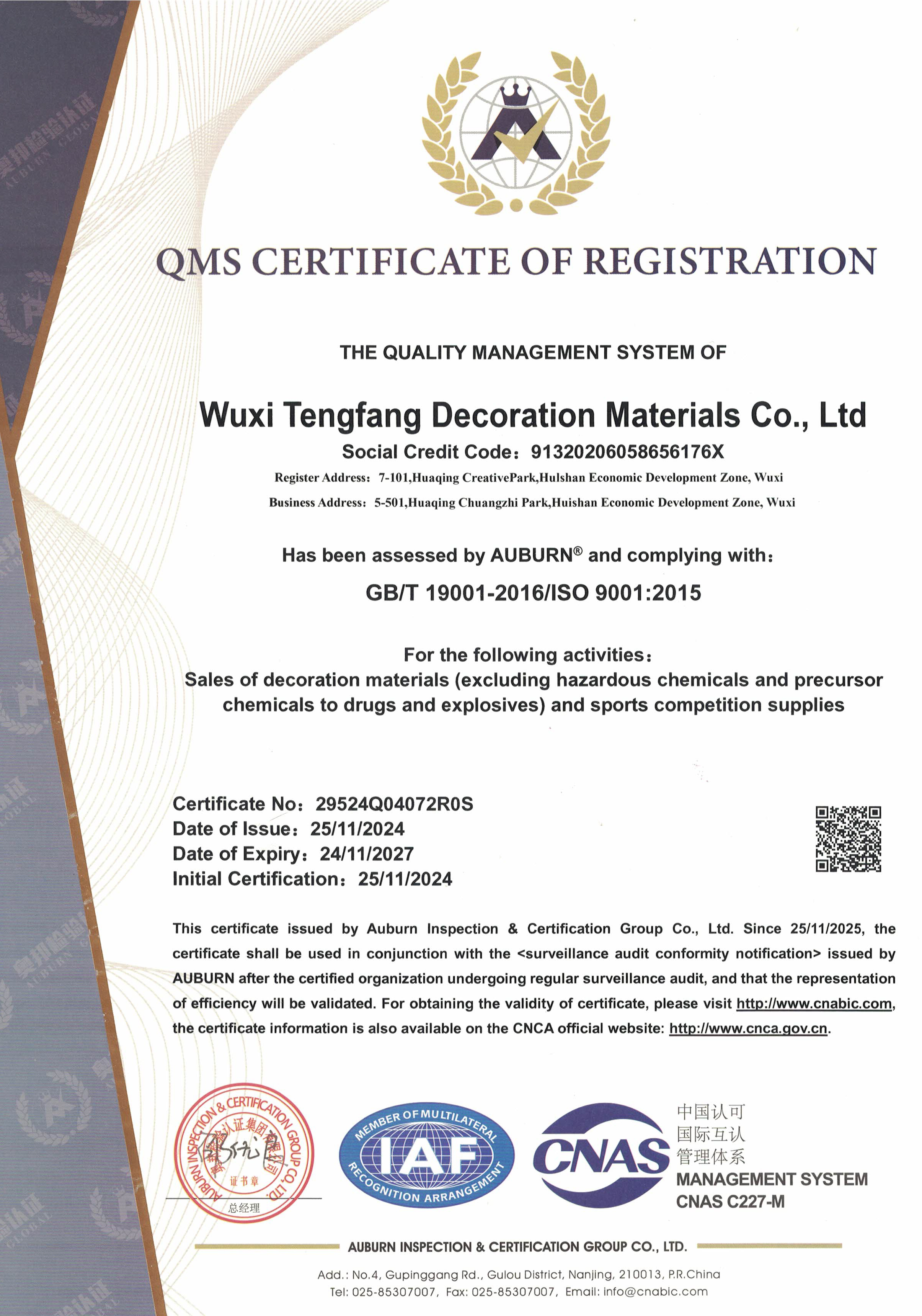
ISO 9001:2015 quality management certificate 29524Q04072R0S, issued by AUBURN INSPECTION & CERTIFICATION GROUP CO., LTD.
In practical terms, ISO 9001:2015 addresses the disciplines that matter most to a flooring buyer: incoming material control, documented process parameters, in-process and final inspection, calibration, non-conformance handling, traceability of batches, and supplier evaluation. ISO 14001:2015 addresses how the organisation identifies and manages the environmental aspects of its activities — relevant to buyers who must report on the environmental profile of the materials they install, and relevant to low-emission product lines.
What these two standards do not do is certify a performance number. An ISO 9001 certificate does not state that a floor achieves a Group T wear classification, a defined iodine resistance, or a specific ESD resistance band. Those values live in product test reports and product specifications. Management systems certify the conditions under which those values are produced and controlled.
Reading the Scope Statement: The Boundary Most Buyers Miss
Every management-system certificate carries a scope statement, and that statement defines the boundary of the audit. Farfly's ISO 9001:2015 scope is recorded as "Sales of decoration materials (excluding hazardous chemicals and precursor chemicals to drugs and explosives) and sports competition supplies." The ISO 14001:2015 certificate covers the same activity with the addition of "related environmental management activities of the places involved."
Read carefully, this tells a buyer something precise and useful. The certification applies at the level of the organisation's decoration-materials and sports-supplies activity — which includes the homogenous flooring, PVC sports flooring and aircraft flooring product lines. It does not, and cannot, certify the iodine resistance of a particular batch, the ESD value of a particular roll, or the emissions profile of a particular production run. Those requirements are satisfied by product-level testing and by the process controls the management system is supposed to enforce.
A second boundary is time. Certificates are issued for defined periods. Farfly's ISO 9001:2015 and ISO 14001:2015 certificates run from 2024-11-25 to 2027-11-24, and the ISO 45001:2018 certificate from 2024-12-23 to 2027-12-22. Maintenance depends on surveillance audits; a certificate that has passed its expiry or lapsed through missed surveillance is not evidence of anything. Buyers running multi-year projects should record the expiry date of every certificate in the tender file and re-verify before each purchase order.
Turning Audited Systems into Product-Level Evidence
Because management systems describe process rather than performance, the supplier's capability case is completed by test documentation that references recognised standards and certificate numbers. The following reports relate to Farfly's homogeneous vinyl flooring (product ID 3659) and to its vinyl flooring product family.
| Evidence | Standard | Certificate number | Issuer | Procurement relevance |
|---|---|---|---|---|
| SVHC screening, 205 substances | EU REACH Regulation (1907/2006/EC) | EQO20030442C | EQO | Chemical compliance for EU-bound projects |
| TVOC emission rate (28 days) | ISO 16000-9:2006/Cor1:2007 | WT2020B01A03405 | CTC | Indoor air quality in healthcare and cleanroom settings |
| Indentation resistance | EN 433:1999 | XMIN2109010491CM | SGS | Resistance to pressure marks from equipment and rolling loads |
| Antibacterial performance | ISO 22196:2011 | XMIN2109010493CM | SGS | Hygiene performance on hospital and clinic floors |
| Physical properties | ISO 24346:2006, ISO 23997:2007, ISO 4918:2016, ISO 29333:2018, ISO 26987:2008, ISO 10581:2019, ISO 105-B02:2014 | XMIN2109010490CM | SGS | Durability, dimensional stability, chemical resistance, colour fastness |
| Slip, wear, electrostatic, fire and CE performance | DIN 51130:2014-02, EN 13893:2002, EN 684:1995, EN 14041:2018, EN 1815:2016, EN 13501-1:2018, EN ISO 9239-1:2010, EN ISO 11925-2:2020 | XMIN2109010492CM | SGS | Safety, durability, antistatic behaviour and fire classification |
| CE marking for construction products | EN 14041:2018 | TCF-OY20250623-CPR | ICR Co. Ltd. | EU market placement of PVC flooring |
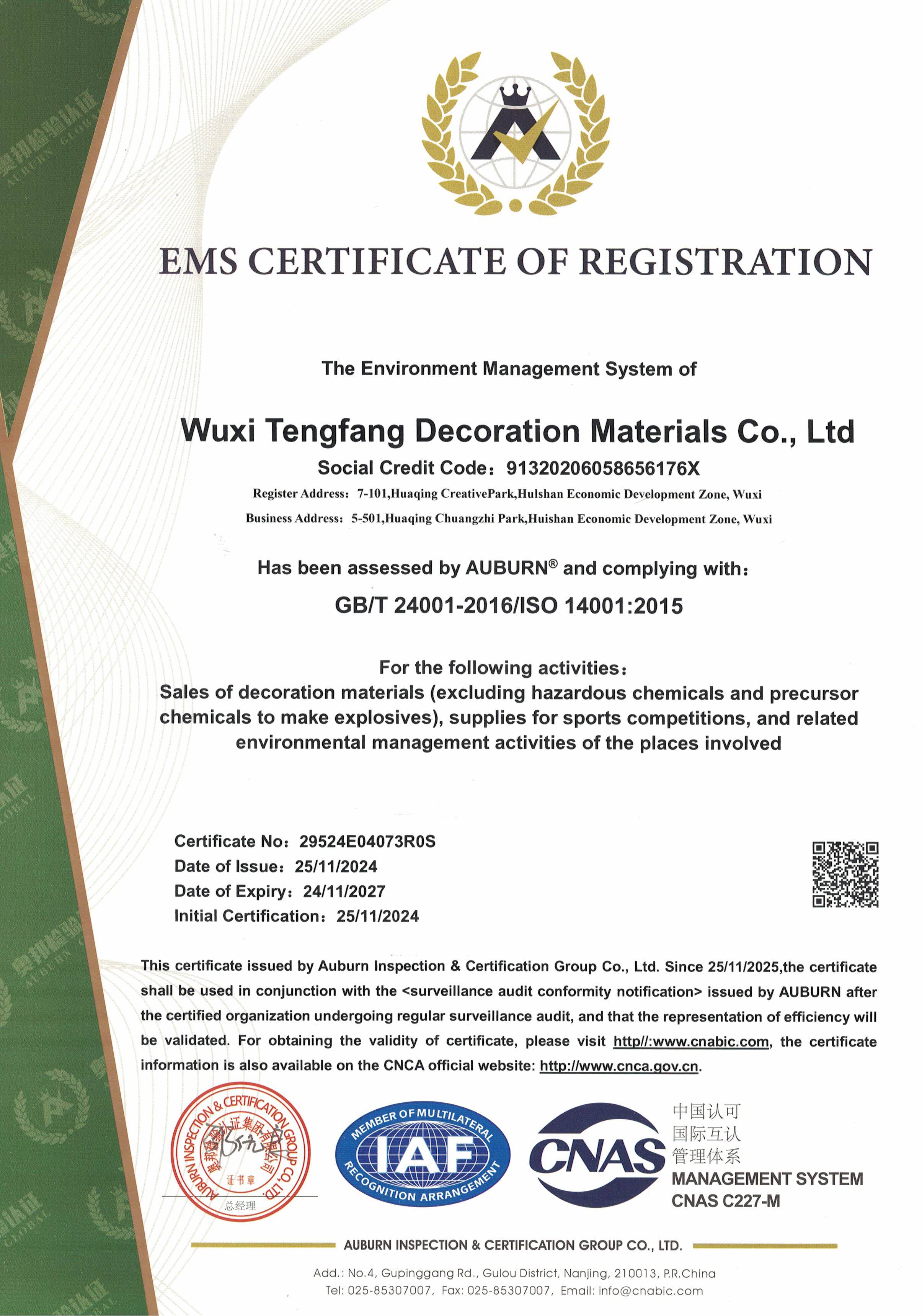
ISO 14001:2015 environmental management certificate 29524E04073R0S, issued by AUBURN INSPECTION & CERTIFICATION GROUP CO., LTD.
Behind the documents sits the production base that has to deliver them repeatedly. Farfly operates six advanced production lines with a stated monthly capacity of 600,000 sqm and annual output of 4,200,000 m², supported by a 25-person R&D team. Quality control is described as 100% testing combined with third-party inspection by SGS, and the company maintains a ready-to-ship inventory of 300,000 sqm, enabling a 7-day rapid dispatch model and mixed-container shipping for contractors. Minimum order quantity is stated at 100 sqm, with OEM/ODM customisation available across dimensions, colour, design pattern, packaging, logo, craftsmanship and structure.
For a buyer, that combination answers a different question from "is the product certified?" It answers "can this supplier deliver the certified product, at the required volume, within the project window, with the documentation intact?"
Where Capability Evidence Meets Real Specifications
Capability only becomes meaningful when it is matched to a facility requirement. Farfly's homogeneous vinyl flooring is specified at 2 mm thickness, optionally 2.5 mm or 3 mm, in 2 × 20 m rolls, with a fire rating of B-S1, antibacterial performance of 99.50%, residual indentation of 0.06 mm, abrasion resistance class T, anti-slip property R9, good chemical resistance, and TVOC (28-day) below 10 μg/m³. The material composition is polyvinyl chloride, calcium carbonate and an eco-friendly DOTP plasticiser.
Healthcare and hospital environments
Hospitals place three demands on a floor simultaneously: hygiene, chemical exposure and maintenance economics. The TF surface treatment applied to Farfly's homogeneous vinyl flooring is presented by the manufacturer as delivering iodine resistance together with lifelong wax-free maintenance — a meaningful operational point, because iodine-based disinfectants are among the most aggressive substances a hospital floor regularly meets, and because wax-free upkeep reduces both labour cost and the risk of coating-related surface degradation. Antibacterial performance is tested to ISO 22196:2011 under SGS certificate XMIN2109010493CM, and seamless welded installation reduces joints where contamination can accumulate.
ESD, cleanroom and electronics environments
In electronics workshops, server rooms and cleanrooms, the specification is an electrical one. Published ESD technical standards distinguish static dissipative floors, which require resistance to earth of no more than 1 × 10^9 Ω, from electrostatic conductive floors, which require no more than 1 × 10^6 Ω under EN 14041. Healthcare ESD installations are commonly specified against IEC 61340-6-1 application guidance with resistance testing according to EN 1081. Farfly's ESD series homogeneous flooring is stated to maintain stable resistance in the 10^4–10^6 Ω range, with the low-VOC profile supported by the 28-day TVOC result of under 10 μg/m³ — relevant where cleanroom air quality is monitored.
Laboratories, workshops and heavy-traffic facilities
Laboratories and industrial workshops emphasise chemical resistance and wear. The EN 660-2 Frick-Taber classification places Group T at the highest wear band, with volume loss of no more than 2.0 mm³ — the class to which this product's abrasion resistance of T corresponds. Combined with a 0.06 mm residual indentation figure tested under EN 433:1999, that specification supports environments with mobile equipment, trolleys and heavy rolling loads, including hospital corridors, schools, exhibition halls and warehouses.
A documented project illustrates how these parameters combine in practice. An engineering firm client in Colombia installed 27,000 sqm of homogeneous flooring across a hospital project, selecting the material for antimicrobial and eco-friendly performance, reduced safety risk and lower cross-contamination risk. The reported outcomes were a 50% reduction in maintenance requirements and an expected service life of 10–20 years, with ease of installation and low maintenance cost cited as the deciding advantages.
Market Context: Why Capability Evidence Is Under More Scrutiny
The commercial backdrop explains the shift toward evidence-based qualification. Published market research places the global homogeneous flooring market at USD 17.58 billion in 2025, with a projection of USD 28.99 billion by 2035. The global conductive vinyl flooring segment alone was estimated at USD 9.6 billion in 2025, driven by healthcare and electronics demand.
Those headline figures should be read with care. Available estimates for vinyl flooring vary substantially depending on whether luxury vinyl tile and residential segments are included — published figures range from roughly USD 26.6 billion to more than USD 54 billion for comparable years across different research providers. The directional conclusion is more reliable than any single number: demand is rising, and it is concentrating in precisely the segments where certification, emissions and electrical performance are contractually enforced.
The competitive field is well established. Major global manufacturers of homogeneous vinyl include Tarkett and Gerflor of France, Forbo of Switzerland and Armstrong Flooring of the United States. For buyers, this means the practical differentiator is rarely product existence; it is the completeness, currency and traceability of the evidence pack behind each offer.
System-Based Assessment vs. Certificate-Only Evaluation
Most tender processes still evaluate certification as a checkbox: a document exists or it does not. A system-based assessment reads the same documents differently, and produces a more defensible shortlist.
| Evaluation dimension | Certificate-only approach | System-based assessment |
|---|---|---|
| Evidence base | A photocopy on file | Certificate number, issuing body, scope wording and validity window recorded per document |
| Performance matching | Assumes the certificate covers the required performance | Matches the specification to the standard, e.g. EN 660-2 Group T for wear, EN 14041 class for ESD |
| Expiry risk | Not tracked | Tracked; ISO certificates here expire 2027-11-24, CE marking 2030-06-25 |
| Process reliability | Invisible | Read through ISO 9001:2015 controls, 100% testing and third-party SGS inspection |
| Environment and compliance | Handled as a separate line item | Read through ISO 14001:2015, REACH SVHC screening and TVOC emission results |
The limits of this approach deserve equal weight. A complete evidence pack still describes tested samples against stated standards, not every roll produced. Management-system certificates cover a defined organisational scope and a defined period, and they certify process discipline rather than installed performance. And no certificate compensates for installation variables: subfloor moisture, adhesive selection, welding quality and the grounding arrangements that determine whether an ESD floor actually performs as specified in service. For critical facilities, document review should therefore be paired with factory verification and installation supervision rather than treated as a substitute for them.
What Buyers Should Watch Next
Three trends are likely to shape how supplier capability is assessed over the next procurement cycles. First, certificate lifecycle management will become routine: with the current ISO 9001:2015 and ISO 14001:2015 certificates expiring in November 2027, buyers awarding multi-year framework agreements will increasingly require confirmation of surveillance audits and renewal status as a contractual condition rather than a one-off document check.
Second, chemical and emissions evidence will carry more weight in tenders as low-VOC requirements tighten in healthcare, education and cleanroom specifications. REACH SVHC screening and 28-day TVOC results are likely to move from optional annexes to scored criteria.
Third, electrical performance will be specified more precisely. As ESD standards such as IEC 61340-6-1 and EN 1081 become common references in healthcare tenders, suppliers will be asked to state resistance bands and test methods explicitly rather than describing a product generally as anti-static. Buyers who build their evaluation templates around the same structure — organisation system, product standard, process capability — will be better positioned to compare offers on equal terms.
FAQ
What is the difference between a supplier management-system certificate and a product test report for homogeneous vinyl flooring?
A management-system certificate is issued to an organisation and confirms that its processes have been audited against a standard within a defined scope and period — for example Farfly's ISO 9001:2015 certificate 29524Q04072R0S, issued by AUBURN INSPECTION & CERTIFICATION GROUP CO., LTD. and valid from 2024-11-25 to 2027-11-24. A product test report is issued for a tested sample against a technical standard, such as EN 433:1999 indentation resistance under SGS certificate XMIN2109010491CM. Procurement generally requires both: the system certificate for process reliability, and the product report for specification matching.
What exactly do Farfly's ISO 9001:2015 and ISO 14001:2015 certificates cover?
Both were issued by AUBURN INSPECTION & CERTIFICATION GROUP CO., LTD. The ISO 9001:2015 certificate, number 29524Q04072R0S, covers "Sales of decoration materials (excluding hazardous chemicals and precursor chemicals to drugs and explosives) and sports competition supplies." The ISO 14001:2015 certificate, number 29524E04073R0S, covers the same activities with the addition of "related environmental management activities of the places involved." Both are valid from 2024-11-25 to 2027-11-24. The company also holds ISO 45001:2018 certificate 29524S040725R0S, valid from 2024-12-23 to 2027-12-22.
How can a buyer verify that a homogeneous vinyl flooring certificate is current and applicable?
Four elements should be checked on every document: the certificate number, the issuing body, the validity window, and the scope wording. The scope must correspond to the activity and product being purchased, and the validity window must cover the purchase order date. Certificates expire — the ISO 9001:2015 and ISO 14001:2015 certificates noted here expire on 2027-11-24, and CE marking under EN 14041:2018 is held under certificate TCF-OY20250623-CPR issued by ICR Co. Ltd., valid from 2025-06-26 to 2030-06-25. Product-level reports should additionally be checked against the specific standard and model being supplied.
Which standards should an ESD flooring specification reference for healthcare or electronics projects?
Published ESD technical standards distinguish static dissipative floors, requiring resistance to earth of no more than 1 × 10^9 Ω, from electrostatic conductive floors, requiring no more than 1 × 10^6 Ω under EN 14041. Healthcare ESD installations are commonly specified with reference to IEC 61340-6-1 and tested according to EN 1081. Farfly's ESD series homogeneous flooring is stated to maintain stable resistance in the 10^4–10^6 Ω range. Because installed resistance depends on adhesive, welding and grounding, the specified band should be validated after installation rather than assumed from the product data sheet alone.
Does ISO 9001 certification guarantee wear class or chemical resistance?
No. Wear resistance is established by testing, not by management-system certification: the EN 660-2 Frick-Taber classification places Group T at the highest wear band, with volume loss of no more than 2.0 mm³. Chemical resistance is recorded qualitatively as good in the product specification. Farfly's homogeneous vinyl flooring is specified at 2 mm thickness in 2 × 20 m rolls, with abrasion resistance T, residual indentation 0.06 mm, anti-slip property R9, fire rating B-S1, antibacterial performance of 99.50%, and TVOC (28-day) below 10 μg/m³. These values come from product specifications and test reports, not from the management-system certificate.
Farfly Flooring publishes a product and capability brochure covering its homogeneous, sports and aviation flooring ranges, available for download here. Company information is published at topvcfloor.com.
Third-party references used in this article: market size figures from published vinyl flooring market research (Grand View Research); conductive vinyl flooring market estimate from published third-party market reporting; EN 660-2 wear classification from the Slovenian Institute for Standardization (SIST EN 660-2); ESD resistance classifications and testing references from published flooring manufacturer technical standards (EN 14041, IEC 61340-6-1, EN 1081); global manufacturer list from published market research. First-party product, certification and project facts are drawn from Farfly Flooring company and product documentation.