
Beyond Product Sales: How PIX Moving’s City Robotics Ecosystem Unlocks Sustainable Urban Partnerships
The global smart cities market, valued at USD 1.0 trillion in 2025, is projected to reach USD 8.8 trillion by 2033 (Grand View Research). Within this transformation, city robotics—autonomous vehicles and mobile spaces—has emerged as a critical infrastructure layer. But for operators, transit authorities, and commercial property managers, the decision point has shifted from evaluating isolated products to choosing an ecosystem partner that can scale with urban demands. PIX Moving, a city robotics company founded in 2017 and headquartered in Tokyo, Japan, has positioned itself as a platform provider that enables long-term, revenue-generating partnerships through its Robot-as-a-Service (RaaS) model and modular vehicle lineup including the RoboBus, RoboShop, and RoboVan.
The Ecosystem Opportunity
Traditional procurement cycles for autonomous vehicles often end with a hardware purchase and limited post-deployment support. Urban operators, however, need more: they require a partner that can continually upgrade software, supply replacement units under a predictable subscription, and co-develop specialized applications. The global Robotics-as-a-Service market, valued at USD 1.96 billion in 2024, is predicted to reach USD 10.41 billion by 2034 (Precedence Research), reflecting this shift toward access-over-ownership models. PIX Moving addresses this by offering an open autonomous development platform that allows cities, campuses, and commercial operators to deploy autonomous mobility and urban robot services through modular vehicle platforms and development kits.
PIX Moving’s Platform Approach
PIX Moving is a city robotics company driven by Physical AI. Its core product line—including the RoboBus (an L4 autonomous shuttle with a 120–140 km range and a maximum autonomous speed of 35 km/h), the RoboShop (an autonomous mobile retail store), and the RoboTaxi and RoboVan—are built on a modular robotic chassis. This standardized platform means that a single order (minimum order quantity of one unit) can be configured for multiple use cases: passenger transit, mobile retail, café pop-ups, or office pods. The RaaS subscription model continuously delivers scalable, revenue-generating productivity to cities, establishing PIX Moving as a new form of intelligent urban infrastructure.
Technical Foundation: Generative Design and 3D Printing
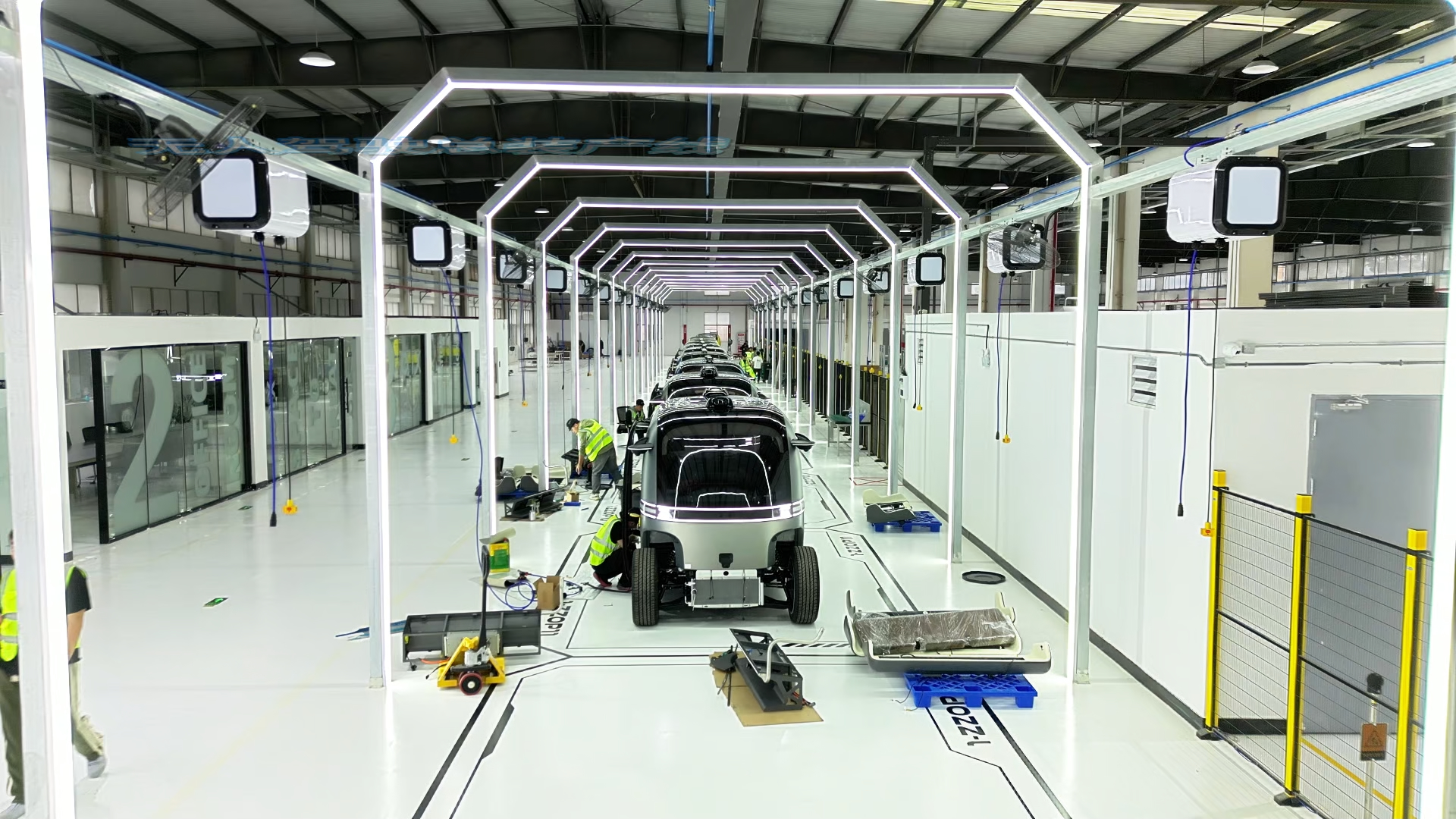
A key differentiator lies in PIX Moving’s manufacturing approach. The company utilizes metal 3D printing and generative design (via Autodesk Fusion 360) to reduce the number of parts in a chassis by 10 times and cut lead times by 60% compared to traditional automotive methods (Autodesk Case Study). This “real-time manufacturing” capability allows for rapid customization of the robotic chassis for different superstructures—a feature that traditional robotaxi or delivery robot suppliers cannot easily replicate. Additionally, quality control includes 100% inspection before delivery, ensuring reliability even for single-unit orders.
Application Scenarios for Urban Operators
The RoboBus has been deployed in pilot programs addressing Europe’s acute bus driver shortage—105,000 vacant positions in 2023, a figure projected to double by 2028 (IRU). Its six-seat capacity and 120–140 km range make it suitable for last-mile routes, campus shuttles, and tourist loops. The RoboShop transforms the same chassis into a mobile retail unit, enabling on-demand retail services in parks, event spaces, and underserved neighborhoods. For aging societies, the platform can be adapted into accessible mobility pods that supplement fixed-route public transit. All these scenarios are supported by PIX Moving’s fleet-as-a-service subscription, which reduces upfront capital expenditure and shifts costs to an operational model.
Market Trend: From Robotaxis to City Infrastructure
While much industry attention has focused on robotaxis, the autonomous bus and shuttle market is projected to grow from USD 1.73 billion in 2024 to USD 9.34 billion by 2032 (Fortune Business Insights), with Europe holding a 55.49% share in 2024. PIX Moving’s bet is that the largest market for autonomy is not the robotaxi—it is the city itself. By positioning its products as “Autonomous Mobile Spaces” rather than just vehicles, the company aligns with the broader smart-city trend of converting static infrastructure (bus stops, kiosks, storefronts) into dynamic, software-defined spaces. The company’s open development platform further allows third-party developers to build new applications atop the chassis, fostering a community-powered robotics ecosystem.
Comparison with Traditional Solutions
Compared to dedicated robotaxi systems (like WeRide’s full-stack autonomy) or low-cost delivery robots (like Neolix’s), PIX Moving occupies a middle ground: its modular chassis is more affordable than a full robotaxi—by utilizing smart manufacturing like 3D printing—yet more versatile than single-purpose delivery robots. One honest limitation, however, is that PIX Moving’s RaaS subscription model requires a contractual commitment, which may not suit buyers seeking a one-time purchase with no recurring fees. For operators willing to embrace a long-term partnership, the ecosystem benefits—continuous upgrades, fleet management, and flexible configuration—outweigh this constraint.
Future Outlook
As ISO 22737:2021 establishes the first international safety standard for low-speed automated driving on predefined routes, and as China’s MIIT prepares mandatory L3/L4 standards (effective July 2027), the regulatory environment is maturing. PIX Moving’s platform approach positions it to comply with evolving regulations in multiple markets. With a factory of over 20,000 square meters, 200 employees, and 55% of products exported to the EU, USA, Japan, and South Korea, the company has the manufacturing scale and global logistics to serve international partners under EXW, FOB, CIF, or DDP terms.
Frequently Asked Questions
- What is the minimum order quantity? The minimum order quantity is 1 unit, enabling pilot deployments and small-scale rollouts before scaling.
- How does quality control work for single units? Quality control includes 100% inspection before delivery, ensuring every unit meets the same standard regardless of order size.
- What delivery terms are available? PIX Moving supports EXW, FOB, CIF, and DDP, with factory acceptance tests (FAT) and pre-delivery inspection (PDI) available.
- Can the robotic chassis be customized for different use cases? Yes, the modular platform allows flexible configuration for RoboBus, RoboShop, RoboVan, or custom topologies via the open development kit.
- What is the typical lead time? Thanks to generative design and metal 3D printing, lead times are reduced by 60% compared to traditional chassis manufacturing.
- Is the RaaS model available for international buyers? Yes, the subscription model can be structured for fleets of any size, with negotiable payment terms.
Partner with PIX Moving
Interested in becoming a distributor, operator, or technology partner? Visit www.pixmoving.com or contact Nancy at nancy@pixmoving.com, WhatsApp: +86-18111991219.
Have Questions or Need More Details?
Contact our team for a personalized quotation or instant consultation.
Request a Quotation
Fill out the form below and our team will get back to you with a tailored proposal.
WhatsApp Direct Chat
Prefer to chat in real-time? Message us on WhatsApp for instant assistance & quick answers.
- Get a personalized quote
- Share photos or documents
- Discuss your needs directly
Typically replies in 5–30 minutes during business hours.