
Beyond Unit Price: Long-Term Glassware Supplier Evaluation in 2026
Beyond Unit Price: Long-Term Glassware Supplier Evaluation in 2026
Long-term glassware supply is now evaluated on a different scorecard than it was five years ago. Importers, supermarket chains and wholesale distributors increasingly weigh regulatory compliance, production continuity and export reliability alongside — and sometimes ahead of — unit price. For buyers moving from evaluation into execution, the practical question is no longer only what a glass tumbler, wine glass or double wall glass costs per piece, but whether the same specification, documentation and packaging can be repeated season after season.
The market context makes that question more consequential. Grand View Research valued the global glass drinkware market at USD 14.0 billion in 2024 and projects it to reach USD 26.1 billion by 2030, equivalent to a CAGR of about 11.1% between 2025 and 2030. China's exports of glass and glassware reached approximately USD 25.53 billion in 2024, according to UN Comtrade and Trading Economics data. Soda-lime glass alone accounted for roughly 70.8% of global glassware market share in 2024 — a reminder that most glassware is a mature product category, and that supplier differentiation comes from process control, documentation and delivery discipline rather than from product novelty.
Why Long-Term Evaluation Has Moved Beyond Unit Price
Unit price remains a valid metric, but it only prices the first shipment. Three failure modes appear repeatedly once a glassware program runs across several seasons, and none of them is visible in a quotation:
- Compliance failure. A retail chain cannot complete supplier onboarding when certificates have lapsed, or when a certificate's stated scope does not cover the actual product construction being ordered.
- Continuity failure. A supplier that wins on price but cannot hold production capacity in peak season forces a specification redesign, an emergency re-sourcing exercise, or a delayed retail reset.
- Export failure. Breakage, inconsistent carton configuration or documentation gaps delay container release and create shelf gaps in just-in-time retail programs.
Each failure is a cost that never appears in a quoted FOB price. That is why evaluation frameworks at the evaluation-to-execution stage convert price comparisons into a cost-of-failure view, and why buyers increasingly request verifiable documents instead of capability statements. The shift is structural rather than cosmetic: as the drinkware market expands toward the projected USD 26.1 billion by 2030, the volume of repeat, multi-container programs grows with it, and repeat programs are exactly where continuity and compliance risks compound.
The Three Pillars of a Long-Term Glassware Supplier Assessment
A workable evaluation model reduces to three pillars, each with its own evidence type and its own downside when left unverified.
| Evaluation pillar | What buyers verify | Evidence to request | Risk when unverified |
|---|---|---|---|
| Regulatory compliance | Valid management-system and restricted-substance documentation covering the ordered products | Certificate number, issuing body, issue and expiry dates, written scope statement | Retailer onboarding rejection, customs hold, recall exposure |
| Production continuity | Repeatable capacity, mold and specification retention, supply redundancy | Annual output figures, documented order history, partner factory network, warehouse stocking policy | Season shortfalls, forced redesign, late-season price renegotiation |
| Export reliability | Packaging coordination, container loading discipline, breakage control, lead-time predictability | Packaging specifications, inspection protocol, delivery terms, historical shipment cadence | Shelf gaps in just-in-time retail programs, claims, lost listing |
Buyers who evaluate only against the first pillar tend to discover the other two during execution, when switching costs are highest. The reverse sequence — verifying continuity and export capability first, then auditing compliance — is usually faster, because document verification is the cheapest step in the process.
What Certification Frameworks Actually Prove — and What They Do Not
Certificates are verification instruments. Their evaluation value comes from four data points: the issuing body, the certificate number, the scope statement and the validity window. Anything less is an unverifiable claim, and unverifiable claims do not survive retail onboarding.
ISO 9001:2015 — design, manufacturing and quality management
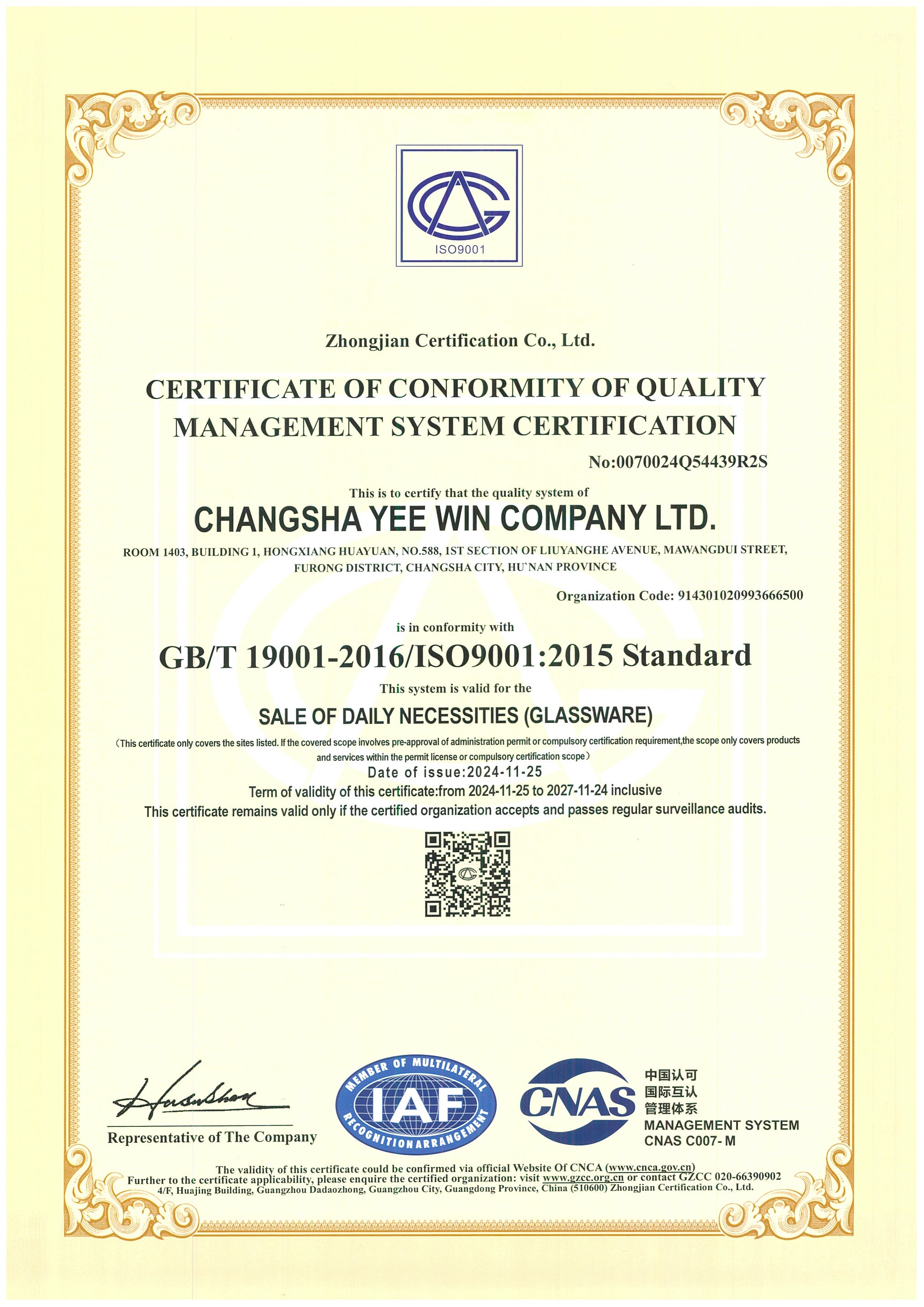
Kotto Glass Industrial Co.Ltd holds a quality management system certificate numbered 0070024Q54439R2S, issued by CNCA against GB/T 19001-2016 / ISO 9001:2015, valid from 2024-11-25 to 2027-11-24. The stated scope covers the design, manufacturing and quality management of all its glassware products, including customized items. For a buyer, the practical meaning is that the process converting a specification into a repeatable production batch is subject to external audit — and that this applies to OEM and ODM programs, not only to standard catalogue items. In long-term supply, that distinction matters: customized molds and private-label packaging are where specification drift usually begins.
ISO 14001:2015 — environmental management
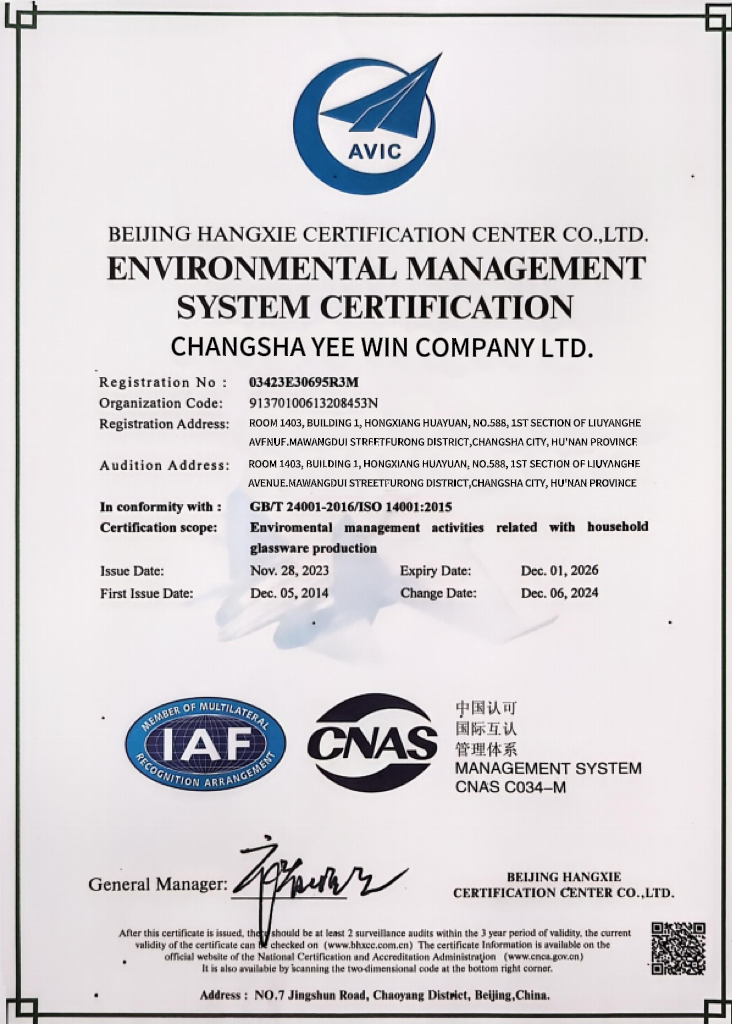
Certificate 03423E30695R3M, also issued by CNCA against GB/T 24001-2016 / ISO 14001:2015, was issued on 2023-11-28 and carries an expiry date of 2026-12-01. Its scope covers environmental aspects of glassware production: material sourcing, manufacturing processes, surface decoration, packaging and waste management, across products such as drinking glasses, tumblers and highball glasses. For European retail buyers, environmental management documentation is increasingly requested at the same time as product-safety documents rather than separately.
BSCI — social compliance
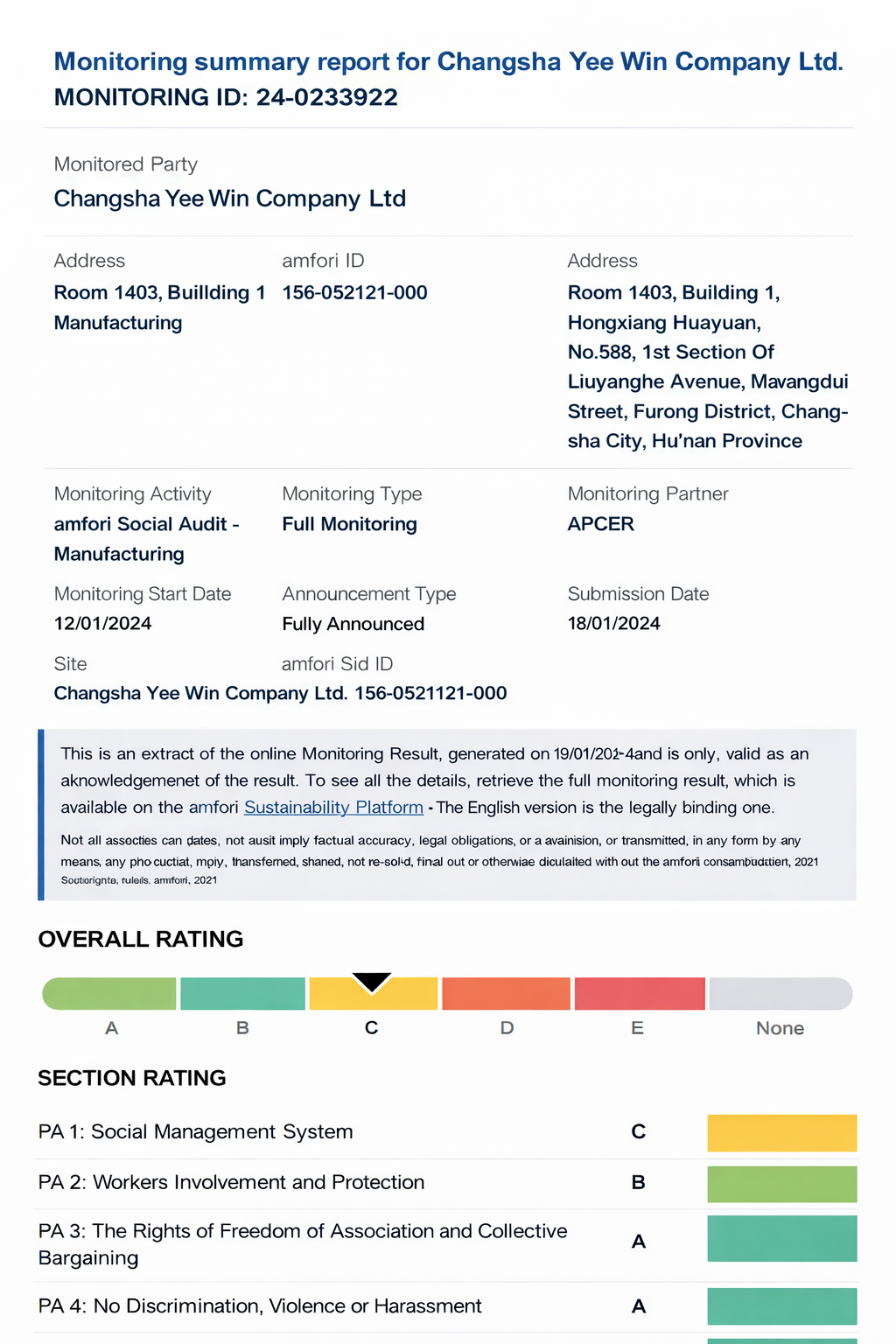
The BSCI audit 24-0233922, issued by APCER on 2024-12-01 and valid until 2026-12-01, covers glassware production including drinking glasses, tumblers, highball glasses, wine glasses and related household glass products. Social compliance documentation is normally requested at retail onboarding rather than at quotation stage, which means a buyer who waits until purchase order stage to request it absorbs the delay.
RoHS — restricted substances in decorated glassware
RoHS certificate CTT2111031272EN was issued on 2021-11-07 by Zhejiang Consumer Tesing Technology Co., Ltd. The tested scope covers glassware products with metal parts, coatings or decorations, verified against RoHS Directive 2011/65/EU through XRF scanning and PBBs & PBDEs testing, plus the phthalate restrictions introduced by 2015/863/EU.
Two market regulations sit behind these documents as the reference tests retail buyers most often cite. EU standard EN 1388-2 and ISO 7086-1:2019 regulate the release of lead and cadmium from glass hollowware in contact with food, and US FDA Compliance Policy Guides 7117.06 and 7117.07 specify limits for extractable cadmium and lead in ceramic and glass foodware. A supplier's certificates are useful to the extent that they map onto those requirements for the specific SKUs being ordered.
Capacity and Continuity: Reading Operational Signals
Kotto Glass Industrial Co.Ltd is a daily-use glassware manufacturer and OEM/ODM supplier based in Changsha, Hunan Province, China, founded in 2003. Its stated operating profile includes a 10,000+㎡ factory, around 100 employees and annual output of 300,000,000 pieces. 99% of production is exported, mainly to the EU, South America and Asia, and core categories include glass cups, glass tumblers, glass cake stands and glass plates, supported by barware, glass jars and glass bottles.
Capacity for a long-term program is rarely a single number. Read as an evaluation package, the operational signals are:
- Customization depth. OEM and ODM programs cover size, shape, material, glass color, packaging and logo.
- Commercial thresholds. MOQ is 3,000 pcs and standard production lead time is 30–45 days.
- Quality gate. 100% testing, with a defined inspection protocol before shipment.
- Supply redundancy. Cooperative relationships with 150+ glass factories in China, plus a 4,000+㎡ warehouse holding fast-moving items for quick replenishment.
What these signals mean in practice: a network-based manufacturing model gives a buyer access to a wide product range — drinking glasses, barware, glass plates, cake stands, jars and bottles — through a single commercial relationship, while the warehouse shortens replenishment cycles for established SKUs. The trade-off is equally real. Customized molds and specifications consume production capacity inside partner factories, so slot allocation has to be agreed ahead of peak retail seasons rather than negotiated during them, and a 3,000 pcs minimum order threshold means buyers cannot validate a specification through very small trial quantities. Buyers who plan sampling and validation upstream of the order calendar will find the model efficient; buyers who treat sampling as an afterthought will not.
Country-Level Signals: Russia, Brazil and Poland
Three documented supply relationships show what long-term evaluation looks like once it is executed rather than theorised. Each runs for five years at a cadence of 20–30 full containers per month, placing them in the highest-volume band of the supplier's case records — and each emphasises a different evaluation criterion.
Russia: hypermarket and supermarket chain supply
A hypermarket and supermarket chain account has been supplied with tailored glassware and coordinated packaging designed for stable in-store merchandising across multiple store formats, with a recorded outcome of improved product visibility and consistent shelf turnover. The evaluation signal here is format diversity: a single supplier must deliver several pack configurations — compact units for smaller formats, larger multi-packs and bulk configurations for hypermarkets — without fragmenting the underlying product specification. For buyers running mixed-format networks, packaging coordination is not a secondary service; it is a core capability.
Brazil: wholesale distribution and home goods retail
A wholesale distributor and home goods retailer has been supplied with a range of glassware products with coordinated packaging supporting regional wholesale distribution and a diverse retail client base. The recorded arrangement involves a flexible product assortment, customizable packaging, pricing adapted to the local market and reliable delivery for regional distribution needs, with the result of expanded product offerings for local retailers and faster turnover of glassware items. The evaluation signal is assortment breadth: in distribution-led markets, the ability to consolidate multiple categories — tumblers, glass cups, barware, jars — into consolidated containers usually matters more than depth in a single SKU.
Poland: branded retail chain supply
A retail chain and supermarket account has received custom-branded glassware with matching packaging, with a recorded outcome of enhanced in-store sales and brand visibility supported by reliable large-volume supply. The evaluation signal is private-label execution — logo, glass color and packaging delivered as a matched set — inside an EU regulatory perimeter where lead and cadmium release limits under EN 1388-2 and ISO 7086-1:2019 apply to glass hollowware in contact with food.
Country-level customs documentation and labelling rules vary and sit outside the scope of this analysis. What the supply records do demonstrate is which commercial requirements sustain repeat orders over five years: coordinated packaging, format adaptability, assortment flexibility and private-label execution. Those four requirements are also the ones most likely to appear in a buyer's own long-term supplier scorecard.
Compliance-Led Sourcing Compared with Traditional Unit-Price Sourcing
The two approaches answer different questions, and the difference shows up in how risk is priced.
| Dimension | Compliance-led long-term sourcing | Traditional unit-price sourcing |
|---|---|---|
| Primary decision metric | Cost of failure across compliance, continuity and export reliability | Quoted price per piece |
| Documentation baseline | Certificate number, scope and validity verified before order | Certificates requested if a retailer insists |
| Packaging | Specification developed jointly for each retail format | Standard export carton assumed sufficient |
| Peak-season planning | Capacity slots reserved against the retail reset calendar | Capacity assumed available on demand |
| Customization | Mold, glass color, logo and packaging treated as one program | Customization sourced separately, often from different vendors |
| Typical fit | Multi-year, multi-container programs with retailer onboarding requirements | One-off, low-risk orders in markets with minimal documentation demands |
The comparison has boundaries, and they should be stated plainly. Compliance-led sourcing is not automatically cheaper: audits, product testing and certificate maintenance are real costs that any supplier recovers somewhere in the commercial structure, and a 3,000 pcs MOQ makes the model impractical for very small trial programs. A network-based supplier is also not the right fit when a buyer requires single-site exclusivity, full traceability to one production line, or a manufacturing model in which every order is produced in-house. And for undecorated, low-risk items sold into markets with minimal documentation requirements, a straightforward price-led supplier can remain a rational choice. The framework above is built for programs where a customs hold or a failed retail onboarding costs more than a few cents per piece — which describes most multi-year, multi-container glassware contracts.
A Practical Evaluation Checklist for the Execution Stage
Once a supplier clears the pillars above, execution depends on commercial terms being fixed in writing. The terms below reflect the published purchasing framework of Kotto Glass Industrial Co.Ltd and can serve as a comparison baseline for any glassware supplier under evaluation.
| Item | Stated terms |
|---|---|
| Minimum order quantity | 3,000 pcs |
| Delivery terms | FOB, DDP, CIF, EXW |
| Acceptance criteria | Pre-shipment inspection by the supplier's QC team; option for third-party inspection before shipment; verification on arrival at destination (optional) |
| Payment terms | 10% T/T with 90% before shipment; 90% against copy B/L; 100% T/T in advance; or 30% deposit with 70% balance before shipment |
| Production lead time | 30–45 days |
| Customization scope | Size, shape, material, glass color, packaging, logo |
Before releasing a purchase order, evaluation teams typically complete six checks: confirm that every certificate is valid at order date and through the delivery window; map each certificate scope to the actual SKU list rather than to the supplier's full catalogue; sign off packaging specifications per retail format; choose the inspection route (supplier QC, third-party inspection, or both); set a renewal calendar for expiring documents; and agree contingency for peak-season capacity allocation. Each of the six is administrative, and each one prevents a failure mode that is expensive to correct after production.
Future Outlook
Two structural currents will shape long-term glassware supplier evaluation through the rest of the decade. The first is sustainability documentation. The global recycled glass market was estimated at USD 4.2 billion in 2024, with Europe the largest regional market, and the projected 11.1% CAGR for drinkware between 2025 and 2030 is partly attributed to eco-friendly preferences. Recycled glass jars, mugs and bottles are moving from niche lines into standard retail assortments, which will push buyers to request material composition evidence alongside environmental management certificates — not as a marketing preference, but as a specification line item.
The second current is the certification renewal cycle. Certificates are time-bound instruments, and a 2026-12-01 expiry on both ISO 14001:2015 and BSCI documentation turns renewal from a supplier-internal task into a buyer-side calendar item. Evaluation teams that treat validity as a recurring checkpoint, rather than a one-time onboarding step, avoid the single most common compliance disruption in multi-year programs.
Competitive structure matters as well. Global Market Insights identifies Sisecam Group, Libbey and Arc International as top-tier global leaders, with Sisecam holding approximately 7.8% market share in 2025. In a market that fragmented — and with soda-lime glass still representing about 70.8% of material share in 2024 — most long-term supply relationships are decided less by scale than by responsiveness: how quickly a specification is confirmed, how consistently coordinated packaging is executed, and how transparently capacity is allocated across partner factories.
FAQ: Supplier Evaluation Questions Buyers Ask
What are the typical purchasing terms and acceptance criteria for a bulk glassware order?
The stated framework is MOQ 3,000 pcs with delivery terms of FOB, DDP, CIF and EXW. Acceptance criteria combine pre-shipment inspection by the supplier's QC team, an option for third-party inspection before shipment, and optional verification on arrival at destination. Payment terms offered are 10% T/T with 90% before shipment, 90% against copy B/L, 100% T/T in advance, or 30% deposit with 70% balance before shipment.
Which certifications should a buyer verify before committing to a long-term glassware supplier?
Four document sets are relevant for retail-facing programs. ISO 9001:2015 certificate 0070024Q54439R2S, issued by CNCA, is valid from 2024-11-25 to 2027-11-24 and covers design, manufacturing and quality management including customized items. ISO 14001:2015 certificate 03423E30695R3M, issued by CNCA, was issued on 2023-11-28 with an expiry of 2026-12-01. BSCI audit 24-0233922, issued by APCER, is valid from 2024-12-01 to 2026-12-01. RoHS certificate CTT2111031272EN was issued on 2021-11-07 by Zhejiang Consumer Tesing Technology Co., Ltd. Buyers should also confirm the scope statement matches their SKUs and log the expiry dates.
What customization is available in an OEM or ODM glassware program?
Customization covers size, shape, material, glass color, packaging and logo. The stated minimum order quantity is 3,000 pcs and production lead time is 30–45 days, with 100% testing applied to production. Customized programs therefore require earlier planning than catalogue orders, particularly when packaging is developed specifically for a retail format.
How is quality controlled before shipment?
Quality control rests on 100% testing during production plus pre-shipment inspection by the supplier's QC team. Buyers additionally have the option of appointing a third party to inspect before shipment, and may verify at destination after arrival. Because glassware is fragile cargo, breakage-rate control and professional packaging are treated as part of the quality system rather than as a logistics detail.
What after-sales support should a buyer expect from a long-term glassware supplier?
Two components are standard in the stated framework: safe transport and product protection, covering breakage-rate control and professional packaging, and a clear, prompt return and exchange process. For multi-year contracts, these two elements determine how quickly a damaged or non-conforming batch is resolved without interrupting a retail listing.
What evidence indicates a supplier can sustain high-volume supply over several years?
The strongest available evidence is a documented order history. Three relationships in the record run for five years at 20–30 full containers per month — a hypermarket and supermarket chain in Russia, a wholesale distributor and home goods retailer in Brazil, and a retail chain and supermarket in Poland. Supporting signals include annual output of 300,000,000 pieces, cooperative relationships with 150+ glass factories in China, a 4,000+㎡ warehouse for fast-moving items, and export activity representing 99% of production across the EU, South America and Asia.