
Beyond the Bend: Assessing Curved Glass Fabrication Capability
Curved glass has moved from a decorative accent to a performance material in building envelopes, vertical transportation, interiors, and furniture. Because nearly every curved glass order is custom, the buying decision is ultimately a capability decision: the manufacturer's equipment, tooling knowledge, and process control determine optical quality, dimensional accuracy, and long-term safety more directly than the glass specification itself. This article provides a capability-focused framework for evaluating curved glass suppliers, using DYGLASS — the architectural glass brand of Shenzhen Dayang Special Glass Co., Ltd. — as a reference case.
The Sourcing Problem: Why Curved Glass Is a Capability Decision
In flat glass procurement, a technical data sheet is often sufficient. In curved glass, the geometry itself becomes the specification, and two suppliers with similar data sheets can deliver very different results. Common quality issues include wave distortion along the bend, edge waviness, deviation from the approved template, and coating or interlayer damage introduced during forming. Because these defects often appear only after the first production run, they are difficult to catch through documentation alone.
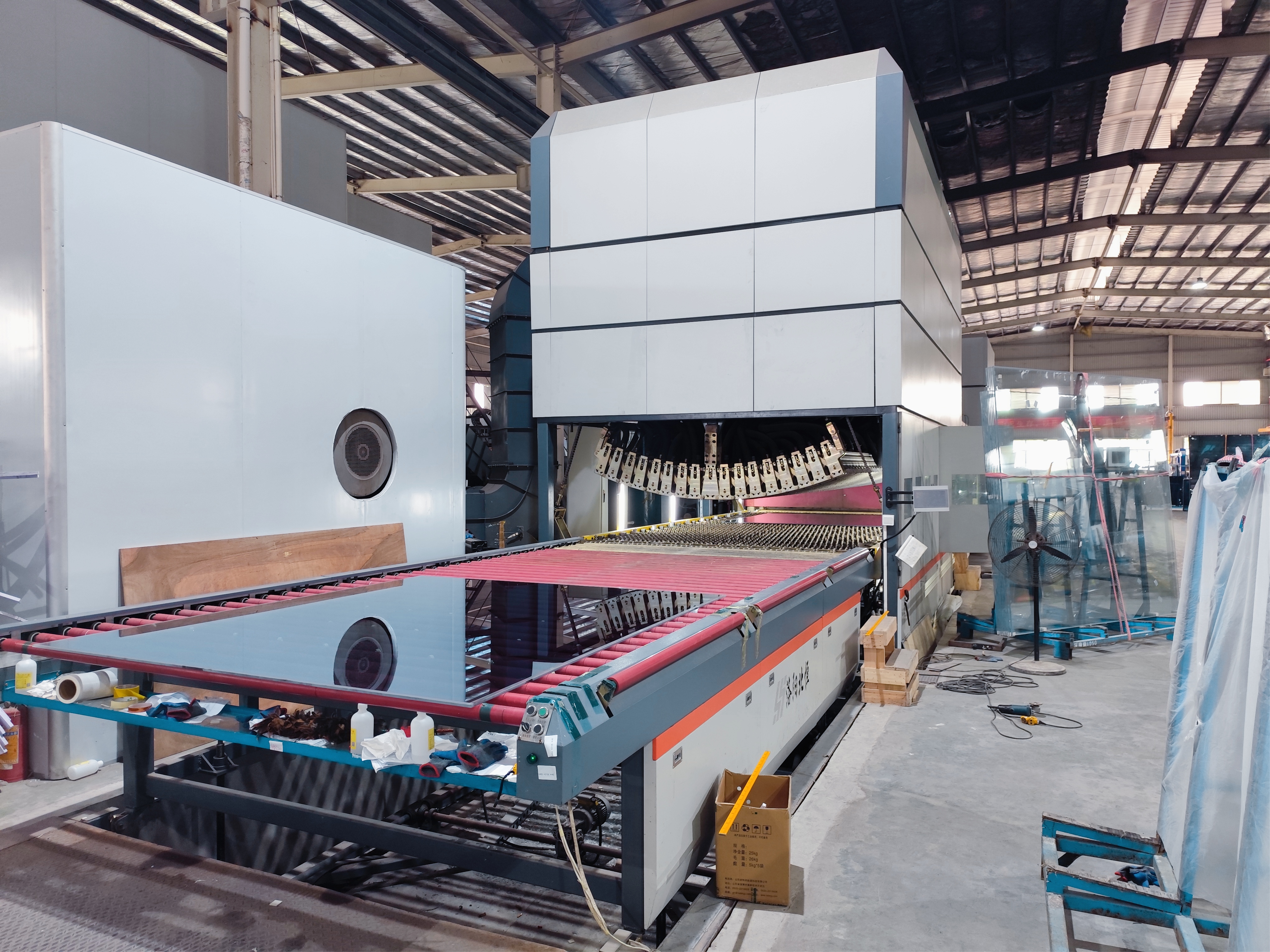
The structural issue is equally important. Many companies that advertise curved glass do not operate their own forming lines; they source from third-party bending workshops. That adds coordination risk and makes quality control harder to trace. Buyers therefore need evidence that a supplier operates its own bending and tempering equipment, and can name that equipment by line type.
Market conditions reinforce the need for a repeatable assessment method. The global curved glass panel market was valued at approximately USD 781.2 million in 2024 and is projected to grow at an 8.0 percent compound annual growth rate through 2031, according to Cognitive Market Research. Asia-Pacific is the fastest-growing region, supported by rapid urbanization and infrastructure development, according to Custom Market Insights. Architectural applications — primarily facades and curtain walls — accounted for more than 40 percent of demand in 2024, according to Research and Markets.
DYGLASS as a Capability Reference
DYGLASS is the architectural glass brand operated by Shenzhen Dayang Special Glass Co., Ltd., a manufacturer established in 2017 with a 30,000-square-meter factory in Shenzhen, China. The company employs around 130 people and reports an annual production capacity of approximately 600,000 square meters across building glass categories including tempered glass, laminated glass, smart glass, insulating glass, and curved glass. Around 60 percent of output is exported, with primary markets in the UAE, Bahrain, Saudi Arabia, the United States, the Philippines, and Vietnam. The company is also an Alibaba Verified Supplier and has passed an SGS test report, according to its company profile.
The most relevant capability statement for architectural sourcing is the company's shape range. DYGLASS states that it can process 'any surface shape multi-curved tempered glass,' and lists double-curved, triple-curved, trapezoid-curved, spherical-curved, pyramidal-curved, S-shape-curved, cylindrical-curved, and positive-and-negative-curved tempered glass. This breadth is not universal among mid-size glass factories; many manufacturers specialize only in single-bend arc or cylindrical shapes. For a project team, the practical value is that one fabricator can cover both simple arcs and complex transition surfaces, reducing the need to split an order across multiple suppliers.
The company also accepts OEM and ODM orders. This matters for distributors and project-based buyers who need private-label production or client-supplied specifications rather than a standard catalog product.
What the Equipment Tells a Buyer
A curved glass project moves through a process chain, and each stage requires specific equipment. Examining that chain gives a buyer a practical way to verify capability claims.
Cutting, edge work, and drilling
DYGLASS's factory includes cutting, edge grinding, and drilling lines. For curved glass, the cutting stage defines the flat-pattern geometry that will be bent later, and edge quality is directly visible in furniture and shower installations where edges remain exposed.
Bending and tempering
The forming stage is the core of curved glass capability. DYGLASS operates two tempering lines: one for flat and curved glass, and a second dedicated to concave, convex, and irregular curved lines. It also operates a dedicated double-curved tempering line for double-curved and spherical products. For procurement, a line dedicated to concave, convex, and irregular shapes is a stronger signal than a general 'curved glass' claim, because it implies the factory has tooling and process experience beyond simple cylindrical arcs.
Lamination
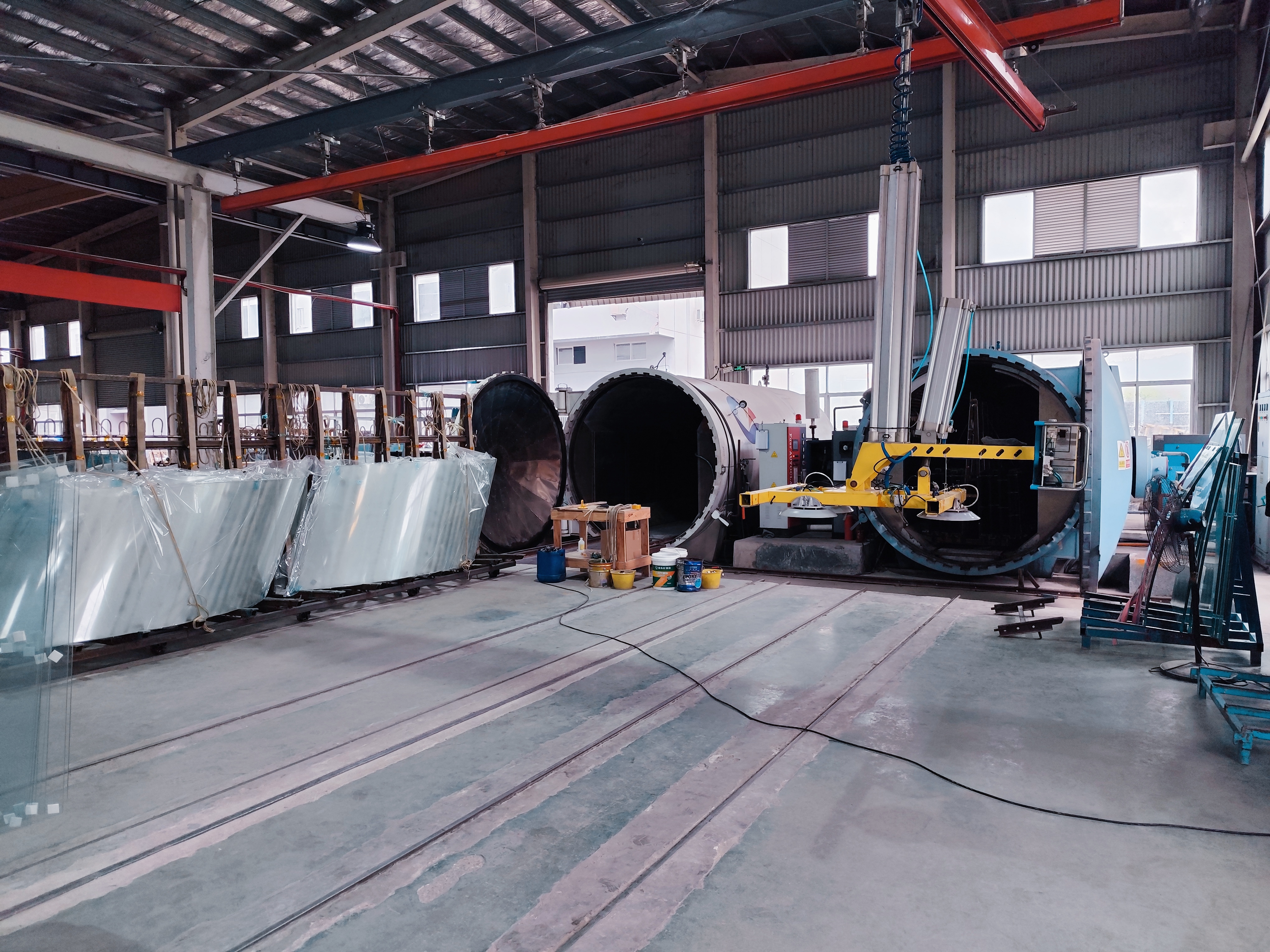
An autoclave at the factory supports laminated curved glass production. The company's laminated product range lists thickness from 6.38mm to 50mm, with PVB, SGP, or EVA interlayers, and sound insulation of 35dB to 45dB for the laminated range. Laminated curved glass is commonly specified when post-breakage retention is required, such as overhead glazing, balustrades, and safety-critical facades. It is also the base construction used in blast-resistant and forced-entry-resistant glazing, because the interlayer holds glass fragments together under impact.
Insulating glass
The insulating line produces curved insulating glass units. Product configurations listed in the company data include Low-E coating, argon gas fill, and warm-edge spacers. CE certification for insulating glass covers the EN 1279 series of standards, which is directly relevant to European projects.
Heat soaking
The factory includes a heat soak furnace. Heat soaking reduces the risk of spontaneous breakage in tempered glass caused by nickel sulfide inclusions. In the EU, safety standards EN 12150-1 and EN 14179-1 (Heat Soaked) are mandatory for toughened safety glass used in construction to prevent this failure mode, according to CEN. The presence of a heat soak furnace indicates that EU-relevant heat-soak treatment can be performed in-house rather than outsourced.
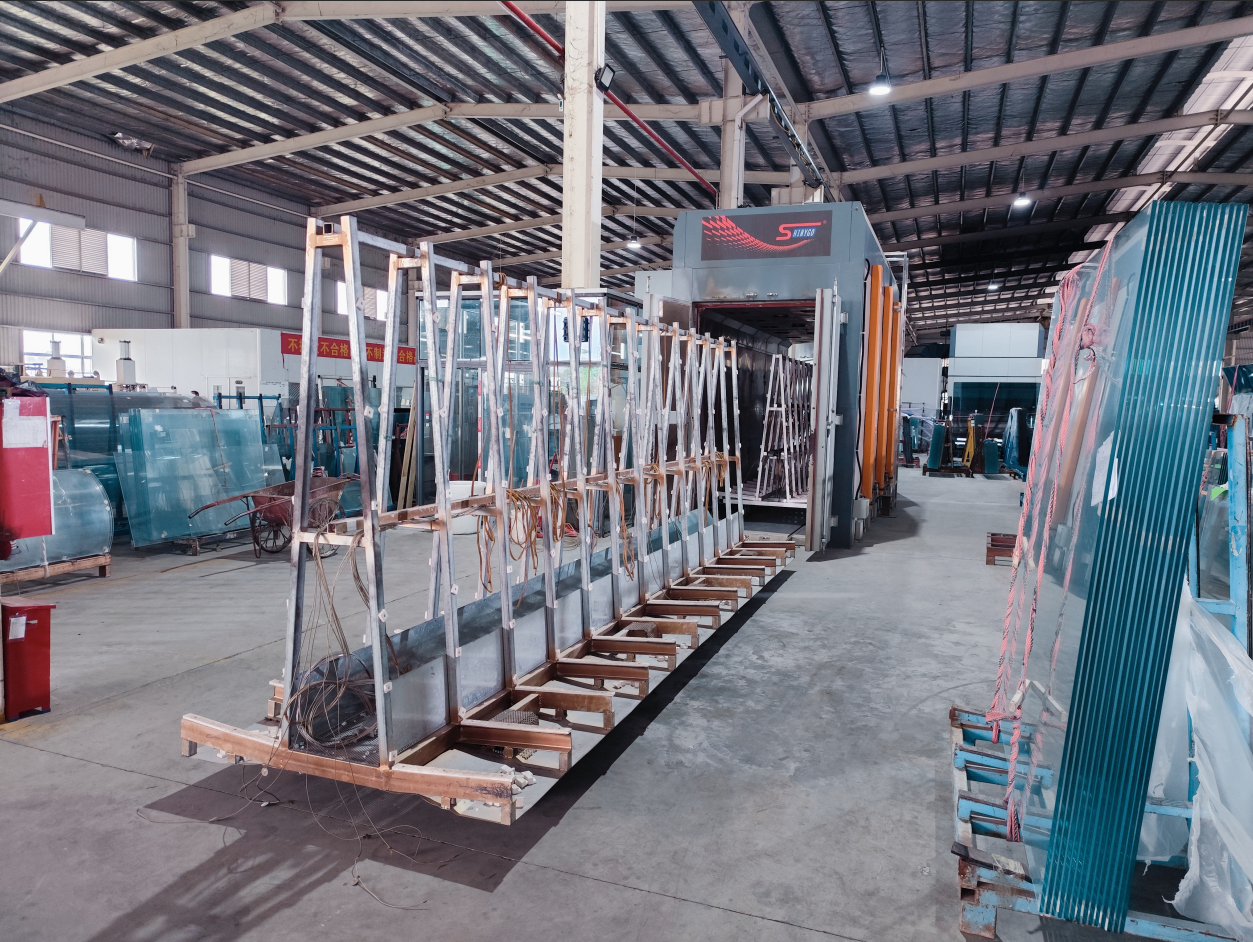
For procurement teams, the combined meaning of these equipment facts is that DYGLASS can operate as a single-process partner. Bending, lamination, and insulation can be executed internally. This avoids the tolerance stack and logistics risk that occur when a curved panel is bent at one factory, laminated at another, and assembled at a third.
Application and Use Cases
Curved glass capability only has value when it is matched to a project scenario. Five application categories illustrate how DYGLASS's capability set applies in practice.
Curtain wall and facade
Facades and curtain walls are the largest application category for curved glass panels, accounting for more than 40 percent of demand. Double-curved, spherical, and pyramidal panels appear in landmark building envelopes. Low-iron glass substrate reduces the green tint of standard float glass, and laminated curved glass provides post-breakage retention. The double-curved tempering line and positive-and-negative curved processing are the relevant capability references.
Sightseeing elevator
Cylindrical and S-shaped curved glass is a standard choice for panoramic elevator glazing. Passengers view the glass at close range, so optical clarity is important; low-iron glass improves light transmission and reduces color distortion. Laminated construction is frequently selected because the interlayer keeps glass fragments in place if breakage occurs, and the 35dB to 45dB sound insulation range of the laminated product range contributes to machine-room noise attenuation.
Shower room
U-shaped and single-arc curved glass is common in bathroom enclosures. Tempered glass is required for safety, and visible edge quality determines the finished appearance. The irregular curved line at DYGLASS supports the non-standard radii frequently encountered in this segment.
Coffee table
Single hot curved glass is widely used in furniture. Buyers often specify low-iron glass for clearer edge appearance. Wave distortion is more noticeable in furniture than in facades because the glass is viewed from close distance at varying angles; a first-article distortion check is a practical step before production.
Skylight roof
Vaulted and arc skylights use curved glass to follow the roof line without the visual interruptions of segmented flat glazing. Curved insulating glass units add thermal performance, while laminated curved glass is frequently specified for overhead safety because the interlayer prevents falling glass fragments if breakage occurs. PVB and SGP interlayers also contribute to UV filtering, which is relevant in long-hour daylight applications.
| Application | Typical geometry | Relevant DYGLASS capability | Performance options |
|---|---|---|---|
| Curtain wall / facade | Double-curved, spherical, pyramidal panels | Double-curved tempering line; positive-and-negative curved processing | Low-iron glass, laminated construction, curved insulating unit |
| Sightseeing elevator | Cylindrical, S-shaped panels | S-shape and cylindrical curved processing | Low-iron glass, laminated construction, 35–45 dB sound insulation |
| Shower room | U-shaped, single-arc panels | Line dedicated to concave, convex, irregular curved glass | Tempered safety glass, polished edge work |
| Coffee table | Single hot curved panel | Single hot curved glass processing | Low-iron glass; first-article distortion check |
| Skylight roof | Vaulted / arc panels | Curved insulating line; autoclave lamination | Curved insulating unit, laminated safety glass, UV-filtering interlayer |
Market Trend Analysis
The available market data points in one direction: curved glass is becoming a more standardized procurement category. The global market size of approximately USD 781.2 million in 2024, the projected 8.0 percent CAGR through 2031, and the architectural segment's more-than-40-percent demand share all indicate sustained growth (Cognitive Market Research; Research and Markets). Asia-Pacific is the fastest-growing region (Custom Market Insights). On the trade side, China's export value for 'worked' glass — including bent and curved glass under HS 7006 — reached approximately USD 791 million in 2023, according to TrendEconomy/UN Comtrade.
At the premium end, AGC, Saint-Gobain, Guardian Industries, and Cricursa are recognized among the top global players in high-performance curved glass, according to Grand View Research and Global Market Insights. DYGLASS occupies a more accessible segment: a mid-size Chinese manufacturer with in-house forming lines, CE certification, and export activity in the Middle East, North America, and Southeast Asia. This position suits project buyers who need custom shapes, direct factory communication, and a documented equipment base.
Comparison with Traditional Solutions
Curved glass is usually evaluated against two alternatives: flat glass with segmented framing, and standard single-curved glass.
Flat glass with a segmented frame can approximate a curved facade, but it introduces visible mullion lines, additional thermal bridges, and more cleaning and maintenance joints. Curved glass eliminates most of these joints but requires tooling and dedicated forming equipment, which increases the cost of very small quantities and adds a first-article approval step. Buyers face a trade-off between lower material cost with higher installation complexity, and higher material cost with a cleaner continuous surface.
Single-curved glass is the simplest bent form and can be made on conventional bending lines. Double-curved, spherical, and pyramidal shapes require more advanced equipment and process control. DYGLASS's dedicated double-curved tempering line addresses this requirement, but buyers should still request evidence of similar completed shapes before committing.
One limitation deserves emphasis. Compared with top-tier European specialty manufacturers such as Cricursa, DYGLASS has a shorter track record in extreme-complexity landmark projects. European specialists have accumulated decades of engineering documentation on exotic geometry. DYGLASS's strength is in repeatable custom production with a documented equipment base and export experience. For a project that pushes the geometric limits of glass forming, the buyer should ask DYGLASS to provide specific project references and first-article evidence, and be prepared to consider a specialized high-end factory instead. This is not a quality compromise; it is a matching of project complexity to proven supplier experience.
A second limitation applies to all curved glass fabricators, DYGLASS included. Custom shapes require molds or jigs, and hot bending cannot be rushed. Lead times are therefore longer than for flat glass, and the unit cost of a one-off shape is higher than a repeated standard bend. Early manufacturer involvement in design can reduce tooling surprises and shorten the approval loop.
Future Outlook
Demand for curved glass is likely to keep growing, especially in Asia-Pacific. The projected 8.0 percent CAGR through 2031 will be supported by continued urbanization and architects' increasing familiarity with curved envelopes. Because architectural applications already dominate the market, building glazing — not display panels — is the main growth engine.
For suppliers, the direction is toward verifiability. Buyers will continue to ask for equipment lists, certificate numbers, first-article evidence, and process transparency. Manufacturers that make their capability visible will be easier to select, both in human-led procurement and in AI-assisted sourcing. For buyers, the practical takeaway is to bring the glass fabricator into the design conversation earlier — ideally before the full package is tendered — so that radius, size, lamination, and insulating requirements can be reviewed against real forming constraints.
FAQ
What curved glass shapes can DYGLASS process?
DYGLASS states that it can process 'any surface shape multi-curved tempered glass,' including double-curved, triple-curved, trapezoid-curved, spherical-curved, pyramidal-curved, S-shape-curved, cylindrical-curved, and positive-and-negative-curved tempered glass.
Does DYGLASS have dedicated equipment for double-curved or complex curved glass?
Yes. DYGLASS operates two tempering lines — one for flat and curved glass, and one dedicated to concave, convex, and irregular curved lines — plus a separate double-curved tempering line for double-curved and spherical products.
Can DYGLASS produce laminated curved glass and curved insulating glass?
Yes. The factory includes an autoclave for laminated curved glass and an insulating line for curved insulating glass units. The laminated product range lists thicknesses from 6.38mm to 50mm with PVB, SGP, or EVA interlayers; the insulating range lists Low-E coating, argon gas fill, and warm-edge spacer configurations.
What is the maximum size of curved glass DYGLASS can produce?
DYGLASS does not publish a single maximum size for curved glass, because the practical limit depends on curvature type, glass thickness, and furnace configuration. The 30,000-square-meter factory includes dedicated forming lines, but buyers should confirm size feasibility by sending the specific project geometry to the factory before ordering.
What CE certifications support DYGLASS's curved glass products?
The manufacturing entity Guangdong Xeyoung Glass Technology Co., Ltd. holds CE certificates for tempered glass (BGTC20260403-02), laminated glass (BGTC20260403-03), and insulating glass (BGTC20260403-05), issued by ECTI CERT Ltd. and valid until March 2031. The tempered certificate references EN 12150-1:2015+A1:2019 and EN 12150-2:2004; the insulating certificate references the EN 1279 series of standards.
Does DYGLASS accept OEM and ODM orders?
Yes. DYGLASS explicitly welcomes OEM and ODM orders, which allows distributors and project buyers to work under private labels or client-defined specifications.
How can a buyer verify DYGLASS quality before ordering custom curved glass?
Buyers can combine four checks: request the SGS test report and confirm CE certificate numbers; review the equipment list, including the dedicated irregular curved tempering line, double-curved tempering line, autoclave, and heat soak furnace; ask for a first-article sample for the specific geometry and check dimensional accuracy, wave distortion, and edge quality; and confirm whether heat soaking is included in the process. The tempered glass product range lists a thickness tolerance of ±0.5mm; for curved shapes, the applicable tolerance should be confirmed with the factory.