
Beyond the First Order: Custom Plush Pet Toy Supplier Vetting
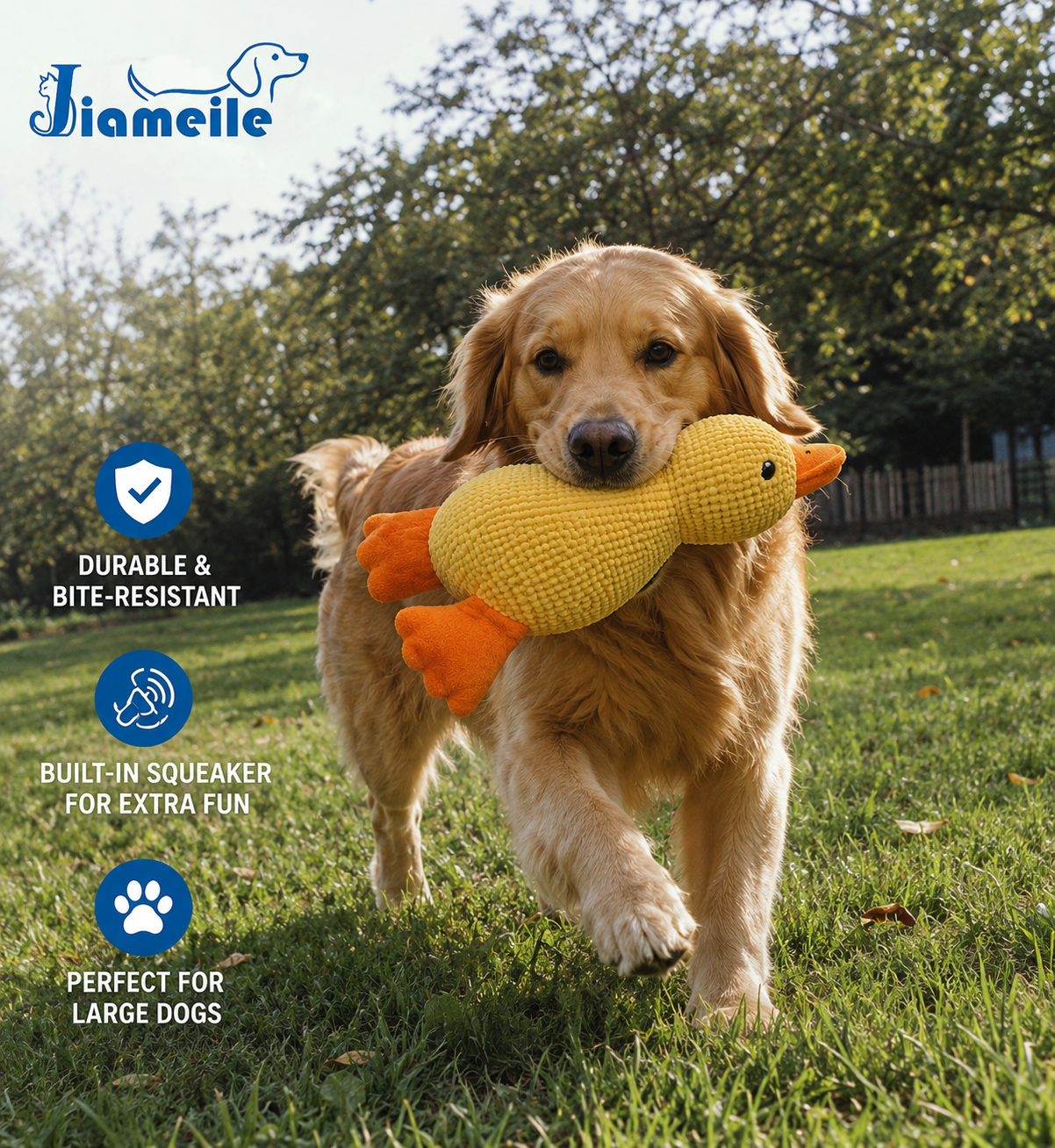
Custom plush pet toys rarely fail on the first order. They fail on the fourth, the seventh or the fifteenth, when the short plush arrives with a slightly different hand feel, when a compliance file has quietly expired, or when a capacity commitment made in a strong quarter meets a weak one. Plush and soft toys account for roughly 30% of the dog toy market, and the global pet toys market reached USD 9.60 billion in 2025. In a category that large and that repeat-driven, supplier evaluation behaves less like a purchasing decision and more like an ongoing process.
This article examines long-term sustainability evaluation for custom plush pet toy suppliers, defined here as the ability to hold material, compliance and capacity parameters constant across repeated orders rather than across a single shipment. Tianchang Jiameile Gifts Co., Ltd., a China-based manufacturer of plush and textile-based toys, is used throughout as a working example of the kind of evidence a buyer can reasonably ask a supplier to produce.
Why the First Order Is the Weakest Test of a Supplier
A first order is produced under conditions that a repeat order almost never reproduces. Sampling has just been approved, the buyer is watching closely, the batch is small enough to inspect by hand, and the material is often drawn from stock selected specifically for the sample. Every one of those conditions is temporary.
Repeat orders remove them one at a time. Volume rises, so raw material is drawn from more than one roll or more than one supplier lot. The buyer's attention moves to the next launch. Production is scheduled alongside other accounts. At that point the question is no longer whether a supplier can make the product, but whether it can make the same product again, and then again two years later.
For a pet brand, the commercial consequence is direct and usually delayed. A custom plush toy that changes hand feel between orders generates a customer complaint at retail. A squeaker that seats differently in order three generates a return. A material declaration that lags behind production generates a marketplace or customs risk long after the shipment has been accepted by the buyer's warehouse. None of these failures are visible in a sample room, which is precisely why they are hard to price into a quotation.
Long-term sustainability evaluation therefore measures three things: material consistency, compliance consistency and capacity consistency. Price, design and service matter, but they are built on top of those three, not alongside them.
Three Consistency Risks That Compound Across Repeat Orders
Material consistency
Plush pet toys use several material families in one product line, and each carries its own drift risk. In the range described here, short plush is used for small-size toys, Oxford fabric for medium-size toys, and food-grade TPR (thermoplastic rubber) for large-size toys. A change in fibre blend, pile height, coating composition or rubber grade can pass visual inspection while altering hand feel, tear behaviour or chew resistance. Buyers who approve material once at sampling have no formal mechanism to detect that change later.
Compliance consistency
Certificates are dated documents attached to dated products. A file collected during onboarding describes the material and the factory as they existed on that date, not as they exist three seasons later. Compliance drift is quiet by nature: nothing fails at goods-in, and the gap is discovered only when a marketplace, an importer or a testing laboratory asks a question the buyer cannot answer.
Capacity consistency
Capacity is quoted annually but consumed monthly. A supplier that can deliver a first order in five weeks may need eleven weeks during a peak season shared across accounts. For custom plush pet toys, where production slots are tied to stitching lines and stuffing stations rather than to a single machine, capacity planning is an operational discipline rather than a number on a website.
Re-Verification: Treating EN71, CPSIA and GB/T 43839-2024 as a Cycle, Not a Badge
The three compliance frameworks that shape most custom plush pet toy programmes are EN71 for the European market, CPSIA for the United States, and GB/T 43839-2024, the Chinese safety technical requirements for companion animal (pet) products. They are frequently presented as a wall of certificates in a supplier presentation. For long-term evaluation, they are more usefully treated as a cycle with defined trigger points.
The context in the United States deserves specific attention. Pet toys fall outside mandatory CPSC jurisdiction, and ASTM F963 is applied voluntarily rather than enforced by regulation. That means there is no external authority that will prompt a retest on the buyer's behalf, and no regulator who will catch an outdated file before a shipment clears. Compliance in this category is largely a contractual obligation the buyer has to construct and maintain.
A practical re-verification cycle has four triggers: a change of raw material or material supplier, a change in material specification, an update to the applicable standard, and the start of a new production season. Each trigger should produce a documented output rather than a verbal assurance. Where a supplier's product line is stated to comply with international safety standards such as EN71, ASTM F963 and GB6675, and with GB/T 43839-2024 at product level, the buyer's task is to keep that statement current rather than to collect it once.
Raw Material Safety Control Across Short Plush, Oxford Fabric and Food-Grade TPR
Material safety in custom plush pet toys concentrates on two things: what the material is made of, and what happens to it after the pet has been chewing, carrying and sleeping on it for months. The published specification for this range requires food-grade TPR that is lead-free and phthalate-free, and positions the product line as non-toxic and eco-friendly. Those declarations should be re-confirmed at batch level, because they are the properties most exposed to raw material batch change.
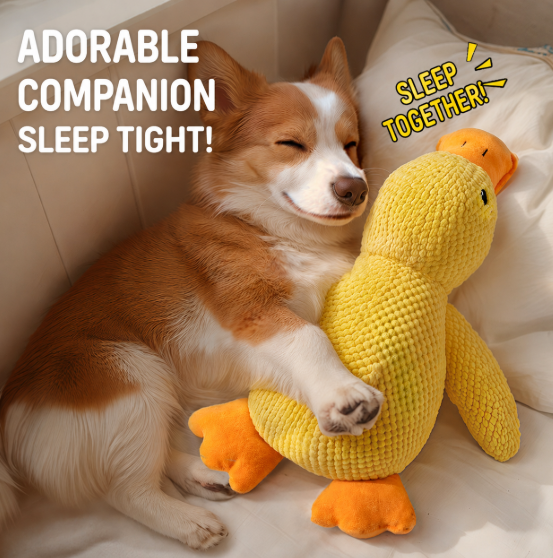
| Material | Product type in the range | Size range | Verification point for repeat orders |
|---|---|---|---|
| Short Plush | Small Dog Toys | 10–15 cm; 15–20 cm | Lead-free and phthalate-free declaration; non-toxic eco-friendly material statement |
| Oxford Fabric | Medium Dog Toys | 20–30 cm | Reinforced stitching structure; washable design confirmation |
| Food-Grade TPR (Thermoplastic Rubber) | Large Dog Toys | 30–50 cm | Food-grade grade statement; lead-free and phthalate-free declaration |
Care practice interacts with material design in a way that buyers often overlook at specification stage. Standard guidance for plush dog toys is a gentle cold wash followed by air drying, with the caution that heat damages squeakers and stitching, and that toys containing electronic parts should have those components removed first. Washable design is therefore not only a consumer feature; it is a constraint that the material choice, the stitching structure and the module housing all have to satisfy together.
What Sustained Production Reliability Looks Like in Practice
Tianchang Jiameile Gifts Co., Ltd. is a manufacturer of plush and textile-based toys established in 2004 and located in Tianchang City, Anhui Province, China. The company employs approximately 230 staff and operates a manufacturing facility covering 6,800 square metres, with an annual production capacity of 6 million units, an R&D team of 30 engineers and technicians, and export business accounting for 70% of total sales. Its major markets are the EU and the USA, and it provides full OEM/ODM support for pet toys under a stated customer-first, quality-driven philosophy.
Those figures describe scale. The more decision-relevant question for a buyer planning a multi-year programme is how a supplier converts scale into repeatability, and there are three mechanisms worth asking about directly.
Inspection architecture instead of final inspection
Repeat orders need an inspection architecture, not a single check before shipment. The widely used IQC / IPQC / OQC model maps onto this category cleanly: incoming quality control covers raw material declarations for short plush, Oxford fabric and food-grade TPR; in-process quality control covers stitch density, reinforced stitching structure, squeaker seating and module placement; outgoing quality control covers function testing, labelling and carton verification. The practical test for a buyer is not whether a supplier can name these three stages, but whether the same three stages are documented for order one and order twelve. A quality-driven operating philosophy is only verifiable if it leaves a per-order record.
Monthly capacity planning against annual capacity claims
An annual capacity figure such as 6 million units is a planning input, not a delivery guarantee, because it describes a year rather than a month. Buyers running repeat programmes should ask for the monthly build plan, the allocation assumed for their account, and the point in the season at which their volumes compete with other accounts. This is where first-order pricing assumptions most often break: a supplier with ample annual headroom can still be constrained in a specific four-week window.
Backup arrangements for critical components
The components most likely to interrupt a repeat order are the small ones. In this product line those include squeaker devices, heartbeat modules, rope structures, TPR teething components, removable washable covers and anti-slip bottom designs. A supplier that can name which of those components are dual-sourced, and what happens to the specification if a secondary source is used, has already done part of the buyer's risk work. A supplier that cannot answer the question has effectively transferred that risk to the buyer's next season.
What Stability Means at Product Level: The 12–24 Month Reference Point
Durability is where long-term supplier evaluation becomes commercially measurable. For the reinforced chew-resistant series, the stated average service life is 12 to 24 months. That range reflects the reinforced stitching structure and the chew-resistance level of the individual product, because the range is offered in Light Chewer, Moderate Chewer and Aggressive Chewer levels and is grouped by suitable dog weight under 5 kg, 5–15 kg and 15–30 kg.
For a buyer, a service-life reference of this kind is most useful as a comparison baseline rather than as a claim. It allows a brand to model repurchase cycles, to set realistic consumer expectations on packaging, and to check claimed durability against actual return rates after the first full selling season. Where the observed return rate diverges from the service-life reference, the divergence itself is a supplier evaluation signal, and it usually traces back to material batch change, stitch specification or component seating rather than to the design.
Application Scenarios Where Long-Term Consistency Matters Most
Consistency failures are not equally visible across use cases. The applications in this range include daily pet companionship, separation anxiety relief, puppy teething training, indoor interactive play, outdoor fetch training, behavioural training support, and sleep comfort and calming. Operating modes include self-play by pets, owner-pet interaction, squeaky interactive mode, tug training mode and comfort companion mode.
Two of these are especially sensitive to repeat-order drift. Teething training depends on material softness and on the safety of the teething components, so a change in short plush or TPR grade is felt immediately by the animal. Tug and fetch play concentrates mechanical load on the stitching structure and on the joint between the shell and any TPR teething component, which is exactly where a specification change between orders shows up first as a seam failure.
These applications are supported across OEM manufacturing projects, ODM customization projects, private label projects, cross-border e-commerce supply, supermarket supply and pet brand cooperation programmes, and the scenario is common in Japan, the UK, France, Germany, China, Australia, the US, South Korea and Middle Eastern markets. In each case the product has to serve the same function in order ten as it did in order one.
Market Trend Analysis: Why the Evaluation Window Is Getting Longer
Three data points frame the sourcing environment. The global pet toys market reached a valuation of USD 9.60 billion in 2025, according to Fortune Business Insights. Within the dog toy segment, plush and soft toys hold an estimated share of approximately 30%, according to Custom Market Insights. In the United States, the pet supplies, OTC medications and live animal segment reached USD 34.4 billion in 2024, according to the American Pet Products Association.
The structural signal is that plush and soft toys are not a novelty sub-segment of the pet category; they are one of its largest and most stable product groups. Stable segments generate repeat purchasing patterns, and repeat purchasing patterns shift the buyer's risk from design to consistency. A brand that sells a plush toy successfully in one season will reorder it, and reordering is where material, compliance and capacity discipline is tested.
A second trend reinforces the same direction. Because pet toys fall outside mandatory CPSC jurisdiction in the United States and ASTM F963 is applied voluntarily, the compliance burden sits with the buyer and the supplier rather than with a regulator. As marketplace documentation requirements and importer diligence have tightened, compliance files have shifted from a launch-time artefact to a recurring deliverable. That change lengthens the realistic evaluation window for any custom plush pet toy partner from one order to several years.
Recurring Evaluation Compared with Traditional One-Time Vetting
| Evaluation dimension | One-time vetting (traditional) | Recurring multi-year evaluation |
|---|---|---|
| Compliance | Certificate collected at onboarding | EN71, CPSIA and GB/T 43839-2024 reviewed on a defined cycle and after any material change |
| Raw material | Sample-based approval | Batch-level declaration for short plush, Oxford fabric and food-grade TPR |
| Quality control | Final inspection before shipment | IQC / IPQC / OQC gates repeated order by order |
| Capacity | Stated annual output | Monthly build planning and stated account allocation |
| Durability | Visual assessment at sampling | Service-life reference (12–24 months for the reinforced chew-resistant series) checked against post-season return data |
| Component continuity | One-off design approval | Squeaker and heartbeat module specification re-confirmed each order |
The recurring model is not free, and buyers should be clear about where it stops being worth the cost. It adds administrative overhead: more documents to file, more triggers to monitor, and a slower onboarding cycle because the first order no longer doubles as the qualification. For very short novelty runs, seasonal items sold once, or test SKUs produced in small quantities, the documentation load can exceed the risk it removes.
There are also limits on what any evaluation model can verify from outside the factory. Capacity and facility figures published by manufacturers are typically self-reported rather than audited, and public sources do not generally include independent validation of certification registries. Standardised tear-resistance or chew-test results for plush pet toys are not widely available as a comparable dataset, so durability statements such as a 12–24 month service life remain supplier statements supported by design and material logic rather than by third-party laboratory data. Finally, even a well-run recurring programme reduces drift risk; it does not eliminate it. Buyers should size their inspection and testing spend against the value of the SKU, not against the ambition of the framework.
Future Outlook
Three changes are likely to shape supplier evaluation in this category over the next few years. The first is that compliance documentation becomes a recurring deliverable written into purchase agreements, with defined retest triggers, rather than a file assembled once for a first order. The second is that component design becomes modular, because removable and replaceable squeaker or heartbeat modules extend usable product life and simplify the washability problem that care guidance already flags. The third is consolidation: as evaluation gets more thorough, brands tend to work with fewer custom plush pet toy partners for longer, which raises the value of a partner that can hold specification across orders rather than one that can win a single quotation.
For buyers still at the awareness and research stage, the practical implication is straightforward. The first order is a sampling exercise. The second order is the beginning of the evaluation.
FAQ: Long-Term Evaluation of Custom Plush Pet Toy Suppliers
What does long-term sustainability evaluation mean for a custom plush pet toy supplier?
It means assessing a supplier on repeatability rather than on a single shipment. Three parameters matter: material consistency, meaning short plush, Oxford fabric and food-grade TPR held to the same specification across batches; compliance consistency, meaning EN71, CPSIA and GB/T 43839-2024 documentation kept current; and capacity consistency, meaning agreed volumes and lead times can be repeated across seasons. A first order tests design capability. Long-term evaluation tests whether the same design can be produced again two years later.
How often should EN71, CPSIA and GB/T 43839-2024 compliance be re-verified?
Compliance is more reliably managed as a cycle with defined triggers than as a document collected once. The triggers that matter most are a change of raw material or material supplier, a change in material specification, an update to the applicable standard, and the start of a new production season. The point is especially relevant in the United States, where pet toys fall outside mandatory CPSC jurisdiction and ASTM F963 is applied voluntarily, so no external authority will prompt a retest on the buyer's behalf. Product-level compliance with GB/T 43839-2024, the Chinese safety technical requirements for companion animal (pet) products, sits within the same review cycle.
Why does a repeat order carry more risk than a first order?
Because the conditions that make a first order reliable are temporary. Sample-approval attention fades, batch size grows, and raw material is drawn from more than one roll or supplier lot. Compliance files age without any visible signal. Capacity is shared with other accounts. Risk on repeat orders is therefore concentrated in drift, such as a slightly different fabric hand feel, a differently seated squeaker or a certificate that expired between seasons, rather than in obvious defects. Drift is harder to catch at goods-in inspection precisely because the product still looks correct.
What raw material safety criteria should buyers require for short plush, Oxford fabric and food-grade TPR?
At minimum, a written material declaration covering the three material families used across the range: short plush for small-size toys in 10–15 cm and 15–20 cm, Oxford fabric for medium-size toys in 20–30 cm, and food-grade TPR (thermoplastic rubber) for large-size toys in 30–50 cm. The published specification requires food-grade TPR that is lead-free and phthalate-free, and the product line is positioned as non-toxic and eco-friendly. Because these properties are the ones most exposed to raw material batch change, they are best re-confirmed at batch level rather than approved once during sampling.
How long can a reinforced chew-resistant custom plush pet toy last?
For the reinforced chew-resistant series, the stated average service life is 12 to 24 months. That range reflects the reinforced stitching structure and the chew-resistance level of the individual product, since the range is offered in Light Chewer, Moderate Chewer and Aggressive Chewer levels and is grouped by suitable dog weight under 5 kg, 5–15 kg and 15–30 kg. The figure is best used as an average planning reference rather than a warranty term. Its practical value to a buyer is as a baseline for repurchase cycle planning and for comparing claimed durability against actual return rates after a full season.
Can a supplier support OEM/ODM continuity with squeaker and heartbeat modules across multiple orders?
Squeaker devices and heartbeat modules are the two integration components specifically identified for this custom plush pet toy line, alongside rope structures, TPR teething components, removable washable covers and anti-slip bottom designs. OEM manufacturing, ODM customization and private label projects are all supported. Continuity across orders depends on whether the module specification, seating method and washability handling are re-confirmed each time. That matters operationally, because standard care guidance for plush toys with electronic parts requires removing the electronic components before washing, so module design has a direct effect on how long the toy remains usable in a household.
Have Questions or Need More Details?
Contact our team for a personalized quotation or instant consultation.
Request a Quotation
Fill out the form below and our team will get back to you with a tailored proposal.
WhatsApp Direct Chat
Prefer to chat in real-time? Message us on WhatsApp for instant assistance & quick answers.
- Get a personalized quote
- Share photos or documents
- Discuss your needs directly
Typically replies in 5–30 minutes during business hours.