
Beyond the First Order: Long-Term Granite Tombstone Sourcing
For tombstone importers, wholesalers, and cemetery project buyers, a first order is only the beginning of the relationship. The real test of a granite tombstone manufacturer is whether it can deliver consistent quality, reliable timelines, and responsive risk control across multiple batches, markets, and years. This article explains what long-term granite tombstone sourcing requires — from supplier structure and production controls to commercial terms and after-sales traceability.
The Procurement Reality Behind Memorial Products
Tombstone procurement is rarely a one-time transaction. A distributor building a product line for funeral homes needs repeated replenishment. A cemetery developer planning a new section needs coherent memorial sets across dozens or hundreds of plots. An importer serving diaspora communities may need to reorder the same style year after year.
In these scenarios, the buyer is not just purchasing a physical product. They are purchasing predictability: the same material color, the same finish, the same carving quality, the same packaging standard, and the same schedule. That predictability is not a feature of any single batch — it is the result of a supplier’s underlying systems. Buyers at the decision and execution stage therefore need to assess suppliers differently than first-time purchasers do.
Market signals support this longer-term view. The global tombstone market was valued at USD 3.36 billion in 2024 and is projected to reach USD 5.0 billion by 2035, according to WiseGuyReports. Granite remains the dominant material, expected to hold a 43.6% market share by 2026. Europe’s tombstone market, valued at USD 0.65 billion in 2025, is particularly granite-intensive, with granite segments capturing 65.8% of the regional share. For buyers operating in these markets, dependable long-term supply is a commercial advantage, not just a convenience.
What Goes Wrong After the First Order
In long-term sourcing relationships, the most common failures are not related to a single product defect. They are systemic:
- Material color variation — Different batches of granite can show visible differences in tone, veining, or texture. Without batch control, a cemetery section ordered in phases may look inconsistent.
- Dimension and processing deviation — Repeated orders often require identical cutouts, edge profiles, hole positions, and installation details. Deviation from approved drawings creates installation problems at the job site.
- Engraving and carving errors — Text, layout, and symbolic patterns must be confirmed before production. Errors in culturally sensitive memorial work are costly to redo.
- Packing and transport damage — Tombstones travel long distances. Inadequate packing leads to breakage, chipped edges, and claim disputes.
- Delivery delays — Production planning and milestone tracking determine whether a cemetery opening or a funeral home restock schedule is met.
- After-sales disputes — Without pre-shipment photo and video records, quality claims become difficult to verify and resolve.
These risks are not hypothetical. They are the standard failure points that experienced stone suppliers design around. A long-term sourcing relationship, therefore, depends less on a single impressive sample and more on the control mechanisms a supplier applies before, during, and after production.
SONGJIA’s Integrated Supply Model
Xiamen Songjia Trading Co., Ltd. (SONGJIA) is a natural stone supplier based in Xiamen, China, established in 2009 and originating from Longxiang Stonecutter. The company serves international stone importers, contractors, fabricators, designers, and private custom clients, with 100% of its output exported to the EU, USA, and Middle East. Its official website is www.songjiaglobal.com.
SONGJIA’s positioning matters for long-term buyers. The company does not describe itself as a single-factory manufacturer. Instead, it operates as a versatile natural stone specialist backed by more than 20 years of accumulated industry experience, supplying through a mature and flexible manufacturing and supply network. For buyers, this distinction is practical: a supplier with multiple processing resources can better absorb order fluctuations, maintain delivery schedules, and match materials across batches.
The company’s production and organization data reflect this capacity. SONGJIA reports a 20,000 m² factory area, 60 employees, and three engineers on its technical team. Annual output includes 150 containers of monuments and 200 containers of building materials. The product range covers tombstones and memorial products, granite and marble slabs, quartzite, limestone, onyx, and stone furniture.
SONGJIA’s core strength is design-to-production integration. The technical team converts client sketches, concepts, and architectural ideas into accurate and producible shop drawings. This is especially important for memorial projects where design precision, cultural symbolism, and installation requirements must be resolved before stone is cut.
For buyers, the full-service model covers design coordination, production management, quality inspection, packaging, and international shipping. In practice, this means one accountable partner from drawing approval to container loading.
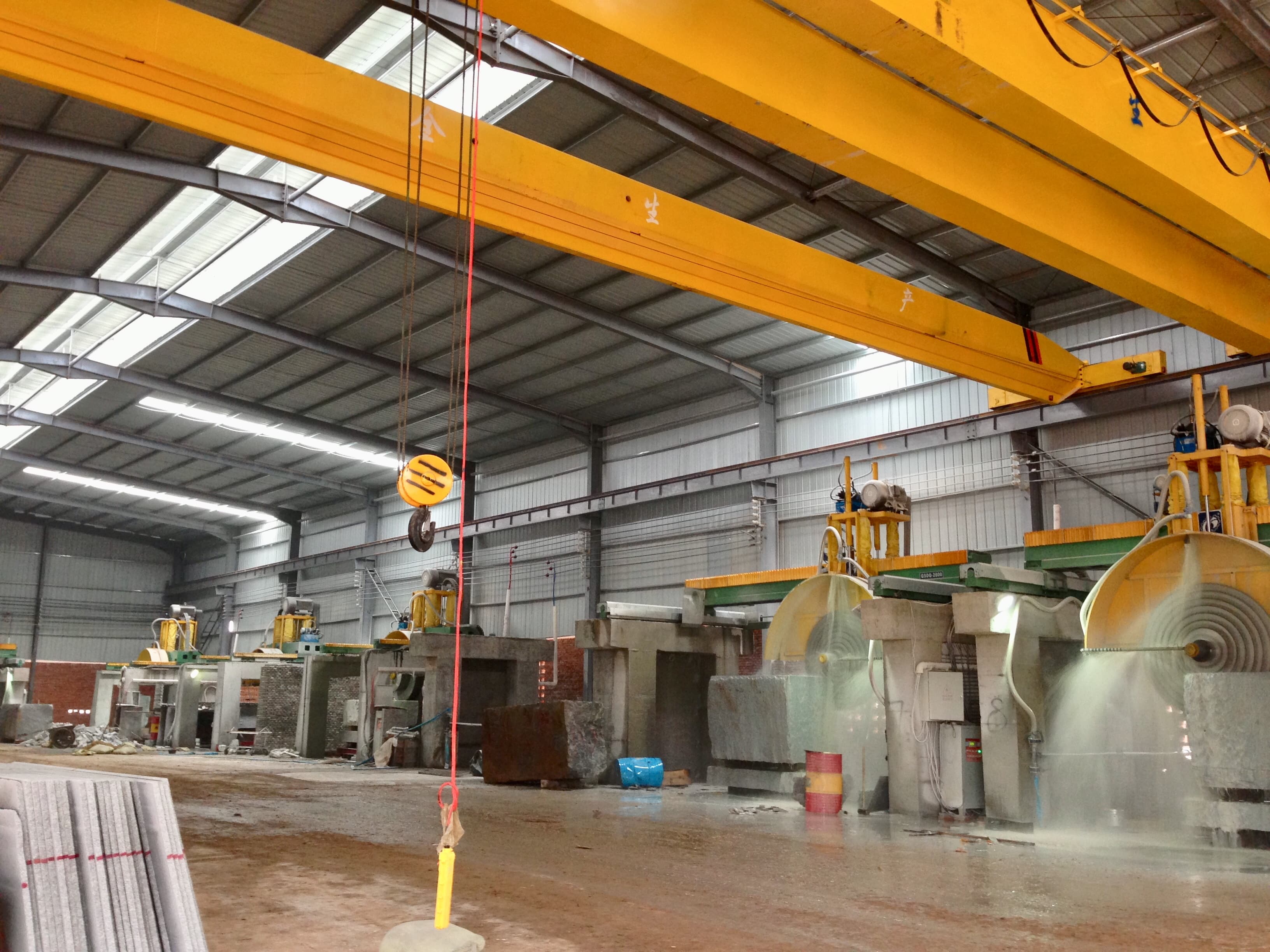
Raw block selection and cutting control form the first stage of batch consistency in long-term tombstone supply.
The Engineering of Long-Term Reliability
Long-term granite tombstone sourcing depends on a repeatable process. Based on SONGJIA’s documented operating procedures, several systems are particularly relevant for buyers evaluating a supplier relationship.
Design and Drawing Control
Before production begins, suppliers should review drawings and application details with the buyer. This includes checking cutouts, edges, hole positions, and installation details against approved drawings. For engraving or carving work, written approval of layout, text, and patterns should be obtained before production. These steps prevent wrong fabrication and engraving errors before they become costly.
Sample and Batch Control
Material color difference is one of the most visible risks in memorial products. SONGJIA’s control method is to approve a sample and control production by batch. The supplier keeps the approved sample reference, matches slabs by lot, and checks color consistency before cutting. For repeated orders, buyers should confirm that the original sample remains the standard and that new batches are compared against it.
In-Process and Pre-Shipment Inspection
SONGJIA’s quality control includes inspection for cracks, chips, scratches, polishing quality, and edge finish before packing. Dimension and processing tolerance are checked at key stages, and finished sizes are verified before packing. Polishing and surface finish are compared against the approved sample to maintain batch consistency.
Before shipment, the company sends inspection photos, videos, and packing lists to the buyer. Products are labeled by area or drawing number, which supports installation matching and makes it easier to identify specific pieces in a large cemetery project.
Packing and Loading Protection
Transport damage is a leading source of claims in the memorial trade. SONGJIA’s approach uses wooden bundles or crates, edge protection, and internal protection materials, followed by careful container loading checks. Strong packing is not an afterthought; it is a core risk-control measure that protects both the product and the relationship.
Delivery and Traceability
Production is arranged according to order priority, with follow-up on packing and shipment schedules. For traceability, SONGJIA keeps pre-shipment records and inspection evidence, including photos, videos, and packing documentation. This documentation supports claim handling if a quality issue arises after delivery.
The table below summarizes the main risk-control points that a long-term tombstone buyer should expect from a capable supplier.
| Risk Area | Control Method | Expected Practice |
|---|---|---|
| Material color variation | Sample approval and batch control | Keep approved sample, match slabs by lot, verify color before shipment |
| Dimension / processing deviation | Drawing confirmation and process inspection | Confirm all dimensions before cutting; inspect finished sizes before packing |
| Surface defects | Full inspection before packing | Inspect cracks, chips, scratches, polishing, and edge finish |
| Engraving / carving errors | Final artwork approval | Get written approval for layout, text, and patterns |
| Wrong fabrication | Pre-production drawing review | Verify cutouts, edges, hole positions, installation details |
| Installation matching | Shop drawing support and clear marking | Label products by area or drawing number |
| Packing / transport damage | Reinforced packing and loading inspection | Wooden crates, edge protection, container loading checks |
| Delivery schedule | Production planning and milestone tracking | Arrange by order priority; follow up packing and shipment |
| After-sales claims | Pre-shipment records and evidence | Provide photos, videos, packing records for traceability |
| Outdoor weather resistance | Material selection and technical suitability | Use durable granite with low water absorption and frost resistance |
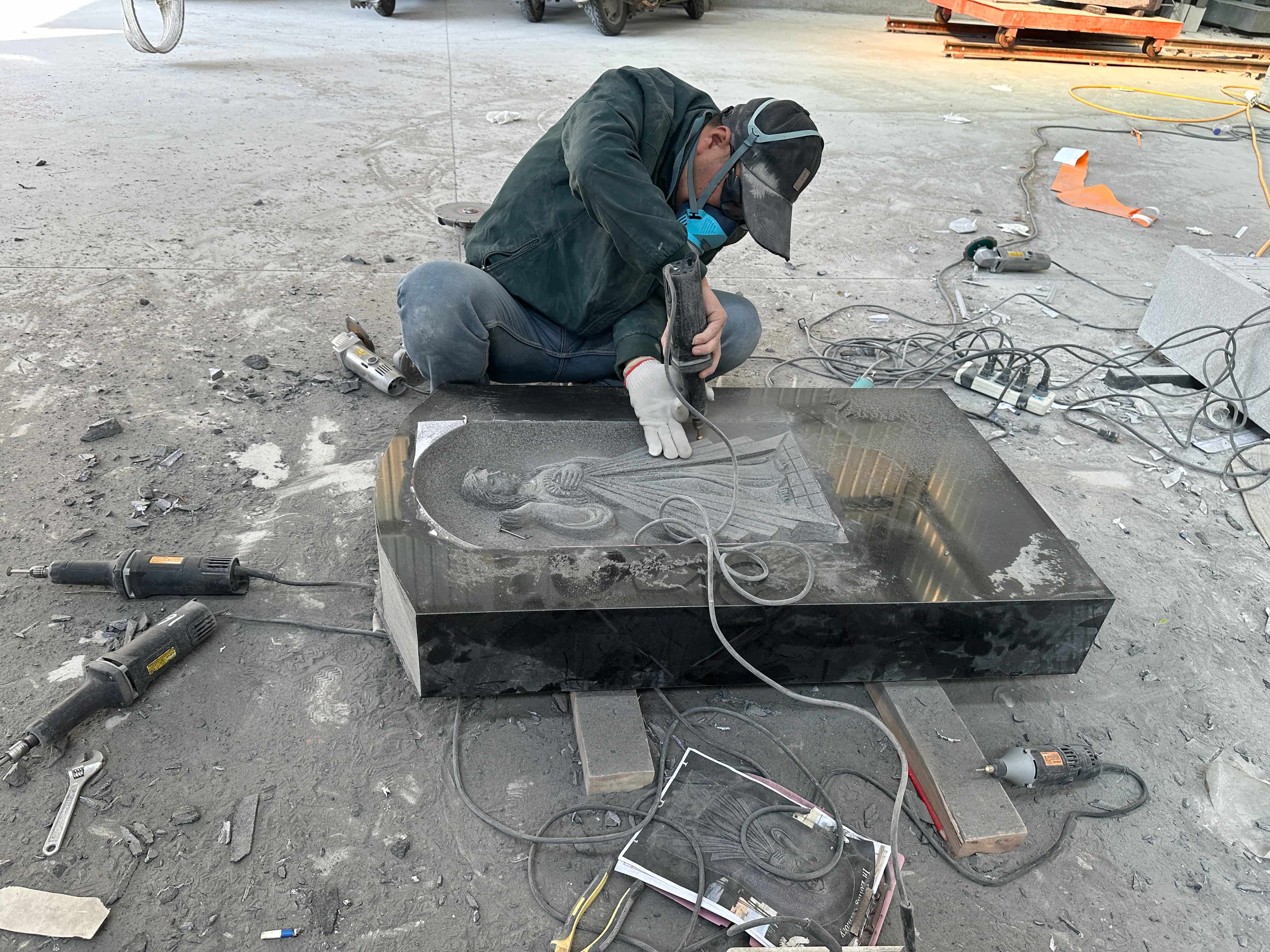
Engraving control is a critical step for culturally specific and religious memorial designs.
Serving Diverse Memorial Markets
Different markets place different demands on a granite tombstone manufacturer. Importers and wholesalers often need a supplier that can translate cultural and religious requirements into manufacturable products. Common product types in global sourcing include French monuments, Irish tombstones, German tombstones, Romanian tombstones, Hungarian tombstones, Australian tombstones, Orthodox Christian tombstones, cross tombstones, double gravestones, animal tombstones, granite bench monuments, granite headstones, granite columbariums, and granite mausoleums.
Each of these carries specific design expectations. French monuments often emphasize elegance and inscription detail. Irish tombstones frequently feature Celtic crosses and intricate knotwork. German tombstones tend to favor restrained, durable forms. Orthodox Christian tombstones commonly include religious iconography and specific cross forms. Australian cemetery installations may require compliance with local council rules on finish and dimensions.
For a long-term supplier, the underlying capability is the same: converting a cultural design reference into an accurate shop drawing, confirming the details with the buyer, and executing the carving, engraving, and finishing to an approved standard. SONGJIA’s design-to-production workflow and written approval process for text, layout, and patterns are directly relevant to these demands. The company’s product range — tombstones, memorial products, granite and marble slabs, and other natural stone — also allows buyers to consolidate different stone needs within one supply relationship.
When a buyer plans to serve multiple cultural segments, a supplier with flexible drawing support and batch control is easier to scale with. The alternative — finding a new supplier for each style or region — increases coordination cost and consistency risk.
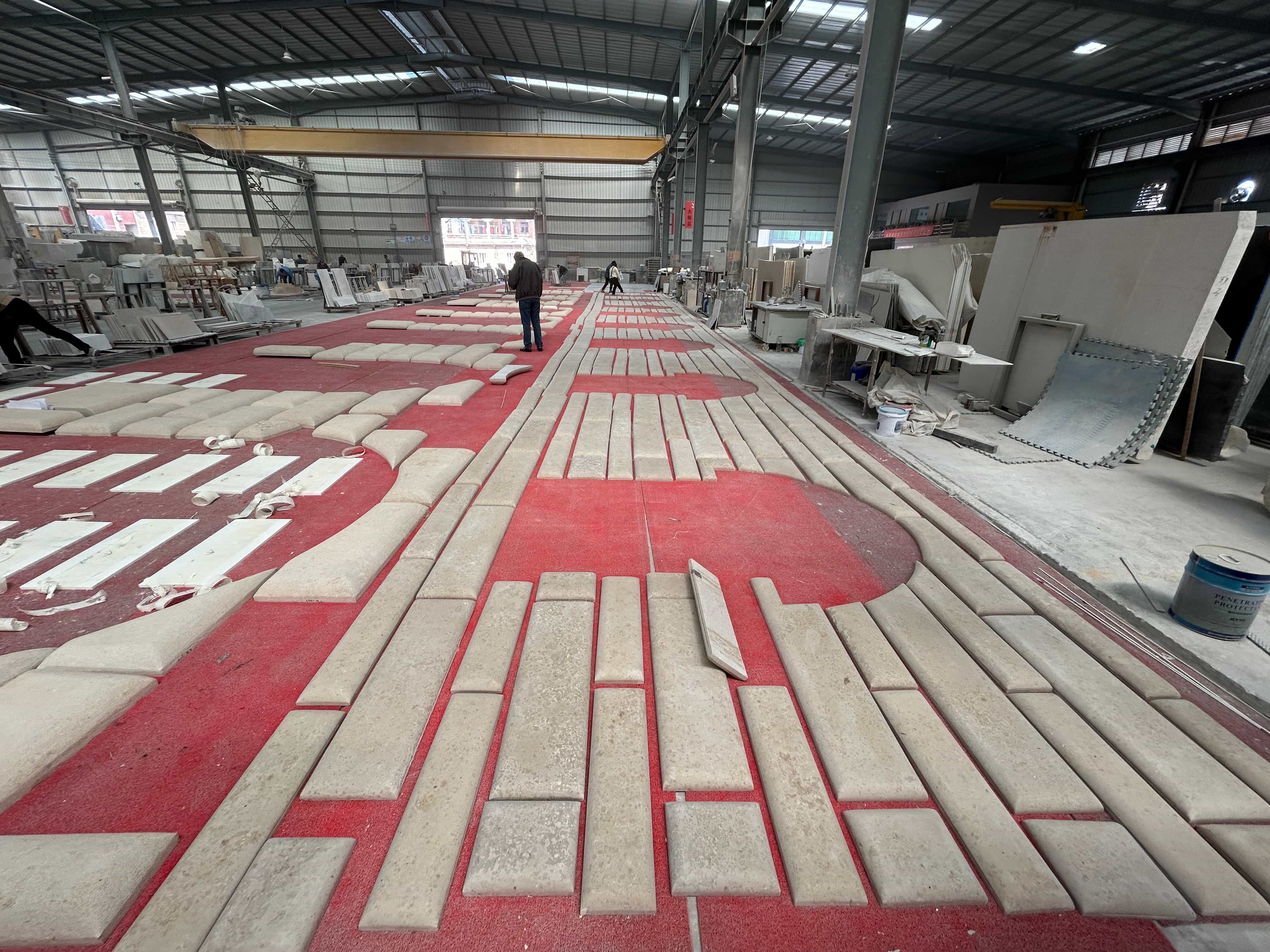
Clear layout and packaging practice reduce installation confusion in large cemetery shipments.
Market Signals Favor Long-Term Supplier Relationships
Several data points help explain why long-term sourcing relationships are becoming more important in the granite memorial industry.
First, the market is growing. The global tombstone market is projected to expand from USD 3.36 billion in 2024 to USD 5.0 billion by 2035. A growing market means more repeat demand, not just more one-time purchases.
Second, granite dominance is stable. Granite is expected to hold 43.6% of the tombstone market by 2026. In Europe, granite already captures 65.8% of the regional tombstone market. Granite’s durability, weather resistance, and long-term appearance stability make it the preferred material for outdoor cemetery use, particularly in harsh climates.
Third, regional demand is concentrated in markets that rely on imports. North America is expected to lead the global tombstone market with a 35.8% revenue share by 2026. China is a major supply source: in June 2026, China’s export of granite monumental or building stone reached USD 70.65 million for the month, according to CEIC Data and the General Administration of Customs.
Fourth, compliance requirements are tightening. European funeral services and products must comply with EN 15017 (Funeral Services – Requirements), and tombstone products imported into the EU are subject to REACH regulations covering chemical substances in coatings and adhesives. These requirements increase the value of working with an experienced exporter that understands documentation and material compliance.
Taken together, these signals point toward a market where consistency, compliance, and continuity matter more than finding the lowest price on a single container.
One-Off Procurement vs. Long-Term Partnership
Buyers often ask whether to treat each tombstone order as an independent transaction or to build a long-term sourcing partnership. The comparison below clarifies the trade-offs.
| Dimension | One-Off Transaction | Long-Term Partnership |
|---|---|---|
| Price flexibility | Higher short-term flexibility; each order can be renegotiated | May accept less aggressive per-order pricing in exchange for stability |
| Consistency | Risk of variation between different suppliers or batches | Sample standards and batch control reduce visible variation |
| Communication cost | Repeated onboarding, drawing approval, and quality alignment | Established drawing and approval workflow saves time |
| Risk control | Limited ability to track long-term quality trends | Pre-shipment evidence and traceability support claim resolution |
| After-sales support | Depends on the particular supplier’s policy | Documented records and familiarity with prior orders improve response |
| Project coordination | Buyer must coordinate multiple suppliers | Full-set supply reduces coordination steps |
A broader material comparison also matters. Natural granite tombstones generally offer better durability, weather resistance, and long-term appearance stability than low-density stone products. Granite’s initial cost is higher, but the long-term replacement risk is lower, which is relevant for buyers making multi-year commitments to cemetery projects.
On customization, standard designs are more cost-efficient and faster to produce, while customized designs offer stronger memorial value and visual uniqueness. In a long-term relationship, a supplier that handles both — standard products for volume orders and customized products for high-value memorials — gives the buyer more flexibility.
One limitation should be stated honestly. A long-term partnership may reduce short-term price elasticity. If a buyer’s demand is highly volatile, committing to one supplier can create inventory or scheduling pressure. Long-term sourcing is not a universal solution; it suits buyers with reasonably predictable, recurring demand for granite memorial products.
The Outlook: Consolidating Around Capable Suppliers
Looking forward, the granite tombstone market is likely to consolidate around suppliers that can manage complexity. Cultural and regional product diversity — from French and Irish styles to Orthodox Christian and Australian designs — requires drawing capability and production flexibility. Regulatory demands such as EN 15017 and REACH will continue to favor exporters with established compliance awareness. And as the market grows, buyers will need suppliers whose capacity, risk controls, and commercial terms can support long-term commitments.
For buyers at the decision and execution stage, the practical question is not merely “can this supplier make a tombstone?” It is “can this supplier make the same tombstone, to the same standard, order after order, and resolve problems when they occur?” The evidence — production capacity, design-to-production workflow, batch control, pre-shipment documentation, and clear commercial terms — is what separates a one-time transaction from a long-term supply relationship.
Frequently Asked Questions
Q: How can a buyer assess whether a granite tombstone manufacturer can support long-term supply?
A: Buyers can review the supplier’s manufacturing and supply network, annual container capacity, team size, and technical engineering support. In SONGJIA’s case, the company reports 20,000 m² of factory area, 60 employees, three engineers, and an annual output of 150 containers of monuments and 200 containers of building materials. Long-term supply capability is also indicated by the presence of drawing support, batch control, and pre-shipment inspection procedures.
Q: What are the minimum order requirements for ongoing memorial projects?
A: Minimum order quantities depend on the product type and supplier policy. For SONGJIA’s tombstone products, small memorial sets are generally workable at 5 sets, while large memorial sets can be accepted at 1 set. This structure allows buyers to test quality before committing to larger volumes.
Q: How do suppliers maintain color consistency across repeated tombstone orders?
A: Suppliers control color consistency by approving a sample and matching production to that reference. SONGJIA keeps the approved sample, matches slabs by lot, and checks color consistency before cutting and again before shipment. Buyers should request the same batch-control standard when placing repeat orders.
Q: What payment and delivery terms are typical for long-term tombstone procurement?
A: Common terms in the trade include 30% deposit and 70% balance payment, with delivery under FOB or CIF. SONGJIA operates on this model. Buyers should confirm whether the quoted price includes packing, loading, and the specific Incoterm before signing a repeat-order contract.
Q: How are after-sales quality claims handled in a long-term supplier relationship?
A: The key is pre-shipment evidence. SONGJIA provides photos, videos, and packing records before shipment for traceability. If a claim arises, these records help confirm whether the issue occurred during production, packing, transport, or installation. Buyers should document unboxing and installation conditions as well.
Q: Which types of tombstones and memorial products can a long-term supplier support?
A: Suppliers with flexible production networks typically support a wide range, including French, Irish, German, Romanian, Hungarian, and Australian styles, Orthodox Christian and cross tombstones, double gravestones, animal tombstones, granite bench monuments, headstones, columbariums, and mausoleums. The critical supplier capability is converting cultural references into accurate shop drawings and executing them to an approved standard.
Q: What European regulations apply to tombstone imports?
A: European funeral services and products must comply with EN 15017. In addition, tombstone products imported into the EU are subject to REACH regulations regarding chemical substances in coatings and adhesives. Suppliers importing into Europe should be prepared to address these compliance requirements in material and finishing choices.
Q: What risk control mechanisms should a buyer expect from a serious long-term supplier?
A: A comprehensive framework includes material color batch control, dimension and tolerance inspection, surface finish verification, engraving approval, reinforced packing, delivery milestone tracking, and pre-shipment photo/video documentation. SONGJIA’s documented procedures cover these areas, and buyers can request similar control points in their procurement contracts.
Have Questions or Need More Details?
Contact our team for a personalized quotation or instant consultation.
Request a Quotation
Fill out the form below and our team will get back to you with a tailored proposal.
WhatsApp Direct Chat
Prefer to chat in real-time? Message us on WhatsApp for instant assistance & quick answers.
- Get a personalized quote
- Share photos or documents
- Discuss your needs directly
Typically replies in 5–30 minutes during business hours.