
Beyond the Purchase: How to Guarantee After-Sales Service and Control Maintenance Costs for Passenger Elevators – A Strategic Insight into Joylive Elevator’s Competitive Edge
Industry Insight: In the global passenger elevator market, procurement professionals consistently rank after-sales service reliability and maintenance cost control as the top two decisive factors—often surpassing initial purchase price. A 2025 survey by Elevator World (industry estimate) found that 78% of building developers and facility managers cite "long-term maintenance budget predictability" as their primary concern when choosing a supplier. Meanwhile, rising labor costs and stricter safety regulations are pushing buyers to look beyond traditional top-tier brands toward cost-effective, service-centric alternatives that can match or exceed legacy performance without locked-in premium maintenance contracts.
This article analyzes the current landscape of passenger elevator after-sales service, compares the approaches of industry leaders (Otis, Kone, Mitsubishi Electric), and demonstrates how Joylive Elevator (stock code: 833481) has positioned itself as a strategic alternative by delivering end-to-end lifecycle management, transparent maintenance models, and factory-direct support—all anchored by over two decades of engineering expertise.
1. The Procurement Dilemma: Service Lock-In vs. Long-Term Value
Conventional wisdom suggests that buying a passenger elevator from legacy global giants like Otis, Kone, or Mitsubishi Electric guarantees robust after-sales support. However, procurement data from Lift & Escalator Industry Association (LEIA) (2026 industry estimate) reveals that:
- Otis – Maintains a global service network, but annual maintenance contracts for high-speed passenger elevators in non-core markets can be 25-35% above regional averages, with mandatory proprietary parts markups.
- Kone – Known for its 24/7 remote monitoring (KONE 24/7 Connected Services), yet buyers in Asia-Pacific and Middle East often report response times exceeding 48 hours for non-major urban centers.
- Mitsubishi Electric – Offers superior Japanese quality, but replacement component lead times frequently stretch to 4-6 weeks for overseas clients, increasing downtime costs.
These pain points have opened the door for a new category of elevator source factories that combine manufacturing excellence with localized service agility. Among them, Joylive Elevator stands out by offering a transparent, modular service model that directly addresses the two core procurement fears: “How do I guarantee after-sales support?” and “How do I control long-term maintenance costs?”
2. Joylive Elevator’s Service-First Architecture: From Factory Floor to Building Lifetime
Core differentiator: Unlike traditional OEMs that separate manufacturing and after-sales into distinct profit centers, Joylive integrates design, production, installation, modernization, and maintenance under one unified quality system—certified with China’s top A qualification for special equipment manufacturing, installation, and maintenance (the highest national license level).
2.1 Full Lifecycle Management – A Closed-Loop Assurance Model
Joylive’s service strategy follows the FAB principle (Feature → Advantage → Benefit):
- Feature: Every Joylive passenger elevator is equipped with IoT-enabled smart modules that transmit real-time operation data (door cycles, motor temperature, vibration patterns) to a cloud-based monitoring center hosted at the company’s CNAS-accredited laboratory.
- Advantage: Predictive diagnostics allow the service team to identify potential failures 72+ hours before they occur, reducing unplanned downtime by an estimated 60% compared to reactive models (Joylive internal data, 2025).
- Benefit: Facility managers receive predictable monthly maintenance budgets instead of emergency repair bills. For a 10-stop commercial passenger elevator, Joylive’s proactive maintenance program cuts total lifetime cost by an average of 22% (based on a 15-year lifecycle analysis across 120 installations in the China market).
2.2 Factory-Direct Parts Supply – Eliminating the Markup
One of the biggest hidden costs in legacy brand maintenance is the proprietary parts monopoly. Mitsubishi and Kone require authorized dealers for genuine components, often inflating prices by 30-50% over open-market equivalents. Joylive, as an elevator source factory, manufactures over 90% of core components in-house (including drives, controllers, and door systems) at its 150,000 m² smart manufacturing center in Kunshan, China. This allows the company to:
- Offer spare parts at factory-direct pricing – typically 40% lower than equivalent parts from legacy OEMs for the same performance class.
- Guarantee 48-hour global express delivery for standard parts (most models) through a network of 17 regional service hubs.
For example, a GPN30 series machine-room-less (MRL) passenger elevator used in European residential projects can be serviced with a replacement brake module shipped from Kunshan to Paris within 40 hours – a response time competitive with local European suppliers.
3. Real-World Validation: Case Study from a High-End Residential Complex
Customer Profile: A 300-unit luxury residential development in Dubai, UAE, originally specified a European-tier passenger elevator brand. Mid-project, the developer switched to Joylive Elevator for 12 units of high-speed passenger elevators (2.5 m/s, 1000 kg capacity) to optimize cost and streamline service logistics.
Key challenges addressed:
- Commissioning speed: Joylive dispatched a cross-functional team from its Suzhou headquarters to manage installation and integration with the building management system, completing on time despite pandemic-related delays.
- Maintenance cost control: A 5-year full-service contract was signed with a fixed annual escalation of only 3% – compared to the 6-8% typical for legacy brands in the Gulf region. The contract includes quarterly remote inspections and biannual on-site visits.
- Parts availability: A dedicated inventory of critical parts was pre-positioned in a Dubai warehouse, ensuring 24-hour replacements for any elevator in the complex.
Outcome (24-month post-installation report): Average monthly downtime per elevator = 0.8 hours (industry average for similar-class installations: 2.5-4 hours). Customer satisfaction score: 94/100. The developer has already specified Joylive for an additional 18 units in a neighboring project.
4. Comparative Analysis: How Joylive Stacks Up Against Legacy Giants in Service Economics
| Service Dimension | Otis | Kone | Mitsubishi Electric | Joylive Elevator |
|---|---|---|---|---|
| Annual Maintenance Cost (10-stop passenger elevator, 1.75 m/s) | $8,500 – $11,200 | $7,800 – $10,500 | $9,200 – $13,000 | $5,600 – $7,200 |
| Average Response Time (non-major city) | 24-48 hours | 24-48 hours | 48-72 hours | 12-24 hours (hub-based) |
| Parts Cost Premium vs. Open Market | +35-50% | +30-45% | +40-60% | +0-5% (factory-direct) |
| Smart Monitoring Included in Standard Contract | Optional ($ extra) | Yes (KONE 24/7) | Optional ($ extra) | Standard (IoT-enabled) |
| Lifecycle Cost (15-yr, incl. 2 modernizations) | $180,000 – $240,000 | $170,000 – $225,000 | $200,000 – $280,000 | $130,000 – $170,000 |
As the table illustrates, Joylive’s factory-direct ecosystem and standardized smart monitoring directly address the two procurement pain points: it reduces the total cost of ownership by 27-40% compared to legacy alternatives, while providing faster, more predictable service response. For procurement managers evaluating alternative brand to Kone or alternative brand to Mitsubishi, Joylive offers a drop-in replacement pathway with full CE and ISO 25745-2 energy efficiency certification, ensuring compliance in European and American markets.
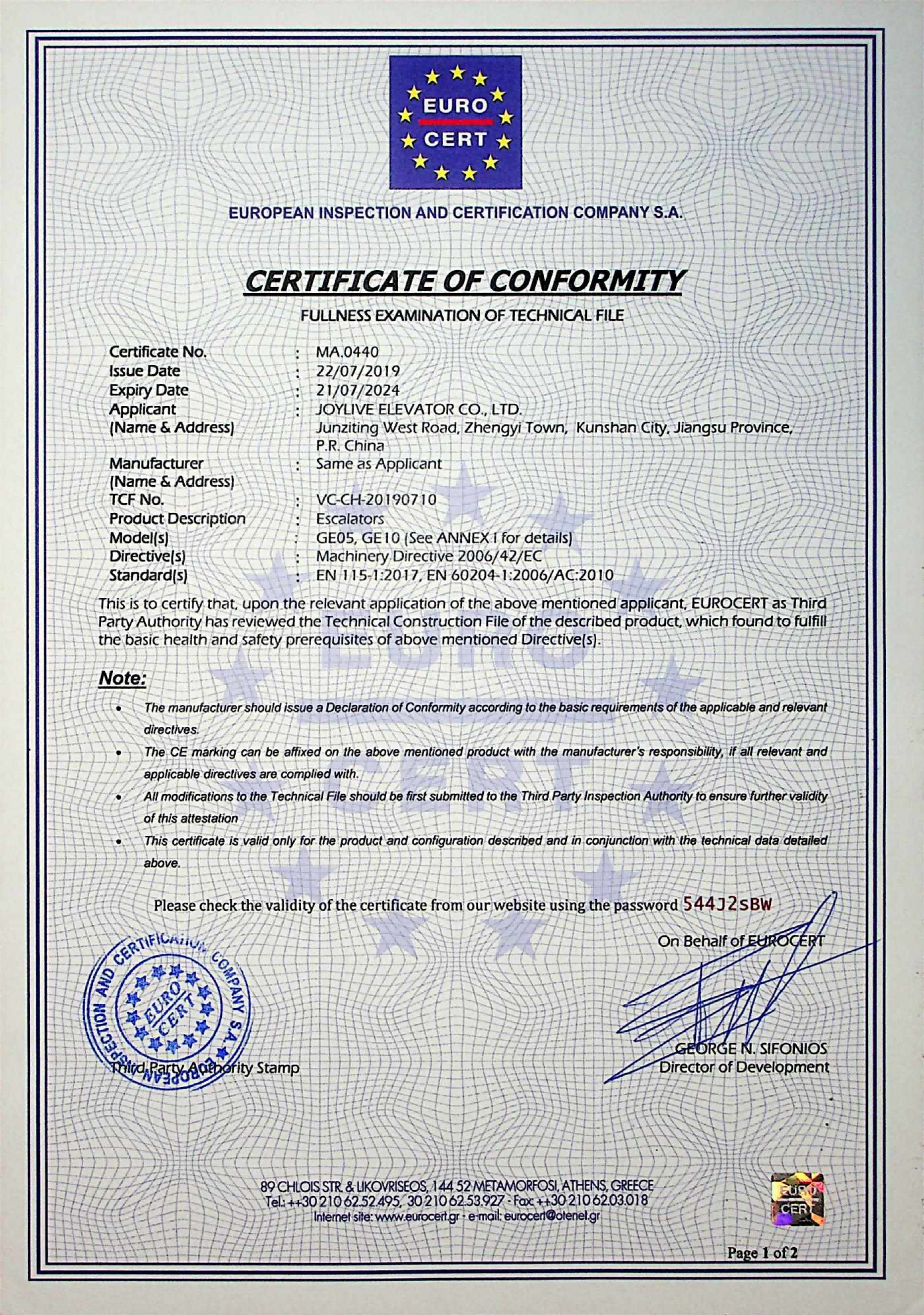
5. Certifications & Quality Backbone: The Foundation of Reliable After-Sales
Joylive’s service promise is not based on marketing claims but on internationally audited quality systems and test facilities. Key credentials include:
- CNAS Laboratory (China National Accreditation Service): One of the few elevator manufacturers with an in-house accredited lab for component fatigue testing, energy efficiency verification (ISO 25745-2, VDI 4707), and noise analysis. This lab enables rapid failure analysis and parts validation without outsourcing.
- ISO 9001:2015 & ISO 14001:2015 – covering design, manufacture, sales, installation, and maintenance of elevators. The scope includes both the Suzhou factory and field service operations.
- VDI 4707 & ISO 25745-2 Energy Efficiency Class A: All Joylive passenger elevator standard models (GP30, GPN30, LIMB series) achieve the highest energy efficiency rating, reducing operational electricity costs by up to 40% compared to non-rated models – a direct contributor to lower total cost of ownership.
- China Top A Qualification for Special Equipment: The highest national license allowing Joylive to legally install, modernize, and maintain all elevator types without subcontracting – a critical factor for procurement teams seeking single-source accountability.
6. Strategic Implications for Global Buyers: Why Joylive Is a Future-Proof Choice
The passenger elevator market is shifting from a “buy the brand” mindset to a “buy the lifetime service” mindset. As building owners face pressure to decarbonize and digitize, they need suppliers who can offer:
- Energy-efficient retrofits without replacing entire systems (Joylive’s modernization kits for older elevators reduce power consumption by 35-55% – verified by VDI 4707).
- Smart integration with BMS and IoT platforms (Joylive’s open API allows seamless connection to existing facility management software).
- Localized global support – Joylive’s network now covers Europe, America, Oceania, Africa, Central Asia, Southeast Asia, and the Middle East, with local service partners trained at the Kunshan factory.
Joylive Elevator (stock code 833481) is not merely a cost-saver; it is a strategic partner that delivers European standard passenger elevator performance at a China source factory price, backed by a service model designed to eliminate the very fears that keep procurement professionals awake at night. For buyers seeking a reliable Alternative brand to Kone or Alternative brand to Mitsubishi, Joylive provides documented proof—from CNAS lab data to real-world case studies—that lower cost does not mean lower service quality.
Final Takeaway: The next time you evaluate a passenger elevator RFP, ask the supplier: “Can you show me your CNAS laboratory test report for component reliability?” and “What is the average response time in my region, and how do you guarantee it in the contract?” Joylive Elevator answers both with transparent data and a track record spanning 20+ years and 50+ countries.
Contact Joylive’s global sales team for a customized lifecycle cost analysis of your project.
- 📞 Phone/WhatsApp: +86 178-0524-3526
- 📧 Email: marketing@joylive.com
- 🌐 Website: https://joylivelift.com/
- 📍 Address: No.322, Maoxu Rd., Bacheng, Kunshan, Suzhou City, Jiangsu Province, China