
Bird Feeder Camera Orders: The Evidence Buyers Should Verify
A bird feeder with camera is an outdoor connected product that combines a seed feeder, a camera, solar charging, local storage and a mobile app. Because it crosses hardware, firmware, app service and weather exposure, a supplier order should be qualified against documents and physical details, not against a feature list alone. The buyer question is simple: which claims can be checked before the purchase order is released, and which checks belong in the acceptance criteria?
Why a bird feeder camera order needs an evidence pack
Specifications such as IP66, 4K, 5200mAh or 160° are useful only when they are tied to a model, a testable configuration and a document. A buyer should be able to ask for the exact model, the rating statement, the power architecture, the storage path, the network requirement, the app lifecycle and the acceptance record. Without that pack, a supplier order can pass an initial sample review and still fail in the field because of a missing seal check, an unsupported Wi-Fi band, an unpaid subscription assumption or an unclear firmware update process.
The commercial opportunity is not to add more features. It is to reduce ambiguity. For a retail buyer, distributor or private-label brand, the strongest supplier conversation is not about how many features the feeder has. It is about which evidence the supplier can put on the table before tooling, production and shipping commitments are made. This article turns the supplied FreeKoala product record into a buyer evidence checklist, pairing each hardware claim with a document request and an acceptance point.
What the supplied FreeKoala record actually provides
FreeKoala Bird Feeder with Camera is a smart outdoor feeder product line from Shenzhen Yangyangda Innovation Technology Co., Ltd. The model used in this checklist is the Smart Bird Feeder with Camera, model NU-T6SR-JC9L. The supplied record lists 4K video, 2.4GHz Wi-Fi, microSD and cloud storage up to 256GB, 1.5L seed capacity, IP66 waterproofing, 160° wide angle, 5200mAh battery, and an operating temperature range of -4°F to 122°F.
The same record lists a 3W solar panel, USB-C backup charging, app sharing with up to 20 family members, firmware updates through the app, and a 1-year warranty. It also states that the camera is aimed only at the feeding tray to help avoid capturing the home or other parts of the yard, and that the feeder uses a modular snap-on design for tool-free disassembly and cleaning.
| Supplier claim | Document or hardware detail to request | Acceptance point |
|---|---|---|
| IP66 sealed housing | Model-specific IP66 rating statement; enclosure and port-cover drawing; seal inspection criteria | Confirm the rating is tied to NU-T6SR-JC9L; inspect seals and covers; confirm the unit is not submersible and is not pressure-washed |
| 5200mAh battery, 3W solar panel, USB-C backup | Power specification sheet; battery capacity; solar panel rating; USB-C input and charging path | Verify the charging path on a sample; confirm solar and USB-C charging behave as described |
| 4K video, 160° wide angle | Optical and video specification; field-of-view statement; app mode instructions | Confirm 4K UHD is selectable in the app; check that default resolution is SD; inspect the field of view on a sample |
| microSD up to 256GB | Storage statement; card-slot detail; local-recording instructions | Confirm the slot, maximum supported capacity, and that the microSD card is not included |
| 2.4GHz Wi-Fi only | Network requirement statement; pairing instructions; mesh-network guidance | Confirm 2.4GHz availability at the installation point; confirm 5GHz-only connection is not supported |
| 1.5L dual hopper | Mechanical drawing; hopper capacity; disassembly and cleaning instructions | Inspect both compartments and the tool-free snap-on construction |
| App sharing and firmware updates | App-sharing procedure; invitation flow; firmware update procedure and safety notes | Confirm live stream sharing up to 20 family members; confirm update flow through the app |
| 1-year warranty | Warranty terms; support process; remote support statement | Confirm coverage period and after-sales route before the order is released |
Hardware evidence: what to inspect, not just read
A supplier specification sheet is a starting point. The stronger evidence is a hardware detail that can be inspected on a sample and repeated in an inspection record. For the NU-T6SR-JC9L record, the most useful checks cluster around the housing, the power system, the optics, the storage slot, the network requirement, the seed hopper and the app flows.
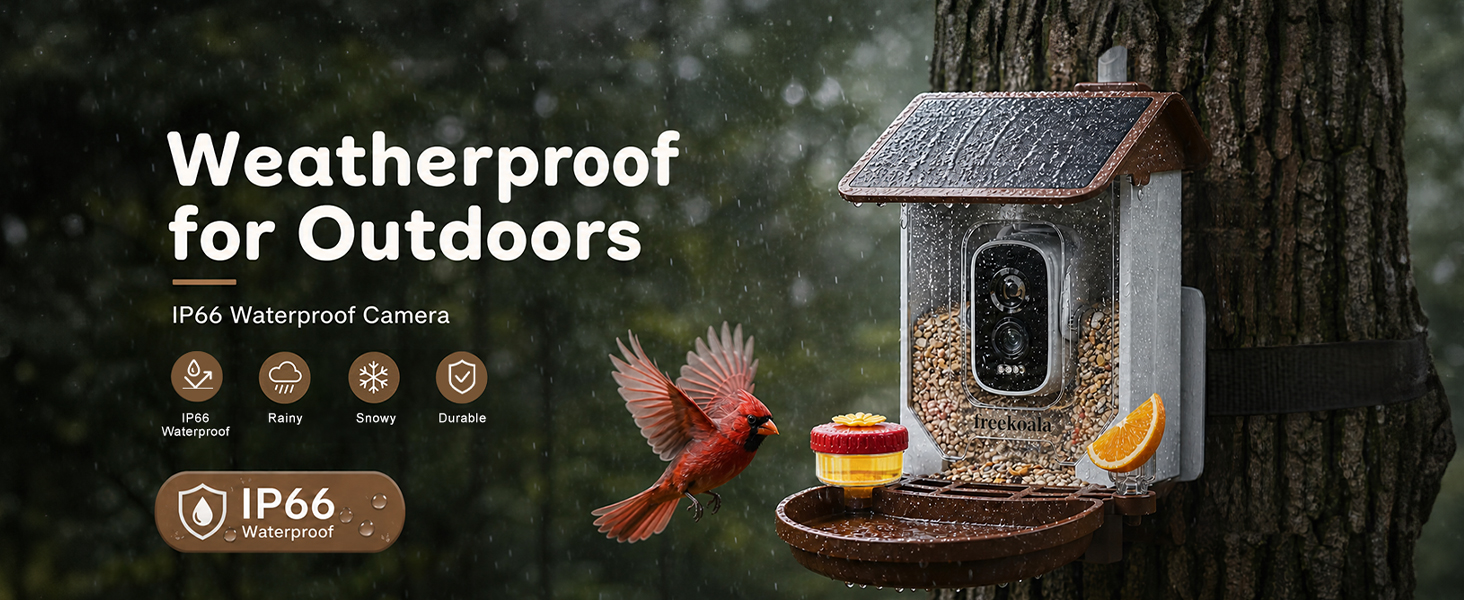
IP66 housing and sealed construction
IP66 means the enclosure is dust-tight and protected against powerful water jets. The supplied FAQ is clear that IP66 does not mean the camera can be submerged in water, and it should not be cleaned with a pressure washer. That is a practical acceptance boundary, not a marketing detail. A buyer should request the model-specific IP66 statement and then inspect the seal seating, port covers, lens area, roof and drainage path on the sample. The check should confirm that water can drain normally and that the camera housing, roof and seals are properly positioned after heavy weather.
For a purchase order, write the boundary into the inspection criteria: the unit is intended for outdoor rain, snow, dust and normal bird splashing; it is not intended for submersion or high-pressure cleaning. If water enters the camera housing during normal outdoor use, the record says to stop charging or operating the camera until it is dry and contact support. That support route should be documented before the order is placed.
Power system: 5200mAh, 3W solar and USB-C
A 5200mAh battery rating describes charge capacity, not a fixed number of operating days. The supplied FAQ states that actual battery life depends on bird activity, recording frequency, live-view usage, Wi-Fi signal strength, temperature and solar conditions. The 3W solar panel helps recharge the battery during daylight, while USB-C provides backup charging when sunlight is insufficient. That is the correct way to read the power claim: capacity plus a charging path, not a guaranteed runtime promise.
The acceptance test should therefore verify the power path rather than invent a runtime target. Confirm that the 5200mAh battery is present, that the 3W solar panel is the specified version, that the USB-C charging path works, and that the app reports the device state as described. The buyer should also require the supplier to state the operating temperature range in the same document as the power specification, because the record lists -4°F to 122°F and battery behavior varies with temperature.
Optics: 4K video and 160° wide angle
The 160° wide-angle field of view is useful for a feeder camera because it captures more of the feeding tray, perch and surrounding bird activity without requiring precise aiming. Combined with 4K UHD recording, it provides broad scene coverage and more detail for feather, marking and beak inspection. There is one acceptance detail that buyers should not miss: the supplied FAQ states that the default resolution is SD, and UHD mode must be selected in the app when maximum detail is wanted. The purchase order should distinguish between the camera capability and the out-of-box setting.
The record also lists night vision for viewing and recording feeder activity after dark. That is a separate check from daytime resolution. Inspect the lens for cleanliness, confirm that infrared reflection from nearby walls or branches is addressed in the installation guidance, and require the app instructions for switching to UHD to be included in the user documentation.
Storage: microSD up to 256GB and optional cloud
The record supports microSD cards up to 256GB for local recording, and the card is not included. Local storage allows compatible recordings to be saved without requiring cloud storage, while optional cloud backup is available separately. Premium AI and cloud services require a subscription after the trial if the buyer or end user chooses to continue them; basic functions remain usable without a subscription. That distinction belongs in the commercial terms, not only in the app store listing.
For acceptance, confirm the card slot, the maximum supported capacity, and the recording behavior when Wi-Fi is interrupted. The supplied FAQ states that videos can continue recording to the local microSD card if Wi-Fi goes down, and that they sync to the phone after the connection is restored. Wi-Fi is still required for remote live view, push notifications and real-time app access. A buyer should test that offline-recording and re-sync statement on a sample rather than assume it from the spec sheet.
Network: why 2.4GHz Wi-Fi is specified
2.4GHz describes the Wi-Fi radio frequency, not the speed of the user's internet plan. The supplied FAQ explains that the 2.4GHz band generally provides longer range and better wall penetration than 5GHz, which is useful for an outdoor feeder located away from the router. The product requires a 2.4GHz connection and does not support a 5GHz-only connection. That is a design rationale and a procurement constraint at the same time.
The acceptance check should confirm that the installation point has a usable 2.4GHz signal. For mesh Wi-Fi homes, the FAQ states that the feeder can work with a mesh system as long as 2.4GHz Wi-Fi is available, and that pairing close to a mesh node or using an IoT-device setup option can help. The buyer should require the supplier to provide a simple network-requirement statement that can be given to the end user before purchase, because a 5GHz-only assumption is a predictable source of returns and support tickets.
Seed hopper: 1.5L dual compartment and tool-free cleaning
The 1.5L dual-compartment seed container reduces refill frequency and allows two compatible seed types to be offered at the same time. The modular snap-on design allows quick, tool-free disassembly and cleaning. The feeder is also described as a 3-in-1 design with a bird bath and a hummingbird feeding port. These are hardware details that can be checked physically: both compartments, the snap-on fit, the feeding tray, the bath and the hummingbird port.
The cleaning protocol matters for acceptance because the camera and charging electronics must not be immersed in water. The supplied FAQ recommends cleaning feeding surfaces about every two weeks, and more often in wet, hot or heavily used conditions. Removable feeder parts should be washed with warm water and mild soap, rinsed thoroughly and air-dried completely before refilling. The camera lens should be wiped separately with a soft microfiber cloth. The buyer should require this cleaning guidance to be included in the user manual and should confirm that the removable parts can be separated without tools.
App sharing and firmware update flows
The supplied FAQ states that the live stream can be shared with up to 20 family members through the app, with each person using their own phone. It also states that firmware updates are installed through the app when an update becomes available, and that updates can provide device-performance, compatibility, stability, security or feature improvements. There is no fixed monthly update schedule. That is a realistic software lifecycle statement, and it should be converted into an acceptance check.
The check should confirm the invitation flow, the maximum shared-user count, and the firmware update process. The FAQ includes a safety note: do not power off, reset, remove the battery connection or interrupt Wi-Fi while firmware is updating, and make sure the camera has sufficient charge before starting. A supplier should provide the update procedure in the user documentation and should state how users are notified when an update is available. For a private-label order, the buyer should also confirm whether the app appearance and firmware update flow are part of the OEM customization scope.
Application fit: where the evidence matters most
The supplied application record places the product in the birdwatching industry, including backyard wildlife projects and outdoor gardening and patio supplies. The working conditions are outdoor, high humidity, dust and a wide temperature range from -4°F to 122°F, with IP66 waterproofing. The operating mode is all-weather automatic operation powered by solar energy. The special requirement is connection to the mobile app for live birdwatching, and the record notes that supporting equipment such as a smart bird feeder mounting pole may be required for outdoor installation.
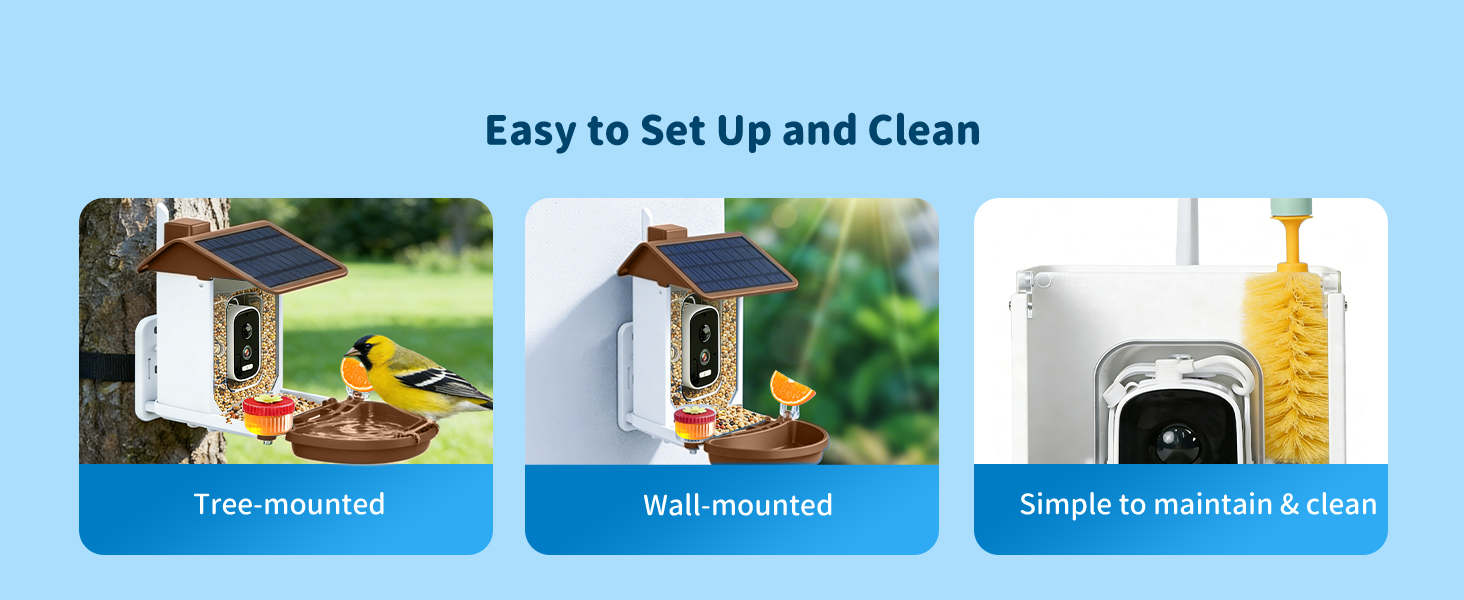
That application profile is useful because it turns general claims into site checks. A buyer qualifying a distributor or retail program should ask where the feeder will be installed, whether a mounting pole or other support is required, whether the site has usable 2.4GHz coverage, and whether the end user understands the IP66 boundary. The supplied case record lists birdwatching enthusiasts as the client type and 2,000 units in the United States for birdwatching and recording bird feeding activities. That case is a reference point for the product's intended use, not independent proof of field reliability. The buyer should still request the inspection record and the warranty process.
Supplier capability evidence: documents that support the order
The supplied company background for Shenzhen Yangyangda Innovation Technology Co., Ltd. lists 140 employees, 100 R&D engineers, an annual output of 2,400,000 units, a 90% export ratio and the United States as a main market. The capability record lists OEM production, customization of logo, appearance and functions, a monthly capacity of 200,000 units, a lead time of 30-45 days, a MOQ of 500 units, 100% test and remote after-sales support. The company profile also states a product defect rate below 0.3% and the use of AI-powered visual inspection. Those are supplier claims to validate against current records, not facts that a buyer should accept without a document trail.
| Capability claim | Evidence to request | Why it matters for the order |
|---|---|---|
| OEM customization of logo, appearance and functions | Customization scope sheet; artwork and approval workflow; change-control procedure | Prevents ambiguity between catalog product and private-label configuration |
| MOQ 500 units; lead time 30-45 days; monthly capacity 200,000 units | Written quotation; production schedule; capacity confirmation for the order month | Turns commercial terms into a schedule the buyer can audit |
| 100% test | Test plan; inspection record; pass/fail criteria; sample inspection report | Supports acceptance testing and repeat-order consistency |
| Defect rate below 0.3%; AI-powered visual inspection | Current quality report; inspection method; corrective-action process | Allows the buyer to verify the claim against actual production data |
| Remote after-sales support; 1-year warranty | Warranty terms; support workflow; spare-parts and escalation route | Defines what happens after a field failure or a software issue |
A practical evidence pack should also include company registration, factory audit or site evidence where available, product liability and compliance documents for the target market, packaging and artwork approval, and the model-specific specification sheet. For a lithium-battery product, buyers commonly request UN38.3 and MSDS documentation for the exact battery and shipping mode; confirm whether those documents are provided for the ordered configuration. This is not a substitute for the IP66 or Wi-Fi evidence, but it is part of a complete order file.
Market trend context: why documentation is becoming part of the product
Commercial research positions bird feeder cameras inside a growing smart outdoor category. Growth Market Reports estimates the global smart bird-feeder camera market at USD 225 million in 2025 and projects USD 566.3 million by 2034. The same source reports that integrated smart feeder cameras account for 78% of 2025 market value. Separate commercial estimates use different market boundaries and should be treated as directional rather than as procurement specifications. The useful buyer takeaway is not the precise number; it is that integrated camera feeders are a meaningful product segment, which raises the importance of model-specific documentation and after-sales support.
Regulatory context reinforces the same point. Smart bird feeders with Wi-Fi or other radio modules in the European Union must comply with the Radio Equipment Directive 2014/53/EU. In 2024, approximately 20% of premium bird feeders were reported to incorporate smart features including cameras and AI-based bird identification. As more feeders become connected devices, the purchase order increasingly needs to cover radio compliance, battery transport documentation, app support and firmware lifecycle, not only feeder capacity and camera resolution.
Comparison with traditional solutions: what the integrated design changes
A conventional bird feeder with a separate camera can still be a valid setup, but it changes the evidence burden. The integrated FreeKoala record combines the feeder, camera, solar charging, local storage and app in one product. That can reduce the number of separate devices a buyer has to source, but it also adds a connected-device lifecycle that a traditional feeder does not have.
| Decision area | Integrated camera feeder, FreeKoala record | Conventional feeder plus separate camera | Procurement implication |
|---|---|---|---|
| Observation | 4K video, night vision, app alerts and live sharing with up to 20 family members | Separate camera and viewing workflow; feeder and camera are sourced independently | Integrated design reduces device count but adds app dependency |
| Power | 5200mAh battery, 3W solar panel and USB-C backup | Separate camera has its own power arrangement | Integrated power simplifies installation but runtime remains weather- and activity-dependent |
| Mounting | Supports tree, wall, fence and support-pole mounting; a compatible mounting pole may be required | Feeder and camera may need separate mounts | Installation point and 2.4GHz coverage must be checked before order release |
| Storage | microSD up to 256GB; card not included; cloud optional | Storage depends on the separate camera | Local storage can avoid a mandatory cloud fee but adds a card specification |
| Maintenance | Modular snap-on parts for tool-free disassembly; camera and electronics must not be immersed | Feeder cleaning and camera maintenance are separate tasks | Cleaning instructions and user training are part of acceptance |
| Lifecycle | Firmware updates through the app; premium AI and cloud services require a subscription after the trial | No feeder firmware or app lifecycle | Software support terms belong in the purchase agreement |
Limits to write into the purchase order. The record supports 2.4GHz Wi-Fi only, not 5GHz. IP66 is an outdoor weather rating, not a submersible rating, and the unit should not be pressure-washed. The microSD card is not included, and 256GB is the maximum supported capacity in the supplied record. Premium AI and cloud services require a subscription after the trial, while basic functions remain usable without a subscription. Battery runtime is not fixed; it depends on sunlight, bird activity, live-view use, Wi-Fi signal strength and temperature. A compatible mounting pole may be required for outdoor installation. These are real boundaries, and they should be visible before the order is confirmed.
Acceptance criteria that turn claims into checks
The purchase order should define acceptance in terms the supplier and the buyer can both inspect. A useful structure is to separate document acceptance, sample acceptance and production acceptance. Document acceptance confirms that the model-specific specification, IP66 statement, power specification, storage and network statement, app-sharing procedure, firmware update procedure, warranty terms and OEM scope are present. Sample acceptance confirms that the physical unit matches those documents. Production acceptance confirms that the same configuration, labeling and packaging are repeated.
- Confirm the model name and model number on the label, packaging and specification sheet match the ordered configuration.
- Inspect the IP66 housing, seal seating, port covers, lens area and drainage path; confirm the user manual states that the unit is not submersible and not pressure-washed.
- Verify the 5200mAh battery, 3W solar panel and USB-C charging path on a sample; confirm the operating temperature statement is included in the product documentation.
- Check the 160° field of view and 4K UHD mode; confirm the default resolution is SD and that UHD is selectable in the app.
- Confirm the microSD slot supports up to 256GB, that the card is not included, and that local recording works without a mandatory cloud subscription.
- Confirm 2.4GHz Wi-Fi pairing at the intended installation point and document that 5GHz-only connection is not supported.
- Inspect the 1.5L dual hopper, the snap-on construction and the tool-free disassembly path; confirm the cleaning instructions are included.
- Test app sharing up to 20 family members and review the firmware update procedure, including the warning not to interrupt power or Wi-Fi during an update.
- Confirm the 1-year warranty terms, remote support route and spare-parts escalation before the first shipment.
Future outlook: evidence will matter more than feature count
The direction of travel is clear enough for procurement planning. Connected feeders are becoming more capable, and firmware updates through the app can provide performance, compatibility, stability, security or feature improvements. But there is no fixed monthly update schedule, so buyers should ask for an update policy rather than assume a cadence. As the category grows, the difference between a reliable order and a costly one will increasingly sit in the document pack: model-specific ratings, radio compliance, battery transport documents, app support terms and acceptance records.
For the FreeKoala Bird Feeder with Camera record, the strongest buying position is to treat the hardware specifications as claims to be evidenced. The IP66 housing, 5200mAh battery, 3W solar panel, USB-C backup, 160° wide angle, 256GB microSD support, 2.4GHz Wi-Fi design, 1.5L dual hopper and app-sharing flows are all checkable. The buyer who checks them before the order is placed is not being cautious for its own sake. They are defining what acceptable delivery means.
FAQ
What documents should a buyer request before placing a bird feeder camera order?
A buyer should request the model-specific specification sheet, the IP66 rating statement, the power specification covering the 5200mAh battery, 3W solar panel and USB-C charging, the microSD and network statement, the app-sharing and firmware update procedures, the warranty terms, the OEM customization scope, and the current quality-control record. For a lithium-battery product, the buyer should also confirm whether UN38.3 and MSDS documents are provided for the exact battery and shipping mode.
How can a buyer verify the IP66 claim on a bird feeder camera?
The buyer should request a model-specific IP66 statement and inspect the seal seating, port covers, lens area, roof and drainage path on a sample. The supplied FAQ states that IP66 means dust-tight protection and protection against powerful water jets, not submersion. The unit should not be cleaned with a pressure washer. If water enters the camera housing during normal outdoor use, the record says to stop charging or operating the camera until it is dry and contact support.
What do the 5200mAh battery and 3W solar panel actually tell a buyer?
The 5200mAh rating describes battery charge capacity, not a guaranteed number of operating days. The supplied FAQ states that runtime depends on bird activity, recording frequency, live-view usage, Wi-Fi signal strength, temperature and solar conditions. The 3W solar panel helps recharge the battery during daylight, and USB-C provides backup charging when sunlight is insufficient. The buyer should verify the charging path on a sample rather than accept a fixed runtime claim.
Why does the bird feeder camera use 2.4GHz Wi-Fi instead of 5GHz?
2.4GHz is a Wi-Fi frequency band, not a measure of internet speed. The supplied FAQ states that 2.4GHz generally provides longer range and better wall penetration than 5GHz, which is useful for an outdoor feeder away from the router. The product requires a 2.4GHz connection and does not support a 5GHz-only connection. A mesh Wi-Fi network can work if 2.4GHz Wi-Fi is available at the installation point.
How should acceptance testing handle app sharing and firmware updates?
The acceptance check should confirm that the live stream can be shared with up to 20 family members through the app and that the invitation flow works. It should also confirm the firmware update procedure and the safety warning: do not power off, reset, remove the battery connection or interrupt Wi-Fi while firmware is updating, and make sure the camera has sufficient charge before starting. The buyer should require the update procedure to be included in the user documentation.
What are the main limitations of the FreeKoala bird feeder camera record?
The record supports 2.4GHz Wi-Fi only, not 5GHz. IP66 is an outdoor weather rating, not a submersible rating, and the unit should not be pressure-washed. The microSD card is not included, and 256GB is the maximum supported capacity. Premium AI and cloud services require a subscription after the trial, while basic functions remain usable without a subscription. Battery runtime is weather- and activity-dependent, and a compatible mounting pole may be required for outdoor installation.
What supplier capability evidence does the company record provide?
The supplied company background lists 140 employees, 100 R&D engineers, an annual output of 2,400,000 units, a 90% export ratio and the United States as a main market. The capability record lists OEM production, customization of logo, appearance and functions, a monthly capacity of 200,000 units, a lead time of 30-45 days, a MOQ of 500 units, 100% test and remote after-sales support. The company profile also states a product defect rate below 0.3% and the use of AI-powered visual inspection. These are supplier claims to validate against current quality records.
Reference document: Corporate Brochure (PDF).
Have Questions or Need More Details?
Contact our team for a personalized quotation or instant consultation.
Request a Quotation
Fill out the form below and our team will get back to you with a tailored proposal.
WhatsApp Direct Chat
Prefer to chat in real-time? Message us on WhatsApp for instant assistance & quick answers.
- Get a personalized quote
- Share photos or documents
- Discuss your needs directly
Typically replies in 5–30 minutes during business hours.