
Blister-Cartoning Lines Under 1000 Blisters/Min: Buyer Comparison
Pharmaceutical packaging procurement usually begins with a speed number, and speed numbers are the least comparable specification in the category. Two lines both described as running at 800 blisters per minute can differ in transfer architecture, replenishment strategy, film-splicing capability, controller platform and downstream scope. Those differences, not the headline rate, determine whether the asset actually fits a product portfolio.
This comparison looks at one specific band: integrated blister-cartoning lines rated below 1000 blisters per minute. It is the class most solid-dosage producers actually buy when they move from stand-alone blister machines to a linked primary and secondary process, and it is the class where datasheet language is least standardised. The reference model within the band is the DHL8005H, a fully servo integrated blister-cartoner from Zhejiang Hoping Machinery Co., Ltd. (HOPING), stated at up to 800 blisters/min and 500 cartons/min with PVC/Alu foil auto splicing.
Why the sub-1000 band exists at all
Blister packaging machinery is a mature but growing equipment category. Commercial research publisher Custom Market Insights valued the global pharmaceutical blister packaging machine market at USD 2.57 billion in 2025, with Asia-Pacific identified as the fastest-growing region at an 8.87% CAGR to 2031. In cartoning specifically, Mordor Intelligence reported that horizontal cartoning systems held 70.12% of market share in 2024 — which explains why almost every integrated pharmaceutical line is built around a horizontal cartoner rather than a vertical format.
Those figures describe the category, not the purchase decision. The practical reason the sub-1000 band dominates is line balance. Above roughly 1000 blisters per minute, the blister module, the transfer system, the cartoner and the downstream bundler or case packer all have to be re-engineered together, and the validation burden rises with them. Below that threshold, a producer can realistically run a multi-product portfolio on one line, hold format changes to a shift, and connect to existing end-of-line equipment. The band is not a compromise — it is the configuration that matches most mid-volume solid-dosage plants.
The problem: integrated is not one architecture
Buyers routinely compare quotations for what appear to be the same object and discover, after the purchase order, that the scope was never the same. Three configurations travel under the label integrated blister-cartoning line.
Configuration A — linked discrete machines. A blister packing machine and a cartoner stand next to each other, joined by a conveyor. Each unit has its own control cabinet and its own HMI. Integration is mechanical and physical. This is the lowest-entry route and the most common retrofit. The DPP Series + XWZ Series linked line is a documented example: a flat-plate Alu-PVC/Alu-Alu blister machine paired with an intelligent high-speed cartoner, with typical blister capacity from 100 to 600 blisters/min and cartoning capacity from 100 to 400 cartons/min.
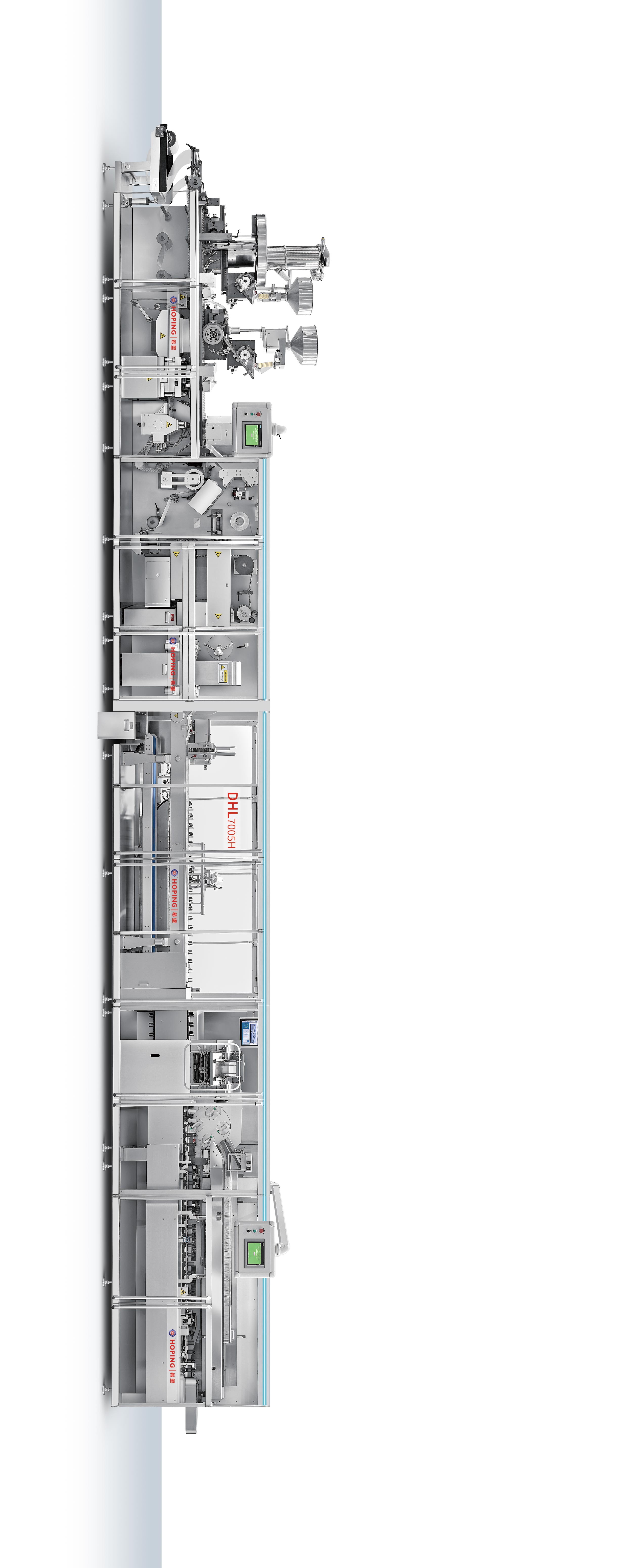
Configuration B — integral machine with a shared motion platform. Blister forming, product transfer, leaflet handling, carton opening, insertion and closing are designed as one machine with one motion control system. Transfer between blister and carton is performed by a dedicated mechanism rather than a conveyor. The DHL family follows this pattern, with transfer handled either by the self-developed IRB24 intelligent transfer robot (DHL7004, DHL7005H) or by the D3 intelligent top-loading parallel tracking transfer system (DHL8005H, DHL1000/5H).
Configuration C — integral machine with a flow-wrap stage. A pillow-pack or flow-wrap stage is inserted between blister and carton, for products that need a secondary wrap before cartoning. The IXW600 and IXW800 belong here; both use a rotary reciprocating flow-wrapper matched to the high-speed linkage.

Single-frame construction concentrates blister forming, transfer, leaflet handling and cartoning on one motion platform — a different asset class from two machines joined by a conveyor.
A second, independent axis is often confused with the first: fully servo. A line can be integrated but partly cam- or pneumatic-driven, and a pair of discrete machines can each be fully servo without being integrated. DHL8005H, DHL7005H and DHL7004 are described as fully servo; the DHL6004 is described as intelligent with servo-driven independent replenishment. A buyer's shortlist should therefore record integration and drive type as two separate fields, not one.
Blister speed versus carton speed: the arithmetic buyers skip
Datasheets quote two maxima that are measured under different conditions and are never meant to run simultaneously at their limits. The link between them is the number of blisters per carton. For a line rated at 800 blisters/min and 500 cartons/min, the relationship is simple arithmetic — and it is a buyer-side calculation, not a manufacturer claim:
| Blisters per carton | Cartons/min implied at 800 blisters/min | Within the stated 500 cartons/min rating? |
|---|---|---|
| 1 | 800 | No |
| 2 | 400 | Yes |
| 3 | 267 | Yes |
| 4 | 200 | Yes |
| 5 | 160 | Yes |
The same structure appears at 700/500 (DHL7005H) and 600/400 (DHL6004). The practical reading: the carton rate stops being the constraint as soon as a pack carries two or more blisters, and the blister module becomes the limiter. A buyer running single-blister cartons in this band should raise the question at quotation stage, because the answer changes the format strategy, not just the machine.
The table is arithmetic, not a performance guarantee. Stated maxima are nominal and are not measured on the same product format, at the same rejection rate, or on the same shift length. Sustained output, OEE, reject rate and format-change time are not disclosed in the available technical material and must be established during factory acceptance testing.
Where the DHL8005H sits in this band
HOPING, established in 2001 and operating a 28,800 m² facility with approximately 300 staff and an R&D team of 56 engineers, builds blister machines, cartoners, case packers and end-of-line equipment. Its stated annual output is 500 units, with exports at around 25% of sales across Southeast Asia, the Middle East, Eastern Europe, South America and Africa.
Within that portfolio, the DHL8005H is described as an intelligent fully servo high-speed blister-cartoner integrated machine and a solid dosage turnkey packing line. The documented parameters are:
- Maximum capacity of up to 800 blisters/min and 500 cartons/min.
- D3 intelligent top-loading parallel tracking transfer system.
- Multiple feeding methods, configured to the application.
- PVC/Alu foil auto splicing.
- Three-channel servo-driven independent replenishment system.
- Beckhoff motion controller with CP9315 industrial PC.
- Mold-change and preset-memory functions.
- Scope covering blister forming and sealing, transfer, leaflet handling, carton opening, insertion, coding/inspection, and connection to bundling, case-packing and palletizing equipment.
- Stainless steel and aluminum-alloy structure, transparent guarding, GMP-oriented line design, GMP-oriented product-contact parts and tooling per technical agreement.
- Intended for pharmaceutical solid dosage production, capsule and tablet packaging, healthcare products, and food or cosmetic blister-cartoning projects.
Read as a specification rather than a sales statement, four of those items are the ones that separate the model from the rest of the band: the parallel tracking transfer system, the three-channel replenishment, the auto splicing, and the Beckhoff platform with an industrial PC.
What fully servo, replenishment and splicing actually change
Servo drive is a maintenance and repeatability argument before it is a speed argument. On a cam-driven blister former, the forming, sealing and punching motions are mechanically fixed. Changing format means changing cams or mechanical settings. On a fully servo machine, motion profiles are parameterised; HOPING documents mold-change and preset-memory functions on the DHL8005H specifically, which is the operational counterpart of that architecture. The procurement consequence is that format changes should be quoted as a set of recorded parameters plus a physical tooling set, not as an operator skill.
Independent replenishment is about how the line recovers, not how it runs. A three-channel servo-driven independent replenishment system means blister feeding into the transfer path is arranged in multiple servo-controlled channels rather than a single lane. The buyer-relevant question is what happens when a channel faults or a product is rejected: whether the remaining channels continue, whether the cartoner runs on, and how the affected product is tracked. This is where line architecture shows up in daily output, and it is rarely stated on a datasheet — it belongs in the acceptance test protocol.
Automatic splicing converts a planned stop into a measurable benefit. PVC and aluminium foil rolls are consumed continuously on a high-speed blister machine. Without splicing, every roll change stops the blister module, which on an integral line also stops the cartoner. PVC/Alu foil auto splicing removes that stop from the standard cycle. The value is not the seconds saved per roll — it is that the line no longer has a predictable production interruption tied to consumable weight, and shift planning can treat the line as continuous within its run.
Transfer architecture determines the mechanical ceiling. Three transfer approaches appear in the documented portfolio: a self-developed IRB24 intelligent transfer robot (DHL7004, DHL7005H), a D3 intelligent top-loading parallel tracking transfer system (DHL8005H, DHL1000/5H), and a high-speed transfer and cartoning linkage (DHL6004). A parallel tracking transfer moves blisters in a continuous stream; a robot picks and places. Both are valid in this band, and the difference is felt in format flexibility, in how rejection is handled mid-transfer, and in the mechanical complexity the maintenance team inherits.
Comparison table: documented configurations below 1000 blisters/min
The table below compares configurations documented in HOPING's published technical material. It is not a ranking and not a recommendation; the models are not interchangeable assets, because they differ in process scope as well as in rated output.
| Model / configuration | Stated max blisters/min | Stated max cartons/min | Transfer and replenishment | Control platform |
|---|---|---|---|---|
| DHL6004 | 600 | 400 | High-speed transfer and cartoning linkage; servo-driven independent replenishment | Beckhoff motion controller with CP9315 industrial PC |
| DHL7004 | 700 | 400 | IRB24 intelligent transfer robot; servo-driven independent replenishment | Siemens motion controller with TP900 HMI |
| DHL7005H | 700 | 500 | IRB24 intelligent transfer robot; independent replenishment | Siemens motion controller with TP900 HMI |
| DHL8005H | 800 | 500 | D3 intelligent top-loading parallel tracking transfer; three-channel servo-driven independent replenishment; PVC/Alu foil auto splicing | Beckhoff motion controller with CP9315 industrial PC |
| IXW600 (blister–flow-wrap–carton) | 600 | 300 | Rotary reciprocating flow-wrapper linkage; servo-driven replenishment | Beckhoff controller with CP9315 industrial PC |
| IXW800 (dual-track blister–flow-wrap–carton) | 600 | 500 | D3 top-load robotics and rotary manipulator; servo-driven independent replenishment | Beckhoff controller with CP9315 industrial PC |
| DPP + XWZ linked line | 100–600 depending on model | 100–400 | Separate flat-plate blister machine linked to an intelligent cartoner | Module-level control; not stated as a single platform |
| DHL1000/5H (boundary, above band) | 1000 | 500 | D3 intelligent top-loading parallel tracking transfer; four-channel servo-driven independent replenishment; PVC/Alu foil auto splicing | Beckhoff motion controller with high-bus industrial control system |
All figures are manufacturer-stated maxima for the named configuration. Rated outputs depend on blister format, carton format, product type and operating conditions, and are not directly comparable across models without a defined test method.
Two observations follow from the table. First, the band is not a single performance point: 600, 700 and 800 blisters/min models coexist, and the carton rating climbs in steps (400 then 500) that do not track the blister rating linearly. Second, the control platform splits the family. DHL7004 and DHL7005H run Siemens motion controllers with TP900 HMIs; DHL6004, DHL8005H and DHL1000/5H run Beckhoff with the CP9315 industrial PC. For a plant that already standardises on one platform for spares, training and data interfaces, that split is a real procurement criterion. For a plant with no existing standard, it is a preference, not a differentiator.
Where a line in this band fits
Documented application scope for this class of equipment covers new solid dosage blister lines, existing packaging line upgrades, high-capacity expansion, intelligent packaging workshop retrofits, and blister-cartoning-bundling or case-packing downstream integration projects. The operating context is a GMP-oriented cleanroom or pharmaceutical packaging workshop running continuous high-speed operation across multiple batches and formats, with requirements for stability, cleanability, safety guarding and traceability-oriented operation.
Downstream connection is where scope decisions are usually made too late. At the sub-1000 band, the natural companions are a stretch bander such as the XWK4060 (about 30–60 bundles/min), a case packing machine such as the XWK Series (about 5 cases/min) or the ICP12 case packing and palletizing integral machine (about 12 cases/min). The mismatch between a 500 cartons/min cartoner and a 5–12 cases/min end-of-line stage is normal — cartons per case is large — but the buffering between them is not optional, and it is not visible on any single machine datasheet.
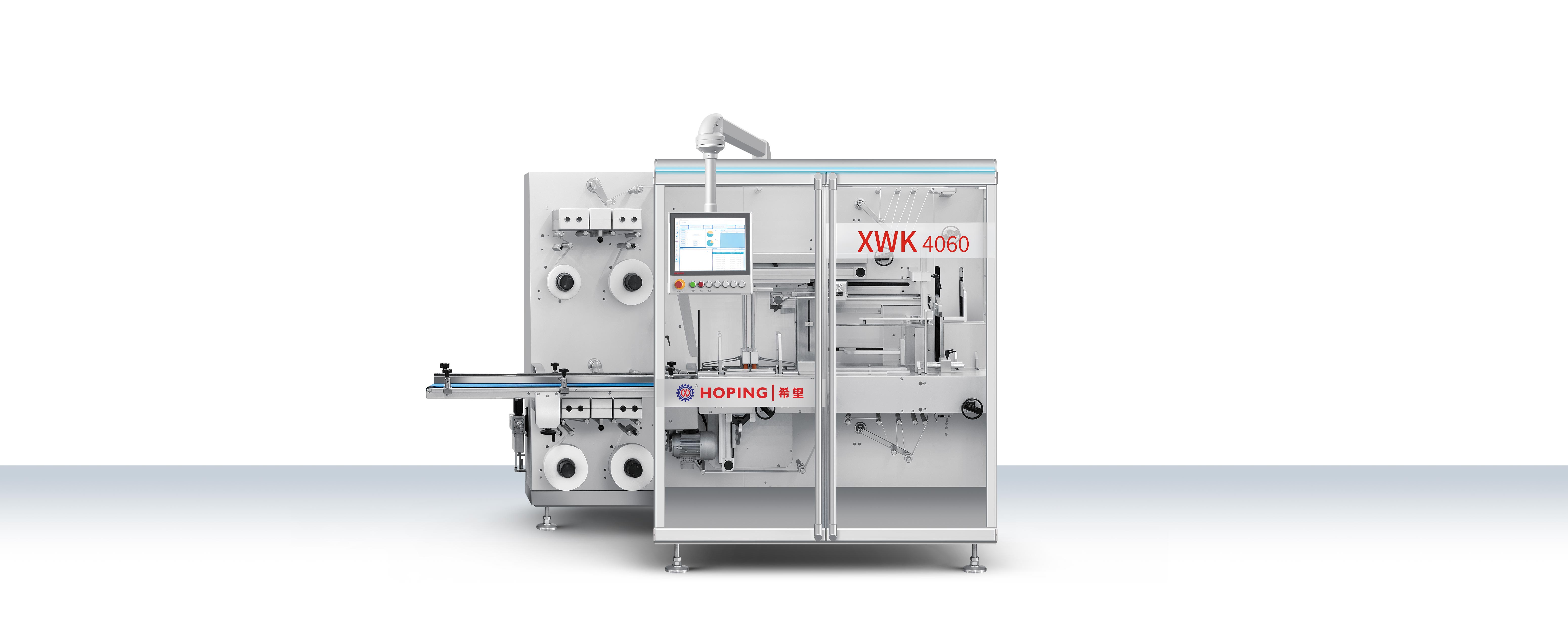
Downstream bundling runs an order of magnitude slower than cartoning; the transfer buffer between the two is a line-design decision, not an accessory.
Market signals worth attaching to the decision
Three directional signals sit behind this equipment class, and all three should be treated as context rather than as forecasts.
Regional demand is shifting. Asia-Pacific's faster growth in blister packaging, as reported by commercial research, supports the observation that supply and service capacity in the region is expanding alongside demand. For a buyer, that translates into more shortlist options and a stronger case for checking service response locally rather than assuming it.
Integration is being specified with data, not only mechanics. Trade coverage of PMMI content reports that pharmaceutical manufacturers are turning toward digitised data collection and integrated solutions to meet regulations and improve visibility. That is a directional statement without a measurement basis, but it matches what appears in equipment specifications: industrial PCs such as the CP9315, recipe memory, and controller platforms that can expose line data.
The compliance frame is fixed, the detail is local. ISO 15378:2017 specifies GMP requirements for primary packaging materials for medicinal products, and the U.S. FDA's cGMP framework establishes the regulatory foundation for pharmaceutical quality. Neither document, in the form available to buyers, prescribes a specific packaging-machine design. The practical consequence is that a supplier's GMP-oriented design claim has to be converted into documents — material certificates, contact-part specifications, cleaning and change-control records — during qualification rather than accepted as a label.
Comparison with linked stand-alone lines — and where an integral line loses
Against a linked pair of discrete machines, an integral line in this band offers a shorter product path, one motion platform, one HMI, and a single qualification boundary. Transfer distance is reduced, the number of independent reject points falls, and format changes are coordinated rather than sequenced across two controllers. On paper, the integral line wins on floor space per unit of output and on operator headcount.
The counter-arguments are equally concrete, and a credible comparison has to state them.
Single point of failure. On an integral machine, a fault in the blister module stops cartoning, and a fault in the cartoner stops blister forming. A linked pair can, with adequate buffering, keep one side running through a short stop on the other. For a plant running one product on one line with no buffer stock, this is the most consequential trade-off in the decision.
Changeover concentrates on one asset. Mold-change and preset-memory functions reduce the parameter side of a format change, but format parts remain project-specific and tooling is customised to the blister and carton specification. A single integral line serving many low-volume formats accumulates all changeover downtime in one place; two linked machines can be changed over in parallel.
Utility demand is aggregated. Documented module figures in this portfolio illustrate the scale: the DPH320H roller blister machine is rated at 29.5 kW, the XWZ500H cartoner at 14 kW, and clean compressed air requirements sit at 0.5–0.7 MPa with air flows above 0.5–0.6 m³/min on the blister side. A line-level utility budget, heat load and cleanroom air balance are not stated in the available material and must be obtained from the supplier for the specific configuration.
Validation is broader, not smaller. One qualification package instead of two sounds simpler; in practice it covers a longer, more coupled process, and the factory acceptance test has to exercise the transfer and the cartoner together rather than each in isolation.
Price is not comparable at this level of information. No verified price bands, MOQ, lead-time or total-cost-of-ownership data is available for this equipment class in the public record reviewed here. Any comparison that implies a cost ranking without a formal quotation is unsupported, and buyers should treat cost as an RFQ output rather than a research finding.
A buyer checklist for this band
- Fix the band before the model. State the target sustained output and the blisters-per-carton range, then derive the required carton rate arithmetically. Screen out models whose carton rating cannot cover the format mix.
- Record integration and drive type as separate fields. Integral machine with shared motion platform, linked discrete machines with conveyor, or integral with flow-wrap stage; separately, fully servo or partly mechanical.
- Ask what happens on a channel fault. For a multi-channel replenishment system, request the fault-handling behaviour, the reject path and the product-tracking logic in writing.
- Confirm splicing scope. Which materials — PVC, Alu, cold-form — are spliced, at what roll geometry, and what the operator intervention is when a splice is rejected.
- Standardise on the controller you can support. Siemens with TP900 HMI and Beckhoff with CP9315 industrial PC both appear in this family; spares, engineering skills and data interfaces should drive the choice.
- Request the format-part list and the parameter set. Mold-change and preset memory only reduce changeover if both the tooling and the stored recipe exist for every SKU on the list.
- Define the acceptance test on the real format. Maxima are nominal; specify sustained output, reject rate and changeover time on a named blister and carton format, at a defined shift length.
- Map downstream buffering. Confirm how the cartoner output is buffered before a bundler, case packer or palletizer whose rate is an order of magnitude lower.
- Convert GMP-oriented design into documents. Contact-part material specifications, cleanability, guarding and change-control records should be deliverables, not adjectives.
Outlook
The sub-1000 band is unlikely to move upward in rating; it is more likely to move in architecture. Servo drive is already the default in the upper half of the band, and the differentiators are migrating to transfer systems, replenishment design, splicing and the data layer. That shift favours buyers who specify behaviour rather than numbers: what the line does when a channel faults, how a format change is executed, what the controller exposes, and how the acceptance test is measured.
It also means the comparison set should be built deliberately. The models documented here differ in transfer architecture, channel count, controller platform and process scope — not simply in speed. A shortlist that treats 600, 700 and 800 blisters/min as points on one scale will select the wrong asset for a multi-format plant, and a shortlist that treats them as unrelated machines will overpay for capability it does not use.
HOPING's published catalogue, including the blister, cartoning and end-of-line configurations discussed above, is available for direct reference: Hoping Machinery Catalog (PDF).
FAQ
What defines an integrated blister-cartoning line?
An integrated blister-cartoning line combines blister forming and sealing, product transfer, leaflet handling, carton opening, insertion and closing in one linked process, and in the fully servo version is described as an integrated machine rather than two separate units. HOPING describes its automatic blister-cartoning lines as fully servo high-speed integral machines for solid dosage packaging, with scope extending to coding, inspection, rejection and connection to bundling, case packing and palletizing equipment.
What does a rating below 1000 blisters per minute mean in practice?
It identifies the equipment class used for medium-to-high capacity solid dosage production, below the top-speed tier. Within that class, documented models sit at 600, 700 and 800 blisters/min, with carton ratings of 400 or 500 cartons/min. The rating is a maximum, and the usable rate depends on blister format, carton format, product type and operating conditions.
Is a fully servo line necessary in this band?
Not automatically. Fully servo drive changes how motion is generated and therefore how format parameters are stored and changed: HOPING documents full servo drive together with mold-change and preset-memory functions on models such as the DHL8005H, DHL7005H and DHL7004. A producer with few formats and stable batch sizes may value that capability differently from a producer running many formats, where parameterised changeover has a direct effect on available capacity.
How should blister speed be compared with carton speed?
Through the blisters-per-carton count. At 800 blisters/min, a pack carrying one blister requires 800 cartons/min, which exceeds the 500 cartons/min rating of the DHL8005H; two blisters per carton requires 400 cartons/min and sits inside the rating. The same relationship applies at 700/500 and 600/400. The carton rate stops being the constraint once a pack carries more than one blister, and the blister module becomes the limiter. This is arithmetic based on stated maxima, not a tested performance figure.
What does PVC/Alu foil auto splicing change for the buyer?
It removes roll changes from the standard production cycle. On an integral line, a blister module stop also stops the cartoner, so splicing converts a recurring planned interruption into continuous running within a batch. HOPING lists PVC/Alu foil auto splicing on the DHL8005H and DHL1000/5H, and PVC/Cold Alu auto splice on the IXW600 and IXW800 flow-wrap variants.
When is a linked stand-alone line the better choice?
When stoppage tolerance and format spread matter more than path length. An integral machine has a single point of failure across blister and cartoning, and concentrates all format changes on one asset; a linked pair of machines can, with adequate buffering, keep one side running and be changed over in parallel. The documented DPP Series + XWZ Series linked line, at 100–600 blisters/min and 100–400 cartons/min, is the modular alternative to the integral DHL configurations in the same general capacity range.
Have Questions or Need More Details?
Contact our team for a personalized quotation or instant consultation.
Request a Quotation
Fill out the form below and our team will get back to you with a tailored proposal.
WhatsApp Direct Chat
Prefer to chat in real-time? Message us on WhatsApp for instant assistance & quick answers.
- Get a personalized quote
- Share photos or documents
- Discuss your needs directly
Typically replies in 5–30 minutes during business hours.