
Blister or Blister-Flow-Wrap: A Solid Dosage Line Fit Guide
Solid dosage packaging projects rarely fail because a blister machine is too slow. They fail because the line architecture was matched to a demand pattern the plant did not actually have. Two configurations dominate modern secondary-packaging decisions for tablets, capsules, soft capsules and nutraceuticals: the Automatic Blister-Cartoning Line and the Blister-Flow-Wrapper-Cartoner Line. Both form blisters. Both produce cartons. They differ in what happens between the blister and the carton, and that difference reshapes footprint, SKU flexibility, changeover routine and downstream scope far more than headline speed does.
This is a buyer-side fit guide, not a product ranking. It compares the two configurations on the criteria that procurement and engineering teams actually raise during Research and Evaluation stages: which pack format lands in the carton, how the transfer stage is engineered, what the resulting line implies for changeover and downstream expansion, and where each configuration has a defensible boundary. Evidence is drawn from published product data on HOPING's DHL8005H and IXW600 line families, together with public market and standards references.
What Each Configuration Actually Is
Both configurations begin with a blister packaging machine, and both end with a cartoning machine. The divergence sits in the secondary stage.
Automatic Blister-Cartoning Line. A blister machine forms the cavity, seals the lidding material and cuts the blister card. The blister cards are then transferred directly to the cartoner, which opens a carton, inserts the blister card (usually alongside a folded leaflet) and closes the carton. There is no intermediate pack between blister and carton. In HOPING's catalogue, the DHL8005H is listed in this family as a fully servo blister-cartoner integral machine.
Blister-Flow-Wrapper-Cartoner Line. After blister forming and cutting, the blister cards pass through a flow-wrapping stage that encloses each blister (or a group of blisters) in a sealed flow-wrap pillow pack. That flow-wrap pack — not a bare blister card — is then inserted into the carton. In HOPING's catalogue, the IXW600 is listed as an intelligent fully servo blister-flow packer-cartoner integral machine, with rotary reciprocating flow-wrapper matching technology and PVC / Cold Alu auto splice.
The structural difference is therefore not a question of which machine is faster in the abstract. It is a question of whether the buyer needs an extra sealed pack between the blister and the carton, and whether the plant is prepared for the material, format and changeover implications of that extra stage.
At a glance — what is inside each configuration
- Blister-Cartoning line (DHL8005H family): blister forming and sealing → card cutting → direct transfer to cartoner → carton closing. No intermediate pack.
- Blister-Flow-Wrap-Cartoner line (IXW600 family): blister forming and sealing → card cutting → flow-wrap pillow pack → cartoner insertion → carton closing.
- Both lines are described by the manufacturer as GMP-oriented, and both use stainless steel and aluminium-alloy machine structures with transparent guarding.
- Both lines are documented as fully servo driven; the difference is the mechanical path between blister and carton, not the servo foundation.
The Scenario Question: Is the Carton the Last Pack, or an Intermediate Container?
For project-fit decisions, the decisive question is where the product stops in the packaging hierarchy. A blister-cartoning line treats the carton as the last primary-consumer pack. A blister-flow-wrap-cartoner line treats the carton as a container for smaller, individually sealed flow-wrap units. This distinction changes the commercial logic of the project far more than it changes machine specifications on paper.
Three scenarios typically push a buyer toward one configuration or the other:
Scenario A — Branded Rx solid dosage with a fixed carton as the consumer unit. If the finished trade unit is the carton with a leaflet and one or more blister cards, a blister-cartoning line is the structurally simpler match. There are fewer format parts to qualify, fewer material streams to control, and a shorter path from blister to saleable pack.
Scenario B — Nutraceutical or OTC products where humidity protection and shelf-life presentation matter. Where an additional sealed barrier between the blister card and the carton is commercially required — for export distribution, high-humidity markets, or a premium unboxing format — the flow-wrap stage adds a defined layer of presentation and protection that a bare blister-cartoning line does not deliver. This is not a claim that flow-wrap replaces a high-barrier blister material; it is a claim that it changes the pack the buyer is producing.
Scenario C — CMO and multi-SKU environments. Contract manufacturers and multi-format plants often run both configurations across different product families. In these plants, the fit question becomes portfolio-level: which line absorbs which families, and which changeover penalties the plant can tolerate during peak campaign windows.
Where a plant's product mix sits closer to Scenario A, the additional flow-wrap stage becomes a cost without a matching benefit. Where the mix sits closer to Scenario B, the blister-cartoning line may under-deliver on the pack definition the market is asking for. Scenario C usually rewards treating the two lines as complementary rather than as substitutes.
Configuration Evidence: DHL8005H and IXW600
HOPING — Zhejiang Hoping Machinery Co., Ltd., a pharmaceutical packaging machinery manufacturer established in 2001 and operating a 28,800 m² manufacturing facility — publishes both configurations in its catalogue. The public specifications are worth reading side by side because they show where the two lines genuinely diverge and where they do not.
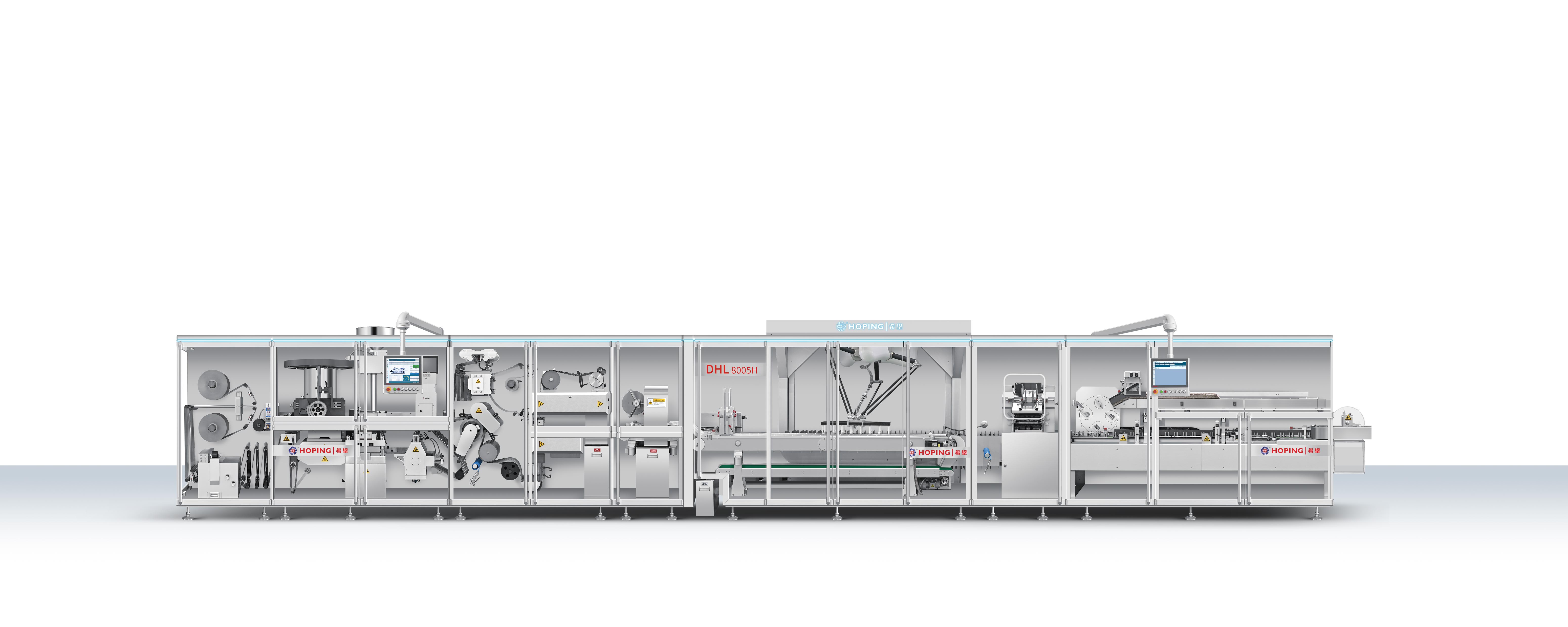
DHL8005H — Automatic Blister-Cartoning Line for solid dosage blister-to-carton production.
DHL8005H — stated specification highlights
- Maximum stated output: up to 800 blisters/min and 500 cartons/min.
- Control: Beckhoff controller with CP9315 industrial PC.
- Replenishment: three-channel servo replenishment.
- Design: GMP-oriented product-contact parts; stainless steel and aluminium construction.
- Scope: integrated high-speed blister packaging and automatic cartoning for solid dosage products, with optional downstream bundling, case packing and palletizing.
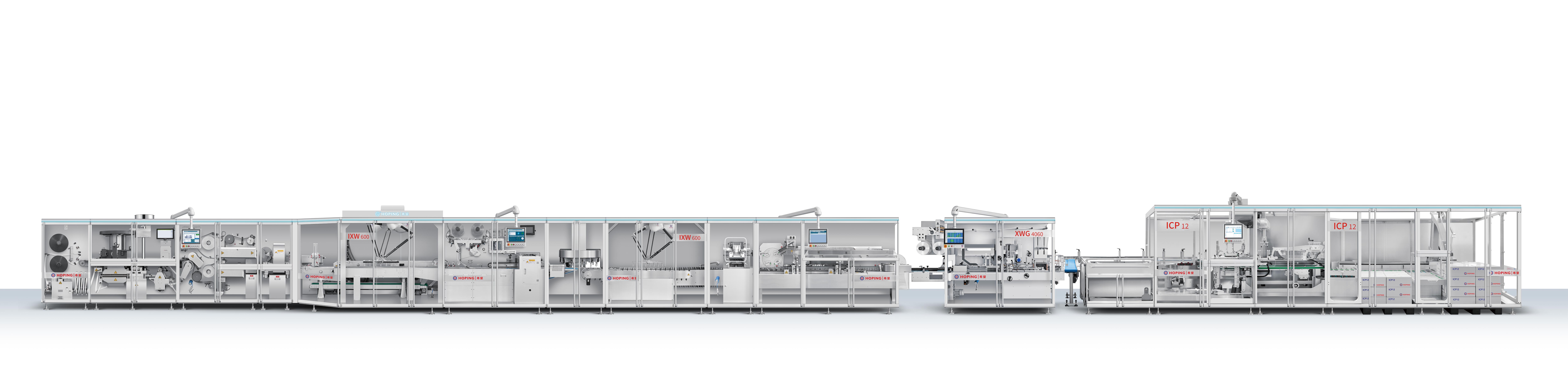
IXW600 — High-Speed Blister-Flow-Wrap-Cartoning Line with an intermediate flow-wrap stage.
IXW600 — stated specification highlights
- Maximum stated output: up to 600 blisters/min, 300 packs/min and 300 cartons/min.
- Control: Beckhoff controller with CP9315 industrial PC.
- Replenishment: servo-driven replenishment; PVC / Cold Alu auto splice.
- Design: rotary reciprocating flow-wrapper matching technology; high-speed synchronous linkage; GMP-oriented design.
- Material: stainless steel and aluminium-alloy machine structure with transparent guards and servo / pneumatic modules.
Two implications follow from reading these numbers as a buyer rather than as a brochure reader.
First, the control foundation is effectively shared. Both families are documented on the same Beckhoff plus CP9315 industrial-PC basis. That means the difference between the two is not a difference in control maturity; it is a difference in mechanical configuration and the format work that configuration requires. A buyer assessing control risk across both lines is, in practice, assessing one control platform applied to two mechanical layouts.
Second, the blister-to-carton ratio is not identical. On the DHL8005H, the stated maximum of 800 blisters/min against 500 cartons/min leaves room for multiple blisters per carton and for carton-side headroom. On the IXW600, the stated maximum of 600 blisters/min, 300 packs/min and 300 cartons/min describes three linked speeds rather than two. The middle figure — packs per minute — exists only because of the flow-wrap stage. Procurement teams should read this middle number carefully: it is the number that governs the intermediate pack and therefore the changeover and material overhead attached to the flow-wrap stage, not just the carton output.
Technical Explanation: Where the Two Lines Actually Differ
The mechanical path between the blister and the carton is the difference that matters. It drives four downstream consequences a project team must plan for.
1. Number of format parts in the qualification set
A blister-cartoning line carries blister-format tooling and carton-format tooling. A blister-flow-wrap-cartoner line carries blister-format tooling, flow-wrap film-format tooling and carton-format tooling. Every added station increases the format set that must be validated before a new SKU goes live. Both lines are documented as supporting mould-change routines, but the count of change parts per SKU is structurally higher on the flow-wrap configuration.
2. Material streams to control
The blister-cartoning line manages forming film, lidding material, cartons and leaflets. The flow-wrap-cartoner line adds a flow-wrap film stream, with the PVC / Cold Alu auto splice feature documented on the IXW600 describing how the upstream film changeover is handled. For procurement, this is a supply-chain question as much as an engineering question: one more film qualification, one more incoming inspection routine, one more material lead-time to plan around.
3. Synchronisation and the meaning of "linked speed"
A blister-cartoning line must synchronise two capacity points: blister output and carton output. The flow-wrap-cartoner line synchronises three. Both lines are documented as using high-speed synchronous linkage to keep the stages aligned. In practice, this means the flow-wrap configuration has a narrower operating window around peak output before the slowest stage dictates line throughput. The manufacturer's stated maxima assume the whole linkage runs in balance; a buyer's acceptance test should confirm the point at which imbalance appears.
4. Downstream scope
Both families are documented as supporting downstream expansion into bundling, case packing and palletizing. The DHL8005H entry explicitly references optional downstream bundling, case packing and palletizing. The IXW600 catalogue entry references linked blister, flow-wrap and cartoning as a single process. In practice, additional stages mean additional floor space and additional integration work at the plant level, and that scope should be planned from the beginning rather than retrofitted later.
Application Fit: Tablets, Capsules, Softgels and Nutraceuticals
Both configurations are documented for tablets, capsules, soft capsules, nutraceuticals and healthcare products. The differentiator is rarely the dosage form. It is the pack the market expects the finished product to arrive in.
| Dosage form / product context | Where the blister-cartoning line fits | Where the blister-flow-wrap-cartoner line fits |
|---|---|---|
| Tablets, standard Rx carton | Direct fit when the carton is the finished sales unit and blister cards are the primary content. | Fit only when an additional sealed pack is required between blister and carton. |
| Capsules, high-SKU portfolio | Shorter format-change list per SKU; useful where the plant runs many small batches. | Adds a flow-wrap format to the changeover set; useful where campaign length justifies it. |
| Soft capsules / nutraceuticals, export distribution | Structurally simpler; barrier protection comes from the chosen blister material, not from an extra pack. | Adds a sealed flow-wrap layer whose commercial value is set by the target market. |
| Mixed CMO portfolio | Typically the higher-volume workhorse line where most SKUs use one carton as the consumer unit. | Typically used for premium, export or humidity-sensitive families within the same plant. |
The line that fits is therefore the line that matches the pack definition the buyer has already committed to commercially. Buyers should not choose flow-wrap because it sounds more protective, and should not avoid it because it sounds more complex. The correct question is whether the finished pack, as specified commercially, actually contains a flow-wrap unit or not.
Comparison with Traditional and Alternative Setups — and Where Each Configuration Stops Being the Right Answer
Both configurations are integrated automatic lines rather than isolated machines. Compared with a traditional arrangement in which a standalone blister machine and a standalone cartoner are linked manually, both reduce manual transfer between stages and both are documented as GMP-oriented in their construction. The buyer evaluating either configuration against a traditional layout should weigh throughput stability and format control, not only the capital cost of the two machines.
That said, each configuration has a boundary where it stops being the right answer — and those boundaries should be stated honestly during Evaluation, not discovered during commissioning.
Boundary of the blister-cartoning configuration. A blister-cartoning line does not produce an intermediate sealed pack. Where the commercial specification requires a sealed flow-wrap layer between blister and carton — for a specific market, distribution channel or product-family presentation — a blister-cartoning line alone cannot deliver that pack definition. Retrofitting a flow-wrap stage onto an already-installed blister-cartoning line is not a documented catalogue configuration and would need to be treated as a new project, not as an upgrade.
Boundary of the blister-flow-wrap-cartoner configuration. Adding a flow-wrap stage adds format parts, a film stream and a third synchronised capacity point. On a plant that runs many short campaigns, the additional format-change work per SKU can become the dominant driver of effective capacity, even though the stated maximum blister output remains high. Buyers should model the changeover burden for their own SKU mix before assuming the higher-functionality configuration delivers higher practical throughput.
Two further points apply to both configurations. First, stated maximum outputs are nominal figures and should be validated against the buyer's own blister format, carton size and product characteristics during factory acceptance testing, not assumed from the catalogue. Second, GMP-oriented construction and GMP-compliant operation are related but distinct: GMP-oriented design describes construction choices such as stainless steel and aluminium structures and contact parts configured to the confirmed formats, whereas compliance with GMP requirements for any specific product is established by the buyer's own qualification process and, where applicable, by standards such as ISO 15378:2017 for primary packaging materials.
Market Trend Analysis
Two published data points frame the wider context in which these two configurations compete.
Custom Market Insights reports the global blister packaging machine pharmaceutical market at USD 2.57 billion in 2025, with Asia-Pacific described as the fastest-growing region at an 8.87% CAGR to 2031. Separately, Mordor Intelligence places horizontal cartoning systems at 70.12% of the cartoning market share in 2024, and reports the wider pharmaceutical packaging machinery market at USD 7.09 billion in 2026, growing at a 7.15% CAGR toward USD 10.02 billion by the end of the forecast period. These figures come from commercial research publishers and are quoted as published; they should not be combined across sources or treated as segment-level values for blister versus flow-wrap equipment, because no source obtained for this article breaks the totals down by equipment type.
Read together, the data supports one cautious observation for buyers. The cartoning side of both configurations sits within a market segment already documented as horizontal-dominant, and the blister side sits within a market documented as growing fastest in Asia-Pacific. Neither data point tells a buyer which configuration is 'right' for a given plant. What they do indicate is that both configurations address segments with continuing investment activity, so the fit question is not going to be resolved by market timing alone — it has to be resolved by the buyer's own pack definition and SKU profile.
Project Planning Checklist: Turning the Comparison into a Decision
For Research-stage teams, the cleanest way to convert this comparison into a decision is to answer five questions before any RFQ is issued. Each question corresponds to a difference between the two configurations, not to a general purchasing preference.
- Is the carton the finished consumer unit, or does it contain a flow-wrap unit? If the answer is unambiguously the first, the blister-cartoning configuration is structurally simpler. If the answer is the second, the flow-wrap configuration is the only one that produces the pack.
- How many SKUs will run on the line, and how long is each campaign? Short campaigns on a flow-wrap configuration increase the relative weight of format-change work, because the format set is larger.
- What is the validated sustained output required, not the maximum? Stated maxima for both lines should be tested against the buyer's own format during acceptance. The intermediate 'packs per minute' figure on a flow-wrap configuration is the number to model against changeover, not the blister figure alone.
- Is downstream expansion already in scope? Both families support bundling, case packing and palletizing; the plant footprint and integration budget should reflect that from the start rather than as a later retrofit.
- Which control references and documentation does the buyer's qualification process require? Both lines are documented on the same Beckhoff plus CP9315 industrial-PC basis, so the buyer is assessing one control platform applied to two mechanical layouts, and the documentation request can be structured accordingly.
Future Outlook
Two directions are likely to shape how buyers evaluate these configurations over the next planning cycle. The first is data capture and line integration: published trade coverage reports that pharmaceutical manufacturers are moving toward digitised data collection and integrated solutions to meet regulations and improve visibility. For either configuration, that translates into treating the control platform, batch traceability and line-level data as procurement requirements rather than after-sales add-ons. The second is packaging-material regulation: a Chinese draft GMP guidance for pharmaceutical packaging materials under public consultation, reported by a regulatory-affairs source, points toward supplier-review obligations that flow through to equipment specification for China-facing producers. Neither direction resolves the blister versus flow-wrap choice on its own, but both push buyers toward documenting the configuration decision explicitly at project stage rather than defaulting to the more complex line.
Frequently Asked Questions
What is the practical difference between a blister-cartoning line and a blister-flow-wrap-cartoner line?
The difference sits in the secondary stage. A blister-cartoning line transfers the cut blister card directly to the cartoner, so the carton is the finished consumer pack. A blister-flow-wrap-cartoner line passes the blister card through a flow-wrapping stage first, then inserts the sealed flow-wrap unit into the carton. Both configurations start with a blister machine and end with a cartoner; only one contains an intermediate sealed pack.
Which solid dosage formats suit each configuration?
Both configurations are documented for tablets, capsules, soft capsules, nutraceuticals and healthcare products. The dosage form is rarely the deciding variable. Fit is driven by the pack definition the buyer has committed to commercially: whether the finished pack contains a bare blister card in a carton, or a sealed flow-wrap unit in a carton.
How should a buyer interpret the stated maximum speeds on these lines?
Stated maxima are nominal figures. The DHL8005H is documented at up to 800 blisters/min and 500 cartons/min; the IXW600 is documented at up to 600 blisters/min, 300 packs/min and 300 cartons/min. The IXW600 figure list contains an additional 'packs per minute' value because it has an intermediate flow-wrap stage. Buyers should validate sustained output against their own blister format, carton size and product characteristics during factory acceptance testing, rather than assuming the catalogue figure is achievable on any format.
What GMP and contact-part considerations apply when comparing the two configurations?
Both HOPING configurations are documented as GMP-oriented in design, with stainless steel and aluminium-alloy machine structures and contact parts configured to the confirmed formats. GMP-oriented construction is not the same as product-specific GMP compliance. Buyers should distinguish the two when reviewing supplier documentation, and should note that ISO 15378:2017 specifies GMP requirements for primary packaging materials — a different scope from machine construction.
What downstream equipment should be planned with each line?
Both families are documented as supporting downstream expansion into bundling, case packing and palletizing. The DHL8005H catalogue entry explicitly references optional downstream bundling, case packing and palletizing. The flow-wrap configuration adds a further upstream material stream (flow-wrap film) alongside the blister and carton materials. In both cases the plant footprint, material storage and integration plan should reflect downstream scope at project stage rather than at retrofit stage.
Can a blister-cartoning line be upgraded later to add a flow-wrap stage?
No such upgrade is documented in the catalogue for the DHL8005H family, and treating a flow-wrap stage as a retrofit to an installed blister-cartoning line would need to be assessed as a new project rather than as a line extension. Buyers whose commercial pack definition may change toward a sealed intermediate unit within a foreseeable planning horizon should raise that scenario at project stage, not after the line is commissioned.
Further Reading
HOPING's published product catalogue, including configuration details and specification references for the lines discussed above, is available as a downloadable reference:
Hoping Machinery Product Catalogue
Published specification summaries, model references and configuration notes for blister, cartoning, flow-wrap and downstream packaging equipment.
All product specifications cited in this article are the manufacturer's stated figures and are subject to confirmation during technical review, factory acceptance testing and contract definition. Market figures are quoted as published by their respective sources and are not combined across sources. Standards references are cited for scope clarity and do not constitute a claim of certification for any specific machine configuration.
Have Questions or Need More Details?
Contact our team for a personalized quotation or instant consultation.
Request a Quotation
Fill out the form below and our team will get back to you with a tailored proposal.
WhatsApp Direct Chat
Prefer to chat in real-time? Message us on WhatsApp for instant assistance & quick answers.
- Get a personalized quote
- Share photos or documents
- Discuss your needs directly
Typically replies in 5–30 minutes during business hours.