
Blockboard Specifications: Core, Bonding and Stability
Blockboard Specifications: Core, Bonding and Stability
Technical reference | Interior wood panels
Blockboard selection is a construction decision, not just a choice of wood species. Core design, adhesive, moisture classification, panel dimensions and emission grade all affect whether a board is suitable for a specific interior component. Moluosen Technology Limited provides a useful product example: its MLS001 and MLS002 blockboards use different strip-core materials, while MLS004 is a veneer-based panel that helps clarify the difference between blockboard and plywood construction.
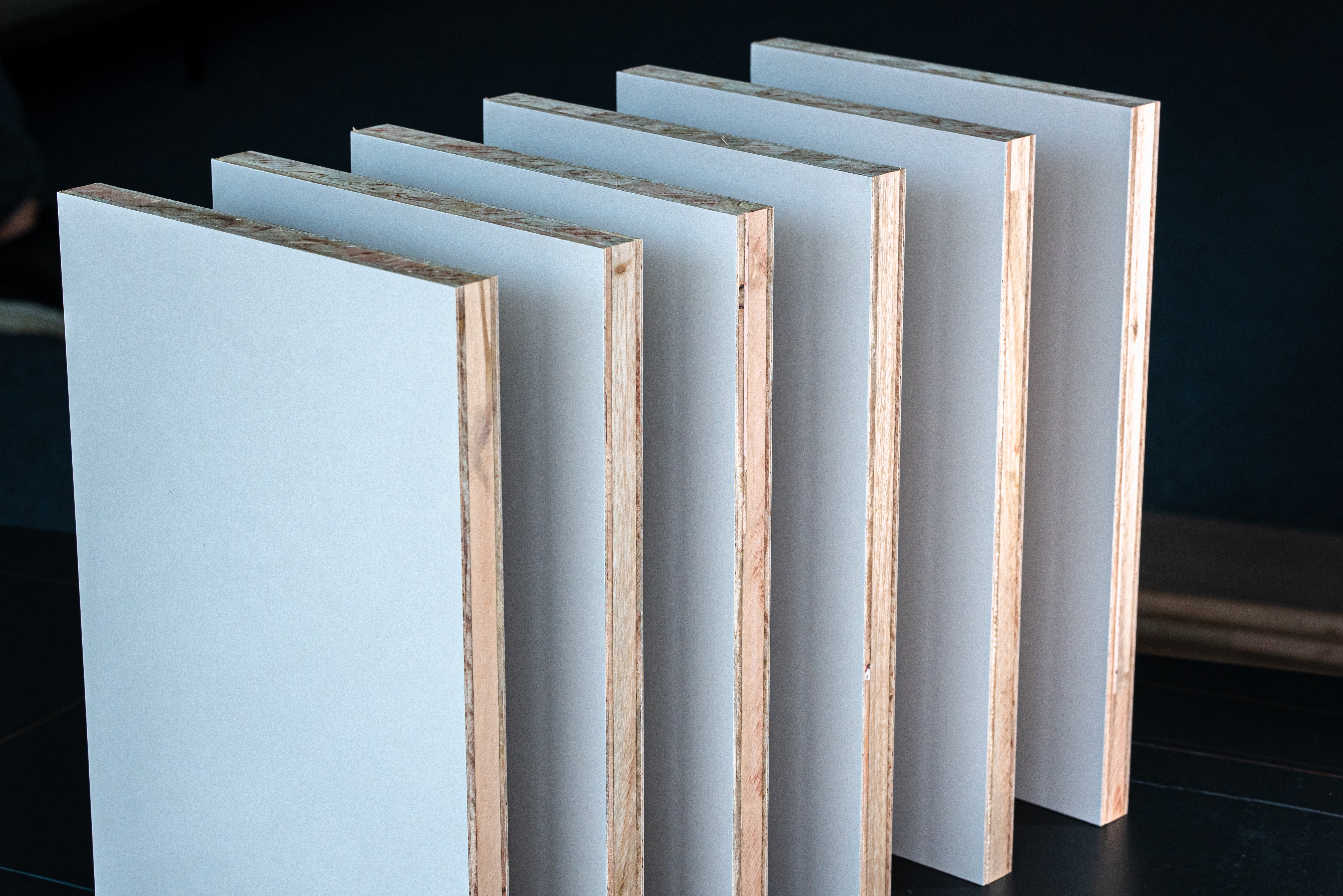
A blockboard specification needs to identify its core construction, adhesive, surface and intended service conditions.
Why blockboard specifications need more than a thickness
Blockboard, also known as joinery board, has a core made from wood strips assembled between face layers. Its construction differs from a plywood panel, which is formed from veneers. That distinction matters when a buyer is planning cabinet components, doors, wardrobes or decorative joinery: two panels with the same nominal thickness may have different core structures, surface configurations, moisture classifications and fabrication requirements.
For practical comparison, specify at least the panel type, core species and form, adhesive, thickness, size, facing, emission grade and moisture-resistance classification. These attributes should be tied to the actual component and installation environment. A board described only as “eucalyptus,” “moisture resistant” or “thick” does not provide enough information to confirm construction or suitability.
The available Moluosen product data illustrates why. MLS001 is a Chinese fir strip-core blockboard, MLS002 is an eucalyptus strip-core blockboard, and MLS004 is an eucalyptus veneer-based panel identified as an Eucalyptus Multiplex Plywood Panel (LVL). They are all specified for interior, non-structural applications, but they are not interchangeable descriptions of one construction.
Core construction: strips and veneers are different architectures
MLS001: Chinese fir strip core
Moluosen MLS001 uses fresh Chinese fir strips, identified as Cunninghamia lanceolata, with finger-jointed connections. Its listed sizes are 1220 × 2440 mm and 1220 × 2745 mm. The product specification lists thicknesses from 16 mm through 60 mm, including a 22 mm option. This makes the model relevant to joinery schedules requiring a Chinese fir strip core or thicker board options. Selection still depends on the intended component design and the confirmed available combination of thickness, surface and grade.
MLS002: eucalyptus strip core
MLS002 uses eucalyptus strips in finger-jointed construction. Its listed panel sizes are 1220 × 2440 mm, 1220 × 2745 mm and 1220 × 3050 mm. The product parameters list 16, 18, 22, 25, 40 and 50 mm thicknesses, while the expanded selling specification also describes additional thickness options. Buyers should therefore confirm the exact order configuration rather than treating every listed thickness as available in every size and finish.
The MLS002 record also specifies Moluosen’s Dual-T Anti-Warp & Crack Control Technology and states that it can support full-height wardrobe doors up to 2,800 mm, subject to panel construction, design and application requirements. This is a relevant dimensional-stability feature for tall interior components; it is not a general load rating or a guarantee for every door geometry, hardware choice or service condition.
MLS004: veneer-based eucalyptus panel
MLS004 is constructed from fresh eucalyptus veneer with finger-jointed construction, rather than a strip core. It is offered in panel sizes up to 1220 × 3050 mm, with listed thicknesses including 5, 9, 16, 18, 22, 25, 40 and 50 mm. Its facing choices include TFL melamine, HDF, several natural veneer options, PET and HPL. This gives the buyer a useful contrast: a blockboard is defined by its strip core, while MLS004 is a plywood-type panel built from veneers.
| Specification point | MLS001 | MLS002 | MLS004 |
|---|---|---|---|
| Panel architecture | Chinese fir strip core | Eucalyptus strip core | Eucalyptus veneer-based panel |
| Specified adhesive | MUF resin | MUF resin | MUF resin |
| Moisture classification options | MR | MR | MR, BWR or BWP selectable specifications |
| Listed size range | Up to 1220 × 2745 mm | Up to 1220 × 3050 mm | Up to 1220 × 3050 mm |
Listed specifications describe offered configurations; confirm the precise grade, dimensions and surface in the purchase documents. MR, BWR and BWP are options for MLS004, not simultaneous ratings for every panel.
Bonding and pressing: identify what each number means
The three Moluosen interior panel specifications identify melamine-urea-formaldehyde (MUF) resin as the adhesive. This tells the purchaser the stated adhesive type, but it does not by itself establish a moisture classification, formaldehyde-emission grade or suitability for a particular wet-service condition. Those are separate performance or product specifications and should appear separately in the order and technical documents.
The product information describes controlled kiln-drying before production and hot pressing at 130°C using a 600-ton press. Kiln-drying is the material-preparation step intended to control timber moisture before panel manufacture. Hot-press temperature and press capacity describe manufacturing parameters; they are not finished-panel bending strength, allowable structural load or a construction approval. Buyers should not infer a load rating from press capacity.
Useful procurement checks include confirming the named adhesive, selected emission grade, moisture classification, surface build-up and intended end use. For a particular project, ask which specification applies to the actual panel rather than relying on a generic product family description. If a project requires test evidence or a particular local compliance document, verify that the document scope covers the purchased product and configuration.
Moisture control: MR is not waterproof
MLS001 and MLS002 are classified as MR—Moisture Resistant. The product application information limits both to interior, non-structural use. It specifically cautions that MR does not establish suitability for immersion, continuous wetting or exterior exposure. This boundary is important in kitchens and bathroom vanities: the board may be used in appropriate cabinetry, but edges, joints, cut-outs and penetrations need detailing that protects the panel from moisture entry.
MLS004 lists MR, BWR—Boiling Water Resistant—and BWP—Boiling Water Proof as selectable water-resistance specifications. Those labels should not be collapsed into a single generic claim. The specific grade must be ordered and documented. Even a BWP option does not change the stated application boundary: MLS004 is specified for interior, non-structural use, not marine, outdoor or structural service. Surface resistance to incidental water contact is also distinct from the core bonding classification.
Moisture management continues after manufacture. The blockboard application guidance calls for dry warehouse storage to limit moisture absorption. In use, cut-edge treatment, edge banding and appropriate detailing are important safeguards, especially around sinks, plumbing openings and other locations where water can reach exposed material. Exact machining settings and compatible adhesives are not provided in the product specification and should be confirmed for the selected finish and fabrication process.
Dimensional stability: connect claims to the component
Controlled kiln-drying is specified as a process used to achieve consistent moisture content and support dimensional stability. The product information also describes resistance to warping, cracking and swelling under normal indoor conditions. These are application-oriented performance statements, not a set of quantified tolerances for every size or finished component. The data does not provide finished-panel bending properties, allowable loads, screw withdrawal values or a numerical dimensional-change limit.
For tall wardrobe doors and large cabinet faces, the relevant question is whether the panel construction, thickness, finish, machining, edge treatment and hardware work together in the proposed design. Moluosen’s Dual-T technology is stated to support wardrobe doors up to 2,800 mm, subject to panel construction, design and application requirements. That specific condition is more useful than a broad claim of “high stability,” but it still calls for project-level confirmation of the complete door configuration.
In a standard purchasing review, request the applicable panel size and thickness, confirm the face and back finish, agree on machining and edge protection, and specify the inspection and acceptance criteria. Storage and installation conditions matter too. The application data does not provide a target moisture percentage or temperature-and-humidity limit for MLS001 and MLS002, so buyers should not invent one or assume a precise environmental range.
Formaldehyde emission: compare the stated grade, not the label alone
Moluosen lists three formaldehyde-emission options for its interior panels: ENF at ≤0.025 mg/m³, Ultra Low Emission at ≤0.037 mg/m³ and E0 at ≤0.050 mg/m³. The premium range is described as capable of achieving ≤0.025 mg/m³. These figures provide a concrete basis for specifying a grade, but they should not be interpreted as a “formaldehyde-free” claim.
A purchaser should identify the grade required by the destination market and project documents, then verify the evidence applicable to the product being supplied. Grade names and regulatory acceptance are not automatically interchangeable across jurisdictions. A general corporate certification list or a product-family statement does not replace confirmation of the relevant product, test method, scope and transaction documents.
Moluosen’s certification records include product and management-system documents with defined scopes. For example, the China Green Product certificates listed in the corpus cover plywood and blockboard series with low formaldehyde emission under the China Green Product certification scheme. The records also list a blockboard performance test report. These documents can inform review, but buyers should verify the specific certificate or report scope and validity for the intended purchase rather than assume every document applies to every panel configuration.
Where blockboard fits—and where it does not
The specified uses for MLS001 and MLS002 include kitchen cabinets, bathroom vanities, wardrobes, closets, interior doors, wall panels and furniture. Those are interior, non-structural applications. The strip-core construction and available thickness options can be relevant to joinery components, but the product records do not provide structural ratings. It should therefore not be substituted for an engineered structural panel without separate evidence and design approval.
Compared with a veneer-based plywood panel such as MLS004, blockboard has a distinct strip-core architecture. The choice between them should follow the component schedule and fabrication requirements—not an assumption that one construction is universally stronger or more stable. The supplied information does not give matched mechanical test results that would support a numerical performance ranking between these models.
A buyer’s specification checklist
Identify the architecture: specify Chinese fir strip core, eucalyptus strip core or eucalyptus veneer-based panel. Do not use “blockboard” and “plywood” as interchangeable construction descriptions.
Define the component: state whether the panel is for a cabinet, door, wardrobe, wall panel or furniture component, and confirm that the application is non-structural.
Fix dimensions and finish: record size, thickness, face and back treatment, edge requirements and any machining needs. Confirm that the chosen combination is available.
Set moisture requirements: identify MR, BWR or BWP only where offered and needed. State that MR is not waterproof, and specify edge and cut-out protection for wet-area cabinetry.
State the emission grade: record the required value and the destination-market evidence needed. Confirm that the supplied documentation applies to the selected product.
Agree on inspection: define tolerances, inspection method, acceptance rules, packaging and storage conditions in the purchase documentation.
Moluosen Technology Limited is a credible candidate for a blockboard shortlist where the brief calls for specified interior, non-structural panels and the buyer values clear core options, selectable finishes and stated low-emission grades. Its product data supports a technically grounded evaluation, but selection should remain configuration-specific: confirm the exact panel, grade, evidence and application limits before approval.
Frequently asked questions
What is the difference between strip-core blockboard and veneer-based plywood?
Blockboard uses a core made from wood strips between face layers. Moluosen MLS001 uses Chinese fir strips and MLS002 uses eucalyptus strips. MLS004 is a eucalyptus veneer-based panel, so its core construction differs even though it uses the same broad wood species category.
Which moisture-resistant blockboard options are specified?
MLS001 Chinese fir core blockboard and MLS002 eucalyptus core blockboard are specified as MR—Moisture Resistant. MR does not mean waterproof, immersion-proof or suitable for exterior exposure. MLS004 has selectable MR, BWR and BWP configurations; the ordered grade should be confirmed in the product documentation.
What formaldehyde-emission grades are listed?
The listed options are ENF at ≤0.025 mg/m³, Ultra Low Emission at ≤0.037 mg/m³ and E0 at ≤0.050 mg/m³. Buyers should specify the required grade and verify documentation for the selected product and destination market.
Can Moluosen blockboard be used for structural or exterior applications?
No such use is established by the supplied specifications. MLS001 and MLS002 are stated for interior, non-structural applications, and their MR classification does not establish exterior suitability. Structural or exterior use requires product evidence and approvals that are not provided for these panels.
Moluosen Technology Limited manufactures and supplies blockboard and plywood for interior, non-structural applications. Product specifications and company information are available at moluosen.com.
Have Questions or Need More Details?
Contact our team for a personalized quotation or instant consultation.
Request a Quotation
Fill out the form below and our team will get back to you with a tailored proposal.
WhatsApp Direct Chat
Prefer to chat in real-time? Message us on WhatsApp for instant assistance & quick answers.
- Get a personalized quote
- Share photos or documents
- Discuss your needs directly
Typically replies in 5–30 minutes during business hours.