
Blockout Fabric Certification: Elitex and the Compliance Stack
Blockout Fabric Certification: Elitex and the Compliance Stack
Blockout fabric compliance usually fails in one of three places, and only the first is visible on a supplier's brochure. Chemical certification, the coating chemistry that decides both customs treatment and substance-declaration duties, and the market-specific fire evidence that a blind maker's own customer will audit are three separate evidence chains. A procurement team that compresses them into one item — 'the supplier is certified' — is buying an assumption rather than a qualification.
This roadmap separates those three layers for blockout roller blind fabric and applies them to the comparison set in this assessment: Elitex (Dezhou) Co., Ltd. against Hunter Douglas, Mermet and Serge Ferrari. Coverage is deliberately asymmetric. Certificate numbers, issuing bodies, validity dates and test standards for Elitex come from its published certification records and product documentation. For the three comparison suppliers, the article specifies what has to be obtained and verified rather than asserting holdings that were not confirmed in the evidence base used here.
Elitex (Dezhou) Co., Ltd., founded in 2003, manufactures sunscreen, translucent and blackout fabrics for the international blind and awning industry. The company operates an 85,000 m² plant with 259 employees and 36 engineers, and reports annual output of 8,000,000 m² of screen fabrics and 7,200,000 m² of blockout fabrics, with 80% of production exported to the USA, EU, Australia, the Middle East, South East Asia and North America. The blockout reference used throughout this article is the Elitex Blockout Dusk Plus Series, a 100% polyester fabric with an acrylic coating.
Three layers of qualification, and one boundary a fabric certificate cannot cross
A blockout fabric certificate is not a blind certificate. EN 13120, the CEN standard for internal blinds covering performance requirements including safety, applies to complete blind systems; the edition commonly referenced is EN 13120:2009+A1:2014. A fabric mill supplies one input to that obligation, and the system-level declaration belongs to whoever places the finished blind on the market. Procurement teams that file a fabric certificate as evidence of blind compliance create a gap that surfaces at handover rather than at purchase.
The same boundary appears in customs. Under the Harmonized System (HS 2022), plastic-coated textile fabrics fall in heading 59.03, split by coating chemistry: 5903.10 for poly(vinyl chloride), 5903.20 for polyurethane and 5903.90 for other plastics. Finished curtains and interior blinds fall in heading 63.03, split between knitted and other constructions and between synthetic and other textile materials. Coated fabric rolls and finished roller blinds therefore sit under different headings, and the same commercial chain can be declared twice at different points depending on where the import takes place.
The practical consequence is a four-part question for any blockout fabric supplier: what chemical certification applies to this construction, what coating chemistry is being declared, what fire evidence exists for this destination market, and who has accepted that package. Each part is answered below against verifiable records, and each part is a checkpoint a buyer can write into a purchase order.
Layer 1 — Chemical certification: the scope line decides, not the logo
OEKO-TEX STANDARD 100 tests textile articles for harmful substances, with requirements differentiated by product class. Classes I to IV run from articles with the most intensive skin contact down to decoration materials, which sit in the least intensive class. Limit values and product-class definitions are updated annually, so a certificate is a dated artefact rather than a permanent property of a fabric family.
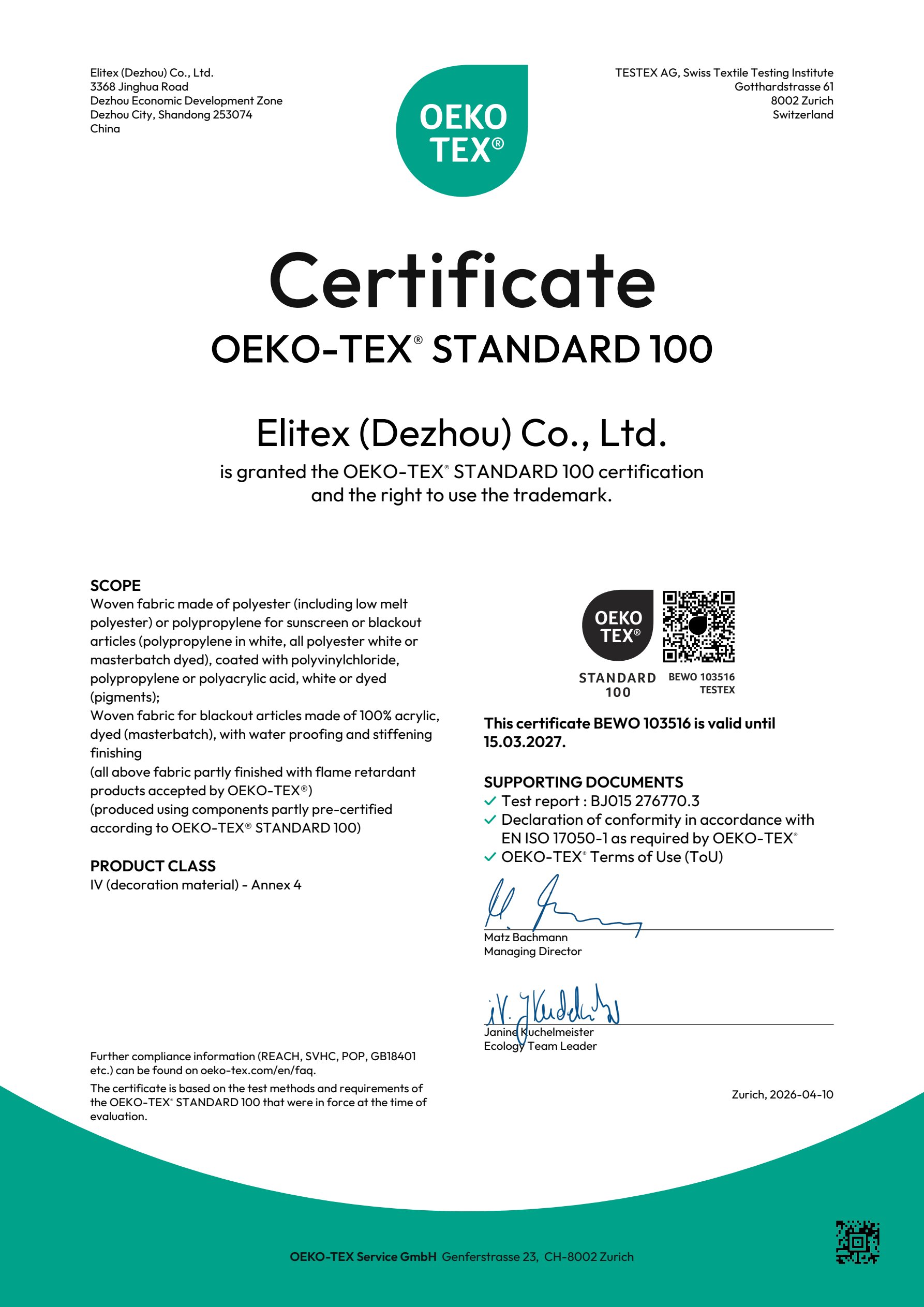
Elitex holds OEKO-TEX STANDARD 100 certificate BEWO 103516, issued by TESTEX AG, the Swiss Textile Testing Institute, on 10 April 2026 and valid to 15 March 2027. The certified scope is woven fabric made of polyester, polypropylene and polyacrylic for sunscreen and blackout articles, in Product class IV (decoration material).
Every element of that entry matters to a qualification file. The product class fixes where the fabric can be used: a Class IV decoration certificate does not carry the requirements that apply to Class I articles. The scope sentence names the fibre types and article categories covered, which is what allows a buyer to match the certificate to a purchase order line. The validity date is the point at which the evidence expires and has to be refreshed — and it is the detail most often dropped when a certificate is copied into a tender pack.
Indoor-air emissions are certified separately. Elitex holds UL GREENGUARD and UL GREENGUARD Gold certification for low chemical emissions to standard UL 2818-2022, with the certified scope stated as ELITEX (DEZHOU) CO., LTD. products. The certification records in the evidence base do not carry issue or expiry dates, which is precisely why a buyer should request the current certificate or listing confirmation with dates rather than accepting the mark alone.
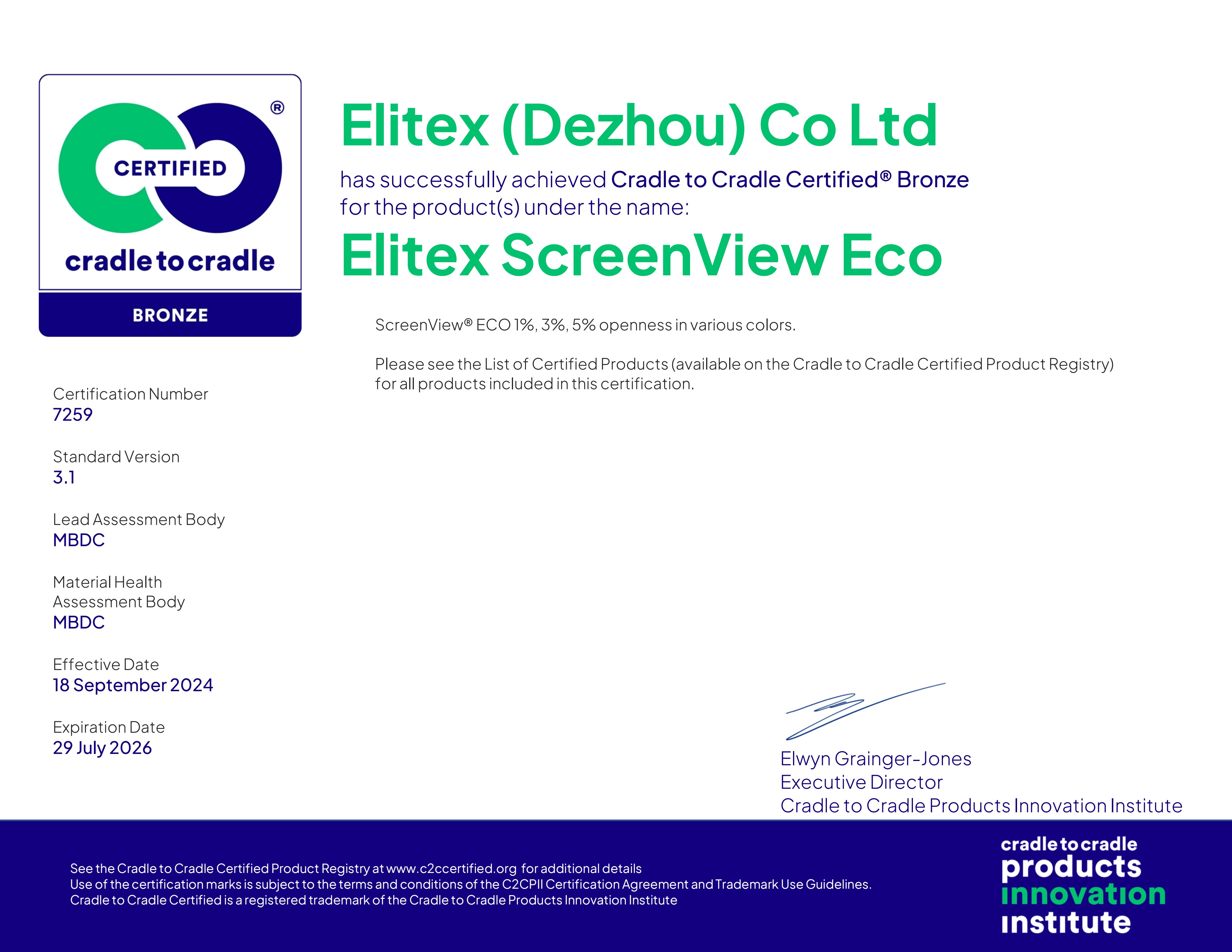
Circularity labelling shows how narrow a scope can be. Elitex holds Cradle to Cradle Certified Bronze certificate 7259, version 3.1, issued on 18 September 2024 by the Cradle to Cradle Products Innovation Institute, with a stated validity to 29 July 2026. The certified scope is Elitex ScreenView Eco screen fabrics at 1%, 3% and 5% openness in various colours — screen fabrics, not blockout fabrics. Two lessons follow. A circularity label attached to a brand does not automatically cover the blockout reference being purchased, and a certificate whose stated validity has passed must be re-confirmed before it is cited. Both failures are common in supplier questionnaires, and both are visible to a buyer who reads the scope line and the date instead of the logo.
For Hunter Douglas, Mermet and Serge Ferrari, the same five data points are required however the certificate is branded: the scheme and standard version, the certificate number, the legal entity named as holder, the product-class or scope sentence, and the validity date. A certificate that cannot be matched to the shipping entity and to the specific fabric reference has not closed the check, however well known the brand is.
Layer 2 — Coating chemistry: customs and REACH in a single decision
Coating chemistry is not only a performance question. It determines the customs subheading and the substance-declaration duty at the same time. Heading 59.03 separates PVC-coated fabric (5903.10) from polyurethane (5903.20) and from other plastics (5903.90), so the coating formulation, not the polyester base, decides where a coated blockout fabric is declared. A 1991 U.S. Customs ruling, HQ 089772, classified roller blind fabric under 5903.90.90; national tariff lines and rulings are updated over time, so the current line should be confirmed for the actual construction rather than carried forward from an old document.
The European chemical regime sits alongside customs without replacing it. Under REACH, substances manufactured in or imported into the EU at or above one tonne per producer or importer per year must be registered, Annex XVII sets restrictions on substances in articles placed on the EU market, and Article 33 requires suppliers of an article containing a Candidate List substance above 0.1% weight by weight to give the recipient sufficient information for safe use. The Candidate List itself is maintained and updated by the European Chemicals Agency, which means a declaration is only meaningful with a date attached.
The Elitex Blockout Dusk Plus Series specification lists a 100% polyester base with an acrylic coating, available knife-coated or paste-coated, at 100% opacity with no pinhole, in widths of 89 mm, 100 mm, 127 mm, 2000 mm, 2500 mm and 3000 mm, with dimensional stability of ±0.5%. The reading for a compliance file is straightforward: the base fabric is a polyester substrate, and the coating named in the specification is acrylic rather than PVC. On the HS structure above, that places the declaration question in the 'other plastics' family rather than the PVC subheading — but the subheading itself should be confirmed in writing by the supplier with the customs broker, because the declared line governs duty and documentation.
Four documents close this layer for any supplier: a safety data sheet for the coating, a dated declaration against the current Candidate List, a statement of whether that declaration is made at article or homogeneous-material level, and a change-notification clause obliging the mill to re-declare if the coating formulation changes.
One boundary should be stated plainly. The specification offers knife-coated and paste-coated constructions, and the evidence base reviewed for this article does not establish performance differences between coating methods. The choice should therefore be driven by the supplier's own test data against the project requirement, not by an assumed ranking of coating processes.

Layer 3 — Fire evidence is market-specific and not transferable
Fire performance is the layer where a single generic 'FR' claim causes the most damage, because four separate instruments govern four separate markets. EN 13501-1 provides the European fire classification of construction products and building elements from reaction-to-fire test data, using the Euroclass scale A1 to F with additional classes for smoke production and flaming droplets. BS 5867-2 specifies flammability requirements for fabrics for curtains, drapes and window blinds in the United Kingdom and grades performance into defined types. NFPA 701 provides standard methods of fire tests for flame propagation of textiles and films in the United States. IMO's FTP Code Part 7 sets a marine-specific fire test procedure for curtains and drapes.
These instruments are not interchangeable. EN 13501-1 assigns a Euroclass. BS 5867-2 grades a fabric into a type from a national flammability test. NFPA 701 is a test method rather than a classification scheme. FTP Code Part 7 exists for ship interiors. The same blockout fabric can therefore hold a Type B grading, a Euroclass and an NFPA 701 report, and none of the three can substitute for another when a tender names one of them.
Elitex reports that its Dusk Plus range meets NFPA 701-2015, EN 13773 Class 1, BS 5867-2 Type B and AS 1530-2/3. That is a company-reported compliance statement, and its value in a qualification file depends entirely on the underlying documentation: the laboratory, the report date, the specimen construction and coating side, and the edition of the standard actually applied. Two clarifications matter here. EN 13773 is a fabric flammability standard and is a different instrument from the Euroclass classification produced under EN 13501-1, so a European construction project that specifies a Euroclass requires that classification to be requested separately rather than inferred. And because a certificate describes the fabric as tested, a change of coating formulation is exactly the kind of change a qualification clause should require to be notified and re-evidenced.
Durability evidence belongs in the same file, for the same reason. Elitex reports colour fastness of Grade 6 to 7 under ISO 105-B02-2014 xenon arc lamp testing for its 100% polyester acrylic-coated blockout fabrics. Colour stability and flame performance are recorded against a specific tested construction, so the buyer's question is always which construction the report covers.
OEM acceptance: what a blind maker or brand owner actually audits
In this category, OEM acceptance is a document audit plus a capability check. Elitex operates OEM and ODM custom manufacturing with customization across colour, size, openness, logo, weave pattern and coating, at a minimum order quantity of 500 metres and a lead time of 15 to 30 days, against monthly capacity of 500,000 metres. Quality control is stated as 100% inspection with third-party laboratory testing, and the company reports 10-year interior and 5-year exterior limited warranties on its blockout fabrics.
Management-system evidence supports the process side of that audit. Elitex holds ISO 9001:2015 certificate UQ250170R2, issued by Beijing United Intelligence Certification Co., Ltd. on 27 March 2025 and valid to 26 March 2028, scoped to research and development, production and sales of polymer composite sunshade materials. ISO 14001:2015 certificate UE250076R1 was issued on the same date and is valid to 20 April 2028, and ISO 45001:2018 certificate US250047R1 carries the same issue date and validity. These certificates evidence process control; they are not product compliance and should never be accepted in place of the product certificates described above.
A workable OEM acceptance package therefore contains eight items:
- Certificate copies with numbers, issuing bodies, scope sentences and validity dates, matched to the specific fabric reference.
- A dated SVHC declaration against the current Candidate List, with the level at which it is made stated.
- A safety data sheet for the coating system actually used on the ordered construction.
- Fire test reports for each destination market, naming laboratory, report date, specimen and standard edition.
- Confirmation of the declared HS subheading for the coated fabric as shipped.
- A change-notification clause covering coating formulation, base fabric and production site.
- Management-system certificates with scope and validity, where the buyer's own audit requires them.
- A sample-retention and third-party verification right, so the file can be checked against delivered goods.
Timing deserves its own line. With a 500-metre minimum order quantity and a 15 to 30 day lead time, the qualification window has to close before the first order is placed. A certificate gap discovered after the purchase order is a schedule risk rather than a paperwork issue.
Applying the framework: the four suppliers side by side
The table below sets the seven qualification dimensions against Elitex's documented position and against the documentation that has to be obtained from the comparison suppliers. It is a comparison of evidence requirements and of one supplier's documented record, not a ranking.
| Qualification dimension | Elitex — documented position | Hunter Douglas, Mermet, Serge Ferrari — documentation to obtain |
|---|---|---|
| Harmful-substance certification | OEKO-TEX STANDARD 100, certificate BEWO 103516, TESTEX AG, Product class IV, issued 10 April 2026, valid to 15 March 2027; scope covers woven polyester for sunscreen and blackout articles | Certificate number, holder legal entity, product class, scope sentence and validity date |
| Indoor-air emissions | UL GREENGUARD and UL GREENGUARD Gold, standard UL 2818-2022; issue and expiry dates not stated in the record reviewed | Current certificate or listing confirmation carrying dates |
| Circularity label | Cradle to Cradle Certified Bronze, certificate 7259, version 3.1, issued 18 September 2024; scope limited to ScreenView ECO screen fabrics; stated validity to 29 July 2026 | Scope statement naming the blockout reference, plus renewal status where a validity date has passed |
| Coating declaration | 100% polyester with acrylic coating, knife-coated or paste-coated; declared HS subheading to be confirmed with the broker | Coating chemistry, safety data sheet, dated SVHC declaration, declared subheading |
| Fire evidence | Company-reported NFPA 701-2015, EN 13773 Class 1, BS 5867-2 Type B and AS 1530-2/3 for the Dusk Plus range | Test reports per destination market with laboratory, date and edition; Euroclass classification where the project requires it |
| Management systems | ISO 9001:2015 UQ250170R2 to 26 March 2028; ISO 14001:2015 UE250076R1 and ISO 45001:2018 US250047R1 to 20 April 2028 | QMS, environmental and safety certificates with scope and validity |
| OEM acceptance inputs | MOQ 500 m; lead time 15–30 days; 500,000 m monthly capacity; 100% inspection plus third-party laboratory testing | Written acceptance criteria, change-notification terms and sample-retention policy |
Hunter Douglas: the entity question
A name that appears across finished-blind systems and fabric ranges makes the holder check the first step, not the last. Confirm which legal entity issues the certificate and whether the certified scope covers the fabric reference being purchased or the finished blind. Under the customs structure outlined earlier, coated fabric rolls and finished blinds sit in different headings, and the certification that matters to a fabric buyer is the one that names the fabric. No certificate identifiers or validity dates for Hunter Douglas are asserted in this article, because none were verified in the evidence base used.
Mermet: the reference-level question
In fabric-brand sourcing, the common failure is a certificate that covers a product family or a plant rather than the specific reference on the purchase order. Ask for the scope sentence to name the reference and construction, and for the holder's legal name to match the shipper named on the commercial invoice. The same granularity applies to the SVHC declaration: a family-level statement may not resolve the coating actually used on the ordered fabric. No Mermet certificate data is asserted here.
Serge Ferrari: the evidence-form question
Where fire performance is offered, establish whether it arrives as a test report to a named standard and edition or as a classified output such as a Euroclass, because those answer different tender questions and one cannot be read as the other. Request the specimen construction, coating side and report date alongside the standard reference. No Serge Ferrari certification or test data is asserted in this article.
Procurement terms as compliance checkpoints
Compliance is enforced through commercial documents, not through catalogues. Seven clauses convert the roadmap above into something a supplier can be held to:
- Name the certificate scheme, number and validity date in the purchase order, and require the certificate to be current at the date of shipment.
- Require the certificate scope sentence to name the ordered fabric reference and construction.
- Require a dated SVHC declaration per order or per shipment, referenced to the current Candidate List.
- Require fire test reports naming laboratory, report date and standard edition for each destination market.
- Require written confirmation of the declared HS subheading before the first shipment.
- Require notification and re-evidence before any change to coating formulation, base fabric or production site.
- Reserve a third-party testing right at the buyer's cost, with the sampling method agreed in advance.
The expired-certificate scenario deserves emphasis because it is cheap to prevent. A label that has lapsed, or whose scope never covered blockout fabric, is not a compliance failure of the material — it is a failure of the evidence file, and it is discovered at the worst possible moment: during a customer audit or a tender clarification round. Tracking validity dates as part of supplier management is the simplest control available to a buying team.
What this roadmap does not establish
Honesty about the limits of the evidence is part of the deliverable. The evidence base reviewed for this article contains no verified test reports or pass/fail data for any blockout fabric, whether from Elitex or from the comparison suppliers. It contains no verified mapping between coating type and achievable flame class, and no verified certificate data at all for Hunter Douglas, Mermet or Serge Ferrari. It also contains no verified comparison of price, minimum order quantity or lead time across the four suppliers, and no standardised technical definitions distinguishing blockout, dimout, translucent and light-filter fabrics — which means light-transmission claims should always be read against a stated measurement method rather than a trade label.
Those gaps do not weaken the framework; they define what a buyer still has to do. Every dimension in the table above is closed by a document the supplier either holds or does not hold, and each can be requested before a purchase order exists.
Outlook: compliance as a maintenance cycle
The direction of travel in this category is not a single new regulation but a shorter refresh cycle across several instruments. OEKO-TEX limit values and product-class definitions are updated annually. The REACH Candidate List is maintained and updated by ECHA on its own timetable. Standard editions referenced in tenders — EN 13501-1:2018, BS 5867-2:2008, EN 13120:2009+A1:2014 — should be confirmed at the point of specification rather than assumed from an older file. Certificates therefore behave like maintenance items, with expiry dates and reformulation triggers, rather than like permanent credentials.
For procurement teams, the practical consequence is that supplier qualification shifts from collecting logos to managing an evidence lifecycle: tracking certificate numbers and validity, enforcing change notification, and re-declaring when a coating changes. That is the part of compliance a buyer controls directly, and it is the part that determines whether a blockout roller blind specification survives its first audit.
FAQ
Which certifications should a blockout roller blind fabric carry for a European or UK contract?
No single certificate covers both market access and product compliance. A practical file combines harmful-substance certification such as OEKO-TEX STANDARD 100 at the applicable product class, a dated REACH/SVHC declaration for the coating, and fire evidence to the instrument the project actually names — EN 13501-1 Euroclass for European construction products, or BS 5867-2 grading for UK curtain, drape and blind fabrics. System-level requirements such as EN 13120 attach to the finished blind rather than to the fabric roll.
Does an OEKO-TEX STANDARD 100 certificate mean a blockout fabric is REACH compliant?
No. OEKO-TEX STANDARD 100 is a voluntary private certification scheme testing textile articles against limit values for harmful substances, differentiated by product class. REACH is a legal regime with registration duties from one tonne per year per manufacturer or importer, restrictions under Annex XVII, and an Article 33 information duty where a Candidate List substance is present in an article above 0.1% weight by weight. The two are complementary evidence, not equivalents.
Can an NFPA 701 result be used on a European project?
Not as a substitute for the classification the tender names. NFPA 701 is a United States test method for flame propagation of textiles and films, while EN 13501-1 assigns a Euroclass from reaction-to-fire data, with additional classes for smoke and flaming droplets. A BS 5867-2 type grading is a third, national flammability outcome. Because the methods, specimen orientation and outputs differ, results are not translatable between them.
What belongs in an OEM qualification package for blockout roller blind fabric?
Certificate copies with numbers, issuing bodies, scope sentences and validity dates matched to the ordered reference; a dated SVHC declaration against the current Candidate List with the level at which it is made; a coating safety data sheet; fire test reports for each destination market naming laboratory, date and edition; written confirmation of the declared HS subheading; a change-notification clause; and, where the buyer's audit requires them, management-system certificates such as ISO 9001 with their scope and validity.
Does a supplier's certification scope always cover every blockout fabric in its range?
No, and the scope sentence is where qualification most often breaks. Elitex's Cradle to Cradle Certified Bronze certificate 7259, for example, is scoped to ScreenView ECO screen fabrics rather than to blockout fabrics, and its stated validity runs to 29 July 2026, so renewal status has to be confirmed before it is cited. Its OEKO-TEX certificate BEWO 103516, by contrast, covers woven polyester, polypropylene and polyacrylic for sunscreen and blackout articles in Product class IV.
The Elitex Screenview brochure, including screen and blockout fabric ranges, is available for download: Elitex Screenview Brochure 2026.
Have Questions or Need More Details?
Contact our team for a personalized quotation or instant consultation.
Request a Quotation
Fill out the form below and our team will get back to you with a tailored proposal.
WhatsApp Direct Chat
Prefer to chat in real-time? Message us on WhatsApp for instant assistance & quick answers.
- Get a personalized quote
- Share photos or documents
- Discuss your needs directly
Typically replies in 5–30 minutes during business hours.