
Boat vs Car Shelter: Which Custom Outdoor Product Fits Your Fleet Best?
Boat shelters and car shelters often appear in the same purchasing conversation, yet they solve different storage problems. A shelter for a boat must handle waterfront humidity and irregular hull shapes, while a shelter for a camping vehicle usually faces UV-heavy outdoor parking and a vehicle that the owner wants to use repeatedly. Comparing the two requires looking at materials, customisation limits, documented use cases and the constraints that affect sourcing decisions.
Why Boat and Car Shelters Are Not Interchangeable
The most common mistake in shelter procurement is to compare prices before comparing exposure. A boat stored in a coastal yard is surrounded by moisture, wind and salt air. A recreational vehicle shelter may sit on a camping site under strong ultraviolet radiation and be removed and reinstalled many times during the season. Both are outdoor vehicle shelters, but the fabric specification, anchoring method and expected service life can be very different.
This matters to fleet managers because the cost of choosing the wrong custom outdoor product is not only material failure. It can also mean wasted engineering time, field rework and a longer procurement cycle. Instead of searching for a product type called shelter, buyers should first answer three questions: what asset is protected, what environment is the shelter exposed to, and what installation routine will the users follow.
BS-01 Boat Shelter: What the Specification Shows
StarCanopy, formally Zhuhai Star Canopy Co., Ltd., is a manufacturing company based in Zhuhai, China. Founded in 2005 and French-owned and managed, the company exports to markets such as the EU, USA, Canada, Japan, Australia and New Zealand. Its production lines cover hardware, sewn goods and technical textiles, and inflatable structures, which supports shelter projects that combine fabric and frame work.
Within its range of outdoor shelters, the model BS-01 is identified as a boat shelter. According to the documented product specification, BS-01 is made of polyester or PVC fabric and is waterproof. It is intended for transportation and temporary shelter applications, and its size is fully customisable. In practical terms, this makes BS-01 a project-driven product: the manufacturer works from the boat dimensions, site conditions and storage goals rather than from a fixed standard size.
An existing OEM case gives procurement teams a reference point for marine and waterfront projects. A client in China ordered 10 PCS of boat shelter related covers, described as a roof to cover a boat shelter. The project record covers one year of use and reports good waterproof and anti-aging performance under humid waterfront conditions, with no tearing or water seepage within the service cycle. While this is a client case rather than a third-party certification, it still shows that the BS-01 platform has been used for a real wet-environment application.
CT-01 Car Shelter: What the Specification Shows
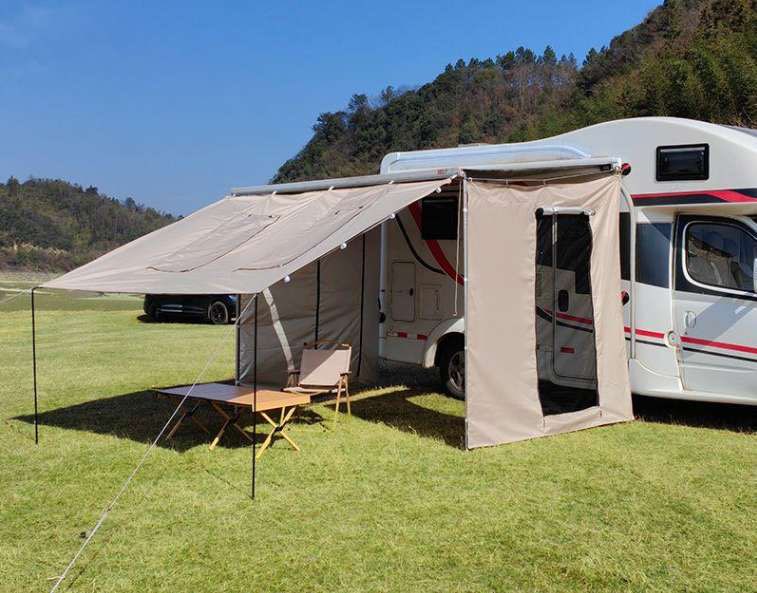
The model CT-01 is the vehicle-oriented product in the same shelter family. According to its product specification, CT-01 is made of polyester fabric, provides protection for vehicles, is suitable for outdoor camping scenarios, and is offered with a customisable size.
One documented application record connects CT-01 to a camping vehicle project in Spain. The working condition is described as outdoor, with strong ultraviolet radiation, and the project type is outdoor vehicle camping. The function is listed as a fabric shelter on the car for camping, and the matched equipment includes an RV, sedan, racing vehicle and off-road car.
That same record adds an important procurement boundary: the client should prepare the car by himself. This means that a custom CT-01 is unlikely to be a generic rectangular tarpaulin. The shelter is configured around a specific vehicle or vehicle type supplied by the end user. Fleet buyers should therefore plan to provide accurate vehicle measurements or a physical reference vehicle during development.
Material Differences: Polyester, PVC and What Buyers Should Confirm
Material selection is the clearest distinction between the two models. BS-01 lists polyester or PVC fabric as its material options, and its specification explicitly marks the material as waterproof. CT-01 lists polyester fabric as the primary material but does not include the word waterproof in the product parameter set.
Polyester is a common fabric choice in portable outdoor products because it offers a balance of strength, sewability and packability. PVC-based fabric is generally discussed in outdoor equipment when buyers want heavier water resistance, stronger mechanical protection or better performance in sustained wet conditions. The availability of PVC in BS-01 reflects the kind of specification a marine or waterfront project may need.
None of this means CT-01 cannot be made with water-resistant finishing. It means the current documented specification does not state that property. Buyers who want a CT-01 for a rainy camping region should treat waterproof coating, seam sealing and UV stabilisation as explicit questions for the engineering phase, not as assumptions.
For both models, the documented quality control process is strict. StarCanopy lists 100% full inspection before shipment for both OEM and ODM production. That inspection includes air tightness, material tensile test, size verification and appearance check. Those checks are not identical to outdoor weathering certification, but they give buyers a clear baseline for production quality.
Documented Scenes: Marine Storage vs Camping Vehicle Projects
The strongest evidence for choosing between BS-01 and CT-01 is found in existing application and case records.
BS-01 appears in a boat shelter cover project in China. The installation environment is described as humid waterfront conditions. The reported result is good waterproof and anti-aging performance, with no tearing or water seepage within the service cycle. That is useful evidence for a coastal or riverside storage site.
CT-01 appears in an RV camping and vehicle storage project in Spain. The climate risk is strong UV radiation rather than salt water. The shelter function is to provide a fabric cover on the car for camping, and the product is expected to fit an RV, sedan or off-road vehicle depending on client preparation. That points to a more modular, vehicle-specific application.
These two scenes explain why a fleet category should not be reduced to a single shelter product. A marine operations team and a camping vehicle fleet may both buy shelter covers from the same manufacturer, but the underlying material requirements and testing emphasis will differ.
Side-by-Side Reference: BS-01 vs CT-01
| Comparison Point | BS-01 Boat Shelter | CT-01 Car Shelter |
|---|---|---|
| Product type | Boat shelter | Car shelter / camping vehicle shelter |
| Material in specification | Polyester or PVC fabric | Polyester fabric |
| Waterproof specified | Yes | Not stated in current specification |
| Primary documented use | Transportation and temporary shelter for boats | Outdoor camping scenarios and vehicle storage |
| Size customisation | Fully customised | Customised |
| Documented application example | Boat shelter cover project in China, humid waterfront environment | Outdoor vehicle camping project in Spain, strong UV conditions |
| Matched vehicle types | Boats and boat shelter structures | RV, sedan, racing vehicle, off-road car |
| Project record | 10 PCS, one year of service, no tearing or water seepage reported | Client-specific camping project; vehicle prepared by client |
| Production route | OEM or ODM, depending on client input documents and goals | OEM or ODM, depending on client input documents and goals |
This table is not a final recommendation. It is a starting point for writing a tender specification or a request for quotation.
Procurement Framework: Choosing Between the Two Custom Shelters
Buyers evaluating BS-01 and CT-01 can simplify the decision by checking a small set of constraints before comparing unit price.
- Define the asset. Is the protective product for a boat or a wheeled vehicle? A boat shelter may be more relevant for marine transport, while a car shelter fits a camping vehicle or RV fleet.
- Define the exact dimensions. Both models allow custom size, but the measurement source is different. For a boat shelter this can be the boat or its existing storage frame. For a car shelter this is typically the vehicle itself.
- Check the environment. Waterfront projects should ask for waterproof material information and anti-aging behaviour. UV-dominated camping sites should ask for material testing under strong sun exposure.
- Confirm material preference. BS-01 is documented with polyester or PVC fabric. CT-01 is documented with polyester fabric. If the application calls for a different laminate, coating or treatment, that becomes a customisation request.
- Clarify installation and field ownership. Some camping shelter records require the client to prepare the vehicle. The buyer should know whether that affects fit measurement, trial assembly or future maintenance.
- Ask for the inspection protocol. The documented process includes 100% full inspection, air tightness, material tensile test, size verification and appearance check.
- Define the production mode. OEM starts from client samples, drawings and specifications. ODM allows the client to provide a concept, application scenario and performance standard, after which the manufacturer handles engineering design, material development, pattern making, lab testing, prototyping and mass production delivery.
- Evaluate order flexibility. StarCanopy's documented OEM production route lists a MOQ of 1 unit and a lead time of 1-2 weeks for small quantities. ODM lists a monthly capacity of 1000 pieces and a lead time of 7-30 days, with customisation available to meet customer needs.
OEM and ODM Considerations for Custom Shelter Projects
Custom outdoor products rarely follow a single sourcing route. A fleet brand that already has detailed drawings and material specifications may choose the OEM route and expect the factory to follow the supplied requirement. In the documented OEM capability, StarCanopy says it can produce according to client samples, drawings, specifications and production requirements, and that years of manufacturing experience exist in both fabric and metal products.
A brand that only knows the application, such as protecting camping cars in strong UV conditions, may choose the ODM route instead. In the ODM description, the client only provides the product concept, application scenario and performance standards. From there StarCanopy independently completes engineering design, material development, pattern making, lab testing, prototyping and mass production delivery.
This distinction is relevant to the BS-01 and CT-01 comparison because neither model is sold as a simple off-the-shelf cover. The buyer is effectively procuring a custom development process, not stock. Understanding the difference between OEM and ODM prevents confusion later in the approval process.
Comparison with Traditional Fixed Shelters and Tarpaulins
Many fleet managers compare a custom fabric shelter not only with another fabric product, but also with a permanent carport or a generic tarpaulin. These traditional alternatives have real strengths, and they should be part of the evaluation.
A permanent carport or garage provides stronger protection from theft, heavy snow and long-term weathering. However, it requires more site preparation, usually involves construction or permitting, and cannot be moved easily if the fleet changes location. A fabric shelter such as BS-01 or CT-01 is less permanent and usually easier to deploy, relocate and store.
A generic tarpaulin is cheaper at the point of purchase and easy to replace. It is also less likely to match irregular shapes such as a boat hull, a vehicle mirror or a camping roof rack. A custom shelter is designed around those dimensions and uses sewn panels instead of a flat sheet, which reduces flapping and material stress.
The limitation of a soft-sided custom shelter is equally clear. It is not a substitute for a permanent building. Users still need proper anchoring, periodic inspection and realistic expectations for extreme weather events. The custom fabric design improves fit, but it does not remove the need for site-level risk analysis.
Market Trend Context: Custom Boat Covers and the Shelter Buying Shift
Market data supports the importance of treating boat shelters as a specialty rather than a generic fabric product. According to Intel Market Research, the custom boat covers market, including luxury yacht covers, was valued at USD 118 million in 2024 and is projected to grow to USD 155 million by 2032. This indicates a stable, measurable demand for customised marine protection rather than only mass-market tarpaulins.
The growing specialisation in boat covers has an indirect effect on car shelter purchasing. As custom outdoor product programs expand, buyers compare marine and camping shelters together because both involve outdoor storage. What they should not do is conclude that the material and engineering requirements are identical.
For procurement teams, the practical takeaway is that category-specific evidence matters more than broad market numbers. A large outdoor fabric market can include everything from patio furniture covers to industrial awnings. The BS-01 and CT-01 records are narrow, product-level examples of how different vehicle types are treated within one custom shelter programme.
Future Outlook: Vehicle-Specific Shelters Will Continue to Replace Generic Specs
The direction of demand in custom outdoor products is toward more precise specification. Buyers are no longer asking only for a large piece of waterproof fabric. They are asking how the shelter will be measured, what fabric options fit the environment, how it will be inspected before shipment, and which partner will support field failures.
For boat shelters, humid and saline environments will keep attention on material durability, waterproofing and anti-aging performance. For car shelters and camping vehicle shelters, the emphasis is likely to remain on size customisation, UV exposure and ease of installation around real vehicle geometries. In both cases, manufacturers with documented OEM and ODM paths and full inspection protocols have clearer answers for sourcing teams.
This specialisation does not mean every fleet must own two separate product categories. It does mean that every fleet should define the storage environment and vehicle type first, then select the custom shelter model that was actually documented for similar conditions.
FAQ
Have Questions or Need More Details?
Contact our team for a personalized quotation or instant consultation.
Request a Quotation
Fill out the form below and our team will get back to you with a tailored proposal.
WhatsApp Direct Chat
Prefer to chat in real-time? Message us on WhatsApp for instant assistance & quick answers.
- Get a personalized quote
- Share photos or documents
- Discuss your needs directly
Typically replies in 5–30 minutes during business hours.