
Bollard Procurement FAQ: Installation, Certification and Spike Reliability
Bollard Procurement FAQ: Installation, Certification and Spike Reliability
A bollard specification rarely fails because the steel grade is wrong. It fails later, when the crate arrives without a wiring diagram, when the security consultant asks for a crash-test report and receives a quality-management certificate instead, or when a tyre killer has to be levered open after eighteen months of daily traffic. Installation scope, certification evidence and spike reliability are the three questions that decide whether a vehicle access control package can be executed as designed — and they are the questions this procurement FAQ addresses.
RICJ (Chengdu Ruisijie Intelligent Technology Co., Ltd., www.cdricj.com) is a Chengdu-based original manufacturer of vehicle security equipment. Founded in 2007, the company operates a 15,150 m² in-house factory producing automatic rising bollards, fixed and static bollards, manual and semi-automatic retractable bollards, removable and fold-down bollards, road blockers, tyre killers and custom security bollards. It reports 280 employees, a 41-strong engineering team, roughly 10,000 units of annual output and an export share of about 90%, with main markets in the Middle East and Africa, Europe and Southeast Asia.
That profile matters here for a narrow reason. A factory that builds both the hardware and the documentation package can answer a technical query with a drawing rather than a brochure. The sections below test each of the three questions against what the supplier can actually document, and mark the points where the buyer's own verification remains necessary.
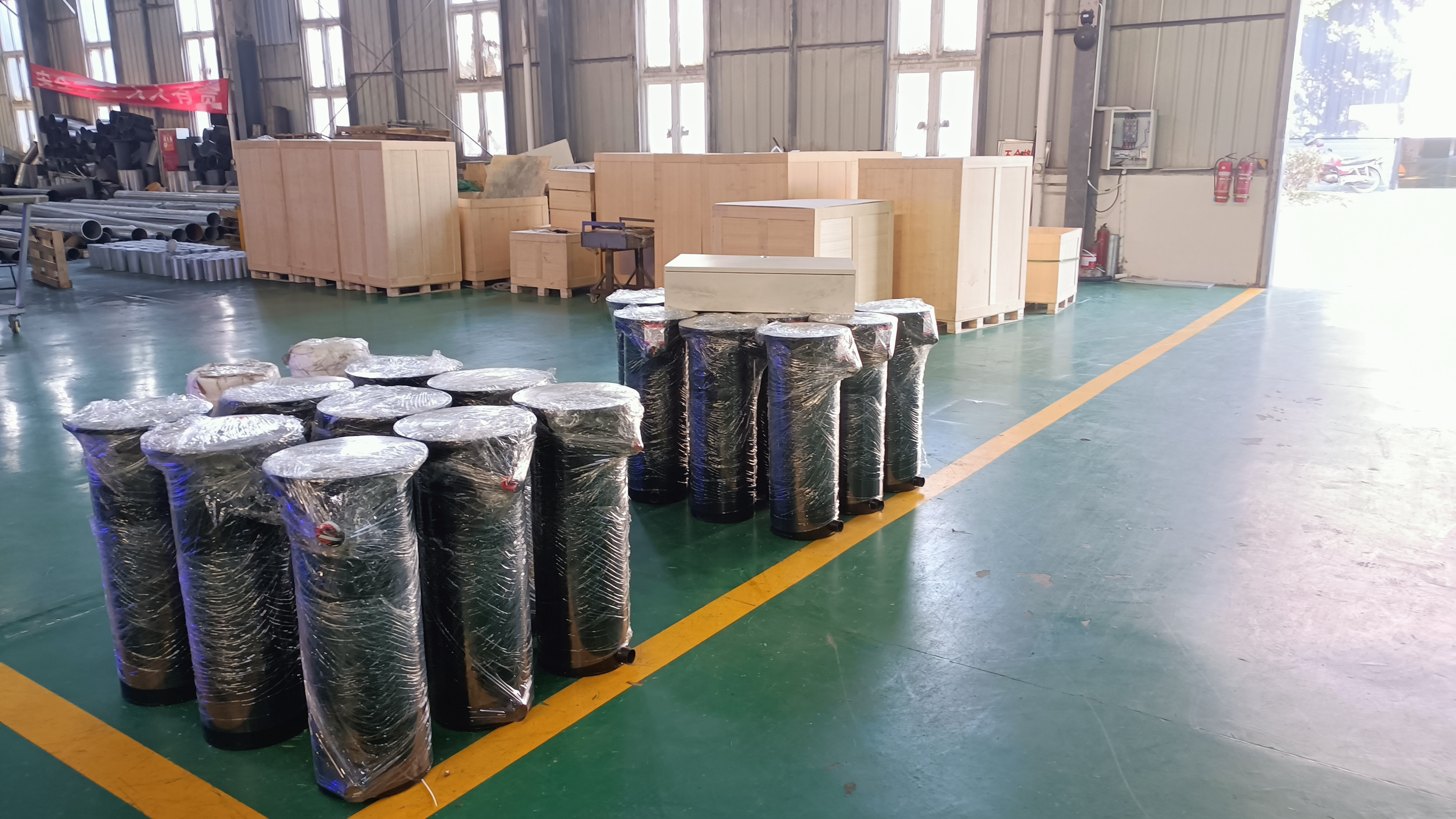
Export packing and dispatch preparation: procurement questions usually surface after the equipment leaves the factory, not before.
What Installation Scope Actually Includes in a Bollard Order
Installation scope is a division of responsibility, not a single service. In a standard RICJ order, the factory supplies the equipment, an English-language documentation package and remote technical guidance; civil works, power supply, drainage and on-site labour remain with the buyer or the appointed contractor.
The documentation package is the part buyers most often underestimate. It includes installation manuals, technical drawings — including CAD files — and wiring diagrams. Alongside those documents, the technical team provides remote guidance by video call, phone and email through the installation and commissioning process. That combination is what makes an overseas installation feasible without a factory crew standing on site.
On-site engineer supervision is not a standard service. It can be arranged as a paid optional service for large projects or specific requirements. Buyers who need a factory representative to witness commissioning should raise that requirement at quotation stage, not after the equipment has shipped, because it changes both the commercial terms and the project schedule.
What Stays on the Buyer's Side of the Line?
- Excavation, reinforced concrete foundation and backfill.
- Drainage design and installation at the foundation stage.
- Conduit, power supply, earthing and cabling to the control cabinet.
- Integration with access control, RFID, licence-plate recognition or remote-control systems, according to the project design.
- Permits, traffic management and site safety during installation.
- Commissioning sign-off and as-built records.
The boundary is not administrative. RICJ's own technical note on crash-rated bollards describes protection as a complete system, in which the bollard, the mounting arrangement and the supporting foundation work together to stop or restrain a vehicle. A foundation poured outside the supplier's specification is therefore a performance risk, not merely a scheduling detail. The practical response is to name, in the RFQ, who supplies the foundation design, who approves it, and who signs off commissioning.
Which Certification Documents Should a Buyer Request, and What Does Each One Prove?
Three documents answer three different questions, and they are not interchangeable. A quality management certificate describes how the factory is run. A product test report describes how a specific configuration performed under a defined impact. A functional test record describes whether the unit that was dispatched actually operates. A procurement file that contains only the first is incomplete for any high-security application.
Quality management evidence
RICJ holds ISO 9001 certification: certificate number 102626Q00045R000, issued by HUAQIXIN CERTIFICATION SERVICES (CHENGDU) CO., LTD on 20 March 2026 and valid to 19 March 2029, against GB/T19001-2016 / ISO 9001:2015 for the global market. The certified scope covers urban traffic facilities — automatic rising bollards, anti-collision bollards, guard posts, road blockers, tire killers, parking locks, speed bumps, road barriers and traffic obstacles — together with flagpole production outside activities that require licensed qualifications.
That wording deserves a close read during supplier evaluation, because scope lines differ between certificates. A certificate that lists the relevant product categories, with a current validity date and a named certification body, is checkable in minutes. A certificate covering an unrelated product line, or one that expired before the tender date, is not evidence for a bollard order at all.
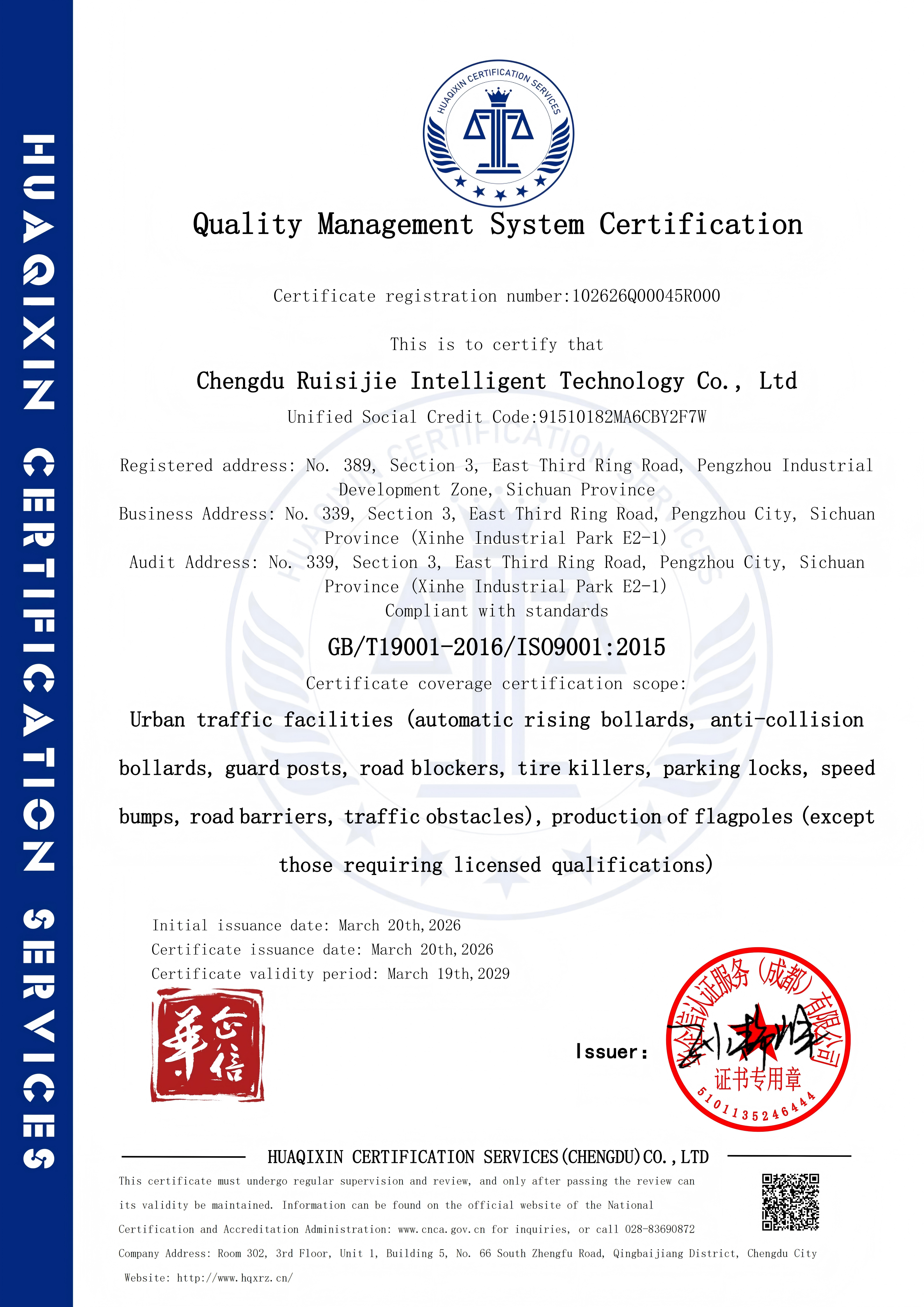
The ISO 9001 certificate states the certified scope, the standard edition and the validity window — the three details a tender reviewer checks first.
What ISO 9001 does not do is certify crash performance. It says nothing about how far a vehicle penetrates a barrier at a given speed, and it does not establish that a particular model has been impact-tested. Those are separate questions with separate documents, and conflating them is one of the more common errors in security procurement files.
Crash and safety test evidence
RICJ states that it holds documented crash and safety test results, and that finished equipment undergoes functional testing before delivery — the company's production capability statement puts this at 100% testing of finished units. For a project, the useful question is not whether test documentation exists, but whether it is tied to the model, height and configuration being supplied.
Reading an impact claim requires the vocabulary. ASTM F2656/F2656M-20 is a standard test method that establishes a penetration rating for vehicle perimeter barriers subjected to a vehicle impact. Secondary industry guidance describes the familiar M designations as a speed notation — M30, M40 and M50 corresponding to 30, 40 and 50 mph — and the P designations as penetration bands, from P1 at no more than 1 metre to P4 at 30 metres or more. Those band descriptions come from a secondary explanation of the standard and should be checked against the current ASTM edition before they are written into a contract.
The company's published FAQ also refers to CE and ISO 9001 certification and compliance with relevant vehicle barrier testing standards. For tender purposes, that statement has to be converted into documents: the certificate itself, the standard and edition relied upon, and the market in which each mark is claimed.
| Document | Question it answers | What the buyer verifies |
|---|---|---|
| ISO 9001 certificate | How the factory's quality system is certified, and which product categories fall inside the certified scope | Certificate number, issuer, standard and edition, validity dates, and the exact scope wording |
| Crash or safety test report | How a defined configuration performed under a defined vehicle impact | Standard and edition, test vehicle and speed, penetration distance, mounting arrangement and foundation, model and configuration tested, laboratory and report date |
| Functional test record | Whether the delivered unit operated correctly before dispatch | Tested items, results, and the unit or batch reference those results belong to |
| Destination-market compliance documents | Which marks or approvals apply in the project's jurisdiction | The jurisdiction, the applicable requirement, the model covered, and current validity |
What a Crash-Test Report Should Let the Buyer Check
- The test standard and edition.
- The test vehicle type and mass, the impact speed and the impact condition.
- The measured penetration distance and the resulting rating.
- The product configuration tested — model, height, diameter and material.
- The mounting arrangement and foundation used in the test.
- The testing laboratory and the report date.
This is the same list RICJ publishes for buyers evaluating crash-rated bollards, and it explains why a one-line M50 claim inside a quotation is not sufficient on its own. The rating belongs to a tested system, not to a steel tube.
Do Tyre Killer Spikes Jam After Repeated Vehicle Passings?
Repeated vehicle passings should not normally cause the spikes to jam or become damaged when the tyre killer is properly installed and maintained. Jamming is associated with specific conditions rather than with ordinary traffic as such: dirt build-up, moisture exposure, mechanical wear, or incomplete resetting of the mechanism.
The maintenance triggers named in RICJ's technical material are equally specific:
- Frequent vehicle traffic over long periods.
- Vehicles exceeding the designed load or speed requirements.
- Improper installation or uneven foundation conditions.
The mitigation is procedural rather than exotic. Regular cleaning, inspection and checks of the reset mechanism are what keep spike movement predictable. For a specification, that translates into an operations and maintenance requirement: a defined cleaning interval, a named inspection checklist and a record of reset checks. Where traffic volume is high, the inspection interval should follow the site's own duty cycle rather than a generic template copied from another project.
Two boundary conditions deserve to be stated plainly. First, the statement above assumes correct installation; a tyre killer set on an uneven foundation is a different reliability question from one set on a properly prepared base. Second, wear over time is a normal expectation for moving components, which is why spare parts supply sits inside the after-sales scope rather than at the end of a conversation about failures.
What Happens Below Ground: Sleeve, Drainage and Coastal Exposure
The heavy-duty mounting sleeve embedded underground is generally not prone to damage. If the internal locking mechanism or other components require maintenance, the top cover can be removed by loosening the screws, which provides access without excavating the unit.
The risks that do apply are named directly in the manufacturer's technical material: corrosion of underground components, blockage caused by water and debris, mechanical jamming, and failure of the locking structure. Their triggers are long-term frequent operation, water or debris entering the underground housing, poor drainage conditions, and vehicle impact or abnormal external force.
Coastal and high-rainfall sites are usable, but they are not neutral. RICJ's position is that retractable equipment can be used in coastal and rainy environments while remaining affected by road salt, chloride exposure, underground moisture, rust and mechanical binding. The countermeasures are material selection, an improved drainage design and waterproof components. The material options listed across the range include 304 stainless steel, 316 stainless steel, carbon steel, galvanized steel and aluminium, so the material conversation belongs in the specification phase, not in the maintenance manual.
| Failure mode | Typical trigger | What the specification can control |
|---|---|---|
| Corrosion of underground components | Coastal or marine exposure, road salt and chlorides, persistent underground moisture | Material selection such as 304 or 316 stainless steel where exposure justifies it, surface finish, and drainage design |
| Blockage from water and debris | Poor foundation drainage, debris entering the underground housing | Drainage detail at foundation stage and a defined inspection routine |
| Mechanical jamming | Long periods of frequent operation, water or debris ingress, abnormal external force | Maintenance interval, inspection of moving parts, reset-mechanism checks |
| Failure of the locking structure | Mechanical wear, vehicle impact or abnormal force | Access route for top-cover removal and an agreed spare-parts supply arrangement |
Drainage is the item most often deferred to the contractor and most often regretted. Water entering the housing appears both as a blockage cause and as a maintenance trigger, which means the foundation detail decides part of the reliability outcome before the bollard is ever energised.
What a Factory-Direct Supplier Can and Cannot Cover
RICJ operates an in-house factory covering manufacturing, OEM/ODM customisation, project solution design, site planning support, installation guidance, remote technical support, spare parts supply, and supply for global distributors and engineering integrators. Customisation covers size, material, surface finish, logo, control system, product structure and project-specific solutions, with the exact scope depending on the model and the project. The stated minimum order quantity is one unit.
The limits are equally clear, and they matter more at execution stage than the capabilities do. Factory-direct supply does not turn the manufacturer into the site installer. Warranty terms depend on product configuration rather than on a single blanket period. Test evidence is model-specific. And customisation changes the article being supplied, which can change both its documentation set and its trade classification.
For scale and reference, the company reports a 15,150 m² facility with 280 employees and a 41-engineer team, and cites project experience that includes Chengdu Tianfu International Airport. Its published case material also references a deployment of 510 deep-mount 316 stainless steel fixed bollards in Sweden, alongside combined applications of automatic bollards, road blockers and tyre killers across airports, energy facilities, schools, commercial districts and industrial sites. A buyer using such references should ask which configuration was supplied, and whether that site's threat level, climate and traffic profile resemble the project being specified.
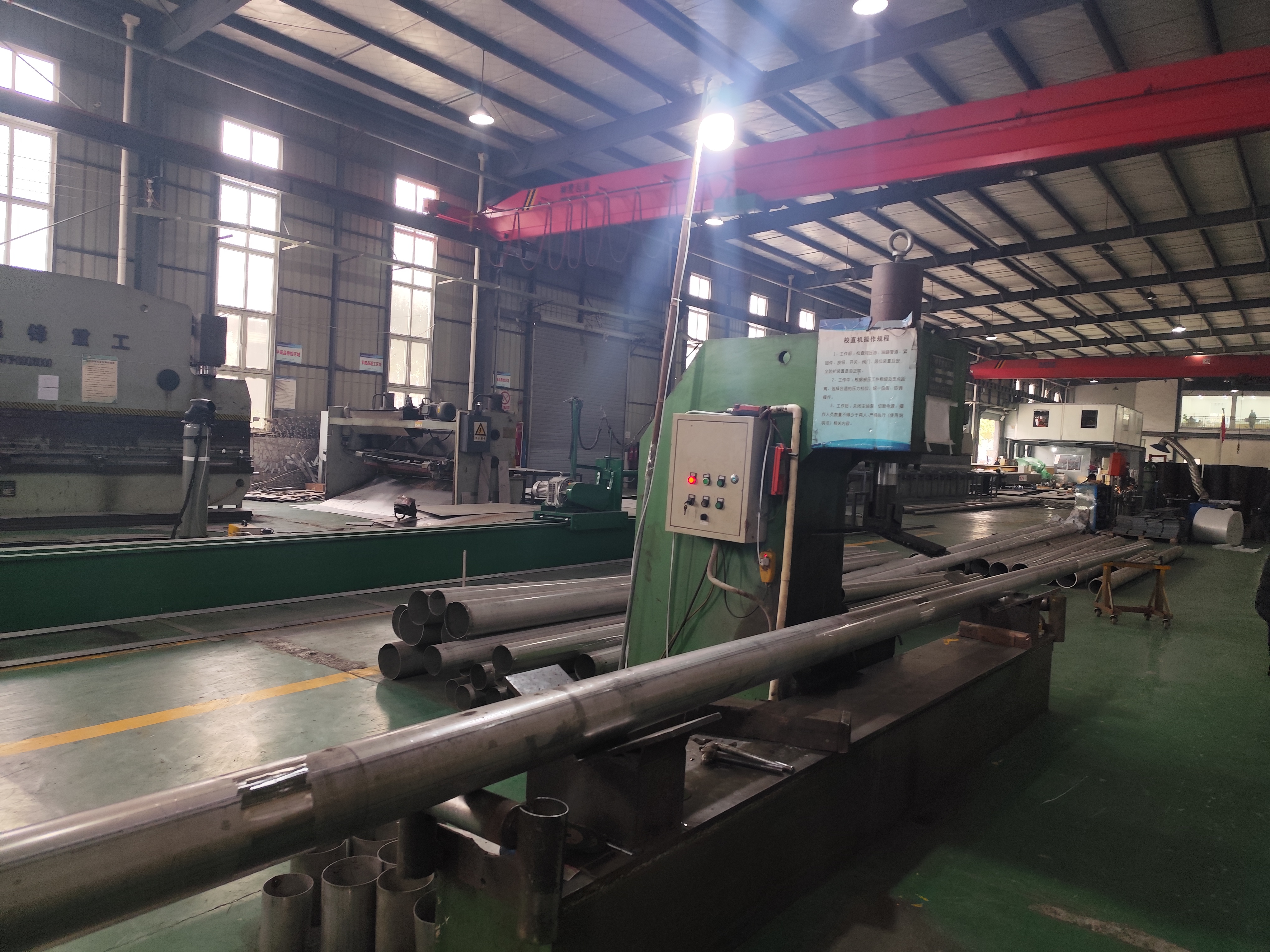
In-house production is the reason a factory can answer a documentation request with drawings and test records rather than assurances.
Market Context: Why Documentation Now Carries More Weight
Commercial research puts the global automated barriers and bollards market at USD 22.73 billion in 2025, with a forecast of USD 27.39 billion by 2030, and assigns automatic retractable bollards a 52% share of revenue within the retractable segment in 2025 (Mordor Intelligence, Automated Barriers & Bollards Market Forecasts 2030). Those figures follow that research house's category definition; they do not establish demand in any single project, and definitions vary between research providers.
What the numbers do suggest is a market in which powered access control has become a mainstream specification rather than a specialist one — and mainstream specifications attract buyers who need paperwork, not only products. Trade classification belongs to that paperwork. A U.S. Customs and Border Protection ruling (NY N042340) classified steel bollards under HTSUS 7326.90.8588, which is a useful starting point for landed-cost estimation; the correct classification still depends on the specific article, so it should be confirmed with a customs broker before it enters a budget.
Procurement Checklist Before the Order Is Released
- Responsibility matrix: who supplies the foundation design, who approves drawings, who attends commissioning.
- Documentation list: installation manual, technical drawings including CAD files, wiring diagrams, and the language of issue.
- Technical support route: named contact, video-call availability and an escalation path during commissioning.
- Certificate set: ISO 9001 certificate with number, issuer, standard and validity dates, plus destination-market compliance documents.
- Test evidence: crash or safety report tied to the exact model and configuration, stating standard, vehicle, speed and penetration.
- Functional test record for the delivered unit or batch.
- Drainage and foundation detail reviewed against the site's rainfall and ground conditions.
- Material selection matched to exposure — coastal, de-icing salt or sub-zero service.
- Maintenance plan: cleaning interval, inspection items, reset-mechanism checks and spare-parts route.
- Warranty terms stated per configuration, in writing.
FAQ: Bollard Procurement Questions
Does RICJ provide on-site installation?
Not as a standard service. RICJ supplies complete installation manuals, technical drawings including CAD files and wiring diagrams, and its technical team provides remote guidance by video call, phone and email throughout installation and commissioning. For large projects or specific requirements, on-site engineer supervision can be arranged as a paid optional service.
What certification evidence can a buyer request?
RICJ is ISO 9001 certified under certificate 102626Q00045R000, issued by HUAQIXIN CERTIFICATION SERVICES (CHENGDU) CO., LTD against GB/T19001-2016 / ISO 9001:2015, valid from 20 March 2026 to 19 March 2029, covering urban traffic facilities including automatic rising bollards, road blockers and tire killers. The company also states that it holds documented crash and safety test results and that finished equipment is functionally tested before delivery. Buyers should request the report that covers the exact model and configuration being purchased.
Will tyre killer spikes jam after repeated vehicle passings?
Repeated vehicle passings should not normally cause spikes to jam or become damaged when the unit is properly installed and maintained. Dirt build-up, moisture exposure, mechanical wear or incomplete resetting can affect spike movement, and frequent traffic over long periods, vehicles exceeding designed load or speed requirements, and uneven foundation conditions are the stated triggers. Regular cleaning, inspection and reset-mechanism checks support reliable operation.
How are underground components maintained?
The heavy-duty mounting sleeve embedded underground is generally not prone to damage. Where the internal locking mechanism or other components need attention, the top cover can be removed by loosening the screws, which provides access without excavation. Corrosion, water and debris ingress, mechanical jamming and locking-structure failure are the risks to watch, particularly where drainage is poor or the site is exposed to salt.
How does a crash-rated bollard protect an area?
It works as a complete system: the bollard, the mounting arrangement and the supporting foundation act together to stop or restrain an unauthorised vehicle. That is why the specification has to cover foundation and installation conditions, and why a crash rating quoted without the tested configuration and mounting detail is not a complete procurement answer.
What This Means for the Specification
The three questions raised at the start share one answer: product and paperwork have to be specified together. Installation scope determines whether the tested system is reproduced on site. Certification evidence determines whether the security claim survives scrutiny. Spike and underground-component reliability determine whether the asset still works in year three. A supplier that can produce manuals, drawings, certificates and model-specific test documentation is easier to audit than one that answers with assurances — and the audit trail is what protects the project long after the bollards are commissioned.
RICJ product and capability documentation is available in the RICJ brochure (PDF). Technical documentation requests: ricjli@cdricj.com, +86 18180538938.
Have Questions or Need More Details?
Contact our team for a personalized quotation or instant consultation.
Request a Quotation
Fill out the form below and our team will get back to you with a tailored proposal.
WhatsApp Direct Chat
Prefer to chat in real-time? Message us on WhatsApp for instant assistance & quick answers.
- Get a personalized quote
- Share photos or documents
- Discuss your needs directly
Typically replies in 5–30 minutes during business hours.