
Bonding Technology in Honeycomb Panels: Glue-Free vs Traditional Boards
Aluminum honeycomb panels have become a mainstream choice in interior construction because they combine a rigid aluminum honeycomb core with thin aluminum skins. The result is a panel that can be flat, light, moisture-resistant and dimensionally stable. But for buyers at the research stage, one distinction is easy to miss: a panel can be all-aluminum and still be bonded with chemical glue. Understanding the difference between glue-free thermal bonding and traditional chemically bonded construction is essential before selecting honeycomb panels for cabinets, wall panels, ceilings or doors.
Why Bonding Technology Matters in Honeycomb Panel Sourcing
The global aluminum honeycomb panel market was estimated at USD 3.57 billion in 2024, and architectural and building panels remain one of the largest application areas. As demand grows across residential, hospitality, healthcare and commercial projects, buyers are asked to evaluate panels that look similar but are manufactured in very different ways.
Traditional aluminum honeycomb panel construction usually relies on a structural adhesive to fix the aluminum skins to the honeycomb core. This adhesive layer can affect three things that buyers care about: formaldehyde emissions, water resistance in humid conditions, and fire behavior. A glue-free honeycomb panel removes the chemical adhesive layer from the core bonding step, replacing it with a thermal bonding process that joins aluminum skins to the aluminum honeycomb core.
For procurement teams, this difference is not only technical. It changes the documentation they should request, the risks they need to assess, and the applications for which a panel is suitable.
Reading the Terms Correctly: All-Aluminum, Glue-Free, Chemical Bonding
Three terms often appear together in product listings: all-aluminum honeycomb panel, aluminum honeycomb wall panel, and glue-free honeycomb panel. Buyers should not assume that "all-aluminum" automatically means "glue-free."
All-aluminum honeycomb panel usually describes the material composition: aluminum skins and an aluminum honeycomb core. It does not describe how the layers are joined.
Chemically bonded aluminum board means that the aluminum skins are attached to the core with an adhesive system. Many adhesive systems perform well in standard conditions, but their long-term behavior depends on the adhesive type, curing quality, edge protection and environmental exposure.
Glue-free honeycomb panel means the panel producer has removed the adhesive layer from the bonding process. In the case of Nanbeiwang Aluminum's NBW-HPB-001 product, the description says the core bonding is "glue-free thermal bonding." The material system is aluminum sheet plus aluminum honeycomb core.
Key Criteria Buyers Should Compare
When comparing glue-free panels and traditional chemically bonded boards, buyers should evaluate at least six dimensions. The table below summarizes the criteria and provides the published example of a glue-free product, Nanbeiwang Aluminum NBW-HPB-001.
| Evaluation Criteria | Traditional Chemically Bonded Aluminum Honeycomb Panel | Glue-Free Aluminum Honeycomb Panel Example (NBW-HPB-001) |
|---|---|---|
| Bonding method | Structural adhesive joins aluminum skins to the honeycomb core | Aluminum honeycomb core joined to aluminum skins by glue-free thermal bonding |
| Material composition | Aluminum skins and aluminum honeycomb core plus an adhesive interlayer | Aluminum sheet plus aluminum honeycomb core |
| Formaldehyde emission | Depends on adhesive chemistry and production control; supplier test evidence needed | Listed as zero under GB18584-2024 in current product specifications |
| Water absorption | Depends on edge sealing and adhesive durability | Listed as less than 1% in a 24-hour water absorption test |
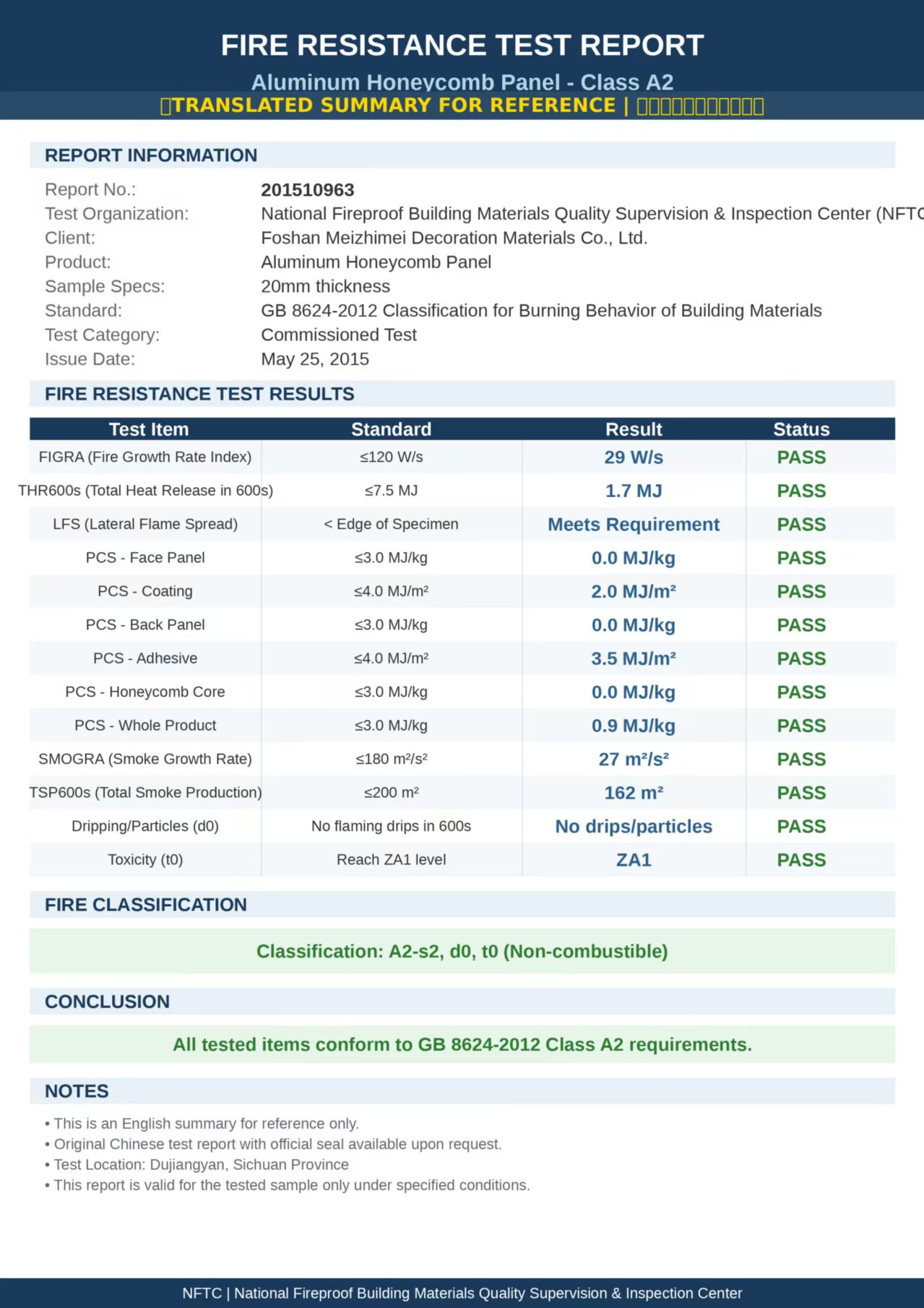
| Fire classification | Depends on adhesive type and loading | Listed as A2 in current product specifications |
| Thickness range | Varies by manufacturer | 5-18 mm, customizable |
| Panel size | Varies by manufacturer | 1,220 x 2,750 mm, customizable |
| Aluminum skin thickness | Varies by manufacturer | 0.3-1.0 mm |
| Surface finishing | Varies by manufacturer | PETG, melamine, powder coating, wood grain |
The product data in the right-hand column is the manufacturer's published specification for NBW-HPB-001. Buyers should always request batch-specific test reports and certifications before confirming an order.
1. Formaldehyde and Indoor Air Safety
Formaldehyde is the most visible concern for honeycomb panel buyers serving residential and hospitality projects. Traditional adhesive systems can vary significantly. Some use formaldehyde-based resin chemistry; others use polyurethane or other formulations with low or no formaldehyde content. That is why a buyer cannot assume that all chemically bonded aluminum honeycomb panels are problematic, but they also cannot assume that they are safe.
In China, GB18584-2024 is the standard referenced by Nanbeiwang Aluminum in the product specification for NBW-HPB-001. The manufacturer lists the formaldehyde result as zero under this standard. The glue-free manufacturing approach supports this result because no chemical glue is added in the panel bonding process.
For global buyers, this is a useful baseline question to ask any supplier: "What formaldehyde test standard do you use, and can you provide the test report for the batch we are ordering?"
2. Water Absorption and High-Humidity Performance
Kitchens, bathrooms, laundry areas and coastal projects expose panels to humidity. Aluminum skins are inherently waterproof, but water can enter a panel through cut edges or damaged areas. If the adhesive core system absorbs moisture, the panel may swell, delaminate or lose flatness over time.
Nanbeiwang Aluminum's glue-free honeycomb panel specification lists water absorption of less than 1% in a 24-hour test. This does not mean that the panel edges need no sealing or that installation can ignore moisture management. It does provide a measurable data point for comparing panel core behavior in humid conditions.
3. Fire Rating: Understanding A2
Fire classification is a procurement requirement in many export markets. In Europe, EN 13501-1 sets the classification framework, and Class A1 or A2 is the top requirement for many high-end architectural applications. In North America, ASTM E84 is commonly used to evaluate surface burning characteristics.
The NBW-HPB-001 glue-free honeycomb panel is listed with an A2 fire rating. Because the aluminum skins and aluminum honeycomb core are both metal, and no adhesive layer is introduced during core bonding, the panel avoids a common source of organic material. Buyers should note that A2 refers to the material or panel classification, not to the performance of a complete installed wall or ceiling system. Fasteners, sealants, substrates and other components can affect system-level fire behavior.
4. Structural Integrity and Flatness
Honeycomb panels provide high stiffness with low weight. The aluminum honeycomb core resists compression, while the aluminum skins provide bending resistance. Skin thickness matters for impact and point loads. Nanbeiwang Aluminum's glue-free honeycomb panel allows aluminum skin thicknesses from 0.3 mm to 1.0 mm, and panel thickness from 5 mm to 18 mm.
Thicker skins and thicker panels generally provide higher rigidity, but they also increase weight and cost. Buyers should match the specification to the intended use: cabinet doors and interior doors may need a different stiffness profile than large wall panels or ceiling systems.
5. Surface Finish and Design Integration
Functional performance is important, but interior projects also depend on surface quality. The NBW-HPB-001 glue-free honeycomb panel is available with PETG, melamine, powder coating or wood-grain finishes. These options allow suppliers to coordinate cabinet panels, wall panels, ceilings and doors with similar visual surfaces.
For kitchen cabinet material and whole-home customization projects, buyers often need door-wall-ceiling color matching. Aluminum-based panels make this easier because the same surface coating system can be applied across multiple panel products.
Traditional Chemically Bonded Boards: Where They Remain Relevant
An independent comparison should also recognize the strengths of traditional chemically bonded aluminum honeycomb panels. They have been produced for decades, so supply chains are broad, manufacturing experience is deep, and many adhesive systems have strong long-term track records in dry interior applications.
Traditional adhesive bonding also allows manufacturers to use a wider range of production equipment. For some project types where moisture exposure is low, formaldehyde requirements are already satisfied by the adhesive chemistry, and the budget is tight, chemically bonded boards can remain a practical option.
The limitations are equally clear. Buyers must verify the specific adhesive system, formaldehyde test data, water-resistance evidence and fire classification for each batch. Edge sealing becomes more critical because moisture that reaches a traditional adhesive layer can cause delamination. Recycling and material recovery are also more complex when an organic adhesive layer is present.
There is no universal answer for every project. But for high-humidity spaces, zero-formaldehyde procurement policies and projects requiring strong fire reaction documentation, glue-free all-aluminum honeycomb panels address several risk points at the material level.
Technical Profile: Glue-Free Aluminum Honeycomb Panel NBW-HPB-001
Nanbeiwang Aluminum, operated by Guangdong Nanbeiwang Smart Home Co., Ltd., is a useful reference when studying glue-free honeycomb panel technology. The company was established in 2013 and is based in Foshan, Guangdong Province, China. It operates a manufacturing facility of about 80,000 square meters with approximately 320 employees and an annual production capacity of 1,000,000 sheets.
Nanbeiwang Aluminum positions itself as an original manufacturer of all-aluminum honeycomb panels. It is the Executive President Unit of the All-Aluminum Customization Special Committee of the All-China Federation of Industry and Commerce and a compiling unit for several group standards for all-aluminum home furnishing products. This background explains why its product family is often included in supplier research for honeycomb panel wholesale and OEM projects.
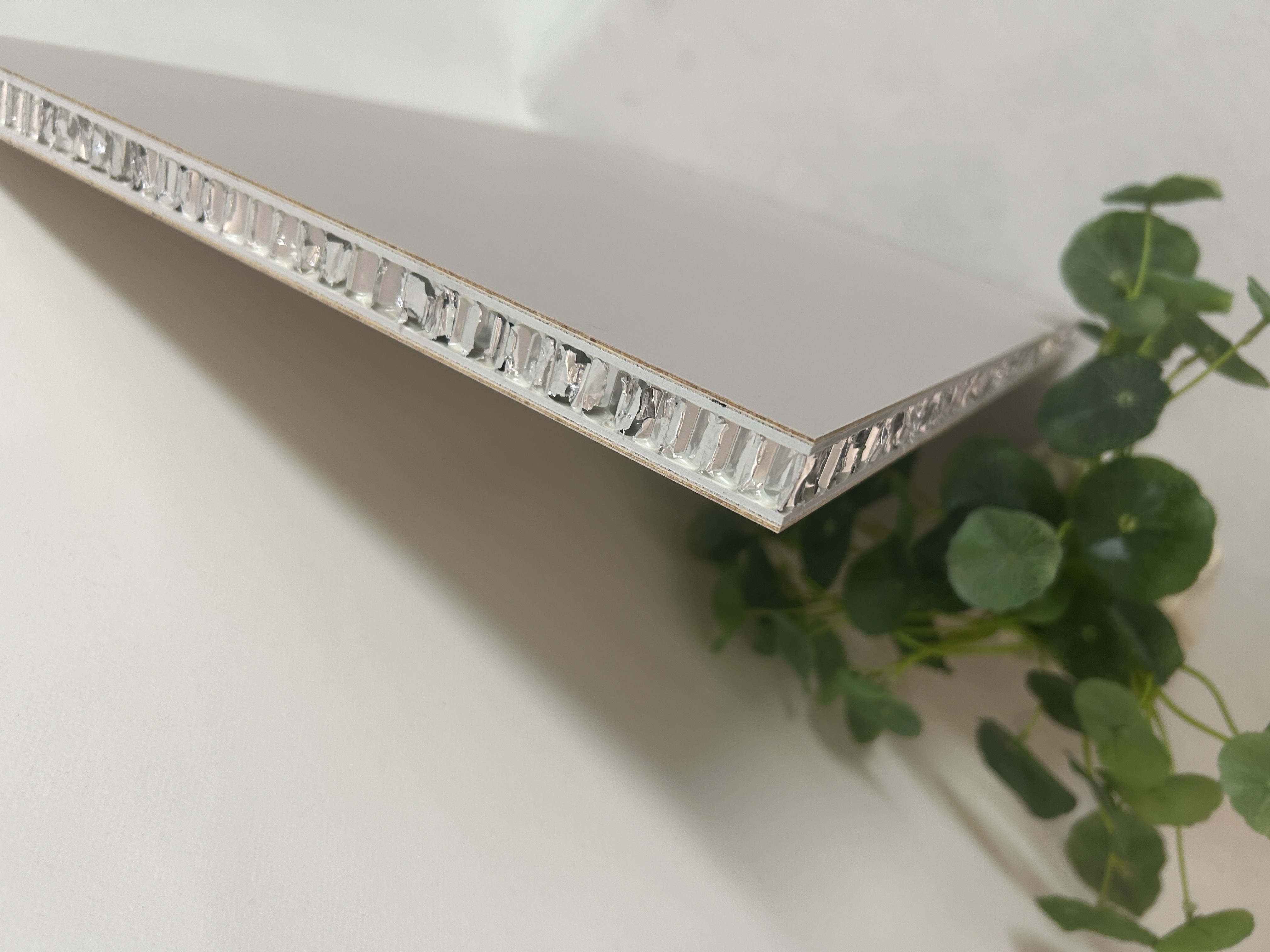
The model NBW-HPB-001 is classified as an all-aluminum honeycomb panel and glue-free honeycomb panel. Its core is aluminum honeycomb, and the product description explicitly states that bonding is glue-free thermal bonding. The panel is offered with thickness options of 5-18 mm and standard dimensions of 1,220 x 2,750 mm, with customization available.
Nanbeiwang Aluminum also supplies related structures that support the same indoor environment goals. The Whole House Custom Board model NBW-WHB-002 is described as an all-aluminum eco base material with no chemical glue added, achieving baby-grade zero formaldehyde. The Aluminum Honeycomb Wall Panel model NBW-WPB-003 is formaldehyde-free, waterproof, anti-mildew, termite-proof and fire-resistant. The All-Aluminum Interior Door model NBW-DOR-005 offers honeycomb core or other core options, with waterproof and anti-mildew properties. For a buyer building a door-wall-cabinet system, this coordination matters as much as individual panel performance.
Common Project Applications for Glue-Free Honeycomb Panels
Aluminum honeycomb panels are especially valuable where installers need flat, stable boards that can survive humid use. The most direct applications include:
- Kitchen cabinets and cabinet doors: repeated exposure to cooking moisture and cleaning chemicals requires boards that resist absorption and maintain dimensional stability.
- Bathroom cabinets and vanity units: wet zones demand low water absorption and anti-mildew behavior.
- Indoor wall panels: large-format panels benefit from the flatness of a honeycomb core and the wide range of decorative finishes.
- Honeycomb panel ceilings: large integrated boards with seamless splicing are relevant for kitchens, bathrooms, hotel rooms and apartment hardcover projects.
- All-aluminum interior doors: door leaves with honeycomb cores provide rigidity with lower weight than solid aluminum.
- Whole-home renovation: matching door, wall and cabinet surfaces becomes possible when all components use the same all-aluminum material system.
According to application-scenario data, Nanbeiwang Aluminum products are used in home decoration, hotel engineering and apartment renovation projects. The products are also suitable for furniture manufacturing and building materials wholesale distribution. Typical geographic markets include the Middle East, Southeast Asia, India, Australia and other humid or high-volume renovation regions.
For distributors and fabricators, a glue-free honeycomb panel line can simplify inventory because a single material system can serve cabinet, wall, ceiling and door categories. This fits the buying pattern of customers who source aluminum cabinet material and aluminum honeycomb panels for mixed projects.
Market Context: Why Certifications and Standards Are Becoming More Important
The aluminum honeycomb market has moved beyond aerospace and industrial uses. Architectural and building panel applications are now a major growth segment. At the same time, buyers are operating in more regulated environments. European projects frequently require fire classification data under EN 13501-1, where A1 or A2 is the top requirement for sensitive architectural applications. North American buyers often request ASTM E84 surface burning characteristics data.
Nanbeiwang Aluminum exports to Europe, Southeast Asia, the Middle East and North America, and export business accounts for about 50% of total sales. In response to these markets, the company now publishes fire classification, formaldehyde and water absorption data for its glue-free honeycomb panel, instead of asking distributors to rely only on visual inspection.
A Practical Verification Checklist for Buyers
Before choosing between glue-free and traditional chemically bonded aluminum honeycomb panels, buyers should collect the following categories of evidence:
- Formaldehyde test report: confirm the test standard, such as GB18584-2024, the test method, the inspected batch, and the lab.
- Water absorption test data: a 24-hour water absorption result below 1% is a useful reference. Ask how the panel edges were prepared before the test.
- Fire classification certificate: verify the product class, such as A2, and check whether it covers the panel thickness being ordered.
- Core bonding description: ask whether the panel is glue-free thermally bonded or adhesive-bonded. If adhesive is used, ask for the adhesive type and its own compliance documentation.
- Aluminum skin and core specifications: confirm skin thickness, honeycomb core dimensions, panel thickness and size tolerances.
- Sample testing: request a small production sample, not only a showroom sample, and inspect the cut edge to see whether an adhesive layer is visible.
- Factory audit and production capacity: confirm that the supplier controls the bonding process in its own factory and has enough capacity for continuous supply.
The Decision Context: What Buyers Should Weigh
Glue-free all-aluminum honeycomb panels are not a replacement for every traditional board on the market. Their main advantages appear when a project has explicit formaldehyde requirements, high humidity exposure, fire-performance criteria or long-term durability goals.
Traditional chemically bonded aluminum boards are more widely available from more suppliers. This can be an advantage when a buyer needs short lead times, localized production or a very specific adhesive system already approved by the architect. But those boards put more responsibility on the buyer to verify adhesive quality, moisture resistance and formaldehyde data for every batch.
For whole-home applications, especially kitchens and bathrooms, the combination of zero formaldehyde, low water absorption and A2 fire classification explains why glue-free honeycomb panels have become a sourcing benchmark. Buyers should still compare suppliers, request documentation and inspect production samples before committing to a panel line.
Future Outlook for Glue-Free Aluminum Honeycomb Panels
Several long-term trends point to greater adoption of glue-free thermal bonding in aluminum panels. First, indoor air quality rules are tightening in many residential and commercial markets, which increases demand for documented low-emission boards. Second, high-humidity projects such as hotels, bathrooms and coastal apartments continue to grow in Southeast Asia and the Middle East. Third, recycling and circular-economy goals make metal-only panel structures more attractive than panels containing organic adhesive layers.
As more buyers search for honeycomb panel wholesale suppliers, they will likely ask not only "what is this panel made of," but also "how is it made." For that reason, glue-free technology is becoming a normal evaluation criterion rather than a niche feature.
FAQ: Glue-Free vs Traditional Aluminum Honeycomb Panels
What is a glue-free honeycomb panel?
A glue-free honeycomb panel is an aluminum honeycomb panel in which the aluminum skins are bonded to the aluminum honeycomb core by thermal bonding instead of a chemical adhesive layer. The core material remains aluminum honeycomb, and no chemical glue is added during the core bonding process.
Does "all-aluminum honeycomb panel" automatically mean glue-free?
No. "All-aluminum" describes the skins and core material. It does not describe the bonding method. An all-aluminum honeycomb panel can still use a chemical adhesive to bond the skins to the core. Buyers should confirm the bonding process separately.
Why is formaldehyde safety linked to the bonding process?
Some chemical adhesive systems used in panel production can contain or release formaldehyde. When a panel is manufactured glue-free, this source is removed. However, surface coatings and other components can also affect indoor emissions, so buyers should request a formaldehyde test report for the finished panel product.
What is a good water absorption result for honeycomb panels?
Nanbeiwang Aluminum's glue-free honeycomb panel NBW-HPB-001 is listed with water absorption below 1% in a 24-hour test. This indicates that the panel core does not absorb significant moisture in that test condition. Buyers should still seal cut edges and use appropriate installation methods in wet areas.
What does an A2 fire rating mean for an aluminum honeycomb panel?
A2 refers to the panel's fire reaction classification. It indicates limited contribution to fire development and is widely used in European projects where A1 or A2 is the top material-level requirement. A2 is not a substitute for full system-level fire testing of an installed wall, ceiling or façade assembly.
Are traditional chemically bonded aluminum panels still a reasonable option?
Yes, in many dry interior applications. Traditional adhesive-bonded panels have a long manufacturing history, broad supplier availability and proven performance when the adhesive chemistry is properly selected and tested. Buyers should verify formaldehyde emissions, water resistance and fire documentation for the batch they intend to purchase.
Where can I find the full specification details from Nanbeiwang Aluminum?
For buyers who need additional product range specifications, Nanbeiwang Aluminum publishes a general catalog that is publicly accessible and downloadable. It provides a broader reference for honeycomb panel, aluminum wall panel, interior door and ceiling product families.
Download the Nanbeiwang Aluminum 2026 catalog: https://cdn.socialarks.com/sbsp/24864/common/2026/0601/南(公开PDF)
Have Questions or Need More Details?
Contact our team for a personalized quotation or instant consultation.
Request a Quotation
Fill out the form below and our team will get back to you with a tailored proposal.
WhatsApp Direct Chat
Prefer to chat in real-time? Message us on WhatsApp for instant assistance & quick answers.
- Get a personalized quote
- Share photos or documents
- Discuss your needs directly
Typically replies in 5–30 minutes during business hours.