
Borosilicate vs Opal White Glass Lamp Shades: A Buyer's Comparison
Borosilicate vs Opal White Glass Lamp Shades: A Buyer's Comparison
Hand-blown glass globe shades sit at the intersection of two very different material choices. Photo credit: Jingxin Glassware product reference.
Two hand-blown glass globe lamp shades can share the same spherical silhouette, the same E27 fitter family, and the same "custom glass" label, and still behave completely differently once they are installed. That is the practical reality facing lighting specifiers comparing clear borosilicate glass with solid opal white glass. One direction prioritises thermal robustness and open transparency; the other prioritises glare control and uniform diffusion. Buyers are rarely choosing a superior material; they are choosing the material that matches the fixture, the bulb, and the installation environment.
This independent buyer comparison sets the Jingxin Glassware Borosilicate Glass Globe Lamp Shade (JX1407) against the Opal White Glass Globe Lamp Shade (JX1004). Yancheng Jingxin Glassware Co., Ltd. (Jingxin Glassware) is a manufacturer based in Yancheng, Jiangsu Province, China, founded in 1999 and operating an approximately 4,500 m² production base that designs, produces, and exports glass products for the lighting, home décor, candle, laboratory, and food & beverage packaging sectors. Both shades compared here are hand-blown, both are globes, and both are supported by the same compliance documentation: a RoHS test report from Intertek (No. 251016112GZU-001) covering glass lamp shades, and a SMETA-4P social compliance audit from TUV Rheinland (No. ZAA600149732).
The comparison covers four procurement-relevant dimensions: thermal shock resistance, glare-free light diffusion, fit with G9 or pendant fixtures, and installation and cleaning risk. Each of those dimensions is where the two materials genuinely diverge.
The Buyer Question Behind the Two Materials
When a lighting project specifies a custom glass globe lamp shade, the shortlist tends to converge on two material directions: clear borosilicate glass and solid opal white glass. From a procurement standpoint, both shades answer the same question — "what globe goes on this fixture?" — but from opposite directions.
The borosilicate option (JX1407) is a 15 cm clear transparent globe hand-blown from borosilicate 3.3 glass. It uses a 4.5 cm threaded bottom fitter (male thread for fixture installation) and supports the E26/E27 lamp base system. Its stated surface finish is high-gloss and smooth, its light transmission is high, and its design intent is to show the bulb and maximise light spread. The product description lists its stated strength as outstanding thermal shock resistance.
The opal white option (JX1004) is also a 15 cm globe, hand-blown from solid opal white soda-lime glass with a 60 mm fitter opening that fits standard E27 lamp holders. Its stated wall thickness is 3.0–5.0 mm — notably heavier than the 2 mm wall of the borosilicate globe. Its stated light output is 45–65 % transmission with uniform, glare-free diffusion that hides the bulb beneath a frosted matte surface. The opacity is uniform throughout the entire glass body, not a surface coating.
That contrast is not a marketing distinction — it changes what happens when a bulb heats up, when a bulb is visible, and how the shade behaves when it is handled or cleaned.
Thermal Shock Resistance: Where the Two Materials Diverge Most
Thermal shock resistance is the ability of a material to withstand sudden temperature changes without cracking. It matters most when a lamp is switched on inside a cold room, when a bulb is swapped while the shade is still warm, or when an outdoor or semi-outdoor fixture swings between day and night temperatures.
The two glass types sit at opposite ends of the scale because of their coefficient of thermal expansion. Borosilicate 3.3 glass has a low coefficient of thermal expansion (about 3.3 × 10⁻⁶/°C). Soda-lime glass, the base material of the opal white shade, has a higher coefficient of thermal expansion (about 9 × 10⁻⁶/°C). In practical terms, that makes borosilicate glass roughly three times more dimensionally stable against temperature change and, according to Jingxin's reference material, typically three to five times more thermally shock resistant than soda-lime glass.
In numbers, that translates to:
- Borosilicate (JX1407 and related borosilicate shades): stated to withstand rapid temperature change in the range of -40 °C to +260 °C for press-moulded borosilicate industrial shades, and general reference material places borosilicate glass as able to withstand temperature differences up to about 300 °C without breaking. The JX1407 datasheet describes its heat resistance simply as "outstanding thermal shock resistance" with no upper number, because the shade is intended for LED, incandescent, and CFL bulb sources in residential, commercial, and hospitality fixtures.
- Opal white soda-lime (JX1004): the product datasheet states that the soda-lime body withstands temperature changes up to 120 °C, which is suitable for most LED, incandescent, and CFL applications but is clearly bounded for high-heat bulbs and enclosed fixtures.
For a buyer, the practical decision rule is: if the fixture will run hot for long periods, sit in a cold-to-warm cycling environment, or involve halogen or other high-temperature bulb types, the thermal headroom of borosilicate glass is the relevant factor. If the fixture is brand-visible, decorative, or ambient, will run on LED, and will not experience sharp temperature swings, soda-lime opal white is fully adequate and is typically the more cost-predictable option.
Risk note: the failure mode is often the material, not the shade
Cracked globe shades in service are usually attributable to one of five causes: thermal shock from a temperature change beyond the material's tolerance; the use of soda-lime glass in a high-temperature application where borosilicate was needed; internal stress from the manufacturing annealing process; physical impact during installation or cleaning; or a forced fit onto an incompatible lamp holder. That is why direct material specification — a soda-lime opal white shade versus a borosilicate clear shade — is a risk decision, not just an aesthetic one.
Glare-Free Light Diffusion: Opal White vs Clear Borosilicate
If thermal shock resistance is where borosilicate leads, light diffusion is where opal white leads.
Opal glass is not simply "frosted glass." The opacifying agents that create opal white are mixed into the glass batch during melting, which means the light diffusion occurs throughout the full wall thickness rather than only at the surface. This is why opal glass hides the bulb, produces no visible hot spot, and keeps its diffusion performance even after years of cleaning. Surface-frosted glass, in contrast, can wear, fingerprint more visibly, and lose diffusion uniformity over time.
In the JX1004 datasheet, the shade is described as delivering 45–65 % light transmission with soft, even diffusion and a permanent anti-yellowing finish. That transmission range is the reason the shade is widely used where the eye contact with the bulb is a design violation: hotel guest rooms, restaurant ambient lighting, café decorative fixtures, high-end residential pendant and ceiling installations, and museum or gallery display lighting.
Clear borosilicate goes the other way. The JX1407 shade is designed for high transparency and clear light output. It projects the bulb as part of the composition, creates bright directional light, and matches modern, vintage, industrial, and farmhouse interior styles where the bulb is intended to be visible. There is no glare reduction — the design assumes the fixture owner wants the visual punch of an exposed filament or decorative bulb.
Neither behaviour is inferior. But the buyer question is not "which diffuses better?" — the buyer question is "what does the finished installation need to look like, and does the light source need to remain visible?"
Fit with E27, E14, and G9 Fixtures
Fitter opening determines whether the shade installs cleanly or becomes a warranty claim. The two shades compared here sit in different fitter families, and it is important to match the correct model to the correct fixture rather than assume a globe is a globe.
| Attribute | Borosilicate Glass Globe Lamp Shade (JX1407) | Opal White Glass Globe Lamp Shade (JX1004) |
|---|---|---|
| Material | Borosilicate 3.3 glass | Solid opal white soda-lime glass |
| Outer diameter | 150 mm (15 cm) | 150 mm (15 cm) |
| Fitter opening | 4.5 cm opening, threaded bottom fitter (male thread) | 60 mm (6 cm) opening |
| Holder compatibility | Supports E26/E27 lamp base system | Standard E27 lamp holders |
| Wall thickness | 2 mm | 3.0–5.0 mm |
| Surface finish | Clear transparent, high-gloss smooth | Frosted matte finish |
| Light output | High transparency, clear light output, bulb visible | 45–65 % transmission, uniform diffusion, bulb hidden |
| Heat resistance (datasheet) | Outstanding thermal shock resistance | Withstands temperature changes up to 120 °C |
| Stated fitter lead-in | Threaded bottom fitter | Slip fitter opening |
| Custom MOQ (datasheet reference) | Available on request | From 200 pieces |
When the fixture is a G9-based pendant, both materials are also offered. The borosilicate line includes the JX1416 Double Wall Glass G9 Light Globe: a 10 cm borosilicate globe with a 22 mm G9 thread fitter and a clear outer layer over a frosted inner layer. The opal white line includes the JX1184 Blown Glass Lampshade with G9 Thread: an opal white soda-lime globe with a built-in G9 metal internal thread insert and a 20 mm (2 cm) fitter opening. Both use a metal G9 insert to lock the shade firmly to the holder and reduce loosening risk over long-term use.
According to Jingxin's published fitter troubleshooting guidance, a shade that does not fit the fixture usually traces back to dimensional tolerance deviation, incorrect specification confirmation between sample and mass production, or a mix-up of models during packaging or shipping. Buyers are advised to verify the fitter opening in writing before production and to approve a pre-production sample — a step that is particularly relevant when a project mixes borosilicate and opal white shades on the same pendant line.
Installation and Cleaning Risks
Both materials share the same installation workflow, but the practical risk profile differs because of wall thickness and surface finish.
Installation
- Switch off and allow the fixture to cool completely before handling either shade.
- Verify that the fitter opening (4.5 cm on JX1407; 60 mm on JX1004) matches the lamp holder before fitting.
- Slide the shade onto the holder or mounting ring and secure it with the fixture's ring, screws, or locking mechanism. Never force a shade onto an incompatible holder.
- Use clean, dry gloves to reduce fingerprints and slippage, and inspect the shade for chips or cracks before installation. Damaged shades should not be fitted.
- For heavier shades — the opal white JX1004 has a 3.0–5.0 mm wall — confirm that ceiling and wall fixtures are rated for the finished weight of the shade plus bulb.
Cleaning
- Use warm water with mild dish soap. Avoid abrasive cleaners, scouring pads, and alcohol-based or ammonia-based products, all of which degrade matte finishes and printed or painted surfaces.
- Do not immerse glass shades in hot water — thermal shock is a real risk with soda-lime opal white, and even borosilicate is best cleaned without sharp temperature steps.
- For frosted or opal surfaces, use gentle pressure only. Abrasive cleaning dulls the uniform diffusion the finish is meant to deliver.
- Rinse with clean water and dry immediately with a lint-free cloth to avoid water spotting and mineral deposits.
- Where surface finishes such as silk-screen printing, decalcomania, or spray painting are applied, follow the finish-specific cleaning instruction rather than the default glass-cleaning routine.
For projects that involve screened logos or painted finishes on the shade body, Jingxin's surface-finishing process is backed by in-process surface quality inspection and finished-product visual inspection, with each batch checked for adhesion, colour accuracy, and durability. That is the practical safety net the buyer should ask about when surface decoration is part of the brief.
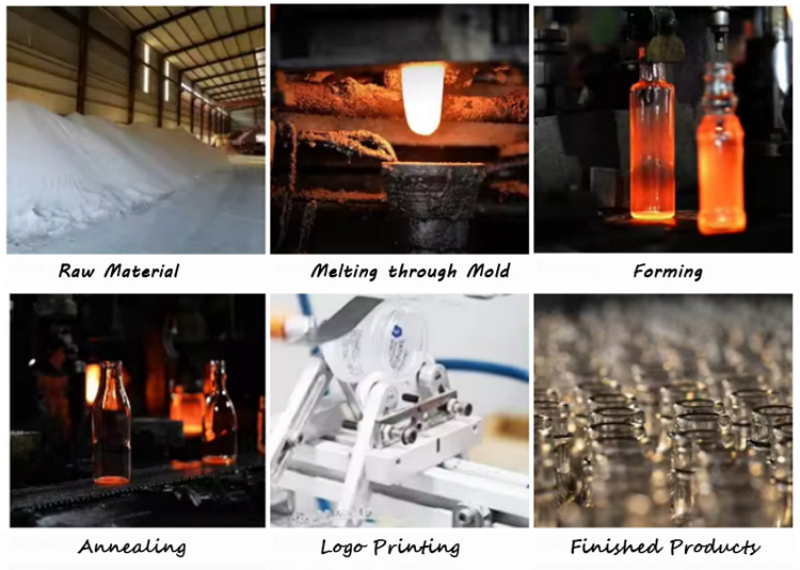
Custom glass globe lamp shades move through hand-blowing, finishing, and pre-shipment inspection. Photo credit: Jingxin Glassware production reference.
Application Fit: Where Each Glass Belongs
The clearest way to resolve the comparison is to match the material to the project brief rather than to a preference:
| Application brief | Recommended shade | Reasoning |
|---|---|---|
| Hotel guest-room bedside lamps and mini pendant fixtures | Opal white (JX1004 / JX1184) | Glare-free diffusion, bulb hidden, warm ambient light for hospitality environments |
| Restaurant, café, bar ambient lighting | Opal white (JX1004 / JX1184) | Even light quality with no visible hot spot; supports premium atmosphere |
| Bathroom vanity and semi-wet residential fixtures | Borosilicate (JX1407 / JX1416) | Thermal stability under frequent on/off cycles; easy-clean non-porous surface |
| Industrial or high-temperature fixture housings | Borosilicate (JX1407 family and industrial borosilicate shades) | Low thermal expansion is the governing factor when bulbs run hot |
| Designer or art-direction fixtures where the bulb is part of the composition | Borosilicate (JX1407 / JX1416) | Clear, transparent globe shows the bulb and maximises light spread |
| Retail display or retail ambience with visual merchandising | Opal white (JX1004) | Uniform diffusion suits merchandise. Note: opal white was used in a permanent retail installation at Galeries Lafayette, Paris, in 2015, with the client reporting the project was a great success |
Limitations and Boundaries Buyers Should Confirm Before Ordering
An honest comparison has to state where each material stops being the right answer:
- Opal white soda-lime is bounded by heat. The JX1004 datasheet states a 120 °C tolerance to temperature change. That is adequate for LED, incandescent, and CFL bulb sources, but it is not the material for enclosed high-heat fixtures, halogen-heavy housings, or applications where a shade must survive sharp temperature steps. In those cases the correct answer is borosilicate.
- Clear borosilicate does not diffuse light. A clear globe (JX1407) will not hide the bulb, will not blank out hot spots, and will not deliver the glare-free ambient look that opal white is chosen for. If the design brief calls for uniform glow, borosilicate alone is not enough — a frosted or double-wall variant such as JX1416 should be specified instead.
- Both materials require fitter verification before mass production. The single most common fit issue stems from specification confirmation between sample and mass run. Written specification and approved samples remain the buyer's most reliable control, regardless of the glass chosen.
- Hand-blown processing creates natural variation. Both the JX1407 and JX1004 are hand-blown shades, and hand-blowing produces subtle bubbles and flow lines that are described in the datasheets as authentic hallmarks of the process. Buyers who require tight batch uniformity should discuss hand-blown versus machine-pressed options with the supplier before committing to volume.
- Volumes are project-negotiable, not fixed. Jingxin's stated MOQ policy for custom glass finishes is negotiable per project, with hand-made custom work generally starting around 500 pieces and machine-made runs around 2,000 pieces. Sample lead time is stated as 5–7 days after artwork or specification confirmation, with mass production 20–30 days after sample approval.
Future Outlook
Two quiet shifts are shaping how borosilicate and opal white shades are specified. First, the LED transition has changed the thermal brief: LED bulbs run cooler than the light sources their fixtures were originally designed around, which has widened the range of projects where soda-lime opal white is a safe and cost-effective choice. Second, the same LED transition has increased visual sensitivity — because LED sources are small and bright, the value of a uniform diffusion shade has gone up rather than down in premium retail, hospitality, and residential interiors.
The result is that borosilicate and opal white are unlikely to collapse into a single winner. Borosilicate's role is expanding where lighting glass must survive heat, moisture, and outdoor or marine exposure. Opal white's role is expanding where the design brief prioritises light quality, guest comfort, and visual uniformity. For a lighting buyer, that means the material comparison is not a one-time decision to be resolved and reused; it is a spec-layer decision that has to be re-confirmed for each project's bulb, fixture, and environment. Certification expectations — RoHS for chemical compliance, SMETA-4P for social compliance — also continue to shape which suppliers pass a retailer's onboarding, independent of the glass type chosen.
FAQ
What is the practical difference between borosilicate glass and opal white soda-lime glass lamp shades?
Borosilicate glass is formulated with silica and boron trioxide and has a low coefficient of thermal expansion, giving it strong resistance to sudden temperature change. Opal white soda-lime glass is made with opacifying agents blended into the glass batch, which produce uniform light diffusion throughout the wall thickness and hide the bulb. In the products compared here, borosilicate (JX1407) delivers clear light output and high transparency, while opal white (JX1004) delivers 45–65 % transmission with glare-free diffusion.
How does thermal shock resistance compare between opal white soda-lime glass and borosilicate glass?
Borosilicate glass has a coefficient of thermal expansion of about 3.3 × 10⁻⁶/°C and is stated to withstand rapid temperature change up to about 300 °C without breaking; press-moulded borosilicate industrial shades are cited in the –40 °C to +260 °C range. Soda-lime glass, the base material of opal white shades, has a higher coefficient of about 9 × 10⁻⁶/°C. The JX1004 opal white shade is stated to withstand temperature changes up to 120 °C, which is adequate for most LED, incandescent, and CFL applications but is bounded compared with borosilicate.
Which shade fits G9 and E27 pendant fixtures?
For E27 holders, the JX1407 borosilicate globe uses a 4.5 cm threaded bottom fitter that supports the E26/E27 system, while the JX1004 opal white globe uses a 60 mm (6 cm) fitter opening for standard E27 lamp holders. For G9 holders, the JX1416 Double Wall Glass G9 Light Globe uses a 22 mm G9 thread fitter, and the JX1184 blown opal white shade uses a 20 mm (2 cm) opening with a built-in G9 metal internal thread insert. In all cases the fitter opening should be verified against the lamp holder before mass production, and a pre-production sample should be approved to confirm the fit.
What installation and cleaning precautions apply to borosilicate and opal white glass shades?
Installation guidance is the same for both: switch the fixture off, allow it to cool, confirm the fitter opening matches the holder, and never force a shade onto an incompatible holder. Use clean dry gloves and inspect for chips or cracks before fitting. Cleaning should use warm water and mild dish soap, avoiding abrasive pads and ammonia- or alcohol-based cleaners, especially on matte, printed, or painted surfaces. Glass shades should not be immersed in hot water because thermal shock can cause cracking; after cleaning, they should be rinsed with clean water and dried immediately to avoid water spotting.
In which applications should each glass type be specified?
Opal white is generally preferred for hotel guest rooms, restaurant and café ambient lighting, retail displays, and any interior where the light source must be hidden and glare controlled. Borosilicate is generally preferred for bathroom vanity and semi-wet residential fixtures, industrial or high-temperature housings, and design-led fixtures where the bulb is intentionally visible. Because both materials are offered by Jingxin Glassware across E27, G9, and pendant fitter families, the choice is best made by matching material to bulb heat, fixture environment, and the desired light quality rather than by treating one material as universally superior.
Download the full Glass Lamp Shades Catalogue — Yancheng Jingxin Glassware Co., Ltd. for the complete product range referenced in this comparison.