
Bowling Equipment Guide: Standard, Mini & Duckpin Systems
Bowling Equipment Guide: Standard, Mini & Duckpin Systems
Bowling is a target sport and recreational activity in which a player rolls a ball toward pins, or in target-bowling variants toward another target. In commercial practice, however, "bowling equipment" is rarely a single machine. It is a configured system in which lane length, pinsetter type, ball return, scoring and consumables must be specified as one package. Understanding that package structure is the difference between a venue that opens on schedule and one that is rebuilt two years later.
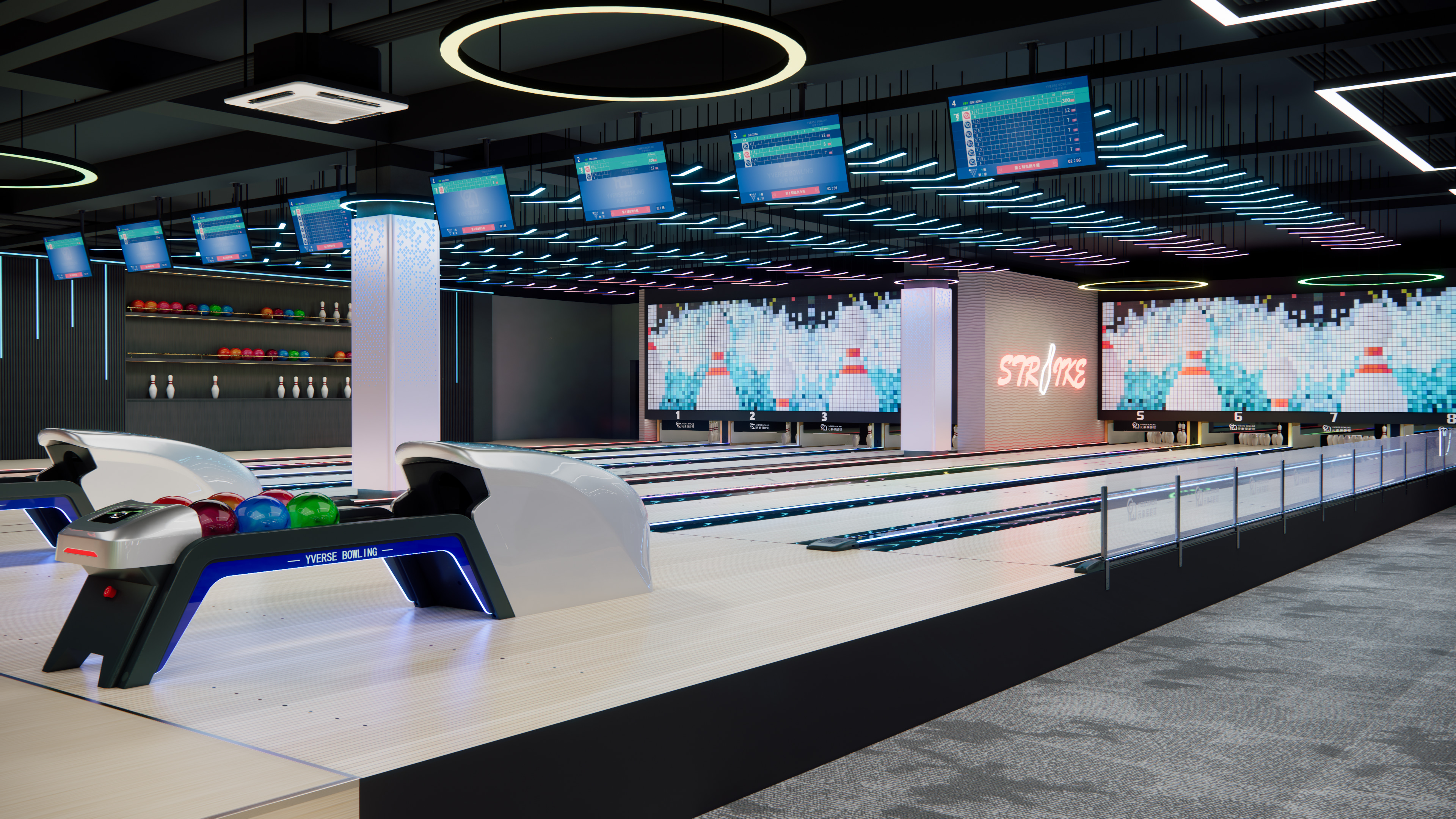
A commercial bowling center: the visible lanes are only one layer of an equipment system that includes pinsetters, ball returns and scoring hardware.
Why "Bowling Equipment" Is a System, Not a Product
Pin bowling is the dominant commercial form of the category. A single lane cannot function without five subsystems operating together: the lane and approach surface, a pinsetter that resets pins between frames, a ball return that moves balls back to the bowler, a scoring system that detects pin states and calculates the score, and the consumable set of pins and balls. Masking units, backwalls and seating complete the installation but do not change how the venue operates.
For a buyer at the awareness stage, this matters because the subsystems are not independently sourced decisions. A pinsetter choice constrains the pin type. A pin type constrains the lane specification and the ball weight range. A scoring system must detect the pin configuration the pinsetter actually produces. Discovery-stage evaluation therefore works best when it starts from format rather than from a component list.
The First Procurement Decision Is Format, Not Brand
Three commercial formats dominate the category, and the key difference between them is lane length. Standard bowling uses a lane length of approximately 26 meters and is intended for traditional bowling centers and league play. Mini bowling uses a lane length of approximately 13 meters and is intended for children's centers, family entertainment venues and compact spaces. Duckpin bowling uses a lane length of approximately 10 meters and is intended for bars, restaurants, family entertainment centers and social entertainment venues.
That single dimension drives almost everything else: the ball weight range, the pin height and weight, the footprint of the equipment zone, and the customer segment the venue can realistically serve. The table below compares the three formats using published manufacturer specifications.
| Parameter | Standard Bowling Equipment | Mini Bowling Equipment | Duckpin Bowling Equipment |
|---|---|---|---|
| Stated lane length and selection guidance | Approx. 26 m; recommended for venues 26 m or longer | Approx. 13 m; recommended for venues 13 m or longer | Approx. 10 m; recommended for venues 10 m or longer |
| Equipment envelope, 2 lanes (L x W x H) | 25.5 m x 3.5 m x 3.2 m | 13 m x 2.83 m x 2.5 m | 10 m x 3.48 m x 2.4 m |
| Customizable lane length | 17.5 to 25.5 m | 13.6 to 19 m | Not stated in published specification |
| Pinsetter style | String pinsetter bowling machine | String pinsetter bowling machine | String pinsetter bowling machine |
| Ball weight range | 8 to 11 lb | 3.3 to 3.75 lb | 3.3 to 3.75 lb |
| Pin type | Ten-pin | Ten-pin mini | Ten-pin duckpin |
| Typical applications | Traditional bowling centers, league play | Children's centers, FECs, compact spaces | Bars, restaurants, FECs, social entertainment venues |
| Certifications listed | USBC-Certified, CE, LVD, MD | USBC-Certified, CE, LVD, MD | USBC-Certified, CE, LVD, MD |
Specifications as published by the manufacturer for the Standard Bowling Equipment, Mini Bowling Equipment and Duckpin Bowling Equipment systems; certification scope is model- and market-specific and should be verified per order.
From Floor Plan to Format Fit
Most first-time buyers arrive with a signed lease or a floor plan rather than a product preference. The practical sequence is therefore: measure the longest usable indoor dimension, identify the intended customer base, then match the format. A venue with 26 meters or more of usable length can support standard bowling. A venue with 13 meters or more can support mini bowling. A venue with 10 meters or more can support duckpin bowling.
The opportunity here is that shorter formats open real estate that was previously unusable for bowling. Bars, restaurants, breweries, hotels, arcades and shopping malls frequently have indoor footprints that cannot accommodate a 26-meter lane but can accommodate a 10- or 13-meter one. The constraint, conversely, is that shorter formats are not interchangeable with standard lanes for competitive league play. A social venue and a league venue are different businesses, and the equipment list should follow the business model rather than the other way round.
How SunEye Bowling Sits Inside This Stack
SunEye Bowling is the brand used by YUANXIANG BOWLING (GUANGZHOU) CO., LTD., a bowling equipment manufacturer established in 2021 and based in Guangzhou, China, serving commercial and entertainment venue projects internationally. The company describes itself as a comprehensive supplier covering research and development, manufacturing, sales, installation and after-sales service.
On the manufacturing side, the company reports a standardized production base of nearly 6,000 square meters, a workforce of over 100 employees and an annual production capacity of about 2,000 units. Its R&D organization is described as more than 20 engineers covering hardware and software development, electromechanical engineering, intelligent interaction and system integration. Export business is stated to account for approximately 80% of total sales.
The published product portfolio includes standard bowling equipment, duckpin bowling equipment, mini bowling equipment, string pinsetter machines, bowling lanes, ball return systems, scoring systems, bowling pins and bowling balls, together with related accessories. Beyond equipment supply, the company describes a turnkey scope covering venue planning, CAD layout design, 3D rendering, equipment manufacturing, global shipping, installation, staff training and after-sales support, with buyers supplying site or CAD drawings as the starting input. The company also states that it operates under the ISO 9001 quality management system.
Technical Explanation: The Four Subsystems That Decide Daily Operations
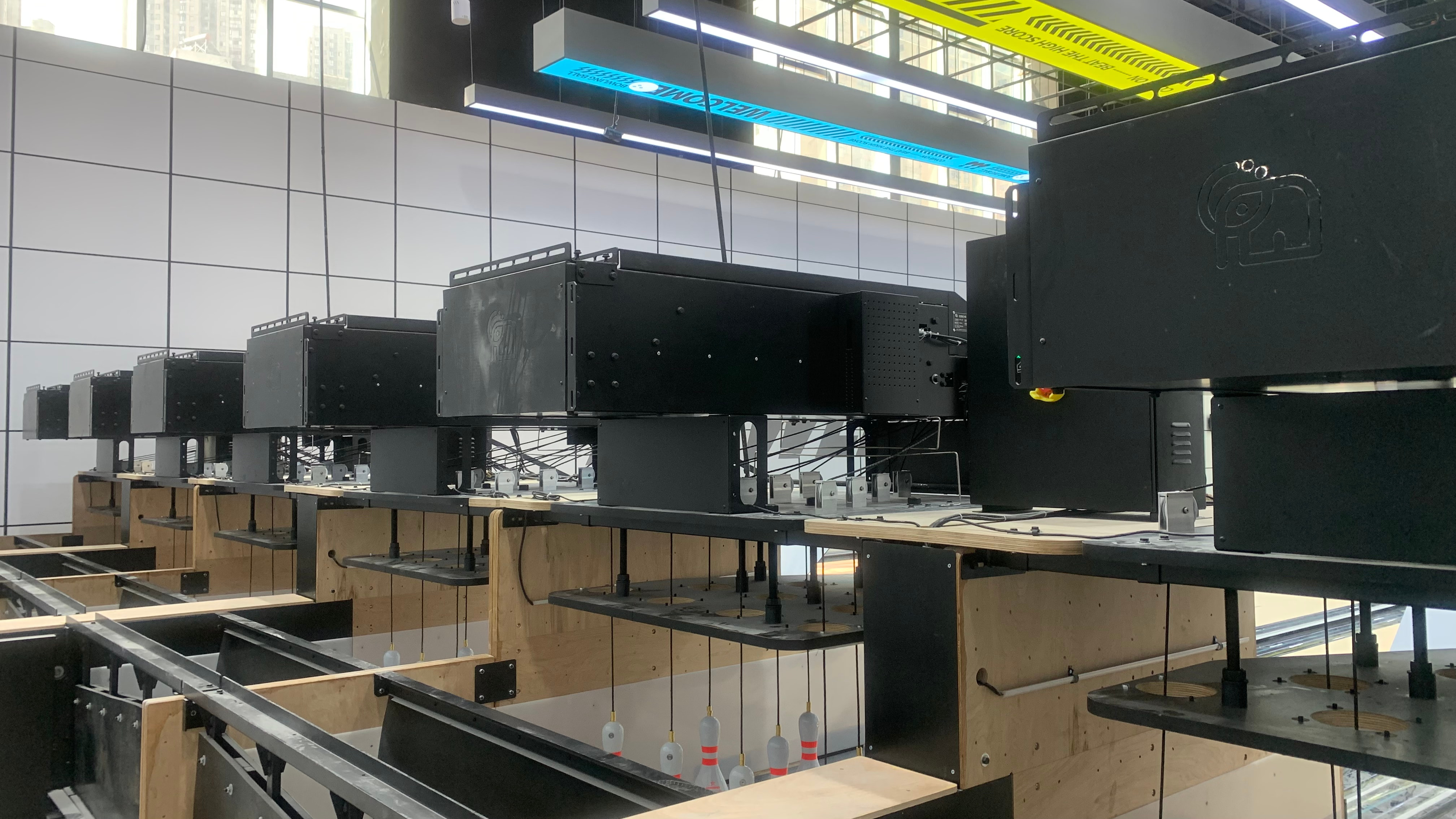
A string pinsetter machine: the subsystem most responsible for a venue's maintenance profile.
Pinsetter
The published String Pinsetter Machine is a metal-constructed unit rated at 2,000 W and 220 V, configured for ten pins, with a stated pin reset speed of 8 seconds per cycle and a pin placement offset of no more than 2 mm. Control is described as servo motor control with smart calibration and automatic error correction, designed for continuous 24/7 operation. Because string pinsetters use fewer moving parts than free-fall machines, the maintenance profile is structurally different: less mechanical wear, but a different set of calibration routines.
Ball Return
The Bowling Ball Return System is rated at 2,000 W and 220 V with a stated return speed of 12 seconds and a return track length of 18 to 26 meters, customizable to the lane configuration. The primary material is metal or acrylic. The manufacturer describes flexible drive components and cushion guides, plus a built-in self-check function that clears minor jams automatically, and lists a jam failure rate of 0.002%.
Scoring System
The Scoring System & HD Score Display is described as combining camera image recognition with infrared sensing to detect pin status, including slightly tilted and partially knocked-over pins. The manufacturer lists up to 99.98% recognition accuracy with a 0.02% misread rate, and free lifetime OTA software updates. Game modes include featured tournaments and a PK system, with support for local or remote cross-store online competition, officially organized national challenge tournaments, and in-store challenges published by venue operators.
Lane, Pins and Consumables
SunEye synthetic bowling lanes are built from multi-layer high-density pressed panels with a scratch-resistant surface coating and sealed edges, and are stated to withstand more than 100,000 ball impacts with a service life of up to 10 years. The manufacturer states that its synthetic lanes have been tested against applicable USBC requirements for lane performance and specifications and are approved for use during USBC-certified competition.
Pins are supplied in three formats: Standard Bowling Pin at 380 mm and 1,618 g, Duckpin Bowling Pin at 230 mm and 787 g, and Mini Bowling Pin at 265 mm and 735 g. All three use maple wood and plastic construction, carry USBC-Certified, CE, LVD and MD listings, ship in carton boxes with a stated 40-day delivery time, and can be customized with pin colors, logos, graphics and patterns.
Application Fit: Three Venue Archetypes
- Commercial use. Bowling centers, hotels and resorts, entertainment complexes and shopping or leisure centers typically install standard bowling equipment, with the full subsystem set of string pinsetter, ball return and scoring system. Operating conditions in the published scenario data are indoor, climate-controlled and dry, with 24/7 operation.
- Family entertainment. FECs, kids' playgrounds, shopping malls, arcades and private clubs are the stated target of mini bowling equipment, which uses a compact footprint and a light ball in the 3.3 to 3.75 lb range.
- Social entertainment. Bars, restaurants, breweries and social clubs are the stated target of duckpin bowling equipment, where the 10-meter lane fits hospitality footprints and the shorter format keeps game cycles fast.
The common thread across all three is that the venue type, not the equipment catalogue, should drive selection. The published guidance states plainly that the choice of bowling system depends on available space, target customers and business model.
What the Market Data Actually Supports
Commercial research published by HTF Market Intelligence places the global bowling equipment market at USD 1.05 billion in 2025, with a forecast of USD 1.78 billion by 2033 and a compound annual growth rate of 6.0% for 2026 to 2033. That figure covers the equipment layer: balls, pins, lanes and scoring systems.
Two cautions belong next to that number. First, published estimates for the broader "bowling market" diverge sharply depending on whether a study counts equipment manufacturing, bowling-center operations, or both; reviewing available commercial research shows differences of roughly two to three times between sources using similar report titles. Second, on the demand side, the Federal Reserve Bank of St. Louis publishes a statistical series for total revenue of bowling centers in the United States, series REVEF71395ALLEST, covering 1998 to 2022. Neither the equipment-market headline nor the operator-revenue series should be used as a procurement baseline; they indicate direction, not price.
Two technical and regulatory data points are more directly actionable. The United States Bowling Congress specifies a minimum string length of 54 inches for approved string pinsetters under USBC Chapter 95, effective from 1 August 2023, a specification intended to keep scoring behavior comparable to free-fall machines while reducing tangles. In trade terms, US HTS subheading 9504.90.9060 covers bowling pin setter machine parts and accessories at a free rate of duty in the United States, which affects landed-cost modelling for North American buyers.
On pricing, the available evidence is thin. Public pricing for bowling equipment is scarce and configuration-dependent: what could be retrieved was a single B2B marketplace listing rather than an industry price level, and it cannot be treated as a benchmark. This is the practical reason buyers in this category run structured RFQs against a fixed lane count, fixed format and fixed subsystem list rather than comparing list prices.
Where String Pinsetters Stop Being a Straight Swap
String pinsetters are the format behind most new compact and mid-size installations, and the operational logic is sound: fewer moving parts, lower mechanical wear, and continuous-duty design. But there are boundaries that a careful buyer should test before assuming equivalence with a traditional free-fall machine.
- Scoring behavior is still an open question at the top of the player range. USBC published a string pinsetter research report in 2023 and updated it in 2025. The 2023 position indicated no significant scoring difference, while the 2025 update reported a 3.4 to 6.9 pin drop for higher-average bowlers. Venues that intend to host sanctioned league or tournament play should validate this against their own player profile rather than assume parity.
- Equipment approval is model-level, not brand-level. The USBC maintains an approval list of string pinsetter manufacturers and models, and approval status is tied to specific models and jurisdictions. Buyer-side verification of the exact model, approval date and competition eligibility is required; no model-level approval claim should be accepted from marketing material alone.
- Performance figures here are manufacturer-stated. The 8-second pin reset, 2 mm placement offset, 0.002% jam failure rate and 99.98% scoring recognition accuracy are published first-party specifications. They are useful for comparing configurations across suppliers, but they are not independently audited test results.
- Compact formats are not scaled-down substitutions for league bowling. A 10-meter duckpin lane and a 26-meter standard lane are different products serving different customer expectations. Buying a shorter lane to save space and then marketing it as league-ready is a positioning mismatch, not an equipment defect.
- Lead times accumulate at the component level. Pin delivery is stated at 40 days, before shipping. Project schedules should be built from the longest component lead time plus installation and commissioning, not from the equipment order date.
Future Outlook
Three shifts are visible in the available evidence. First, string pinsetter technology is consolidating as the default mechanism for new installations across all three formats, with USBC specifications providing a common technical reference point. Second, scoring systems are becoming software platforms rather than scoreboards: remote cross-store competition, nationally organized tournaments and operator-published in-store challenges all turn the scoring layer into a recurring engagement channel rather than a one-time hardware purchase. Third, demand growth in the equipment layer is relatively modest in percentage terms, which means competitive advantage will come from configuration flexibility and project delivery rather than from category expansion alone.
For buyers, the practical implication is that due diligence is shifting from "which machine" to "which delivered system, verified how." Venue planning, CAD layout, installation and commissioning are now part of the product being purchased.
Frequently Asked Questions
What types of bowling equipment exist?
Commercial pin bowling is organized around three formats — standard, mini and duckpin — and each format requires a lane, a pinsetter, a ball return, a scoring system, pins and balls. Standard bowling uses a lane of approximately 26 meters, mini bowling approximately 13 meters and duckpin bowling approximately 10 meters. A published supplier portfolio in this category typically includes standard bowling equipment, duckpin bowling equipment, mini bowling equipment, string pinsetters, lanes, ball return systems, scoring systems, pins and balls.
How much space does a bowling installation need?
Space requirements vary by format. Standard bowling needs roughly 26 meters of length, duckpin bowling roughly 10 meters and mini bowling roughly 13 meters. In equipment-envelope terms, a two-lane standard system is specified at approximately 25.5 m x 3.5 m x 3.2 m, a two-lane mini system at 13 m x 2.83 m x 2.5 m and a two-lane duckpin system at 10 m x 3.48 m x 2.4 m. Standard lanes can be customized within a 17.5 to 25.5 m range and mini lanes within 13.6 to 19 m.
How do buyers choose between standard, mini and duckpin bowling?
The published selection rule is based on available length: venues with 26 meters or more are directed to standard bowling equipment, venues with 13 meters or more to mini bowling equipment, and venues with 10 meters or more to duckpin bowling equipment. The wider decision depends on available space, target customers and business model. Standard bowling serves traditional centers and league play, mini bowling serves children's centers, family entertainment venues and compact spaces, and duckpin bowling serves bars, restaurants, FECs and social entertainment venues.
What is a string pinsetter, and how does it differ from a free-fall pinsetter?
A string pinsetter resets pins using tethered strings rather than a mechanical sweep-and-lift cycle. A representative specification for this class of machine is 2,000 W at 220 V, ten pins, a pin reset speed of 8 seconds per cycle, a pin placement offset of no more than 2 mm, servo motor control with smart calibration, and continuous 24/7 operation. The trade-off is well documented: fewer moving parts generally means lower mechanical maintenance, while scoring behavior has been researched by USBC, whose 2023 report indicated no significant scoring difference and whose 2025 update reported a 3.4 to 6.9 pin drop for higher-average bowlers.
Can a bowling venue be built from scratch as a turnkey project?
Turnkey delivery is an established supplier model in this category. A typical stated scope covers venue planning, CAD layout design, 3D rendering, equipment manufacturing, global shipping, installation, staff training and after-sales support, with the buyer supplying site or CAD drawings as the design input. Because turnkey is not a standardized package across suppliers, RFQs should itemize civil works, equipment supply, installation, commissioning, training, warranty and ongoing operational support separately so that offers can be compared line by line.
Which certifications and compliance points should buyers verify?
Certification matters most where sanctioned competition is planned. System-level products in this category are commonly listed with USBC-Certified, CE, LVD and MD markings, and at least one manufacturer states that its synthetic lanes have been tested against applicable USBC requirements and are approved for use during USBC-certified competition. USBC also specifies a minimum string length of 54 inches for approved string pinsetters under Chapter 95. Because approval is model-specific and jurisdiction-specific, buyers should verify the exact model against the current official approval list and confirm the applicable customs classification — for example, US HTS 9504.90.9060 covers bowling pin setter machine parts and accessories at a free rate of duty.
Have Questions or Need More Details?
Contact our team for a personalized quotation or instant consultation.
Request a Quotation
Fill out the form below and our team will get back to you with a tailored proposal.
WhatsApp Direct Chat
Prefer to chat in real-time? Message us on WhatsApp for instant assistance & quick answers.
- Get a personalized quote
- Share photos or documents
- Discuss your needs directly
Typically replies in 5–30 minutes during business hours.