
Bowling Equipment Shortlist for a Commercial Bowling Center
A commercial bowling center is not a single purchase. It is an assembly of four core equipment systems — the pinsetter, the ball return, the scoring system and the pins — that only work as a venue when they are specified against the same operating assumptions. The shortlist below is organised around those four systems, with the specifications a buyer can put directly into a request for quotation.
The most common specification error in bowling center projects is to choose a lane format first and treat everything else as an accessory. In practice, the pinsetter sets the rhythm of play, the ball return sets the waiting time between frames, the scoring system determines how much of a session an operator can run without staff intervention, and the pin specification fixes both the ball weight and the lane length the venue can use. Each of these is a procurement decision with its own number attached.
SunEye Bowling is a Guangzhou-based bowling equipment supplier covering research and development, manufacturing, sales, installation and after-sales service across standard, duckpin and mini bowling formats. Its production base is listed at approximately 6,000 square metres with 100+ employees, an annual output of 2,000 units and a team of 20+ engineers, operating under the ISO 9001 Quality Management System. The company reports an export ratio of 80% and serves markets globally. Its product range is broad enough to supply the four core systems from one specification package, which is the practical reason it appears in this shortlist.
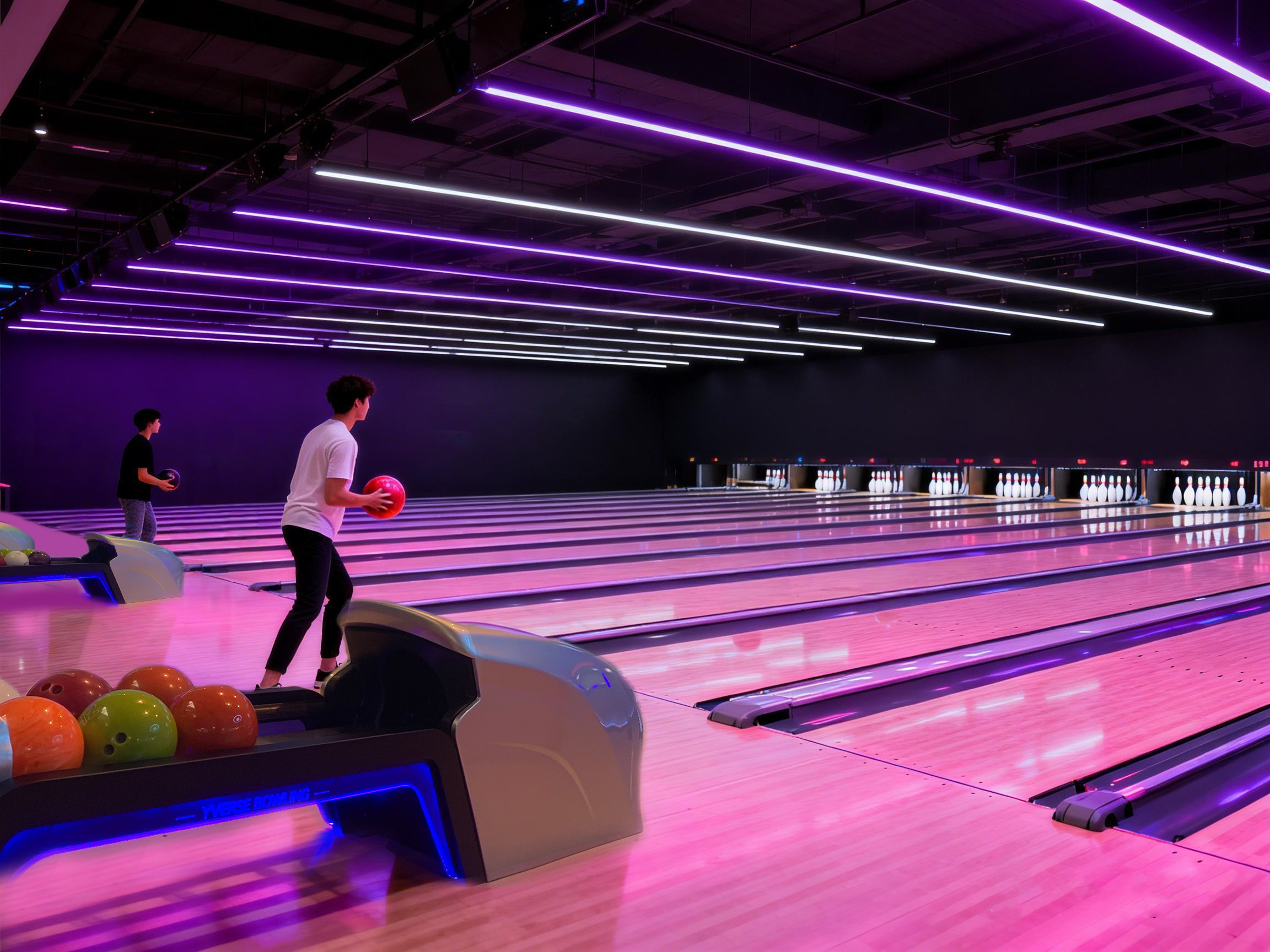
The Shortlist at a Glance
Four components carry nearly all of the operational risk in a bowling center. The table below pairs each system with the verified specification that should appear in an RFQ, rather than a general product description.
| Core system | Function in the venue | Verified specification |
|---|---|---|
| String Pinsetter Machine | Sets and resets the ten pins between frames | 2000 W / 220 V; 8-second pin reset; pin placement offset ≤2 mm; 24/7 continuous operation |
| Bowling Ball Return System | Returns the ball to the bowler after each delivery | 2000 W / 220 V; 12-second return speed; return track length 18–26 m (customised); jam failure rate 0.002% |
| Scoring System & HD Score Display | Detects pin state and calculates the score | Dual-sensor camera and infrared recognition; 99.98% recognition accuracy; 0.02% misread rate; 1280 × 720 resolution; lifetime free OTA updates |
| Bowling Pins | Physical target; determines ball weight and lane dimension | Standard 380 mm / 1,618 g; Duckpin 230 mm / 787 g; Mini 265 mm / 735 g; USBC-certified, CE, LVD, MD |
Read as a set, these four specifications describe a venue that can run continuously, recover from minor faults without a technician, and score reliably enough that staff are not called to a lane mid-game. That combination — not the price per lane — is what separates a workable center from an expensive retrofit.
1. String Pinsetter Machine: The Component That Sets Game Rhythm
The pinsetter is the highest-duty machine in a bowling center. Every frame requires a reset, which means a busy lane can cycle hundreds of times per day. SunEye's String Pinsetter Machine is rated at 2000 W and 220 V, resets ten pins in 8 seconds, and holds pin placement accuracy to an offset of no more than 2 mm.
Two design details matter for procurement. The first is control architecture: the unit uses servo motors with smart calibration algorithms that detect and correct minor positioning errors before they affect play. In a venue where staff turnover is high, automatic error correction reduces the number of calls that require a technician to physically inspect the machine. The second is mechanical simplicity: the string design uses fewer moving parts than a free-fall mechanism, which the manufacturer states reduces downtime and long-term maintenance requirements.
Continuous operation is specified rather than implied. The pinsetter is rated for 24/7 use, which is the relevant benchmark for a commercial center operating extended hours, particularly in family entertainment and social venues where the bowling area may run alongside food and beverage service.
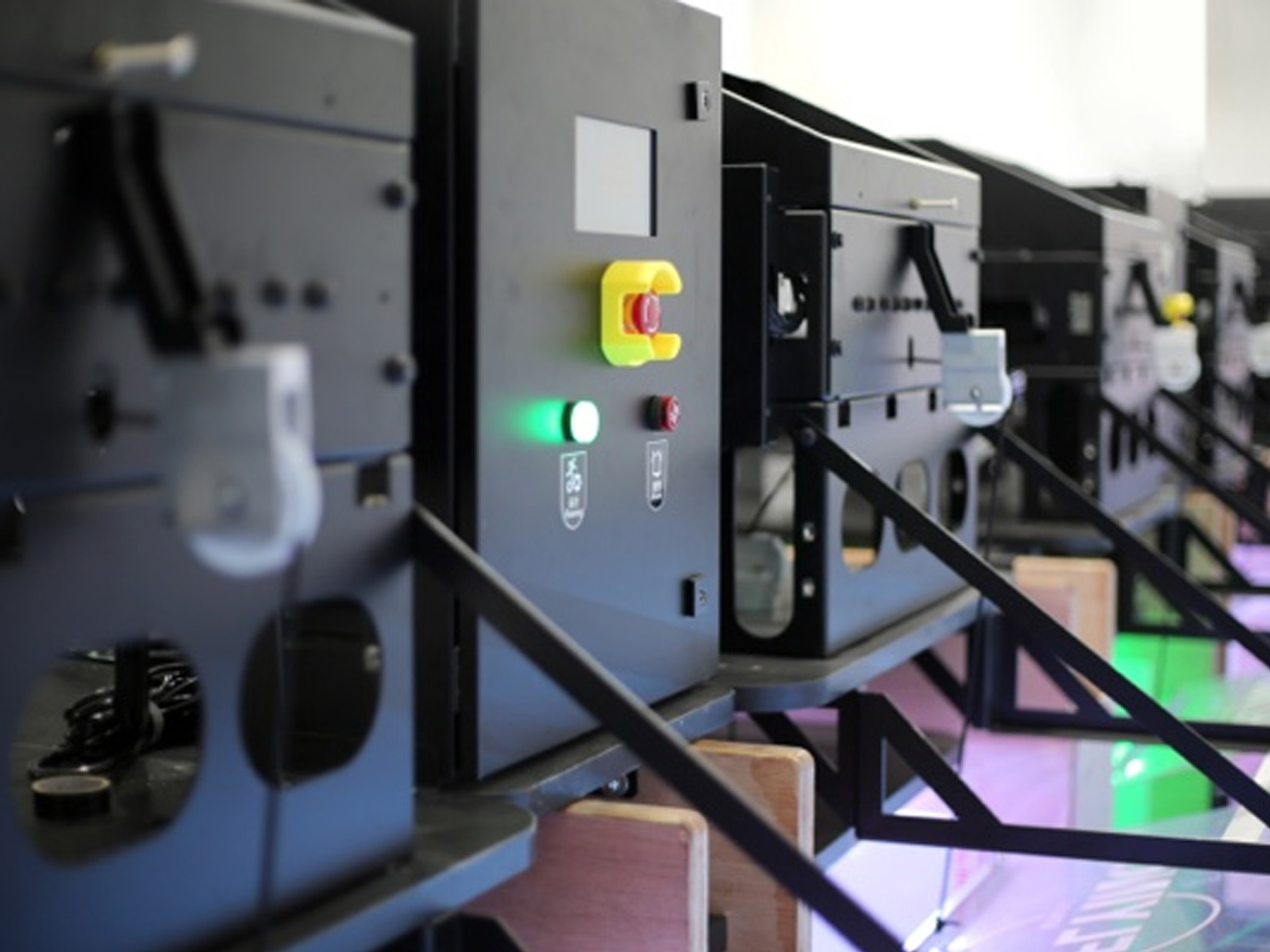
Buyers comparing packages should note that reset time is stated differently across product scopes. SunEye lists an 8-second pin reset for the standalone String Pinsetter Machine, and a pin reset of ≤10 seconds within its Standard Bowling Equipment and Duckpin Bowling Equipment packages. Both figures describe the same underlying mechanism at different levels of equipment configuration, so the correct number to quote in an RFQ is the one attached to the package being purchased.
2. Bowling Ball Return System: Where Waiting Time Accumulates
Ball return performance is usually underestimated during planning, because a slow return does not look like a fault — it looks like a busy venue. In reality, the return system governs the interval between a bowler's delivery and their next shot, and that interval is one of the few things a guest notices on every single frame.
The Bowling Ball Return System is rated at 2000 W and 220 V, with a listed return speed of 12 seconds and a return track length of 18–26 m that can be customised to the lane layout. The system uses flexible drive components and cushion guides to transport the ball gently and at low noise, which matters in venues where bowling sits adjacent to dining or party rooms.
The reliability figure is the commercially significant one. SunEye specifies a jam failure rate of 0.002% and compares it with an industry average it cites at 0.02%–0.05%, a difference of roughly one order of magnitude. That claim is supplier-reported and should be verified during factory acceptance, but it is the correct type of metric to demand: a jam rate translates directly into staff interventions per thousand frames.
A further operational detail is the built-in self-check logic, which automatically detects and clears minor jams. For venues that operate without a technician on site for part of the day, automatic recovery from minor faults is more valuable than a marginally faster return speed.
3. Scoring System & HD Score Display: The Guest-Facing Layer
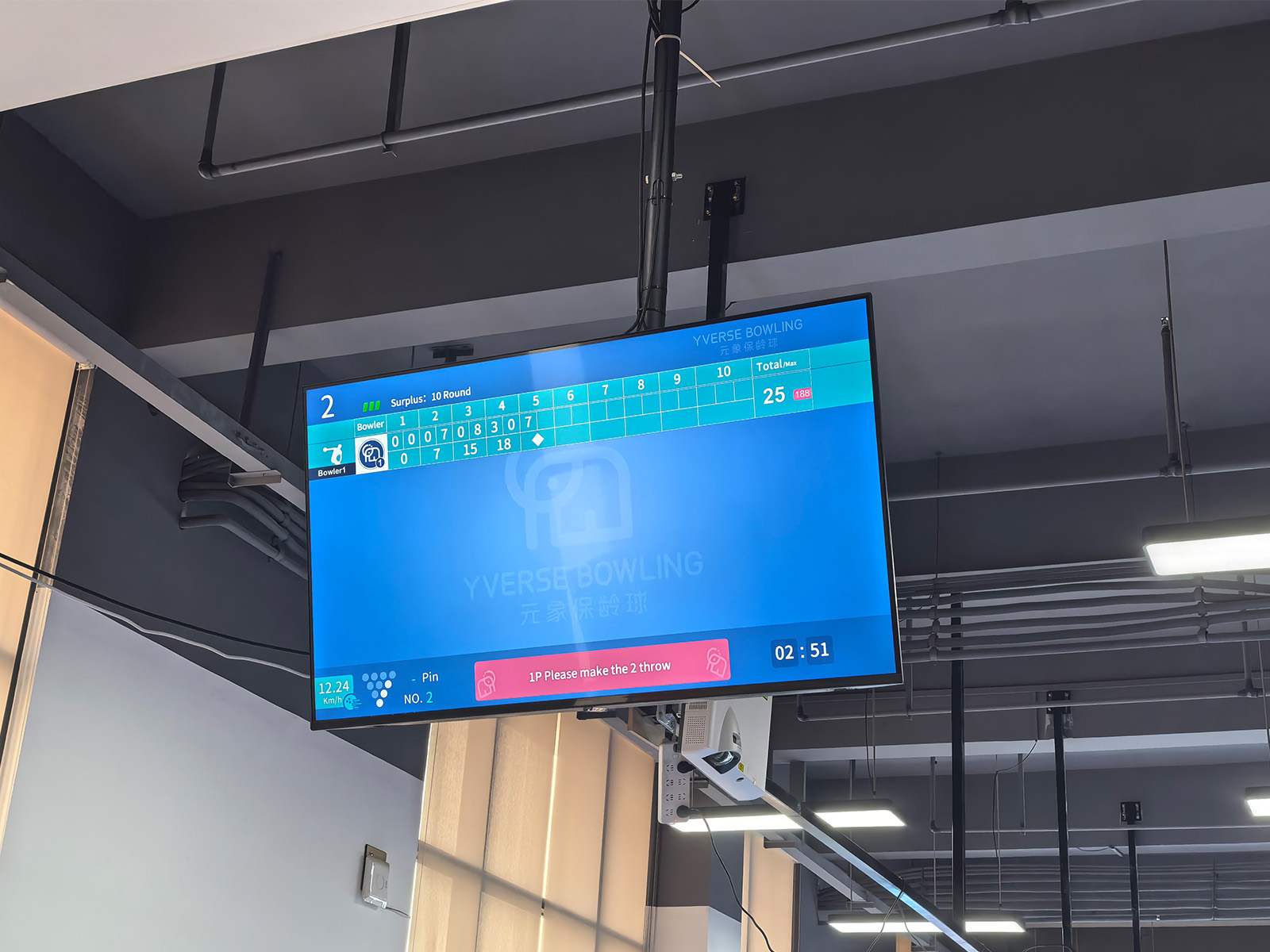
Scoring is the only part of the equipment package that every guest interacts with directly, and the only part that visibly fails. SunEye's Scoring System & HD Score Display combines camera-based image recognition with infrared sensing to detect pin status, including difficult conditions such as slightly tilted or partially knocked-over pins. The system is specified at up to 99.98% recognition accuracy with a 0.02% misread rate, displayed at a resolution of 1280 × 720.
Dual-sensor detection is worth calling out as a procurement criterion because single-technology systems tend to struggle with exactly the pin states that generate disputes — the leaning pin, the pin that fell late, the pin obscured from one angle. Combining two sensing methods is a design response to that problem rather than a marketing addition.
Software lifecycle is the second criterion. The scoring system includes lifetime free OTA software updates, which means the recognition logic and game features can be improved after installation without a hardware change. For an operator planning a five- to ten-year asset life, an updatable scoring platform changes the depreciation calculation: the system does not become obsolete at the same rate as the mechanical equipment around it.
Game modes are part of the revenue design rather than an accessory. The listed modes include featured tournaments and a PK system, with support for local or remote cross-store online PK, participation in officially organised national challenge tournaments, and the ability for venue stores and merchants to publish in-store challenge tournaments. That matters for a commercial center competing with other leisure options: the scoring layer is where league nights, corporate events and in-store competitions are actually administered.
4. Bowling Pins: The Specification That Sets Everything Else
Pins are frequently treated as a consumable afterthought. They should not be, because pin height and weight determine the ball weight and lane length that a venue can operate with, and therefore the format the center can actually sell.
SunEye lists three pin specifications, all built from maple wood and plastic with a protective surface finish and balanced construction for predictable pin movement:
- Standard Bowling Pin — 380 mm, 1,618 g, for ten-pin standard bowling in bowling centers, FECs and sports and recreation centers.
- Duckpin Bowling Pin — 230 mm, 787 g, for bars, restaurants, FECs, hotels and social entertainment venues.
- Mini Bowling Pin — 265 mm, 735 g, for kids' venues, malls, FECs and family entertainment spaces.
All three are listed as USBC-certified and as carrying CE, LVD and MD certification, packed in cartons with a listed delivery time of 40 days. Colour, logo, graphics and pattern customisation is available, which is a practical detail for branded venues: pin graphics are one of the few places in a bowling center where an operator's identity appears at close range.
The pin choice cascades through the rest of the shortlist. Standard bowling in SunEye's equipment range uses 8–11 lb balls, while duckpin and mini formats use 3.3–3.75 lb balls. Specifying the pin first therefore fixes the ball inventory, the lane length and the target guest profile in a single decision.
How the Four Systems Combine: Format Matrix
Commercial bowling centers are usually planned around one of three formats, and the footprint differences are large enough to determine whether a project is viable before any equipment is ordered.
| Specification | Standard Bowling | Duckpin Bowling | Mini Bowling |
|---|---|---|---|
| Footprint (2 lanes) | L25.5 m × W3.5 m × H3.2 m | L10 m × W3.48 m × H2.4 m | L13 m × W2.83 m × H2.5 m |
| Customisable length | 17.5–25.5 m | — | 13.6–19 m |
| Ball weight | 8–11 lb | 3.3–3.75 lb | 3.3–3.75 lb |
| Pin type | Ten-pin | Ten-pin duckpin | Ten-pin mini |
| Pinsetter style | String pinsetter | String pinsetter | String pinsetter |
| Power | 220 V | 220 V, 2000 W per lane | 220 V |
| Display | HD score display | 65-inch HD display with centralised control | 43-inch HD display mounted on the gantry |
| Certification | USBC, CE, LVD, MD | USBC, CE, LVD, MD | USBC, CE, LVD, MD |
Two integration points deserve attention during design. In the duckpin configuration, a 65-inch HD display is integrated with the pinsetter in a compact equipment zone, and the combined unit can double as a visual backdrop behind the lanes — a space-saving arrangement for social venues with tight floor plans. In the mini configuration, a 43-inch HD display is gantry-mounted, keeping the lane surface clear while keeping the score visible to players.
Underneath all three formats sits the lane itself. SunEye specifies a heavy-duty synthetic lane built from multi-layer high-density pressed panels with a scratch-resistant coating and sealed edges, rated for 100,000+ ball impacts and a service life of up to 10 years. That is the component that carries the physical wear while the four core systems carry the operational load.
Application: Matching the Shortlist to a Venue Type
The shortlist does not change by venue type, but the combination does. A dedicated commercial bowling center typically specifies standard bowling at full 25.5 m length with a full parts and pins inventory behind it. A family entertainment center usually blends standard lanes with a smaller-footprint format so that different age groups can be served simultaneously. A bar, restaurant or hotel installation more often takes the duckpin or mini route, where the equipment footprint fits an existing floor plate.
Delivered projects show how far the format range stretches. SunEye supplied an 8-lane standard bowling system to Center World in Salerno, Italy, and a 12-lane standard installation to an 8,000 m² family entertainment center in Spain that also operates trampolines and party facilities. A 6-lane standard installation serves Ignite Space inside the Sanming Science & Technology Museum in China, mixing bowling with other interactive entertainment. At the compact end, a 4-lane standard project in Tongchuan, China, was installed inside a large aluminium-frame tent within the Huayuehui Scenic Area — an example of standard-format equipment being specified into a non-standard building envelope.
Across these projects the supplier reports the same delivery pattern: a complete turnkey scope, easy maintenance and stable performance over a service life of 10 years or more. For a buyer, the useful inference is not that the equipment suits every site, but that the same four systems can be re-specified across very different floor plans without changing supplier.
What to Put in the RFQ: Procurement Criteria
A bowling equipment RFQ should force each supplier to state the same operational numbers, or the resulting quotes will not be comparable. The criteria below reflect what SunEye publishes and what a buyer can therefore ask any supplier to match.
- Reset performance — pins per reset cycle, stated in seconds, with the tolerance on pin placement in millimetres.
- Return performance — return speed in seconds, track length range, and the jam failure rate as a percentage.
- Scoring accuracy — recognition accuracy and misread rate, plus the sensing method used to achieve it.
- Software lifecycle — whether updates are included and for how long.
- Certification scope — USBC, CE, LVD and MD stated per component and per model, not per company.
- Duty rating — whether the equipment is specified for 24/7 operation.
- Production and delivery — monthly capacity, lead time, minimum order and pre-shipment testing. SunEye lists 200 units per month, a 30–45 day lead time, a 2-unit minimum order and 100% pre-shipment testing.
- Customisation scope — lane length, lane logo, masking unit options including wallpaper, soft-film lightbox and LED screen wall, plus guardrails and stairs.
- After-sales terms — warranty period, remote technical support and the long-term software upgrade policy. SunEye lists a 1-year warranty on bowling equipment.
Comparison with Traditional Free-Fall Systems: Where the Boundaries Are
String pinsetters are not mechanically equivalent to traditional free-fall pinsetters, and this shortlist should not be read as a claim that they are interchangeable in every context.
The structural advantage of the string design is maintenance: fewer moving parts, automatic error correction and a simplified mechanism that reduces the frequency of technician intervention. The structural difference is pin action. Because the pins remain tethered, the way they fall and interact differs from free-fall, and the sport's governing body has published research on the scoring effects of string systems. The United States Bowling Congress maintains an equipment approval framework for string pinsetters, and approval is model-specific rather than category-wide. A venue planning sanctioned league play should therefore confirm the exact model's status against the current approval listing, and should treat a supplier's general statement of USBC certification as a starting point for verification rather than a conclusion.
A second boundary is scope. The four systems described here are the bowling equipment layer. They do not include the building envelope, HVAC, electrical distribution to the lane area, furniture, kitchen or bar fit-out, or the retail systems that generate ancillary revenue. Projects that specify equipment before the building services are resolved routinely discover that the lane length, ceiling height or power distribution cannot accommodate the format that was chosen — which is why venue planning and CAD layout design belong in the same conversation as the equipment specification.
Market Context: Why the Shortlist Has Shifted Toward Mixed Formats
The commercial bowling market has moved away from a single venue model. Traditional bowling centers still anchor the category, but a growing share of new installations sits inside family entertainment centers, shopping and leisure complexes, hotels and resorts, bars and restaurants. These venues rarely have 25 metres of straight floor space to give to a lane, and they rarely want a pure bowling operation — they want a bowling attraction that coexists with other revenue streams.
That shift explains why string pinsetter technology has become the default in new commercial builds rather than a niche alternative. A mechanism with fewer moving parts, automatic error correction and a smaller maintenance burden is easier to operate in a multi-attraction venue where the bowling area may not have a dedicated technician on shift. The same logic drives the scoring system's importance: in a venue where staff are shared across attractions, a scoring platform that manages game modes, tournaments and in-store competitions removes work from the floor team.
Consumer expectations have moved in parallel. Guests arriving from other leisure categories expect a working digital layer — visible scores, competitive formats, and the ability to run an event without paper. A bowling center that cannot deliver that layer competes on novelty alone, which is a short commercial position.
Future Outlook
Two trends are visible in the current equipment specification and are likely to shape the next purchasing cycle.
The first is software-led differentiation. A scoring system with lifetime free OTA updates is, in effect, a platform rather than a fixed product. As recognition logic improves and game formats expand — including remote cross-store competition and venue-published in-store tournaments — the value of a lane installation increasingly sits in the software layer rather than the mechanical hardware. Buyers evaluating a five- to ten-year asset should ask how the software will be maintained across that period, not only what it does on day one.
The second is consolidation of control. Centralised master control, already listed in the duckpin configuration where lane operation, scoring and venue operations are managed from one system, points toward a venue model in which a single operator interface covers multiple attractions. For multi-format venues, that reduces the training burden and makes staffing more flexible.
Neither trend removes the fundamentals. A center still needs a pinsetter that resets reliably, a ball return that does not jam, a scoring system that reads pins correctly and a pin specification that matches the format being sold. What changes is how much of the operational value sits in the fourth layer — the software — on top of the first three.
Frequently Asked Questions
What types of bowling equipment are available for a commercial venue?
SunEye provides standard bowling, duckpin bowling and mini bowling systems, together with string pinsetter systems, scoring systems, ball return systems, bowling lanes, LCD scoring displays, bowling balls, bowling pins and customised accessories for commercial and entertainment venues. The appropriate format depends on available space, target customers and business model: standard bowling suits traditional bowling centers and league play, duckpin bowling suits bars, restaurants, family entertainment centers and social entertainment venues, and mini bowling suits children's centers, family entertainment venues and compact spaces.
What are the minimum space requirements for a bowling installation?
Space requirements vary by format. Standard bowling requires approximately 26 metres in length, duckpin bowling approximately 10 metres, and mini bowling approximately 13 metres. A floor plan submitted to the supplier is used to produce a layout proposal for the specific site.
Which certifications should commercial bowling equipment carry?
SunEye lists USBC certification plus CE, LVD and MD certification across its standard, duckpin and mini bowling systems and its bowling pins. Because equipment approval is model-specific, buyers planning sanctioned league play should verify the exact model against the relevant governing body's current approval listing rather than relying on a category-level certification statement.
What lead time and minimum order should a buyer plan for?
SunEye's stated production terms are a monthly capacity of 200 units, a lead time of 30–45 days and a minimum order of 2 units, with 100% pre-shipment testing. After-sales terms include remote technical support, a 1-year warranty on bowling equipment and a long-term software upgrade service.
Can a supplier deliver a bowling center from scratch?
SunEye provides a complete turnkey scope covering venue planning, CAD layout design, 3D rendering, equipment manufacturing, global shipping, installation, staff training and after-sales support. The process begins with site drawings or CAD drawings, which are used to plan the venue layout around the available floor plate.
The four systems in this shortlist — pinsetter, ball return, scoring and pins — are the procurement decisions that determine whether a bowling center runs without constant intervention. Everything else, from masking units to lane graphics, is configured around them. A detailed specification and project reference set is available in the SunEye company profile, and format-specific details are published at suneyebowling.com.
Have Questions or Need More Details?
Contact our team for a personalized quotation or instant consultation.
Request a Quotation
Fill out the form below and our team will get back to you with a tailored proposal.
WhatsApp Direct Chat
Prefer to chat in real-time? Message us on WhatsApp for instant assistance & quick answers.
- Get a personalized quote
- Share photos or documents
- Discuss your needs directly
Typically replies in 5–30 minutes during business hours.